- Interim Update 30th September 2020
Copyright
Reminder
The commentaries that appear at TSI
may not be distributed, in full or in part, without our written permission.
In particular, please note that the posting of extracts from TSI commentaries
at other web sites or providing links to TSI commentaries at other web
sites (for example, at discussion boards) without our written permission
is prohibited.
We reserve the right to immediately
terminate the subscription of any TSI subscriber who distributes the TSI
commentaries without our written permission.
The September-2020
Monthly (and Quarterly) Closing Prices
Today we will review monthly
charts for gold, silver, the HUI, the S&P500 Index (SPX), the Dollar
Index, the Australian dollar and the Yen, starting (as usual) with gold.
In last month's review of monthly closing prices, we wrote:
"...during
August the US$ gold price traded well above and well below its July-2020
close before ending the month with a small net loss. This sort of price
action after a strong rally can mark a top. As discussed in recent TSI
commentaries, a multi-month top would be confirmed by a weekly close below
US$1920."
And:
"Ideally (from a long-term bull's
perspective) there will be a test of or an intra-month spike below the
8-month MA, but not a monthly close below the 8-month MA, at some point
over the next two months as part of a 'corrective' process."
At the time the 8-month MA was in the mid-US$1700s.
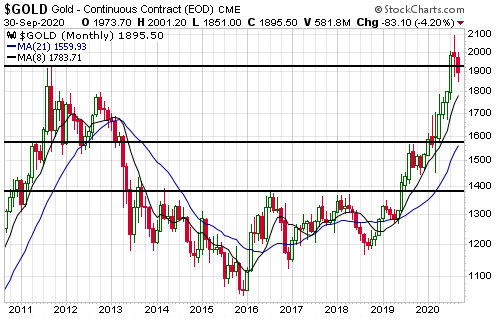
Gold
subsequently spent three weeks consolidating above US$1920 before closing
below this important support level last week. Also, it has now achieved a
monthly close below support.
We don't view the break below US$1920
as a major negative. If an important demarcation level is breached when
the price is already stretched in the direction of the breakout, the
ensuing correction often will test or negate the breakout. We also don't
view the break below US$1920 as a surprise, as evidenced by the fact that
a month ago we were anticipating a correction of sufficient magnitude to
test the 8-month MA.
The 8-month MA (the black line on the
following chart) is now slightly below US$1800. It's still the case that a
test of or an intra-month spike below this moving average could happen as
part of a normal correction, but due to the gold-bullish fundamental
backdrop a monthly close below it is not expected.
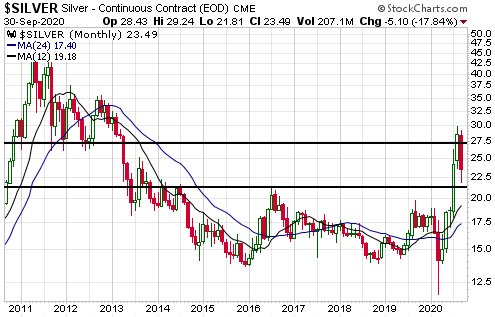
There was a big downward reversal in the silver price during
September. Due to the degree that this market became stretched to the
upside during July-August, last month's large decline wasn't a surprise.
Silver has an important demarcation level in the low-US$21 area.
When this level was exceeded in July it marked the completion of a
long-term base. A return to the top of the base would be normal, but a
monthly close below US$21 would indicate that the August-2020 high was
more significant than we currently think.
We expect that the prices
of both silver and gold will be above their August-2020 highs by the first
quarter of 2021.
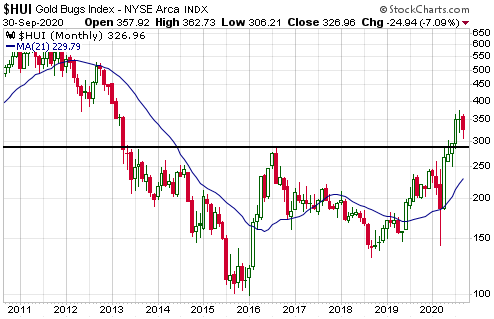
Regarding the gold mining sector, in last month's review of monthly
closing prices we wrote:
"A correction within the next two
months could take the HUI down to the mid-200s and could even test the
21-month MA (the blue line on the following chart), but despite this
short-term risk the intermediate-term risk/reward remains very bullish."
In terms of our expectations not much has changed, although unless the
correction extends into November a test of the 21-month MA is unlikely.
Lateral support at 286 looks important on the monthly chart. We
suspect that this support will be tested or breached during October, but
ideally it will hold on a monthly closing basis.
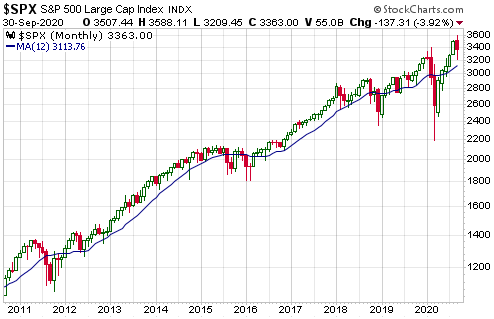
Regarding the US stock market, a month ago we wrote: "...for the
SPX the Q1-2020 crash was an intermediate-term bull-market correction
rather than the first leg of a bear market. However, broader indices that
are not dominated by a handful of mega-cap tech stocks are well below
their all-time highs, so the overall market's long-term trend is not
clear."
The following chart shows that September-2020 was an
outside-down reversal month for the SPX, meaning that the SPX closed lower
on the month after trading above the preceding month's high (to a new
all-time high) and below the preceding month's low. This should be viewed
as a warning that with regard to the next few months, downside potential
is greater than upside potential.
Our big picture view continues to
be that the March-2020 low will not be tested over the remainder of this
year or during the first half of next year, but that it will be tested in
parallel with another recession during 2022.
Turning to the currency market, here's what we wrote a month ago about
the Dollar Index (DX):
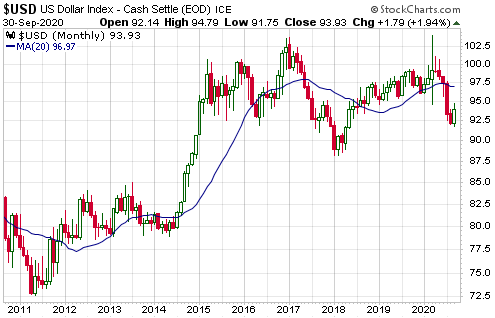
"It is highly probable that the DX is
about 5 months into a 1-2 year downward trend, but there will, of course,
be significant rebounds on the way to much lower levels. It looks like
such a rebound is about to begin.
The coming DX rebound could be
strong, but assuming it's a countertrend move it shouldn't achieve a
monthly close above the 20-month MA (the blue line on the following
chart)."
The DX's rebound began in September. Moreover, the
monthly outside-DOWN reversal for the SPX was accompanied by a monthly
outside-UP reversal for the DX.
We guess that the rebound will
continue in fits and starts for another 1-2 months. As previously noted,
assuming it's a countertrend move it shouldn't achieve a monthly close
above the 20-month MA (the blue line on the following chart).
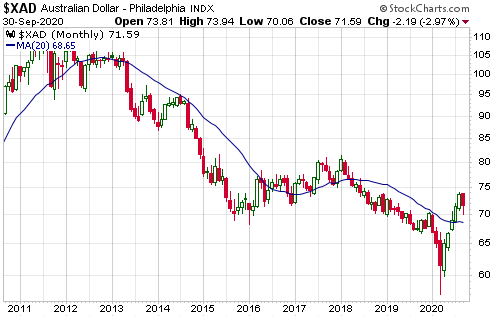
Our view continues to be that the Australian dollar (A$) commenced a
cyclical bull market in March-2020. If so, it's likely that significant
corrections in the A$ will be limited by the 20-month MA (the blue line on
the following chart).
An A$ correction was expected to coincide
with the next meaningful stock market correction, which is exactly what
happened during September.
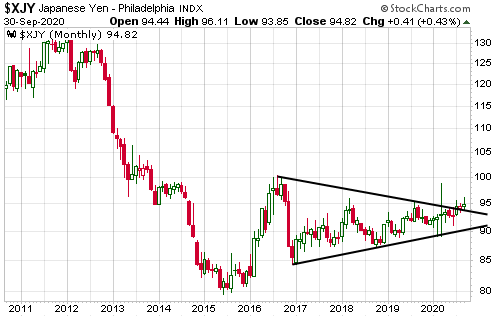
Our final monthly chart shows the Yen.
The Yen has been
consolidating with a slight upward bias since late-2016. Both the monthly
chart and the financial/economic backdrop suggest the potential for a rise
in Yen futures to above 100 within the next few months, but at the moment
we aren't interested in trading this currency.
The Stock Market
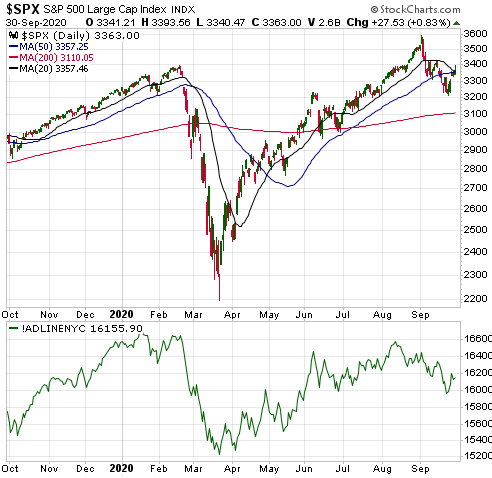
The chaotic first debate between
Trump and Biden had minimal effect on the stock market.
The SPX has
moved up to its 50-day MA but remains well below its early-September high.
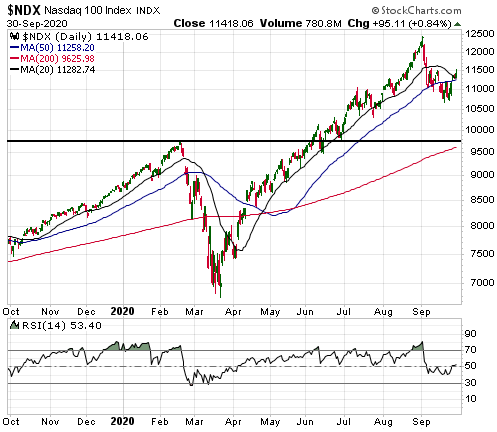
The NASDAQ100 Index (NDX), which is a proxy for the mega-cap tech and
internet stocks that dominated the market over the past several months,
rose above its 50-day MA on Wednesday 30th September, but like the SPX it
remains well below its early-September high.
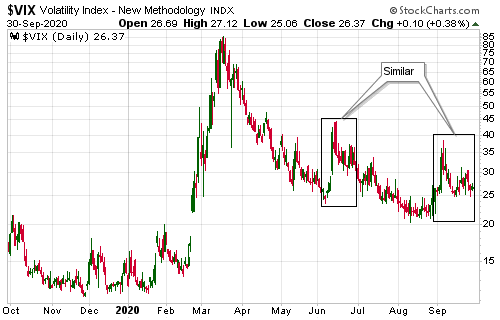
In volatility terms, as represented by the Volatility Index (VIX), the
stock market correction that began during the first few days of September
continues to look like the routine short-term correction that occurred in
June.
As explained in previous TSI commentaries, our view is that from an
overall economic and financial-market perspective the winner of the coming
US presidential election matters less than most people think. Both major
US political parties have stopped pretending to care about government
deficits and indebtedness, so government spending and borrowing will
continue at a torrid pace over the years ahead regardless of who wins in
November-2020. Also, regardless of who wins the coming election the Fed
will be forced to monetise many trillions of dollars of government debt,
ensuring that "inflation" will become an obvious problem. Consequently,
our market views probably won't be changed by the election result,
assuming, of course, that there is a result.
The risk is that there
won't be a clear-cut and/or generally accepted winner. If the voting is
close and neither side is prepared to concede, a constitutional crisis
could develop. This would be the worst-case scenario.
We think it
will make sense to tread carefully regarding equity exposure until the
aforementioned worst-case scenario is taken off the table. This is
especially so when it comes to ownership of the cyclical stocks, such as
the stocks of industrial-commodity producers*, that we expect to perform
very well during at least the first half of next year. It is fine to be
accumulating the beaten-down 'cyclicals' near current prices, but only if
you are hedged in some way against a negative short-term outcome.
At the moment, the short-term risk/reward remains skewed towards risk.
*We plan to discuss the energy sector in some
detail in the coming Weekly Update.
Gold and the Dollar
Gold
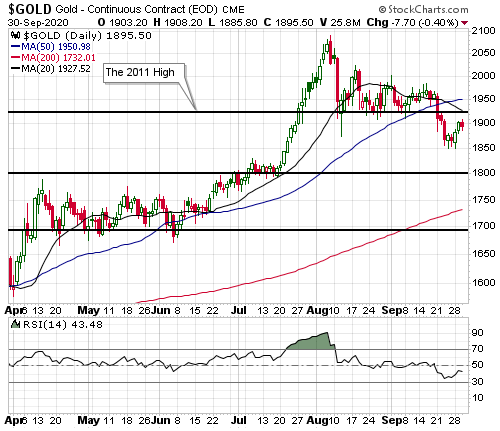
Last week the US$ gold price broke below support in the US$1920s. This
week it rebounded, but the rebound has not gone far enough, yet, to test
last week's downside breakout.
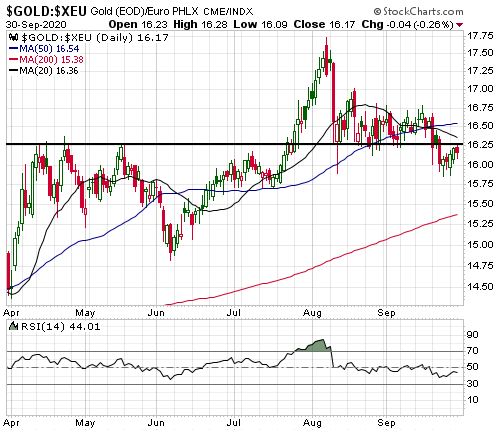
In euro terms, support at 1625 was taken out last week and this week
there was a rebound that tested the breakout.
Every correction has two components. One is price and the other is
time. In both US$ terms and euro terms, gold's correction has lasted
almost two months. 2-3 months is typical for a short-term correction
within an intermediate-term upward trend, so it is fair to say that in
terms of time the correction has done as much as it needed to do. However,
in terms of price there could be some unfinished business.
Chart
patterns, inter-market relationships (the likelihood of significant
additional gains by the Dollar Index over the coming 1-2 months) and
sentiment (speculative enthusiasm for gold ETFs has not been dented by the
price decline of the past two months) suggest that last week's low was not
the ultimate correction low. We suspect that there will be one more leg
down to complete the correction, with US$1800 (or thereabouts) being the
most plausible target for a correction low.
A decline to the
low-US$1800s is our base case, but the correction could end at a higher or
lower level. Consecutive daily closes above US$1950 at any time over the
next couple of weeks would suggest that it had ended at a higher level.
Gold Stocks
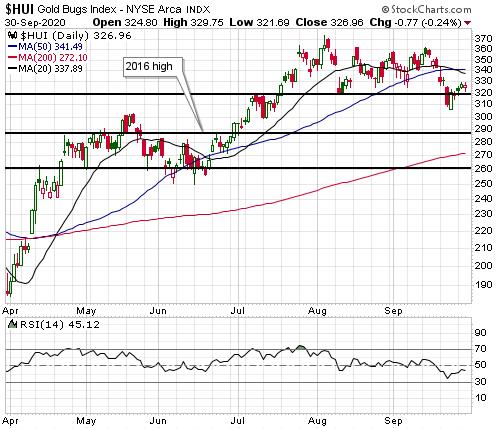
The HUI traced out a pattern
during August-September that created the potential for a mini crash after
support at 320 was taken out. However, a crash didn't happen. Instead,
last week's decline to below 320 was followed by a rebound that has taken
the price back up to the 320s.
A crash was avoided, but there is
no evidence that the 'corrective' process is complete.
The HUI has
a confluence of support in the 260-290 range. This is the most likely area
for a correction low.
The Currency Market
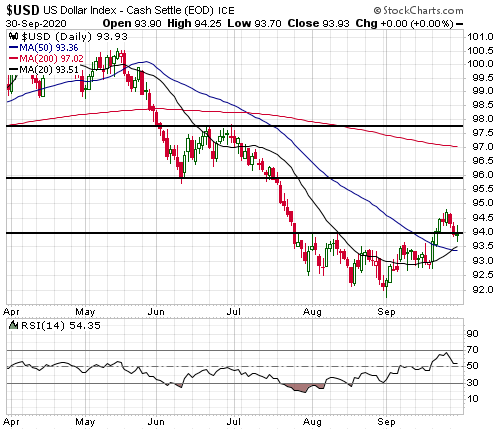
At the end of last week
the Dollar Index (DX) was 'overbought' on a short-term basis. This
suggested the possibility of a pullback, although the DX's short-term
risk/reward remained skewed towards reward.
A pullback happened
over the first three days of this week, leading to a test of the preceding
week's upside breakout. Short-term support lies at 93.5-94.0.
As far as we can tell, all possible outcomes of the US presidential
election are either immediately or ultimately bearish for the US$. A
clear-cut Trump or Biden victory would remove uncertainty and could result
in a US$ bounce, but anticipation of the massive amount of Fed-monetised
government spending set to occur in 2021 probably would ensure that the DX
resumed its downward trend by December of this year. A contested election
would be immediately bearish for the US$ because it would provoke capital
flight from the US.
This should mean that the bulk of the US
dollar's short-term rebound will occur before election day (3rd November).
Updates on Stock Selections
Notes: 1) To review the complete list of current TSI stock selections, logon at
http://www.speculative-investor.com/new/market_logon.asp
and then click on "Stock Selections" in the menu. When at the Stock
Selections page, click on a stock's symbol to bring-up an archive of
our comments on the stock in question. 2) The Small Stock Watch List is
located at http://www.speculative-investor.com/new/smallstockwatch.html
 Comment
on a potential nickel play
Comment
on a potential nickel play
In the 9th September Interim
Update, we wrote:
"...we are now on the lookout for a nickel
play for the TSI List. One possibility is Clean TeQ (ASX and TSX: CLQ), a
former TSI stock selection that provides exposure to cobalt and platinum
in addition to nickel.
CLQ's Sunrise project in NSW is marginal at
current metal prices and the stock is not particularly cheap (with 746M
shares outstanding, at the current price of A$0.30/share the market cap is
about A$220M), but the company is chaired by Robert Friedland and
therefore stands a good chance of being aggressively promoted under the
right market conditions."
And:
"In a recent press
release CLQ advised: "...[the company] will release the final outcomes for
its Project Execution Plan (PEP) at the end of September 2020, including a
full economic evaluation of the [Sunrise] Project. It will incorporate the
latest engineering and design work based on updated material quantities,
vendor pricing and labour costs." Therefore, within the next three weeks
we should get some useful information regarding CLQ's value and potential."
CLQ released its Project Execution Plan, including updated economics,
on Monday 28th September. According to this new information, assuming a
nickel price of US$24,200/t (US$11/pound) and a cobalt price of
US$59,500/t the Sunrise project has a post-tax NPV(8%) of US$1.21B and a
post-tax IRR of 15.4%.
The above IRR is OK, but the assumed metal
prices are about 50% above current prices. At current metal prices the
project isn't close to being economic. Consequently, at this time CLQ
could be viewed as a well-out-of-the-money call option on nickel and
cobalt prices.
The culprit is the pre-production capex. The
estimated operating costs are low enough that if the project were already
in production it would be very profitable, but it is estimated that
putting the project into production would require an investment of about
US$1.8B.
Undeveloped mining projects that require huge increases in
metal prices to be economically viable rarely get put into production,
because even if metal prices move high enough to make these projects
viable there always will be many other projects that are more attractive.
However, the associated stocks do very well from time to time due to
aggressive promotion and speculation. For example, the shares of
International Tower Hill Mines (THM) and Northern Dynasty Minerals (NAK)
periodically get bid-up by hundreds of percent even though the probability
of either company's flagship project ever being put into production is
close to zero.
Therefore, at some point in the future CLQ could be
a good speculation even though there does not appear to be a realistic
chance of the Sunrise project being developed into an operating mine.
Chart Sources
Charts appearing in today's commentary
are courtesy of:
https://stockcharts.com/