|
-- Weekly Market Update for the Week Commencing
1st July 2013
Big Picture
View
Here is a summary of our big picture
view of the markets. Note that our short-term views may differ from our
big picture view.
In nominal dollar terms, the BULL market in US Treasury Bonds
that began in the early 1980s will end by 2013. In real (gold)
terms, bonds commenced a secular BEAR market in 2001 that will continue
until 2014-2020. (Last
update: 23 January 2012)
The stock market, as represented by the S&P500 Index,
commenced
a secular BEAR market during the first quarter of 2000, where "secular
bear market" is defined as a long-term downward trend in valuations
(P/E ratios, etc.) and gold-denominated prices. This secular trend will bottom sometime between 2014 and 2020.
(Last update: 22 October 2007)
A secular BEAR market in the Dollar
began during the final quarter of 2000 and ended in July of 2008. This
secular bear market will be followed by a multi-year period of range
trading.
(Last
update: 09 February 2009)
Gold commenced a
secular bull market relative to all fiat currencies, the CRB Index,
bonds and most stock market indices during 1999-2001.
This secular trend will peak sometime between 2014 and 2020.
(Last update: 22 October 2007)
Commodities,
as represented by the Continuous Commodity Index (CCI), commenced a
secular BULL market in 2001 in nominal dollar terms. The first major
upward leg in this bull market ended during the first half of 2008, but
a long-term peak won't occur until 2014-2020. In real (gold) terms,
commodities commenced a secular BEAR market in 2001 that will continue
until 2014-2020.
(Last
update: 09 February 2009)
Copyright
Reminder
The commentaries that appear at TSI
may not be distributed, in full or in part, without our written permission.
In particular, please note that the posting of extracts from TSI commentaries
at other web sites or providing links to TSI commentaries at other web
sites (for example, at discussion boards) without our written permission
is prohibited.
We reserve the right to immediately
terminate the subscription of any TSI subscriber who distributes the TSI
commentaries without our written permission.
Outlook Summary
Market
|
Short-Term
(1-3 month)
|
Intermediate-Term
(6-12 month)
|
Long-Term
(2-5 Year)
|
|
Gold
|
Bullish
(17-Oct-12)
|
Bullish
(26-Mar-12)
|
Bullish
|
|
US$ (Dollar Index)
|
Neutral
(24-Dec-12)
|
Bullish
(01-May-13)
|
Neutral
(19-Sep-07)
|
|
Bonds (US T-Bond)
|
Bullish
(24-Jun-13)
|
Neutral
(18-Jan-12)
|
Bearish |
|
Stock Market
(DJW)
|
Neutral
(06-May-13)
|
Bearish
(28-Nov-11)
|
Bearish
|
|
Gold Stocks
(HUI)
|
Bullish
(24-Dec-12)
|
Bullish
(23-Jun-10)
|
Bullish
|
|
Oil |
Neutral
(30-Jul-12)
|
Neutral
(31-Jan-11)
|
Bullish
|
|
Industrial Metals
(GYX)
|
Neutral
(30-Jul-12)
|
Neutral
(29-Aug-11)
|
Neutral
(11-Jan-10)
|
Notes:
1. In those cases where we have been able to identify the commentary in
which the most recent outlook change occurred we've put the date of the
commentary below the current outlook.
2. "Neutral", in the above table, means that we either don't have a
firm opinion or that we think risk and reward are roughly in balance with respect to the timeframe in question.
3. Long-term views are determined almost completely by fundamentals,
intermediate-term views by
fundamentals, sentiment and technicals, and short-term views by sentiment and
technicals.
The gold mining sector
breaks a record
In this report we are leading off with a
discussion of gold mining stocks because the recent price action has created a
situation that can now aptly be described as unprecedented. A consequence is
that there has NEVER been a better time to buy gold mining stocks.
The unprecedented situation we just referred to is associated with distance
below the 200-week moving average (MA). This was previously discussed in our
24th April commentary, when we wrote:
"At the end of last week the BGMI [Barrons Gold Mining Index] was 41.5% below
its 200-week MA. This compares to other major bottoms as follows:
- At the 1970 bottom the BGMI was 39.2% below its 200-week MA
- At the 1976 bottom the BGMI was 46.8% below its 200-week MA
- At the 1982 bottom the BGMI was 43.7% below its 200-week MA
- At the 1986 bottom the BGMI was 41.5% below its 200-week MA
- At the 1998 bottom the BGMI was 55.7% below its 200-week MA [and the
XAU was 54.2% below its 200-week MA]
- At the 2000 bottom the BGMI was 43.6% below its 200-week MA [and the
XAU was 43% below its 200-week MA]
- At the 2008 bottom the BGMI was 53.6% below its 200-week MA [and the
HUI was 53% below its 200-week MA]
The BGMI's average distance below its 200-week MA at major gold-sector bottoms
over the past 50 years was 46.3%. The range is from 39.2% to 55.7%.
So, last week's BGMI bottom was within the historical range for a major bottom.
Furthermore, at last week's low the HUI was 46% below its 200-week MA, or right
at the long-term average for a rare, major bottom.
Note that for the HUI to roughly match the most extreme bottoms of the past 50
years in terms of distance below the 200-week MA, it would have to fall to
around 215 within the next few weeks. This could be viewed as a measure of the
maximum remaining downside risk, although we think the chance of the HUI getting
that low is remote. We are only mentioning the possibility because the recent
price action makes almost anything seem possible."
Here is an updated version of the chart we included in our 24th April
commentary. The chart shows the distance, in percentage terms, of the BGMI from
its 200-week moving average.
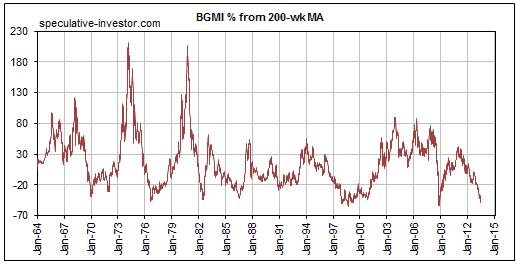
It turned out that almost anything was possible, because at last week's low the
HUI was 55.9% below its 200-week MA. Therefore, using either the BGMI or the XAU
as a sector proxy up to and including 2000 and the HUI as a sector proxy
thereafter, at last week's low the gold-mining sector of the stock market was
further below its 200-week moving average (MA) than it had ever been.
We know from painful experience that there are no absolute benchmarks when it
comes to sentiment and 'oversold' extremes, so the current extreme does not
provide buyers with a guarantee of success. However, it isn't every day that you
get the opportunity to buy an investment at its most 'oversold' level in
history. Hopefully, some of our readers have kept enough cash in reserve to take
advantage of this opportunity.
China Boom and Bust
The PBOC, China's central bank, deliberately
initiated a mini credit crisis within its banking system about three weeks ago.
It then deliberately ended the crisis. At some future time it will no doubt
again turn the proverbial screws on its banks by restricting access to
short-term credit, thus manufacturing another mini-crisis that it will
subsequently end at a time of its choosing. Such machinations by the central
bank are neither here nor there. What's important is that China's policy-makers
have fostered an inflation-fueled boom that is now, like every prior
inflation-fueled boom in history, rolling over into an economic bust.
China's boom and the associated mal-investment of the past 10 years appear to be
record-breaking. As far as we know, there has never before been development of
unused or under-utilised residential buildings, commercial buildings, shopping
centres, highways, railways, bridges and airports on such a grandiose scale.
The fact that China is a command economy at a macro level enabled the
mal-investment to occur for much longer and on a much larger scale than would
otherwise have been possible. In a nutshell, China's government wanted rapid
economic activity in the present regardless of the long-term future consequences
and was able to ensure a steady stream of funding for this activity via its
total control of the banking industry. At the same time, the banks that were
routinely prompted by Communist Party officials to provide large loans to local
governments and State-Owned Enterprises to fund projects with no economic merit
were not required to properly account for their bad investments.
Due to the gargantuan credit-financed push to maintain rapid economic activity,
the total assets of China's banking system rose from 20T Yuan a decade ago to
135T Yuan at the end of last year. And due to the government-sanctioned tendency
of China's banks to not report problems with their loans, the official data show
that the total amount of bad loans is only about 1% of assets. The real number
is probably at least 20-times higher.
So, the banks are hurt by being required to provide loans that will never be
repaid and helped by being allowed to pretend that almost all of their loans are
performing. The banks are also simultaneously helped and hurt by the Chinese
government's control of interest rates on bank deposits. The government limits
the interest rate that banks can pay their depositors to well below the rate of
"price inflation", thus allowing the banks to obtain credit from the general
public at a negative real interest rate. However, the negative real interest
rate on bank deposits encourages the public to keep its money outside the
banking system, thus forcing the banks to offer alternative products with higher
yields and greater risk than normal deposits. The negative real interest rate on
bank deposits also encourages the public to speculate in real estate.
It is always the case that the bigger the boom, the bigger the ensuing bust. It
would therefore be an understatement to say that the experiment being conducted
by China's government is going to end badly.
The Stock
Market
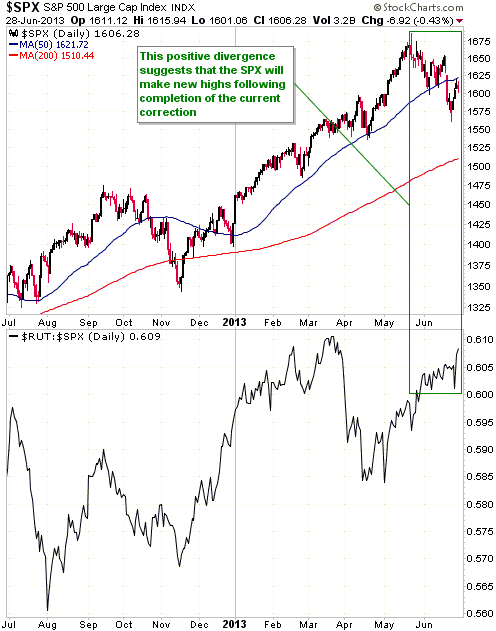
There is no evidence, yet, that the stock
market downturn that began on 22nd May is complete. There is, however, evidence
that this downturn will be followed by rallies to new highs by the senior US
stock indices. We cite, for example, the positive divergence between the SPX and
the RUT/SPX ratio indicated on the following chart.
While the US stock market looks set to make a marginal new high within the next
few months, it looks like major tops are already in place in many stock markets
around the world.
This week's
important US economic events
| Date |
Description |
| Monday Jul 01 |
ISM Mfg Index
Construction Spending | | Tuesday
Jul 02 |
Motor Vehicle Sales
Factory Orders | | Wednesday
Jul 03 |
International Trade Balance
ISM Non-Mfg Index | | Thursday
Jul 04 |
US markets closed for Independence Day
|
| Friday Jul 05 |
Monthly Employment Report |
Gold and
the Dollar
Gold
Retail Demand
Retail demand for gold coins and small gold bars in Asia appears to have waned
since the mid-April demand surge. Many people rushed to their local banks and
coin dealers to buy gold after the price plunged from the $1500s to the $1300s
in April, but the public's enthusiasm has since been sapped by the continuing
price weakness.
This is not a problem. Public enthusiasm for an investment is never bullish. It
is either irrelevant or bearish. We viewed the public's rush to scoop up coins
and small bars in response to the April price plunge as largely irrelevant and
view the public's recent retreat from the market in a similar way.
Large speculators, not Chinese housewives, establish the price trend in the gold
market.
Not the most extreme of all time, but close to it
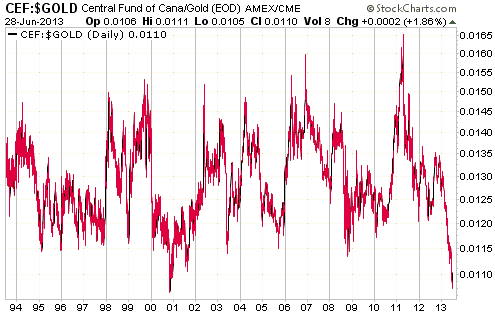
The CEF/gold ratio (see chart below) is one of our favourite long-term sentiment
indicators. In April we noted that this indicator had dropped to a level that
had coincided with an intermediate-term price bottom in all but the most extreme
case of the past 20 years. It subsequently dropped further, though, and last
Thursday came very close to the most extreme case of the past 20 years:
November-2000.
November-2000 was the month that the gold-mining sector commenced its long-term
bull market. The CEF/gold ratio is therefore echoing the message discussed in
the opening section of today's report.
Current Market Situation
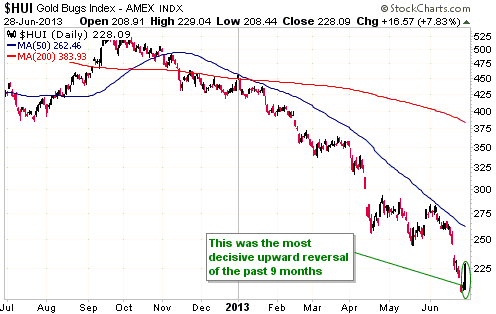
Last Thursday the gold-mining sector made a small gain despite a $30 decline in
the gold price. This was a warning that an upward reversal was in the works in
the bullion market. After initially falling an additional $20 during Asian
trading last Friday, the reversal occurred. By the end of Friday's US trading
session, the initial $20 loss during Asian trading had turned into a $30 gain.
This prompted 2013's best single-day up-move in the gold-mining sector, which
means that the mining stocks signaled an imminent upward reversal on Thursday
and then confirmed the reversal on Friday.
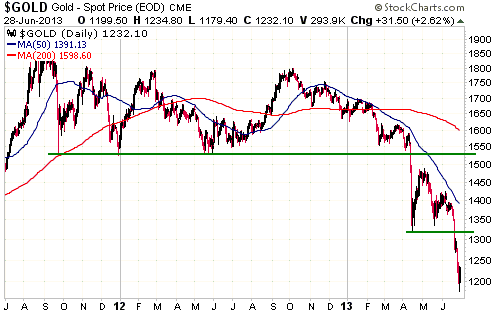
To provide more evidence that a price reversal of importance has happened, gold
will have to do something it failed to do during its April-May rebound: move
decisively back above the most recent breakdown level. During the April-May
rebound the most recent breakdown level was at $1525. It is now at $1320.
Gold Stocks
The gold-mining sector's previous huge bull-market declines
At last week's low the gold-mining sector (basis the HUI) was 68% below its 2011
high. Here's how this compares with previous declines during long-term bull
markets:
1) There was a 61% decline from the 1968 peak to the 1970 trough
2) There was a 68% decline from the 1974 peak to the 1976 trough
3) There was a 70% decline during 2008
So, the HUI's 2011-2013 decline has a) exceeded the 1968-1970 decline by 7%, b)
exactly matched the 1974-1976 decline, and c) fallen 2% short of the 2008
decline.
Current Market Situation
The price action last Thursday-Friday was obviously positive, but it doesn't
provide any assurance that a bottom is in place.
After an important price bottom has been put in place it usually takes at least
a few weeks and it sometimes takes a few months before conclusive evidence
emerges that the price has, indeed, bottomed. In other words, at the time of a
price bottom a prudent investor/speculator can never be sure, or even confident,
that the ultimate bottom is in place.
What we have to work with in real time are indicators such as the distance below
the 200-week moving average and the CEF/gold ratio. Regardless of whether the
ultimate price bottom is in place, these indicators tell us that we now have one
of the best buying opportunities of the past few decades.
Australian Gold Stocks
As well as operating in the world's lowest-risk mining jurisdiction, companies
that mine gold in Australia are likely to be supported over the coming 12 months
by continuing weakness in the Australian Dollar (A$).
Weakness in the A$ has already provided some support to the businesses of
Australia-based gold miners, in that up until now the A$-denominated gold price
(gold/A$) has remained above its April low. As illustrated by the following
daily chart, the plunge in the gold price over the past two weeks resulted in
gold/A$ testing, but not breaching, support.
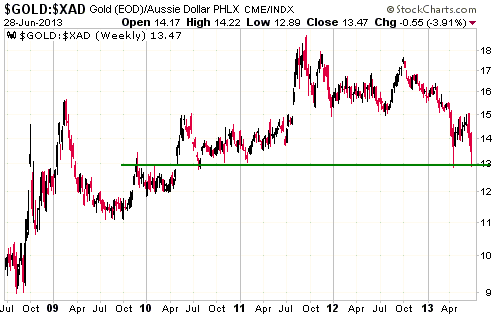
Strength in the A$ gold price relative to the US$ gold price has not yet helped
the stock prices of Australian gold miners, but if it continues it should enable
them to be comparatively good performers in the future. EVN.AX and RMS.AX are
the two TSI stocks that would benefit from such a situation.
Currency Market Update
The Dollar Index has returned to the resistance that extends from 83.5 to 84.5.
The US$ is now moderately 'overbought' on a short-term basis.
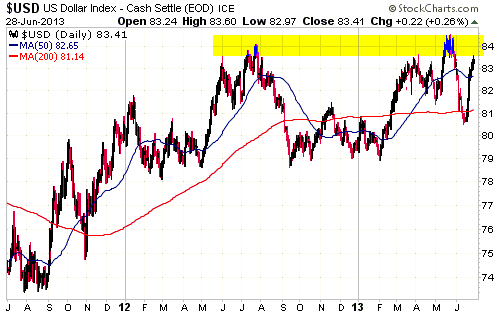
There's a distinct possibility that the Dollar's next move will be a decline to
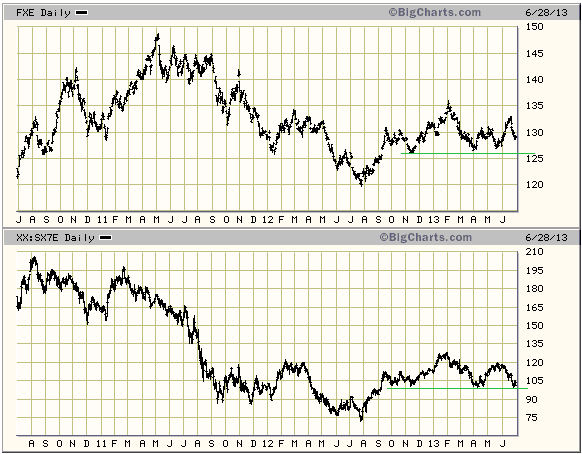
the wide range of support that extends from 79 to 81. However, the following
chart comparison of the euro (represented by FXE) and the EURO STOXX Banks Index
(SX7E) indicates that the current situation is delicately balanced. We are
referring to the fact that SX7E ended last week near important support at 100
and that the performances of the euro and SX7E are linked.
A sustained break below 100 by SX7E would suggest that Europe's banking industry
was re-entering crisis mode and that the euro was on its way back to 120. And a
decline of that magnitude by the euro would probably push the Dollar Index up to
the high-80s.
We suspect that SX7E will hold support for now, but wouldn't bet on it.
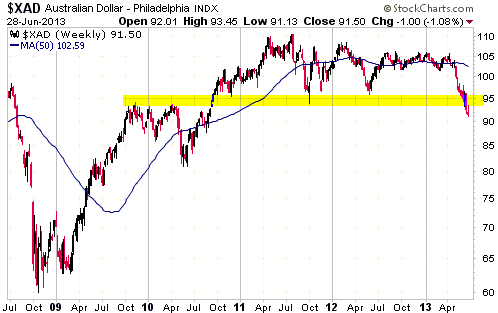
The currency market ignored the A$'s extreme over-valuation for years, but
gradually-increasing recognition of China's economic problems is prompting the
market to correct this oversight. As illustrated by the following daily chart,
the A$ has decisively broken below multi-year support in the mid-90s.
The A$ remains over-valued and has the potential to drop a lot further over the
coming 12 months, but on a short-term basis it is dramatically 'oversold' and
should soon rebound. A normal counter-trend rebound would move the currency up
to the breakdown level at 95-96.
Update
on Stock Selections
Notes: 1) To review the complete list of current TSI stock selections, logon at
http://www.speculative-investor.com/new/market_logon.asp
and then click on "Stock Selections" in the menu. When at the Stock
Selections page, click on a stock's symbol to bring-up an archive of
our comments on the stock in question. 2) The Small Stock Watch List is
located at http://www.speculative-investor.com/new/smallstockwatch.html
 Company
news/developments for the week ended Friday 28th June 2013: Company
news/developments for the week ended Friday 28th June 2013:
[Note: FS = Feasibility Study, IRR = Internal Rate of Return, MD&A =
Management Discussion and Analysis, M&I = Measured and Indicated,
NAV = Net Asset Value, NPV(X%) = Net Present Value using a discount
rate of X%, P&P = Proven and Probable, PEA = Preliminary Economic
Assessment, PFS = Pre-Feasibility Study]
*Americas Bullion Royalty (AMB.TO) made the following announcement
on 24th June: "...MF Investment Holding Company 1 (Cayman)
Limited, part of the Red Kite Group, has indicated that it has or
intends on issuing notices alleging an Event of Default under the
secured facility agreement dated September 25, 2012 (the "Facility
Agreement") and asserting rights to exercise an option to purchase
twenty-six royalty interests including the Pan and Bald Mountain
interests by paying Americas Bullion US$35,000,000 in cash as set
forth in section 7.6 of the Facility Agreement. Americas Bullion
rejects that any Event of Default has occurred under the Facility
Agreement, asserts that no valid and effective notice has been
issued upon it as required by the Facility Agreement and has engaged
legal counsel to challenge the recent conduct of MF Investments."
This is very strange. There doesn't appear to have been a default
event, although the language of the secured facility agreement
leaves enough room for interpretation that an argument could
possibly be made that AMB is in default. In any case, according to
AMB, the lender has never issued a notice of default, which it is
supposed to do. Instead, it has jumped straight for the loan
collateral.
We have no way of knowing why Red Kite (the lender) has taken this
action. One possibility is that it is making an ambit claim with the
ultimate goal of terminating its obligation to provide additional
credit to AMB. Another possibility is that it genuinely believes it
has an opportunity to snare a high-quality royalty portfolio at a
bargain-basement price.
For AMB, the worst case scenario is that it receives an injection of
$25M ($35M minus the $10M credit already provided by Red Kite) and
loses its royalty portfolio. With the royalty portfolio we think
that AMB is potentially worth at least C$0.70/share, but with $25M
(C$0.14/share) of cash and no royalty portfolio we estimate that AMB
would be worth no more than C$0.20/share in the current market
environment.
As far as we know, Red Kite hasn't yet provided any specifics on the
nature of AMB's alleged default, so there is no way of assessing the
probability that its claim will be successful.
In other AMB news, the private placement originally announced in
mid-May was completed last week at a reduced price (the price was
reduced from C$0.15/share to C$0.125/share due to the additional
deterioration in the market environment). 16M of the 17M new shares
were purchased by Kudu Partners, a company controlled by Bill Lupien.
Kudu/Lupien now owns about 16% of AMB.
Bill Lupien purchased an additional 77K shares on the open market on
Thursday 27th June. His buying could be viewed as a vote of
confidence in AMB's ability to retain its royalty assets.
*Clifton Star (CFO.V) published an updated resource estimate for
its Duparquet project (Quebec) prior to the start of trading last
Friday.
There has been a significant increase in the Duparquet project's M&I
gold resource. The project now has 3.11M ounces in the M&I category
(versus 2.4M in the previous estimate) and 1.44M ounces in the
Inferred category. Of the 4.5M-ounce total resource, 3.6M ounces are
'in pit'. This means that the quantity of 'in pit' ounces (the most
economically relevant ounces) has increased by 0.7M.
This is good news. We don't know why the stock price fell on Friday.
*Dragon Mining (DRA.AX) announced results from holes drilled
beneath its underground Orivesi gold mine in Finland. The results
were good and increase confidence in DRA's geological model, but on
a short- and an intermediate-term basis the prospects of the company
and its stock price will be determined by its operating costs.
*Endeavour Mining (EDV.TO) advised that the mill expansion at its
Tabakoto mine (Mali) was completed on time and on budget, enabling
this mine's annual rate of production to increase by about 30K
ounces to around 150K ounces. The combination of the Tabakoto mill
expansion and the new Agbaou mine in Cote d'Ivoire is expected to
result in the company's total gold production rising from 325K
ounces in 2013 to 450K ounces in 2014.
As far as we can tell, at current prices there is no better buy than
EDV.
*Golden Star Resources (GSS) was affected by deletion from the
S&P/TSX Global Gold and Global Mining indices on 21st June and
deletion from the Russell3000 Index on 28th June. The Russell3000
deletion caused the stock price to fall 16% last Friday on 10-times
average daily volume.
At current prices, over all time-frames beyond the next few weeks
EDV.TO has a better risk/reward ratio than GSS by virtue of being
much less risky. However, GSS would be very interesting as a
short-term trade if it could be purchased, early this week, near
Friday's close of US$0.42. The trading opportunity stems from the
likelihood that last Friday's plunge was solely due to the
above-mentioned index change and that with index-related selling now
out of the way the stage is set for a strong rebound.
*Jaguar Mining (JAG.TO) advised that it had drawn down the
remaining $25M of the $30M credit facility provided by Renvest. The
market didn't like this development, but it was a prudent decision
by JAG's management.
*Premier Gold (PG.TO), a newcomer to the TSI Stocks List, reported
the latest round of drilling results from its Cove gold project
(Nevada) last Thursday. Most of the results were good, but two of
them were exceptional. The exceptional results were 84.4m averaging
6.52-g/t gold in Hole AX-27 and 10.5m averaging 40.47-g/t gold in
Hole AX-36. These are two of the best drilling results we've seen
from any gold mining company over the past 12 months. Also worth
singling out were the 10.8M intercept grading 19.6-g/t in Hole AX-35
and the 21.5m intercept grading 7.11-g/t in Hole AX-41.
The initial resource estimate for the Cove project is scheduled to
be completed in Q4-2013.
PG also reported on the progress of its Rahill-Bonanza project
(Ontario), the least advanced of the company's three core projects.
Two drills have been mobilized to test the primary targets at this
project.
*Volta Resources (VTR.TO) traded for less than cash value at last
week's low of C$0.12/share and is presently (at C$0.16/share)
trading for only slightly more than its cash, meaning that the
market is assigning almost no value to its 5M-ounce
exploration-stage gold project. In this regard VTR.TO is in a
similar position to Asanko Gold (AKG).
For new buying we would favour AKG over VTR.TO, but the latter
certainly offers exceptional value.
Chart Sources
Charts appearing in today's commentary
are courtesy of:
http://stockcharts.com/index.html
http://bigcharts.marketwatch.com/

|









