|
-- Weekly Market Update for the Week Commencing 1st September 2008
Big Picture
View
Here is a summary of our big picture
view of the markets. Note that our short-term views may differ from our
big picture view.
Bonds commenced a secular BEAR market in
June of 2003. (Last
update: 22 August 2005)
The stock market, as represented by the S&P500 Index, commenced
a secular BEAR market during the first quarter of 2000, where "secular
bear market" is defined as a long-term downward trend in valuations
(P/E ratios, etc.) and gold-denominated prices. This secular trend will bottom sometime between 2014 and 2020. (Last update: 22 October 2007)
The Dollar commenced a secular BEAR market during the final quarter of 2000. The
first major downward leg in this bear market ended during the first
quarter of 2005, but a long-term bottom won't occur until 2008-2010. (Last update: 28 March 2005)
Gold commenced a
secular bull market relative to all fiat currencies, the CRB Index,
bonds and most stock market indices during 1999-2001. This secular trend will peak sometime between 2014 and 2020. (Last update: 22 October 2007)
Commodities, as
represented
by the CRB Index, commenced a secular BULL market in 2001. The first
major upward leg in this bull market ended during the second quarter of
2006, but a long-term
peak won't occur until at least 2008-2010. (Last update: 08 January 2007)
Copyright
Reminder
The commentaries that appear at TSI
may not be distributed, in full or in part, without our written permission.
In particular, please note that the posting of extracts from TSI commentaries
at other web sites or providing links to TSI commentaries at other web
sites (for example, at discussion boards) without our written permission
is prohibited.
We reserve the right to immediately
terminate the subscription of any TSI subscriber who distributes the TSI
commentaries without our written permission.
Outlook Summary
Market
|
Short-Term
(0-3 month)
|
Intermediate-Term
(3-12 month)
|
Long-Term
(1-5 Year)
|
Gold
|
Bullish
(30-Jun-08)
|
Bullish
(12-May-08)
|
Bullish
|
US$ (Dollar Index)
|
Bullish
(16-Jun-08)
| Bullish
(31-May-04)
|
Neutral
(19-Sep-07)
|
Bonds (US T-Bond)
|
Neutral
(14-Jul-08)
|
Neutral
(19-May-08)
|
Bearish
|
Stock Market (S&P500)
|
Neutral
(02-Jun-08)
|
Bearish
(12-May-08)
|
Bearish
|
Gold Stocks (HUI)
|
Bullish
(30-Jun-08)
|
Bullish
(12-May-08)
|
Bullish
|
| Oil | Bearish
(21-Jul-08)
| Bearish
(22-Oct-07)
| Bullish
|
Industrial Metals (GYX)
| Neutral
(18-Jun-08)
| Bearish
(09-Jul-07)
| Bullish
|
Notes:
1. In those cases where we have been able to identify the commentary in
which the most recent outlook change occurred we've put the date of the
commentary below the current outlook.
2. "Neutral", in the above table, means that we either don't have a
firm opinion or that we think risk and reward are roughly in balance with respect to the timeframe in question.
3. Long-term views are determined almost completely by fundamentals,
intermediate-term views by giving an approximately equal weighting to
fundmental and technical factors, and short-term views almost
completely by technicals.
Market Manipulation
The article linked HERE
and some other recent internet articles discuss the large short
positions in gold and silver futures built up by a small number of
banks just prior to and during the July-August plunges in gold and
silver prices. Most of these articles assert that the banks in question
aggressively sold gold and silver futures with the aim of causing sharp
price declines that would otherwise not have occurred.
We don't know if the aforementioned banks acted with the sole intent of
pushing prices downward or if they correctly positioned themselves for
market moves that would have happened anyway, although we think it is
more likely to be the latter because the prices of almost all
commodities tanked over the same period. It was a virtual certainty
that gold and silver would get hit during the initial phases of a US
dollar recovery and a downturn in industrial commodities; the only real
questions related to timing (when would it happen?) and extent (by how
much would gold and silver fall in response to a US$ rally and
industrial commodity correction?).
In any case, from an ethical perspective there is nothing wrong with
selling something with the sole purpose of forcing the price downward
or buying something with the sole purpose of forcing the price upward.
People should be allowed to sell or buy for their own reasons, whatever
those reasons happen to be. However, selling or buying with the aim of
creating an artificial price move is generally an ill-conceived tactic
because it will tend to result in a loss. The markets tend to reward
buy/sell decisions that are based on the correct assessment of the
facts, not decisions based on an attempt to create a false impression.
From a legal perspective there may well be something wrong with making
a sale for the sole purpose of pushing the price down, but we see no
good reason to rail against the violations of laws that shouldn't exist
and are policed by government agencies that also shouldn't exist.
Putting it another way, we have no desire to encourage the government
to implement more regulations or to more stringently enforce current
regulations that shouldn't exist in the first place.
It should be obvious to any moderately astute observer that
economic/financial problems are routinely used as justifications for
the further expansion of government power, even if some form of
government intervention caused the original problems. For example, the
debt crisis of the past two years has been used as the justification
for assigning more power to the Fed, even though the Fed's actions
sowed the seeds of the crisis. In most cases the popular "government
oughta' do something" response to a perceived problem is, in our
opinion, part of the problem.
Also of note is that if -- and it's a big if -- the recent sharp
declines in the prices of gold and silver were mainly the result of
manipulative selling (selling motivated solely by the desire to push
the price downward) on the parts of a few banks, then these banks have,
in effect, granted to investors the opportunity to purchase bullion at
artificially low prices. This should have been viewed as a plus by gold
bulls with spare financial capacity, but would have presented a problem
for margined-to-the-hilt speculators or anyone who did not have
sufficient cash in reserve to take advantage of the bargains on offer.
It's important to understand, though, that the primary cause of the
latter's dilemma was a money management error, not market manipulation.
We don't think it's wise for any non-professional investor to trade on
margin, but those who choose to do so should use a disciplined
stop-loss approach to ensure that all losses are small losses.
Furthermore, no one knows what financial-market events and
opportunities lie in the future so a substantial cash reserve should
always be maintained just in case.
Lastly, we don't think it's possible for manipulative trading by banks
or governments or anyone else to significantly damage the long-term
bull market in gold. In our opinion there are only two things that
could de-rail the gold bull market, one being a prolonged period of
genuine deflation (money-supply contraction) and the other being a
whole-scale change in the political landscape involving the adoption of
non-inflationary policies. The probability of either of these actually
happening is exceedingly low.
The Stock
Market
Current Market Situation
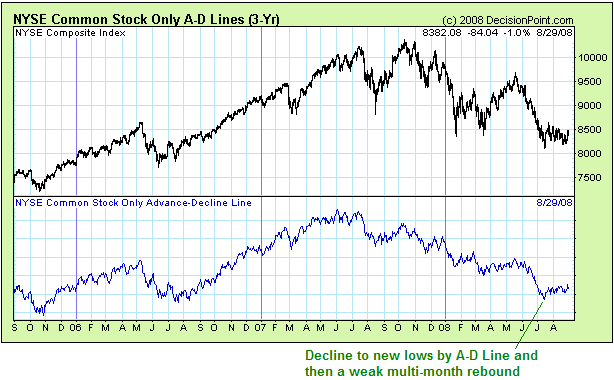
The first of the following charts shows the NYSE Composite Index and
the NYSE A-D Line (a cumulative total of the number of advancing stocks
minus the number of declining stocks). The A-D Line is a measure of
market breadth.
The unimpressive nature of the A-D Line's recent rebound supports our
view that the stock market is experiencing nothing more than a
consolidation within an on-going bear market.
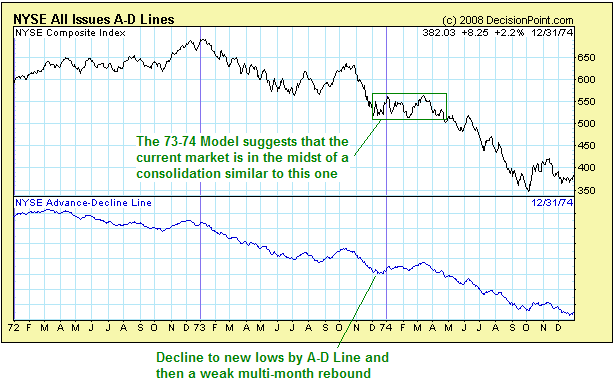
The second of the following charts shows how the NYSE Composite Index
and the NYSE A-D Line performed during 1972-1974. Our view is that the
rebound from the 15th July 2008 interim bottom will prove to be similar
to the bear-market rebound that began in December of 1973. This rebound
will probably encompass at least one test of the July low.
This week's
important US economic events
| Date |
Description |
Monday Sep 01
| US Markets closed for Labor Day
| | Tuesday Sep 02 | ISM Index
Construction Spending
| | Wednesday Sep 03
| Factory Orders
Fed's Beige Book
| | Thursday Sep 04
| ISM Services
Q2 Productivity (revised)
| | Friday Sep 05
| Monthly Employment Report
|
Gold and
the Dollar
Gold and Silver
The "Shortage"
The aboveground stock of gold is so large relative to annual mine
supply and to the amount of metal used each year in
industrial/commercial applications that there can never be a true
shortage of gold. Unlike the situation with commodities that are
consumed, obtaining gold will always be purely a question of price. In
other words, if you are prepared to pay enough you will always be able
to obtain plenty of gold. Due to manufacturing limitations you may not
be able to get the gold in a particular form, but you will be able to
get it in some physical form.
It's the same situation with US dollars or any other type of money in
that there can never really be a shortage of money. For example, if the
Fed freezes the supply of US dollars at its current level then the
purchasing power of the dollar will begin to trend upward, but there
will always be enough dollars to satisfy the requirements of the
economy. A perceived shortage of money can develop during periods when
prices rise faster than the supply of money, but this is because people
are anticipating future inflation. That is, the perception of a
shortage can arise when the anticipated effects of future money-supply
growth get factored into today's prices. Such a shortage can, however,
be addressed by STOPPING the printing presses.
The claim that the modern "dynamic" economy requires a flexible money
supply -- meaning a money supply that can be ramped up at will -- is
just propaganda designed to hoodwink the masses. In reality, the more
constant the money the better for the economy. The reason is that when
money does not get created 'out of thin air' all price signals will be
genuine (undistorted by inflation) and there will be a greater chance
of people making the correct business decisions.
Gold is no longer money, but due to its supply/demand characteristics
it should be analysed as if it were. As is the case with money, the
purchasing power of gold will adjust to account for any amount of
supply.
While a genuine shortage of gold is not possible, as mentioned above it
is certainly possible for there to be a shortage of gold in a
particular type of manufactured form. For example, such a shortage
could develop if manufacturers were unable to convert gold from bar
form to coin form fast enough to meet the public's demand for gold
coins.
There has not been any shortage of gold in the world over the past few
weeks, but the demand for some types of gold coin has been greater than
could be immediately satisfied by various mints. For example, the US
Mint was recently unable to fill orders for 1-ounce gold coins because
it encountered more demand for these coins than had been anticipated.
The question is whether increasing demand for gold coins on the part of
the general public in parallel with a declining gold price should be
construed bullishly. As discussed in our 25th August commentary: we
think not. If it is anything it is a BEARISH sentiment divergence.
The following sharelynx.com
chart entitled "US Mint Gold Coin Sales" was sent to us by one of our
readers. The chart does not provide conclusive evidence regarding the
relationship between the US public's demand for gold coins and the gold
price, but it does support our view that the recent high level of
demand for certain types of gold coin should not be construed
bullishly. For example, the public's demand for gold coins was very
high during the Asian debt crisis of 1997-1998, peaking along with the
financial crisis in October of 1998. This was also an intermediate-term
PEAK for the gold price. The public's demand for gold coins then
collapsed and was almost non-existent when the long-term gold bull
market began in 2000. Also, the early-2003 peak in the public's demand
for gold coins, which was most likely prompted by anticipation of the
Iraq War, occurred just prior to a quick 20% fall in the gold price. On
other hand, the late-1992 peak in coin sales occurred near an
intermediate-term LOW in the gold price.

It is almost
axiomatic that the peak in the public's demand for an investment will
roughly coincide with the peak in the investment's price. It has to be
this way because it is the surge in the public's enthusiasm for an
investment that leads to the massive over-valuation that sets the stage
for the ensuing bear market. We are, of course, aware that the public
was aggressively selling gold and silver artifacts at the January-1980
peak in the precious metals, but we don't think this negates the
previous sentence because most of the things that were being sold by
the public -- silver cutlery and trinkets, for instance -- weren't
purchased as investments. We don't have the data, but our guess is that
the public's demand for gold/silver INVESTMENTS (such as coins) either
peaked in line with the January-1980 price peak or during the 2-year
period following the major price peak.
Having said all that, we aren't very concerned about the public's
recent enthusiasm for some types of gold coins because the message
being sent by other sentiment indicators is that the public is now LESS
bullish on gold than it has been at any time over the past three years.
Current Market Situation
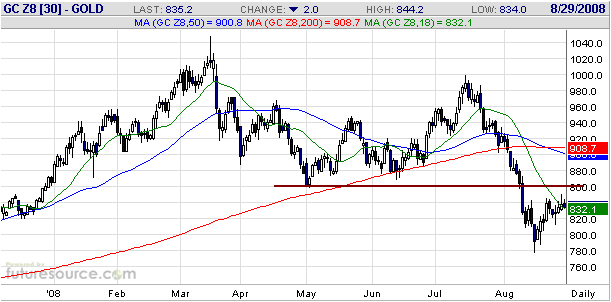
The following daily chart shows that December gold is poised just below resistance at $860.
Regardless of whether the recent up-move proves to be the start of a
new intermediate-term advance or a counter-trend rebound within an
on-going correction, it's reasonable to expect that gold will make some
additional upward progress -- most likely moving beyond the resistance
at $860 -- during the next couple of weeks.
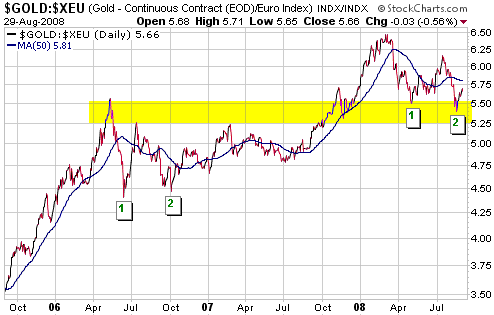
In euro terms the
gold price appears to be following a similar path to the one it
followed during the 2006 correction, the main difference being that in
2006 the second low of the correction was above the initial low whereas
during the current correction the second low was slightly under the
initial low. The situation is depicted below.
We will be very surprised if the euro-denominated gold price breaks below its August low.
Gold Stocks
The gold sector, as represented by the AMEX Gold BUGS Index (HUI), has
consolidated between 340 and 355 over the past 6 trading days.
Consolidations within short-term trends often last 5-8 trading days, so
if the short-term trend has turned up then the HUI should break above
the top of the aforementioned range within the first three days of this
week. As noted in a previous commentary, it is likely that the HUI will
work its way back to around 380 in the near future regardless of
whether or not the overall correction has come to an end.
Over the past ten years there has been a strong tendency for important
turning points in the gold sector to occur during May-June and
October-November. There has recently been a deviation from this
cyclical tendency in that the most important low of 2007 occurred in
August and another important low has potentially been put in place this
August, but last year's October-November cycle still provided an
important turning point (the HUI reversed downward in early November of
2007) and there is a reasonable chance that some sort of extreme (an
important high or low) will occur during October-November of this year.
Based on what we expect to happen in other markets we think an
October-November low is the more likely outcome. Moreover, while an
October-November low would be more bearish on a short-term basis it
would be more bullish on an intermediate-term basis. The reason is that
lows during this turning-point window are generally followed by strong
multi-month rallies whereas highs are generally followed by multi-month
declines. The decline from the November-2007 peak lasted only 6 weeks,
but in some important respects -- most notably the number of gold
stocks that participated -- the subsequent advance to the March-2008
peak was more like a rebound within an intermediate-term downward trend
than a continuation of the August-November-2007 upward trend.
On the following daily HUI chart we've drawn what we perceive to be the
two most likely scenarios, with the blue line based on the assumption
that there will be an important low during October-November of 2008 and
the red line based on the assumption of an October-November high. Under
the "Blue Scenario" the gold sector would be expected to make a
short-term peak during the first half of September and then decline to
an October or November low, after which a major upward trend would
commence. Under the "Red Scenario" the gold sector would maintain an
upward bias into October-November of 2008 and then trend lower for many
months, most likely reaching its ultimate correction low during the
second quarter of 2009.
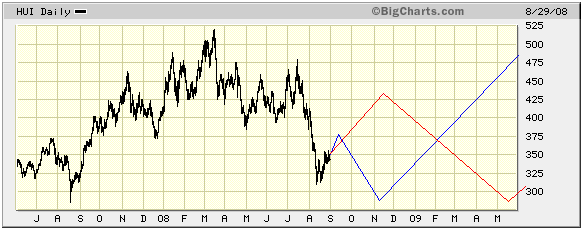
Our current plan is
to exit most short-term trading positions if the HUI moves up to around
380 over the coming fortnight, leaving our much larger longer-term
exposure essentially untouched. If the "Blue Scenario" plays out we
will then look to re-establish short-term positions during
October-November. On the other hand, if the "Red Scenario" plays out we
will reduce our long-term exposure and/or buy some insurance in the
form of put options during October-November.
Currency Market Update
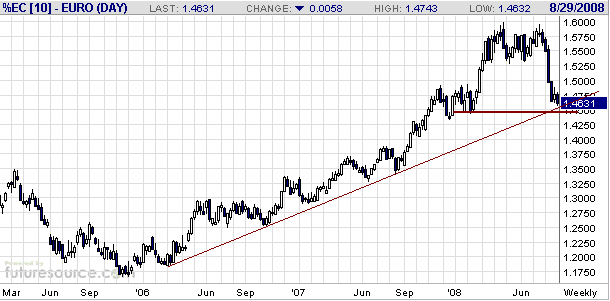
The following weekly euro futures chart shows that there is a
confluence of support at around 1.45. As noted in a recent commentary,
this is a likely area for the euro's INITIAL decline to bottom out.
We remain short- and intermediate-term bearish on the euro, but think
it's likely that a quick rebound to the low-1.50s will soon begin. We
are not interested in buying the euro in anticipation of such a
rebound, but we will consider selling the euro -- or buying euro put
options or making some other form of bearish bet -- if it rises to
around 1.52 at some point over the next few weeks.
Update
on Stock Selections
(Note: To review the complete list of current TSI stock selections, logon at http://www.speculative-investor.com/new/market_logon.asp
and then click on "Stock Selections" in the menu. When at the Stock
Selections page, click on a stock's symbol to bring-up an archive of our comments on the stock in question)
 Gryphon Gold (TSX: GGN). Shares: 62M issued, 80M fully diluted. Recent price: C$0.295 Gryphon Gold (TSX: GGN). Shares: 62M issued, 80M fully diluted. Recent price: C$0.295
We think it's wise at this time to direct most new buying within the
gold/silver sector to the mid-tiers and majors because these are the
stocks that will likely rebound the quickest during the early stages of
a new upward trend. We are referring, in particular, to stocks such as
RGLD, SLW, HL, NGD and GFI. However, the juniors should not be totally
ignored because the current lack of liquidity amongst the more
speculative gold and silver stocks is creating phenomenal bargains. In
fact, it would be an understatement to say that we have been surprised
by how cheap some of the small exploration- and development-stage
stocks have become. With very little new buying coming into these
stocks, even small increases in selling pressure are resulting in
sizeable price declines.
We highlighted the absurd under-valuations of ADM.V, FVI.V, KGN.V and
SBB.V in the 20th August Interim Update and will now take a quick look
at GGN.TO.
GGN has a gold resource of around 2.5M ounces at its Borealis project
in Nevada. This means that at Friday's closing price of C$0.295, GGN
was being valued by the stock market at around US$7 per ounce of
gold-in-the-ground. Such a low valuation would not be unreasonable if
there were no chance of GGN's gold ever being profitably mined, but
based on information provided to date there is a good chance that GGN
will be able to make the transition to a profitable gold producer.
More information is due to be provided in the near future.
Specifically, the company noted in its 22nd August press release that: "The
independent NI 43-101-compliant preliminary assessment study
establishing the economic potential for a heap leach mine from
Gryphon's 700,000-ounce oxide gold resources, as well as the NI
43-101-compliant independent scoping study affirming the longer-term
opportunity for mining from Gryphon's 1.8-million-ounce sulphide gold
resources, are scheduled for release in early September."
Many of the low-priced Canadian juniors will be hit by tax-loss selling
in December, but even so it's likely that some of them are bottoming
now. If the information scheduled to be provided by GGN in early
September confirms the economic viability of its gold project then
there's a good chance that this particular stock will make a higher low
in December.
Geovic Mining Corp. (TSX: GMC). Shares: 101M issued, 134M fully diluted. Recent price: C$1.04
GMC's stock price has recently been very weak in response to the
general lack of interest in junior mining stocks and a sharp decline in
the price of cobalt (GMC's main asset is its 60% stake in the
development-stage Nkamouna cobalt mine in Cameroon). It should be
noted, however, that the projected economics of GMC's mine are very
robust at the current cobalt price of $33/pound. In particular, the
Feasibility Study completed late last year showed that the Nkamouna
project would have an after-tax net present value of US$695M at a
cobalt price of only $20/pound. This suggests that GMC's 60% stake in
the project is worth more than US$400M even allowing for a further 30%
decline in the cobalt price, which compares rather favourably with the
company's current market cap of around $100M.
Also of importance is that GMC has about $66M of cash in the bank. As a
result, the company probably won't have to issue much new equity to
fund its share of Nkamouna's construction.
Although the primary focus of most investors should remain on gold and
silver at this time, it would be reasonable to accumulate some GMC near
its current low price.
Chart Sources
Charts appearing in today's commentary
are courtesy of:
http://stockcharts.com/index.html
http://www.futuresource.com/
http://www.decisionpoint.com/

|