|
-- Weekly Market Update for the Week Commencing 1st October 2007
Big Picture
View
Here is a summary of our big picture
view of the markets. Note that our short-term views may differ from our
big picture view.
Bonds commenced a secular BEAR market in
June of 2003. (Last
update: 22 August 2005)
The stock market, as represented by the S&P500 Index, commenced a secular BEAR market during the first quarter of 2000. The rally
that
began in October of 2002 will end during the first half of 2007. The ultimate bottom of
the secular bear market won't occur until the next decade. (Last update: 02 October 2006)
The Dollar commenced a secular BEAR market during the final quarter of 2000. The
first major downward leg in this bear market ended during the first
quarter of 2005, but a long-term bottom won't occur until 2008-2010. (Last update: 28 March 2005)
Gold commenced a
secular bull market relative to all fiat currencies, the CRB Index,
bonds and most stock market indices during 1999-2001. The first major
upward leg in this secular bull market ended in December of 2003, but a
long-term peak won't occur until at least 2008-2010. (Last update: 13
February 2006)
Commodities, as
represented
by the CRB Index, commenced a secular BULL market in 2001. The first
major upward leg in this bull market ended during the second quarter of
2006, but a long-term
peak won't occur until at least 2008-2010. (Last update: 08 January 2007)
Copyright
Reminder
The commentaries that appear at TSI
may not be distributed, in full or in part, without our written permission.
In particular, please note that the posting of extracts from TSI commentaries
at other web sites or providing links to TSI commentaries at other web
sites (for example, at discussion boards) without our written permission
is prohibited.
We reserve the right to immediately
terminate the subscription of any TSI subscriber who distributes the TSI
commentaries without our written permission.
Outlook Summary
Market
|
Short-Term
(0-3 month)
|
Intermediate-Term
(3-12 month)
|
Long-Term
(1-5 Year)
|
Gold
|
Bearish
(07-Sep-07)
|
Neutral
(15-Aug-07)
|
Bullish
|
US$ (Dollar Index)
|
Bullish
(11-Jun-07)
| Bullish
(31-May-04)
|
Neutral
(19-Sep-07)
|
Bonds (US T-Bond)
|
Neutral
(10-Sep-07)
|
Neutral
(23-Jul-07)
|
Bearish
|
Stock Market (S&P500)
|
Bearish
(27-Aug-07)
|
Neutral
(26-Mar-07)
|
Bearish
|
Gold Stocks (HUI)
|
Bearish
(03-Sep-07)
|
Neutral
(15-Aug-07)
|
Bullish
|
| Oil | Bearish
(23-July-07)
| Neutral
(25-Sep-06)
| Bullish
|
Industrial Metals (GYX)
| Bearish
(11-Jun-07)
| Bearish
(09-July-07)
| Bullish
|
Notes:
1. In those cases where we have been able to identify the commentary in
which the most recent outlook change occurred we've put the date of the
commentary below the current outlook.
2. "Neutral", in the above table, means that we either don't have a
firm opinion on which way the market will move or that we expect the
market to be trendless during the timeframe in question.
3. Long-term views are determined almost completely by fundamentals,
intermediate-term views by giving an approximately equal weighting to
fundmental and technical factors, and short-term views almost
completely by technicals.
Bonds
Why aren't bond yields soaring?
Currently we have:
a) Gold and oil prices at multi-decade highs
b) The prices of agricultural commodities near multi-decade highs
c) The senior US stock indices at or near multi-year highs
d) Some other stock markets at all-time highs and in parabolic upward trends thanks to rapid money-supply growth
e) Blatant evidence of an inflation problem just about everywhere
f) Foreign central banks becoming net sellers of US Treasury debt
And yet, US Government bond yields remain within the bottom third of
their 2-year range. The question, then, is: given the abundant evidence
of an inflation problem and the recent lack of demand for US Treasury
debt from foreign central banks, why aren't US T-Bond yields soaring?
We don't have a satisfactory explanation for the ability of the bond
market to hold up as well as it has over the past month. The bond
market's performance would make sense if the Fed had been aggressively
buying bonds with newly-created dollars, but the Fed's balance sheet
tells us that this hasn't been happening.
The only thing we can think of is that the debt crisis has prompted
many of the investors (individuals, funds and institutions) that must
own debt securities for income purposes to shift from higher-risk to
lower-risk securities, and that this shift in investment demand has
been sufficient to keep T-Bond yields from responding to the obvious
inflation threat. These investors, as a group, may well recognise that
a US T-Bond yielding 4.8% is not a good deal, but at the moment they
are more concerned about return OF capital than return ON capital.
Current Market Situation
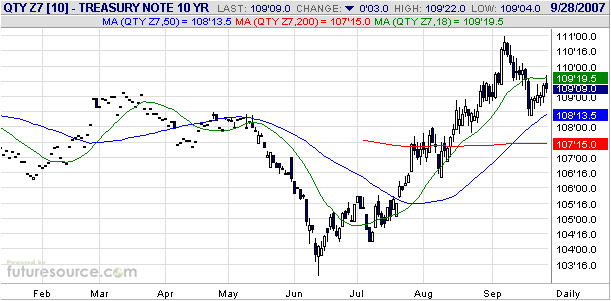
The following daily chart shows the performance of the December T-Note futures contract over the past several months.
T-Note futures were predictably firm during June-August and have pulled
back during September. The surprise is that they haven't pulled back
more sharply over the past few weeks given what has been happening in
the commodity and equity markets, but the fact that they have held up
so well in the face of a blatantly -- at least on the surface --
unfriendly environment means that they will probably move to new highs
for the year during the next multi-week equity/commodity correction.
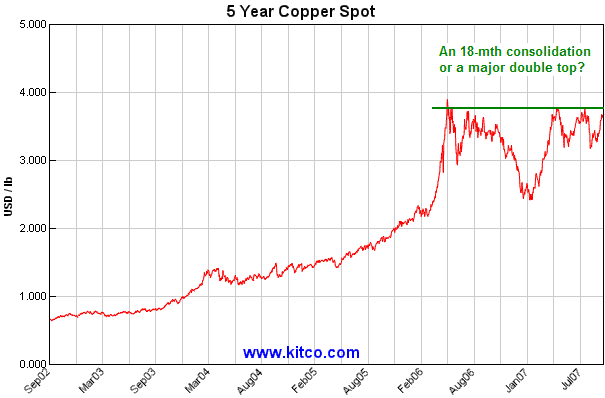
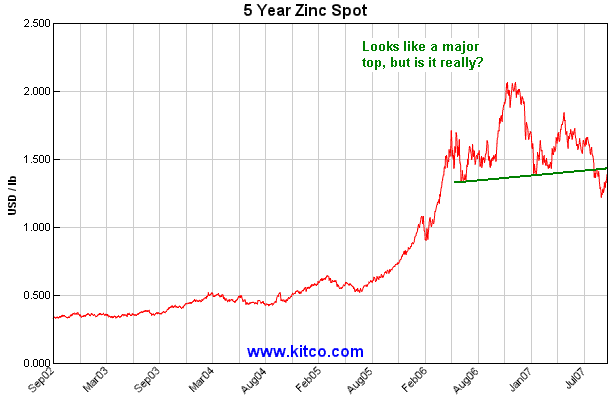
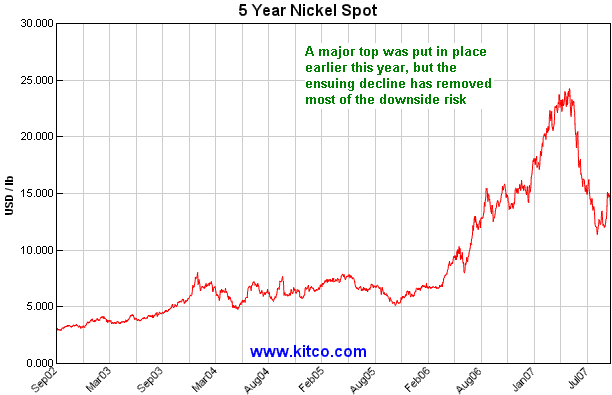
Some quick thoughts on base metals
Analysing
base metals as a group has been problematic over the past two years
because different base metals have regularly had very different chart
patterns and supply/demand situations. Take, for example, the three
charts displayed below.
The first chart shows that copper remains near its highs of the past
two years and could be about to complete a major double top OR end an
18-month consolidation via an upside breakout (we are operating on the
basis that the former is the more likely outcome, but we will be quick
to change tack if the market breaks out to the upside).
In contrast to the copper chart, the second of the following charts
shows that zinc confirmed a major top when it broke-out to the downside
a little over two months ago. However, zinc's bearish price chart
conflicts with the fact that the amount of zinc in LME warehouses just
dropped to an all-time low. The market is clearly anticipating a
meaningful increase in supply relative to demand, but if the
anticipated supply/demand change doesn't happen very soon then zinc's
downside breakout will prove to have been a 'fakeout'.
Lastly, whereas the copper chart potentially shows a major top in the
making and the zinc chart reveals a recent breakout to the downside,
the third of the following charts suggests that a major price
correction in the nickel market might have already run its course.
The Stock
Market
Current Market Situation
Due to what has happened in previous Octobers the arrival of the month
of October generally coincides with a marked increase in the number of
crash forecasts. However, the senior US stock indices have gained
enough ground over the past few weeks to suggest that the 16th August
lows will not be seriously challenged over the remainder of this year.
A sizeable pullback looks likely and this pullback in the broad market
could result in some market sectors -- the financial sector, for
instance -- dropping to new lows for the year, but we suspect that the
S&P500 and the NASDAQ100 will do no worse than retrace about half
the gains made since August's panic low.
Japan
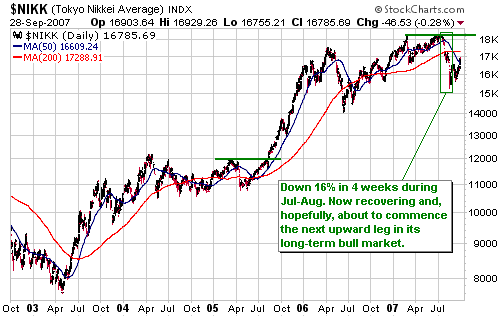
Japan's stock market, as represented by the Nikkei225 Index, fell 16%
from its July peak to its August low. It has therefore already
experienced a mini crash this year and is currently in recovery mode.
On a longer-term basis it is still in the relatively early stages of
the secular bull market that commenced in April of 2003, but has
under-performed most other stock markets since April of 2006.
The Japanese stock
market's relatively poor performance over the past 18 months probably
has a lot to do with monetary policies that unwittingly tend to drive
investment away from the Yen and away from Japan. However, the
long-term bull market should continue despite the best efforts of
Japanese policy-makers.
Not everything on the Japanese policy front is negative, though, in
that the first phase in the privatisation of Japan's postal system --
the world's largest depository of savings -- occurs this week (refer to
http://biz.yahoo.com/ap/070929/japan_postal_privatization.html?.v=4
for further details). The privatisation plan, which was put in place by
former Prime Minister Koizumi, should have a significant positive
effect on Japan's economy over the coming years by paving the way for
the more efficient allocation of investment.
We continue to believe that that longer-term investors should build up
exposure to the Japanese stock market via EWJ, JEQ and JOF. Most
accumulation should be done on weakness, but we'd wait for a breakout
to new multi-year highs by EWJ before making the final one-third
commitment to this market.
This week's
important US economic events
| Date |
Description |
Monday Oct 01
| ISM Index
|
| Tuesday Oct 02 | No important events scheduled
| | Wednesday Oct 03
| ISM Services
| | Thursday Oct 04
| Factory Orders
| | Friday Oct 05
| Monthly Employment Report
Consumer Credit
|
Gold and
the Dollar
Currency Market Update
The currency market is in the driver's seat
We've addressed, ad nauseam, the important role of Yen weakness in the
elevation of asset and debt prices throughout the world. We haven't,
however, devoted much space to the similar role played by US$ weakness.
Despite the fact that US$ weakness is often cited in support of bearish
stock market views, the evidence strongly suggests that most stock
markets and stock market sectors are being helped, rather than hurt, by
dollar weakness.
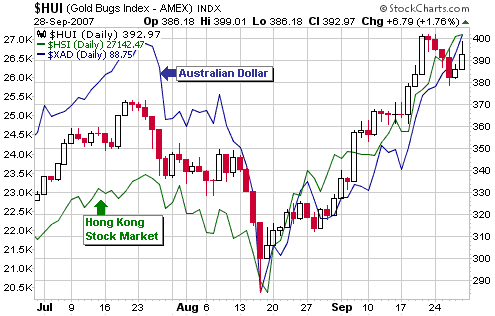
To illustrate this point we've included, below, a short-term chart
comparing the performances of the HUI, the Hong Kong stock market (as
represented by the Hang Seng Index) and the Australian Dollar. Notice
the very strong positive correlations between these three markets.
Clearly, strength in the US$ relative to the A$ between mid July and
mid August went with pronounced weakness in equities of all
descriptions, whereas the subsequent weakness in the US$ relative to
the A$ has gone with a huge rally across a broad range of equities.
If the speed of the
US dollar's decline went from gradual to rapid then the resultant
equity market strength would almost certainly become far more
selective, but a rapid US$ decline relative to other fiat currencies
does not have a realistic chance of happening. This is because the US$
is very oversold and very under-valued relative to most of the other
major fiat currencies. In addition, foreign central banks would not
want their currencies to strengthen rapidly against the US$ and would
take steps to prevent this from happening.
The two realistic possibilities are that the dollar continues its slow
water-torture-style decline over the next few months, interrupted only
by the occasional weak rebound, or that the dollar embarks on an
intermediate-term advance. In the former case the markets and sectors
that had been particularly strong since mid August would probably
continue to trend upward, while in the latter case there would probably
be a market-wide shakeout followed by a shift in relative strength away
from commodity-related equities and Asia (ex-Japan).
Current Market Situation
We expect that the Dollar Index will be significantly higher two months
from now and a lot higher eight months from now, but at this time we
can see no evidence that a bottom is already in place. The Dollar Index
obviously closed at a new low on Friday, but more importantly the gold
price and the Baltic Dry Index both closed at new highs. In other
words, prices that tend to move up in ANTICIPATION of additional dollar
weakness are still making new highs.
A dollar reversal could come at any time, but there's no way to predict
exactly when. It could happen this week, but, on the other hand,
speculative selling could pressure it lower for a short while longer.
Gold and Gold Stocks
A Commitments of Traders (COT) extreme to be reckoned with
The Commercial net-short position in COMEX gold futures was 208K
contracts as at Tuesday 25th September (the cut-off date for the latest
COT report), which roughly matches the all-time high reached in early
October of 2005. This Commercial net-short position is, of course,
balanced by an equally large speculative net-long position.
Although it reveals unbridled optimism on the part of speculators in
gold futures, the current COT situation is not a reason, in and of
itself, to expect anything more than a routine pullback in the gold
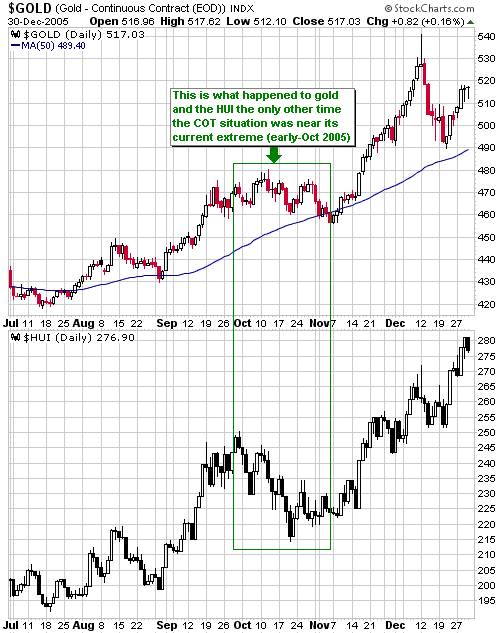
price. That this is the case becomes evident when we look at the
following chart showing the performances of gold and gold stocks (as
represented by the HUI) during the second half of 2005. Note, in
particular, that after the Commercial net-short position peaked in
early October of 2005 the gold market began to work its way back
towards its 50-day moving average. Following a test of this moving
average in early November, another strong rally got underway. Also
note, though, that the HUI peaked almost two weeks prior to gold
bullion and experienced a more substantial correction. Specifically, a
5% correction in gold was accompanied by a 14% correction in the HUI.
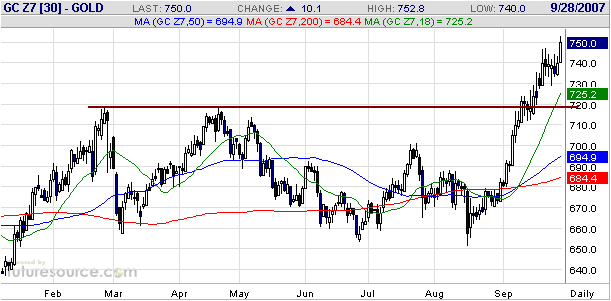
With reference to the
following daily chart, the 50-day moving average for the December gold
futures contract is currently at $695. However, it is rising and four
weeks from now will probably be around $710. A 5% pullback to around
$710 over the next few weeks would therefore be consistent with what
happened the only other time the COT situation was roughly the same as
it is today.
If the HUI also mimicked its performance following the Oct-2005 COT
extreme then it would drop back to the mid-340s over the coming few
weeks. Furthermore, a 5% pullback in gold combined with a 14% pullback
in the HUI would satisfy the requirement, discussed over the past week,
for the HUI/gold ratio to trade at least a few percent below its 40-day
moving average in order to create a short-term bottom.
The main risk for gold isn't the COT; it's the dollar
One of the big differences between the current situation and the
situation in early October of 2005 is that in October of 2005 the US$
had been trending upward for 9 months and was close to an
intermediate-term peak, whereas the US$ is currently (in our opinion)
at the tail-end of an intermediate-term decline. Putting it another
way, the US$ has considerably more upside potential now than it had in
October of 2005. In fact, we think the US dollar can currently be
likened to a beach-ball that is getting pushed further and further
underwater. The pressure being applied by speculative selling may
continue to force it lower in the very short-term, but at some point in
the not-too-distant future it will catapult upward.
We therefore continue to perceive significant downside risk for gold
and substantial downside risk for gold stocks associated with a US$
recovery.
The downside risk for gold stocks is much greater than the downside
risk for gold bullion, for two reasons. First, the gold-stock indices
recently became extremely 'overbought' relative to gold bullion.
Second, US$ weakness has been one of the propellants of the global
stock market rally, so the initial phase of the US dollar's next upward
trend will probably be associated with parallel declines in the gold
market and the broad stock market. This, in turn, will result in gold
stocks being simultaneously hit from two directions.
That being said, it is quite possible that the dollar will undergo a
2-3 month bottoming process rather than a 'V reversal'. For example,
rather than commencing an upward trend and not looking back until after
it has gained a lot of ground, a bottom for the dollar could entail an
initial rebound and then a pullback to test the low prior to the start
of a large rally. If it happens like this then some of the markets that
have been feeding off US$ weakness over the past year could make new
highs during the dollar's pullback to test its low.
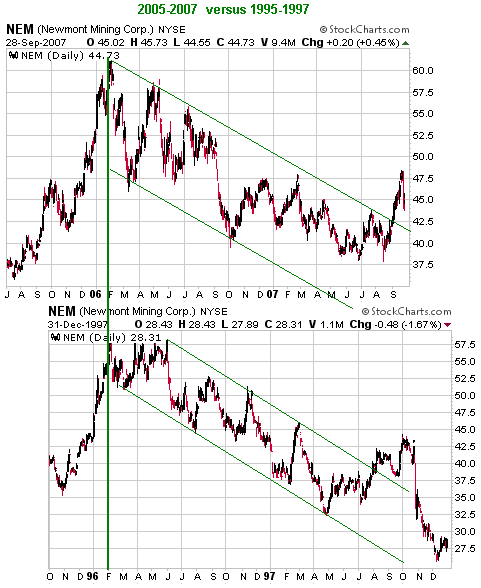
The same stock and the same chart pattern, 10 years apart
In one of the recent editions of his daily report
Kevin Klombies showed an intriguing chart comparing the performance of
Newmont Mining (NEM) during 1995-1997 with its performance during
2005-2007; so intriguing, in fact, that we decided to steal the idea
(Kevin hopefully won't mind) and present a similar chart-based
comparison herewith.
The top section of the following chart shows what NEM did over the
27-month period ending last Friday while the bottom section of the
chart shows what it did over an equivalent-length period during
1995-1997. The two chart sections have been positioned so that the
late-January peak of 2006 lines up with the late-January peak of 1996.
Notice that NEM trended lower within a well-defined channel from
January of 1996 until the third quarter of 1997, at which time it broke
out to the upside. It then pushed upward into the final week of
September-1997, when it abruptly reversed course and entered a steep
downward trend. Notice also that NEM trended lower within a
well-defined channel from January of 2006 until the third quarter of
2007, at which time it broke out to the upside. It then pushed upward
into the final week of September-2007 before reversing course.
Obviously, it is yet to be seen whether last week's downturn was the
start of a large decline or simply a routine pullback within an
on-going advance.
The above is
interesting, but comparisons such as these should always be viewed with
a sceptical eye because there are usually enough differences between
the current period and any prior period to create different twists and
turns in the financial markets. In many respects, for example, the
fundamental backdrop today could hardly be more different to what it
was in October of 1997.
As we've said before, the short-term key is the US dollar. IF the
dollar soon commences a strong multi-month rally then the 1997 analogy
has merit and NEM will probably trade at new multi-year lows within the
next few months. This is the risk being taken by those who are betting
the farm on a continuation of the gold sector's upward trend. On the
other hand, if the dollar continues to grind lower then every pullback
in the gold sector will probably be followed by a move to new highs.
Before leaving the 1997 comparison we'll highlight the fact that NEM's
stock price is roughly the same now as it was 10 years ago. However, 10
years ago the gold price was only $335, versus today's level of around
$740. In other words, since the end of September-1997 NEM has gone
nowhere while the gold price has gained about 120%.
NEM's performance over the past 10 years supports our view that the
major gold stocks are NOT leveraged plays on gold over the long haul.
There will be periods when gold stocks offer excellent leverage to
upside in the gold price, particularly those periods when gold is
trending higher relative to other commodities; but long-term investors
should favour the bullion over the stocks of gold producers.
Outlook
Gold bullion ended last week at a new multi-decade high while the HUI
finished the week about 2% below its 11th May-2006 and 21st
September-2007 peaks. This is a bearish divergence because the stocks
typically lead the metal at important turning points, although it
clearly wouldn't take much additional strength from here in the
gold-stock indices to eliminated the divergence.
Regardless of whether the HUI is in the process of completing a major
double top or is immersed in an intermediate-term upward trend that
will take it much higher over the coming months, a sizeable pullback is
likely to occur over the next few weeks. As previously advised, history
tells us to expect the HUI/gold ratio to trade at least a few percent
below its 40-day moving average prior to the next short-term bottom. If
this happens over the next few weeks and gold concurrently pulls back
by around 5% then the HUI will drop to the 340s.
The sort of pullback described above is the most likely short-term
outcome even if the overall upward trend is going to remain intact.
The risk is that a top of longer-term significance is currently being
put in place. This possibility doesn't mesh with the current
fundamental backdrop and is therefore not the most likely
intermediate-term outcome, but the fundamentals could change and
therefore need to be continually re-assessed. The main fundamental
drivers of the gold price are credit/yield spreads, nominal interest
rates, inflation expectations (the expected rate of purchasing-power
loss), and currency exchange rates. Note that the combination of the
nominal interest rate and the expected rate of purchasing-power loss
creates the real interest rate.
We reacted to last Friday morning's surge in the gold sector by taking
more profits in a stock that had run-up a lot over the preceding few
weeks, but we didn't want to reduce our overall exposure to the sector
(our cash reserve was already large enough) so we also did some buying
of a gold stock that, despite being a highly leveraged play on gold,
had done very little since the August bottom. The stock in question is
the new addition to the TSI Stocks List discussed below.
Update
on Stock Selections
(Note: To review the complete list of current TSI stock selections, logon at http://www.speculative-investor.com/new/market_logon.asp
and then click on "Stock Selections" in the menu. When at the Stock
Selections page, click on a stock's symbol to bring-up an archive of our comments on the stock in question)
 New stock selection: Gold Reserve (AMEX: GRZ). Shares: 55M issued, 58M fully diluted. Recent price: US$4.38 New stock selection: Gold Reserve (AMEX: GRZ). Shares: 55M issued, 58M fully diluted. Recent price: US$4.38
GRZ owns the development-stage Brisas gold project in Venezuela. Brisas
contains 10.4M ounces of low-grade (0.67 gpt) gold in the "proven and
probable" reserve category and adjoins the larger/higher-grade Las
Cristinas deposit owned by Crystallex (AMEX: KRY). Despite its low
grade, Brisas is expected to have a total production cost per ounce of
only around US$250 thanks to its by-product copper production.
GRZ's in-ground gold is currently being valued by the stock market at
an extraordinarily low US$23 per proven-and-probable ounce. This low
valuation is largely due to the high country-related risk, but the
country risk is no higher today than it was when the stock was trading
above US$9 in May of 2006 or when it was trading above US$7 in April of
this year. As illustrated by the following, this highly leveraged play
on gold is presently languishing near its lows of the past 18 months
despite the recent strong gains in the gold price.
We don't want to minimise the country risk because there are few
countries in the world that are less secure, from a property rights
perspective, than Venezuela. However, it is very unlikely that Hugo
Chavez will threaten the rights of GRZ/KRY shareholders at this early
stage of project development. As far as we can tell, the main political
risk hanging over both GRZ and KRY at this time is that there will be
additional delays in the issuing of the government permits required to
enable the projects to be fully developed. Note that GRZ received
something called an "Authorization to Affect" in March of 2007, but
while enabling the commencement of certain infrastructure work this
does not constitute government approval for the company to construct
the mill and exploit the mineralization at Brisas.
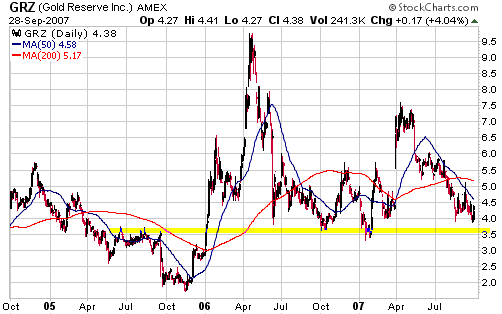
Despite the political
risk, GRZ is the sort of stock that will probably rocket upward if a
sector-wide pullback over the next few weeks is followed by a rally to
new highs. At the same time, the downside risk is partially mitigated
by the extremely low valuation.
Our suggestion is to take an initial position now and add during an
October pullback. The stock will hopefully drop back to around US$4.00
over the coming weeks, but it is reasonable to take an initial position
now to obtain some exposure in case the anticipated pullback fails to
materialise.
Chart Sources
Charts appearing in today's commentary
are courtesy of:
http://stockcharts.com/index.html
http://www.futuresource.com/
http://www.kitco.com/

|