|
-- Weekly Market Update for the Week Commencing 1st November 2010
Big Picture
View
Here is a summary of our big picture
view of the markets. Note that our short-term views may differ from our
big picture view.
In nominal dollar terms, the BULL market in US Treasury Bonds
that began in the early 1980s will end by mid-2010. In real (gold)
terms, bonds commenced a secular BEAR market in 2001 that will continue
until 2014-2020. (Last
update: 09 February 2009)
The stock market, as represented by the S&P500 Index, commenced
a secular BEAR market during the first quarter of 2000, where "secular
bear market" is defined as a long-term downward trend in valuations
(P/E ratios, etc.) and gold-denominated prices. This secular trend will bottom sometime between 2014 and 2020. (Last update: 22 October 2007)
A secular BEAR market in the Dollar
began during the final quarter of 2000 and ended in July of 2008. This
secular bear market will be followed by a multi-year period of range
trading. (Last
update: 09 February 2009)
Gold commenced a
secular bull market relative to all fiat currencies, the CRB Index,
bonds and most stock market indices during 1999-2001. This secular trend will peak sometime between 2014 and 2020. (Last update: 22 October 2007)
Commodities,
as represented by the Continuous Commodity Index (CCI), commenced a
secular BULL market in 2001 in nominal dollar terms. The first major
upward leg in this bull market ended during the first half of 2008, but
a long-term peak won't occur until 2014-2020. In real (gold) terms,
commodities commenced a secular BEAR market in 2001 that will continue
until 2014-2020. (Last
update: 09 February 2009)
Copyright
Reminder
The commentaries that appear at TSI
may not be distributed, in full or in part, without our written permission.
In particular, please note that the posting of extracts from TSI commentaries
at other web sites or providing links to TSI commentaries at other web
sites (for example, at discussion boards) without our written permission
is prohibited.
We reserve the right to immediately
terminate the subscription of any TSI subscriber who distributes the TSI
commentaries without our written permission.
Outlook Summary
Market
|
Short-Term
(0-3 month)
|
Intermediate-Term
(3-12 month)
|
Long-Term
(1-5 Year)
|
Gold
|
Bullish
(27-Oct-10)
|
Bullish
(12-May-08)
|
Bullish
|
US$ (Dollar Index)
|
Neutral
(01-Sep-10)
| Neutral
(27-Sep-10)
|
Neutral
(19-Sep-07)
|
Bonds (US T-Bond)
|
Neutral
(20-Sep-10)
|
Bearish
(14-Dec-09)
|
Bearish
|
Stock Market (S&P500)
|
Neutral
(01-Sep-10)
|
Bearish
(11-Oct-10)
|
Bearish
|
Gold Stocks (HUI)
|
Bullish
(01-Sep-10)
|
Bullish
(23-Jun-10)
|
Bullish
|
| Oil | Neutral
(01-Sep-10)
| Bearish
(01-Mar-10)
| Bullish
|
Industrial Metals (GYX)
| Neutral
(01-Sep-10)
| Bearish
(25-May-09)
| Neutral
(11-Jan-10)
|
Notes:
1. In those cases where we have been able to identify the commentary in
which the most recent outlook change occurred we've put the date of the
commentary below the current outlook.
2. "Neutral", in the above table, means that we either don't have a
firm opinion or that we think risk and reward are roughly in balance with respect to the timeframe in question.
3. Long-term views are determined almost completely by fundamentals,
intermediate-term views by giving an approximately equal weighting to
fundamental and technical factors, and short-term views almost
completely by technicals.
Interesting quote or fact of the week
A neat summary of what the US government and central bank have accomplished over the past two years:
"...the government seized
Fannie and Freddie, thereby effectively nationalizing a large portion
of the entire US housing market; the Fed nationalized AIG; the treasury
secretary told everybody that he needed $700 billion pronto to patch up
the financial sector or the world would end; the treasury secretary
then proceeded to partially nationalize the US financial sector; the
federal government took over two of the Big Three car companies and
threw traditional creditor rights out the window; the Fed more than
doubled the monetary base in six months' time; the new Obama
administration borrowed almost $800 billion to spend on "stimulus"; the
federal government has taken a giant leap forward to socialized
medicine; and just for kicks, the federal government also banned
offshore drilling (though the rules are yet again undergoing revision)."
- From Robert Murphy's article "Putting Austrian Business-Cycle Theory to the Test"
The above summary leaves out a lot, including the $8000 tax credit and
other subsidies designed to encourage greater spending on houses, the
"Cash For Clunkers" program designed to encourage greater spending on
cars, the push for "Cap and Trade" and other legislation designed to
address the imaginary hobgoblin that was originally known as "Global
Warning" and is now known as "Climate Change", and the altering of
accounting rules that miraculously transformed insolvent, loss-making
banks into highly profitable enterprises. It does, however, paint an
accurate picture of a raging bull market in government interventionism.
If the problem is that you are running in the wrong direction, the solution isn't to run faster
Ramping up government spending will make the economy less productive,
so it should be no surprise to logical economists that the "Keynesian"
response to economic downturns has a very poor record. It should,
however, be a big surprise to Keynesian economists, and yet they never
seem to be surprised by evidence that their policy prescriptions didn't
work as advertised. Instead, they usually claim that the prescriptions
would have worked had they been applied more aggressively.
For example, according to Paul Krugman (today's "poster child" for
Keynesian economics), the huge fiscal and monetary stimulus of
2008-2010 hasn't led to a meaningful rebound in the US economy because
it simply wasn't huge enough. Apparently, the US economy would now be
on much stronger footing if the Fed had created, and the government had
spent, a lot more money.
The Keynesian analysis of post-1990 Japan is another example. Japan has
attempted one stimulus package after another for almost 20 years, in
the process racking up a direct federal government debt that amounts to
200% of GDP. The result of the longest and most concerted modern-day
application of Keynesian economics has been a long period of economic
stagnation, but rather than acknowledge a problem with the underlying
theory the Keynesians tell us that Japanese policy-makers didn't
stimulate enough.
A third example worth mentioning involves the interpretation of what
happened during the Great Depression of the 1930s. In 1939, after about
8 years of what would now be called a Keynesian response by the federal
government to the economic weakness of the time, there were roughly as
many unemployed people in the US as there had been at the 1932
depression trough. But rather than acknowledge the failure of a large
increase in government spending and intervention to generate
sustainable improvement in the economy -- an eminently predictable
failure given that greater government spending generally results in the
less-efficient use of resources and intervention creates uncertainty --
today's advocates of Keynesian-style policies claim that the 1937-1939
return of a full-fledged depression was due to the 1936-1937 reduction
in government/Fed stimulus. In other words, they claim, in effect, that
the depression would never have returned in full force if the
government and the central bank had continued to "stimulate"
indefinitely.
One of the most remarkable things about economics is that failed
theories can remain popular for generations. It seems that if an
economic theory meshes with the goals of the politically powerful then
it will never be completely discredited until its relentless
application helps cause total devastation.
More debt obviously can't help
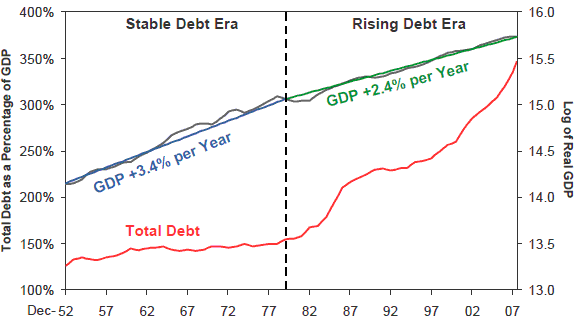
The following chart was extracted from Jeremy Grantham's Q3-2010 Letter.
It shows that the long-term upward trend in the US debt/GDP ratio that
began in the late 1970s has coincided with a long-term slowing in the
rate of GDP growth. The chart doesn't constitute proof that the higher
rate of debt growth CAUSED a slower rate of GDP growth, but it should
give pause to those who believe that encouraging people to take on more
debt is part of the solution.
A big week coming up
During the first three
days of this week the financial markets will have to deal with some
important news events in the form of the US Mid-Term Elections on
Tuesday and a new Federal Reserve policy statement on Wednesday. In
terms of potential short-term effect on the markets, the Fed's policy
statement is by far the more important of these events. The reason is
that the market action of the past two months has been dominated by the
anticipation of QE2, which almost everyone now expects to be introduced
in the statement that follows this week's FOMC meeting.
It seems like only 6 months ago that Bernanke and his cohorts were
discussing their strategy for exiting the ultra-easy monetary stance
that was adopted as a 'temporary' measure in response to the global
financial crisis. Hang on, that was only 6 months ago. And now they are
only a few days away from formally announcing a further easing of their
ultra-easy stance!
How the markets react to Wednesday's announcement by the Fed could be
determined by how they perform during the first half of the week. In
particular, markets that decline on Monday-Tuesday are likely to rally
after the announcement, whereas markets that rally on Monday-Tuesday
are likely to experience PAD (post announcement depression).
The Stock
Market
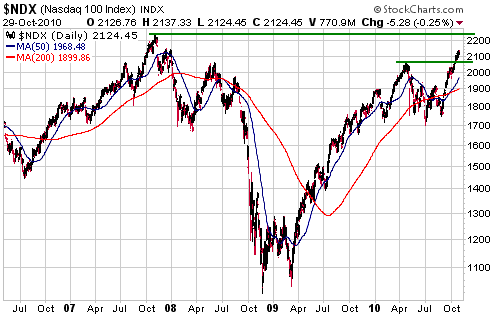
"Economic stimulus" in its
various forms can't possibly help the economy, but it can cause some
prices to rise. For example, the effect of the 2008-2009 stimulus is
clearly evident in the following daily chart of the NASDAQ100 Index
(NDX). The NDX has now recovered almost all of its 2007-2008 losses,
even though the US economy has never really emerged from the recession
that began in 2007.
A 5-10% pullback
could begin at any time, but at this stage there is no evidence that
the stock market's post-November-2008 rally is over. In fact, put/call
ratios suggest that a major top is not yet at hand. In particular, the
10-day moving average of the OEX put/call ratio, an indicator of how
the "smart money" perceives the US stock market's risk/reward, has just
dropped back to near its lows of the past several years. This means
that the "smart money" is now relatively unconcerned about downside
risk. To provide some context, the 2000-2003 and 2007-2008 bear markets
commenced with the 10-day MA of the OEX put/call ratio near a 52-week
high. This year's intermediate-term decline also began with the
aforementioned indicator at a comparatively high level.
Our guess is that a major stock market peak will be put in place within
the next couple of months at not far above current prices, but
sentiment- and price-related evidence of such a peak has not yet
appeared.
This week's
important US economic events
| Date |
Description |
Monday Nov 01
| ISM Manufacturing Index
Personal Income and Spending
Construction Spending
| | Tuesday Nov 02 | Motor Vehicle Sales
Mid-Term Elections
| | Wednesday Nov 03
| FOMC Monetary Policy Statement
Factory Orders
ISM Non-Manufacturing Index
| | Thursday Nov 04
| Q3 Productivity and Costs
| | Friday Nov 05
| Monthly Employment Report
Pending Home Sales
Consumer Credit
|
Gold and
the Dollar
Gold
The faith-based metal
The following note about gold was included towards the end of the
Jeremy Grantham letter that we linked earlier in today's report:
"Everyone asks about
gold. This is the irony: just as Jim Grant tells us (correctly) that we
all have faith-based paper currencies backed by nothing, it is equally
fair to say that gold is a faith-based metal. It pays no dividend,
cannot be eaten, and is mostly used for nothing more useful than
jewelry. I would say that anything of which 75% sits idly and
expensively in bank vaults is, as a measure of value, only one step up
from the Polynesian islands that attached value to certain well-known
large rocks that were traded. But only one step up. I own some
personally, but really more
for amusement and speculation than for serious investing. It may well
work and it may not. In the longer run, I believe that resources in the
ground, forestry, agriculture, common stocks, and even real estate are
more certain to resist any inflation or paper currency crisis than is
gold."
We agree that gold is a faith-based metal, although we don't like the
term "faith-based". It is more appropriate to say that gold's value is
not primarily determined by how much of it gets consumed in industrial,
commercial or digestive processes. Gold is not "mostly used for nothing
more useful than jewelry", as Grantham claims. It is mostly used as a
store of purchasing power. And at a time when there are good reasons to
believe that the official money will be subject to increasingly rapid
inflation, a reliable store of purchasing power is extremely useful.
While it is true that commodities other than gold can be reasonable
stores of purchasing power, gold is best suited to the role. One reason
is that so much of it "sits idly" in vaults. The fact that
industrial/commercial uses account for only a tiny fraction of its
total demand makes gold the only commodity that can be accumulated in
large amounts by investors without adversely affecting the economy.
Of course, the reason there is so much gold sitting idly in vaults is
that gold has proven itself in the past to be extremely useful as a
store of purchasing power. This usefulness relates to its physical
properties. For example, it is much easier and cheaper to transport and
store $10M worth of gold than to transport and store the same dollar
amount of oil or base metals. For another example, diamonds offer the
advantage of being cheap and easy to transport and store, but for many
people diamonds are disqualified as convenient depositories of
purchasing power by their lack of homogeneity (every diamond is
different and it takes an expert to assess the monetary significance of
the differences) and divisibility. The precious metals (gold, silver
and the platinum group metals) are really the only commodities that
have near-ideal physical characteristics to be stores of purchasing
power, but the platinum group metals must be immediately eliminated
from consideration by the fact that all of their supply goes to satisfy
industrial/commercial demand.
Land, especially land that generates an income from the production of
crops, livestock or timber, could turn out to be an excellent store of
purchasing power over the next 10 years, but land has the disadvantage
of being illiquid and immobile. You couldn't, for example, move your
land in order to sidestep an adverse change in the political
environment, and you might not be able to sell it in a hurry.
Common stocks can be good investments if bought at reasonable prices,
but they aren't reliable stores of purchasing power. One reason is that
the real return provided by the shares of a company will largely depend
on the decisions made by the company's management. One wrong decision
by management could wipe out a lot of purchasing power.
In summary, Grantham is correct when he says that gold is a
"faith-based" metal. Like paper currencies, gold has no "intrinsic"
value. Grantham's mistake is assuming that gold's lack of use in
industrial/commercial applications makes gold useless. The reality is
that a reliable, convenient and widely-accepted store of purchasing
power will be very useful at all times, and will deserve a hefty
premium at times when a policy of currency depreciation is being
aggressively pursued by the stewards of the official money.
Current Market Situation
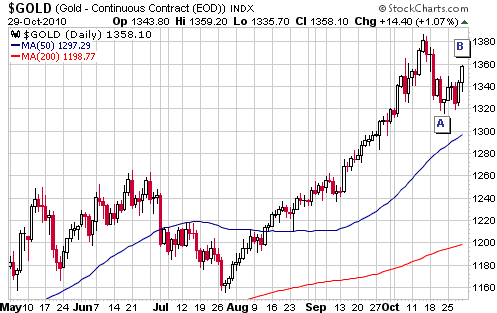
As soon as the US$ gold price began to 'correct' from its early October
peak, the 50-day moving average became a likely near-term target. It is
possible that the correction ended last week at a slightly higher
level, but it is also possible that last week's strength will turn out
to be the 'B' rebound within an A-B-C decline (with the 50-day MA and
lateral support at $1260-$1270 being reasonable targets for the 'C' leg
of the decline). There is no way of knowing.
This week's action
will be dominated by the anticipation of, and the reaction to,
Wednesday's Fed statement. We don't have an opinion on exactly what the
market will do, other than we suspect that a rally during the first
half of the week will be followed by a post-statement pullback and a
decline during the first half of the week will be followed by a
post-statement rally.
Silver Versus Gold
On a long-term basis, silver tends to strengthen relative to gold when
the stock market is trending upward and weaken relative to gold when
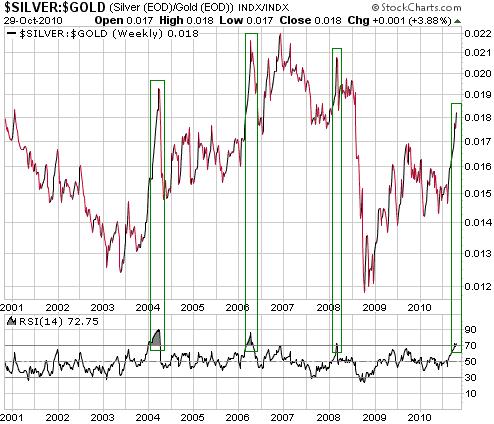
the stock market is trending downward. For example, the silver/gold
ratio weakened in parallel with the 2000-2003 equity bear market,
strengthened in parallel with the 2003-2007 equity bull market, crashed
with the stock market in 2008, and then recovered with the stock market
from October-November of 2008* through to the present. The silver/gold
ratio ended last week at a 2-year high, which makes sense given that
the NASDAQ100 Index, Hong Kong's Hang Seng Index, Brazil's Bovespa
Index and the German DAX Index all made new 2-year highs over the past
three weeks.
The implication is that silver will likely remain strong relative to
gold while the stock market remains in rally mode, but not for much
longer than that. Or, looking at it from another angle, the stock
market will likely remain in rally mode as long as silver remains
strong relative to gold, but not for much longer than that.
The Relative Strength Index (RSI) at the bottom of the following weekly
chart reveals that the silver/gold ratio is now as 'overbought' as it
was at the December-2006 and March-2008 peaks, but is not yet as
'overbought' as it was at the April-2004 and April-2006 peaks. In early
2004 and early 2006 it continued its steep rise for 1-3 months after it
became as 'overbought' as it is right now.
The weekly RSI's message, then, is that the silver/gold ratio could
peak at any time and should peak by January-2011 at the latest.
*Although
the S&P500 and Dow Industrials indices bottomed in March of 2009, a
good argument can be made that stocks bottomed on a global basis along
with the silver/gold ratio in October-November of 2008. The reason is
that October-November of 2008 marked: a) the internal bottom for the
broad US stock market, b) the bottom for the NASDAQ100 Index, c) the
bottoms for several important/leading stock markets around the world,
most notably the Hong Kong, Shanghai and Brazil stock markets.
Gold Stocks
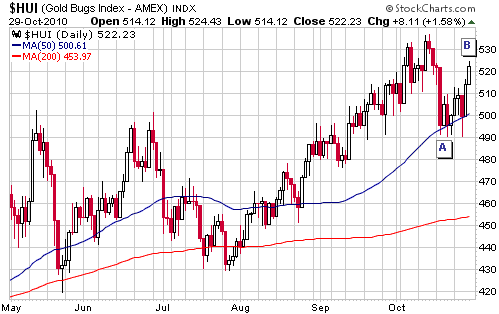
The HUI is in a similar position to gold bullion in that it could have
just completed a short downward correction or it could be about to
complete the 'B' rebound of an A-B-C decline (in which case the 'C' leg
could bottom anywhere from the 480s down to the 450s). As with gold
bullion, there is no way of knowing. There is, however, one significant
difference between the HUI's correction and that of gold bullion, which
is that by dropping back to its 50-day MA the HUI has already achieved
the minimum requirement for a normal correction. The HUI has also
tested lateral support defined by its May-June peaks (the equivalent of
$1260-$1270 for gold bullion).
Currency Market Update
The following daily chart shows that the Swiss Franc (SF) broke
decisively above its March-2008 and November-2009 tops a few weeks ago.
This break above resistance took the SF to a new all-time high. It has
since pulled back to test the former resistance (now support) that lies
just above parity.
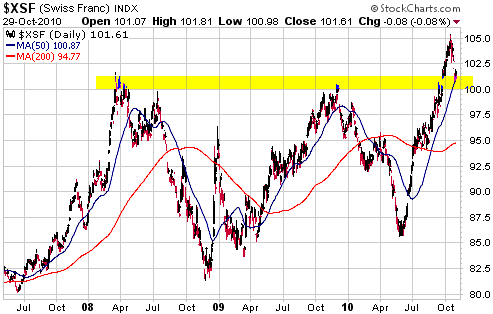
The near-vertical
upward move in the SF from June through to early October reflects the
concerted attempt by the market to factor in a lot of future US$
inflation. This means that for the SF to continue its advance the
market will have to factor in even more US$ inflation than has been
anticipated up to now AND the market will have to believe that the
Swiss central bank will maintain a relatively slow monetary inflation
rate. In our opinion, this makes it unlikely that there will be a
significant extension of the SF's upward trend. For one, it will be
difficult for the Fed to exceed the market's expectations regarding US$
inflation. For another, it is unlikely that the Swiss central bank will
maintain a relatively slow monetary inflation rate if the SF continues
on its upward path.
Our view, then, is that the SF was at or close to a MAJOR high when it
peaked in early October. A rise to a marginal new high at some point
over the next couple of months wouldn't surprise us, but the SF's
remaining upside potential now appears to be minimal.
Update
on Stock Selections
(Notes: 1) To review the complete list of current TSI stock selections, logon at http://www.speculative-investor.com/new/market_logon.asp
and then click on "Stock Selections" in the menu. When at the Stock
Selections page, click on a stock's symbol to bring-up an archive of
our comments on the stock in question. 2) The Small Stock Watch List is
located at http://www.speculative-investor.com/new/smallstockwatch.html)
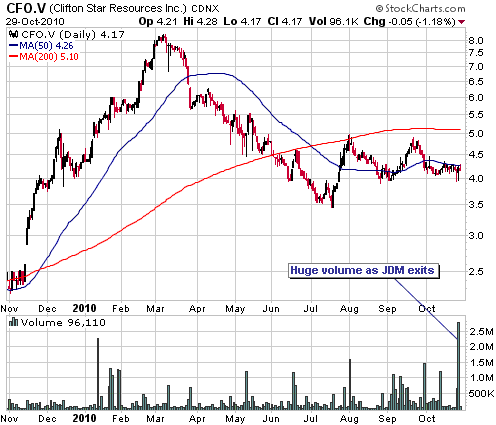
 Clifton Star Resources (TSXV: CFO). Shares: 33M issued, 39M fully diluted. Recent price: C$4.17 Clifton Star Resources (TSXV: CFO). Shares: 33M issued, 39M fully diluted. Recent price: C$4.17
In the 4th October Weekly Update, we wrote:
"We suspect that the
current inability of CFO's stock price to get any traction is primarily
due to the consistent selling of one large shareholder (Joe Dwek
Management - JDM). This shareholder has indirect control over about 13%
of CFO's fully diluted share count, and for reasons that in our opinion
have nothing to do with CFO's speculative merits appears to be set on
making a complete exit by selling into any strength."
Good news: Thursday's massive trading volume in CFO shares (2.8M
shares, or about 8.5% of the company, changed hands on the day) was due
to JDM selling the remainder of its shares. It still controls about
2.5M CFO warrants, but its ability to affect the market is now greatly
reduced.
This year's drilling campaign at CFO's Quebec-based Duparquet project
is complete, but the results of many holes are still to be reported.
Consequently, we expect to see more drilling-related news from CFO over
the next couple of months. The news that will likely have the greatest
effect on CFO's stock price, though, will be the announcement of
whether or not its joint-venture partner (Osisko - OSK) has decided to
continue with the JV. We believe that this announcement will occur by
January at the latest.
Confirmation that OSK has decided to continue with the JV would
effectively be confirmation that CFO's Duparquet project contains at
least 10M ounces of gold, because OSK would not likely be interested in
the project unless it were of this magnitude. It would therefore also
be confirmation that our C$13/share target is reasonable.
There are no guarantees, but we will be very surprised if OSK decides not to continue with the project.
CFO is a good candidate for new buying near its current price.
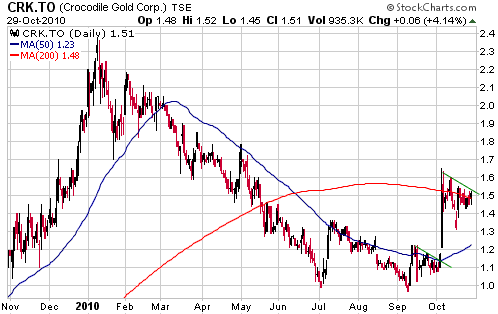
Crocodile Gold (TSX: CRK). Shares: 203M issued, 237M fully diluted. Recent price: C$1.51
CRK is a 120K-oz/yr gold producer with multiple mining assets in
Australia's Northern Territory. It has considerable growth potential,
but a substantially higher stock price is probably justified based only
on its current production and resources.
The stock broke out of a multi-week consolidation pattern at the start
of October and then quickly gained about 30% before commencing another
multi-week consolidation. At this stage, the latest consolidation looks
very much like the preceding one.
We think CRK is a good candidate for new buying in the low-1.50s and
below. Unless something totally unexpected happens, short-term downside
risk is probably limited by support in the C$1.30s, while an upside
breakout from the present consolidation could lead to a quick rise to
around C$2.00.
Chart Sources
Charts appearing in today's commentary
are courtesy of:
http://stockcharts.com/index.html

|