|
-- Weekly Market Update for the Week Commencing
2nd February 2015
Big Picture
View
Here is a summary of our big picture
view of the markets. Note that our short-term views may differ from our
big picture view.
In nominal dollar terms, the BULL market in US Treasury Bonds
that began in the early 1980s ended in 2012. In real (gold)
terms, bonds commenced a secular BEAR market in 2001 that will continue
until 2018-2020. (Last
update: 20 January 2014)
The stock market, as represented by the S&P500 Index,
commenced
a secular BEAR market during the first quarter of 2000, where "secular
bear market" is defined as a long-term downward trend in valuations
(P/E ratios, etc.) and gold-denominated prices. This secular trend will bottom sometime between 2014 and 2020.
(Last update: 22 October 2007)
A secular BEAR market in the Dollar
began during the final quarter of 2000 and ended in July of 2008. This
secular bear market will be followed by a multi-year period of range
trading.
(Last
update: 09 February 2009)
Gold commenced a
secular bull market relative to all fiat currencies, the CRB Index,
bonds and most stock market indices during 1999-2001.
This secular trend will peak sometime between 2014 and 2020.
(Last update: 22 October 2007)
Commodities,
as represented by the Continuous Commodity Index (CCI), commenced a
secular BULL market in 2001 in nominal dollar terms. The first major
upward leg in this bull market ended during the first half of 2008, but
a long-term peak won't occur until 2014-2020. In real (gold) terms,
commodities commenced a secular BEAR market in 2001 that will continue
until 2014-2020.
(Last
update: 09 February 2009)
Copyright
Reminder
The commentaries that appear at TSI
may not be distributed, in full or in part, without our written permission.
In particular, please note that the posting of extracts from TSI commentaries
at other web sites or providing links to TSI commentaries at other web
sites (for example, at discussion boards) without our written permission
is prohibited.
We reserve the right to immediately
terminate the subscription of any TSI subscriber who distributes the TSI
commentaries without our written permission.
Outlook Summary
Market
|
Short-Term
(1-3 month)
|
Intermediate-Term
(6-18 month)
|
Long-Term
(2-5 Year)
|
|
Gold
|
N/A |
Bullish
(26-Mar-12) |
Bullish
|
|
US$ (Dollar Index)
|
N/A |
Neutral
(29-Sep-14) |
Neutral
(19-Sep-07) |
|
US Treasury Bonds (TLT)
|
N/A |
Neutral
(18-Jan-12)
|
Bearish |
|
Stock Market
(DJW)
|
N/A |
Bearish
(28-Nov-11) |
Bearish
|
|
Gold Stocks
(HUI)
|
N/A |
Bullish
(23-Jun-10) |
Bullish
|
|
Oil |
N/A |
Bullish
(17-Dec-14) |
Bullish
|
|
Industrial Metals
(GYX)
|
N/A |
Neutral
(15-Sep-14) |
Bullish
(28-Apr-14) |
Notes:
1. Our short-term expectations are discussed in the commentaries, but except in
special circumstances we won't attempt to assign a "bullish", "bearish" or
"neutral" label to these expectations.
2. The date shown below the current outlook is when the most recent outlook change occurred.
3. "Neutral" means that we think risk and reward are roughly in balance with respect to the timeframe in question.
4. Long-term views are determined almost completely by fundamentals and intermediate-term views
are determined by a combination of fundamentals, sentiment and technicals.
Monetary
Inflation Update
True Money Supply
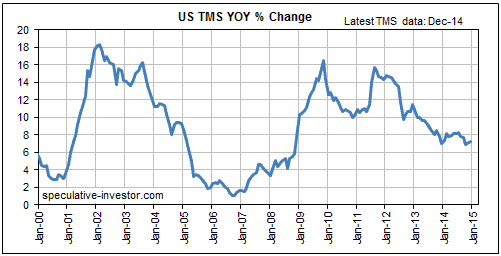
Despite the "tapering" and eventual ending of
the Fed's latest (but almost certainly not last) QE program, the year-over-year
(YOY) rate of growth in US True Money Supply (TMS) essentially went sideways
last year. It began the year at just above 7% and ended the year at just above
7%.
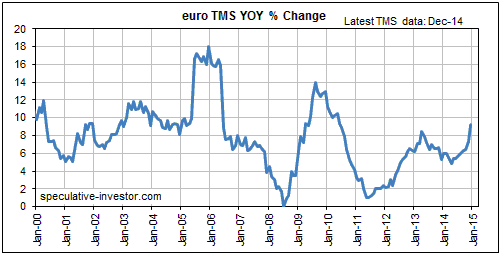
The ECB introduced a new QE program during the week before last. This program is
scheduled to get underway in March and will add to the euro-zone money supply,
but the following chart indicates that the euro-zone's monetary inflation rate
has already accelerated. Specifically, the chart shows that the YOY rate of
growth in euro TMS began to trend upward during the second quarter of last year
and ended the year above 9%, which is the highest it has been since the first
half of 2010. In other words, the ECB has introduced a new money-pumping program
at a time when the money-supply growth rate is already high.
We combine the US$ and euro supplies into something we call G2 money supply. The
next chart shows that the YOY rate of growth in G2 TMS edged upward from just
above 6% to around 8% over the course of last year.
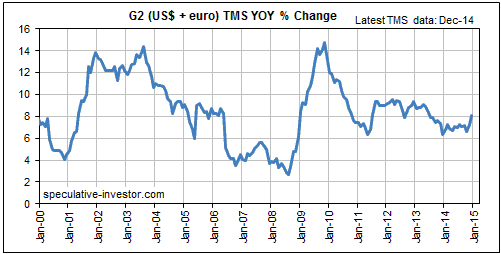
Of the three monetary inflation measures charted above, the G2 TMS growth rate
has the best record with regard to forecasting financial and economic outcomes.
In the past there hasn't been a major economic slowdown or financial-market
crisis until after the G2 TMS growth rate fell below 6%, although we reiterate
that due to the damage caused by prior monetary madness the next major problem
could become apparent at a higher TMS growth rate.
Bank Credit
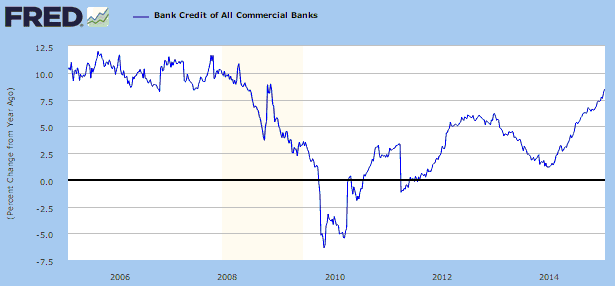
The year-over-year (YOY) rate of growth in US commercial bank credit bottomed at
the beginning of 2014 at around 1.2% and is now at a 6-year high of around 8.5%.
Refer to the following chart for details. The acceleration over the past 12
months in the pace of commercial bank credit creation is why the US monetary
inflation rate ticked upward during 2014 despite the gradual winding-down to
zero of the Fed's money-pumping. It is probably also why the US stock market was
able to rise last year in the face of some serious headwinds.
Modern-day banking has nothing to do with capitalism. It is, instead, a type of
fascism or, to use a less emotive word, corporatism. In essence, this means that
it is an unholy alliance between government and private enterprise, which
involves the government -- directly or via its agents, such as the Federal
Reserve in the US -- having extensive control over the private enterprise and
the private enterprise being given special privileges.
In the US and most other developed countries, the bank-government relationship
generally includes the following repeating sequence:
1. The government either forces or provides financial incentives to the private
banks to expand credit in areas where the government wants more credit to flow.
At the same time, the central bank makes sure that there is plenty of scope for
banks to profit by borrowing short to lend long.
2. The politically-directed or central-bank-stimulated lending causes booms in
some economic sectors. While the boom continues, politicians publicly give
themselves pats on the back, central bankers bathe in the glory stemming from
general confidence in the financial system, and private bankers pay themselves
huge bonuses.
3. The boom inevitably turns to bust, leading to massive loan losses and asset
write-offs at most banks. It becomes clear that many banks are bankrupt.
4. The government and its agents provide whatever financial support is needed
and implement whatever regulatory changes are needed to ensure that the private
banks stay afloat. This is done at the expense of the rest of the economy but is
invariably sold to the public as being either helpful to the rest of the economy
or a necessary evil to prevent a more painful outcome for the overall economy.
5. The private banks, following their near-death experience, 'pull in their
horns' and focus on repairing their balance sheets. A result is that commercial
bank credit creation grinds to a halt.
6. The cessation of commercial bank credit expansion is viewed by the government
and its agents as a drag on the economy and, therefore, as something that must
be fought.
7. Return to Step 1.
There are signs that the US is currently transitioning from Step 2 to Step 3,
with the shale-oil industry being the leading edge of the next deluge of
commercial bank write-offs. However, it isn't a foregone conclusion. We know
that Step 3 is coming, but the exact timing is unknowable. It's possible, for
example, that the acceleration of bank credit creation in other parts of the
economy could mask the effects of the collapsing shale-oil boom.
2015 forecast
for industrial commodities
Oil
As everyone knows, the oil price crashed during the second half of last year.
This crash was due to a number of bearish forces coming together at the one
time. First, oil was expensive relative to commodities in general. Second, oil's
supply/demand fundamentals were price-bearish as the result of slowing economic
activity and rising US supply. Third, the US$ was getting stronger. Fourth,
there was broad-based weakness in the commodity markets. And fifth, the
supply/demand situation became even more bearish when Saudi Arabia decided not
to reduce supply in response to the falling price.
As a consequence of the price crash, over the past two months the oil market not
only became extremely 'oversold' in US$ terms, with oil's weekly RSI hitting its
lowest level since 1986 and Market Vane's bullish percentage for oil achieving
the lowest reading we've ever seen in any market (9%), it also became extremely
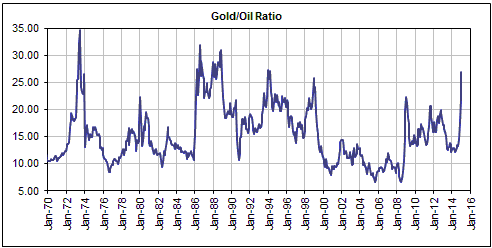
cheap relative to other commodities. In particular, oil dropped to a 15-year low
relative to copper, to a multi-decade low relative to gold, and to within a few
percent of a 15-year low relative to the Continuous Commodity Index. Oil's
long-term position relative to gold is illustrated by the following monthly
chart. Also, relative to the S&P500 Index the oil price fell to its lowest level
since 2002.
This sets the stage for oil to outperform over the next 12 months.
We expect that oil will soon turn upward on a sustained basis relative to
industrial metals such as copper, but that in US$ terms and relative to gold a
sustained up-turn won't get underway until the second half of this year. In US$
terms, we expect that during the first half of the year the oil price will build
a base, with the likely pattern involving a rebound during the first quarter
followed by a second-quarter test of the January bottom.
By the way, our inflation-adjusted (IA) calculations suggest maximum downside
risk during the first half of this year to the mid-to-high-$30s, which is the
current-dollar equivalent of the major price bottom in 1986. We do not expect
that oil will get this cheap, but that level of weakness cannot yet be ruled
out. If oil does get that cheap it will be one of the best buys of the past 50
years.
One reason to believe that it's too early to start speculating on a SUSTAINED
turn to the upside is that although Market Vane's bullish percentage for oil
recently hit an extraordinarily low level and almost everyone seems to be
bearish on oil, which is exactly what would be expected near a major price
bottom, speculators in oil futures haven't yet capitulated. Incredibly,
speculators (as a group) have maintained a sizable net-long position in NYMEX
oil futures over the past four months.
A second reason is that although there has been a large decline in the quantity
of US drilling rigs over the past three months, US oil production hasn't yet
begun to decline. Instead, what's happening is that heavily-indebted US oil
producers are trying to extract oil from their existing wells as quickly as
possible to generate the cash-flow needed to meet their monthly expenses. That
is, they are trying to make up for the large fall in the per-barrel price by
producing more barrels.
Industrial Metals
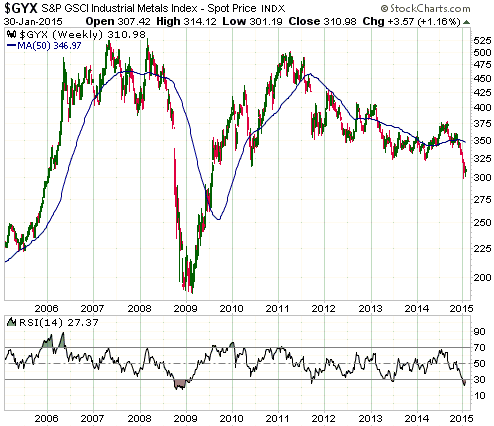
We expect that copper and the Industrial Metals Index (GYX) will commence new
cyclical bull markets from price bottoms during the first half of this year.
This forecast assumes that gold bottomed last November (gold is the leader) and
that central banks will continue to react to economic weakness by increasing the
money supply.
Even if we are right about new bull markets getting underway within the next few
months, the ultimate price lows could be well below current levels. In
particular, we perceive downside risk in the copper price to the low-US$2 area,
which is where the inflation-adjusted copper price would roughly match its 2008
low. $2.00-$2.10 for copper would likely equate to about 250 for GYX.
 The Stock
Market
In last week's Interim Update we wrote that
a daily close below 1970 by the S&P500 (SPX) would provide the first piece of
evidence that the decline from the late-December peak was more than just a
routine short-term pullback. However, that's not entirely true. A daily close
below 1970, which hasn't yet happened, would be a bearish price signal, but it
has been preceded by another piece of evidence that something more serious than
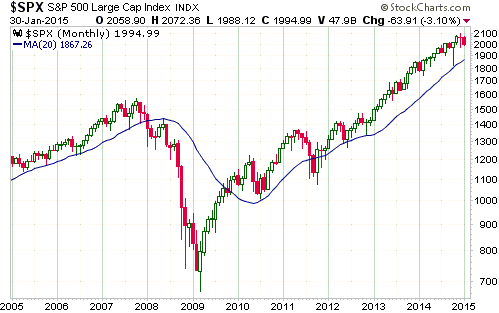
a routine pullback is in progress. We are referring to the fact that the SPX has
just achieved consecutive monthly declines for the first time since H1-2012.
A monthly SPX chart is displayed below. Based on the historical record, the
SPX's consecutive monthly losses points to an extension of the decline to the
vicinity of the 20-month MA (1850-1900).
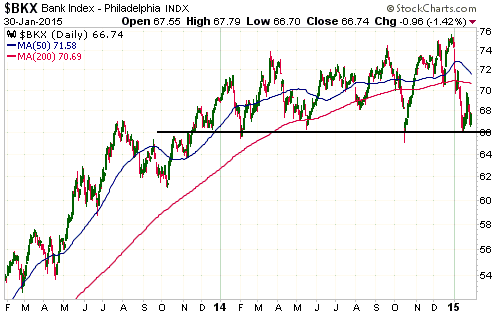
At the end of last week the US Bank Index (BKX) was close to signaling a major
top. A major top would be signaled by a weekly close below 66. It ended last
week at 66.74.
Note that if a major top is signaled within the next two weeks it won't imply
immediate additional downside. The reason is that the obvious confirmation of
weakness would be coming at a time when the market is 'oversold'. Rather than a
break of long-term support being immediately followed by acceleration to the
downside, the obvious confirmation of weakness could be followed by a
counter-tend rebound to the 200-day MA.
This week's
significant US economic events
(The most important events are shown
in bold)
| Date |
Description |
| Monday Feb 02 |
Personal Income and Spending
ISM Mfg Index
Construction Spending | | Tuesday
Feb 03 |
Motor Vehicle Sales
Factory Orders | | Wednesday
Feb 04 |
ISM Non-Mfg Index | | Thursday
Feb 05 |
Q4 Productivity and Costs
International Trade Balance
|
| Friday Feb 06 |
Monthly Employment Report
Consumer Credit |
Gold and
the Dollar
Gold
In the 26th January Weekly Update we pointed out that gold in non-US$ terms had
become extended to the upside on an intermediate-term basis and that gold in US$
terms had become extended to the upside on a short-term basis. The implication
was that a multi-month correction/consolidation was likely in non-US$ terms and
that a multi-week correction/consolidation was likely in US$ terms. We concluded
with the statement: "A decline to $1250 is likely within the next several
weeks even if a new bull market has begun and even if the price first rises to
around $1350."
Gold subsequently pulled back and traded as low as US$1252 on Thursday 29th
January. So, is the anticipated correction in the US$ gold price now complete?
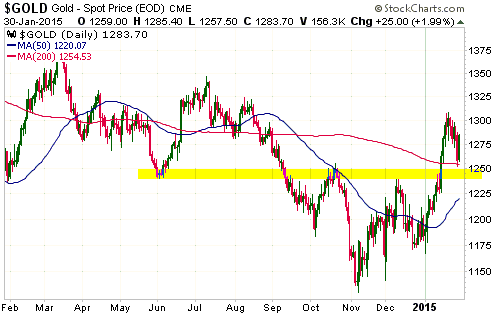
Considering the extent to which gold was short-term 'overbought' when it
recently moved above $1300 and the fact that if a new gold bull market has begun
it is still in its embryonic stage, a pullback to support near $1250 was almost
inevitable. It was also highly probable that in the absence of a bearish
catalyst a quick pullback to obvious support near $1250 would prompt a rebound.
The pullback to support and the ensuing rebound do not imply that the correction
is over.
It's likely that the correction is not yet complete. The main reason is the
sentiment indicated by the Commitments of Traders (COT) data. We are referring
to the fact that the speculative net-long position and the offsetting commercial
net-short position in COMEX gold futures hit new 2-year highs last Tuesday (the
date of the latest COT data). Based on past performance and assuming that a
major price bottom was put in place last November, it is reasonable to
anticipate a price correction that is long enough and/or deep enough to reduce
the aforementioned net positions by at least 70K contracts.
Our guess is that the US$ gold price is a bit more than one week into a
correction that will last at least a few weeks. If so, the most likely pattern
involves a secondary high (or a test of the January high) within the next seven
trading days followed by a return to support near $1250. A break of $1250 would
then project additional downside to the $1220s.
We currently think that the $1220s defines the maximum short-term downside
potential, but a lot depends on the speed with which speculators reduce their
'long' exposure. Speculators drive short-term trends in the gold market.
By the way, weakness in the US$ gold price during any corrective activity over
the next couple of months will probably be muted by weakness in the Dollar Index
as the euro rebounds from its ultra-depressed level.
Gold Stocks
2015 forecast for the gold-mining sector
Gold-mining stocks will normally outperform gold bullion by a wide margin during
the first 2 years of a new cyclical gold bull market. This is due to the fact
that the cost of mining gold follows the gold price with a lag of 1-2 years. Due
to this and depending on the length of the preceding gold bear market, the cost
of mining gold will probably be in a downward trend at the start of a new
cyclical bull market in gold bullion and will probably continue to fall during
the first 1-2 years of a new bull market in gold bullion. A rising trend in the
gold price combined with depressed stock valuations and falling production costs
equals substantial profit-margin expansion and large gains in stock prices.
Consequently, if gold made its ultimate bottom last November then the HUI should
achieve a large percentage gain over the next 18 months in both nominal price
terms and relative to gold bullion.
Of course, that's a big "if". Preliminary signs have emerged that the US$ gold
price did indeed make its ultimate bottom last November (the non-US$ gold price
having almost certainly bottomed way back in December of 2013), but we have been
disappointed before. Last year, to be specific.
A long-term (that is, multi-year) bullish trend in gold mining stocks (as
represented by the HUI) naturally requires a long-term bullish trend in gold
bullion, which probably requires a long-term bearish trend in the US stock
market (as represented by the S&P500 Index). A transition from a long-term
bearish to a long-term bullish trend in the HUI and an associated transition
from a long-term bullish to a long-term bearish trend in the S&P500 Index is our
favoured possibility at this time.
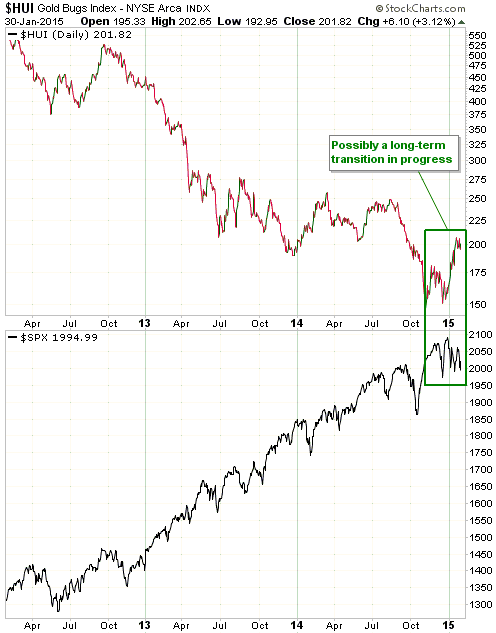
There is, however, another realistic possibility that would lead to substantial
gains in gold mining stocks this year, but would not involve a long-term trend
shift. Specifically, a further 6-12 month extension of the cyclical bull market
in US equities would likely coincide with a very profitable 6-12 month rally in
the gold-mining sector if the extension of the old bull market encompassed a
rotation into commodity-oriented and other basic-material stocks. This would be
similar to what happened during the final quarter of 1986 and the first three
quarters of 1987.
Current Market Situation
Last week the HUI oscillated between its 200-day MA on the upside and its 20-day
MA on the downside. The only significant aspect of last week's price action was
the resilience shown by the gold-mining sector in the face of Thursday's $30
plunge in the gold price. The HUI brushed off this downward spike in the gold
price and held above its 20-day MA.
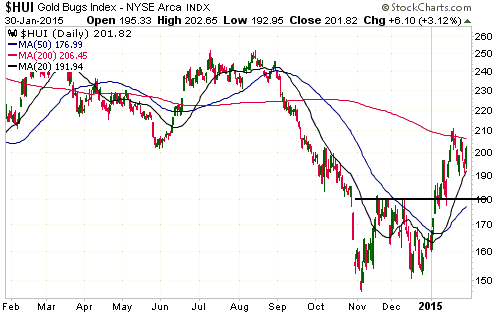
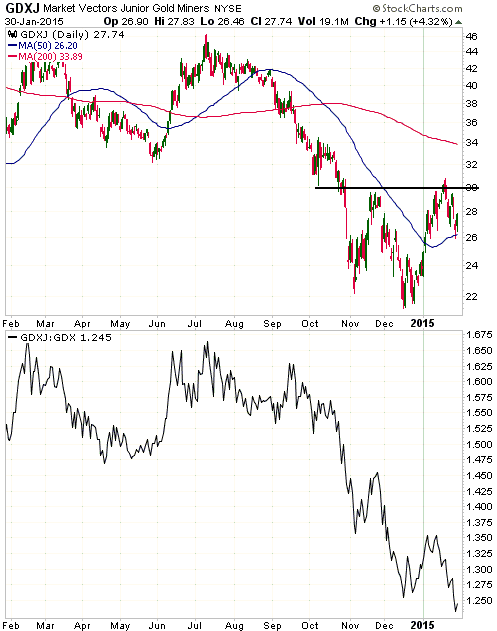
Unlike the HUI, the Junior Gold Miners ETF (GDXJ) hasn't yet broken above its
November-2014 high. For the HUI, the November-2014 high is now support that we
expect to hold during further 'corrective' activity over the weeks ahead. For
GDXJ, the November-2014 high still constitutes resistance.
The juniors (represented by GDXJ) have been weak relative to the seniors
(represented by GDX) since around mid-November. This is evidenced by the
continuing downward trend in the GDXJ/GDX ratio and the new multi-year lows
achieved by this ratio last week. Refer to the bottom section of the following
chart for details.
We can rationalise the continuing downward trend in the GDXJ/GDX ratio. For
example, a reasonable argument could be made that the lower-risk stocks
represented by GDX will naturally be preferred during the early part of a new
bull market when confidence is still fragile and that the higher-risk stocks
represented by GDXJ will come to the fore after confidence in the upward trend
has increased. However, we didn't expect GDXJ's recent relative weakness and it
could potentially be a short-term warning sign.
The Currency Market
2015 forecast for the Dollar Index
When we penned our 2014 forecast for the currency market we had no firm opinion
on whether the Dollar Index would break out to the upside or the downside from
the 5-point horizontal range in which it had oscillated over the preceding two
years. However, we did have an opinion on what would drive the direction of the
eventual breakout. Here's what we wrote:
"It will most likely be relative stock market performance that determines
whether the Dollar Index breaks upward from its 2-year range and makes its way
to the 90s or breaks downward from its 2-year range and makes its way to the
low-70s. European equities currently offer better value, on average, than US
equities, which gives them more intermediate-term upside potential at a time
when monetary inflation rates are roughly the same in the US and Europe. On the
other hand, there's a greater intermediate-term risk of another debt/banking
crisis in Europe than in the US, and despite their relative expensiveness US
equities would probably hold up better than their European counterparts during a
global equity bear market."
We were right about what would drive the Dollar Index during 2014, in that
dramatic strength in US equities relative to European equities (with performance
measured in terms of a common currency) propelled the US$ sharply higher on the
foreign exchange market during the second half of last year. This is confirmed
by the following chart. However, we didn't anticipate the relative strength in
US stocks and failed to react to it in a timely fashion.
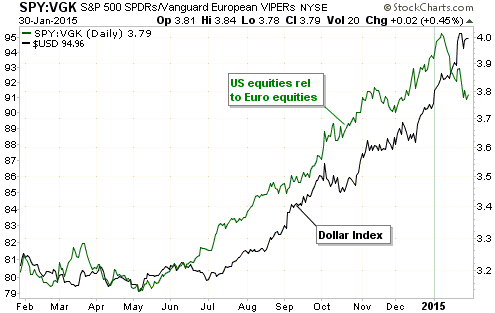
We don't see any reason why the Dollar Index, which is dominated by the USD/EUR
exchange rate, should stop trending with relative equity-market performance. We
therefore view the shift in relative stock-market strength that occurred in
early-January as a bearish omen for the Dollar Index. Furthermore, last year's
relatively poor performance by European equities makes it less likely that they
will underperform over the months ahead, especially considering that euro-zone
monetary inflation has recently accelerated and will likely be given an
additional boost when the ECB's new QE program kicks off in March. Therefore,
the euro will probably have an upward bias and the Dollar Index will probably
have a downward bias during the first half of this year.
That's as far ahead as we are prepared to look at this time.
Current Market Situation
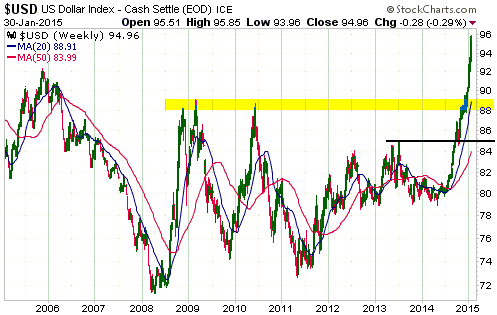
The Dollar Index may or may not have commenced a meaningful correction last
week. It's too early to tell. Once a correction does get underway, support at
88-89 will be the most logical short-term target.
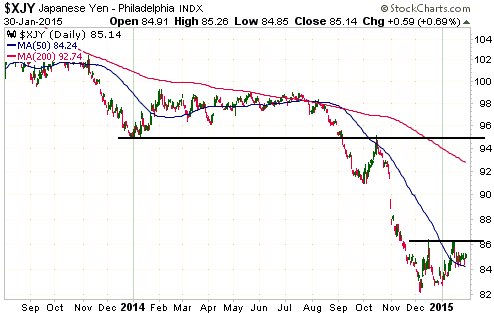
The Yen has been gradually strengthening since early-December, but is having
trouble getting above resistance at 86.5. Additional stock market weakness,
which is a likely near-term prospect, would help the Yen breach this resistance.
Breaking above 86.5 would suggest short-term upside potential to 92-95.
Updates
on Stock Selections
Notes: 1) To review the complete list of current TSI stock selections, logon at
http://www.speculative-investor.com/new/market_logon.asp
and then click on "Stock Selections" in the menu. When at the Stock
Selections page, click on a stock's symbol to bring-up an archive of
our comments on the stock in question. 2) The Small Stock Watch List is
located at http://www.speculative-investor.com/new/smallstockwatch.html
 Company
news/developments for the week ended Friday 30th January 2015: Company
news/developments for the week ended Friday 30th January 2015:
[Note: AISC = All-In Sustaining Cost, FS = Feasibility Study, IRR = Internal
Rate of Return, MD&A = Management Discussion and Analysis, M&I = Measured and
Indicated, NAV = Net Asset Value, NPV(X%) = Net Present Value using a discount
rate of X%, P&P = Proven and Probable, PEA = Preliminary Economic Assessment,
PFS = Pre-Feasibility Study]
*Dalradian Resources (DNA.TO): DNA's stock price moved sharply
higher on Tuesday 27th January in reaction to news that Ross Beaty, a highly
regarded mining investor/entrepreneur, had made a big investment in the company.
Beaty's decision to pay $11.3M (12.5M shares at C$0.90/share) for a 10% stake in
DNA is an important vote of confidence in DNA's Curraghinalt gold project.
This news along with general firmness in gold-mining stocks has injected some
value into the DNA C$0.90 warrants (DNA.WT) that are set to expire on 19th
February. Due to the close proximity of the expiry date, the week before last we
said that it would probably make sense for a speculator with exposure to both
the stock and the warrants to exit the warrants now (they were trading at around
C$0.06 at the time) and for a speculator with exposure to only the warrants to
continue holding the warrants. If you are still holding the warrants our
suggestion is to do one of the following:
1) If you have no desire to exercise the warrants, then sell them now at C$0.10
or better. At Friday's closing price of C$1.03 for the DNA shares, the intrinsic
value of the warrants is C$0.13.
2) Exercise the warrants immediately or within the next 2 weeks, paying C$0.90
to the company for each new share. Note that if you already own DNA shares and
don't want to increase your position, you could exercise the warrants and
simultaneously sell enough of your existing shares to pay for the new shares.
*Pilot Gold (PLG.TO) has three main 'irons in the fire'. Due to
news flow, the two that have been front and centre over the past couple of years
are the TV Tower gold project in Turkey (60% PLG, 40% Teck) and the Kinsley
Mountain gold project in Nevada (79% PLG, 21% NEV.V). The third is the Halilaga
copper-gold project in Turkey (40% PLG, 60% Teck).
Halilaga is a low-grade copper-gold porphyry deposit with a total resource
comprising 2.1B pounds of copper and 3.3M ounces of gold (roughly half
Indicated, half Inferred). A PEA completed back in 2012 came up with an
estimated post-tax NPV(7%) of $800M using a copper price of $3.30/pound and a
gold price of $1350/oz. According to this PEA, a mine with average annual
production of 90M pounds of copper and 90K ounces of gold could be built at a
capital cost of $1.2B.
We have never assigned significant value to Halilaga, because with an initial
capital cost of $1.2B there was very little chance that this low-grade project
that required a copper price well north of $3/pound would ever be developed into
a mine. However, a revised PEA published last week suggests that Halilaga has
more potential than we previously thought.
The revised PEA is based on a much smaller operation. By substantially reducing
the size of the planned mine, the estimated initial capital cost has been pushed
down to $346M and the project appears to be economically robust at $1200/oz for
gold and $2.90/pound for copper. At these metals prices the NPV(7%) and IRR are
estimated to be $474M and 43%, respectively. Furthermore, the figures in the
revised PEA suggest that the project might still be viable at $1200/oz for gold
and $2.25/pound for copper.
Assuming that the copper price makes a sustained turn to the upside from a
bottom during the first half of this year, Halilaga could be very valuable a
year from now.
*Ramelius Resources (RMS.AX) published its quarterly report for
the December quarter, which is the second quarter of the company's 2015
financial year (FY). This report mostly provided more details regarding the
above-plan production result announced in early January.
The new information of interest was upwardly-revised FY2015 production guidance
for the Mt Magnet gold mine of 83K ounces at A$1150/oz (previously 74K ounces at
an AISC of A$1300/oz).
To give you an idea of how the decline in the A$'s exchange rate is giving
Australia-based gold miners an immediate bottom-line boost, a year ago a mining
cost of A$1150/oz would have equated to US$1150/oz, whereas today it equates to
about US$900/oz. In other words, the change in the exchange rate has reduced the
US$-denominated costs of Australia-based miners by more than 20% over the past
year. In RMS's case there is also a significant reduction in the A$-denominated
cost. The result is the transformation of a loss-making cash-consuming company
into a profitable cash-flow-positive one.
*Timmins Gold (TGD) reported a worse than expected production
performance during Q4-2014. The company produced about 25K ounces of gold during
the quarter, which enabled it to achieve a total year production result that was
close to the middle of its guidance range but 3K-4K ounces less than we were
expecting. Also, the company advised that it expects 2015 gold production to be
115K-125K ounces at a cash cost of $800-$850/oz.
The fact that the stock didn't sell off on Monday 26th January in reaction to
this news reflects its low valuation (the current valuation is very low for a
marginally-profitable 120K-oz/yr gold producer with a healthy balance sheet) and
improving sentiment in the gold-mining sector. However, TGD's stock price
subsequently fell more than most in response to the pullback in the gold price.
This is probably because with its current cost structure and near the current
gold price, relatively small changes in the gold price have a big effect on
TGD's bottom-line result.
*True Gold Mining (TGM.V) finally provided some details on the
community-relations problem that caused the suspension of construction at the
Karma mine (Burkina Faso).
As we noted last week: "The problem, in a nutshell, is that TGM's proposed
mine is located in an area that is a Muslim place of pilgrimage and that
contains an important mosque (more than half of Burkina Faso's population
practices Islam). The local Muslims are naturally not enthusiastic about having
an open-pit mining operation near their places of worship." A press release
issued by TGM last Thursday confirmed that this is, indeed, the problem. Of
particular significance, the current mine plan shows that the edge of the "Rambo
pit" is only 1.2kms from the local (town of Ramatoulaye) mosque.
TGM's press release states: "The Rambo pit is a small, shallow pit that will
be mined with smaller, low-intensity equipment over an 18-month period. Mining
the Rambo pit does not require any community relocation and is free digging down
to 50 metres. True Gold has put in place all safety and environmental protection
measures to ensure activities do not impact Ramatoulaye structures, including a
four-meter high sound barrier, a 250-meter wide safety zone, ground water
monitoring and several dust suppression initiatives."
TGM is working with the government and the local community to address the
concerns and is working with its main contractor to determine the effects on the
project schedule and budget, but at this stage no solution has been agreed.
It occurs to us that a potential solution would be to not develop the Rambo pit.
Based on information in the FS, total production from this pit would only be
20K-30K ounces. This suggests that at the current gold price the total loss of
profit to TGM from not mining this part of the overall deposit would be around
$5M, which is significant but manageable. Furthermore, total production could
still be maintained or increased by mining the North Kao deposit. North Kao
isn't included in the current mine plan, but based on the PEA published last
October it could yield about 300K low-cost ounces.
We expect that TGM will be able to remove the obstacle that is currently
preventing construction work from proceeding, but at this time the unknowns are
too big to justify buying the stock.
List of candidates for new buying
From within the ranks of TSI stock selections the best candidates
for new buying at this time, listed in alphabetical order, are:
1) AKG (last Friday's closing price: US$1.55).
2) EDV.TO (last Friday's closing price: C$0.60).
3) TGD (last Friday's closing price: US$1.10).
Note that the above list is limited to five stocks. It will
sometimes contain less than five, but it will never contain more
than five regardless of how many stocks are attractively priced for
new buying.
Chart Sources
Charts appearing in today's commentary
are courtesy of:
http://stockcharts.com/index.html
http://research.stlouisfed.org/

|









