|
-- Weekly Market Update for the Week Commencing 2nd March 2015
Big Picture
View
Here is a summary of our big picture
view of the markets. Note that our short-term views may differ from our
big picture view.
In nominal dollar terms, the BULL market in US Treasury Bonds
that began in the early 1980s ended in 2012. In real (gold)
terms, bonds commenced a secular BEAR market in 2001 that will continue
until 2018-2020. (Last
update: 20 January 2014)
The stock market, as represented by the S&P500 Index,
commenced
a secular BEAR market during the first quarter of 2000, where "secular
bear market" is defined as a long-term downward trend in valuations
(P/E ratios, etc.) and gold-denominated prices. This secular trend will bottom sometime between 2014 and 2020.
(Last update: 22 October 2007)
A secular BEAR market in the Dollar
began during the final quarter of 2000 and ended in July of 2008. This
secular bear market will be followed by a multi-year period of range
trading.
(Last
update: 09 February 2009)
Gold commenced a
secular bull market relative to all fiat currencies, the CRB Index,
bonds and most stock market indices during 1999-2001.
This secular trend will peak sometime between 2014 and 2020.
(Last update: 22 October 2007)
Commodities,
as represented by the Continuous Commodity Index (CCI), commenced a
secular BULL market in 2001 in nominal dollar terms. The first major
upward leg in this bull market ended during the first half of 2008, but
a long-term peak won't occur until 2014-2020. In real (gold) terms,
commodities commenced a secular BEAR market in 2001 that will continue
until 2014-2020.
(Last
update: 09 February 2009)
Copyright
Reminder
The commentaries that appear at TSI
may not be distributed, in full or in part, without our written permission.
In particular, please note that the posting of extracts from TSI commentaries
at other web sites or providing links to TSI commentaries at other web
sites (for example, at discussion boards) without our written permission
is prohibited.
We reserve the right to immediately
terminate the subscription of any TSI subscriber who distributes the TSI
commentaries without our written permission.
Outlook Summary
Market
|
Short-Term
(1-3 month)
|
Intermediate-Term
(6-18 month)
|
Long-Term
(2-5 Year)
|
|
Gold
|
N/A |
Bullish
(26-Mar-12) |
Bullish
|
|
US$ (Dollar Index)
|
N/A |
Bearish
(26-Jan-15) |
Neutral
(19-Sep-07) |
|
US Treasury Bonds (TLT)
|
N/A |
Neutral
(18-Jan-12)
|
Bearish |
|
Stock Market
(DJW)
|
N/A |
Bearish
(28-Nov-11) |
Bearish
|
|
Gold Stocks
(HUI)
|
N/A |
Bullish
(23-Jun-10) |
Bullish
|
|
Oil |
N/A |
Bullish
(17-Dec-14) |
Bullish
|
|
Industrial Metals
(GYX)
|
N/A |
Neutral
(15-Sep-14) |
Bullish
(28-Apr-14) |
Notes:
1. Our short-term expectations are discussed in the commentaries, but except in
special circumstances we won't attempt to assign a "bullish", "bearish" or
"neutral" label to these expectations.
2. The date shown below the current outlook is when the most recent outlook change occurred.
3. "Neutral" means that we think risk and reward are roughly in balance with respect to the timeframe in question.
4. Long-term views are determined almost completely by fundamentals and intermediate-term views
are determined by a combination of fundamentals, sentiment and technicals.
Last
week's posts at the TSI Blog
Strange Bedfellows
Economics
Myths
Volcker's Undeserved Reputation
Can the Bear get much worse?
By the way, today we discovered a problem with the email address
linked to the TSI Blog (steve@tsi-blog.com), which, as far as we can
tell, arose when the blog was migrated to a different server in
early January. When the problem was fixed we were inundated with two
months of emails that we previously hadn't seen.
We are confident that future emails sent to the blog address will
get through and apologise for the lack of response to questions sent
over the past two months.
A potential early-March turning
point
We expected that there would be short-term trend
reversals in some markets in late-January, with the 22nd January ECB meeting and
the 25th January Greek elections acting as the specific catalysts for the
reversals (in a "buy the rumour sell the news" situation). The most clear-cut
trend change ended up being the downward reversal in the non-US$ gold price,
largely because this was the price that had trended most strongly into the
expected turning-point.
The stage is again set for some short-term trend reversals. The European stock
and government-bond markets are the most obvious candidates for trend changes,
in both cases from up to down. Other likely candidates include an upward
reversal in the US$ gold price and downward reversals in the US stock market and
the Dollar Index.
Unlike in January there isn't an obvious news-related catalyst for market
reversals at this time, although it's possible that an ECB meeting could again
do the job. At the meeting scheduled for Thursday 5th March it's both likely and
expected that the ECB will announce the starting date and provide additional
details for its QE program.
Money-supply explosion in euro-land
In the 2nd February Weekly Update we mentioned that even though
the ECB's new QE program was not due to start until March, the year-over-year (YOY)
rate of growth in euro TMS (True Money Supply) had already accelerated to around
9%. This was the highest rate of monetary inflation since the first half of
2010. As it turned out, though, the sharp rise to 9% was just a taste of what
was to come, as the monetary data published by the ECB last Thursday revealed
that the euro-zone's YOY TMS growth rate jumped to 11.5% in January.
We don't know the reason for the dramatic acceleration in euro-zone monetary
inflation over the past few months, as European commercial banks don't appear to
be doing much on the lending front and the ECB's QE program hasn't yet begun.
Our guess is that it's because the commercial banks have been busily monetising
government bonds. Anyhow, at this time we are more concerned about what's
happening than why it's happening.
Here is the relevant chart.
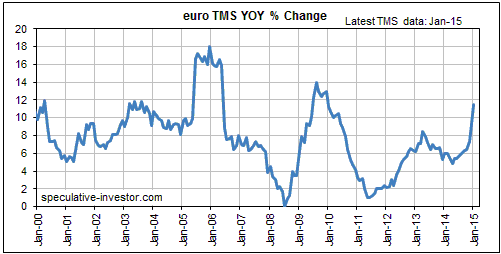
So, the euro-zone (EZ) has a current monetary inflation rate of 11.5% and a new
central-bank money-pumping program set to begin later this month. Look no
further for an explanation of the recent rapid advances in European equity
prices.
A consequence is that even as many pundits fret over the possibility of
deflation in the EZ, the EZ is now heading full steam towards a major inflation
problem. This would be funny if it weren't so serious.
Relative stability in the US monetary inflation rate (the YOY rate of growth in
US TMS has remained in the 7.0-7.5% range over the past few months) combined
with the recent surge in euro supply has pushed our measure of the G2 (US plus
euro-zone) monetary inflation rate up to 9%, which, as illustrated below, is not
far from its high of the past 4 years.
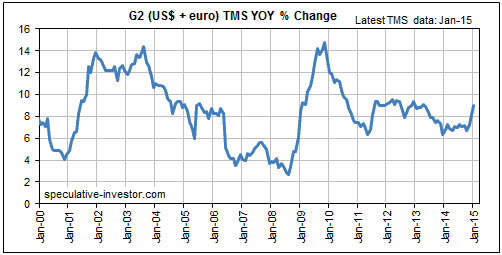
The moderate-to-high rate of G2 monetary inflation over the past 12 months all
but eliminates the possibility of a 2008-style crisis this year, but it is
probably setting the scene for extreme volatility in stocks and bonds. For
example, the realisation that the euro-zone is about to experience rising
"inflation" could prompt some frenetic re-positioning by large speculators, with
EZ government bonds likely taking a big hit.
The Stock
Market
Japan
Here is a long-term monthly chart of the Nikkei225 Index prepared by BOA Merrill
Lynch. We found the chart, along with some accompanying "technical analysis"
about a potential breakout into a secular bull market, at
Barry Ritholtz's blog.
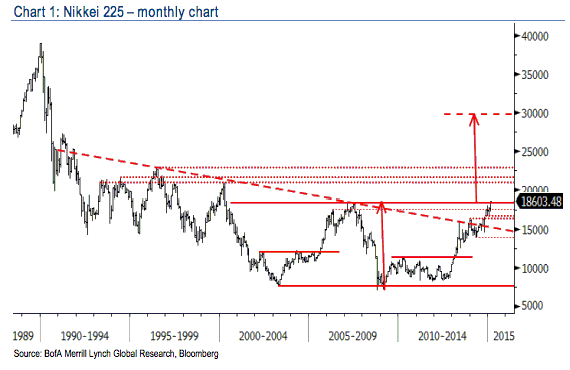
The above chart (along with the associated analysis) is of interest to us
because it reflects a mainstream view that Japan's stock market is turning
upward on a very long-term basis. Japan's stock market, like most stock markets
around the world, is 'overbought' on a short-term basis, but if the 'new secular
bull market' idea becomes popular then corrections over the next couple of
months could be short-lived as investors quickly buy the dips in an effort to
get positioned for the new long-term trend.
Additionally, Japanese policy-makers are effectively forcing some large
Japan-based pension funds and other large investors 'into' the stock market by
all but closing down the market for Japanese Government Bonds (the BOJ is now
the buyer of almost all JGBs put up for sale) and by promising to create
"inflation".
Europe
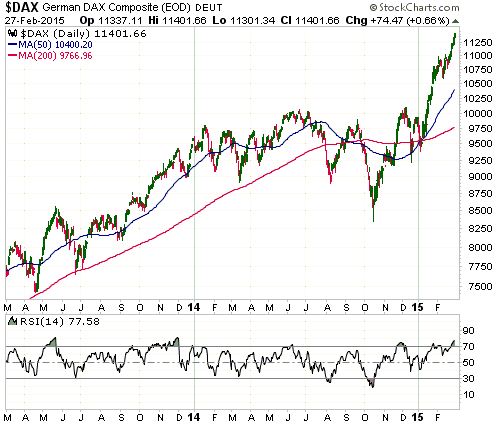
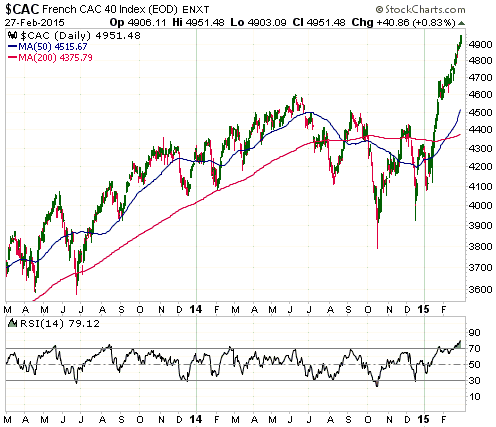
The most important European stock indices continued their rallies last week and
are now very 'overbought' on a short-term basis. Daily charts of the two best
examples are displayed below.
We suspect that short-term peaks will be put in place this week and that these
peaks will be followed by 5%-10% declines.
The US
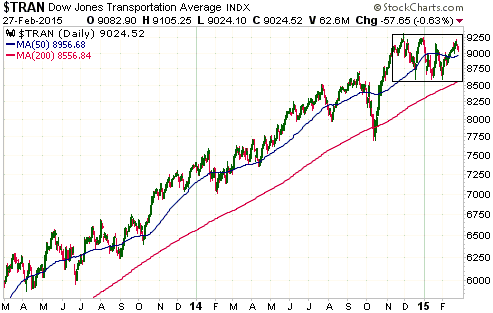
Despite the fact that transportation companies are among the most clear-cut
beneficiaries of the large decline in the oil price, the Dow Transportation
Average (TRAN) is still refusing to confirm the new multi-year highs recently
achieved by many other US stock indices. We don't know the reason for this
non-confirmation. It could reasonably be construed as a short-term bearish sign,
but we do not think it has long-term importance.
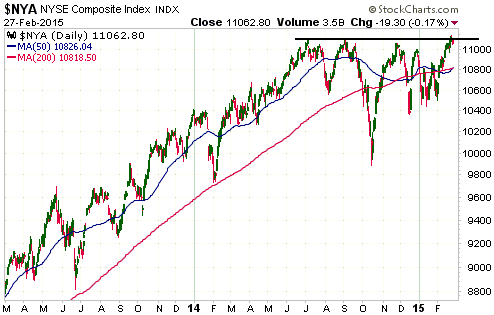
On a longer-term basis, the performance of the NYSE Composite Index (NYA)
probably has greater significance. The NYA came close to breaking above its 2014
double top last week, but Friday's pullback was enough to avoid an upside
breakout.
The price action that would lend the most support to the intermediate-term
bearish case would involve an upside breakout this week that failed within the
ensuing two weeks. This would logically be the next step in a topping process
that was similar to the 2000 top.
Regardless of the big picture (ending bull market or continuing bull market), a
short-term top is probably close at hand.
This week's
significant US economic events
(The most important events are shown
in bold)
| Date |
Description |
| Monday Mar 02 |
Personal Income and Spending
ISM Mfg Index
Construction Spending | | Tuesday
Mar 03 |
Motor Vehicle Sales | | Wednesday
Mar 04 |
Fed's Beige Book
ISM Non-Mfg Index | | Thursday
Mar 05 |
Q4-2014 Productivity and Costs
Factory Orders
ECB Meeting (QE details)
|
| Friday Mar 06 |
Monthly Employment Report
International Trade Balance
Consumer Credit |
Gold and
the Dollar
Gold
How to tell whether a price move was driven by the physical market or the
paper (that is, futures) market
When the gold price rallies or suddenly reverses upward, many gold-market
commentators will be quick to claim that the bullish price action was caused by
physical buying. And when the gold price falls or suddenly reverses downward,
the same commentators will be quick to claim that the bearish price action was
caused by the short-selling of 'paper' gold. In reality, the opposite is often
the case.
The routine claims that the market is being supported by physical buying and
regularly being depressed by 'paper' selling are generally backed-up by nothing
more than anecdotes. There is, of course, always substantial buying and selling
of physical gold and there is always substantial buying and selling of 'paper'
gold, with the amount bought always equal to the amount sold. It will therefore
always be possible to come up with specific examples of physical buying or
physical selling or 'paper' buying or 'paper' selling to support any claim you
wish to make. However, you would only do this if you were more interested in
promoting an agenda than reporting useful information.
We are sceptical that there's significant value in knowing whether a gold price
move was driven by the physical market or the 'paper' market, but such
information is available to anyone who wants it. The information can be found in
relative market prices.
Since the amount of gold sold during a period will always be exactly equal to
the amount of gold bought during the same period, counting up the total number
of ounces that were bought or sold would be a complete waste of time even if it
were possible. Instead, if you want to know whether the change in price during a
certain brief period was driven by the physical market or the paper market then
you must look at the change in the spot price relative to futures prices. For
example, if a particular price rise was driven by physical buying then the spot
price will have risen relative to the price of the nearest liquid futures
contract. Alternatively, if the price rise was accompanied by a rise in the
futures price relative to the spot price then 'paper' buying was the primary
driver.
Actually, to be totally accurate the final two sentences in the above paragraph
should contain the words "all else remaining equal", because a change in the
zero-risk US$ interest rate will have an effect on the gold futures price
relative to the spot price. For example, the differences between the spot gold
price and the prices of gold for future delivery are a lot smaller today than
they were 10 years ago because the yields on US Treasury bills and notes are now
much lower. Therefore, to find out whether a change in the gold price over a
short period was driven by the physical market or the paper market you must
consider changes in futures prices relative to the spot price and you must
account for changes in US$ interest rates. Our point, however, is that there is
no need to guess or rely on anecdotal evidence. The information is contained in
market prices.
As we said, we are sceptical that there is much value in knowing whether a price
change was primarily driven by the physical market or the 'paper' market.
Therefore, if we had to do the spot versus futures calculations ourselves, we
wouldn't bother. Fortunately, we can get the information without going to any
trouble because Keith Weiner makes it available every week in his
Monetary Metals Supply and
Demand Report.
Current Market Situation
In last week's Interim Update, we wrote:
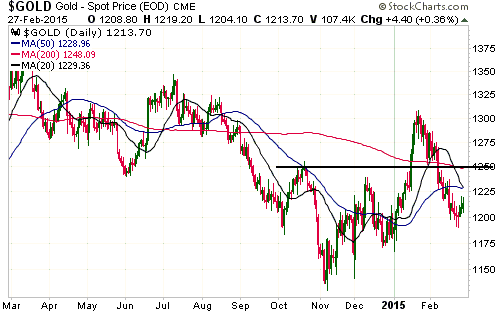
"Our impression is that gold's correction has done as much as it needed to do
(in US$ terms, but not in terms of the euro and some other currencies), but this
doesn't imply that the correction is over. We suspect that a short-term bottom
is either in place or will be put in place next week, after which there will be
a multi-week rally that results in a lower high for the year in gold bullion and
a higher high for the year in the HUI."
Nothing of significance has changed since the Interim Update.
Gold's rebound during the second half of last week wasn't strong enough to
signal the start of the expected multi-week rally, but the on-going strength in
the gold-mining indices relative to gold bullion (the HUI/gold ratio is not far
below its January peak) and the fact that the rebound followed a spike below
$1200 are reasons for optimism.
Gold Stocks
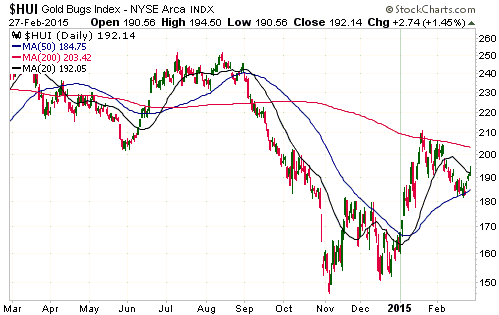
The HUI tested its 50-day MA and lateral support at 180 during the first half of
last week and then rebounded to its 20-day MA. The price action continues to be
consistent with a routine short-term correction, but the rebound during the
second half of last week wasn't strong enough to signal an end to the
correction. A preliminary signal would be generated by a daily close above the
20-day MA.
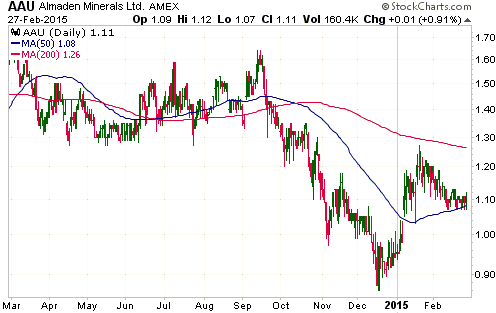
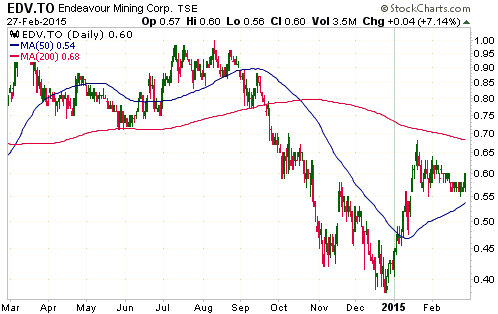
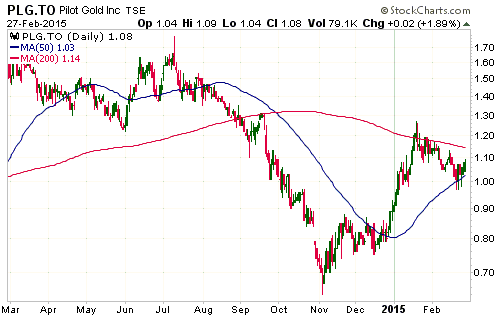
Like the HUI, many individual gold stocks have experienced what currently appear
to be normal pullbacks to near their 50-day MAs. Three examples from the TSI
Stocks List are shown below. Some stocks have done better and some stocks have
done worse, but the three depicted below are typical.
The Currency Market
During the final two days of last week the Dollar Index broke out to the upside
from its narrow, contracting range. This paves the way for a test of the January
high or a marginal new high within the next several days, but does not point to
a substantial extension of the upward trend that began in mid-2014.
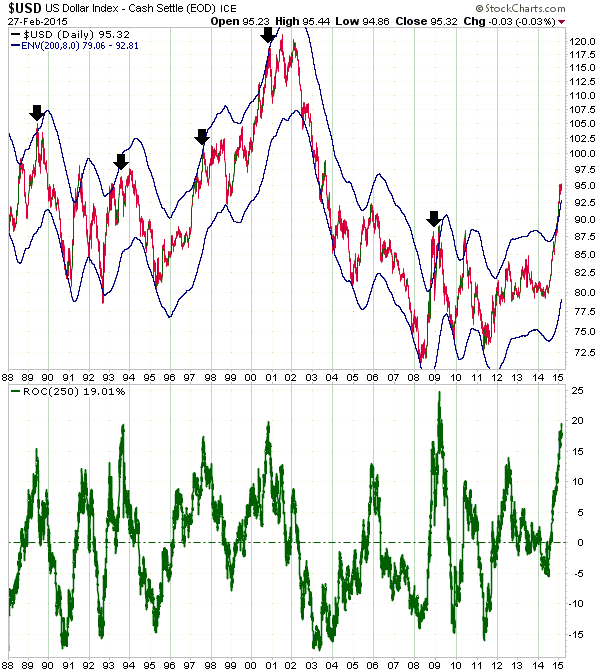
A substantial extension of the Dollar's upward trend is very unlikely. The
reason is illustrated by the following chart.
The bottom section of the chart shows that last week's upside breakout from a
narrow multi-week trading range has pushed the Dollar Index's 250-day rate of
change (ROC) to 19%. Based on this ROC and the Dollar Index's position relative
to the MA envelope indicated on the top section of the chart, a comparable
situation has occurred only five times over the past 27 years. These comparable
situations are identified by downward-pointing arrows on the top section of the
chart.
Regardless of whether or not the Dollar Index makes a marginal new high during
the days immediately ahead, the historical record suggests two intermediate-term
possibilities. Neither of these possibilities is bullish.
The first possibility, which we think has the lower probability, is that a
multi-quarter downward trend is about to begin. The second and more likely
possibility is that a high during the coming six trading days will be followed
by this sequence:
1) A sharp multi-week decline of at least 5 points
2) A rally to slightly above the January-March peak
3) A larger decline
Updates
on Stock Selections
Notes: 1) To review the complete list of current TSI stock selections, logon at
http://www.speculative-investor.com/new/market_logon.asp
and then click on "Stock Selections" in the menu. When at the Stock
Selections page, click on a stock's symbol to bring-up an archive of
our comments on the stock in question. 2) The Small Stock Watch List is
located at http://www.speculative-investor.com/new/smallstockwatch.html
 Company
news/developments for the week ended Friday 27th February 2015: Company
news/developments for the week ended Friday 27th February 2015:
[Note: AISC = All-In Sustaining Cost, FS = Feasibility Study, IRR = Internal
Rate of Return, MD&A = Management Discussion and Analysis, M&I = Measured and
Indicated, NAV = Net Asset Value, NPV(X%) = Net Present Value using a discount
rate of X%, P&P = Proven and Probable, PEA = Preliminary Economic Assessment,
PFS = Pre-Feasibility Study]
*Clifton Star (CFO.V) published its financial report for the
quarter ending 31st December 2014. The report showed that the company had
working capital of about C$3M at the end of last year. This is sufficient to
keep the doors open and continue the legal action against Osisko's new owners (Agnico
Eagle and Yamana Gold) for a few more quarters, but nothing more.
With the option on the Duparquet project having been allowed to expire and with
there seemingly being no chance to replace current senior management prior to a
shareholders meeting scheduled for June, the only reason to continue holding CFO
is the potential for a positive settlement of the aforementioned legal action.
The legal action relates to a C$22.5M loan that should have been provided to CFO
by Osisko in 2012, but wasn't.
At Friday's closing price of C$0.10/share, CFO's current market cap and
enterprise value are only C$4M and C$1M, respectively.
*Dalradian Resources (DNA.TO) reported that almost all of its
C$0.90 February-2015 warrants were exercised, resulting in a C$8.6M cash
injection. Taking into account the cash from the warrant exercise and the recent
$11M equity placement to Ross Beaty, we estimate that DNA currently has about
C$50M of cash in its treasury. This gives it one of the strongest balance sheets
in the world of exploration-stage gold miners.
DNA moved to an 18-month high last week, making it a standout performer in a
generally lacklustre equity sector. This prompted us to take another look at its
valuation.
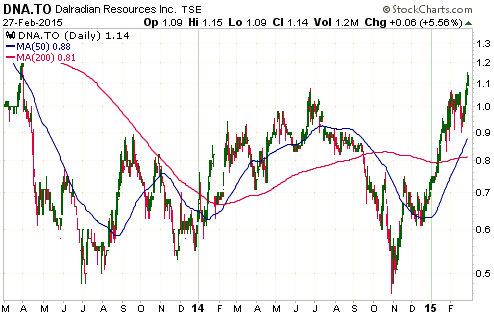
Since we last looked at DNA's valuation the stock price has increased from
around C$0.60 to C$1.14, the share count has increased from 140M to 163M, and
some cash has been added to the balance sheet. What we found is that despite the
substantial percentage increase in market cap associated with the rising share
count and share price, DNA still offers good value. In fact, based on the
economics indicated in the October-2014 PEA for its Curraghinalt gold project in
Northern Ireland, DNA is still one of the best value propositions in the world
of exploration-stage gold mining stocks, with valuation-related upside potential
at today's gold price of around 100%.
The most important caveat is that the 'P' is in PEA (Preliminary Economic
Analysis) for a good reason. Assumptions are made in a PEA that might not
survive more rigorous testing and engineering. According to DNA's current
schedule, the more rigorous testing and engineering needed to generate a PFS
will be completed before the end of this year.
A pullback to the low-C$0.80s would create an excellent opportunity for new
buying, but that's unlikely to happen in the near future.
*Endeavour Mining (EDV.TO, EVR.AX) reported unexpectedly bad
financial results for the final quarter of 2014. We are referring to the
reported deterioration in its net-debt position (long-term debt plus
cash-related liabilities minus working capital), not the large impairment charge
associated with the accounting values of its mining assets. The impairment
charge is mostly the result of a lowered gold price assumption.
EDV reported a $70M deterioration in its net debt position for the final quarter
of last year. This was unexpectedly bad, in that based on the excellent Q4
production results that were reported in January we had expected to see an
improvement in the balance sheet. $23M of the deterioration was due to a tax
payment that we should have expected, but most of it was due to large capital
expenditures at the Tabakoto project (Mali).
According to the company, the growth-related capital spending program is now
compete and non-sustaining capital expenditure will be only $20M during 2015,
which is about $100M less than it was in 2014. Based on other information
provided by EDV, at a gold price of $1200/oz this should allow the company to
add US$50M-US$80M to its balance sheet in 2015. At a gold price of
$1300-$1350/oz, which is where we currently expect the 2015 average to be, the
net cash addition would likely be in the $100M-$150M range.
Based on its balance sheet and forecast 2015 production details, we think that
EDV would be fully valued at around C$1.00/share assuming a gold price $1200/oz.
In other words, we perceive 65%-70% valuation-related upside potential in EDV
assuming no change in the gold price. At a significantly higher gold price
assumption, the valuation-related upside potential would be much greater. For
example, we estimate that an increase in the gold price from $1200/oz to
$1350/oz would increase EDV's valuation from C$1.00/share to C$1.50/share.
*The stock price of Evolution Mining (EVN.AX) fell 10% last Friday
on massive volume. The sole reason for the decline was the sale by Newcrest
Mining of more than half of its EVN shares at a 10% discount to the market
price. As a result, Newcrest's EVN stake has fallen from 32.3% to 14.9%.
Newcrest is selling down its EVN position in an effort to strengthen its own
balance sheet, not due to a problem with EVN. In fact, it was EVN's relatively
good performance over the recent past that created the opportunity for Newcrest
to sell.
*UEX Corp. (UEX.TO) reported the results of the first 19 holes of
its drilling program at the 100%-owned Hidden Bay project in Canada's Athabasca
Basin. The press release was quite technical, but from our perspective the
salient line was: "Anomalous radioactivity was not observed in the down-hole
surveys".
List of candidates for new buying
From within the ranks of TSI stock selections the best candidates
for new buying at this time, listed in alphabetical order, are:
1) AAU (last Friday's closing price: US$1.11).
2) AKG (last Friday's closing price: US$1.58).
3) EDV.TO (last Friday's closing price: C$0.60).
4) EVN.AX (last Friday's closing price: A$0.84).
5) TGD (last Friday's closing price: US$0.88).
Note that the above list is limited to five stocks. It will
sometimes contain less than five, but it will never contain more
than five regardless of how many stocks are attractively priced for
new buying.
Chart Sources
Charts appearing in today's commentary
are courtesy of:
http://stockcharts.com/index.html

|









