|
-- Weekly Market Update for the Week Commencing
2nd June 2014
Big Picture
View
Here is a summary of our big picture
view of the markets. Note that our short-term views may differ from our
big picture view.
In nominal dollar terms, the BULL market in US Treasury Bonds
that began in the early 1980s ended in 2012. In real (gold)
terms, bonds commenced a secular BEAR market in 2001 that will continue
until 2018-2020. (Last
update: 20 January 2014)
The stock market, as represented by the S&P500 Index,
commenced
a secular BEAR market during the first quarter of 2000, where "secular
bear market" is defined as a long-term downward trend in valuations
(P/E ratios, etc.) and gold-denominated prices. This secular trend will bottom sometime between 2014 and 2020.
(Last update: 22 October 2007)
A secular BEAR market in the Dollar
began during the final quarter of 2000 and ended in July of 2008. This
secular bear market will be followed by a multi-year period of range
trading.
(Last
update: 09 February 2009)
Gold commenced a
secular bull market relative to all fiat currencies, the CRB Index,
bonds and most stock market indices during 1999-2001.
This secular trend will peak sometime between 2014 and 2020.
(Last update: 22 October 2007)
Commodities,
as represented by the Continuous Commodity Index (CCI), commenced a
secular BULL market in 2001 in nominal dollar terms. The first major
upward leg in this bull market ended during the first half of 2008, but
a long-term peak won't occur until 2014-2020. In real (gold) terms,
commodities commenced a secular BEAR market in 2001 that will continue
until 2014-2020.
(Last
update: 09 February 2009)
Copyright
Reminder
The commentaries that appear at TSI
may not be distributed, in full or in part, without our written permission.
In particular, please note that the posting of extracts from TSI commentaries
at other web sites or providing links to TSI commentaries at other web
sites (for example, at discussion boards) without our written permission
is prohibited.
We reserve the right to immediately
terminate the subscription of any TSI subscriber who distributes the TSI
commentaries without our written permission.
Outlook Summary
Market
|
Short-Term
(1-3 month)
|
Intermediate-Term
(6-12 month)
|
Long-Term
(2-5 Year)
|
|
Gold
|
Neutral
(02-Jun-14) |
Bullish
(26-Mar-12) |
Bullish
|
|
US$ (Dollar Index)
|
Bearish
(16-Apr-14) |
Bearish
(27-Jan-14) |
Neutral
(19-Sep-07) |
|
Bonds (US T-Bond)
|
Bullish
(11-Dec-13)
|
Neutral
(18-Jan-12)
|
Bearish |
|
Stock Market
(DJW)
|
Bearish
(07-Apr-14) |
Bearish
(28-Nov-11) |
Bearish
|
|
Gold Stocks
(HUI)
|
Neutral
(02-Jun-14) |
Bullish
(23-Jun-10) |
Bullish
|
|
Oil |
Neutral
(02-Jun-14) |
Neutral
(31-Jan-11) |
Bullish
|
|
Industrial Metals
(GYX)
|
Neutral
(17-Feb-14) |
Bullish
(28-Apr-14) |
Bullish
(28-Apr-14) |
Notes:
1. The date shown below the current outlook is when the most recent outlook change occurred.
2. "Neutral", in the above table, means that we either don't have a
firm opinion or that we think risk and reward are roughly in balance with respect to the timeframe in question.
3. Long-term views are determined almost completely by fundamentals,
intermediate-term views by
fundamentals, sentiment and technicals, and short-term views by sentiment and
technicals.
T-Bond Update
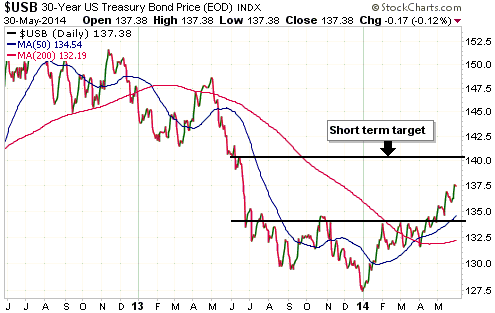
Despite the upward trend in the T-Bond price
and the downward trend in the T-Bond yield that began almost 6 months ago, the
Commitments of Traders (COT) data tells us that the average speculator continues
to stubbornly bet on a lower price and a higher yield. This suggests that the
T-Bond will make significant additional price gains over the months ahead.
However, on a short-term basis the T-Bond price is now stretched to upside. It
is also within three points of the initial chart-based objective created by the
break above the top of its multi-quarter basing pattern (refer to the daily
chart displayed below).
The T-Bond price will probably reach its initial chart-based objective of 140
before entering 'correction mode', but probably won't do much more than that.
Therefore, our short-term outlook for this market will automatically shift from
"bullish" to "neutral" if T-Bond futures trade at 139.50.
Oil Update
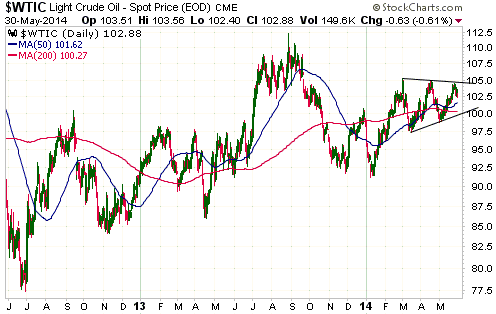
The oil futures market has short-term resistance
at $105 and short-term support at $100. It therefore ended last week
approximately mid-way between support and resistance. We have been anticipating
a sizeable move to the downside to complete the oil market's multi-year
consolidation, but the price action suggests that a break above resistance and
an ensuing rise to test the 2013 high ($110-$112) is just as likely as a break
below support and an ensuing decline to test last year's low (around $92). Our
short-term oil outlook has therefore shifted from "bearish" to "neutral".
 The Stock
Market
The NASDAQ100 Index (NDX) ended last week
within 2 points of its March-2014 peak. This means that it hasn't yet confirmed
the new high in the S&P500 Index (SPX).
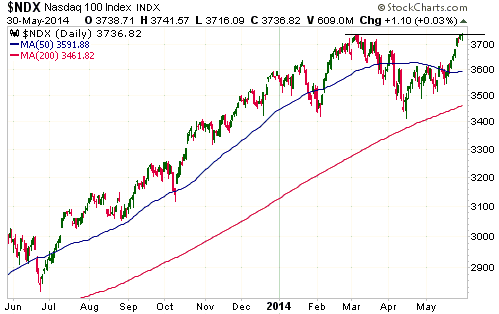
The NDX's failure to confirm the new highs made by the SPX over the past two
months is a bearish omen, but it isn't the most important bearish omen. These
are of greater importance:
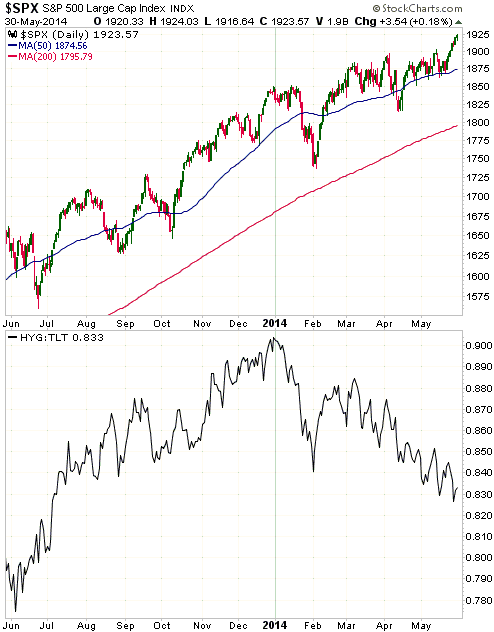
1. As illustrated by the following chart, last week's new high for the year by
the SPX was accompanied by a new low for the year by the HYG/TLT ratio (junk
bonds relative to Treasury bonds). This means that while a group of large-cap US
stocks is acting as if there is nothing to worry about, the credit market is
beginning to point to increasing risk aversion and worsening growth prospects.
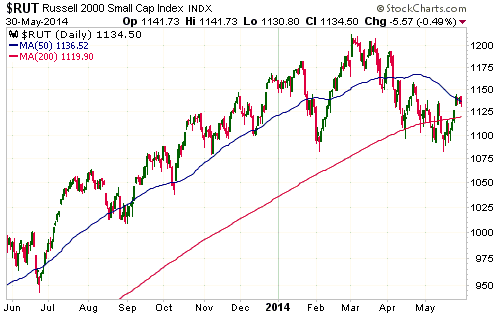
2. The Russell2000 Small-Cap Index (RUT) peaked in March and has done no more
over the past two weeks than rebound to the vicinity of its declining 50-day MA.
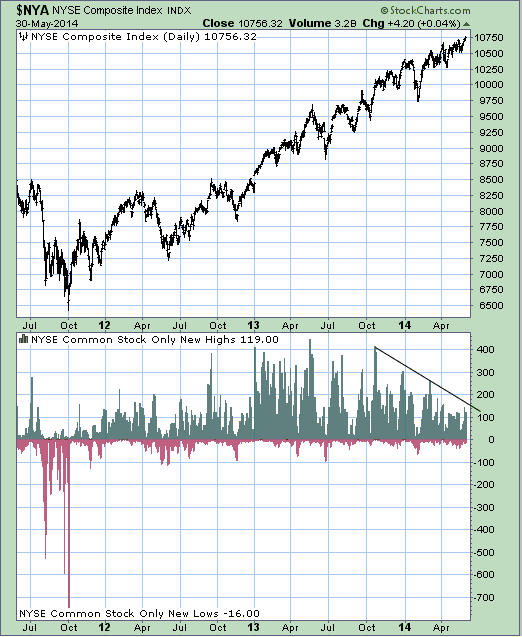
3. The following chart shows that the number of individual NYSE common stocks
making new 52-week highs peaked above 400 last October and has since made a
sequence of lower highs. Despite the SPX and the NYSE Composite closing at new
all-time highs last Friday, on the same day only 119 individual NYSE common
stocks made new 52-week highs. This means that the stock market's advance
continues to get narrower.
4. The major bank stocks are performing poorly relative to the SPX, with the BKX/SPX
ratio ending last week only slightly above its 52-week low.
The evidence continues to indicate that a top of at least intermediate-term
significance is close at hand in the SPX and is already in place in some other
stock indices. This won't change if the NDX makes a new high for the year over
the days ahead, although a new high for the NDX would usher in the possibility
that the overall topping process will continue for a few more months.
This week's
important US economic events
| Date |
Description |
| Monday Jun 02 |
Construction Spending
ISM Mfg Index | | Tuesday
Jun 03 |
Motor Vehicle Sales
Factory Orders | | Wednesday
Jun 04 |
Q1 Productivity and Costs (revised)
ISM Non-Mfg Index
International Trade Balance
Fed's Beige Book | | Thursday
Jun 05 |
No important events scheduled
|
| Friday Jun 06 |
Monthly Employment Report
Consumer Credit |
Gold and
the Dollar
Gold
The "Golden Cross" and the "Death Cross"
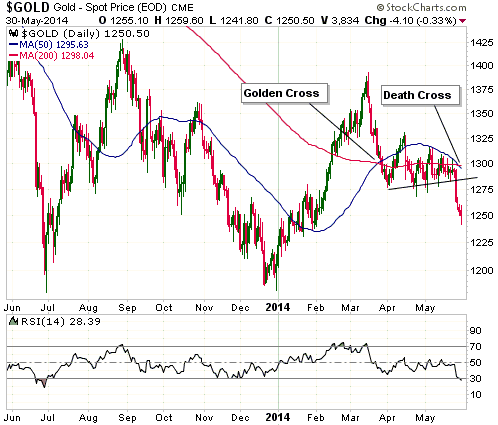
There was a "Golden Cross" in the gold market during the second half of March.
It worked the way that the historical record indicated it would work (it marked
a high of at least short-term importance), which happens to be the opposite of
the way that most commentators and analysts believe it is supposed to work. To
further explain, here is an excerpt from our 19th March commentary:
"While on the subject of false beliefs, another one that will soon come into
play in the gold market is the "Golden Cross". A Golden Cross is defined as a
move -- in any market -- by the 50-day MA from below to above the 200-day MA.
Its opposite (a move by the 50-day MA from above to below the 200-day MA) is
often referred to as a Death Cross.
There is widespread belief that Death Crosses are bearish and Golden Crosses are
bullish, but nobody who has bothered to check the historical record could hold
this belief. Here are the facts:
1) A sizeable majority of Death Crosses in major financial markets occur near
lows of at least short-term importance. A Death Cross therefore tends to be a
BULLISH signal.
2) On average, a Golden Cross has no predictive value. The historical record
suggests that it is neither reliably bullish nor reliably bearish. However, in
the gold market a particular type of Golden Cross has generally occurred near a
high of at least short-term importance. We are referring to the situation where
the cross occurs after the 50-day MA has risen from a long way below the 200-day
MA. This is the situation we will be dealing with if -- as is very likely -- the
gold market achieves a Golden Cross in the near future."
As illustrated by the following daily chart, the gold market's March-2014 Golden
Cross occurred about one week after a multi-month price high. There has since
been sufficient price weakness to pull the 50-day MA below the 200-day MA,
creating a so-called Death Cross. The Death Cross occurred last week. Contrary
to popular belief, the historical record indicates that this is a bullish
signal.
Current Market Situation
Last week, gold broke below support at $1280 and quickly dropped to the $1250s.
This means that last week's price action extended the downward correction.
Furthermore, the decline to the $1250s did not immediately lead to a reversal,
which means that there is no evidence that the correction has ended.
Our short-term outlook was wrong. First, we didn't expect gold to break below
$1280. Second, we thought that if a break below $1280 and a quick decline to the
$1250s did occur it would lead to a reversal within a few days. There could be a
reversal this week, but the price has deviated far enough from the expected path
to shift our short-term outlook to "neutral".
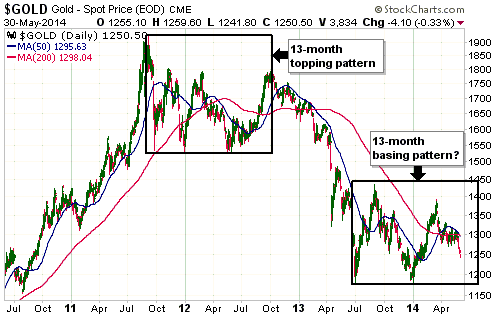
The recent price action ushers in the possibility that the gold market is
bottoming in a similar way to how it topped during 2011-2012. In particular, we
note that a major downward trend didn't get underway until about 13 months after
the 2011 top. If the bottoming/basing pattern turns out to be symmetrical to the
topping pattern, then a major upward trend won't get underway until about 13
months after the end-June 2013 bottom. Early-August 2014, in other words. The
following chart shows the potential top-bottom symmetry.
The future of any market price is never certain, but the fundamental backdrop,
which turned decisively bullish for gold in April of this year, indicates with
near certainty that a complex basing pattern -- as opposed to a lengthy sideways
move within a continuing bear market -- is what we are dealing with. On an
intermediate-term basis we therefore couldn't be more bullish.
On a short-term basis, $1230 (plus or minus a few dollars) is the chart-based
objective created by the break below support at $1280. In the absence of a quick
rebound that generates a daily close above $1280, this chart-based objective
will be a likely target for a short-term bottom.
Silver
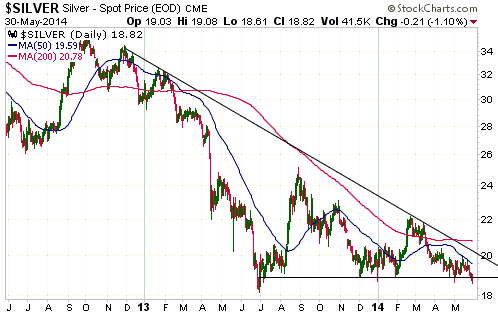
Silver just achieved its lowest daily and weekly closes since last June. It is
'oversold' and probably close to a bottom, but last week's break below support
at $19.00 suggests that the June-2013 low will be fully tested before an upward
trend gets underway.
Gold Stocks
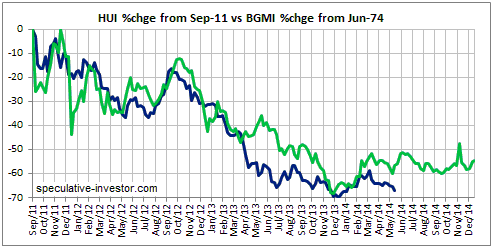
The gold sector's price action of the past two years has the most in common with
its price action during the final 18 months of the mid-1970s cyclical bear
market and the first 6 months of the late-1970s cyclical bull market. The
similarities are evident on the following weekly chart. However, last week's
price action constituted a divergence from the 'road map' created by the BGMI's
performance during the mid-to-late 1970s. This doesn't make it more likely that
a bear market is still in progress; it just makes it more difficult to get a
handle on the likely short-term performance.
The HUI's break below support at 215-220 and failure to immediately reverse
upward from the more important support at 205-210 was a bearish departure from
the expected short-term path, but the recent bullish divergence between the HUI
and the GDXJ/GDX ratio remains intact. In fact, the aforementioned bullish
divergence became more pronounced last week. Refer to the following daily chart
for details.
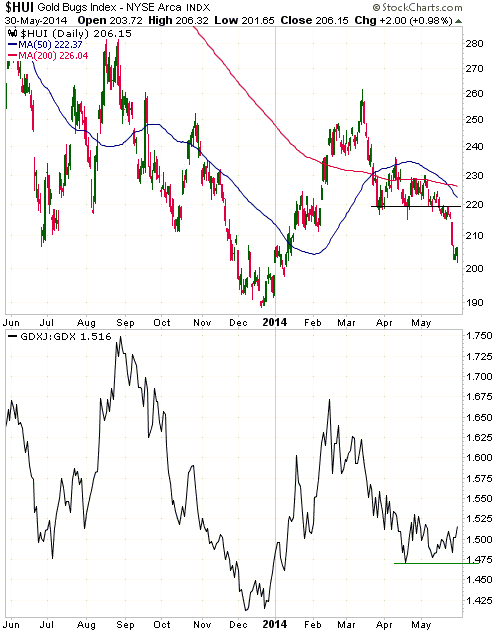
While the bullish divergence between the HUI and the GDXJ/GDX ratio suggests
that a short-term bottom has either just been put in place or will be put in
place within the next few days near last week's low, the extension of gold
bullion's downward correction suggests that the HUI could test its December-2013
bottom before commencing a multi-month advance. The latter possibility indicates
additional downside risk of around 15 points. At the same time, a counter-trend
rebound would be limited by former support (now resistance) at 215-220.
The uncertainty reflected by the above paragraph has prompted a shift in our
short-term outlook from "bullish" to "neutral".
The Currency Market
There is great anticipation about what the ECB will decide at its meeting this
coming Thursday. Clear hints have been given by senior ECB representatives that
new actions will be taken to promote inflation, but the details are unclear.
It's possible that a QE program will be introduced, but it's more likely that
the ECB's actions will be confined to additional downward manipulation of
interest rates. Given that the ECB directly controls three separate interest
rates (the Refi Rate, the Deposit Rate and the Lending Rate), the question then
becomes: which interest rate(s)?
One of the most lame-brained things that the ECB could decide to do is reduce
the Deposit Rate (the interest rate paid to banks for money deposited overnight
with the ECB). The reason is that it is already at zero, so a reduction would
result in a negative interest rate. However, a negative Deposit Rate is a likely
outcome according to many pundits. The idea would be to prod banks into making
more loans, even if they happen to be financially stretched and unable to find
qualified borrowers. It is Keynesian economics taken to a new absurd level.
A negative Deposit Rate would be bearish for the euro's exchange rate, but the
euro's sharp pullback of the past three weeks might have already discounted such
a development. We say this because the speculative net-short position in euro
futures just hit a 10-month high and because the euro's daily RSI just hit its
lowest level in almost two years (refer to the chart displayed below).
The market reaction to the outcome of this week's ECB meeting is certainly going
to be interesting. The stage appears to be set for an upward reversal, but the
close proximity to support (the 200-day MA and a poorly-defined trend-line
dating back to mid-2012) makes the technical situation precarious.
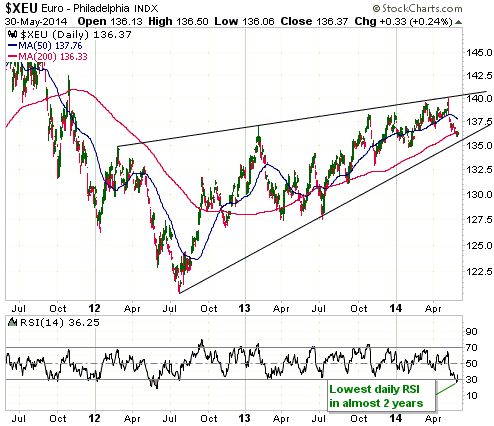
While the euro should be close to a pullback low, the chart pattern is neutral
(not providing any clues regarding the next move of significance). The euro
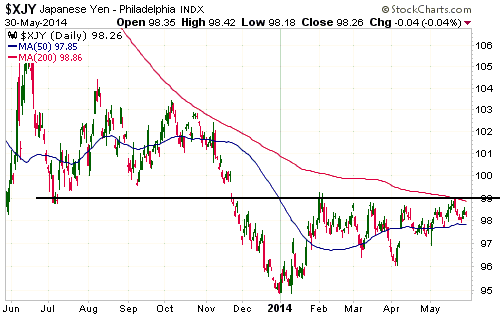
could break either way over the next couple of weeks. The Yen, however,
continues to 'coil' in preparation for what we expect to be a tradable move to
the upside.
Updates
on Stock Selections
Notes: 1) To review the complete list of current TSI stock selections, logon at
http://www.speculative-investor.com/new/market_logon.asp
and then click on "Stock Selections" in the menu. When at the Stock
Selections page, click on a stock's symbol to bring-up an archive of
our comments on the stock in question. 2) The Small Stock Watch List is
located at http://www.speculative-investor.com/new/smallstockwatch.html
 Company
news/developments for the week ended Friday 30th May 2014: Company
news/developments for the week ended Friday 30th May 2014:
[Note: AISC = All-In Sustaining Cost, FS = Feasibility Study, IRR =
Internal Rate of Return, MD&A = Management Discussion and Analysis,
M&I = Measured and Indicated, NAV = Net Asset Value, NPV(X%) = Net
Present Value using a discount rate of X%, P&P = Proven and
Probable, PEA = Preliminary Economic Assessment, PFS =
Pre-Feasibility Study]
*Clifton Star Resources (CFO.V) issued its mandatory reports for
the March quarter.
CFO's latest financial statements reveal $2.5M of working capital at
31st March, including $1.8M of cash. To proceed with a Feasibility
Study at its Duparquet project the company will therefore have to
raise more cash, but raising a meaningful amount of cash at a
reasonable cost would be impossible for CFO under current market
conditions.
We expect that CFO will conserve its cash over the next couple of
quarters by doing very little to advance its gold project and
devoting the small financial resources at its disposal to the legal
pursuit of the $22.5M loan that -- according to CFO -- should have
been provided by Osisko 18 months ago. This loan will soon be the
obligation of the Agnico Eagle (AEM) -Yamana Gold (AUY) joint
venture, which is in the process of buying Osisko.
Taking legal action to obtain the above-mentioned $22.5M loan is
currently the best way for the company to use its limited resources,
because doing so could prompt the AEM-AUY joint venture to settle
the matter by purchasing CFO or doing some other deal that would
benefit CFO shareholders.
*Dragon Mining (DRA.AX) has sold two early-stage non-core projects
in Northern Finland to Aurion Resources (AU.V). The deal is not
financially significant for DRA.
*Premier Gold (PG.TO) reported results from drilling at its Cove
gold-silver project in Nevada. Some of the intercepts were
interesting. For example: 182.87 grams per tonne gold across 1.5
metres and 40.23 grams per tonne gold across 4.9 metres. However, it
is too early in the exploration of this project to know the
significance of these results.
Of greatest interest to us at this time is PG's 7M-oz Hardrock
project in Ontario, which presently accounts for almost all of PG's
value. This project has just entered the Feasibility stage and is
scheduled to have a new resource estimate within the next month.
*Ramelius Resources (RMS.AX) reported some decent drilling
intercepts from its Vivien gold project and a narrow high-grade
intercept from exploration at its Coogee project. The plan is for
the Vivien project to be developed into a small-scale low-cost
underground gold mine. This plan is supported by the results of a
Feasibility Study that were also reported last week.
According to the FS, the Vivien project could be developed into an
underground gold mine that produces around 100K ounces of gold at an
AISC of around US$830/oz over a 30-month period. It is estimated
that mine construction would cost A$20M and would take 8 months. An
unanswered question at this time is: How will the $20M be obtained?
Raising this money via an equity financing near the current share
price would greatly reduce the value of an RMS share.
In other news, RMS has arranged to farm-in on some exploration
licenses in the Tanami Complex of Australia's Northern Territory.
Under the terms of the deal, RMS can earn an 85% interest in the
prospects by spending $500K on exploration over three years. The
deal is not financially significant for RMS at this time.
*True Gold Mining (TGM.V), a new addition to the TSI List (as
notified in the Market Alert email sent to subscribers on 28th May),
had three noteworthy announcements last week.
First, TGM announced that the construction of its Karma open-pit
gold mine in Burkina Faso has commenced. The first gold pour is
scheduled to happen at the end of next year.
Second, TGM announced that detailed engineering work had uncovered
almost $10M of potential cost savings related to the Karma project's
initial capex. This reduces the risk that the actual cost to build
the mine will be higher than the $132M figure included in the FS.
Third, the company published its financial report for the March
quarter. The report shows that TGM had $63M of working capital at
31st March.
Is TGM a takeover candidate?
Possibly, but the fact that TGM raised almost half the cash needed
to build its mine via a large equity financing earlier this year and
will soon have debt in place for the balance suggests that a
takeover is not likely within the next several months. In our
opinion, if TGM were going to be taken over it would have happened
prior to the construction financing being put in place.
That being said, B2GOLD (BTG) is one company that could be
interested in acquiring TGM. This is due to BTG's relatively
expensive shares and the apparent desire of its management to expand
into West Africa. However, rumour has it that BTG is about to make a
bid for Papillon Resources (PIR.AX), a company with a lucrative gold
deposit in Mali. If so and a deal is done, a BTG bid for TGM would
be almost out of the question this year. It is also worth mentioning
that a takeover bid for TGM by Endeavour Mining (EDV.TO) can't be
ruled out, although such a turn of events wouldn't make financial
sense for EDV at this time due to the relative cheapness of EDV
shares and the fact that this company already owns a
Feasibility-stage gold project in Burkina Faso (the Hounde project).
Review
of price action for individual stocks
Last week (in the 26th May Weekly Update) we pointed out that the stocks of
companies that have economically-viable businesses at the current gold price had
generally held up well and appeared to be completing, or in a few cases to have
already completed, routine corrections. AAU, AKG, EDV.TO, EVN.AX, LYD.TO, ORE.TO,
PG.TO, PLG.TO, PVG and TGM.V (potential future TSI stock at that time, but now
current TSI stock) were the examples we cited from the TSI Stocks List. Despite
the ensuing downside breakouts in the gold-stock indices, with one exception the
chart patterns of the aforementioned stocks did not become more bearish over the
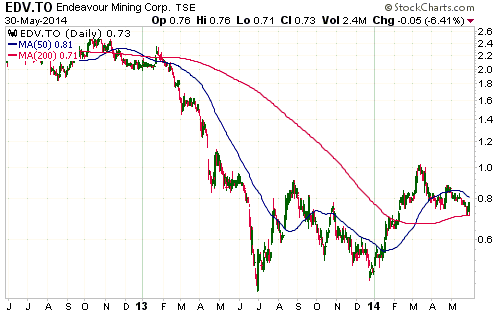
past week. The one exception is EDV.TO, which broke below important support at
C$0.75 (see chart below). However, even in this case the 200-day MA limited the
damage.
List
of candidates for new buying
From within the ranks of TSI stock selections, the best candidates for new
buying at this time are:
1) EDV.TO (last Friday's closing price: C$0.73).
2) EVN.AX (last Friday's closing price: A$0.78).
3) PLG.TO (last Friday's closing price: C$1.24).
4) TGM.V at C$0.35 (last Friday's closing price: C$0.37).
Potential
new TSI stock selection: Timmins Gold (TGD, TMM.TO). Shares: 164M issued, 175M
fully diluted. Recent price: US$1.25
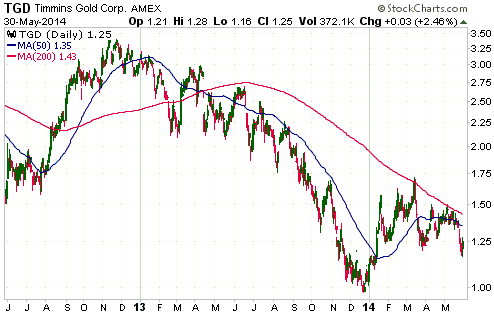
As mentioned in the 28th May Market Alert email, Timmins Gold will be added to
the TSI Stocks List if it trades at US$1.10. This entry price is just above
major support at US$1.00, which could be tested in the near future as part of a
'wash-out' decline.
TGD is a widely-followed stock in the gold-mining universe and has been known to
us for a few years. In many ways it is similar to Rio Alto (RIOM), in that it
operates a single, technically-simple and profitable gold mine in Latin America.
Prior to the decision by RIOM's management to pay way-over-the-top for Sulliden
Gold (SUE.TO) it didn't offer as much value as RIOM, which is why it hasn't
previously been seriously considered for the TSI List. However, due to the
RIOM-SUE.TO deal TGD not only offers good value in absolute terms; it offers
materially better value than RIOM.
Here's an overview of TGD's story and speculative merits:
1) TGD owns the San Francisco (SF) gold mine in Mexico. This mine consists of
two open pits -- the in-production San Francisco pit and the development-stage
La Chicharra pit.
2) The SF mine has 1.9M ounces of gold in the M&I category, including 1.6M
ounces of P&P reserves, as well as 1.8M ounces of gold in the Inferred category.
3) As at 31st March the company had no long-term debt and US$67M of working
capital, including US$44M of cash.
4) Based on Friday's closing price of US$1.25, the current market cap is US$205M
and the enterprise value is US$138M.
3) Q1-2014 production was 35K ounces at an AISC of $790/oz. This production
resulted in a bottom-line profit of $8.1M.
4) Annualising the Q1-2014 profit yields a P/E ratio of only 4.3, although
actual earnings for 2014 will be determined to a large extent by what happens to
the gold price during the second half of the year. Also, production is expected
to be a little lower over the next couple of quarters.
5) 2014 guidance is for production of around 120K ounces, which means that TGD
is currently being valued by the stock market at only $1150 per ounce of
expected 2014 production. This is low for a profitable miner operating in
politically secure location.
6) The mine life at this time is about 10 years, but the conversion of existing
resources to reserves and the discovery of new resources should enable the mine
life to be extended.
TGD is a reasonable candidate for new buying at its current price, but in the
depressed market environment of today we think we can afford to be stingier than
usual.
Chart Sources
Charts appearing in today's commentary
are courtesy of:
http://stockcharts.com/index.html

|









