|
-- Weekly Market Update for the Week Commencing 2nd July 2007
Big Picture
View
Here is a summary of our big picture
view of the markets. Note that our short-term views may differ from our
big picture view.
Bonds commenced a secular BEAR market in
June of 2003. (Last
update: 22 August 2005)
The stock market, as represented by the S&P500 Index, commenced a secular BEAR market during the first quarter of 2000. The rally
that
began in October of 2002 will end during the first half of 2007. The ultimate bottom of
the secular bear market won't occur until the next decade. (Last update: 02 October 2006)
The Dollar commenced a secular BEAR market during the final quarter of 2000. The
first major downward leg in this bear market ended during the first
quarter of 2005, but a long-term bottom won't occur until 2008-2010. (Last update: 28 March 2005)
Gold commenced a
secular bull market relative to all fiat currencies, the CRB Index,
bonds and most stock market indices during 1999-2001. The first major
upward leg in this secular bull market ended in December of 2003, but a
long-term peak won't occur until at least 2008-2010. (Last update: 13
February 2006)
Commodities, as
represented
by the CRB Index, commenced a secular BULL market in 2001. The first
major upward leg in this bull market ended during the second quarter of
2006, but a long-term
peak won't occur until at least 2008-2010. (Last update: 08 January 2007)
Copyright
Reminder
The commentaries that appear at TSI
may not be distributed, in full or in part, without our written permission.
In particular, please note that the posting of extracts from TSI commentaries
at other web sites or providing links to TSI commentaries at other web
sites (for example, at discussion boards) without our written permission
is prohibited.
We reserve the right to immediately
terminate the subscription of any TSI subscriber who distributes the TSI
commentaries without our written permission.
Outlook Summary
Market
|
Short-Term
(0-3 month)
|
Intermediate-Term
(3-12 month)
|
Long-Term
(1-5 Year)
|
Gold
|
Neutral
(16-May-07)
|
Bearish
(21-May-07)
|
Bullish
|
US$ (Dollar Index)
|
Bullish
(11-Jun-07)
| Bullish
(31-May-04)
|
Bearish
|
Bonds (US T-Bond)
|
Neutral
(26-Mar-07)
|
Bearish
(26-Mar-07)
|
Bearish
|
Stock Market (S&P500)
|
Neutral
(13-Jun-07)
|
Neutral
(26-Mar-07)
|
Bearish
|
Gold Stocks (HUI)
|
Neutral
(16-May-07)
|
Bearish
(21-May-07)
|
Bullish
|
| Oil | Neutral
(12-Mar-07)
| Neutral
(25-Sep-06)
| Bullish
|
Industrial Metals (GYX)
| Bearish
(11-Jun-07)
| Neutral
(26-Mar-07)
| Bullish
|
Notes:
1. In those cases where we have been able to identify the commentary in
which the most recent outlook change occurred we've put the date of the
commentary below the current outlook.
2. "Neutral", in the above table, means that we either don't have a
firm opinion on which way the market will move or that we expect the
market to be trendless during the timeframe in question.
3. Long-term views are determined almost completely by fundamentals,
intermediate-term views by giving an approximately equal weighting to
fundmental and technical factors, and short-term views almost
completely by technicals.
A logical inconsistency of monumental proportions
...the
central bank's purpose is NOT to set the price of credit at the CORRECT
level... Instead, the main purpose of the central bank is to facilitate
inflation by ensuring that the real price of credit remains at an
artificially LOW level...
Most economists can readily explain why it would make no sense for a
government committee to set the price of eggs. They will tell you,
quite rightly, that no committee could ever gather sufficient
information and react quickly enough to changing circumstances to
ensure that the egg price set by the committee was consistently
equivalent to the price that brought supply and demand into balance.
They will also tell you, again quite rightly, that the price-setting
errors that would inevitably be made by such a committee would create
problems in the egg market. Specifically, they will point out that
setting the price of eggs too high would create a glut because egg
producers would respond to the artificially high price by producing
more at the same time as egg consumers were responding to the
artificially high price by consuming less; and that setting the price
of eggs too low would create a shortage because it would cause
producers to cut back at the same time as consumers were trying to take
advantage of the low price by ramping-up their buying.
None of this is rocket science. It is, in fact, the main reason why
Socialism and its various derivations (Communism, Fascism,
Welfare-Statism, Interventionism, etc.) don't work and free markets do
work. Strangely, though, when it comes to central banking many of the
economists and financial market commentators who claim to believe in
free markets dispense with this fundamental logic. They have no
difficulty explaining why a central planning agency could not
consistently set the correct price of something as simple as the humble
egg regardless of how well-intentioned and well-funded this agency
happened to be, and yet in the next breath they will argue that a
central bank -- a central planning agency responsible for setting the
price of something as complex as credit -- is a good thing. In doing so
they prove that they are either disingenuous (they don't really believe
in free markets at all) or clueless.
As is the case with eggs, when a central planning agency responsible
for setting the price of credit (the interest rate) gets it wrong the
inevitable result will either be a glut or a shortage of credit,
although there is an important difference between the egg market and
the credit market. The difference is that the producers of eggs have
costs that effectively set a low limit on the selling price at which
they will be prepared to produce, but under the current monetary system
the main producers of credit -- the central bank and the rest of the
financial establishment -- have no such limits (they can create
credit/money at zero cost ad infinitum) or have devised ways of getting
around any limits (structured finance and the Yen carry trade spring to
mind). Therefore, unlike the producers of eggs the main producers of
credit have the ability to profitably grow their businesses by
ramping-up supply in response to every increase in credit demand
spurred by a falling price.
Given that the right price of eggs or credit or anything else is the
price that would bring supply and demand into balance, which is, in
turn, the price that would be set by a free market, why on earth do we
have central banks?
The answer is that the central bank's purpose is NOT to set the price
of credit at the CORRECT level (the correct level is where the price
would be in the ABSENCE of the central bank). Instead, the main purpose
of the central bank is to facilitate inflation by ensuring that the
real price of credit remains at an artificially LOW level most of the
time. That's why, after several decades of central banking, we have
arrived at the point where there is an enormous and unprecedented
global glut of credit (sometimes mistakenly referred to as a savings
glut).
Incredibly, the logical inconsistency of the self-proclaimed free
market advocates who also advocate central banking goes a step further
in that every major problem caused by a central bank's intervention in
the markets routinely gets trumpeted, by these people, as a reason for
even more intervention by the central bank. For example, when a central
bank creates a 'boom' by holding the price of credit at an artificially
low level for an extended period and the 'boom' turns into a 'bust', as
all inflation-fueled booms inevitably must, you can be sure that the
'bust' will be cited as justification for even more
central-bank-sponsored inflation. It is akin to a doctor prescribing
increased alcohol consumption for a patient suffering from the
deleterious effects of alcohol consumption, and would be laughable if
it weren't so serious.
Bonds
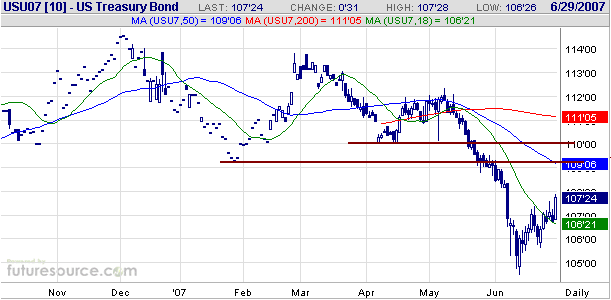
Below is a daily chart of September T-Bond futures.
It is clear that the bond market bottomed when it was supposed to
(May-June has now produced an important bond market turning-point in
each of the past 5 years). The question is: did June-2007 provide a
short-term bottom only, or is an intermediate-term bottom also now in
place?
At this stage we are assuming the former (we are assuming that the
current rebound will be followed, at some point over the next 1-3
months, by a break to new lows for the year). However, there's a
significant risk that a more bullish intermediate-term scenario for
bonds is on the cards.
A more bullish intermediate-term scenario for bonds would require a
decidedly bearish intermediate-term outcome for industrial commodities
such as oil and the base metals, as well as minimal strength over the
next several months in agricultural commodities. We are giving such a
scenario some credence because there are signs that the commodity trend
is rolling over. To be specific: a) oil has recently been very strong,
but last week's move in the oil price to new highs for the year was not
confirmed by the airline sector -- a.k.a the anti-oil sector -- of the
stock market; b) it looks to us like the base metals have peaked for
the year, but that prices are being supported on a temporary basis by
the potential for strike-related supply disruptions; c) silver has
broken below important support; d) there was a potentially significant
downward reversal in the Canadian Dollar on Friday; and e) although
substantially higher grain prices are inevitable, the recent sharp
correction in the corn market could mean that there won't be as much
upward pressure on food prices over the remainder of this year as we
have been anticipating up until now.
In other words, the price action in commodities over the coming month
could prompt us to upgrade our intermediate-term bond market outlook.
The Stock
Market
Current Market Situation
We don't know whether the problems in the CDO (Collateralised Debt
Obligations) market, which are, in turn, linked to the problems in the
sub-prime lending market, will eventually have a large adverse effect
on the broad stock market. What we do know is that IF the CDO/sub-prime
drama is going to evolve into a major stock market problem then signs
of stress will appear throughout the stock market well before a large
decline occurs. At this stage we are seeing a lot of worrying as
evidenced by the low level of optimism indicated by some sentiment
surveys, the recent spike in the volatility implied by option prices,
and the relatively high level of short-selling on the NYSE (the level
of short-selling is well below where it was in early March of this year
and slightly below where it was at this time last year, but is high
relative to the market's price action); but we aren't seeing any signs
of stress outside the sectors that are directly affected by the
CDO/sub-prime problems.
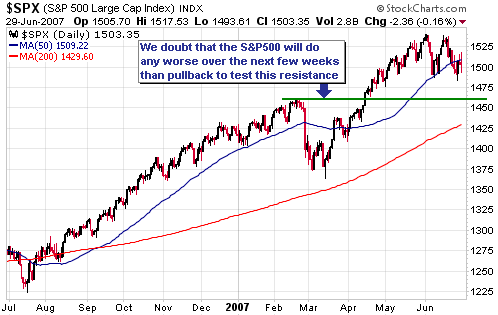
Based on the generally positive price action and the way public
sentiment towards the US stock market continues to become very fearful
whenever the market shows the slightest sign of weakness, we don't
expect the S&P500 to do any worse over the next few weeks than drop
back to test the resistance identified on the following chart.
There appears to be
considerably more short-term downside risk in the stock markets of Asia
(ex-Japan) and other emerging-economy stock markets around the world
than in the US stock market. The reason is that these foreign markets
are where the average US investor has been doing most of his/her new
buying. The US public has been indifferent-to-bearish on its own stock
market for the past several months, but has directed a lot of money
towards mutual funds that invest in emerging market equities.
This week's
important US economic events
| Date |
Description |
Monday Jul 02
| ISM Index
Canadian markets closed
|
| Tuesday Jul 03 | Factory Orders
Early close for US markets
| | Wednesday Jul 04
| US markets closed for Independence Day
| | Thursday Jul 05
| ISM Services
| | Friday Jul 06
| Monthly Employment Report
|
Gold and
the Dollar
Gold Stocks
A Strange Relationship
Even if the following chart-based comparison has no predictive value,
it is interesting. At least, we found it interesting, although that
might say more about us than about the chart itself.
The comparison in question shows the 9-year performances of Centex
(NYSE: CTX), a major homebuilding company that we are using as a proxy
for the homebuilding sector of the stock market, and the AMEX Gold BUGS
Index (HUI), with the HUI chart lagged by 10 months. The implication is
that the bull market in the gold sector has been following along 10
months behind the bull market in the homebuilding sector.
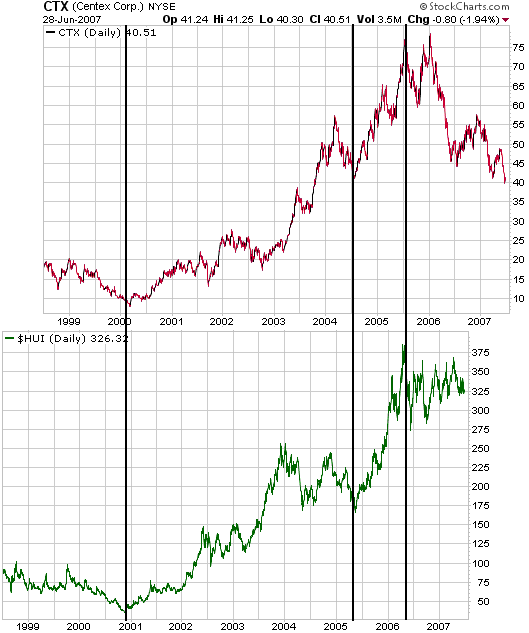
If this strange
relationship continues to hold (a big if) and if the homebuilding
sector bottoms in July as we recently said it might (another big if),
then the correction in the gold sector will end in May of next year (10
months after the July-2007 bottom in the homebuilding sector).
The only reason we are bothering to mention this relationship is that
we think May of 2008 is one of the two most likely times for the gold
sector's major correction to end, the other being October-November of
this year. Furthermore, applying some reverse logic, and again making
the big assumption that the relationship implied by the above chart
comparison will continue to hold, leads us to the conclusion that the
homebuilding sector of the stock market must bottom during the coming
month if the gold sector's correction is going to end by May of next
year.
One last point worth mentioning before we leave this topic is that the
bull market in the US homebuilding sector began during the first
quarter of 2000 -- at around the same time that the US stock market
bubble was bursting. It was as if the equity market knew that the
property market would be a major beneficiary when the Fed eventually
got around to doing what it always does during a period of distress
(ramp-up the money supply). The point is that the homebuilding sector
proved to be more sensitive than the gold sector to the impending
change in monetary conditions during 2000-2001 and may well prove to be
more sensitive to a similar change during 2007-2008.
Current Market Situation
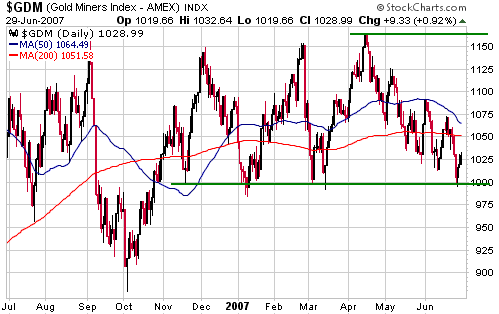
With reference to the following chart, the AMEX Gold Miners Index (GDM)
has intermediate-term support at 1000 and intermediate-term resistance
at 1160. A break below 1000 would confirm our intermediate-term bearish
outlook whereas a break above 1160 would invalidate it.
1160 currently seems a long way away, but note that if GDM were to
surprise us by rising through 1160 then the bulk of the gains in the
major gold stocks, and almost all the gains in the small gold stocks,
would still lie ahead. Therefore, even if you disagree with our view
that the gold sector is more likely to breakout to the downside than to
the upside there isn't a lot to be gained -- and there is potentially a
lot to be lost -- by being fully invested at this time in anticipation
of an upside resolution.
As far as the next couple of weeks are concerned, the gold sector
remains oversold and stands a good chance of rebounding before it moves
significantly lower. If there is some near-term strength then those who
haven't yet scaled back to a core position should take the opportunity
to 'lighten up'.
Gold and Silver
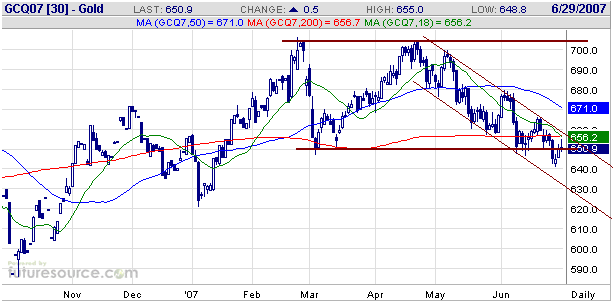
The following daily chart shows that August gold did just enough during
the final two days of last week to end the week above support at $650.
This means that the gold market ended the week in 'no man's land' (the
territory that extends from $650 up to $703). A break below $650 would
confirm our intermediate-term bearish outlook whereas a break above
$703 would negate it. Oscillations within these boundaries are, in
effect, just 'noise'.
In gold's favour, the Commitments of Traders (COT) data is now
decidedly bullish. For example, over the past three years the net-long
position of small traders in COMEX gold futures has only been as low as
it is right now on three occasions: May of 2005, November of 2005, and
October of 2006. These were all good times to be buying gold.
The relatively bullish structure of the gold market at this time could
support the price for a while, but sentiment alone won't change the
trend. Putting it another way, the current lack of interest by small
traders means that there will be plenty of fuel to propel the price
higher IF the trend changes for some other reason, but the lack of
interest won't CAUSE the trend to change. Furthermore, note that if the
current correction is of a larger degree than the other corrections of
the past several years then sentiment indicators such as the COT report
should end up becoming far more depressed than they were at the earlier
correction lows.
In the absence of the US$ gold price breaking above resistance defined
by the February and April highs, some things that would turn our
intermediate-term outlook more bullish include:
a) Further widening of credit spreads
b) Lower REAL short-term interest rates brought about by lower nominal interest rates and/or increased inflation expectations
c) Further weakness in the US$
d) Strength in gold relative to the euro
While gold managed to
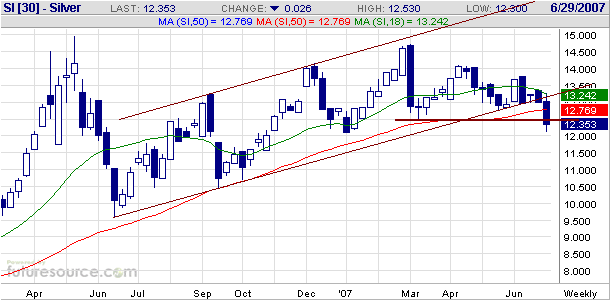
end last week above support defined by its March-2007 low, silver did
not. As evidenced by the following weekly chart, silver futures have
broken-out to the downside. This doesn't mean that silver will continue
its decline in the immediate future because after having just fallen by
10% over the past 4 weeks the silver market is now oversold. However,
last week's action added weight to the intermediate-term bearish case.
Our expectation is that silver will test its June-2006 low before year-end.
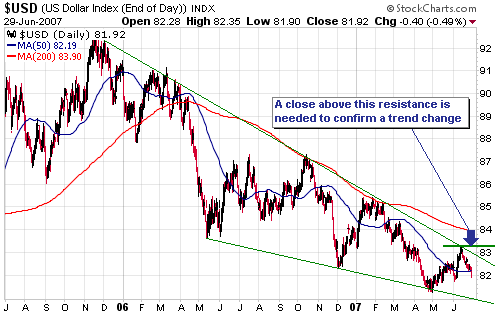
The Dollar
With reference to the following chart, the Dollar Index touched
trend-line resistance during the week before last and has since pulled
back. It closed below its 50-day moving average on Friday, but this
sign of weakness was not confirmed by the gold market. As discussed in
last week's Interim Update, turning points in the currency market tend
to be led by turning points in the gold market.
We don't expect the Dollar Index to do any worse over the coming few
weeks than test its April low. On the other hand, it needs to close
above its early-June high to signal that a tradable rally is underway.
Update
on Stock Selections
(Note: To review the complete list of current TSI stock selections, logon at http://www.speculative-investor.com/new/market_logon.asp
and then click on "Stock Selections" in the menu. When at the Stock
Selections page, click on a stock's symbol to bring-up an archive of our comments on the stock in question)
 Northern Orion Resources (TSX: NNO, AMEX: NTO) Northern Orion Resources (TSX: NNO, AMEX: NTO)
The proposed 3-way merger between Yamana Gold (TSX: YRI, NYSE: AUY),
Northern Orion Resources (TSX: NNO) and Meridian Gold (NYSE: MDG)
announced after the close of trading on 27th June involves, amongst
other things, YRI making a conditional all-stock bid for NNO. In
response to this 3-way merger proposal we commented: "...we
aren't interested in having any exposure to Yamana at this time so we
are going to take this opportunity to remove the NNO warrants from the
TSI List. For record purposes we will use the average price during
today's (Thursday 28th June) trading session as our exit price."
The average price for the warrants turned out to be C$1.87, giving us a
profit of 188% based on our February-2005 entry price of C$0.65.
Our C$1.87 exit price was a lot lower than we expected it would be
given the initial premium implied by YRI's offer. Unfortunately, for
two reasons very little of the initial premium ended up materialising.
First, the YRI stock price plunged by 10% as shareholders sold en masse
in reaction to the huge dilution that would result from the Meridian
component of the 3-way merger proposal. And second, the market
discounted the risk that the takeover of NNO would not actually go
ahead due to Meridian shareholders rejecting the YRI offer (the offer
for NNO is contingent upon YRI gaining control of Meridian).
Our impression may not be accurate, but the way it looks to us is that:
1) NNO's management shopped the company around.
2) YRI's management was interested, but was concerned that such an
acquisition would result in a company that was more of a copper play
than a gold play (this would be a concern because gold mining companies
sell at hefty premiums to copper mining companies).
3) To remove the 'sticking point' mentioned in item 2) above, NNO's
management offered to help finance a bid by Yamana for Meridian Gold.
The 3-way merger proposal was thus born.
YRI is now very oversold and will probably bounce over the next two
weeks assuming that nothing really negative happens to the overall gold
sector. If so, this will provide the holders of NNO shares and warrants
with a better opportunity to exit their positions. Just to be clear,
though, we do think that these positions should be exited in the near
future.
The possibility exists that a higher bid will emerge for NNO, but we
see this as a long-shot (we previously considered Xstrata to be a
likely buyer of NNO, but our guess is that NNO's management approached
Xstrata before deciding to do a deal with Yamana).
USEC Inc. (NYSE: USU). Shares: 87M. Recent price: US$21.98
During April and May we suggested taking PARTIAL profits in uranium
enrichment company USU in the $22-$24 range, but we've now decided to
make a complete exit from the stock. Based on our January-2006 entry at
$11.95 and Friday's closing price of $21.98, our profit was 84%.
We've decided to make a complete exit from USU because we are
uncomfortable with the way the company's management is approaching the
financing of the $2B enrichment plant currently under construction. In
the current financial and commodity market environment the required $2B
could be raised with consummate ease at a low cost by issuing debt, or
equity, or a combination of debt and equity (with the stock price in
the 20s it would make sense to raise at least half the required sum by
issuing new shares). However, USU's management seems determined to
obtain some form of federal government support (handout), and has even
intimated that government assistance will be necessary if the new plant
is to be built.
If government assistance is forthcoming then USU's financial position
will be strengthened. However, while management is busily trying to
paint an unrealistically dismal picture of the company's financial
condition in order to qualify for government aid an opportunity is
going begging to use the debt and/or equity markets to raise more than
enough money at very competitive rates.
Crowflight Minerals (TSXV: CML). Shares: 234M issued, 276M fully diluted. Recent price: C$0.94
CML, a development-stage nickel miner operating in Canada, has
completed a scoping study undertaken to assess the potential to
increase production at its Bucko mine from the current design rate of
1000 tonnes per day (tpd) to 1500 tpd. According to this scoping study
the expansion would cost only C$8.5M and would increase the annual cash
flow from C$100M to C$143M assuming a nickel price of US$12/pound.
Based on the expanded production cash flow stated above and applying a
fairly conservative 5-times cash flow multiple, our valuation for CML
remains at C$2.50/share using the current fully-diluted share count of
276M (note that our earlier valuations were based on a lower share
count and a slightly higher nickel price). We therefore continue to
believe that CML is very under-valued at its current price, although
some execution risk obviously needs to be accounted for given that the
Bucko mine isn't expected to be in production until the 2nd quarter of
next year.
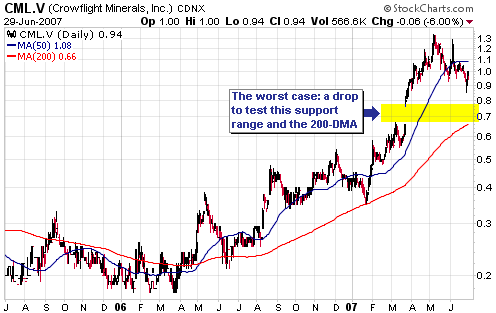
We are comfortable with the way CML is progressing and would be buyers
of the stock on weakness. Speculators who currently don't own any CML
shares should consider taking an initial position near the current
price of C$0.94, while those who are looking to add to existing
positions could anticipate a drop to the support area shown on the
following chart. Note that for CML to drop to this support range there
will probably have to be a sizeable sell-off in commodity-related
equities or significant additional weakness in the nickel price.
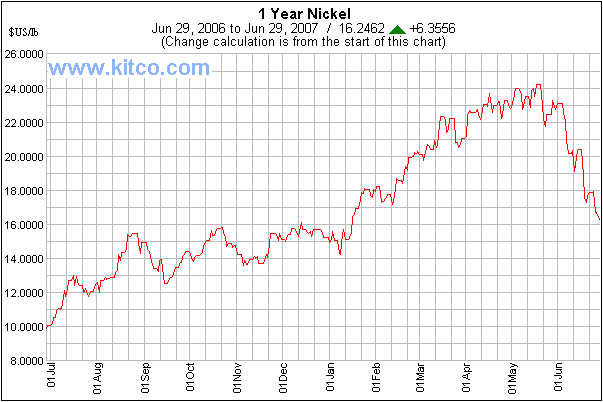
The following nickel
chart illustrates the main reason for the recent weakness in CML and
most other junior nickel miners. The nickel market has just experienced
a bona fide crash, with the nickel price tumbling 33% in 6 weeks.
Notice, though, that this crash has taken the price back to support
defined by the peaks made between August and December of last year.
This could mean that there won't be a lot of additional downside, at
least in the short-term.
Our best guess is that nickel is close to a correction low, but that a
considerable amount of time (at least 1-2 years) will transpire before
this year's peak is exceeded. The thing is, in order for CML to do well
over the coming 12-18 months we don't need a higher nickel price; what
we need is for the nickel price to not fall much lower and for CML's
management to execute its current plans.
Chart Sources
Charts appearing in today's commentary
are courtesy of:
http://stockcharts.com/index.html
http://www.futuresource.com/
http://www.kitcometals.com/

|