|
-- Weekly Market Update for the Week Commencing 2nd July 2012
Big Picture
View
Here is a summary of our big picture
view of the markets. Note that our short-term views may differ from our
big picture view.
In nominal dollar terms, the BULL market in US Treasury Bonds
that began in the early 1980s will end by 2013. In real (gold)
terms, bonds commenced a secular BEAR market in 2001 that will continue
until 2014-2020. (Last
update: 23 January 2012)
The stock market, as represented by the S&P500 Index, commenced
a secular BEAR market during the first quarter of 2000, where "secular
bear market" is defined as a long-term downward trend in valuations
(P/E ratios, etc.) and gold-denominated prices. This secular trend will bottom sometime between 2014 and 2020. (Last update: 22 October 2007)
A secular BEAR market in the Dollar
began during the final quarter of 2000 and ended in July of 2008. This
secular bear market will be followed by a multi-year period of range
trading. (Last
update: 09 February 2009)
Gold commenced a
secular bull market relative to all fiat currencies, the CRB Index,
bonds and most stock market indices during 1999-2001. This secular trend will peak sometime between 2014 and 2020. (Last update: 22 October 2007)
Commodities,
as represented by the Continuous Commodity Index (CCI), commenced a
secular BULL market in 2001 in nominal dollar terms. The first major
upward leg in this bull market ended during the first half of 2008, but
a long-term peak won't occur until 2014-2020. In real (gold) terms,
commodities commenced a secular BEAR market in 2001 that will continue
until 2014-2020. (Last
update: 09 February 2009)
Copyright
Reminder
The commentaries that appear at TSI
may not be distributed, in full or in part, without our written permission.
In particular, please note that the posting of extracts from TSI commentaries
at other web sites or providing links to TSI commentaries at other web
sites (for example, at discussion boards) without our written permission
is prohibited.
We reserve the right to immediately
terminate the subscription of any TSI subscriber who distributes the TSI
commentaries without our written permission.
Outlook Summary
Market
|
Short-Term
(1-3 month)
|
Intermediate-Term
(6-12 month)
|
Long-Term
(2-5 Year)
|
| Gold
|
Bullish
(26-Mar-12)
|
Bullish
(26-Mar-12)
|
Bullish
|
| US$ (Dollar Index)
|
Neutral
(28-May-12)
| Neutral
(09-Jan-12)
|
Neutral
(19-Sep-07)
|
| Bonds (US T-Bond)
|
Bearish
(02-Jul-12)
|
Neutral
(18-Jan-12)
|
Bearish
|
| Stock Market
(DJW)
|
Neutral
(25-Apr-12)
|
Bearish
(28-Nov-11)
|
Bearish
|
| Gold Stocks
(HUI)
|
Bullish
(26-Mar-12)
|
Bullish
(23-Jun-10)
|
Bullish
|
| Oil | Bullish
(02-Jul-12)
| Neutral
(31-Jan-11)
| Bullish
|
| Industrial Metals
(GYX)
| Bullish
(02-Jul-12)
| Neutral
(29-Aug-11)
| Neutral
(11-Jan-10)
|
Notes:
1. In those cases where we have been able to identify the commentary in
which the most recent outlook change occurred we've put the date of the
commentary below the current outlook.
2. "Neutral", in the above table, means that we either don't have a
firm opinion or that we think risk and reward are roughly in balance with respect to the timeframe in question.
3. Long-term views are determined almost completely by fundamentals,
intermediate-term views by giving an approximately equal weighting to
fundamental and technical factors, and short-term views almost
completely by technicals.
Monetary Inflation and
Gold
Major peaks in the gold market tend to follow major shifts in the monetary backdrop -- from a high to a low monetary inflation rate -- with a lag of more than two years. It probably happens this way because it takes years for the effects of a large increase in the money supply to ripple through the economy. In other words, the markets and the economy will still be reacting to a period of rapid/accelerating money-supply expansion for more than two years after the monetary trend has reversed. From a practical standpoint this is useful information because it pegs the second half of next year as the earliest time for a major gold peak.
The first half of the 1970s provides us with a good example of the relationship between the major monetary trend and the major gold trend. At the end of 1974 the gold price reached a peak that would be followed by a 2-year downward trend, whereas a major downward trend in the money-supply (TMS) year-over-year growth rate commenced near the end of 1972.
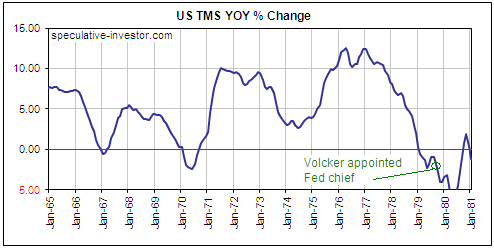
The second half of the 1970s provides us with an even better example. As evidenced by the first of the following charts, the TMS year-over-year growth rate began trending downward in early 1977 and had turned negative by early 1979. That is, by early 1979 the US was experiencing monetary DEFLATION. But as the second of the following charts shows and as everyone knows, the gold price rose during 1977-1978 and then accelerated upward in dramatic fashion during 1979. The ultimate peak was reached in January of 1980 -- three years after the monetary trend had turned gold-bearish and one year after the US had begun to experience monetary deflation.
As an aside, Paul Volcker is now widely credited with having ended the inflation of the 1970s, but when Volcker was appointed Fed chief in August of 1979 the US was already immersed in monetary deflation. This means that a commodity collapse was "baked into the cake" PRIOR to Volcker taking the top job at the Fed . Whoever was appointed Fed chief in August of 1979 would now have the credit for killing inflation, because by that time inflation was already dead. Commodity speculators just hadn't realised it yet.
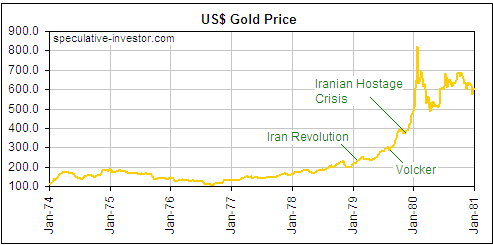
In 1979, gold was in a bubble and during an investment bubble almost any news will be interpreted as a reason to buy the investment in question. There's a revolution in Iran? Buy gold! 52 Americans have been taken hostage in Iran? Buy a lot of gold! These pieces of news have nothing to do with gold's fundamental value? Doesn't matter, just buy! There was a similar bubble in the oil market during the first half of 2008. During that period almost any news was viewed as a reason to buy oil even though there was clear-cut evidence at the time that oil demand was declining relative to oil supply.
During the current gold bull market we haven't experienced anything like the sentiment that drove the spectacular advance in the gold price in 1979 or the spectacular advance in the oil price in 2008. That's still to come.
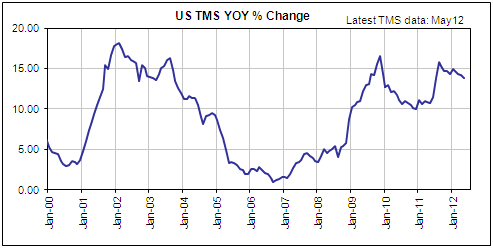
We'll end this discussion by returning to the comment we made in the opening paragraph, which is that the relationship between the monetary backdrop and gold pegs the second half of next year as the EARLIEST time for a major gold peak. This comment is based on the fact that the most recent peak in the TMS year-over-year growth rate occurred in August of 2011. If the gradual tapering-off in the TMS growth rate since last August (refer to the following chart for details) evolves into a multi-year downward trend, then a major peak in the gold price would be likely during the second half of 2013 or during 2014. However, if the TMS growth rate returns to the vicinity of its 2011 peak within the next two years or remains in double figures for another 1-2 years, then the likely timing of gold's next major peak will shift into the second half of this decade.
EU tries to buy some more
time
There was a very positive reaction in the financial markets on Friday to the outcome of the latest EU summit meeting, even though the meeting achieved nothing. According to the
summary statement
issued at the conclusion of the summit:
"We affirm that it is imperative to break the vicious circle between banks and sovereigns. The Commission will present Proposals on the basis of Article 127(6) for a single supervisory mechanism shortly. We ask the Council to consider these Proposals as a matter of urgency by the end of 2012. When an effective single supervisory mechanism is established, involving the ECB, for banks in the euro area the ESM could, following a regular decision, have the possibility to recapitalize banks directly. This would rely on appropriate conditionality, including compliance with state aid rules, which should be institution specific, sector-specific or economy-wide and would be formalised in a Memorandum of Understanding.
We urge the rapid conclusion of the Memorandum of Understanding attached to the financial support to Spain for recapitalisation of its banking sector. We reaffirm that the financial assistance will be provided by the EFSF until the ESM becomes available, and that it will then be transferred to the ESM, without gaining seniority status."
In other words, they have committed to come up with proposals by the end of this year for an EZ-wide banking supervisory mechanism. Not to implement such a mechanism, just to come up with proposals. If these proposals are agreed to by everyone then the ESM will possibly be able to recapitalise banks directly. And in the mean time, the ESM will provide some money to help Spain's banks (as had already been determined prior to the meeting).
Or, to put it more succinctly: Nothing of consequence will be done over the remainder of this year, but there's a chance that something will be done next year.
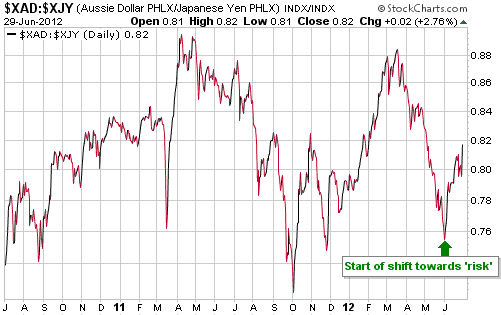
We don't see why the output of the meeting was widely viewed as a reason to celebrate, but the fact is that Friday's moves in the financial markets solidified the shift towards 'risk' that had commenced about 4 weeks earlier. This shift towards risk has been confirmed by every indicator that we track, so the odds are in favour of it continuing for at least a few more weeks. We won't be surprised, though, if Friday's moves are partially retraced on Monday.
Changes to Short Term
Views
As noted above, Friday's moves will probably be partly retraced early this week. There is a good chance, however, that meaningful trend changes have recently occurred in several markets, with the commodity and bond markets now coming into line with the reversals that occurred in other markets over the preceding four weeks. We have no way of knowing how far the new trends will extend, but the potential extension is enough in some cases to alter our short-term assessment of risk versus reward.
As a result of the mounting evidence that a shift towards risk is underway and likely to continue for at least a few more weeks, our short-term views on oil and the industrial metals have changed from "neutral" to "bullish". As a result of the same evidence and the T-Bond's break below its 20-day moving average on Friday (see chart below), our short-term T-Bond view has changed from "neutral" to "bearish".

The Stock
Market
Friday's rally in response to the EU news took the S&P500 Index (SPX) back to its
19th June short-term high.
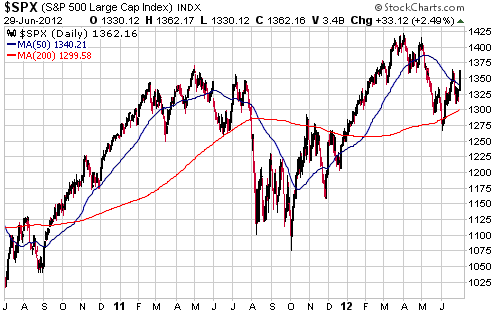
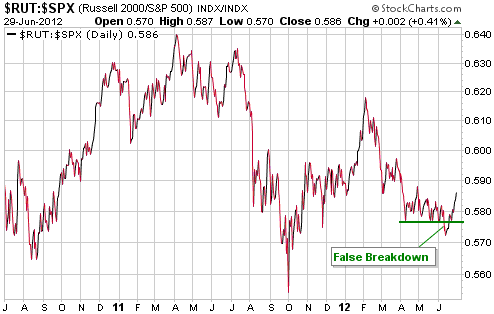
Of significance, the rally was confirmed by "market internals". We note, in particular, that on Friday there was a big increase in the number of individual stocks making new 52-week highs while the number of stocks making new 52-week lows shrunk to almost zero. Also of significance is the recent strength in small-cap stocks relative to large-cap stocks evidenced by the upturn in the RUT/SPX ratio (see chart below). The upturn in this ratio over the past two weeks suggests that the early-June breakdown was false.
It currently looks like the stock market is following the price pattern we guessed in the 20th June Interim Update. At that time we wrote:
"The rebound from the 1st June low was likely to take the S&P500 (SPX) up to at least the 1350s. With this minimum target having just been achieved and with both the SPX and the DJW (the Dow Jones World Index) now 'overbought' by some short-term measures, we are tempted to change our short-term stock market outlook from "neutral" to "bearish". However, by the barest of margins there is still enough remaining upside potential to keep us "neutral". Our guess as to the pattern from here is a few days of pullback/consolidation and then a rally that takes the SPX up to 1375-1400.
One reason we suspect that the stock market will make additional headway before embarking on its next downward leg is discussed in the Currency Market section of today's report. If a new plan to support EZ government debt is confirmed next week [the week ending 29th June] it will probably bring about a stock market celebration."
There's a decent chance of the senior US stock indices testing their March-April highs within the next several weeks. If they do it will be interesting to see if there are any important non-confirmations. The sort of non-confirmation that would point to a top would be a new high for the year in the Dow Industrials Index that wasn't confirmed by the NASDAQ100 Index and/or the S&P500 Index.
To maintain a short-term positive bias the indices must not close below last week's intra-day lows.
This week's
important US economic events
| Date |
Description |
| Monday Jul 02 | ISM
Manufacturing Index
Construction Spending
| | Tuesday Jul 03 | Motor
Vehicle Sales
Factory Orders
| | Wednesday Jul 04 | US
markets closed for Independence Day | | Thursday
Jul 05 |
ISM Non-Manufacturing Index
|
| Friday Jul 06 | Monthly
Employment Report
|
Gold and
the Dollar
Gold
Gold versus T-Bonds
The following chart shows the gold/TLT ratio over the past 10 years. The performance of TLT, an ETF that holds T-Bonds, reflects the total return of long-dated Treasury securities. That is, TLT accounts for the income generated by T-Bonds as well as any price change. The gold/TLT ratio is therefore a fair representation of how an investment in gold bullion has performed relative to an investment in T-Bonds.
There have been a few periods of 6-12 months during which T-Bonds out-performed gold, the two most notable being March-November of 2008 and August-2011 through to the present. However, it is clear that gold has been by far the better long-term investment since the early-2000s.
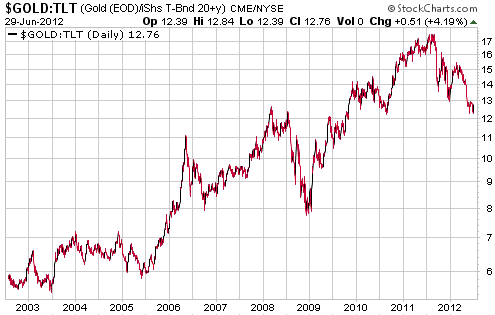
We think that the two large downward corrections in the gold/TLT ratio can aptly be described as flights to quantity (not quality). For large-scale investors who desire a safe temporary hiding place for billions of dollars, the Treasury market can look like the best option. This market is big enough and liquid enough to enable tens of billions of dollars to be quickly traded. It doesn't offer long-term safety because one way or another the US Government will eventually default on its debt, but the inevitability of default at some point in the distant future is probably of no concern to someone looking for a safe place to park some money for the next 6 months.
Current Market Situation
Over the long-term gold is most definitely a "risk off" asset, but in the short-term it sometimes moves in the same direction as "risk on" assets such as the stock market. This is because short-term price moves are driven by sentiment and subject to considerable randomness.
Friday's rebound in the gold price from support in the $1550s doesn't look significant on the following daily chart. Gold simply moved back to its 50-day moving average. The rebounds in some other commodities were more impressive, mainly because Friday was a "risk on" day.
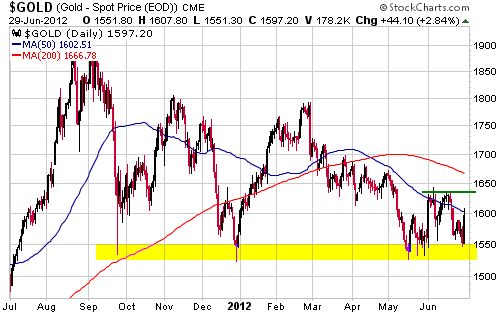
Although Friday's price action didn't materially alter gold's chart pattern, we suspect that another successful test of support has just occurred. This suspicion would be confirmed by gold closing above short-term resistance in the low-$1640s.
Gold Stocks
The public will often be more bearish on an investment near the end of the first downward correction in a new intermediate-term advance than they were at the bottom. This is because most people assume that a decline to new lows is underway. Similarly, the public will often be more bullish near the end of the first upward correction in a new intermediate-term decline than they were at the top. This is because most people assume that a rise to new highs is in progress.
The future is always uncertain, meaning that you can never be anywhere near 100% sure of the outcome when you establish a position in a financial market. However, betting against the public is one of the most reliable strategies at those times when the public is totally convinced that the price of the investment in question is destined to continue in a particular direction. One way to make such a bet right now is to buy gold stocks.
If it turns out that last Thursday's intra-day low marked the end of the downward correction that began in early June then the XAU's correction retraced about two-thirds of the initial rally from the May bottom. Friday's rally in the gold sector wasn't particularly impressive, but we expect that gold stocks will show a lot more strength if gold can 'prove' to traders that it has bottomed by closing above resistance in the $1640s.
We have the low-200s in mind as
an upside target for the XAU to reach before year-end.

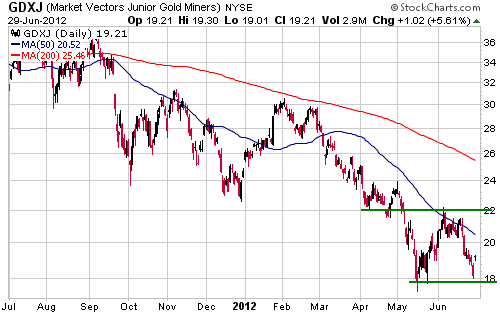
Whereas the XAU's correction from its early-June high retraced about two-thirds of its initial rally, the GDXJ, a proxy for junior gold stocks, totally retraced its initial rally and completed a full test of its May low. GDXJ has the potential to rise to $26 within the next four months.
Currency Market Update
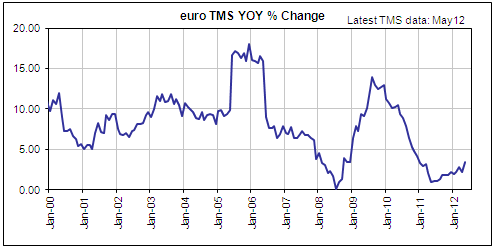
At the end of last week the ECB released the euro-zone money-supply data for May-2012. The data reveal that the year-over-year rate of growth in euro TMS (True Money Supply) increased from 2.2% in April to 3.4% in May. 3.4% is still low compared to the monetary inflation rates elsewhere, but it is the highest rate of growth in euro supply since December of 2010. A rising rate of growth in its supply is long-term bearish for any currency, but in the short term the euro could benefit from a rising inflation rate. This is because a higher rate of growth in euro supply could temporarily allay the fears of default and collapse.
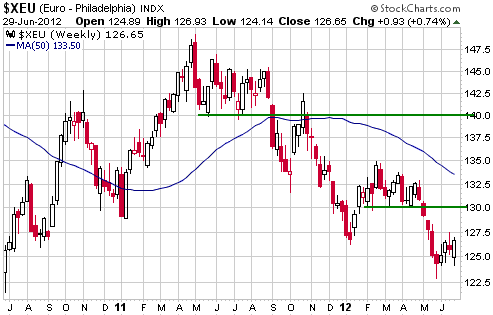
A weekly euro chart is displayed below.
We are tempted to change our short-term US$ (Dollar Index) outlook from "neutral" to "bearish" due to a) the likelihood of a continuing shift towards risk over the next few weeks and b) the extent to which the euro is oversold. A routine counter-trend rebound could take the nearest euro futures contract to resistance at 129-130, but the speculative net-short position in the euro futures market is so large that its unwinding could push the price as high as 140. A rise in the euro to 140 would likely coincide with a decline in the Dollar Index to around 75.
The speculative net-short position in euro futures will eventually unwind. In fact, at some point within the next 12 months we will likely find that speculators are heavily net-long the euro. The question is whether the current shift towards risk will last long enough to enable the complete unwinding of the speculative short position. There's a better-than-even-money chance that it won't and that there will be another pronounced shift towards safety during August-October, so we are staying "neutral" for now.
The following daily chart shows that the A$/Yen exchange rate made a new multi-week high last Friday. Ideally, the up-move will extend to 0.86-0.88.
Update
on Stock Selections
Notes: 1) To review the complete list of current TSI stock selections, logon at
http://www.speculative-investor.com/new/market_logon.asp
and then click on "Stock Selections" in the menu. When at the Stock
Selections page, click on a stock's symbol to bring-up an archive of
our comments on the stock in question. 2) The Small Stock Watch List is
located at http://www.speculative-investor.com/new/smallstockwatch.html
 Pretium Resources (TSX and NYSE: PVG). Shares: 94M issued, 101M fully diluted. Recent price: C$14.12 Pretium Resources (TSX and NYSE: PVG). Shares: 94M issued, 101M fully diluted. Recent price: C$14.12
In our opinion PVG is the world's premier exploration-stage gold mining stock. However, this doesn't mean that it should be bought at any price. Almost any asset can be a bad investment if the price is high enough and almost any asset can be a good investment if the price is low enough.
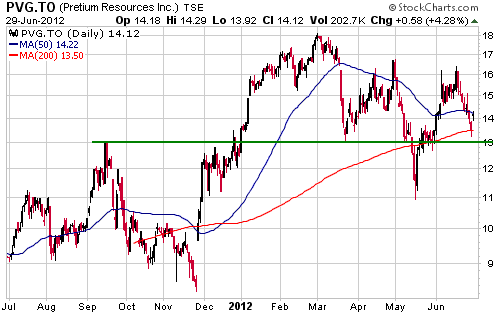
After Thursday's market action we thought we'd be able to highlight PVG as a buy in today's report. The reason is that it ended Thursday's session in the C$13.50s and could easily have ended the week in the low-C$13s if Friday had been another day of consolidation in the gold sector. As it turned out, almost everything rallied on Friday and PVG ended the week above C$14.
This note is therefore just a reminder that PVG should be considered a strong candidate for new buying if it drops back to near intermediate-term support in the low-C$13s. It traded as low as C$11 near the climax of the May panic, but we doubt that it will ever trade that low again.
PVG has its hands on a very special deposit at its Brucejack project. It is a deposit in Canada with defined gold resources of well over 10M ounces at an unusually high average grade of more than 17-g/t (the grade is what makes the deposit special). This project will definitely be of interest to more than one major gold miner. It also has its hands on a low-grade deposit with more than 30M ounces of defined gold resources at the neighbouring Snowfield project.
Chart Sources
Charts appearing in today's commentary
are courtesy of:
http://stockcharts.com/index.html

|









