|
-- Weekly Market Update for the Week Commencing
2nd September 2013
Big Picture
View
Here is a summary of our big picture
view of the markets. Note that our short-term views may differ from our
big picture view.
In nominal dollar terms, the BULL market in US Treasury Bonds
that began in the early 1980s will end by 2013. In real (gold)
terms, bonds commenced a secular BEAR market in 2001 that will continue
until 2014-2020. (Last
update: 23 January 2012)
The stock market, as represented by the S&P500 Index,
commenced
a secular BEAR market during the first quarter of 2000, where "secular
bear market" is defined as a long-term downward trend in valuations
(P/E ratios, etc.) and gold-denominated prices. This secular trend will bottom sometime between 2014 and 2020.
(Last update: 22 October 2007)
A secular BEAR market in the Dollar
began during the final quarter of 2000 and ended in July of 2008. This
secular bear market will be followed by a multi-year period of range
trading.
(Last
update: 09 February 2009)
Gold commenced a
secular bull market relative to all fiat currencies, the CRB Index,
bonds and most stock market indices during 1999-2001.
This secular trend will peak sometime between 2014 and 2020.
(Last update: 22 October 2007)
Commodities,
as represented by the Continuous Commodity Index (CCI), commenced a
secular BULL market in 2001 in nominal dollar terms. The first major
upward leg in this bull market ended during the first half of 2008, but
a long-term peak won't occur until 2014-2020. In real (gold) terms,
commodities commenced a secular BEAR market in 2001 that will continue
until 2014-2020.
(Last
update: 09 February 2009)
Copyright
Reminder
The commentaries that appear at TSI
may not be distributed, in full or in part, without our written permission.
In particular, please note that the posting of extracts from TSI commentaries
at other web sites or providing links to TSI commentaries at other web
sites (for example, at discussion boards) without our written permission
is prohibited.
We reserve the right to immediately
terminate the subscription of any TSI subscriber who distributes the TSI
commentaries without our written permission.
Outlook Summary
Market
|
Short-Term
(1-3 month)
|
Intermediate-Term
(6-12 month)
|
Long-Term
(2-5 Year)
|
|
Gold
|
Bullish
(17-Oct-12)
|
Bullish
(26-Mar-12)
|
Bullish
|
|
US$ (Dollar Index)
|
Neutral
(24-Dec-12)
|
Bullish
(01-May-13)
|
Neutral
(19-Sep-07)
|
|
Bonds (US T-Bond)
|
Bullish
(24-Jun-13)
|
Neutral
(18-Jan-12)
|
Bearish |
|
Stock Market
(DJW)
|
Bearish
(15-Jul-13)
|
Bearish
(28-Nov-11)
|
Bearish
|
|
Gold Stocks
(HUI)
|
Bullish
(24-Dec-12)
|
Bullish
(23-Jun-10)
|
Bullish
|
|
Oil |
Neutral
(30-Jul-12)
|
Neutral
(31-Jan-11)
|
Bullish
|
|
Industrial Metals
(GYX)
|
Neutral
(30-Jul-12)
|
Neutral
(29-Aug-11)
|
Neutral
(11-Jan-10)
|
Notes:
1. In those cases where we have been able to identify the commentary in
which the most recent outlook change occurred we've put the date of the
commentary below the current outlook.
2. "Neutral", in the above table, means that we either don't have a
firm opinion or that we think risk and reward are roughly in balance with respect to the timeframe in question.
3. Long-term views are determined almost completely by fundamentals,
intermediate-term views by
fundamentals, sentiment and technicals, and short-term views by sentiment and
technicals.
Don't confuse the monetary
base and the money supply
We occasionally see articles where the
monetary base is wrongly discussed as if it were akin to the money supply or as
if the change in the monetary base indicated the amount of monetary inflation in
the economy. We'll now outline the differences between the monetary base and the
money supply and explain how these differences are related to the contrasting
inflation situations in Japan and the US.
The monetary base (MB) is made up of bank reserves and physical currency (notes
and coins). Bank reserves are not counted in the money supply (MS) for the good
reasons that a) they are not available for spending and b) they provide 'cover'
for money that is available for spending and is counted in the money supply. The
physical currency that resides outside the banking system is, of course,
available for spending and is naturally counted in the MS as well as in the MB,
but these days the combined value of all notes and coins tends to be small
relative to the total MS. Also, the total quantity of notes/coins can only
increase due to the withdrawal of bank deposits, a process that is always
money-supply neutral (every dollar added to the total quantity of physical
currency will be offset in the MS calculation by a dollar coming out of a demand
or savings deposit). In other words, adding to the supply of physical currency
never increases the total money supply.
An implication of the above paragraph is that boosting the monetary base will
not boost the money supply. There is an indirect link in that an increase in
reserves held at the central bank could prompt commercial banks to lend more
money into existence, but the point is that increasing the MB won't immediately
put additional money into the economy and won't necessarily even lead to a
higher money supply in the future. A related implication is that a large
increase in the MB will not necessarily lead to currency depreciation.
The difference between an increase in the MB and an increase in the MS is linked
to why the pro-inflation policies of the Bank of Japan (BOJ) have not, over the
past 20 years, led to "price inflation" worthy of the name. In Japan,
quantitative easing (QE) does not directly expand the money supply; it only
expands the monetary base. The BOJ relies on commercial banks and other private
financial institutions ramping-up their investing/lending in order to transform
a QE-related increase in the MB into a higher MS. As a consequence, the BOJ's QE
is not necessarily inflationary.
Up until now the BOJ's QE has not led to much in the way of monetary inflation,
which is why it hasn't brought about much in the way of "price inflation". The
rate of growth in Japan's money supply has averaged only 2% per year over the
past 20 years -- a level of monetary inflation that would be expected to result
in no "price inflation" assuming an average annual rate of productivity
improvement of at least 2%. In other words, there's no mysterious disconnect
between money supply and money purchasing-power at work in Japan. The lack of
"price inflation" is exactly what should be expected given the low rate of
monetary inflation.
The situation in the US is very different. Whereas the BOJ's QE is not
necessarily inflationary, the Fed's QE is always inflationary (meaning: it
always increases the money supply, leading to price rises in some parts of the
economy, distortions in relative prices, and, eventually, a decline in money
purchasing-power). As explained in many previous commentaries, the reason is
that when the Fed monetises X$ of assets it adds X$ to bank reserves (part of
the MB, but not part of the MS) AND it adds X$ to demand deposits at commercial
banks (part of the MS). A consequence is that in the US there is no requirement
for commercial banks to expand their lending/investing in order for the money
supply to grow, because the Fed is capable of increasing the US money supply by
whatever amount it desires regardless of what the commercial banks are doing.
It's amazing that very few people understand this.
The bottom line is that the monetary base is not necessarily a good indicator of
the monetary inflation situation. The main focus of analysts should therefore be
on the change in the money supply, not the change in the monetary base.
Unfortunately, not many analysts know how to correctly measure the money supply.
The Stock
Market
The iShares Home Construction ETF (ITB) made
an intermediate-term peak in May and made a new daily-closing low for the year
last week. This ETF's price action runs counter to the widespread view that the
US housing market is continuing to recover.
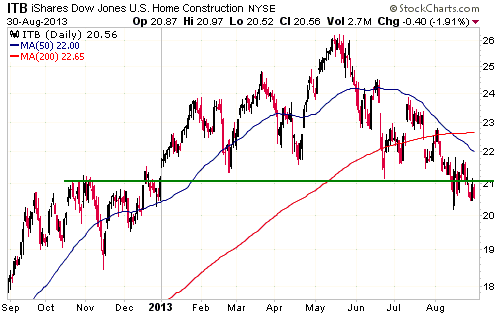
The weakness in the home-building sector is a bearish omen for the broad US
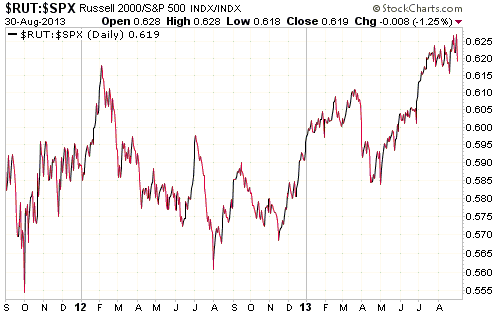
stock market, but the market's overall price action is mixed. For example:
1) The RUT/SPX ratio (small-cap US stocks relative to large-cap US stocks) made
a new high for the year last week. This is a sign of strength.
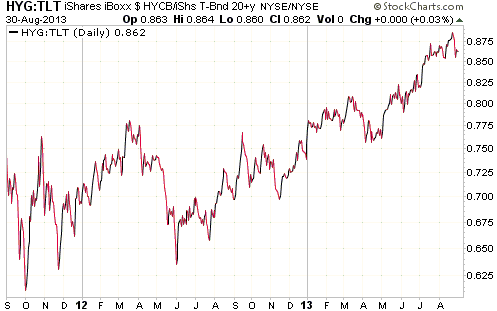
2) The HYG/TLT ratio (high-risk bonds relative to low-risk bonds) has declined
over the past two weeks, but hasn't yet shown significant weakness. This
suggests that a meaningful shift away from risk has not yet begun, which is a
sign of underlying strength.
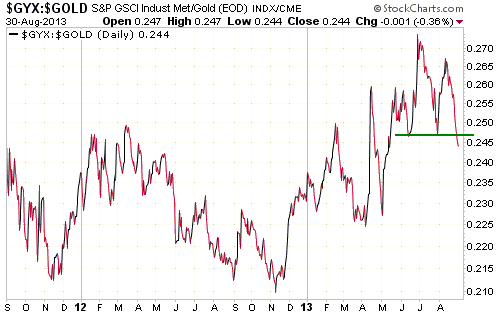
3) The GYX/gold ratio (industrial metals relative to gold) broke to a 3-month
low last week. This should be viewed as a warning of economic and stock market
weakness to come.
We remain very concerned about downside risk on a short-term and a longer-term
basis. In our opinion, we are dealing with either an incomplete downward
correction within an aging bull market or the first downward leg of a new bear
market. There isn't yet any solid evidence to support the latter possibility,
but by the time such evidence emerges the senior stock indices will likely be
trading at much lower levels.
This week's
important US economic events
| Date |
Description |
| Monday Sep 02 |
US (and Canadian) markets closed for public
holiday | | Tuesday
Sep 03 |
ISM Mfg Index
Construction Spending | | Wednesday
Sep 04 |
Motor Vehicle Sales
International Trade Balance
Fed's Beige Book | | Thursday
Sep 05 |
Q2 Productivity and Costs
Factory Orders
ISM Non-Mfg Index
|
| Friday Sep 06 |
Monthly Employment Report |
Gold and
the Dollar
Gold
Gold and the Fed
There's a lot of discussion/debate in the financial press about who will replace
Bernanke as Fed Chairman early next year. However, as far as the US economy's
prospects and gold's prospects are concerned, it doesn't matter.
The times make the Fed Chairman, not the other way around. If there is a general
belief that aggressive monetary inflation and downward manipulation of interest
rates are what's needed, then the Fed will deliver aggressive monetary inflation
and downward manipulation of interest rates regardless of the identity of its
chief. By the same token, if there is a general belief that solving an inflation
problem is the top priority, then the Fed will deliver genuinely tight monetary
policy regardless of the identity of its chief.
Presently there is an almost total absence of political will to end the
pro-inflation policy, so more 'money-printing' is on the cards. But as discussed
in previous commentaries, more money-printing over the next few quarters will
not be required for gold to embark on the next leg of its long-term bull market.
This is because there has already been more than enough money-printing to set
the stage for such an outcome. What's needed, now, is evidence that the Fed's QE
has either not helped or done greater harm than good. The evidence could come in
the form of blatant "price inflation", but is more likely to come in the form of
data that indicates economic weakness.
This week we get the most important monthly US economic data, beginning with the
ISM Manufacturing report on Tuesday and ending with the employment numbers on
Friday. The Manufacturing report will be particularly interesting because the
same report a month ago suggested that the US economy was doing much better than
expected. The report scheduled for this Tuesday will tell the financial markets
if last month's strong data constituted a fluke or a true indication.
Current Market Situation
The gold market quickly gave back its small Syria premium during the final two
days of last week.
As noted in last week's Interim Update, a normal short-term correction could
take the gold price down as far as the $1350s, but shouldn't result in a daily
close below $1350. This means that to keep alive the chance of new multi-month
highs during September, gold must remain above $1350 during the days immediately
ahead.
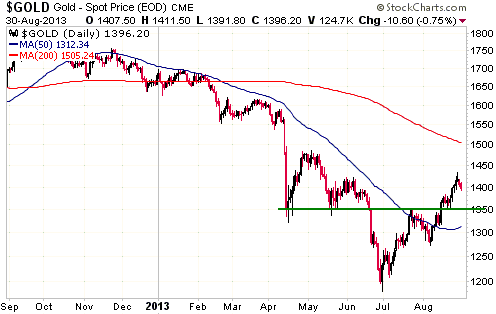
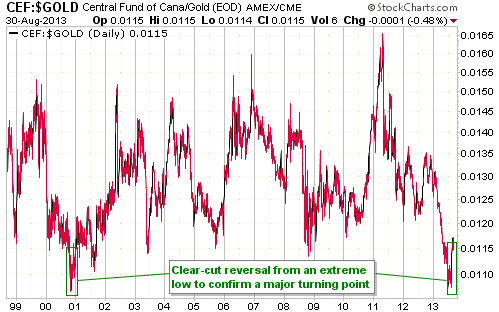
Regardless of whether the current pullback turns out to be a minor interruption
to a continuing short-term upward trend or the start of a short-term downward
trend, the gold market has done enough over the past two months to confirm that
a major low was put in place in June. Aside from gold's ability to break above
important resistance levels in both US$ and euro terms, the pronounced upward
reversal in the CEF/gold ratio from its extreme low (see chart below) is a clear
sign of a major trend change. This doesn't preclude the possibility of a test of
the June low during October-November, but it does mean that a successful test of
the June low is probably now the worst-case scenario.
Gold Stocks
HUI Scenarios
Over the past 15 years, October-November has been by far the most consistent
timeframe for important (intermediate-term or long-term) turning points in the
gold sector. May has been the second most consistent time for such turning
points. When the HUI broke to a new low for the year in June of 2013, the gold
sector's cyclical tendency suggested that a sustained turn to the upside would
wait until October-November of 2013.
A final low during October-November of 2013 is still one of the two most likely
HUI scenarios.
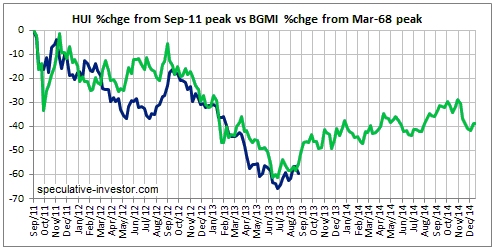
The second of the two highest-probability scenarios is based on the fact that of
all the major gold-sector corrections of the past 50 years, the major correction
of 2011-2013 most resembles the 1968-1970 episode. Of particular significance
and interest, the following chart comparison of the Barrons Gold Mining Index (BGMI)
from its 1968 peak and the HUI from its 2011 peak reveals that the HUI's
performance over the past 12 months has been remarkably similar to the BGMI's
performance during the final 10 months of its 1968-1970 cyclical bear market and
the first two months of its 1970-1974 cyclical bull market.
Under this scenario, the HUI made a major correction low towards the end of June
and is now in the early part of a new multi-year bull market. Continuing to
track the 1968-1970 model would entail a rally over the next two weeks followed
by about two months of choppy sideways movement.
These are obviously two very different short-term scenarios. Which one should
you bet on?
The answer is that there is no good reason to bet heavily on any single
short-term scenario. The possibility that the more bearish scenario will play
out can be taken into account by maintaining a substantial cash reserve and
ensuring that any new buying is done gradually on weakness. The possibility that
the more bullish scenario will play out can be taken into account by maintaining
core exposure to the gold sector and not being afraid to do some buying of
high-potential gold stocks as opportunities (pullbacks to support) arise.
Note that under either scenario a major low will be in place by November of this
year.
Current Market Situation
The following daily chart of the HUI could be interpreted bullishly or
bearishly. The obvious bullish interpretation is that last week's pullback is
part of the right shoulder of a head-and-shoulders bottoming pattern. The
bearish interpretation is that the HUI's recent inability to get above lateral
resistance is a sign of weakness that portends a test of the June low, and
possibly new multi-year lows, within the next two months.
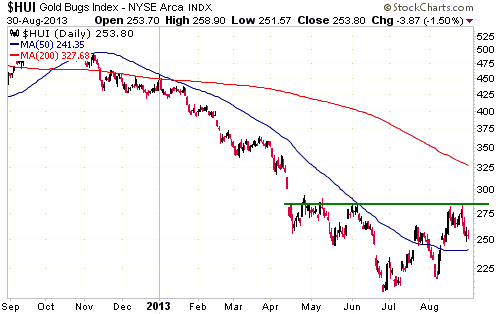
For the more bullish of our two short-term scenarios to remain in play the HUI
must soon close above 285.
South African gold stocks
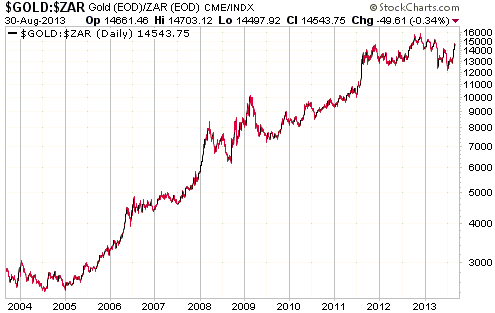
South Africa (SA) has a big inflation problem. The inflation problem is
reflected in the performance of gold in South African Rand (ZAR) terms (see
chart below), but SA gold miners aren't benefiting from the situation because
the inflation problem has also led to persistent labour unrest and rapid cost
increases.
A 30th August
article at Mineweb.com discussed the labour unrest that is plaguing the SA
economy in general and SA's mining industry in particular. Here's an excerpt:
"Weeks of strikes and violence led Harmony to suspend output at its biggest
mine for two months this year. A precondition to reopening the operation was
that employees sign a code promising to respect the rule of law. The AMCU is the
majority union at the mine.
A wave of mining strikes cut about 15 billion rand in output last year.
Stoppages in the industry have already shaved 0.3 percent off growth in 2012,
President Jacob Zuma said June 13.
Should gold miners down tools, they would join 30,000 operators at car
manufacturers including the local unit of Toyota Motor Corp., who have been on
strike since Aug. 19. Another 90,000 construction employees and 72,000 workers
at gas stations and car dealerships may walk out after talks failed.
The six-member FTSE/JSE Africa Gold Mining Index has fallen 45 percent this year
compared with an 8.1 percent increase in the FTSE/JSE Africa All-Share Index."
Unless a last-minute deal is reached, a new round of strikes will hit SA's
gold-mining industry this Tuesday.
Almost regardless of how cheap they get, our intention is to avoid SA gold
stocks. They aren't worth the trouble.
Currency Market Update
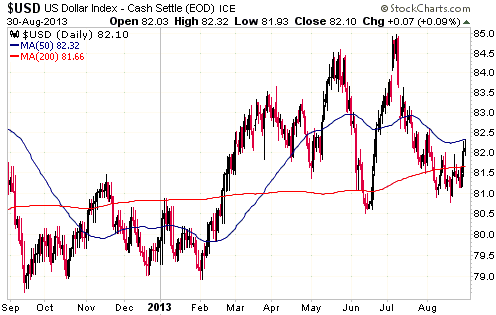
Last week's currency-market action was a little puzzling, in that the Dollar
Index did almost nothing in reaction to the news that the US was laying the
groundwork for some sort of military assault against Syria (heightened risk of
international conflict in the Middle East would normally boost the US$) and then
strengthened late in the week after the financial world became less worried
about the Syria situation. However, the net effect of this price action wasn't
significant. As illustrated by the following daily chart, the Dollar Index moved
back above its 200-day MA but was unable to break above its 50-day MA.
Price action is neutral, as is sentiment and momentum. Consequently, as far as
the Dollar Index is concerned, on a short-term basis we see no good reason to
lean to the bullish side or the bearish side.
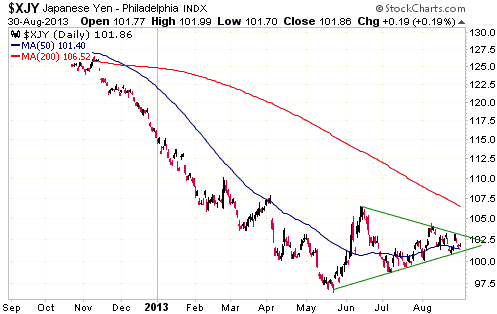
The Yen is more interesting, because although it has done very little over the
past few weeks the following daily chart suggests that it is poised to break
sharply in one direction or the other within the next two weeks.
We continue to believe that on a short-term basis the Yen has more upside
potential than downside potential, largely because currency speculators, as a
group, are positioned for Yen weakness. This positioning on the part of
speculators means that signs of strength would probably lead to a wave of short
covering.
Update
on Stock Selections
Notes: 1) To review the complete list of current TSI stock selections, logon at
http://www.speculative-investor.com/new/market_logon.asp
and then click on "Stock Selections" in the menu. When at the Stock
Selections page, click on a stock's symbol to bring-up an archive of
our comments on the stock in question. 2) The Small Stock Watch List is
located at http://www.speculative-investor.com/new/smallstockwatch.html
 Company
news/developments for the week ended Friday 30th August 2013: Company
news/developments for the week ended Friday 30th August 2013:
[Note: FS = Feasibility Study, IRR = Internal Rate of Return, MD&A =
Management Discussion and Analysis, M&I = Measured and Indicated,
NAV = Net Asset Value, NPV(X%) = Net Present Value using a discount
rate of X%, P&P = Proven and Probable, PEA = Preliminary Economic
Assessment, PFS = Pre-Feasibility Study]
*Dragon Mining (DRA.AX) issued its financial statements for the
half-year ended 30th June 2013. The statements indicate that there
was a small improvement in the company's financial position during
the first half of this year. Specifically, working capital edged up
from $14M to $16.5M with no long-term debt and no change in
non-current liabilities.
There should be additional improvement in DRA's financial position
during the second half of this year IF the improved production
performance achieved in the June quarter is repeated.
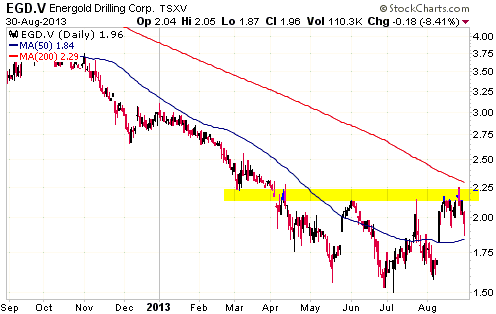
*Energold Drilling (EGD.V) issued its financial results for the
June-2013 quarter last Thursday.
Due to the seasonal nature of its energy-drilling business, EGD's
operational performance during the June quarter is dominated by its
Minerals Division. Revenue generated by the Minerals Division during
the June quarter of this year was $16M, which is $6M less than the
same quarter last year. Furthermore, the bulk of the revenue decline
was in the higher-margin drilling conducted on behalf of junior
miners, so the profit decline was greater than the revenue decline.
The decline in EGD's revenue and earnings was not surprising and was
fully discounted by the stock market some time ago. That's why EGD's
stock price didn't move by much after the sub-par financial results
were published.
EGD's financial performance is also likely to be sub-par over the
remainder of this year, but, again, the stock's valuation suggests
that such an outcome has been fully discounted by the stock market.
As evidence we cite the fact that even after the recent rebound in
its stock price, EGD's market cap is only about $10M higher than its
working capital. In effect, this means that the stock market is
valuing a $130M/year drilling business with excellent long-term
prospects at only $10M.
EGD's stock price appears to be building a base, with resistance at
C$2.15-$2.25. FWIW, C$3.00 would be the technical objective
following a break above this resistance.
*Evolution Mining (EVN.AX) issued its annual report for the
financial year ended 30th June 2013. Most of the useful information
in the annual report had previously been provided in quarterly
reports.
The balance sheet is the most important new information. It shows
that at 30th June the company had $13.7M of cash and $12M of working
capital. The company also had $73M of unused credit. This means that
EVN's liquidity situation has deteriorated substantially over the
past 12 months, although it is still OK. Anyhow, EVN should be a net
generator of cash from now on.
A large reduction in capital expenditure is the main reason that EVN
should go from being a substantial cash consumer in FY-2013 to a
substantial cash generator in FY-2014. Capex was very high at $375M
in FY-2013, but is expected to fall to about $175M in FY-2014.
*Pretium Resources (PVG) arranged another small equity financing
last week. The latest financing involves the purchase by Liberty
Metals and Mining of about 1.1M new shares at $9.35/share, for
proceeds to PVG of around $10M. This means that PVG has added a
total of $25M to its treasury over the past two weeks.
Candidates
for new buying
From within the ranks of TSI stock
selections, the best candidates for new buying at this time are:
1) EDV.TO at around C$0.70 (last Friday's closing price: C$0.82).
2) EGD.V below C$2.00 and preferably near the 50-day MA in the mid-C$1.80s (last
Friday's closing price: C$1.96).
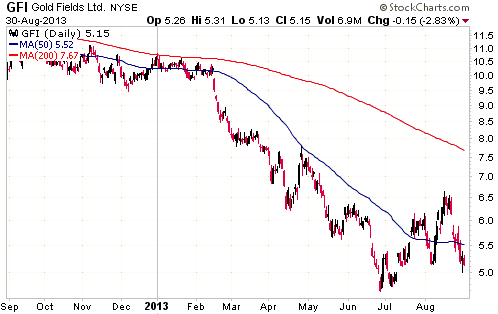
3) GFI shares or GFI Jan-2015 US$7.00 call options. GFI is being treated/valued
by the stock market as if it were still a South African producer, but after the
recent deal with Barrick is consummated 42% of its production will come from
Australia and only 11% of its production will come from South Africa. GFI is
well positioned to benefit from the Australian Dollar's bear market.
4) GSS in the low-US$0.50s (last Friday's closing price: US$0.55). Use a tight
stop if buying for a short-term trade.
5) RIO.TO at around C$2.35 (last Friday's closing price: C$2.64) or RIOM at
around US$2.25 (last Friday's closing price: US$2.52).
6) SBB.TO at C$1.15-C$1.20 (last Friday's closing price: C$1.24).
Chart Sources
Charts appearing in today's commentary
are courtesy of:
http://stockcharts.com/index.html

|









