|
-- Weekly Market Update for the Week Commencing
2nd December 2013
Big Picture
View
Here is a summary of our big picture
view of the markets. Note that our short-term views may differ from our
big picture view.
In nominal dollar terms, the BULL market in US Treasury Bonds
that began in the early 1980s will end by 2013. In real (gold)
terms, bonds commenced a secular BEAR market in 2001 that will continue
until 2014-2020. (Last
update: 23 January 2012)
The stock market, as represented by the S&P500 Index,
commenced
a secular BEAR market during the first quarter of 2000, where "secular
bear market" is defined as a long-term downward trend in valuations
(P/E ratios, etc.) and gold-denominated prices. This secular trend will bottom sometime between 2014 and 2020.
(Last update: 22 October 2007)
A secular BEAR market in the Dollar
began during the final quarter of 2000 and ended in July of 2008. This
secular bear market will be followed by a multi-year period of range
trading.
(Last
update: 09 February 2009)
Gold commenced a
secular bull market relative to all fiat currencies, the CRB Index,
bonds and most stock market indices during 1999-2001.
This secular trend will peak sometime between 2014 and 2020.
(Last update: 22 October 2007)
Commodities,
as represented by the Continuous Commodity Index (CCI), commenced a
secular BULL market in 2001 in nominal dollar terms. The first major
upward leg in this bull market ended during the first half of 2008, but
a long-term peak won't occur until 2014-2020. In real (gold) terms,
commodities commenced a secular BEAR market in 2001 that will continue
until 2014-2020.
(Last
update: 09 February 2009)
Copyright
Reminder
The commentaries that appear at TSI
may not be distributed, in full or in part, without our written permission.
In particular, please note that the posting of extracts from TSI commentaries
at other web sites or providing links to TSI commentaries at other web
sites (for example, at discussion boards) without our written permission
is prohibited.
We reserve the right to immediately
terminate the subscription of any TSI subscriber who distributes the TSI
commentaries without our written permission.
Outlook Summary
Market
|
Short-Term
(1-3 month)
|
Intermediate-Term
(6-12 month)
|
Long-Term
(2-5 Year)
|
|
Gold
|
Neutral
(04-Nov-13)
|
Bullish
(26-Mar-12)
|
Bullish
|
|
US$ (Dollar Index)
|
Neutral
(24-Dec-12)
|
Neutral
(18-Sep-13)
|
Neutral
(19-Sep-07)
|
|
Bonds (US T-Bond)
|
Neutral
(11-Nov-13)
|
Neutral
(18-Jan-12)
|
Bearish |
|
Stock Market
(DJW)
|
Neutral
(18-Nov-13)
|
Bearish
(28-Nov-11)
|
Bearish
|
|
Gold Stocks
(HUI)
|
Neutral
(04-Nov-13)
|
Bullish
(23-Jun-10)
|
Bullish
|
|
Oil |
Neutral
(30-Jul-12)
|
Neutral
(31-Jan-11)
|
Bullish
|
|
Industrial Metals
(GYX)
|
Bearish
(06-Nov-13)
|
Bearish
(13-Nov-13)
|
Neutral
(11-Jan-10)
|
Notes:
1. In those cases where we have been able to identify the commentary in
which the most recent outlook change occurred we've put the date of the
commentary below the current outlook.
2. "Neutral", in the above table, means that we either don't have a
firm opinion or that we think risk and reward are roughly in balance with respect to the timeframe in question.
3. Long-term views are determined almost completely by fundamentals,
intermediate-term views by
fundamentals, sentiment and technicals, and short-term views by sentiment and
technicals.
The Borneo Experience,
Part 2
In last week's Interim Update we wrote about
our experience in buying an under-construction house in Kota Kinabalu (KK),
Malaysian Borneo, with a particular focus on the delays and other problems
caused by government-imposed limitations on the hiring of non-Malaysian workers.
We'll now discuss a couple of other (hopefully) interesting aspects of KK that
probably wouldn't be obvious to the average vacationer.
One of these aspects is the general absence of a visible police presence. It is
rare to see a police car on the road or a policeman on the street. As far as I
can tell there are no red-light cameras or radar speed traps, and not once have
I seen anyone pulled over by the police for breaking a road rule (although most
people still drive sensibly).
Since we arrived here a little more than two years ago there have only been two
times when the police had a noticeable effect on my day. One occasion was when
my son and I went to our local bowling alley but weren't able to bowl because
the police had booked every lane. The other occasion was during a road trip to a
town about three hours drive from KK. At one point the traffic slowed to a crawl
due to a checkpoint set up by the police, most likely with the aim of catching
illegal immigrants from Indonesia and the Philippines. I drove up to the
checkpoint and expected to be waved through, but to my surprise a policeman
gestured for me to pull over to the side. He then asked me to get out and walk
around to the front of the car, which I did. He then pointed at the registration
sticker on the front windscreen, stated that the registration had expired about
two months previously and that I should have paid to renew it. I said that I
didn't realise, because nobody had sent me a bill. In most places, I told him,
the government sends you a bill if they want you to pay for something. He
shrugged his shoulders. I said I'd take care of it when I got back to KK. He
laughed, shook my hand, and then waved me on my way.
Every now and then you'll see a policeman directing traffic and a couple of
times a year you could see a police motorcycle escort for a visiting high-level
politician, but the local police-force doesn't appear to do much except try to
apprehend illegal immigrants. Therefore, from the perspective of anyone who
isn't an illegal immigrant the police here will generally be inconspicuous. This
is a big plus.
Another mention-worthy aspect about KK is that a disproportionately large number
of the businesses are owned and managed by Chinese (we believe that this applies
to the whole of Malaysia, but we only have first-hand knowledge of KK). The
employees are usually Malaysian, but the bosses are usually Chinese. However,
the government is dominated by Malaysians.
One consequence is an undercurrent of inter-racial tension, with Malaysians
envious of the economic success of the Chinese and the Chinese annoyed by the
political favouritism enjoyed by the Malaysians. At this time in KK it doesn't
appear to be a serious issue, but it has the potential to become a serious issue
during the next major economic downswing.
Another consequence is that Chinese (especially Cantonese) is a useful language
here if you are doing more than just being a tourist. For example, the fact that
my wife is Chinese (from Hong Kong) has been helpful in sourcing and dealing
with various contractors and suppliers. Bahasa Malaysia (the local language) is
naturally also useful, but in most situations you can get by without it. You
could also get by with nothing other than the English language, but your options
would be more limited.
Oil Update
The oil price usually trends in the same
direction as the Canadian Dollar (C$). Sometimes the two markets will diverge
for a short while, but they always end up coming back into line with each other.
At least, that's the way the Oil-C$ relationship has worked for many years.
The relationship we are talking about is illustrated by the following chart. The
top half of the chart shows the oil price and the bottom half of the chart shows
the C$.
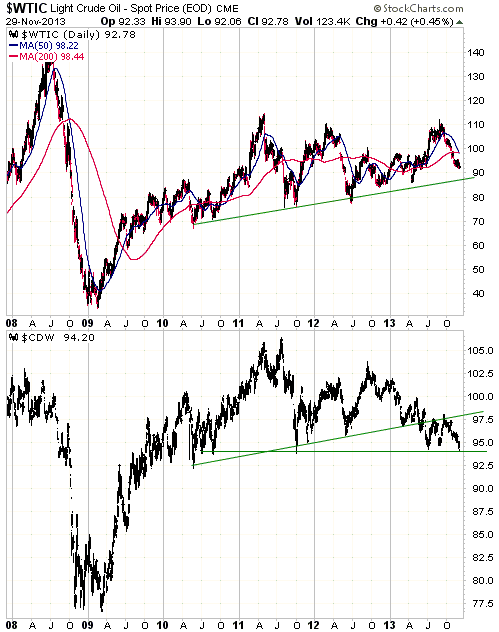
The Oil-C$ relationship is interesting right now due to the divergence of the
past several months. The C$ has been trending lower for more than 12 months and
either -- depending on how we draw the lines on the chart -- broke below
long-term support and completed a major topping pattern in the second quarter of
this year or is very close to completing a major topping pattern. A divergence
was created by the fact that the oil price maintained an upward bias until
early-September of this year, but the two markets now appear to be moving back
into line with each other.
Oil and the C$ ended last week at support and both are 'oversold' on a
short-term basis, so rebounds could soon begin. However, if the C$ is in the
process of completing a major topping pattern then the oil market is probably
doing the same.
The Stock
Market
The US
Just when the rubber band appears to be stretched to the limit, it stretches a
little further. We are referring to the combination of price and sentiment in
the US stock market.
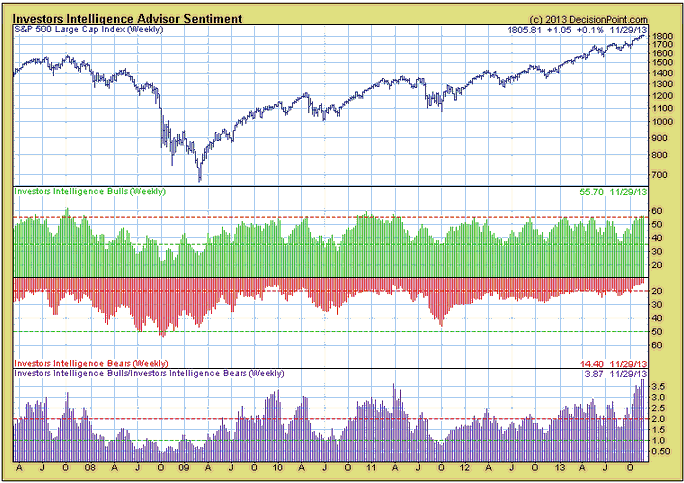
Three weeks ago we noted that the Investors Intelligence (II) bull/bear ratio
(the number of bullish advisors relative to the number of bearish advisors) had
reached the uncommonly elevated level of 3.5. The bottom section of the
following chart shows that it has since moved up to 3.87, which is a rare
extreme indeed. In fact, it is the highest level for this ratio since 1987.
The bull/bear ratio is being driven upward mainly by the capitulation of bears.
Only 14.4% of the advisors monitored by II are now bearish, which means that
85.6% of advisors are now either outright bullish or bullish but expecting a
short-term correction.
The stage is being set for a cyclical bear market of historic proportions.
That's the risk that should be taken into account. However, having made it into
December without a significant correction the odds are in favour of the US stock
market making it to year-end without a significant correction.
We don't know why, but small-cap US stocks generally out-perform large-cap US
stocks from mid-December through to mid-January.
Copper Stocks
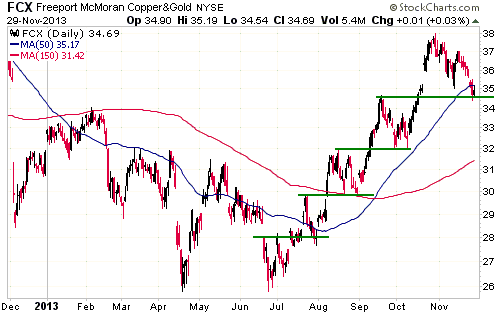
The following daily chart shows that Freeport McMoran (FCX), the world's largest
listed copper producer, ended last week at support. A solid break below this
support would differentiate the current decline from the other declines of the
past five months. It would suggest that the short-term trend had changed.
Japan
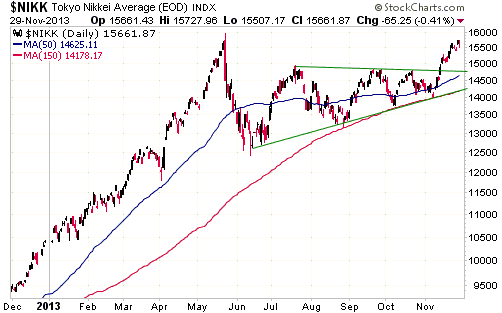
Japan's Nikkei225 Index broke upward from a multi-month consolidation 2-3 weeks
ago. This breakout indicated that the Nikkei would probably test its May high
(and that the Yen would probably test its May low). A test of the May high is
now underway.
We have no opinion about whether the test of the May high will be successful,
but this is a time to pay close attention to signs of reversal. Potential
reversal signs include a sharp gain early in the day that is given back by the
end of the day, a breakout to a new high that fails to hold, and a daily close
back inside the multi-month triangular consolidation pattern of June-October.
This week's
important US economic events
| Date |
Description |
| Monday Dec 02 |
ISM Mfg Index
Construction Spending | | Tuesday
Dec 03 |
Motor Vehicle Sales | | Wednesday
Dec 04 |
New Home Sales
ISM Non-Mfg Index
International Trade Balance
Fed's Beige Book | | Thursday
Dec 05 |
Q3 GDP (revised)
Factory Orders
|
| Friday Dec 06 |
Monthly Employment Report
Personal Income and Spending
Consumer Sentiment
Consumer Credit |
Gold and
the Dollar
Gold
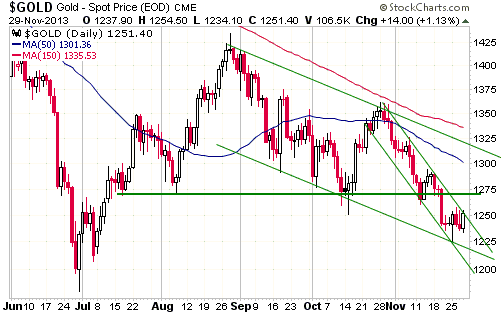
Although the gold price did very little last week, the price action helped to
define the two price channels indicated on the following daily chart. Notice, in
particular, that last week's intra-day low coincided with the bottom of a
channel dating back to the late-August rebound high and the bottom of a narrower
and more steeply-sloped channel dating back to the October rebound high.
Friday's close coincided with the top of the steeply-sloped channel dating back
to the October high, so any additional price gain from here would create a minor
upside breakout. However, more important resistance lies in the $1270s. A
counter-trend rebound shouldn't do more than test this resistance, which is why
we would interpret consecutive daily closes above $1280 as confirmation that an
important bottom was in place.
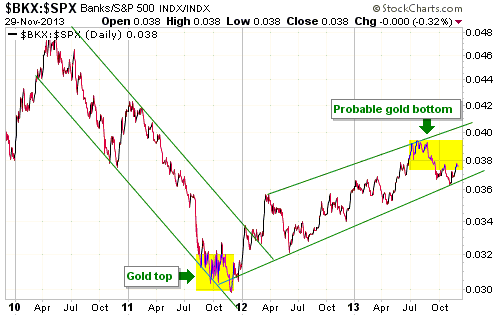
Over the past 5 years, one of the most important gold-market 'fundamentals' has
been the relative performance of the US banking sector as indicated by the BKX/SPX
ratio. Gold tends to do well when the banking sector is weakening relative to
the broad stock market and gold tends to do poorly when the banking sector is
strengthening relative to the broad stock market. The following chart shows the
performance of the BKX/SPX ratio.
There is preliminary evidence in the market action that the BKX/SPX ratio made a
trend reversal of at least intermediate-term significance at the end of
June-2013. Taking out the early-November low would provide conclusive evidence
of such a development and would substantiate the view that the gold market
commenced a major bottoming process in June.
Gold Stocks
In last week's Interim Update we wrote: "It's noteworthy that the XAU hasn't yet
confirmed the HUI's move below its June low. This could turn out to be
significant because the XAU also failed to confirm the HUI's ultimate peak in
September of 2011." The following two charts illustrate what we were talking
about.
The first chart compares the XAU and the HUI from mid-2010 through to the end of
2011. The XAU hit its ultimate peak on 7th December 2010 and then made
marginally lower peaks in April of 2011 and September of 2011. The HUI, on the
other hand, made marginally higher peaks in April of 2011 and September of 2011.

The second chart compares the XAU and the HUI over the past 12 months. The
situation would change with a small amount of additional weakness in the XAU,
but as things currently stand the XAU made its ultimate low in late-June and a
marginally higher low last week whereas the HUI made a marginally lower low last
week.
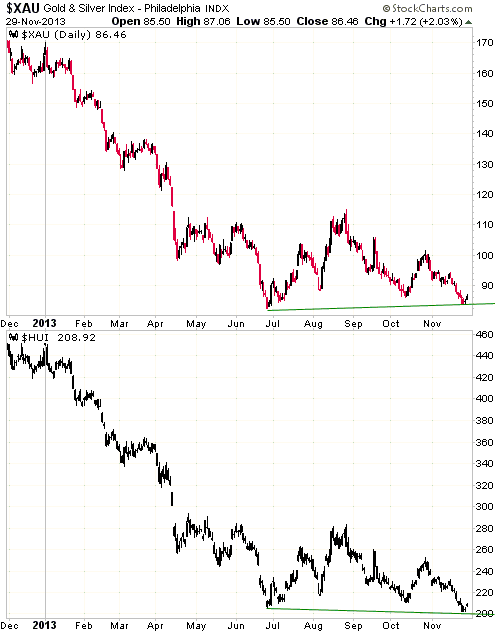
The upshot is that we could be getting some symmetry between the topping process
of 2010-2011 and the bottoming process of 2013.
Apart from the XAU's failure to confirm the HUI's drop to a new multi-year low,
nothing noteworthy happened to the gold-mining sector last week. A bottoming
process is probably almost complete, but a reversal has not yet been signaled.
Currency Market Update
The 'moment of truth' has arrived for the Dollar Index. It clearly broke out to
the upside during the first half of November and has since pulled back. This
pullback currently looks like a normal reaction to the preceding sharp gain, but
support at 80.5 must hold in order for the reaction to remain within the bounds
of a normal correction. The corollary is that a solid daily close below 80.5
would suggest that the upside breakout was a 'fake-out' and that a return to
important support at 79 was on the cards.
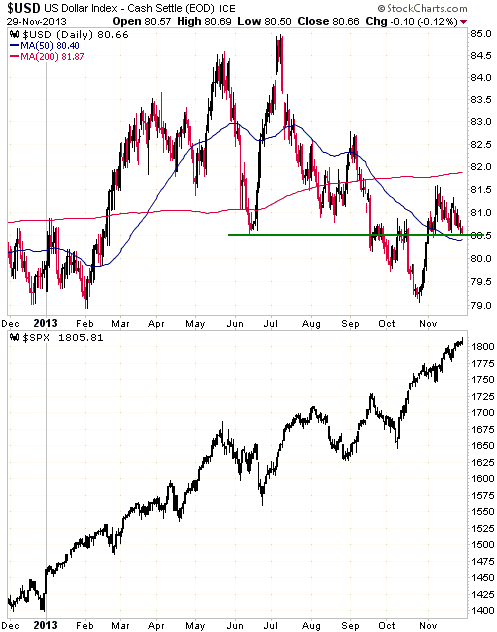
The relationship between the Dollar Index and the nominal performance of the
stock market has been nowhere near as consistent this year as it was during the
preceding several years. We are referring to the fact that prior to this year
there was a consistent inverse relationship between the Dollar Index and the
stock market (the Dollar Index generally trended in the opposite direction to
the S&P500 Index), but that during 2013 the Dollar Index has spent similar
amounts of time moving with and counter-to the stock market. To be more
specific, the above chart shows that the Dollar Index and the SPX trended upward
together during the first half of this year and then trended in opposite
directions during the bulk of the year's second half.
With the consistent inverse relationship of prior years apparently no longer in
effect and with the US stock market being expensive relative to most other stock
markets around the world, we are no longer confident that the next equity bear
market will go hand-in-hand with US$ strength.
Update
on Stock Selections
Notes: 1) To review the complete list of current TSI stock selections, logon at
http://www.speculative-investor.com/new/market_logon.asp
and then click on "Stock Selections" in the menu. When at the Stock
Selections page, click on a stock's symbol to bring-up an archive of
our comments on the stock in question. 2) The Small Stock Watch List is
located at http://www.speculative-investor.com/new/smallstockwatch.html
 Company
news/developments for the week ended Friday 29th November 2013: Company
news/developments for the week ended Friday 29th November 2013:
[Note: AISC = All-In Sustaining Cost, FS = Feasibility Study, IRR =
Internal Rate of Return, MD&A = Management Discussion and Analysis,
M&I = Measured and Indicated, NAV = Net Asset Value, NPV(X%) = Net
Present Value using a discount rate of X%, P&P = Proven and
Probable, PEA = Preliminary Economic Assessment, PFS =
Pre-Feasibility Study]
*Almaden Minerals (AAU) reported another set of results from the
infill drilling program at its Tuligtic gold-silver project
(Mexico).
In the 4th November Weekly Update we wrote that to avoid repetition
we wouldn't mention future results from AAU's 2013 infill drilling
program unless the results were out of the ordinary. The latest
results were far enough out of the ordinary (in a positive way) to
warrant a mention. Of particular note, one hole intersected 101m
with an average grade of 4.2 g/t gold-equivalent and another hole
intersected 125m with an average grade of 2.3 g/t gold-equivalent.
These are very good results. They are infill holes and therefore
probably won't increase the size of the defined resource, but they
confirm the economic potential of the deposit.
*Americas Bullion Royalty (AMB.TO), the company originally called
Golden Predator, announced last Tuesday that it had settled a
dispute with Red Kite (RK), the provider of its $35M credit
facility. $10M had earlier been drawn against this facility and RK
had alleged that a default had occurred. Under the terms of the
credit facility, RK would be within its rights to take ownership of
AMB's entire royalty portfolio in return for a total cash payment of
$35M if a default had, in fact, occurred. With RK having already
provided $10M to AMB, the additional payment to AMB would be $25M in
exchange for the entire royalty portfolio.
Under the settlement that was announced last week, AMB will receive
a total payment of $32.8M for the bulk of its royalty portfolio.
This means that it will receive a cash payment of $22.8M, its
existing $10M debt to RK will be cancelled, and it will get to keep
some of its royalties. Unfortunately, the royalties that it will be
giving up include those associated with the Pan and Gold Rock
projects owned by Midway Gold (MDW) and the Bald Mountain project
owned by Barrick Gold (ABX), which are the only ones that have
significant value at this time.
After last week's deal is 'put to bed' and AMB makes the $5M payment
it owes for the purchase of the Springer tungsten mine, we estimate
that AMB will have about $16M of cash, no debt to speak of, the
Pre-Feasibility stage 1.5M-oz Brewery Creek gold project in the
Yukon, the ready-for-development Springer tungsten mine in Nevada,
and a bunch of low-value royalties. $16M is equivalent to about
$0.09/share, so all of AMB's current market cap is covered by the
cash it will receive. To put it another way, buyers of the stock at
the current price would effectively be getting the non-cash assets
for free.
In a more normal market, if a company with AMB's assets was trading
at cash value it would be a screaming buy, but in the current market
AMB's extremely low valuation doesn't stand out. Furthermore, the
assets that led to AMB's inclusion in the TSI List are no longer
part of the company.
We own AMB shares and have no intention of selling at the current
low price, especially since the cash injection resulting from last
week's deal removes any short-term threat to the company's survival.
Instead, we will hold out for a better selling opportunity, which we
suspect will arrive during the first quarter of next year. However,
with last week's sale of the only assets that prompted our initial
and on-going coverage of this company at TSI, we have removed AMB
from the TSI List. This has resulted in the recording of another
substantial loss for 2013.
*Clifton Star Resources (CFO.V) issued its MD&A and financial
statements for the September quarter. The financial statements
indicated that the company had about $3M of cash and $4.5M of
working capital at 30th September. This is probably enough to fund
the business until around mid-2014.
The next important event for CFO is expected to be the completion of
the PFS for the Duparquet gold project, which is scheduled for next
March. Resolution of the dispute with Osisko regarding the provision
of a $22.5M loan will also be an important event, but the timing of
this event is unknown.
*East Africa Metals (EAM.V) is not part of the TSI Stocks List,
but it is part of the TSI Small Stocks Watch List and has
speculative merit due to the large discount to its cash at which it
is currently trading. The financial statements published last week
indicated that the company has no long-term liabilities and working
capital of $23.5M. With 67M shares outstanding, the working capital
position is therefore equivalent to about C$0.35/share. The company
also owns a 1M-ounce exploration-stage gold project in Tanzania.
The shares ended last week at C$0.155, so buyers at the current
price are effectively buying dollars at less than 50c each and also
getting a stake in a 1M-oz gold deposit for free.
*Endeavour Mining (EDV.TO, EVR.AX) announced that the
commissioning of its Agbaou gold mine in Cote d'Ivoire is
progressing ahead of schedule. The first gold pour has just been
made and commercial production is expected during the first quarter
of next year.
With an expected AISC of around $800/oz, Agbaou will be a relatively
low-cost mine and will reduce EDV's overall cost per ounce if it
achieves its design parameters.
*Energold Drilling (EGD.V) published its results for the quarter
ended 30th September.
In our discussion of its results for the June quarter (in the 2nd
Sep Weekly Update), we wrote that EGD's financial performance would
likely be sub-par over the remainder of this year, but that such an
outcome had probably been fully discounted by the stock market. The
September quarter results were in line with our expectations in that
they were, indeed, sub-par.
For the September quarter EGD reported a net loss of $7M and a
decline in working capital of about $10M. The loss was mostly due to
the on-going contraction in minerals-related drilling activity (EGD
provides drilling services to both the metals-mining industry and
the oil-and-gas industry).
EGD's valuation remains extremely low. As evidence we cite the fact
that the company has working capital of about $75M and a current
market cap of about $82M, which means that its drilling business is
effectively being valued by the stock market at only $7M even though
2013 revenue is likely to be more than $110M (assuming Q4-2013
revenue of at least $17M).
Despite the low valuation we have decided to remove EGD from the TSI
List at a roughly break-even result for the trade, for two reasons.
The first reason is that when we added EGD to the TSI List in early
August there was a decent chance of a major price turnaround in gold
and gold-mining by October, paving the way for an upturn in drilling
activity during the first half of 2014. Now, however, it looks like
the anticipated price turnaround will wait until early 2014, which
probably means that there won't be a meaningful upturn in drilling
activity until the second half of 2014. That's a long time to wait.
The second reason is that the TSI List is overweight in 'deep value'
stock plays.
List
of candidates for new buying
From within the ranks of TSI stock selections, below is a list of the best
candidates for new buying at this time. Due to our on-going focus on risk, this
week's list contains three relatively low-risk gold producers.
1) EDV.TO/EVR.AX (last Friday's closing price: C$0.57)
2) EVN.AX (last Friday's closing price: A$0.60)
3) RIO.TO/RIOM (last Friday's closing price: C$1.63/US$1.61)
Chart Sources
Charts appearing in today's commentary
are courtesy of:
http://stockcharts.com/index.html
http://www.decisionpoint.com/

|









