|
-- Weekly Market Update for the Week Commencing
3rd February 2014
Big Picture
View
Here is a summary of our big picture
view of the markets. Note that our short-term views may differ from our
big picture view.
In nominal dollar terms, the BULL market in US Treasury Bonds
that began in the early 1980s ended in 2012. In real (gold)
terms, bonds commenced a secular BEAR market in 2001 that will continue
until 2018-2020. (Last
update: 20 January 2014)
The stock market, as represented by the S&P500 Index,
commenced
a secular BEAR market during the first quarter of 2000, where "secular
bear market" is defined as a long-term downward trend in valuations
(P/E ratios, etc.) and gold-denominated prices. This secular trend will bottom sometime between 2014 and 2020.
(Last update: 22 October 2007)
A secular BEAR market in the Dollar
began during the final quarter of 2000 and ended in July of 2008. This
secular bear market will be followed by a multi-year period of range
trading.
(Last
update: 09 February 2009)
Gold commenced a
secular bull market relative to all fiat currencies, the CRB Index,
bonds and most stock market indices during 1999-2001.
This secular trend will peak sometime between 2014 and 2020.
(Last update: 22 October 2007)
Commodities,
as represented by the Continuous Commodity Index (CCI), commenced a
secular BULL market in 2001 in nominal dollar terms. The first major
upward leg in this bull market ended during the first half of 2008, but
a long-term peak won't occur until 2014-2020. In real (gold) terms,
commodities commenced a secular BEAR market in 2001 that will continue
until 2014-2020.
(Last
update: 09 February 2009)
Copyright
Reminder
The commentaries that appear at TSI
may not be distributed, in full or in part, without our written permission.
In particular, please note that the posting of extracts from TSI commentaries
at other web sites or providing links to TSI commentaries at other web
sites (for example, at discussion boards) without our written permission
is prohibited.
We reserve the right to immediately
terminate the subscription of any TSI subscriber who distributes the TSI
commentaries without our written permission.
Outlook Summary
Market
|
Short-Term
(1-3 month)
|
Intermediate-Term
(6-12 month)
|
Long-Term
(2-5 Year)
|
|
Gold
|
Bullish
(13-Jan-14) |
Bullish
(26-Mar-12) |
Bullish
|
|
US$ (Dollar Index)
|
Neutral
(13-Jan-14) |
Bearish
(27-Jan-14) |
Neutral
(19-Sep-07) |
|
Bonds (US T-Bond)
|
Bullish
(11-Dec-13)
|
Neutral
(18-Jan-12)
|
Bearish |
|
Stock Market
(DJW)
|
Bearish
(13-Jan-14)
|
Bearish
(28-Nov-11) |
Bearish
|
|
Gold Stocks
(HUI)
|
Bullish
(13-Jan-14) |
Bullish
(23-Jun-10) |
Bullish
|
|
Oil |
Neutral
(30-Jul-12) |
Neutral
(31-Jan-11) |
Bullish
|
|
Industrial Metals
(GYX)
|
Bullish
(15-Jan-14) |
Neutral
(06-Jan-14) |
Neutral
(11-Jan-10) |
Notes:
1. In those cases where we have been able to identify the commentary in
which the most recent outlook change occurred we've put the date of the
commentary below the current outlook.
2. "Neutral", in the above table, means that we either don't have a
firm opinion or that we think risk and reward are roughly in balance with respect to the timeframe in question.
3. Long-term views are determined almost completely by fundamentals,
intermediate-term views by
fundamentals, sentiment and technicals, and short-term views by sentiment and
technicals.
Monetary Inflation Update
The ECB published its December monetary data
last week, enabling us to update our charts of euro TMS (True Money Supply)
growth and G2 TMS growth. What we refer to as G2 TMS is the combination of US$
and euro supply. It is the most useful monetary aggregate from a practical
speculation standpoint.
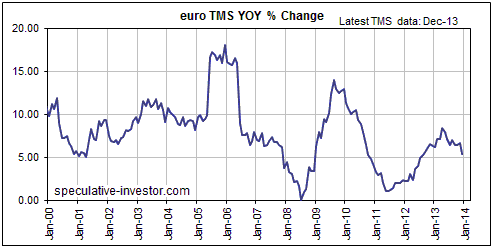
The first of the following charts shows that the year-over-year (YOY) rate of
growth in euro TMS has fallen to 5.4%. This is just above the level at which
euro-zone financial crises and/or recessions began in 2000-2001, 2007-2008 and
2010-2011.
The second of the following charts shows that the YOY rate of growth in G2 TMS
has fallen to 6.4%. This is near a 5-year low, but is still comfortably above
the level that preceded global financial crises and/or recessions in 2000-2001
and 2007-2008.
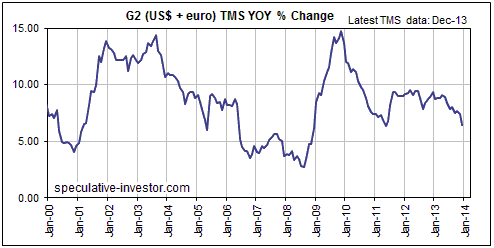
The historical record suggests that the G2 TMS growth rate will fall below 5%
prior to the start of the next global crisis/recession, but as we've warned in
the past it is distinctly possible that the next major downturn will begin at a
higher monetary inflation rate. This is due to the structural economic damage
done by earlier bouts of money-pumping. As is the case with other addictions,
the more that monetary inflation is used to create a good feeling, the more
dependent on continued monetary inflation the economy will become.
Copper Update
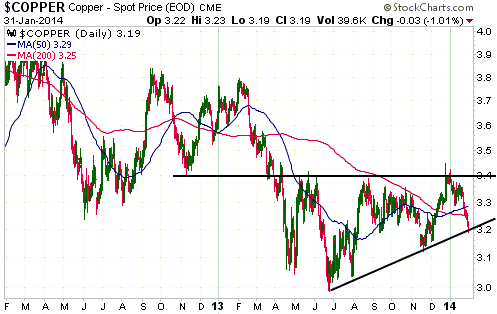
About 2.5 weeks ago the price action prompted a
shift to "bullish" in our short-term copper (and industrial metals) outlook.
This short-term bullish outlook was contingent upon the copper price remaining
above $3.20 on a daily closing basis.
Copper closed at $3.19 last Friday, but it's not clear that this was a breakout.
As illustrated below, it's possible that copper is testing the bottom of its
9-month trading range. Consequently, our short-term "bullish" view will be given
some more rope.
We suspect that copper will do well after the US stock market reaches a
short-term bottom.
The Stock
Market
The US market
The senior US stock indices have fallen to short-term support levels. For
example, the following daily chart shows that the Dow Industrials Index ended
last week at lateral support defined by its August-September highs and its
December low.
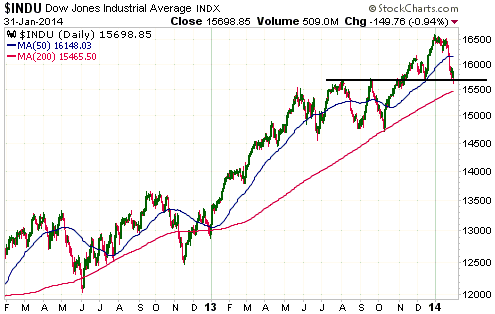
It would be normal for the indices to rebound for at least a few days, but it
would also be normal for the decline to then resume in earnest.
The market is a) declining from a very elevated level in terms of momentum,
sentiment and valuation, b) not yet 'oversold' on even a short-term basis, and
c) overdue for a correction of at least 10%. That's the bullish case. The
bearish case is that the decline from the January-2014 peak will turn out to be
the first leg of a cyclical bear market.
The Japanese market
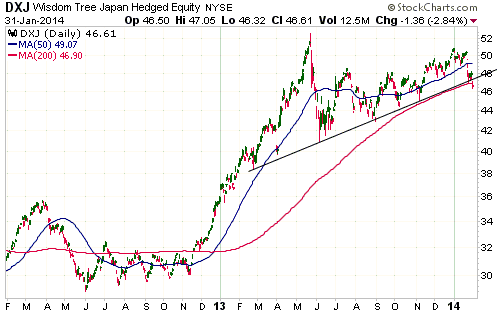
In last week's Interim Update we wrote that DXJ, an ETF that benefits from the
combination of strength in Japanese equities and weakness in the Yen, had not
yet signaled a major downward trend reversal, but that any significant
additional weakness would create evidence of such a reversal. The evidence
emerged last Friday when DXJ closed below a well-defined trend-line and closed
below its 200-day moving average for the first time since November-2012.
The world's cheapest stock market
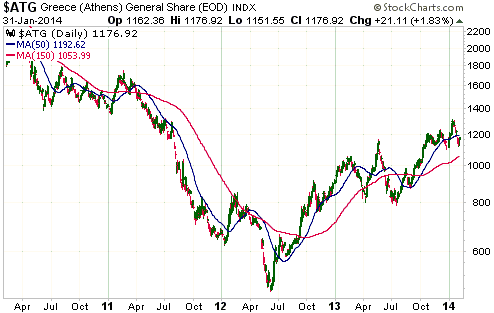
Greece's stock market has rebounded strongly from its mid-2012 bear market
bottom. In fact, the following chart shows that the Athens General Share Index (ATG)
has more than doubled over the past 18 months. However, with a
Cyclically-Adjusted P/E ratio (CAPE)* of less than 4, the market's valuation is
still extremely low. By way of comparison, Spain's stock market has a CAPE of
around 10, Germany's stock market has a CAPE of around 16, and the US stock
market has a dangerously-high CAPE of around 25.
It could make sense to take a long position in Greece's stock market after
evidence emerges that the US stock market has reached a short-term bottom. For
most people, the simplest and best way to do so would be via the purchase of the
Global X Greece 20 ETF (NYSE: GREK).
*The P/E ratio where the denominator is the average annual
earnings of the past 10 years.
This week's
important US economic events
| Date |
Description |
| Monday Feb 03 |
Motor Vehicle Sales
ISM Manufacturing Index
Construction Spending | | Tuesday
Feb 04 |
Factory Orders | | Wednesday
Feb 05 |
ISM Non-Mfg Index | | Thursday
Feb 06 |
Productivity and Costs
International Trade Balance
|
| Friday Feb 07 |
Monthly Employment Report
Consumer Credit |
Gold and
the Dollar
Gold and Silver
The Gold/Silver Ratio
In some ways gold and silver are similar investments, but the differences are
enough to cause large moves in the price of one relative to the other. These
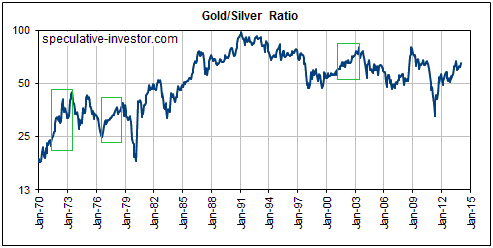
large price moves are clearly evident on the following long-term monthly chart
of the gold/silver ratio. Here's what we conclude about gold relative to silver
based on the long-term chart of the gold/silver ratio and logical deduction.
First, silver tends to perform better than gold -- causing the gold/silver ratio
to decline -- during the late stages of intermediate-term precious-metals
rallies and especially during the late stages of cyclical precious-metals bull
markets. It does so for the same reason that highly-speculative junior
gold-mining stocks tend to be much stronger than their larger/lower-risk
counterparts during the late stages of multi-year advances. As a rally
progresses, speculators are emboldened to take more risk and go further down the
food chain in search of the proverbial killing.
Second, gold tends to perform better than silver -- causing the gold/silver
ratio to rise --during the first two years of a cyclical precious-metals bull
market. The historical sample size is admittedly small, thanks to the gold price
being fixed until 1971, but this is what happened during the first two years of
the three cyclical bull markets of the past 45 years. Specifically, gold
outperformed silver from mid-1971 through to mid-1973, from mid-1976 through to
late-1978, and from early-2001 through to mid-2003 (the three periods shown in
boxes on the above chart). Usually, speculators (as a group) favour gold over
silver until after they become confident that a precious-metals bull market is
underway.
Third, on a very long-term (multi-generational) basis, gold appears to be in an
upward trend relative to silver. We can't yet prove that this is the case, but
there is some logic to it because gold is certainly in a very long-term upward
trend relative to commodities in general (as represented by the Continuous
Commodity Index) and industrial/commercial usage is far more important to the
silver market than to the gold market. That being said, whether or not such a
multi-generational trend is underway has no practical implications for anyone
with an investment timeframe of less than 10 years.
Fourth, 50-65 now appears to be the normal range for the gold/silver ratio.
Spikes in the ratio to below 50 now indicate that silver is 'overbought'
relative to gold and that a precious-metals rally is in its final phase, whereas
rises in the ratio to above 65 suggest that the entire precious-metals sector is
'oversold' and that long-term investors should be favouring silver over gold.
The ratio ended last week at 65, which means that it is at the top of its normal
range and at a level where silver is 'oversold' relative to gold and the overall
sector is 'oversold'. This suggests to us that long-term investors should now
have a bias in favour of silver. On the other hand, we know that gold tends to
outperform silver during the first two years of a new cyclical bull market and
that if a new cyclical bull market has begun then it is only about 7 months old
(taking late-June 2013 as the starting point).
The upshot is that we are presently long-term neutral on the gold/silver ratio.
However, for our own account we are more interested in accumulating silver
bullion than gold bullion at this time, solely because we have a lot of
equity-related exposure to gold and very little equity-related exposure to
silver.
Current Market Situation
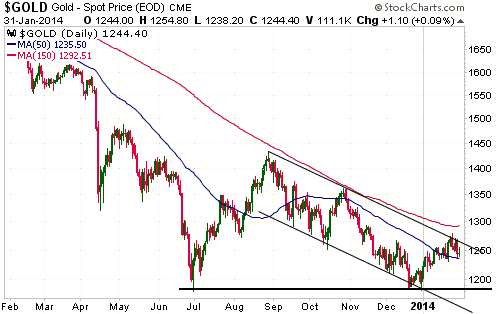
Gold continues to consolidate just below its channel top and just above its
50-day MA.
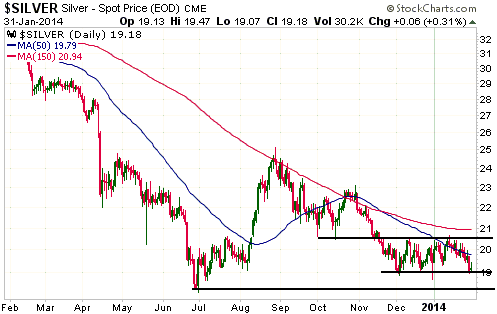
When gold was testing its June-2013 bottom in December, silver was making a
higher low. However, whereas gold is now consolidating near the top of its
3-month range, silver has dropped all the way back to its lows of the past 3
months. This could mean that silver is about to do what gold did in December:
successfully test its June-2013 bottom.
Silver needs to close above $20.50 to confirm an upward trend reversal.
Gold Stocks
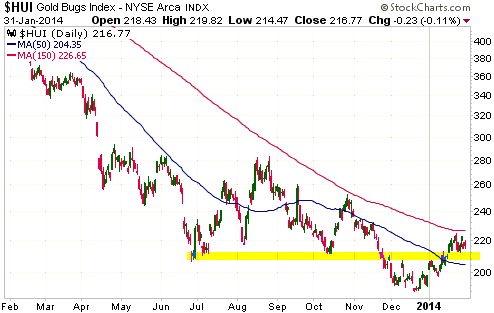
The HUI is consolidating below its 150-day MA and just above support at 207-212.
Based on seasonal patterns, a likely short-term scenario entails a
pullback/consolidation low during the first half of February followed by a rally
into, and a short-term peak during, the
PDAC Convention in early March. Based on the gold sector's historical record
following cyclical bear markets, the HUI is likely to trade with a '3 handle' by
the middle of this year.
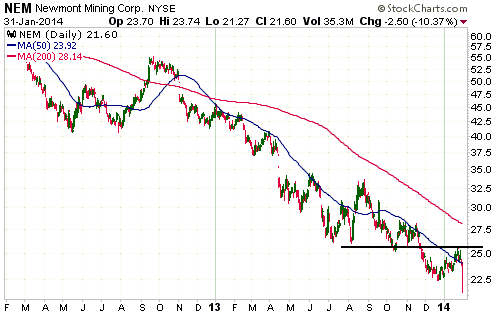
The HUI would have gained some ground last Friday if not for the 10% decline in
the stock price of Newmont Mining (NEM). The market was apparently disappointed
by NEM's 2014 guidance.
Friday's plunge took the NEM price to a new bear-market low. It is now at its
lowest level since November of 2008.
Although its valuation is more attractive today than it has been for a long time
and although it will undoubtedly rebound from last week's drubbing, NEM doesn't
interest us right now as either a short-term trade or a long-term holding. We
prefer the sorts of gold-mining companies that NEM will be forced to buy over
the next two years in order to replenish its reserves.
Currency Market Update
At the moment, all currency-market fundamental and technical indicators are
neutral with regard to both the short-term and the intermediate-term outlook for
US$/euro. However, our intermediate-term outlook for the Dollar Index recently
shifted to "bearish" due to our expectation that European stocks will
out-perform US stocks over the coming 6-12 months. Relative strength in European
stocks should lead to greater speculative demand for the euro and a downward
trend in the Dollar Index.
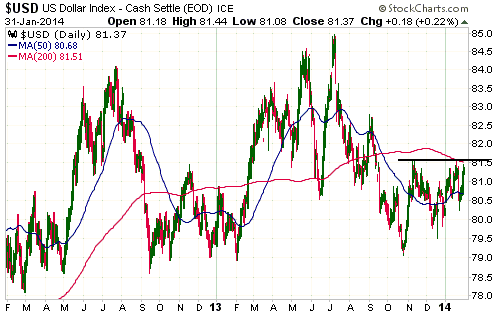
The Dollar Index bounced last week, but only by enough to take it up to near the
top of its narrow short-term trading range. For a rally in the Dollar Index to
be significant it will have to result in a weekly close above 81.6.
It's a negative for the US$ that the Dollar Index hasn't yet managed to achieve
a weekly close above 81.6 despite the assistance provided by the
"emerging-markets" turmoil. That being said, the "emerging-markets" turmoil
isn't over.
Updates
on Stock Selections
Notes: 1) To review the complete list of current TSI stock selections, logon at
http://www.speculative-investor.com/new/market_logon.asp
and then click on "Stock Selections" in the menu. When at the Stock
Selections page, click on a stock's symbol to bring-up an archive of
our comments on the stock in question. 2) The Small Stock Watch List is
located at http://www.speculative-investor.com/new/smallstockwatch.html
 Company
news/developments for the week ended Friday 31st January 2014: Company
news/developments for the week ended Friday 31st January 2014:
[Note: AISC = All-In Sustaining Cost, FS = Feasibility Study, IRR =
Internal Rate of Return, MD&A = Management Discussion and Analysis,
M&I = Measured and Indicated, NAV = Net Asset Value, NPV(X%) = Net
Present Value using a discount rate of X%, P&P = Proven and
Probable, PEA = Preliminary Economic Assessment, PFS =
Pre-Feasibility Study]
*Asanko Gold (AKG) advised prior to the start of trading last
Friday that its merger with PMI Gold had been approved by the
shareholders of both companies. Selling pressure immediately abated
and the expected catch-up move got underway. Initial resistance lies
at US$1.80.
*Batero Gold (BAT.V) issued financial statements for the 3-month
period ending 30th November 2013. The statements showed that the
company had no long-term liabilities and net cash of $14M (about
$0.16/share) at 30th November. This means that BAT continues to
trade at a significant discount to its cash (the stock price ended
last week at C$0.12).
*Dragon Mining (DRA.AX) reported that it produced 17.9K ounces of
gold in the December quarter at a cash cost of US$1076/oz. Although
the production quantity was good, DRA is clearly not profitable at
the current gold price.
We estimate that DRA has about $9M of working capital. Its survival
is not under threat at this time, but like many other gold producers
it will need a higher gold price to remain viable.
*Endeavour Mining (EDV.TO, EVR.AX) announced that it has achieved
commercial production at its Agbaou gold mine in Cote d'Ivoire, on
time and slightly under budget. So far so good, as EDV's management
continues to execute according to plan. The company now has four
operating gold mines in West Africa -- one in Ghana, one in Burkina
Faso, one in Mali and one in Cote d'Ivoire.
If Agbaou achieves its design parameters it will be a low-cost
100K-ounce/year operation and will reduce EDV's average per-ounce
production cost. Specifically, Agbaou's AISC is expected to be about
$800/oz, which should help bring the AISC/ounce for the overall
company down from around $1100 to around $1000.
Separately, EDV reported its final production result for 2013 and
provided 2014 guidance. 2013 gold production came in at 324K ounces,
which means that the company produced 86K ounces during the December
quarter. The December quarter's production included 6K ounces from
the new Agbaou mine, so the three existing mines produced a total of
80K ounces. This is about 10% less than the preceding quarter, but
the amount of gold produced for the full year was in the top half of
the company's guidance and the AISC/oz was also according to plan.
2014 production is expected to be around 420K ounces at an AISC of
around $1000/oz, with the increase (from 324K ounces in 2013) being
due to the new Agbaou mine and a full year's contribution from the
expanded mill at the Tabakoto project (Mali).
At an average gold price of $1250/oz, EDV's management expects that
the company would have 2014 sustaining cash flow of $95M.
Considering the amount that will be spent on growth-related projects
and exploration, this would result in almost no free cash flow. In
other words, if the gold price stays near its current level over the
next 12 months then EDV's business will probably do little more than
tread water.
We expect the gold price to average well over $1250/oz this year,
enabling EDV to add plenty of cash to its balance sheet.
*Evolution Mining (EVN.AX) issued its quarterly report for the
December quarter.
Total production for the quarter from EVN's five operating gold
mines was 107.2K ounces -- the same as the preceding quarter and in
line with guidance. Importantly, there was a further significant
improvement on the cost front. After falling from A$1266/oz during
the June quarter to A$1091/oz during the September quarter, the AISC
fell to A$1049/oz during the December quarter. We won't know the
full financial effects of the improved operational performance of
the past two quarters until about one month from now when the
company issues its half-year report, but we expect that the cost
reductions will have boosted EVN's net financial position by about
$20M.
Production guidance for the financial year ended 30th June 2014 was
maintained at 400-450K ounces of gold at an all-in sustaining cost
of A$1080-$1130/oz.
*Golden Star Resources (GSS) reported the results of infill and
step-out holes drilled below the current open-pit mine at its Wassa
gold project in Ghana. The results were good enough that if they had
been issued by an exploration-stage miner they would probably have
given the stock price a hefty boost, but for a company with more
than 300K ounces of current gold production they were assessed by
the market to be of only minor importance. This assessment is
correct, as mining of the deep, high-grade resources at Wassa won't
commence for at least 3 years, and in the meantime GSS will either
be a spectacular success or a complete failure based on the
performance of the gold price and company's ability to control costs
at its existing operations.
*Lydian International (LYD.TO) has appointed Howard Stevenson to
take over from retiring CEO Tim Coughlin. This is something of a
coup for a small, exploration-stage miner, as Mr. Stevenson is
currently the President and COO of Alacer Gold, a mid-tier gold
producer with operations in Turkey.
Also, LYD is topping up its treasury via a $15M "bought deal" equity
financing (15M shares at $1/share). This financing reduces the
company's per-share value by about 10%, but it is a reasonable move
because a) it reduces risk and b) unlike recent equity financings
announced by other junior gold miners, it doesn't magnify the stock
dilution by including warrants with the new shares.
We estimate that LYD will have about $25M of working capital after
this financing is complete, which should ensure that the company is
fully funded to the point where it begins to construct a mine.
*Premier Gold (PG.TO) reported the results of PEA studies on the
Hardrock and Brookbank deposits at its Trans-Canada gold project
(Ontario). The Hardrock PEA is the important news, as the Brookbank
deposit is small and doesn't contribute much at the current gold
price.
The PEA published last week considered only the portion of the
overall project resource that could be mined via an open pit. It
determined that Hardrock could be developed into an open-pit mine
with average annual production of 203K ounces over 15 years, at a
capital cost of $410M (including $83M contingency). At a gold price
of $1250/oz, the after-tax NPV(5%) and IRR were estimated to be
$359M and 19%, respectively, rising to $633M and 28% at a gold price
of $1450/oz. Considering the high capital cost, the project is
economically marginal at $1250/oz and robust at $1450/oz.
The above figures are roughly in line with what we were expecting.
Hardrock's economics are not terrific at the current gold price, but
considering the attractive location (Ontario) they are probably good
enough to make the project of interest to a mid-tier or senior gold
producer after the gold price breaks decisively above $1300/oz. For
example, the PEA results reported last week indicate that the
Hardrock project has better economics than the Rainy River project
acquired by New Gold last year and roughly equivalent economics to
the Magino project acquired by Argonaut Gold in 2012. Like Hardrock,
both Rainy River and Magino are located in Ontario.
*Ramelius Resources (RMS.AX) issued its quarterly activities
report for the December quarter.
It was already known that production was well below plan as a result
of November's ball-mill motor failure at the Mt Magnet project.
Production for the quarter came in at 21.8K ounces, versus the
27K-ounce plan. The per-ounce cash cost was A$1450, which means that
it was another loss-making quarter for RMS.
Guidance for the March-2014 quarter is 27K ounces at a cash cost of
around A$1200/oz. A cash cost of A$1200/oz implies a total cost of
at least A$1400/oz. Therefore, at the current A$-denominated gold
price (A$1420) RMS would do no better than break even if it achieved
its latest guidance. It has enough cash that its survival is not
presently under threat, but it will need a much higher gold price in
order to generate meaningful profits and cash flow.
Until gold definitively confirms an upward trend reversal by
breaking decisively above US$1300/oz, it will make sense to favour
relatively low-risk stocks such as EVN.AX over more-leveraged and
higher-risk stocks such as RMS.AX.
List
of candidates for new buying
From within the ranks of TSI stock selections, below is a list of the best
candidates for new buying at this time.
1) AKG (last Friday's closing price: US$1.75)
2) EDV.TO/EVR.AX (last Friday's closing price: C$0.67)
3) EVN.AX (last Friday's closing price: A$0.64)
4) RIO.TO/RIOM at around C$2.00/US$1.80 (last Friday's closing price:
C$2.18/US$1.97)
Addition
to Small
Stocks Watch List (SSWL)
The SSWL contains stocks that are probably too small and/or too illiquid to be
included in the TSI Stocks List, but appear to have substantial upside potential
and could be of interest to risk-tolerant speculators capable of doing their own
company research. We are going to make two additions to the SSWL: the
rare-earths 'play' discussed below and a very small exploration-stage gold miner
to be discussed in this week's Interim Update.
*Geomega Resources (TSXV: GMA). Shares: 43M issued. Recent price:
C$0.29
GMA is a former member of the SSWL. It was removed in May of 2013 due to the
lousy overall market for small-cap resource stocks and the absence of a good
reason to expect the stock to do anything except continue to struggle. We are
now returning it to the SSWL. Its return is partly due to an improving overall
market for this type of stock, but is mostly due to important company-specific
news.
GMA is developing the Montviel REE (rare earth element) project in Quebec. This
project has an Indicated resource of 184M tonnes averaging 1.45% TREO (total
rare earth oxides), making it one of the world's largest REE deposits outside
China. Within the Indicated resource is 446M kg of Nd2O3 (Neodymium Oxide) --
the equivalent of about $36B of Nd2O3 at the current market price. Neodymium is
most commonly used to make permanent magnets and has a fast-growing market.
The news we are referring to came on 14th January via the press release posted
HERE. This press release announced the successful conclusion of tests
confirming physical separation of rare earth elements using a new technology.
The physical separation process has the potential to dramatically reduce the
capital required to build separation facilities compared to conventional
techniques, optimise REE recovery and improve the environmental performance of
operations.
The above-mentioned news caused GMA's stock price to double on high volume (see
chart below). However, at Friday's closing price the company's market cap was
only about $12M, so it's not like the upside potential has already been factored
in. Also, the initial tests dealt only with the separation of europium (Eu),
ytterbium (Yb) and lanthanum (La). If the next set of tests shows that the same
process can be used to separate neodymium then there will almost certainly be a
much greater rise in the stock price. Of course, that's a big 'if'.
In addition to the risk that the next set of tests will not be successful, there
is financing risk with GMA in that the company will have to raise more money
within the next couple of months.
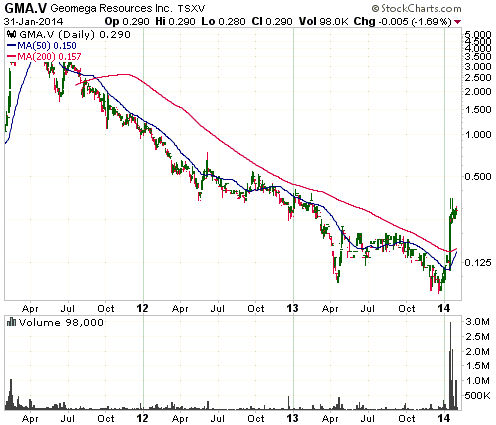
Chart Sources
Charts appearing in today's commentary
are courtesy of:
http://stockcharts.com/index.html

|









