|
-- Weekly Market Update for the Week Commencing
3rd June 2013
Big Picture
View
Here is a summary of our big picture
view of the markets. Note that our short-term views may differ from our
big picture view.
In nominal dollar terms, the BULL market in US Treasury Bonds
that began in the early 1980s will end by 2013. In real (gold)
terms, bonds commenced a secular BEAR market in 2001 that will continue
until 2014-2020. (Last
update: 23 January 2012)
The stock market, as represented by the S&P500 Index,
commenced
a secular BEAR market during the first quarter of 2000, where "secular
bear market" is defined as a long-term downward trend in valuations
(P/E ratios, etc.) and gold-denominated prices. This secular trend will bottom sometime between 2014 and 2020.
(Last update: 22 October 2007)
A secular BEAR market in the Dollar
began during the final quarter of 2000 and ended in July of 2008. This
secular bear market will be followed by a multi-year period of range
trading.
(Last
update: 09 February 2009)
Gold commenced a
secular bull market relative to all fiat currencies, the CRB Index,
bonds and most stock market indices during 1999-2001.
This secular trend will peak sometime between 2014 and 2020.
(Last update: 22 October 2007)
Commodities,
as represented by the Continuous Commodity Index (CCI), commenced a
secular BULL market in 2001 in nominal dollar terms. The first major
upward leg in this bull market ended during the first half of 2008, but
a long-term peak won't occur until 2014-2020. In real (gold) terms,
commodities commenced a secular BEAR market in 2001 that will continue
until 2014-2020.
(Last
update: 09 February 2009)
Copyright
Reminder
The commentaries that appear at TSI
may not be distributed, in full or in part, without our written permission.
In particular, please note that the posting of extracts from TSI commentaries
at other web sites or providing links to TSI commentaries at other web
sites (for example, at discussion boards) without our written permission
is prohibited.
We reserve the right to immediately
terminate the subscription of any TSI subscriber who distributes the TSI
commentaries without our written permission.
Outlook Summary
Market
|
Short-Term
(1-3 month)
|
Intermediate-Term
(6-12 month)
|
Long-Term
(2-5 Year)
|
|
Gold
|
Bullish
(17-Oct-12)
|
Bullish
(26-Mar-12)
|
Bullish
|
|
US$ (Dollar Index)
|
Neutral
(24-Dec-12)
|
Bullish
(01-May-13)
|
Neutral
(19-Sep-07)
|
|
Bonds (US T-Bond)
|
Neutral
(12-Nov-12)
|
Neutral
(18-Jan-12)
|
Bearish |
|
Stock Market
(DJW)
|
Neutral
(06-May-13)
|
Bearish
(28-Nov-11)
|
Bearish
|
|
Gold Stocks
(HUI)
|
Bullish
(24-Dec-12)
|
Bullish
(23-Jun-10)
|
Bullish
|
|
Oil |
Neutral
(30-Jul-12)
|
Neutral
(31-Jan-11)
|
Bullish
|
|
Industrial Metals
(GYX)
|
Neutral
(30-Jul-12)
|
Neutral
(29-Aug-11)
|
Neutral
(11-Jan-10)
|
Notes:
1. In those cases where we have been able to identify the commentary in
which the most recent outlook change occurred we've put the date of the
commentary below the current outlook.
2. "Neutral", in the above table, means that we either don't have a
firm opinion or that we think risk and reward are roughly in balance with respect to the timeframe in question.
3. Long-term views are determined almost completely by fundamentals,
intermediate-term views by
fundamentals, sentiment and technicals, and short-term views by sentiment and
technicals.
Monetary Inflation Update
Late last week the ECB got around to
reporting its money-supply data for April, enabling us to update our charts
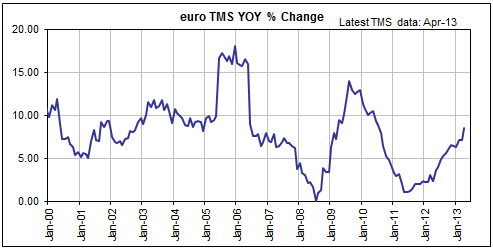
showing the growth rates of euro and G2 (US$ plus euro) True Money Supply (TMS).
The first of the following monthly charts shows that the year-over-year (YOY)
rate of growth in euro TMS began to trend upward during the second half of 2011
and that the April-2013 figures extended the advance. The euro-zone's monetary
inflation rate is now about 8.5%, which is the highest it has been since July of
2010.
The second chart shows that the YOY rate of growth in G2 TMS has oscillated
within a narrow horizontal range at a moderately high level over the past 18
months. It is presently near the top of this range (9.3%).
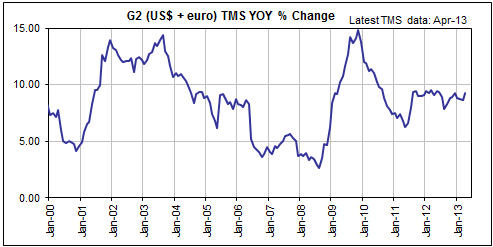
It's not a fluke that the major stock market declines of 2001-2002 and 2007-2009
happened after the G2 monetary inflation rate fell below 5%. There was a
cause-effect relationship at work. This doesn't, however, mean that the equity
markets will be immune to substantial weakness until after the rate of
money-supply growth drops to a much lower level. What it means is that there is
almost no chance of a major deflation scare such as occurred in 2008-2009, or
even a medium deflation scare such as occurred in 2001-2002, getting underway
over the next 6 months.
While the root cause will be the same, the next global crisis will almost
certainly look very different to the last one. Japan's latest monetary
experiment is a potential catalyst for the next global crisis. Japan's
experiment, which has become known as "Abenomics", could result in such a
spectacular and obvious failure of inflation policy that it casts aspersions on
the actions of all the globally-important central banks and governments.
The Stock
Market
Japan
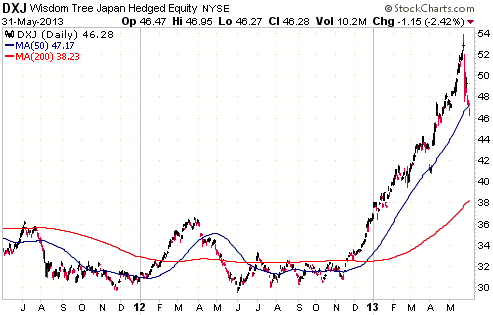
As evidenced by the following daily chart of DXJ, an ETF designed to follow the
Japanese stock market and to hedge changes in the Yen/US$ exchange rate, Japan's
stock market rose at a phenomenal pace for about five months and is now falling
even faster than it rose. DXJ is down by 14% from its 22nd May intra-day peak.
One of the most interesting aspects of the recent market action in Japan is the
interplay between the stock market and the bond market. In Japan and in most
other developed economies over the past 15 years, bond yields have tended to
follow the stock market up and down. However, that hasn't been the case in Japan
over the past few months. Of particular interest, the catalyst for the recent
sharp decline in the Japanese stock market appears to have been rising interest
rates. In other words, rather than a sharp stock market decline causing interest
rates to fall, which is the way the stock-bond relationship has tended to
operate for many years, we now have rising interest rates -- and fear that
interest rates will continue to rise -- causing a sharp decline in the stock
market.
To summarise, there are signs that Japan is transitioning from rising interest
rates being an effect of stock market strength to rising interest rates being a
cause of stock market weakness. If this continues then things could get very
interesting very quickly, because it will result in "Abenomics" becoming
self-defeating sooner than expected.
Brazil
Brazil's stock market was a relative-strength leader last decade, but over the
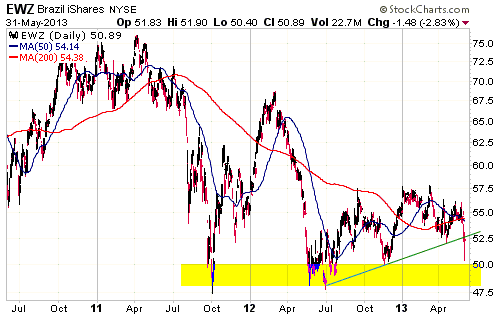
past two years it has been a laggard. As illustrated by the following chart of
Brazil iShares (EWZ), in US$ terms the Brazilian stock market is nearing support
defined by its lows of the past three years. The situation looks similar when
performance is measured in terms of the Brazilian Real.
The two main reasons for the excellent performance of Brazil's stock market from
2003 through to early 2011 were the rising trend in commodity prices and rapid
growth in Brazil's money supply. The rapid growth in Brazil's money supply has
continued (Brazil TMS has risen by about 16% over the past 12 months), but
commodity prices have been immersed in a cyclical decline since early-2011.
Also, the rapid money-supply growth has resulted in an obvious "inflation"
problem that the central bank has been making a futile attempt to address by
hiking official interest rates. The attempt is futile because the central bank
is not addressing the cause of the inflation problem (the rapid growth in the
money supply), but the hiking of interest rates is another source of downward
pressure on the stock market.
The Brazilian stock market is 'oversold' and nearing important support, but at
this time we see no good reason to be bullish on either the stock market or the
economy of this Latin American nation. Having said that, the "Keynesian
stimulus" provided by Brazil's hosting of the 2014 Soccer World Cup could create
a semblance of economic strength over the next 12 months while wasting resources
and worsening the economy's long-term prospects.
The US
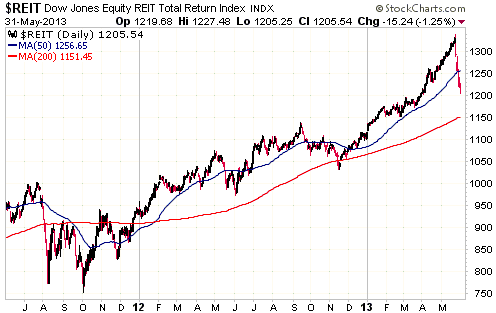
A correction is underway in the US stock market. The senior stock indices
haven't yet fallen far from their highs, but there has been meaningful weakness
among interest-rate sensitive equities such as Utility stocks and REITs (Real
Estate Investment Trusts). As discussed in previous TSI commentaries, the
Utility sector reversed downward in April and has now given back almost all of
the gains achieved over the past 12 months. As illustrated by the following
daily chart, the REIT sector continued its relentless upward trend until about
two weeks ago. It has since reversed downward in impressive fashion.
We suspect that the senior US stock indices will make new multi-year highs
during the second half of this year, but that the ultimate highs will only be
slightly higher than the May-2013 highs.
This week's
important US economic events
| Date |
Description |
| Monday Jun 03 |
ISM Index
Construction Spending | | Tuesday
Jun 04 |
International Trade Balance
Motor Vehicle Sales | | Wednesday
Jun 05 |
ISM Non-Mfg Index
Factory Orders
Fed's Beige Book
Q1 Productivity and Costs | | Thursday
Jun 06 |
No important events scheduled
|
| Friday Jun 07 |
Monthly Employment Report
Consumer Credit |
Gold and
the Dollar
Gold
Current Market Situation
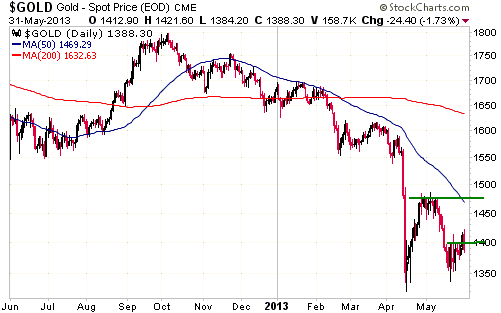
Gold's price action over the final two days of last week was slightly bearish,
the reason being that gold broke above short-term resistance at $1400 on
Thursday only to reverse downward on Friday and fall back to the $1380s. This
creates the appearance of a failed upside breakout, and failed upside breakouts
are more reliably bearish signals than downside breakouts. However, Friday's
bearish price action in the bullion market was counteracted by the resilience of
the gold-mining sector.
All in all, it still looks like gold successfully tested its April low during
May.
The latest Commitments of Traders (COT) data revealed the smallest speculative
net-long position in COMEX gold futures since 2005, when gold was trading at
around $400/oz. This suggests that speculators, as a group, haven't been as
disinterested in gold as they are right now since the early days of the gold
bull market.
The current lack of enthusiasm for gold creates upside potential, but note that
speculators will have to start becoming more enthusiastic about gold's prospects
for gold's bull market to resume in earnest. To put it another way, it's all
well and good for there to be a sentiment platform capable of launching a
multi-year rally, but no rally will get far until sentiment begins to improve.
Furthermore, sentiment needs to improve within the realm of large speculators.
Major upward trends in the gold price are fueled by the buying of large
speculators, not by the buying of Chinese housewives.
Sentiment within the speculating community will begin to improve as evidence
emerges that, like all its predecessors, the latest round of monetary
pump-priming is failing to bring about a sustainable economic recovery and/or is
causing an obvious "price inflation" problem. We expect the former (evidence of
failure to create self-sustaining strength) to emerge prior to the latter
(obvious evidence of a "price inflation" problem).
Supply and demand in the gold market
Notwithstanding the opinions of many gold bulls to the contrary, the law of
supply and demand still applies in the gold market. An implication is that it is
not possible for the price of physical gold to fall over a certain period unless
there is greater urgency to sell physical gold than to buy physical gold over
the period in question. This will be the case regardless of what is happening to
"paper" gold.
The topical example, of course, is the April plunge in the gold price from the
high-$1500s to the low-$1300s. The price of physical gold fell sharply along
with the price of "paper" gold, an outcome that would have been impossible if,
as many pundits have claimed, the demand for physical gold was soaring relative
to the supply of physical gold. Such an outcome could not be made possible by
happenings in the "paper" gold market, because physical demand cannot be
satisfied by "paper" supply.
This is the most basic of basic economics. It is the economics equivalent of "1
+ 1 = 2" in mathematics. When demand rises relative to supply, the price rises
to bring the market into balance. The price cannot possibly fall in such a
situation.
You can probably make a reasonable argument that the happenings in the "paper"
gold market prompted a large wave of selling in the physical market that knocked
the price down. You can certainly make a reasonable argument that the large
decline in price prompted an increase in demand that quickly brought supply and
demand into balance. However, you cannot logically argue that the demand for
physical gold was rising relative to supply while the price was falling!
By the way, what would happen if the demand/supply of physical gold rose while
the demand/supply of "paper" gold fell? The answer is that the price of physical
gold would rise in absolute terms, not just relative to the price of "paper"
gold, while the price of "paper" gold fell. This obviously didn't happen at any
time over the past two months, but it could happen in the future. It is
possible.
We get the impression that a lot of the paper-versus-physical analysis is an
attempt to show that the current gold price is either not real or doesn't mesh
with the real supply/demand situation. It is effectively an attempt to deny
reality and is therefore counter-productive. The truth is that the price is
where it is because of the supply/demand situations in both the physical and
paper gold markets. The price is real, but that doesn't mean it is right.
Market prices are often wrong. If they weren't, it wouldn't be possible to make
large gains by speculating or investing. To put it another way, it's the gap
between value and price that creates the best money-making opportunities. This
gap can become substantial, mainly because the current market price tends to be
determined as much or more by emotion than by the careful weighing of evidence.
Gold Stocks
Current Market Situation
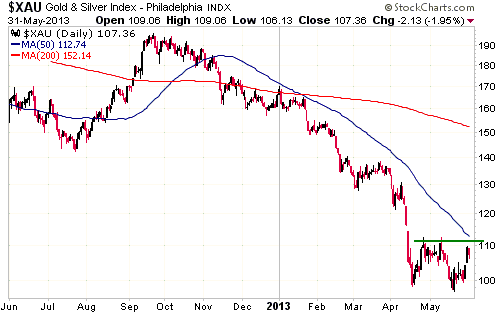
The gold-stock indices ended the week before last in a precarious position, but
held support early last week and then showed meaningful strength over the final
three days of the week. Even Friday's small decline was a sign of strength in
that gold's failure to sustain its break above $1400 could have caused the
gold-stock indices to sell off to a much greater extent.
A daily chart of the XAU is displayed below. Resistance at 290-300 for the HUI
is equivalent to resistance at 110-113 for the XAU. This resistance must be
breached to eliminate most of the remaining doubt that a multi-month bottom is
in place.
There are no guarantees, but there's a very high probability that 2013 will turn
out to be a year during which the gold-mining sector makes a major bottom. It's
possible that the ultimate bottom is already in place, but it's also possible
that a new low or a test of the April-May low will happen during
October-November. Either way, purchases of high-quality gold-mining stocks made
in 2013, especially purchases made when the gold-stock indices are at 'oversold'
extremes, are likely to result in huge gains if held for 1-2 years. In the case
of the beaten-down junior gold-mining stocks with strong balance sheets and
multi-million-ounce projects in secure jurisdictions, "huge" could mean
500%-1000% or even more.
Gold stocks that are breaking out to the upside
In the 27th May Weekly Update we highlighted some gold stocks that had shown
relative strength by holding above their April lows during May. Today we are
going to highlight some gold stocks that are breaking out to the upside from
basing patterns. Not surprisingly, some of the stocks that were showing relative
strength by not breaking below their April lows have been among the first stocks
to break out to the upside.
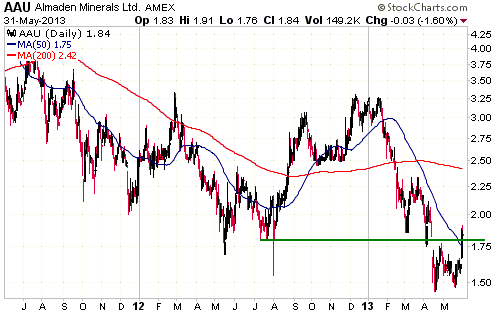
Here are the relevant charts:
a) Almaden Minerals (AAU). By achieving consecutive daily closes above its
50-day MA and resistance at US$1.80, our favourite "prospect generator" has done
enough to confirm that an important bottom is in place.
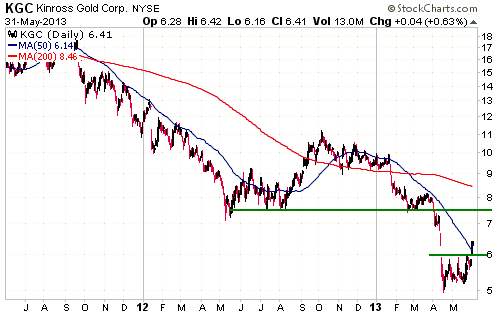
b) Kinross Gold (KGC). By achieving consecutive daily closes above its 50-day MA
and resistance at US$6.00, KGC has done enough to confirm that an important
bottom is in place. As noted last week, the break above US$6.00 creates a
short-term chart-based target of $7.50.
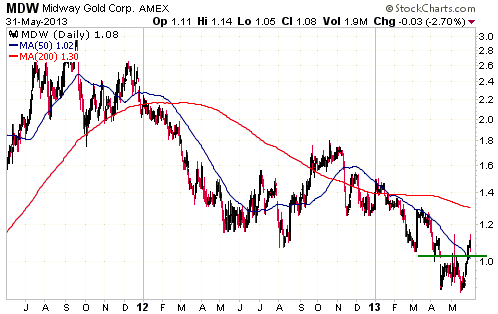
c) Midway Gold (MDW). By achieving consecutive daily closes above its 50-day MA
and resistance at US$1.03, MDW has done enough to confirm that an important
bottom is in place. We have indirect exposure to MDW via AMB.TO, but direct
exposure could be appropriate.
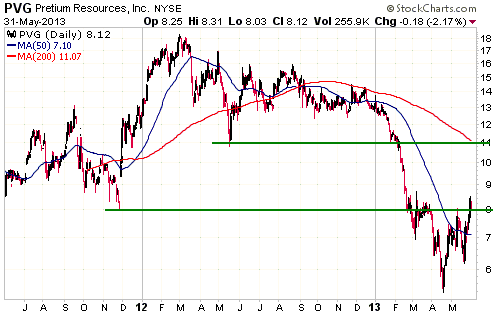
d) Pretium Resources (PVG). The break above US$8.00 completed a multi-month
bottoming pattern. There is some resistance at US$9.00, but the next resistance
of significance lies at US$11.00. PVG's Brucejack project is possibly the best
undeveloped gold project in North America.
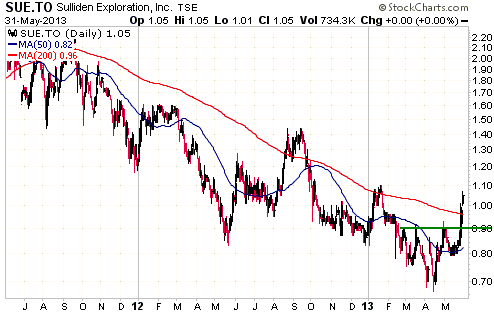
e) Sulliden Exploration (SUE.TO). Impressively, this exploration-stage gold
miner with a project in Peru is now trading above its 200-day MA and near its
high for the year, although it is still trading more than 50% below its high of
the past two years. The relatively strong performance has undoubtedly been
partly due to Agnico Eagle's April-2013 investment in the company.
We successfully traded SUE a few years ago, but currently have no interest. The
company is well-financed and its gold project appears to be economically robust,
but the valuation is comparatively high.
Currency Market Update
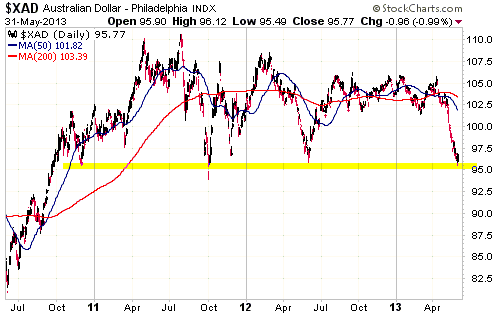
The following daily chart shows that the A$ has continued to fall and is now
testing long-term support at 95.
The next chart shows that the Commercial net-long position in A$ futures (the
blue bars) just moved above its 2012 high. The 2012 high was a 20-year high, so
this means that Commercial traders are now more 'long' the A$ than they have
been at any other time over the past 20 years. By extension, this also means
that the combination of large speculators and small traders is now more 'short'
the A$ than it has been at any other time over the past 20 years.
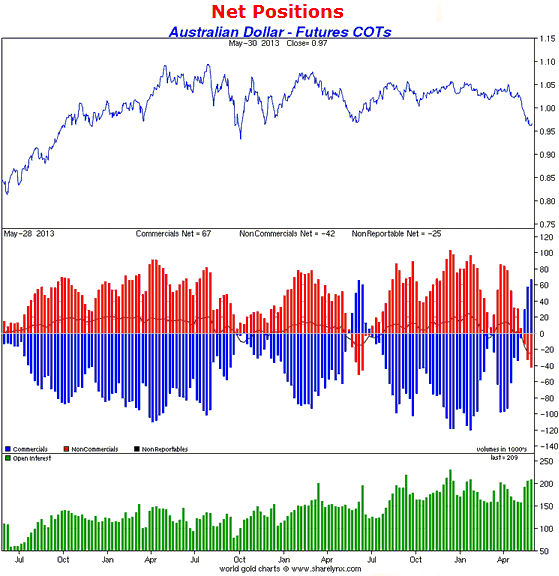
Chart Source: www.sharelynx.com
The A$ is primed for a rebound that will probably last at least a few weeks, but
we wouldn't attempt to play this rebound potential. The reason is that
short-term rebounds aside, the A$ is probably in the process of completing a
major top that could be followed by a much larger decline than we've seen to
date.
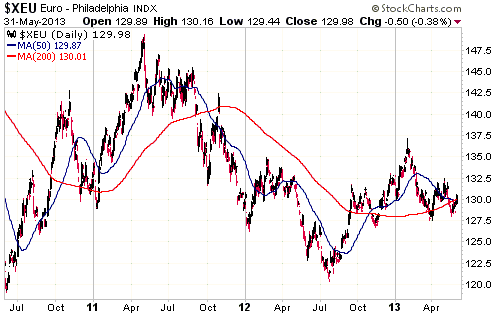
The euro continues to hold up relatively well. We expect that it will decline to
120 or lower within the next 12 months, but over the next two months it is more
likely to rise than fall.
Support at 127 remains critical and must not be breached if the euro is to
maintain its neutral-to-bullish short-term status.
Update
on Stock Selections
Notes: 1) To review the complete list of current TSI stock selections, logon at
http://www.speculative-investor.com/new/market_logon.asp
and then click on "Stock Selections" in the menu. When at the Stock
Selections page, click on a stock's symbol to bring-up an archive of
our comments on the stock in question. 2) The Small Stock Watch List is
located at http://www.speculative-investor.com/new/smallstockwatch.html
 Company
news/developments for the week ended Friday 31st May 2013: Company
news/developments for the week ended Friday 31st May 2013:
[Note: FS = Feasibility Study, IRR = Internal Rate of Return, MD&A =
Management Discussion and Analysis, M&I = Measured and Indicated,
NAV = Net Asset Value, NPV(X%) = Net Present Value using a discount
rate of X%, P&P = Proven and Probable, PEA = Preliminary Economic
Assessment, PFS = Pre-Feasibility Study]
*Americas Bullion Royalty Corp. (AMB.TO) is positively affected by
last week's receipt by Midway Gold of the Class I Air Quality
Operating Permit for its Pan gold project in Nevada. This is because
AMB's most valuable asset is its 4% gross production royalty on this
project. Pan is scheduled to go into production during the second
half of next year.
In other AMB news, metallurgical testing conducted on samples from
the company's Brewery Creek gold project in Canada's Yukon achieved
gold recoveries of 78% to 83% after most of the test ore was crushed
to 9.5mm. This is a satisfactory result.
Brewery Creek could eventually have substantial value, but it is not
the reason for our interest in AMB. Our interest is solely due to
the gold royalties owned by the company, especially the 4% gross
production royalties on Midway Gold's Pan and Gold Rock projects.
*Dragon Mining (DRA.AX) announced that the submission of the
Environmental Impact Assessment Report for its exploration-stage
Kuusamo gold project in Finland has been delayed from the second to
the third quarter of this year. This isn't significant.
*Energy Fuels (EFR.TO) announced prior to the start of trading
last Friday that it has entered into an agreement with a syndicate
of underwriters to raise $5M by issuing new shares at C$0.14. Each
new share issued under this agreement will come with half of a
2-year C$0.19 warrant.
We hate to see new shares issued at such a low price, but unlike the
case of Sabina Gold and Silver (discussed below) a reasonable
argument can be made in favour of EFR's low-priced financing. In
EFR's case the reduction in per-share value resulting from issuing
low-priced shares could be fully offset by the reduction in risk
stemming from the cash infusion.
Considering the price of the equity financing and the overall market
environment, EFR's shares held up remarkably well last Friday. The
stock closed at C$0.17, down C$0.01 on the day and unchanged over
the course of the week.
*Pretium Resources (PVG) reported the result of the first hole of
its 15,000m underground drilling program at the Brucejack project.
The result was in accordance with the projections of the resource
model, which is what we want. PVG also advised that excavation of
the planned 10,000-tonne bulk sample will occur between mid-June and
August.
*Sabina Gold and Silver (SBB.TO) announced a 14M-share equity
financing priced at C$1.40/share. Considering that the company had
more than $100M of cash in the bank at the end of March and was
fully funded for at least the next 12 months and probably the next
18 months, this low-priced financing can aptly be described as
unnecessarily value-destructive and a stupid piece of business.
We can see how a poorly-timed and unnecessary financing such as this
could make sense from management's perspective, because the
financing guarantees that there will be plenty of money to pay
salaries over a longer period of time. Unfortunately, the guarantee
comes at a significant cost to shareholders.
*Sandspring Resources (SSP.V) issued its financial statements and
MD&A for the March quarter. The financial statements showed that SSP
had $5.4M of working capital at 31st March, down from $8.5M at the
end of 2012.
SSP has enough money to fund its planned work program over the next
several months, but will need to arrange additional financing before
year-end. The company has engaged a mining-sector consultant to
assist with this process.
Chart Sources
Charts appearing in today's commentary
are courtesy of:
http://stockcharts.com/index.html

|









