-- Weekly Market Update for the Week Commencing 3rd October 2016
Big Picture
View
Here is a summary of our big picture
view of the markets. Note that our short-term views may differ from our
big picture view.
The BULL market in US Treasury Bonds that began in the early 1980s ended in early-2015, but there will be many years of topping action in bond prices and bottoming action in bond yields before major new trends get underway. (Last update: 29 June 2015)
The stock market, as represented by the S&P500 Index, commenced a secular BEAR market during the first quarter of 2000, where "secular bear market" is defined as a long-term downward trend in valuations (P/E ratios, etc.) and gold-denominated prices. This secular trend will bottom sometime between 2018 and 2020. (Last update: 29 June 2015)
A secular BEAR market in the US Dollar began during the final quarter of 2000 and ended in July of 2008. This secular bear market will be followed by a multi-year period of range trading. (Last update: 09 February 2009)
Gold commenced a secular bull market relative to all fiat currencies, the CRB Index, bonds and most stock market indices during 1999-2001. This secular trend will peak sometime between 2018 and 2020. (Last update: 29 June 2015)
Commodities,
as represented by the CRB Index, commenced a
secular BULL market in 2001 in nominal dollar terms. The first major
upward leg in this bull market ended during the first half of 2008, but
a long-term peak won't occur until 2018-2020.
(Last
update: 29 June 2015)
Copyright
Reminder
The commentaries that appear at TSI
may not be distributed, in full or in part, without our written permission.
In particular, please note that the posting of extracts from TSI commentaries
at other web sites or providing links to TSI commentaries at other web
sites (for example, at discussion boards) without our written permission
is prohibited.
We reserve the right to immediately
terminate the subscription of any TSI subscriber who distributes the TSI
commentaries without our written permission.
Outlook Summary
|
Market |
Short-Term (1-3 month) |
Intermediate-Term (6-18 month) |
Long-Term (2-5 Year) |
| Gold | N/A |
Neutral (27-Jun-16) |
Bullish |
| US$ (Dollar Index) | N/A |
Neutral (17-Aug-16) |
Neutral (19-Sep-07) |
| US Treasury Bonds (TLT) | N/A |
Bearish (19-Oct-15) |
Bearish |
| Stock Market (DJW) | N/A |
Bearish (19-Sep-16) |
Bearish |
| Gold Stocks (HUI) | N/A |
Neutral (04-May-16) |
Bullish |
| Oil | N/A |
Neutral (26-Oct-15) |
Bullish |
| Industrial Metals (GYX) | N/A |
Bullish (04-July-16) | Bullish |
4. Long-term views are determined almost completely by fundamentals and intermediate-term views
are determined by a combination of fundamentals, sentiment and technicals.
Last week's posts at the TSI Blog
Will the Fed be able to fight the next recession?
A
strange sentiment conflict
Summary of current
thinking/positioning
1) Hedged against short-term
downside in gold and the associated mining stocks via GDX put options, GLD
put options and a substantial cash reserve, while maintaining 'core'
exposure in anticipation of large additional gains over the next two
years. Planning to exit short-term hedges (put options) within the coming
two weeks, either following breaches of support and accelerated declines
or following evidence that support levels have held.
2) Gradually
increasing exposure to non-gold commodity-related stocks during periods of
price weakness in anticipation of 2017-2018 being a very bullish period
for commodities.
3) Still betting (via options) on a near-term
decline in the US stock market while continuing to acknowledge that
October-2016 could produce a stock-market high (as per 2007) rather than
the short-term low we are positioned for. Expecting the market to 'tip its
hand' within the next few days.
4) Thinking that the Yen is
topping, the British Pound is basing and the commodity currencies are
still in consolidation mode.
5) Maintaining a large cash reserve in
recognition of the downside risk in almost all equities (current cash
percentage is around 50%), but looking for opportunities to reduce cash
and add to gold/commodity exposure.
The markets are
coiling
A number of financial markets
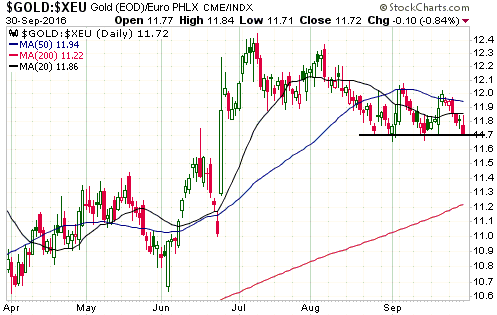
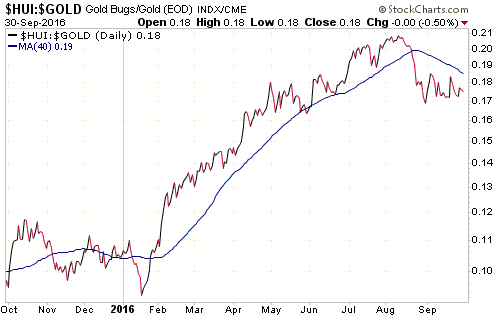
are 'coiling'. To put it another way, in a number of financial markets the
pressure has been steadily building via price fluctuations within
narrowing ranges. Examples include gold bullion, the gold-mining indices,
the Dollar Index, the Yen, the C$, the S&P500 Index and copper. Also, some
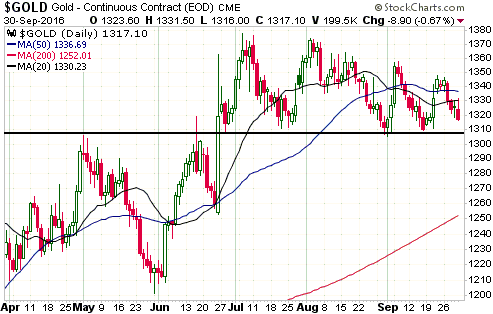
markets are poised just below or just above intermediate-term demarcation
levels. Examples include gold bullion, the Dow Transportation Average and
the Shanghai Stock Exchange Composite Index. Most of these markets/indices
are discussed below.
This sets the stage for interesting price
action (sizable price moves) during October.
Commodity
analysts often can't see the forest for the trees
If you fixate on the trees, that
is, the day-to-day price fluctuations and the associated news, you will
fail to see the forest, that is, the major price trends and the forces
driving those trends. We'll explain what we mean using the example of the
oil market.
In an effort to enlighten us on why the oil price did
what it did on any day, commodity-market analysts, financial journalists
and other pundits will often cite news of increasing supply (to explain a
price fall) or decreasing supply (to explain a price rise). For instance,
the popular view in the press was that the bounce in the oil price during
the final three days of last week was due to news that OPEC was planning
to cut production. The proximate cause of last week's bounce most likely
was the OPEC news, but the important trends in the oil price rarely have
anything to do with OPEC in particular or supply considerations in
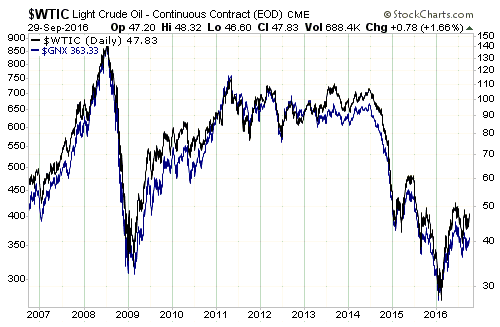
general. As evidence we provide the following chart comparison of the oil
price and the S&P GSCI Commodity Index (GNX).
According to the
Goldman Sachs blurb, the "S&P GSCI contains as many commodities as
possible, with the rules excluding commodities only to retain liquidity
and investability in the underlying futures markets. Currently, the S&P
GSCI contains 24 commodities from all commodity sectors: six energy
products, five industrial metals, eight agricultural products, three
livestock products and two precious metals. This broad range of
constituent commodities provides the S&P GSCI with a high level of
diversification, both across sub-sectors and within each sub-sector."
In summary, GNX is designed to reflect the price performance of a
broad range of commodities. And yet, the following chart shows that over
the past 10 years GNX's performance (the blue line) has been almost
identical to oil's performance (the black line).
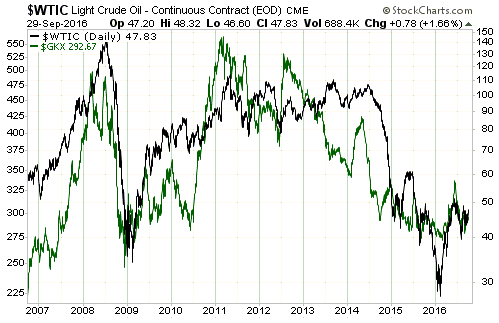
To further make the point, here is a chart comparing the oil price
with the S&P GSCI Agricultural Index (GKX). This chart shows several
short-term divergences, but it also shows that the major price trends are
the same. This is despite the fact that the supply situation for oil is
very different from the supply situations of the agricultural commodities
that comprise GKX.
The point is that regardless of what's happening on the oil-supply
front, the oil price moves up and down with commodity prices in general.
It's the same story with most commodities. There will be times when
something out of the ordinary happens with the supply of a particular
commodity, causing the price of that commodity to separate from the pack.
For most commodities and for most of the time, however, prices trend up
and down as a group.
The logical conclusion is that the important
price trends in the commodity markets are driven by monetary forces rather
than supply considerations. It must be so because money (the US$ in most
cases) is the one thing that all commodity prices have in common. A
follow-on conclusion is that there are no broad-based commodity bull
markets driven by tightening supply, there are only periods when
commodities are among the main beneficiaries of monetary inflation.
Copper Update
Our view since early this year
has been that copper's bear market was essentially complete, but that
there could be a test of the January-2016 low as part of a basing process.
The top of copper's base (or what we think is a base) is at
US$2.25-$2.30. A daily close above $2.25 would be preliminary evidence
that the basing process is complete while a weekly close above $2.30 would
leave little doubt.
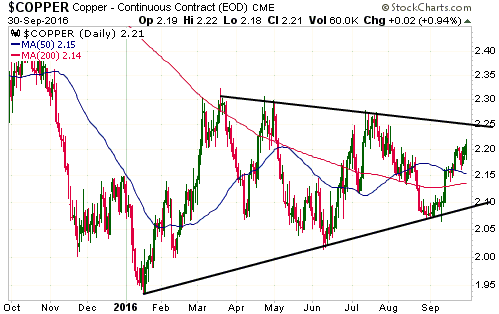
We will be surprised if the copper price breaks out to the upside in
the near future. Considering the price action, the Commitments of Traders
data and the performances of other markets, it's likely that the current
multi-week rally will end near $2.25 and be followed by a multi-week
decline to $2.10 or lower.
The Stock Market
The US
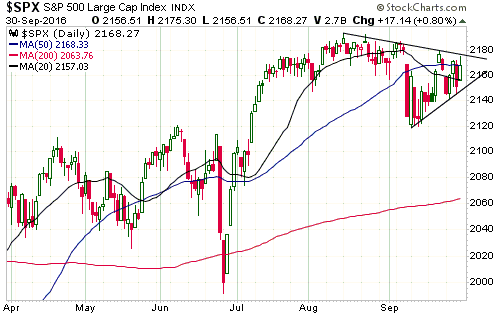
The S&P500 Index (SPX) went nowhere over the course of last week, but the
path it took to get there provided a bit more information. As illustrated
below, the intra-day lows on Tuesday and Thursday of last week have helped
to define an upward-sloping trend-line from the September low. There is
also a fairly-well defined downward-sloping trend-line from the August
high. It will be difficult for the market to avoid breaking through one of
these trend-lines within the coming two weeks.
If it's the upper
(that is, downward-sloping) trend-line that gives way in the near future
then the stage will be set for a quick move to a new all-time high. We
suspect that such an upside breakout would prove to be false, as was the
case with an upside breakout in the SPX at around the same time
(early-October) in 2007. However, we would wait for evidence that the
breakout was false before taking any action.
If it's the lower
trend-line that gives way in the near future then the stage will be set
for a quick decline to a multi-month bottom in October or November.
The Dow Transportation Average (TRAN) did relatively well last week
and is now within spitting distance of intermediate-term resistance
defined by its April-2016 high. An upside breakout would require a WEEKLY
close above 8150.
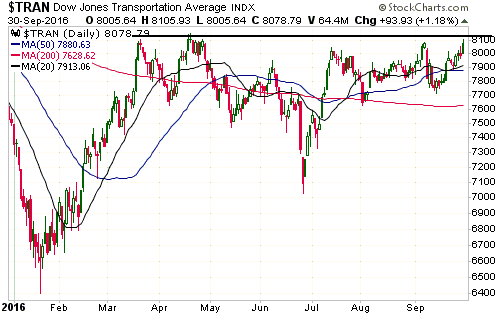
An upside breakout by the TRAN would 'muddy the waters', but at this
stage it looks like the US stock market will trade well below its current
level within the next 6 weeks even if the SPX makes a new high during the
first half of October.
Of potential significance to the stock
market, the next iteration of the ISM Manufacturing New Orders Index (NOI)
gets issued on Monday 3rd October. This index was close to generating a
recession warning last month, so Monday's news could be important.
It would only take a small amount of additional weakness in the NOI to
signal a recession and substantially increase the probability that an
equity bear market is about to begin. Alternatively, a multi-point rise in
the NOI would suggest that the start of the next recession was still at
least a few months away.
The bottom line is that the US stock
market's price action and the US economic data are set up to provide us
with some useful clues over the coming fortnight.
The
Global Banking Sector
Much is being written about Deutsche
Bank (DB) and its possible imminent collapse.
The fear of a DB
collapse has clearly been reflected in the price of DB's stock, but the
financial markets currently do not appear to be concerned that DB's
problems will cause a global banking crisis or even a European banking
crisis. The general lack of concern about the potential knock-on effects
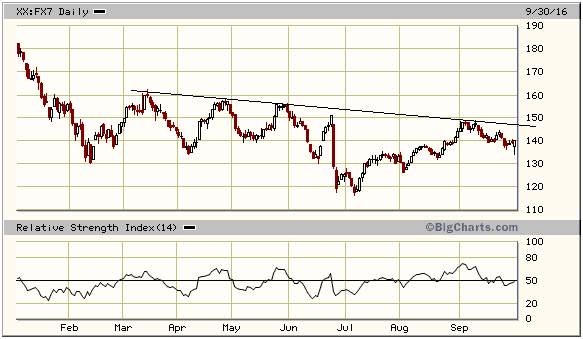
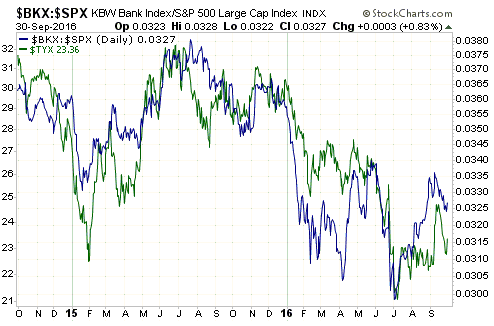
of DB's troubles is evidenced by the following two charts.
The
first chart shows that the Europe 600 Banks Index (FX7) has consolidated
in a routine manner since rallying to resistance in early-September. The
second chart compares the BKX/SPX ratio (the US Bank Index relative to the
SPX) with the 30-year T-Bond yield to make the point that US bank stocks
were relatively strong from early-July through to early-September and that
the relative weakness since early-September is less than would be expected
given the sharp pullback in the 30-year bond yield (the BKX/SPX ratio has
been trending with the 30-year yield for years).
The financial markets could be grossly under-estimating the risk to
the global banking industry posed by DB. If so, it wouldn't be the first
time they've missed the signs of a developing major threat.
Our
view is that DB's issues probably WON'T have severe global consequences,
but that there's enough risk to justify maintaining a much
greater-than-normal cash reserve.
China
The
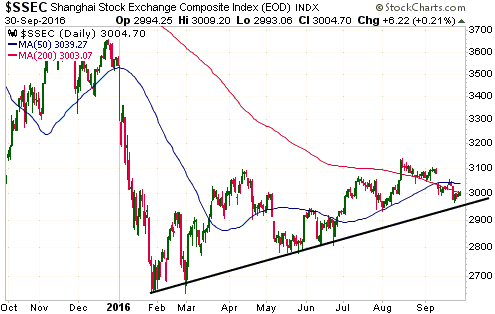
Shanghai Stock Exchange Composite Index (SSEC) plunged from a short-term
high in December of last year to a low in January of this year. It then
rebounded to a high in mid-August, but the 6.5-month rebound recouped less
than half the loss incurred during the 5-week December-January plunge.
The SSEC's rebound from its January low is either a consolidation
within a bear market or part of a drawn-out basing pattern. It is clearly
not the first leg of a cyclical bull market. Furthermore, since hitting a
short-term top in mid-August the index has pulled back to near a
well-defined trend-line. Breaching this trend-line (by closing below 2940)
would suggest that the index was on its way back to the January low.
This week's
significant US economic events
[Notes:
1) The most important events
(to the markets) are shown
in bold. 2) A list of global economic events can be found
HERE]
| Date | Description |
| Monday October 03 |
Motor Vehicle Sales ISM Mfg Index Construction Spending |
| Tuesday October 04 | No important events scheduled |
| Wednesday October 05 |
ISM Non-Mfg Index International Trade Balance Factory Orders |
| Thursday October 06 | No important events scheduled |
| Friday October 07 |
Monthly Employment
Report Consumer Credit |
Gold and the Dollar

 Company
news/developments for the week ending Friday 30th September 2016:List
of candidates for new buyingIntroducing
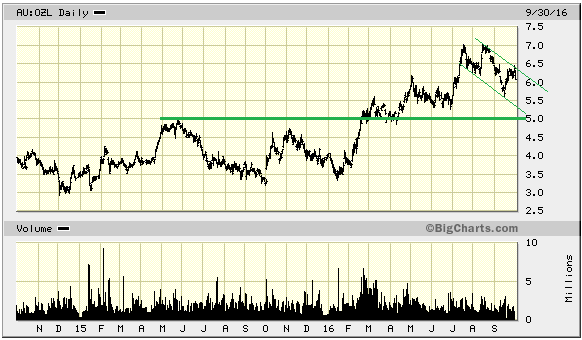
Oz Minerals (ASX: OZL). Shares: 302M. Recent price: A$6.08
Company
news/developments for the week ending Friday 30th September 2016:List
of candidates for new buyingIntroducing
Oz Minerals (ASX: OZL). Shares: 302M. Recent price: A$6.08