|
-- Weekly Market Update for the Week Commencing
3rd November 2014
Big Picture
View
Here is a summary of our big picture
view of the markets. Note that our short-term views may differ from our
big picture view.
In nominal dollar terms, the BULL market in US Treasury Bonds
that began in the early 1980s ended in 2012. In real (gold)
terms, bonds commenced a secular BEAR market in 2001 that will continue
until 2018-2020. (Last
update: 20 January 2014)
The stock market, as represented by the S&P500 Index,
commenced
a secular BEAR market during the first quarter of 2000, where "secular
bear market" is defined as a long-term downward trend in valuations
(P/E ratios, etc.) and gold-denominated prices. This secular trend will bottom sometime between 2014 and 2020.
(Last update: 22 October 2007)
A secular BEAR market in the Dollar
began during the final quarter of 2000 and ended in July of 2008. This
secular bear market will be followed by a multi-year period of range
trading.
(Last
update: 09 February 2009)
Gold commenced a
secular bull market relative to all fiat currencies, the CRB Index,
bonds and most stock market indices during 1999-2001.
This secular trend will peak sometime between 2014 and 2020.
(Last update: 22 October 2007)
Commodities,
as represented by the Continuous Commodity Index (CCI), commenced a
secular BULL market in 2001 in nominal dollar terms. The first major
upward leg in this bull market ended during the first half of 2008, but
a long-term peak won't occur until 2014-2020. In real (gold) terms,
commodities commenced a secular BEAR market in 2001 that will continue
until 2014-2020.
(Last
update: 09 February 2009)
Copyright
Reminder
The commentaries that appear at TSI
may not be distributed, in full or in part, without our written permission.
In particular, please note that the posting of extracts from TSI commentaries
at other web sites or providing links to TSI commentaries at other web
sites (for example, at discussion boards) without our written permission
is prohibited.
We reserve the right to immediately
terminate the subscription of any TSI subscriber who distributes the TSI
commentaries without our written permission.
Outlook Summary
Market
|
Short-Term
(1-3 month)
|
Intermediate-Term
(6-18 month)
|
Long-Term
(2-5 Year)
|
|
Gold
|
N/A |
Bullish
(26-Mar-12) |
Bullish
|
|
US$ (Dollar Index)
|
N/A |
Neutral
(29-Sep-14) |
Neutral
(19-Sep-07) |
|
US Treasury Bonds (TLT)
|
N/A |
Neutral
(18-Jan-12)
|
Bearish |
|
Stock Market
(DJW)
|
N/A |
Bearish
(28-Nov-11) |
Bearish
|
|
Gold Stocks
(HUI)
|
N/A |
Bullish
(23-Jun-10) |
Bullish
|
|
Oil |
N/A |
Neutral
(31-Jan-11) |
Bullish
|
|
Industrial Metals
(GYX)
|
N/A |
Neutral
(15-Sep-14) |
Bullish
(28-Apr-14) |
Notes:
1. Our short-term expectations are discussed in the commentaries, but except in
special circumstances we won't attempt to assign a "bullish", "bearish" or
"neutral" label to these expectations.
2. The date shown below the current outlook is when the most recent outlook change occurred.
3. "Neutral" means that we think risk and reward are roughly in balance with respect to the timeframe in question.
4. Long-term views are determined almost completely by fundamentals and intermediate-term views
are determined by a combination of fundamentals, sentiment and technicals.
The Stock
Market
Current Market Situation
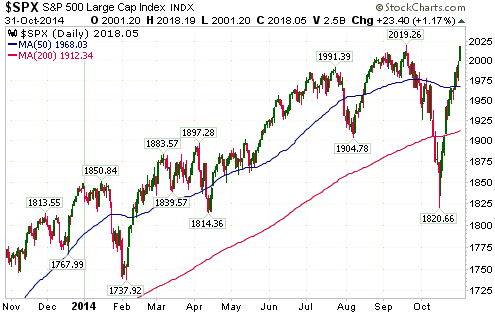
The S&P500 Index (SPX) not only avoided ending the month of October below its
end-September level of 1972, it ended the month at a new closing high for the
year and right at its 19th September intra-day high.
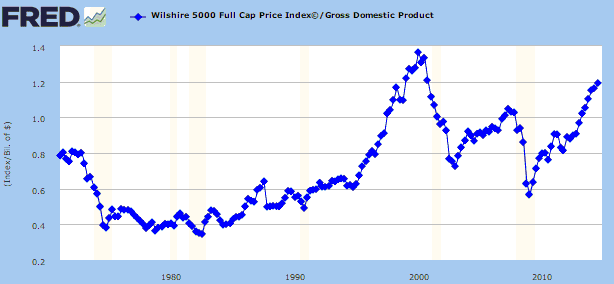
The message of some long-term indicators is that we are currently seeing a
successful test of the September peak as part of a major top. These indicators
are the downward reversal in the SPX/USB ratio featured in the 20th October
Weekly Update, the upward reversal in the TLT/SPY ratio discussed in the 27th
October Weekly Update, and the inability of margin debt to exceed its
February-2014 peak (as noted in last week's Interim Update). Also, the following
chart of the Wilshire5000/GDP ratio shows that the US stock market, as a whole,
is now much more expensive relative to US GDP than was the case at the 2007
major peak, although it still hasn't reached the stratospheric valuation
achieved in 2000.
That being said, last week's action has definitely muddied the waters, for two
main reasons. First, although we thought that the SPX could retrace as much as
100% of its September-October decline as part of an emerging bear market and
that early-November was the most likely time for a rebound peak, the SPX's
failure to achieve consecutive monthly declines means that there is now less
evidence in support of the longer-term bearish case than there would otherwise
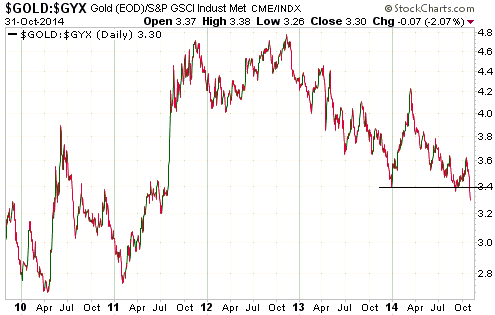
have been. Second, the following chart shows that the gold/GYX ratio, the
premier boom/bust indicator, dropped to a new multi-year low last Friday. This
tells us that the boom hasn't yet ended.
Our expectation is that regardless of the intermediate-term outlook, the October
low (the low-to-mid 1800s for the SPX) will be tested within the next several
weeks. In anticipation of this short-term outcome we purchased an initial
position in SSO January-2015 $100 put options on 22nd October and added to the
position last Friday. Our current plan is to take profits on these puts if the
SPX falls to the mid-1800s during the next 6 weeks or exit at a loss if the SPX
makes a new high after this week (we are allowing for some additional strength
over the next few days).
How will the outcome of the US mid-term elections on 4th November affect the
stock market?
The answer to the above question is: We don't know. We've never been able to
figure out which of the two major US political parties is worse, as they both
opt for Keynesian economic policies and empire-building foreign policies. The
stock market could initially prefer it if the Republican Party were to gain
control of both houses of parliament, as currently looks likely, but only
because such an outcome would crimp Obama's ability to pass new laws and
regulations. Historically, the stock market has performed better under
Democratic administrations than under Republican administrations, but this is
probably a case of correlation not implying causation.
If there is an upward surge on Wednesday 5th November in response to the results
of the 4th November elections, it could create the next short-term top.
This week's
significant US economic events
(The most important events are shown
in bold)
| Date |
Description |
| Monday Nov 03 |
Motor Vehicle Sales
ISM Mfg Index
Construction Spending | | Tuesday
Nov 04 |
Factory Orders
International Trade Balance | | Wednesday
Nov 05 |
Results of US Mid-Term Elections
ISM Non-Mfg Index | | Thursday
Nov 06 |
Q3 Productivity and Costs
|
| Friday Nov 07 |
Monthly Employment Report
Consumer Credit |
Gold and
the Dollar
Gold
Gold, Inflation Expectations and Economic Confidence
As a result of what happened during just one of the past twenty decades (the
1970s), most people now believe that a large rise in "price inflation" or
inflation expectations is needed to bring about a major rally in the gold price.
This impression of gold is so ingrained that it has persisted even though the
US$ gold price managed to rise by 560% during 2001-2011 in parallel with only
small increases in "price inflation" (based on the CPI) and inflation
expectations. The reality is that gold tends to perform very well during periods
of declining confidence in the financial system, the economy and/or the official
money, regardless of whether the decline in confidence is based on expectations
of higher "inflation" or something else entirely.
Inflation expectations are certainly part of the gold story, but only to the
extent that they affect the real interest rate. For example, a 2% rise in
inflation expectations would only result in a more bullish backdrop for gold if
it were accompanied by a rise of less than 2% in the nominal interest rate. For
another example, a 1% decline in inflation expectations would not result in a
more bearish backdrop for gold if it were accompanied by a decline of more than
1% in the nominal interest rate.
Other parts of the gold story include indicators of economic confidence and
financial-market liquidity, such as credit spreads and the yield curve.
That large rises in the gold price are NOT primarily driven by increasing fear
of "inflation" is evidenced by the fact that the large multi-year gold rallies
of 2001-2006 and 2008-2011 began amidst FALLING inflation expectations. These
rallies were set in motion by substantial stock market declines and plummeting
confidence in central banks, commercial banks and the economy's prospects. Even
during the 1970s, the period when the gold price famously rocketed upward in
parallel with increasing fear of "inflation", the gold rally was mostly about
declining real interest rates and declining confidence in both monetary and
fiscal governance. After all, if the official plan to address a "price
inflation" problem involves fixing prices and distributing "Whip Inflation Now"
buttons, and at the same time the central bank and the government are
experimenting with Keynesian demand-boosting strategies, then there's only one
way for economic confidence to go, and that's down.
Since mid-2013 there have been a few multi-month periods when it appeared as if
economic confidence was turning down, but on each occasion the downturn wasn't
sustained. This is due in no small part to the seemingly unstoppable advance in
the stock market. In the minds of many people the stock market and the economy
are linked, with a rising stock market supposedly being a sign of future
economic strength. This line of thinking is misguided, but regardless of whether
it is right or wrong the perception is having a substantial effect on the gold
market.
For now, the economic confidence engendered to a large extent by the rising
stock market is putting irresistible downward pressure on the gold price.
The manipulation that matters
It's extremely unlikely that the US government or the Fed is involved in
manipulating the US stock market upward via the purchase of futures or some
other direct means. However, the Fed regularly concocts monetary policies and
Fed representatives regularly make statements aimed at boosting the stock
market, so indirect upward manipulation often occurs. To the extent that these
actions and words are successful in boosting the stock market, they also put
downward pressure on the gold price.
This prompts the question: Why doesn't the Fed always do what it has done over
the past two years?
The answer is that it does. At least, it always tries to; it's just that the
manipulation is often not successful. The reason is that many independent
factors that aren't controlled by the Fed have to fall into place for the
manipulation to work as the central planners intend. Over the past two years the
most important of these factors were 1) the high starting prices of gold and
other commodities relative to the prices of equities and real estate, 2) the
economic malaise, sovereign debt problems and perceived threat of deflation in
the euro-zone, 3) the stagnation of Japan's economy and the attempts to end the
stagnation by aggressively monetising government debt, and 4) the perception,
which took hold over the past three months, that the ECB would be unable to
create enough new money to sustain the bull run in European equities.
Current Market Situation
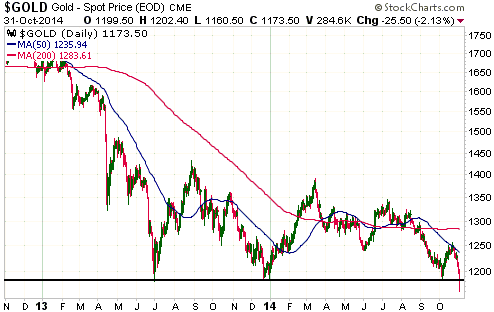
Last Friday the US$ gold price surprisingly (from our perspective) did what
almost everyone has been expecting it to do, which is break to a new multi-year
low. We guessed that the 'triple bottom' at $1180 would eventually be breached,
but not until next year.
The catalyst for Friday's breakdown was news that the Bank of Japan (BOJ) had
quintupled-down on its efforts to revive Japan's economy -- by ramping-up its
already-aggressive 'monetary accommodation'. This monetary accommodation is
commonly referred to as QE (Quantitative Easing), but it can also be called QD
(Qualitative Diseasing) or CO (Counterfeiting Operation).
It's not that QE has become fundamentally bearish for gold, it's that the belief
is now strong that QE helps to improve the economy. As discussed above, anything
that boosts economic confidence will put short-term downward pressure on the
gold price regardless of whether or not the boost in confidence is logical. The
BOJ announcement was the catalyst for Friday's downside breakout in the gold
market because it fueled a surge in economic confidence that manifested itself
in the S&P500 Index achieving a new closing high.
The break below the three lows at $1180 makes it more likely that a major bottom
will be put in place this year rather than the first half of next year. However,
we don't think that gold is a good short-term buy right now. With the breakdown
having just occurred, it would be better to wait for evidence of a reversal
before putting more money at risk. Further to the discussion in the 27th October
Weekly Update, clear-cut evidence that gold's price trend has turned positive
will probably appear in gold/euro or gold/Yen before it appears in the US$ gold
price.
Gold Stocks
The Big Picture
It's time to step back and look at the big picture, mainly relying on the
historical performance of the only gold-mining index with a very long-term
history: the Barrons Gold Mining Index (BGMI).
Like all the other gold-mining indices, the BGMI fell to a new multi-year low
last week. However, unlike the HUI and the XAU, both of which ended last week
near their 2008 crash lows, the following weekly chart shows that the BGMI is
still well above its 2008 low. The red line on the chart is the 200-week MA.
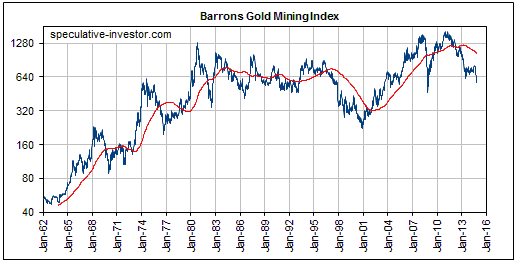
With last week's break to new multi-year lows the price pattern has deviated in
a big way from 1976-1978 and 1970-1972, but from a fundamental perspective there
are still reasons to like the comparison with the 1970s (further to the
discussion in the "Gold" section of today's report, reasons that have nothing to
do with "price inflation").
The price pattern from the beginning of 2008 through to the present day is now
most similar to 1980-1986, which suggests that the coming low for the
gold-mining sector will be equivalent to the H2-1986 low and that a 12-month
bear-market rally will soon begin. We don't like this comparison from a
fundamental perspective, but it would be a realistic possibility if the general
equity bull market were set to continue for another year.
Taking into account last week's break to new multi-year lows, the overall price
pattern and the fundamental backdrop, the most appropriate comparison is with
1996-2000.
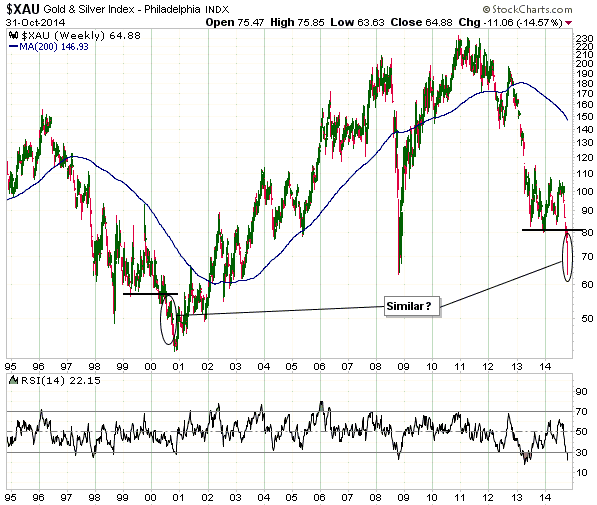
The 1996-2000 cyclical decline in the gold-mining sector lasted about 4.5 years.
The HUI's decline has 'only' lasted a little more than three years to date, but
the XAU's decline from its high is now almost 4 years in duration (the XAU
peaked in December-2010). As noted on the following weekly XAU chart, last
week's break to new multi-year lows could be likened to the final phase of the
1996-2000 decline. This comparison makes the most sense from a fundamental
perspective IF a major peak is at hand in the broad stock market.
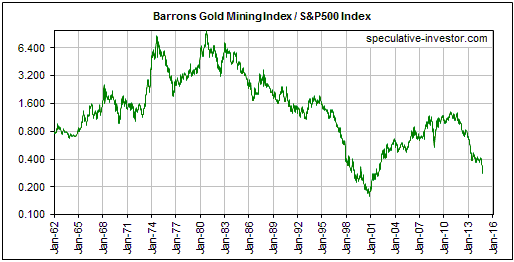
Our next long-term chart shows the BGMI/SPX ratio. The BGMI has collapsed
relative to the SPX since late-2011, but note that the decline is similar, in
magnitude terms at least, to what happened in the middle of the 1970s.
Finally, the following table shows all of the cyclical declines in the gold
mining sector beginning with the 1968-1970 decline, in both nominal terms and
relative to the SPX. The table shows the results using the BGMI throughout, the
XAU from the late-1980s (the XAU was born in 1984), and the HUI from the
mid-1990s (the HUI was born in 1996). The main takeaway from this table is that
the cyclical decline of 2011-2014 is now as big as or bigger than all previous
cyclical declines of the past 50 years apart from 1996-2000.
|
Period |
Decline in BGMI |
Decline in XAU |
Decline in HUI |
Decline in BGMI/SPX |
Decline in XAU/SPX |
Decline in HUI/SPX |
|
1968-1970 |
62% |
|
|
62% |
|
|
|
1974-1976 |
69% |
|
|
77% |
|
|
|
1980-1982 |
73% |
|
|
67% |
|
|
|
1983-1986 |
60% |
|
|
76% |
|
|
|
1987-1992 |
54% |
59% |
|
71% |
73% |
|
|
1994/6-2000* |
75% |
73% |
84% |
92% |
90% |
94% |
|
2011-2014 |
65% |
72% |
76% |
78% |
85% |
86% |
*In dollar terms the
gold-stock indices peaked in 1996, but relative to the SPX they peaked in 1994.
Current Market Situation
From the email sent to subscribers following last Thursday's plunge in the
gold-mining sector:
"The gold-mining sector's recent decline, which accelerated in dramatic
fashion over the past two trading days, cannot be explained by the so-called
"fundamentals". It is not related to the end of the Fed's QE, as most market
participants and observers have known for many months that the QE would end this
week. It is, instead, primarily a sentiment-driven phenomenon that has fed on
itself as price weakness led to forced selling and has resulted in one of the
most extreme market-sentiment situations we've ever witnessed (charts
illustrating the extreme have just been posted at
http://tsi-blog.com/?p=1090). Although
it is at the opposite end of the sentiment spectrum, the current situation in
the gold-mining sector is, we think, close to the manic tech-stock sentiment
near the NASDAQ's blow-off top in March of 2000."
And:
"We aren't planning to do any additional buying of gold-mining stocks in the
immediate future, because we refuse to let our cash reserve fall below 25% and
because it is the most inopportune time imaginable to free-up cash by selling
some gold stocks to buy others. Also preventing us from wading deeper into the
gold-mining pool at this time is the fact that while panics invariably exhaust
themselves within a few days, the current panic is only two days old and could
therefore continue for another 2-4 days. In situations such as this it is
usually better to be one day late than 2-4 days early."
The panic selling continued on Friday 31st October and is probably not yet
complete, although there is a high probability that it will end within the next
three trading days. Our guess is that the panic will be followed by a very sharp
rebound that takes the HUI back to at least 190, but whatever low is made over
the days immediately ahead will probably be tested within the next two months.
For example, the HUI rocketed upward during the 6 trading days following its
October-2008 crash low, but then pulled back to test the crash low about three
weeks later. For another example, the SPX tested its October-1987 crash low
about 6 weeks later.
For fleet-footed traders there is a lot of money to be made on the long side
during the first few days following a market crash, but timing needs to be
perfect because being 1-2 days early will be costly. For most traders who are
interested in taking long positions to profit from the extremes caused by a
price crash, the optimum time to buy is generally a few weeks after the crash --
just after a test of the crash low.
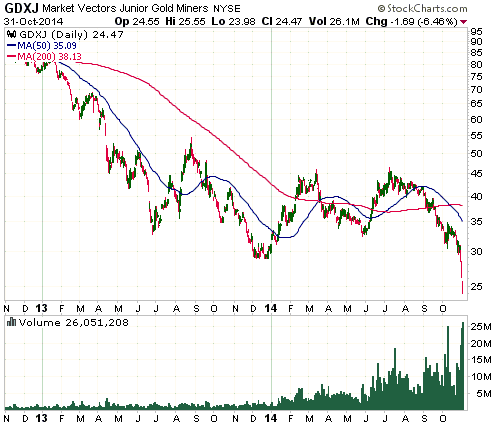
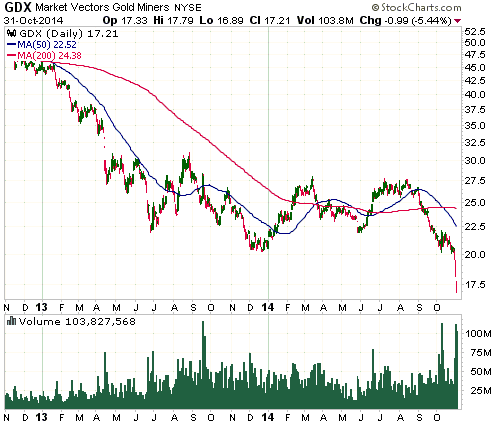
The huge volumes in the senior gold stocks and the gold-stock ETFs during
Thursday-Friday of last week suggest that the price collapse has been driven by
institutions. On Friday, most of the senior gold-mining stocks traded 3-5 times
their average daily volumes and the volumes in the gold-stock ETFs were at or
near all-time highs. Of particular note, GDXJ's trading volume last Friday was
the highest ever and the cumulative trading volume over the final two days of
last week was the highest on record for both GDX and GDXJ.
The Currency Market
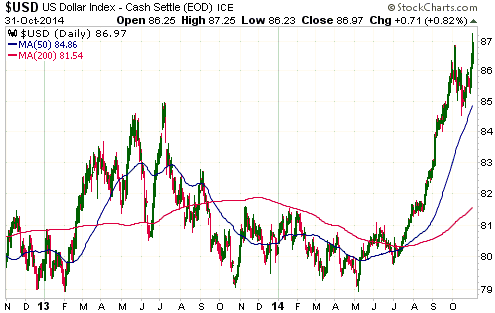
We reiterate that the US$, as represented by the Dollar Index, is not trading
like a safe haven. If it was then it would have fallen during August-September,
rallied strongly during the first half of October and pulled back over the past
two weeks. Instead, it did the opposite. The reason is that it is being driven
almost solely by the relative performance of the US stock market. Recently, the
rise to new highs for the year in US equities relative to European equities
suggested that there was probably one more new high for the year in store for
the Dollar Index, and one more new low for the year in store for the euro,
before short-term extremes were put in place.
The following daily chart shows that the Dollar Index made a marginal new high
for the year last Friday. This, along with the capitulation in the gold-mining
sector and the rise in the SPX to its 19th September intra-day high, points to
the week ahead as a likely time for a short-term high in the Dollar Index.
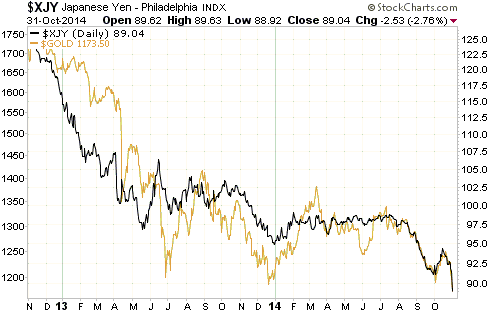
The Yen is the currency that has been trading, and continues to trade, like a
safe haven. Along with the Yen's negative correlation with the stock market,
this is evidenced by the following chart comparison of the Yen (in black) and
the US$ gold price (in gold, naturally). The Yen has had a strong positive
correlation with gold, the ultimate safe haven. Both plunged to new multi-year
lows last week and both are likely to bottom at around the same time. Major
bottoms are possible this month.
Updates
on Stock Selections
Notes: 1) To review the complete list of current TSI stock selections, logon at
http://www.speculative-investor.com/new/market_logon.asp
and then click on "Stock Selections" in the menu. When at the Stock
Selections page, click on a stock's symbol to bring-up an archive of
our comments on the stock in question. 2) The Small Stock Watch List is
located at http://www.speculative-investor.com/new/smallstockwatch.html
 Company
news/developments for the week ended Friday 31st October 2014: Company
news/developments for the week ended Friday 31st October 2014:
[Note: AISC = All-In Sustaining Cost, FS = Feasibility Study, IRR = Internal
Rate of Return, MD&A = Management Discussion and Analysis, M&I = Measured and
Indicated, NAV = Net Asset Value, NPV(X%) = Net Present Value using a discount
rate of X%, P&P = Proven and Probable, PEA = Preliminary Economic Assessment,
PFS = Pre-Feasibility Study]
*Clifton Star Resources (CFO.V) is way behind in its paperwork.
Whereas most of our Canadian-listed stocks are issuing their mandatory reports
for the September quarter, CFO has just got around to issuing its report for the
June quarter.
CFO's latest financial statements reveal $2.0M of working capital at 30th June,
including net cash of around $1.0M. To proceed with a Feasibility Study at its
Duparquet project the company will have to raise more cash, but it won't be able
to do so at a reasonable cost under current market conditions.
Therefore, as we said a few months ago, it's a good bet that CFO will conserve
its cash for the foreseeable future by doing very little to advance its gold
project and devoting the small financial resources at its disposal to the legal
pursuit of the $22.5M loan that -- according to CFO -- should have been provided
by Osisko back in 2012. This loan is now the obligation of the Agnico Eagle (AEM)
-Yamana Gold (AUY) joint venture, which bought Osisko.
Complicating the situation is news that arrived via a CFO press release last
Thursday. We are referring to the fact that CFO has become embroiled in
litigation between the optionors of the Duparquet project (CFO has the right to
earn 100% of the project by making staged payments to the optionors). This
litigation shouldn't affect CFO's rights, but it makes raising additional money
even more difficult.
*Dalradian Resources (DNA.TO) issued an updated PEA for its
Curraghinalt gold project in Northern Ireland. The original PEA was completed in
July of 2012.
DNA's updated PEA is one of the most positive economic assessments of an
exploration-stage gold deposit that we've seen over the past 2 years. Although
the original (2012) PEA indicated an IRR of 41.9% and the current PEA indicates
a slightly lower IRR of 36.2%, the original assessment assumes a gold price of
$1378 whereas the current assessment assumes a gold price of only $1200.
At $1200/oz for gold, the estimated NPV(8%) shown in the updated PEA is $504M.
This is $37M higher than the NPV(8%) estimated in the original PEA, despite the
$178/oz reduction in the assumed gold price. Using a 5% rather than an 8%
discount rate, the estimated NPV rises to $716M.
If we take into account all the numbers shown in the updated PEA, including the
initial capex estimate of $249M, and compare the project value suggested by
these numbers with DNA's current enterprise value, we find that DNA is one of
the most attractively valued stocks in the gold-mining sector. The main caveat
is that the numbers come from a PRELIMINARY economic assessment, which, for one,
means that the assessment involves assumptions that haven't yet been verified by
detailed engineering and drilling. Of particular relevance, the PEA is based on
the assumption that almost all of the project's Inferred resources will
eventually shift into the M&I category.
The bulk of the detailed engineering and drilling needed to firm-up the
project's economics will be done over the coming 12 months as part of a PFS.
This work is fully funded by DNA's cash on hand.
As per the September quarterly report issued late last week, DNA currently has
working capital of around C$37M.
*Evolution Mining (EVN.AX) announced its results for the September
quarter. The company produced 107K ounces of gold at an AISC of around
US$1,000/oz, which was roughly in line with guidance and is a satisfactory
result. Full-year guidance has been maintained at 400K-440K ounces an AISC of
around US$1,000/oz.
EVN is marginally profitable and cash-flow positive at the current gold price.
It is, we think, one of the lowest-risk speculations in the gold-mining sector.
*Timmins Gold (TGD) reported that it made a profit of US$1.6M
during the September quarter, which is a worse bottom-line outcome than
originally expected. Furthermore, the balance sheet that accompanied TGD's
latest quarterly report shows that the company's working capital declined by $3M
during the quarter -- from $68M to $65M. This is also worse than originally
expected. However, the company's overall financial performance during the
quarter was OK considering the record rainfall that slowed production and
increased costs in September.
With the period of record rainfall having ended, TGD's operations are apparently
now running at the planned efficiency. This should mean that production will be
higher and costs will be significantly lower during the current quarter.
The recent collapse in its price has resulted in TGD becoming extremely
attractive as an intermediate-term speculation.
Burkina Faso
In a case of "when it rains, it pours", hundreds of thousands of
people have taken to the streets in Ouagadougou, the capital city of
Burkina Faso in West Africa, with the aim of bringing about
political change. The protests were spurred by the attempts of the
country's president (Blaise Compaore) to amend the Constitution to
enable him to remain in power (his final term was supposed to end
next year). The president has since resigned, but the protestors
aren't satisfied because an unpopular general decided to make
himself the new head of state. Further complicating matters, a
lower-ranking soldier (a lieutenant colonel) also decided to make
himself the new head of state and appears to have gained the upper
hand.
The current political chaos in Burkina Faso creates a risk for
foreign mining companies operating within the country -- the sort of
risk that Donald Rumsfeld would probably classify as a "known
unknown". We know that there's a problem, but at this stage there
isn't enough information to ascertain the ramifications for the
companies in question.
For us, the companies in question are Endeavour Mining (EDV.TO) and
True Gold Mining (TGM.V). Mining assets that we think account for
about 25% of EDV's value and almost all of TGM's value are located
in Burkina Faso. Up until now these assets have not been affected by
the civil unrest, but there is an unquantifiable risk that they will
be affected in the future.
TGM's plunge at the start of trading on Friday (the stock closed at
C$0.24 on Thursday and plummeted to C$0.14 shortly after the open on
Friday) was indirectly related to the political situation in Burkina
Faso. We say "indirectly" because Burkina Faso's increased political
instability prompted Casey Research to issue a 'sell' on TGM near
the close of trading on Thursday, so Friday's plunge on 10-times
average daily volume was mostly due to Casey subscribers stampeding
for the exit in reaction to the previous day's 'sell' advice. The
stock subsequently recouped more than half its losses and ended the
day at C$0.20.
We don't think that it makes sense to sell TGM at C$0.20, because at
this price a lot of risk has been factored in. It certainly didn't
make sense to sell at C$0.14 on Friday, because at that price the
company was being valued at less than its cash in the bank.
We are holders of TGM at the current price and regret that we didn't
have a buy order in at C$0.15 on Friday to take advantage of the
vicious downward spike at the open. Also, we are holders of EDV at
its current price and would be buyers if we didn't already have a
full position in the stock. However, speculators should be aware of
the risks that exist, even if the risks can't be quantified.
In a market where almost all gold stocks have been crushed, most new
buying should be directed towards the high-potential stocks with the
lowest risk. In some respects EDV and TGM fit the bill in this
regard, but the recent escalation of country risk means that they
would no longer be among our first choices for new buying.
List of candidates for new buying
From within the ranks of TSI stock selections the best candidates
for new buying at this time, listed in alphabetical order, are:
1) AAU (last Friday's closing price: US$1.18).
2) DNA.TO (last Friday's closing price: C$0.55).
3) EVN.AX (last Friday's closing price: A$0.60).
4) PVG (last Friday's closing price: US$4.56).
5) TGD (last Friday's closing price: US$1.00).
Note that the above list is limited to five stocks. It will
sometimes contain less than five, but it will never contain more
than five regardless of how many stocks are attractively priced for
new buying.
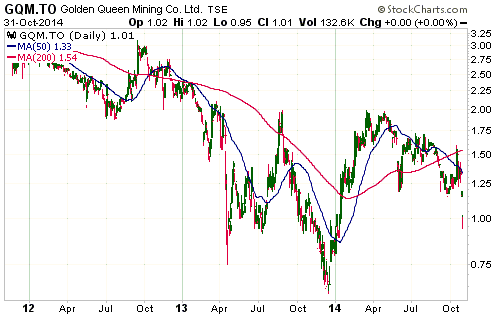
Potential addition to TSI Stocks List: Golden Queen Mining (TSX:
GQM). Shares: 100M issued, 110M fully diluted. Recent price: C$1.03
GQM is developing the Soledad Mountain gold-silver project in
California. The project is fully permitted, almost fully financed
through to production and currently under construction. Production
is scheduled to commence in early-2016.
Soledad Mountain has an M&I resource of 2.4M ounces of gold plus 44M
ounces of silver and is being developed into a mine with average
annual gold production of 77K ounces over 14 years. Taking silver as
a byproduct, the cash cost is expected to be only US$285/oz.
Based on the 2012 FS, the project has an IRR of 39.7% and an NPV(5%)
of US$368M at $1200/oz for gold and $20/oz for silver. Furthermore,
the project is still economically viable at $1100/oz.
Due to a financing deal completed in September, GQM's ownership of
the Soledad project went from 100% to 50%. Some brokerage analysts
stated that this financing deal effectively involved GQM selling
half the project for $110M, but this isn't true. GQM only received
$55M for half the project. The reason is that the $110M didn't go to
GQM, it went to a company that, as part of the deal, became a) the
100% owner of the project and b) 50% owned by GQM. In any case, the
details of earlier financings aren't important for speculators
assessing GQM's merits today. What matters is the current situation,
not how the current situation came to be.
We have been thinking about returning GQM to the TSI List for a few
months (a previous position was exited way back in December-2010
when the stock was trading in the C$2.90s), but thought the price
was a little high. GQM held up remarkably well until last week, when
it finally succumbed to the sector-wide downward pressure and
quickly lost about one-third of its market value.
Near its current price of around C$1.00 it offers good value, but
there is one issue that prevents us from pulling the trigger. The
issue is that the company will have to raise an additional $20M-$30M
to fund the balance of the initial project capex and its working
capital requirements over the coming 12 months. Moreover, with a
current cash balance of almost nothing, a financing will have to be
done soon.
Here's what we are going to do: We will add GQM to the TSI List if
it trades at C$0.82, because at that price we would be happy to take
the financing risk. If the stock doesn't trade that low then we will
wait for a financing announcement before deciding whether or not to
add the stock.
Removing two stocks from the TSI List
With the exception of short-term trading positions, we are determined not to let
the TSI Stocks List get any bigger. We are therefore going to remove one stock
to make up for the 29th September addition of Dalradian Resources (DNA.TO) and
remove a second stock to make way for a new stock with less risk to enter the
List within the next few weeks.
The stocks that are now leaving the List are Lydian International (LYD.TO) and
Sunward Resources (SWD.TO) at losses of 47% and 33%, respectively.
LYD is leaving for two reasons. First, the updated FS published in September
suggests that the initial capex of its gold project is too high, relative to the
project's NPV and rate of return, to make the project financeable or attractive
to large mining companies in the current market environment. Second, considering
the project's economics, the company has more country risk (Armenia) than we are
comfortable with.
SWD is leaving, despite the fact that it is
trading below the value of its cash, because
it was added based on an idea that has since been invalidated. Specifically, in
July of this year we decided to initiate a group trade comprising three
well-financed exploration-stage gold stocks with large, low-grade gold deposits.
Our thinking was that if gold completed its basing pattern during September, as
we thought likely at the time, then these large, low-grade deposits would start
coming back into favour. We made SWD the first member of this group and intended
to add two more stocks to complete the group after evidence emerged that gold's
basing pattern was complete. However, the evidence we were anticipating never
emerged, so other group members were never identified/added. And the
basing-pattern idea was completely invalidated by last week's price action.
Chart Sources
Charts appearing in today's commentary
are courtesy of:
http://stockcharts.com/index.html
http://research.stlouisfed.org/

|









