|
-- Weekly Market Update for the Week Commencing 4th April 2011
Big Picture
View
Here is a summary of our big picture
view of the markets. Note that our short-term views may differ from our
big picture view.
In nominal dollar terms, the BULL market in US Treasury Bonds
that began in the early 1980s ended in December of 2008. In real (gold)
terms, bonds commenced a secular BEAR market in 2001 that will continue
until 2014-2020. (Last
update: 4 April 2011)
The stock market, as represented by the S&P500 Index, commenced
a secular BEAR market during the first quarter of 2000, where "secular
bear market" is defined as a long-term downward trend in valuations
(P/E ratios, etc.) and gold-denominated prices. This secular trend will bottom sometime between 2014 and 2020. (Last update: 22 October 2007)
A secular BEAR market in the Dollar
began during the final quarter of 2000 and ended in July of 2008. This
secular bear market will be followed by a multi-year period of range
trading. (Last
update: 09 February 2009)
Gold commenced a
secular bull market relative to all fiat currencies, the CRB Index,
bonds and most stock market indices during 1999-2001. This secular trend will peak sometime between 2014 and 2020. (Last update: 22 October 2007)
Commodities,
as represented by the Continuous Commodity Index (CCI), commenced a
secular BULL market in 2001 in nominal dollar terms. The first major
upward leg in this bull market ended during the first half of 2008, but
a long-term peak won't occur until 2014-2020. In real (gold) terms,
commodities commenced a secular BEAR market in 2001 that will continue
until 2014-2020. (Last
update: 09 February 2009)
Copyright
Reminder
The commentaries that appear at TSI
may not be distributed, in full or in part, without our written permission.
In particular, please note that the posting of extracts from TSI commentaries
at other web sites or providing links to TSI commentaries at other web
sites (for example, at discussion boards) without our written permission
is prohibited.
We reserve the right to immediately
terminate the subscription of any TSI subscriber who distributes the TSI
commentaries without our written permission.
Outlook Summary
Market
|
Short-Term
(0-3 month)
|
Intermediate-Term
(3-12 month)
|
Long-Term
(1-5 Year)
|
Gold
|
Bullish
(30-Mar-11)
|
Neutral
(24-Jan-11)
|
Bullish
|
US$ (Dollar Index)
|
Neutral
(07-Mar-11)
| Neutral
(07-Mar-11)
|
Neutral
(19-Sep-07)
|
Bonds (US T-Bond)
|
Neutral
(20-Sep-10)
|
Bearish
(21-Mar-11)
|
Bearish
|
Stock Market (S&P500)
|
Neutral
(28-Mar-11)
|
Bearish
(11-Oct-10)
|
Bearish
|
Gold Stocks (HUI)
|
Bullish
(30-Mar-11)
|
Bullish
(23-Jun-10)
|
Bullish
|
| Oil | Neutral
(31-Jan-11)
| Neutral
(31-Jan-11)
| Bullish
|
Industrial Metals (GYX)
| Bearish
(03-Jan-11)
| Bearish
(25-May-09)
| Neutral
(11-Jan-10)
|
Notes:
1. In those cases where we have been able to identify the commentary in
which the most recent outlook change occurred we've put the date of the
commentary below the current outlook.
2. "Neutral", in the above table, means that we either don't have a
firm opinion or that we think risk and reward are roughly in balance with respect to the timeframe in question.
3. Long-term views are determined almost completely by fundamentals,
intermediate-term views by giving an approximately equal weighting to
fundamental and technical factors, and short-term views almost
completely by technicals.
Can inflation happen when the banks aren't lending?
We can state with absolute
certainty that "yes" is the correct answer to the above question. We
know for a fact that the total supply of money can increase in parallel
with a contraction in the commercial banking industry's collective loan
portfolio because that's exactly what has happened in the US since
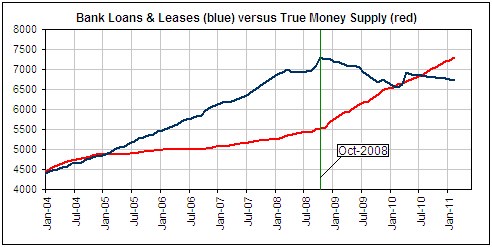
October of 2008. As illustrated by the following chart, "total loans
and leases at commercial banks" (the blue line) peaked and began to
trend downward in October of 2008. As also illustrated by the following
chart, True Money Supply (the red line) has trended upward in parallel
with the post-October-2008 decline in bank lending. In fact, the rate
of growth of the money supply accelerated after bank lending went into
decline!
Considering what has
happened over the past few years, why do some analysts continue to
claim that commercial banks must be willing and able to expand their
loan books, and that the public must be willing and able to take on
more debt, in order to get growth in the economy-wide supply of money?
We don't know; you'd have to ask them. Clearly, they are wrong.
The US money supply, when properly measured, has grown rapidly in the
face of reduced bank lending over the past 2.5 years because the Fed
and the private banks have combined to monetise a huge dollar-amount of
securities. There is possibly a limit to how much the private banks can
monetise, but the Fed's ability to monetise has no rigid bounds. It
really just comes down to how much risk the Fed is prepared to take in
its efforts to "stimulate" the economy, and how much monetary inflation
the bond market is prepared to tolerate.
When the US eventually reaches the point where "inflation" is widely
believed to be the most important economic problem facing the nation,
actions that put a stop to the Fed's monetary profligacy could become
politically feasible. We currently appear to be a long way from that
point.
T-Bond Update
We've
been remiss in not bringing the "Big Picture" T-Bond view that appears
near the top of every Weekly Market Update into line with what we've
been saying for a while, which is that the dollar-denominated T-Bond
price probably reached a secular peak in December of 2008 and then
successfully tested its peak during August-November of 2010. This
omission has now been corrected.
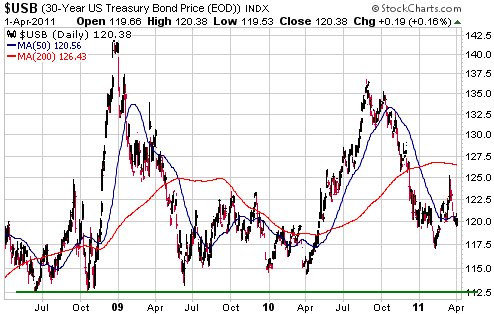
By the way, the price action hasn't yet provided us with definitive
evidence that the T-Bond's December-2008 peak was the secular variety.
Such evidence would be a decisive break below the support line drawn on
the following daily chart. However, considering that committed
inflationists hold the most senior positions at the Fed and that the US
federal government continues to be run/influenced by people who believe
that increased government spending helps the economy, it's a good bet
that a major bearish trend has begun in the US government bond market.
On a short-term basis, we remain "neutral" on the T-Bond. There is a
risk that the February low will be taken out over the weeks immediately
ahead, but it's more likely that the rebound/consolidation that began
in February will continue for another 1-2 months.
Uranium Update
In the days following
the earthquake and tsunami that damaged nuclear reactors at a power
plant in Fukushima, Japan, the spot uranium price dropped from
$67/pound to a low of just under $50/pound. It has since stabilised at
around $60/pound. This means that the spot U3O8 price has suffered a
decline of about 10% in reaction to the Fukushima problems, and that
the declines in the prices of uranium mining equities have been
disproportionately large.
The disproportionately large price declines in uranium mining equities
are 'par for the course', in that short-term movements in share prices
are governed by changes in sentiment. The shares went up a lot more
than the underlying commodity when it was widely believed that uranium
had embarked on a new multi-year bull market, and naturally got hit
much harder in response to news that cast some doubt on the 'new bull
market' theory.
Our opinion is that the uranium bull market is intact, but that it will
take many months to establish the psychological underpinnings of a new
intermediate-term rally in uranium mining shares. In the mean time, we
would consider high-potential exploration/development-stage uranium
mining stocks to be suitable for new buying near current prices and
especially near their recent lows. We would also consider rebounds to
near the immediate pre-crisis levels to be short-term selling
opportunities.
Interesting quote of the week
From this week's commentary by Bob Hoye at www.institutionaladvisors.com:
"Markets lose liquidity,
speculators and policymakers panic. Then when it's over policymakers
boast that without intervention the panic would not have ended.
Without "stimulus"
financial history would have been one continuous panic. The mind
boggles! When will policymakers discover that financial markets always
clear and always on their own?"
Intervention to help banks, 're-liquefy' the financial markets and
prevent a meltdown commenced in August of 2007 when the Fed embarked on
a rate-cutting campaign. 12 months later the banks and the financial
markets were obviously still in trouble, so the Fed dropped its
targeted interest rate to almost zero and began aggressively ramping up
the money supply. The stock and commodity markets then crashed. The Fed
and the Treasury reacted by pumping money into the system at an even
faster pace and buying up the bad investments of the private banks.
Still, the situation didn't seem to get any better and in March of 2009
the S&P500 Index dropped below its November-2008 crash low. At this
point, intervention designed to support the markets had been occurring
for more than 18 months. A sustained up-turn in prices finally began in
March of 2009, and a few months later policy-makers began to
congratulate themselves for saving the world.
And:
"This week's reports
included that house prices (Case-Shiller) took a "sharp decline" on the
January number. This really confirms that "stimulus" does not go into
losers, but goes into winners. Obviously, to speculative excess."
The Fed has unlimited ability to inflate, but it has very limited control over the effects of its inflation.
The Stock
Market
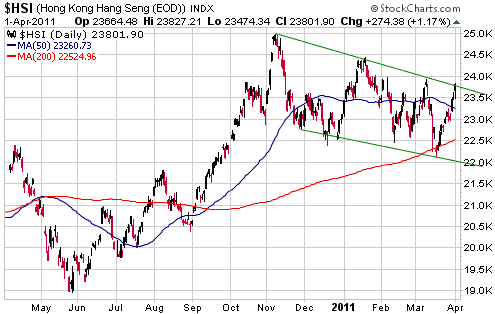
As indicated by the following
daily charts, the Hang Seng Index (HSI) and the S&P500 Index ended
last week at, or near, resistance. Specifically, the HSI ended the week
at trend-line resistance and the SPX ended the week just shy of lateral
resistance defined by its February peak. Neither index is 'overbought'
and both stand a good chance of making additional upward progress over
the next 4-6 weeks, but it would be normal for them to consolidate
below resistance for a week or so before resuming their advances.

If you thought that a
market had a 70% chance of advancing and a 30% chance of declining over
a time period, should you be bullish on that market over the time
period in question?
The correct answer is: it depends on the potential magnitudes of the
advance and the decline. If, for example, you thought that the maximum
upside were limited to about 10% whereas the downside risk were 30%,
then it would not make sense to be bullish.
The above comment reflects our current short-term stock market outlook.
We think there's more chance of senior stock market indices rising than
falling over the next several weeks, but we also think that the
magnitude of the downside risk is substantially greater than the
magnitude of the upside potential. Consequently, we aren't "bullish".
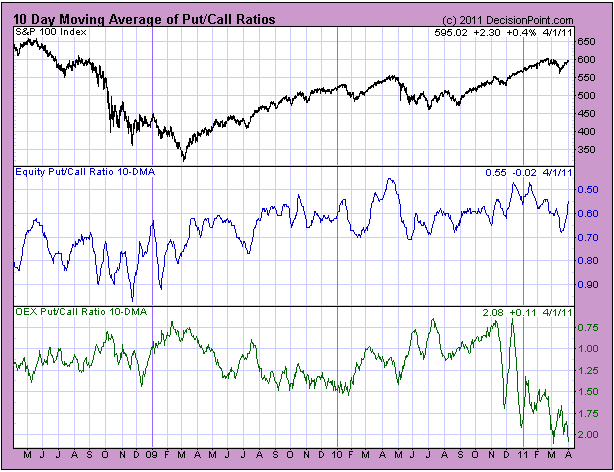
It seems that in being concerned about downside risk we are in good
company, in that the 10-day moving average of the OEX put/call ratio
(the green line on the following chart) has just moved back to near the
20-year high it reached in early March. This suggests that professional
money managers are far more 'hedged' than usual right now. At the same
time, the fact that the 10-day moving average of the equity put/call
ratio (the blue line on the following chart) has moved back to a
relatively low level suggests that the public is complacent. In other
words, the put/call situation suggests that the pros are fearful and
the public is fearless.
The put/call situation is almost as bearish as it gets.
This week's
important US economic events
| Date |
Description |
Monday Apr 04
| No important events scheduled
| | Tuesday Apr 05 | FOMC Minutes
ISM Non-Manufacturing Index
| | Wednesday Apr 06
| No important events scheduled
| | Thursday Apr 07
| Consumer Credit
| | Friday Apr 08
| No important events scheduled
|
Gold and
the Dollar
Gold and Silver
At the close of US trading on Thursday it looked like gold was about to
break decisively into new high territory. However, the US monthly
employment data released on Friday morning was significantly better
than the employment data released over the preceding few months, which
prompted a minor sell-off in the gold market (gold is the ultimate
'safe haven', so it tends to weaken in response to signs of economic
strength). As a result, the April gold futures contract (refer to the
daily chart below) still hasn't broken out to the upside.
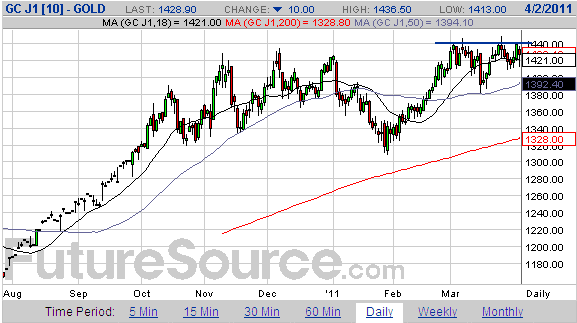
Gold didn't manage to
break out last week, but the odds are in favour of it doing so in the
near future. One of the main reasons is that the silver/gold ratio
ended last week at a new multi-year high. As long as the silver/gold
ratio remains in a short-term upward trend it will be reasonable to
assume that new highs lie ahead for both gold and silver.
When the gold and silver rallies come to an end we are likely to get
substantial weakness in silver relative to gold, causing the
silver/gold ratio to plunge. By the same token, any decline in the gold
price that isn't accompanied by a much larger percentage decline in the
silver price probably won't be indicative of a downward trend reversal.
We expect that an upside breakout will soon occur in the gold market
and we have considerable long-side exposure to gold (mostly via gold
stocks), but we would actually prefer that the gold price did not break
to new highs just yet. A break to new highs and a quick move up to
$1500/oz or $1600/oz over the next 6 weeks would create some
profit-taking opportunities within our equity portfolio, but we doubt
that it would make a big difference to the overall value of our
portfolio. Moreover, it would most likely set the stage for a downward
correction of at least 6 months in duration.
From an intermediate-term perspective, a more bullish scenario involves
the gold price moving down to the low-$1300s over the next 1-2 months.
Price action along these lines would, we think, set the stage for
another 6-12 month rally.
Gold Stocks
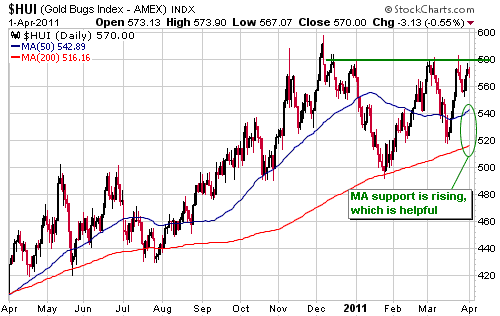
The HUI continues to consolidate below resistance at 580. In order for
the HUI to rise above resistance at 580 and above the December-2010
peak of 600, gold bullion will probably have to close above $1450.
There's a good chance that this will happen within the next few weeks.
In the mean time, support provided by the 50-day and 200-day moving
averages is rising. The 50-day moving average should soon reach 550 and
the 200-day moving average should soon move into the 520s.
Currency Market Update
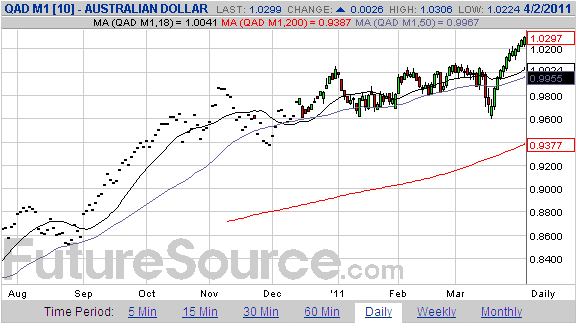
The following daily chart shows that Australian Dollar (A$) futures
have just risen for 11 days in a row. This unusually-long daily winning
streak means that the A$ is 'overbought' on a short-term basis and
should soon begin to correct/consolidate.
The current short-term 'overbought' condition could be remedied via a
routine multi-day pullback, but on a longer-term basis the A$ has
substantial downside risk by virtue of its over-valuation and the fact
that its intermediate-term upward trend is linked to the global stock
market rally. After the senior stock indices commence intermediate-term
declines, the A$ will very likely do the same. The corollary is that
the A$ is unlikely to commence a large decline until the global stock
market rally ends.
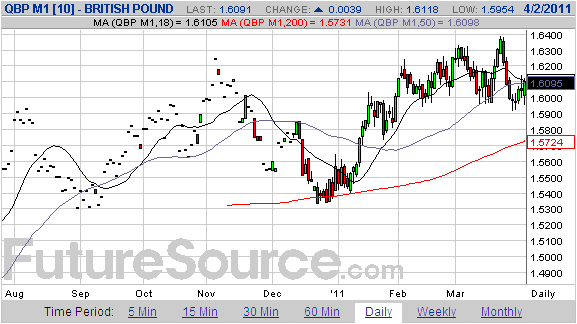
The British Pound
ended last week in an interesting position. It peaked during the third
week of March at 1.64 and then dropped sharply to important support at
1.595. This support has initially held, but the rebound of the past few
days could turn out to be part of a 2-3 month topping pattern.
A solid break below 1.59 would suggest that the Pound made an
intermediate-term peak in March. Furthermore, if, over the next few
weeks, we get a new 52-week high in the euro along with confirmation
(via a move below 1.59) of an intermediate-term peak in the Pound, then
we will have the sort of divergence between the Pound and the euro that
has preceded important lows in the Dollar Index over the past few years.
Update
on Stock Selections
(Notes: 1) To review the complete list of current TSI stock selections, logon at http://www.speculative-investor.com/new/market_logon.asp
and then click on "Stock Selections" in the menu. When at the Stock
Selections page, click on a stock's symbol to bring-up an archive of
our comments on the stock in question. 2) The Small Stock Watch List is
located at http://www.speculative-investor.com/new/smallstockwatch.html)
 Pretium Resources (TSX: PVG). Shares: 85M issued, 90M fully diluted. Recent price: C$10.00 Pretium Resources (TSX: PVG). Shares: 85M issued, 90M fully diluted. Recent price: C$10.00
The recent sharp pullback in PVG's shares was caused by the secondary
offering of part of SSRI's 42% stake in the company. There has been no
change in PVG's share count, but when a large shareholder attempts to
place part of its holding the short-term effect on the stock price is
similar to an offering of new equity. All of a sudden there is a lot
more supply, and the stock price reacts in a way that creates enough
new demand to balance the new supply.
The good news is that SSRI has successfully placed 10M of its PVG
shares at $10/share, which shows that there is presently strong demand
at around $10. The bad news is that this represents less than one-third
of SSRI's overall position. This could mean that the balance of SSRI's
stake will weigh on PVG's stock price over the months ahead. We hope
that Bob Quartermain, PVG's CEO, can prevent this from happening by
arranging for one large investor or a group of investors to take SSRI
completely out of its PVG position.
While the downward pressure caused by SSRI's exit will be an unwelcome
development for anyone with a full position in PVG, it is a positive
development for anyone looking for opportunities to do new buying. A
stock with excellent prospects is having its price reduced for a reason
that has absolutely nothing to do with any adverse change in the
underlying business fundamentals.
For investors/speculators with no current exposure to PVG, it would
probably make sense to take an initial position at around C$10 with a
plan to buy more if the price drops back to the low-C$8 area.
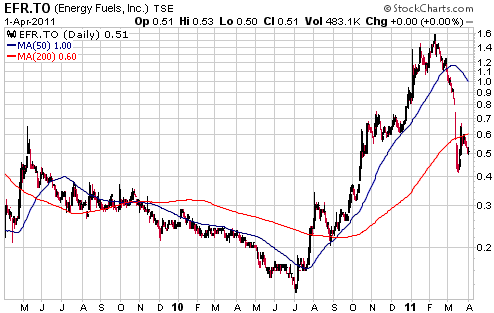
Energy Fuels Inc. (TSX: EFR). Shares: 124M issued, 142M fully diluted. Recent price: C$0.51
EFR has completed its recently announced equity financing. The company has raised $11.5M by issuing 23M shares at C$0.50.
The timing of this financing was unfortunate, coming as it did after
the uranium sector had crashed in reaction to Japan's "nuclear
emergency". On the positive side of the ledger, the fact that EFR now
has the money it needs to begin construction of its uranium mill means
that a significant risk has been eliminated.
The following comment from the 21st March Weekly Update remains applicable:
"EFR shares are now
riskier than they were prior to the recent events in Japan, but they
also now have a lot more upside potential thanks to the large price
decline. For risk-tolerant speculators, we think the shares are
suitable for new buying below the C$0.50 financing price."
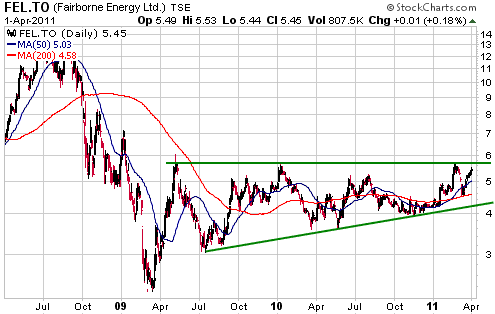
Fairborne Energy (TSX: FEL). Shares: 102M issued, 112M fully diluted. Recent price: C$5.45
The stock price of mid-tier natgas producer FEL pulled back by a little
more than expected during the February-March correction. It would
ideally have held at the 50-day moving average in the high-C$4 area,
but instead it dropped back to the 200-day moving average in the
mid-C$4 area. However, the overall chart pattern remains bullish.
FEL would be a candidate for new buying following a pullback to around
C$5.00. A break above resistance at C$5.70 would create a chart-based
target of C$8.00-C$8.50.
Duoyuan Global Water (NYSE: DGW). Shares: 25M. Recent price: US$5.49
The rapid decline in the stock price of DGW has continued. The decline
is happening due to suspicion/fear that the company's accounts are
fraudulent in some way.
Up until now there has been no evidence of any wrongdoing at DGW. At
this stage, it is purely a case of "guilt by association" -- not just
association with Duoyuan Printing (DYP), a company that is under SEC
investigation and has just been de-listed from the NYSE for failing to
meet listing requirements, but also association with many other
US-traded Chinese companies that are presently under 'accounting
clouds'. The article posted HERE gives examples of such companies.
If its accounts can be trusted, DGW has about US$7/share of working
capital and about US$6/share of cash, meaning that its profitable water
treatment business is currently being valued by the stock market at
less than zero. Obviously, the critical question is: Can the accounts
be trusted? Only the senior managers of DGW know the answer. Everyone
else -- those who are shorting and those who are buying/holding the
shares -- is just speculating.
If the company has the balance sheet and business it claims to have,
then at the current share price the best use of its cash would be to
buy its own stock. This is exactly what some other Chinese companies
with extremely low stock valuations are now planning to do.
We had previously intended to buy more of this stock if it dropped to
its cash value, but our plan has changed. In this case, we'd prefer to
hold off and pay a higher price after an independent audit has given
the accounts a 'clean bill of health'.
Chart Sources
Charts appearing in today's commentary
are courtesy of:
http://stockcharts.com/index.html
http://www.futuresource.com/
http://www.decisionpoint.com/

|