|
-- Weekly Market Update for the Week Commencing 5th February 2007
Big Picture
View
Here is a summary of our big picture
view of the markets. Note that our short-term views may differ from our
big picture view.
Bonds commenced a secular BEAR market in
June of 2003. (Last
update: 22 August 2005)
The stock market, as represented by the S&P500 Index, commenced a secular BEAR market during the first quarter of 2000. The rally
that
began in October of 2002 will end during the first half of 2007. The ultimate bottom of
the secular bear market won't occur until the next decade. (Last update: 02 October 2006)
The Dollar commenced a secular BEAR market during the final quarter of 2000. The
first major downward leg in this bear market ended during the first
quarter of 2005, but a long-term bottom won't occur until 2008-2010. (Last update: 28 March 2005)
Gold commenced a
secular bull market relative to all fiat currencies, the CRB Index,
bonds and most stock market indices during 1999-2001. The first major
upward leg in this secular bull market ended in December of 2003, but a
long-term peak won't occur until at least 2008-2010. (Last update: 13
February 2006)
Commodities, as
represented
by the CRB Index, commenced a secular BULL market in 2001. The first
major upward leg in this bull market ended during the second quarter of
2006, but a long-term
peak won't occur until at least 2008-2010. (Last update: 08 January 2007)
Copyright
Reminder
The commentaries that appear at TSI
may not be distributed, in full or in part, without our written permission.
In particular, please note that the posting of extracts from TSI commentaries
at other web sites or providing links to TSI commentaries at other web
sites (for example, at discussion boards) without our written permission
is prohibited.
We reserve the right to immediately
terminate the subscription of any TSI subscriber who distributes the TSI
commentaries without our written permission.
Outlook Summary
Market
|
Short-Term
(0-3 month)
|
Intermediate-Term
(3-12 month)
|
Long-Term
(1-5 Year)
|
Gold
|
Bullish
(04-Oct-06)
|
Bullish
(29-Jan-07)
|
Bullish
|
US$ (Dollar Index)
|
Neutral
(08-Jan-07)
| Bullish
(31-May-04)
|
Bearish
|
Bonds (US T-Bond)
|
Neutral
(29-Jan-07)
|
Neutral
(23-Aug-06)
|
Bearish
|
Stock Market (S&P500)
|
Neutral
(13-Dec-06)
|
Bearish
(02-Jan-07)
|
Bearish
|
Gold Stocks (HUI)
|
Bullish
(04-Oct-06)
|
Bullish
(29-Jan-07)
|
Bullish
|
| Oil | Bullish
(04-Oct-06)
| Neutral
(25-Sep-06)
| Bullish
|
Industrial Metals (GYX)
| Neutral
(15-Jan-07)
| Bearish
(25-Sep-06)
| Bullish
|
Notes:
1. In those cases where we have been able to identify the commentary in
which the most recent outlook change occurred we've put the date of the
commentary below the current outlook.
2. "Neutral", in the above table, means that we either don't have a
firm opinion on which way the market will move or that we expect the
market to be trendless during the timeframe in question.
3. Long-term views are determined almost completely by fundamentals,
intermediate-term views by giving an approximately equal weighting to
fundmental and technical factors, and short-term views almost
completely by technicals.
Industrial Metals
The March copper futures
contract broke below short-term support at US$2.50 on Friday and ended
the week at its lowest level since last March.
From a longer-term perspective the most important support lies at
US$1.50. As noted on the following monthly chart, the $1.50 support
level for copper can be likened to the $40 support level for oil. In
both cases the support coincides with the top of a multi-decade base
and in our opinion defines the MAXIMUM downside potential. We doubt
that copper will test this long-term support in the absence of a global
recession, but the low-$2 area looks achievable.

The main force behind
copper's price weakness has been the growing belief that the strong
upward trend in copper stockpiles will continue over the coming
months/quarters (the LME copper inventory has almost doubled over just
the past 4 months). However, the following extract from a Reuters
article indicates that fund-related selling and fears of more
fund-related selling are also taking a toll across the industrial
metals complex.
"LONDON (Reuters) - Base
metals prices fell sharply on the London Metal Exchange on Friday on a
report of heavy losses at a hedge fund and in the absence of Chinese
buyers, dealers said.
"The market is collapsing," a European trader said.
Three-months zinc fell by
nearly 9 percent at one stage, copper was down by over 6 percent and
aluminium dropped by some 3 percent in a general
sell-off.
Traders said the selling
was mostly on behalf of funds, triggered by a report of heavy losses at
a hedge fund that specialises in metals trading.
Once prices hit specific chart levels the fall for most metals accelerated.
"Fund liquidation...a lot of stops triggered -- a lot of the stuff on the back of the Red Kite news," the trader said.
Hedge fund Red Kite,
which posted strong gains in 2006, has suffered a roughly 20 percent
loss in the first days of January and is now trying to stall investors
who want to pull money out, The Wall Street Journal reported.
"It is quite scary,
actually, a lot of volume going through and no one is buying the
stuff," analyst Michael Widmer at Calyon said."
Copper and zinc prices have fallen by 24% and 32%, respectively, since
early December and copper is now down by more than 40% from last May's
peak. Given the large amount of speculative interest attracted by these
markets over the past couple of years it would certainly not be
surprising if declines of this magnitude resulted in some hedge fund
blow-ups.
Although it dropped a little on Friday, up until now gold has not been
affected in a big way by the sharp declines in industrial metal prices.
(There is, of course, no good fundamental reason why gold should be
adversely affected by falling industrial metal prices, but there was a
risk that it would be because a lot of speculators bought gold during
2005-2006 as part of a general metals play). In fact, at this stage the
metals-related carnage has been limited to the copper and zinc markets.
The nickel market, on the other hand, ended last week at an all-time
high in response to a near-term supply shortage (nickel stockpiles are
exceptionally low); the tin price is also near an all-time high; and
the recent downturn in the lead price looks more like a routine
consolidation than the start of a large decline. Therefore, as has been
the case for more than 6 months it is still difficult to generalise
when discussing the industrial metals.
Our view has been, and continues to be, that most of the metals will
end up following copper lower. Strong global growth was/is expected to
lend support to prices during the first quarter of this year, but if we
are correct to anticipate slowing growth during the second and third
quarters then falling demand will probably run head-first into rising
supply across the industrial metals complex before this year is out.
The Stock
Market
How has inflation affected stock prices?
One of our more controversial opinions -- controversial as far as our
readership is concerned, anyway -- is that the on-going US$ inflation
(growth in the total supply of dollars) will ensure that US house
prices remain in a long-term upward trend in NOMINAL terms. Or, to put
it more aptly, our view is that it makes no sense to assume that there
will be sufficient inflation to keep the long-term bull market in
commodity prices going -- despite all the theories linking the
commodity bull to the rapid growth of "Chindia", inflation has been and
will continue to be the primary driver of this bull market -- and
insufficient inflation to keep the MEDIAN house price trending higher.
We emphasised the word "nominal" in the above paragraph because we
expect that prices will continue to trend higher for a few more years
in terms of depreciating currency, but not in real terms. Our thinking
is that the majority of houses purchased over the past three years will
prove to be poor investments in real terms.
We also emphasised the word "median" for a reason. Specifically, we
would not be at all surprised if certain sections of the market -- the
sections that have 'benefited' from the greatest amount of speculation
-- have already topped in both real and nominal terms, while the
nominal "median" house price experiences nothing more serious than a
mid-cycle correction. In this respect the US stock market might provide
us with a useful analogy.
Clearly, technology was the main focus of speculation during the final
years of the 1982-2000 bull market in US equities. This technology
focus caused the NASDAQ to move ahead in leaps and bounds relative to
the S&P500 Index and also led to technology-related stocks becoming
an absurdly large chunk of the capitalisation-weighted S&P500
Index. As a result, when the speculative bubble burst the S&P500
was hit hard due to many of its largest components being cut in half
and then cut in half again, while the technology-laden NASDAQ was
absolutely clobbered.
Despite massive US$ inflation during the years since the bursting of
the technology bubble, the capitalisation-weighted S&P500 Index is
still about 6% below its March-2000 peak while the NASDAQ Composite
Index remains more than 50% below its all-time high. However, the
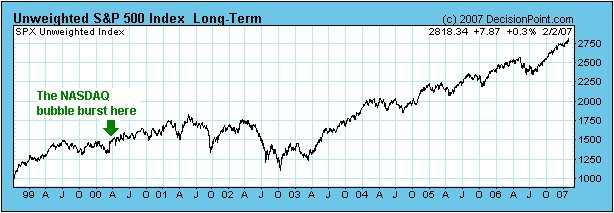
following chart shows that the Unweighted S&P500 Index barely
hesitated when the NASDAQ's bubble burst in 2000 and then experienced a
normal mid-cycle correction during 2001-2002 on its way to much higher
levels.
Quite obviously, the long-term upward trend in the NOMINAL price of the
Unweighted S&P500 Large-Cap Index did not end in 2000. Furthermore,
neither did the long-term upward trends in the NYSE Composite Index,
the S&P400 Mid-Cap Index and the S&P600 Small-Cap Index. It
was, in fact, only a fairly small section of the overall market that
failed to sustain its long-term advance in nominal dollar terms. THIS
is what inflation can do.
Two additional points
are worth making -- reiterating, actually, because we've made these
points many times over the years -- before we leave this topic. The
first is that post-stock-market-bubble America has gone down a very
different path to post-bubble Japan. When the Japanese stock market was
hitting its bubble peak in December of 1989 Japan's broad money supply
was expanding at a year-over-year rate of around 12%, but soon after
the bursting of the bubble the rate of money-supply growth slowed to a
virtual standstill. It then remained at a low level for many years. In
the US, however, the year-over-year rate of money-supply growth began
trending UPWARD following the bursting of the stock market bubble and
reached an 18-year high a full 20 months after the stock market's
bubble peak. The rate of US money-supply growth has since slowed, but
during the 7-year period since the bursting of the NASDAQ bubble it has
expanded at a compound annual growth rate of around 8%. This compares
to about 3% per year compound growth in Japan's total money supply
during the 7-year period following the bursting of the Nikkei bubble.
The second point is that stock markets throughout the world have done
particularly well over the past few years because there's been
substantial inflation without a concomitant rise in inflation fears.
What we've had are effects of inflation that hardly anyone correctly
identifies because almost everyone has been trained to think that the
CPI shows what's happening on the inflation front. This is important
because investors, as a group, are never prepared to pay much for
earnings growth that they perceive to be inflation-induced, but the
fact that valuations in the US are currently near historic highs means
that the earnings growth of the past few years is generally perceived
to be real. Or, to put it another way: there is presently very little
inflation risk priced into the US stock market.
In summary, the US experienced one of the all-time great stock market
bubbles during the 1990s; however, thanks to massive inflation and the
general non-recognition of an inflation problem the majority of stocks
have remained in long-term upward trends to this day. The situation is
precarious because either a significant fall in the inflation (money
supply growth) rate or a rise in inflation fears would likely bring the
bull market to a halt. Right now, though, there is plenty of inflation
and inflation expectations are near an 'optimum' level: not too high to
be a threat to the bond market and not low enough to usher-in a
deflation scare.
Current Market Situation
In past commentaries we've harped on about the bearish divergence
between the NASDAQ100 Index (NDX) and the Dow Industrials Index; that
is, about the fact that the sequence of new 52-week highs in the Dow
over the past two months has not been confirmed by new highs in the
NDX/Dow ratio.
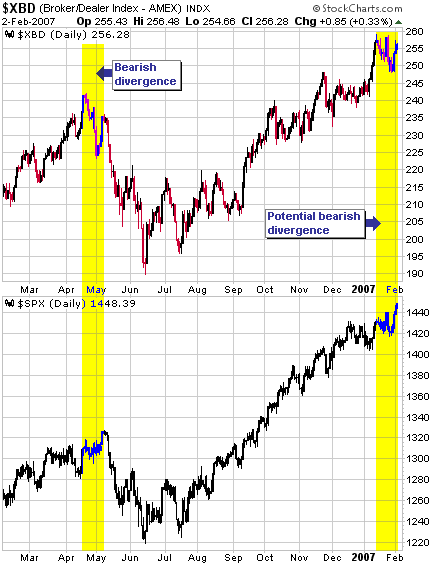
Another potential bearish divergence worth keeping an eye on at this
time is highlighted on the following chart comparison of the AMEX
Broker/Dealer Index (XBD) and the S&P500 Index. The XBD, which
contains companies such as Merrill Lynch, Goldman Sachs, Lehman Bros.
and Morgan Stanley, has been a leader to the upside over the past 2
years. This is not surprising given the huge amount of liquidity
sloshing around the financial world, the global stock market rally and
the plethora of M&A deals.
The interesting thing right now is that the most recent move to new
highs by the S&P500 was not accompanied by new highs in the XBD.
This is a bearish divergence that could quickly be eliminated by the
XBD gaining only 1.5%, but it has our attention at the moment.
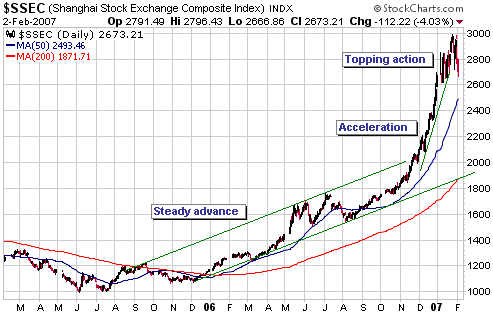
The Shanghai Stock
Exchange Index (SSEC) charted below has gone through a typical bull
market sequence over the past two years. There was a steady advance
that didn't attract much attention; followed by some upward
acceleration as speculators were drawn into the market; followed by an
almost vertical ascent; followed by a large increase in volatility near
the highs. It looks like an intermediate-term top is now in place,
although it wouldn't be surprising to see some more sharp swings in
both directions near the highs before a downward trend begins in
earnest.
So, what do we make of the evidence that China's stock market has either topped or is very close to an important top?
It could turn out to be a warning sign as far as the world's major
stock markets are concerned, but at this stage we aren't reading a lot
into it because China's market tends to march to the beat of its own
drummer; or, to be more accurate, to the Communist Party's beat.
The initial advance from the 2005 lows, for instance, was engineered by
the Government because there were concerns within the Party that the
stock market's sluggish performance was painting an 'unrealistically'
negative picture of the country's economic situation. The efforts to
elevate stock prices worked well, but then things got out of hand in
the opposite direction and it became necessary to throw some water on
the speculative fire. The sort of gains that the SSEC achieved during
the final two months of last year are never sustainable beyond the
short-term regardless of what the manipulators happen to be doing, but
in this case the manipulators applied a little downward pressure via
tighter monetary policy to make sure that the speculative frenzy came
to an end sooner rather than later.
This week's
important US economic events
| Date |
Description |
Monday Feb 05
| ISM Services
|
| Tuesday Feb 06 | No significant events scheduled
| | Wednesday Feb 07
| Q4 Productivity
Consumer Credit
| | Thursday Feb 08
| No significant events scheduled
| | Friday Feb 09
| No significant events scheduled
|
Gold and
the Dollar
Currency Market Update
Short-term Outlook
There's not much we can say about the short-term outlook that we
haven't already said over the past week. In summary, we think it's
likely that the Dollar Index will drop back to test its December low
within the next 2 months, although before embarking on such a pullback
we would not be surprised to see it spike to a new high for the year.
The ideal situation would be for the dollar to spike higher and then
reverse lower within the next week or so.
The Australian Dollar
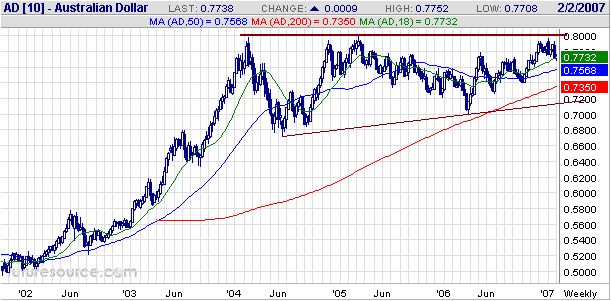
The following weekly chart shows that the A$ has been consolidating for
three years. The eventual breakout from this chart pattern is likely to
be to the upside, but we suspect that a multi-month (or multi-quarter)
decline to the low-0.70s will precede the rally that ultimately takes
the A$ well above resistance at 0.80. At least, this is the outcome
that would fit best with our other market views. In particular,
Australia's economy is leveraged to commodity prices and the mid-cycle
decline in commodities that commenced last May will probably extend
into the second half of this year. The A$ has held up very well during
the first 9 months of this commodity decline because much of the
weakness to date has been concentrated in the 'energies'. However, the
commodity decline should broaden if global growth begins to slow; and
if this happens then the A$ will likely come under pressure.
The chart comparison
included below has been set up to show that the A$ (the AUD/USD
exchange rate) tends to follow the A$ gold price with a lag of around 2
years. The literal interpretation of this chart comparison is that a
powerful A$ rally will begin during the third quarter of this year,
although the tolerance on a long-term relationship such as this would
be at least +/- 6 months.
Further to the above,
a pullback to around 0.73 later this year would provide an excellent
opportunity to go 'long' the A$ relative to the US$.
Gold
Below is a daily chart of February gold futures.
February gold managed to close above its early-December peak last
Thursday and then reversed lower on Friday. Resistance in the high-650s
is therefore yet to be decisively breached, but we continue to expect
that it will be breached within the next few weeks.
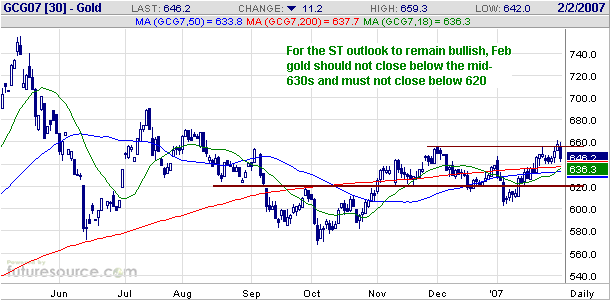
Our expectation is
that gold will test its May-2006 peak during the first half of this
year, but we don't expect gold to move well beyond the 700s until yield
and credit spreads become substantially wider; and yield and credit
spreads probably aren't going to become substantially wider until after
an intermediate-term stock market decline gets underway.
Gold Stocks
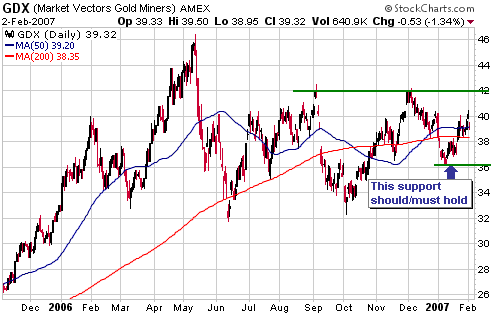
The price action during the final two days of last week was bearish,
with the gold sector giving back early gains on Thursday and then
following through to the downside on Friday. Strength in the US$ on
Friday was certainly a contributing factor, but Thursday's action was a
warning that some additional downside lay in store.
We doubt that last week's downward reversal will prove to have any
significance beyond the immediate-term. It might, though, lead to some
additional consolidation this week and another opportunity for traders
to buy GDX (the ETF that tracks the AMEX Gold Miners Index) within $2
of the support level indicated on the following chart.
We continue to be
bullish on the gold sector, but much more so on the juniors than the
majors. The gold stock indices, which are dominated by the major mining
companies, are unlikely to exceed their May-2006 peaks during the first
half of this year. However, if there's enough strength in the majors to
take the indices to within a few percent of last year's peaks then the
stocks of many exploration-stage miners and junior producers should
trade well above last year's highs.
Update
on Stock Selections
(Note: To review the complete list of current TSI stock selections, logon at http://www.speculative-investor.com/new/market_logon.asp
and then click on "Stock Selections" in the menu. When at the Stock
Selections page, click on a stock's symbol to bring-up an archive of our comments on the stock in question)
 Crowflight Minerals (TSXV: CML). Shares: 190M issued, 240M fully diluted. Recent price: C$0.53 Crowflight Minerals (TSXV: CML). Shares: 190M issued, 240M fully diluted. Recent price: C$0.53
The results of CML's updated Feasibility Study for its Bucko nickel
project were announced last Thursday and they were, to put it mildly,
very positive. In particular, using a discount rate of 8% and a nickel
price of US$8.00/pound (less than half the current US$18/pound spot
price) the project was estimated to have a net present value (NPV) of
C$157M and an internal rate of return (IRR) of 118%. Furthermore, at a
nickel price of US$12/pound the NPV and IRR would rise to C$338M and
418%, respectively. These are obviously great numbers and support our
view that the stock will trade above C$1.00 within the next 12 months.
It is also worth noting that the numbers will get even better once the
recently-reported 32% increase in measured-and-indicated resources is
incorporated into the mine plan.
The stock will likely trade a long way above C$1.00 if the nickel price
is still near current levels when production begins in the first
quarter of next year, but we think it's reasonable to assume that most
of the industrial metals -- nickel included -- will eventually go the
way of copper and have their long-term bull markets interrupted by
large mid-cycle corrections. We therefore think it makes sense to base
company valuations on a long-term price assumption of US$8/pound, even
though this price is 55% below the current spot price. The current
US$18/pound spot price reflects a temporary supply shortage, but nickel
for delivery in April-2009 is trading at 'only' $10.80/pound.
We've highlighted CML as a buy 5 times over the past 4 months at prices
ranging from C$0.35 to C$0.42, most recently in the 24th January
Interim Update when it was trading at C$0.38. Therefore, TSI readers
who are interested in the company are hopefully already 'set' at
significantly lower prices. If not, then it would be reasonable to do
some buying if the stock pulls back to the high C$0.40s. Keep in mind,
though, that the stock can be quite volatile (daily moves of more than
5% are quite common) and that the risk level is still quite high.
Golden Queen Mining (TSX: GQM). Shares: 78M issued, 88M fully diluted. Recent price: C$1.04
We had hoped that a good opportunity to exit GQM would have presented
itself by now, but although the stock price has improved steadily over
the past 4 months there hasn't yet been sufficient strength to take us
out.
GQM's management has a long history of being extremely slow to deliver,
but we are hopeful -- a case of hope triumphing over experience,
perhaps -- that the long-awaited Feasibility Study for the company's
Soledad Mountain gold/silver project will be published before the end
of this month. If so then this could prove to be the catalyst that gets
the stock moving and leads to a good exit point.
The sort of price-range we currently have in mind for an exit is C$1.30-C$1.50.
American Gold Capital (TSXV: AAU) / Chesapeake Gold (TSXV: CKG)
Closing of the AAU-CKG merger has been delayed to 14th February, at
which point AAU shareholders will be entitled to receive CKG shares,
warrants and Class A shares in exchange for their AAU shares.
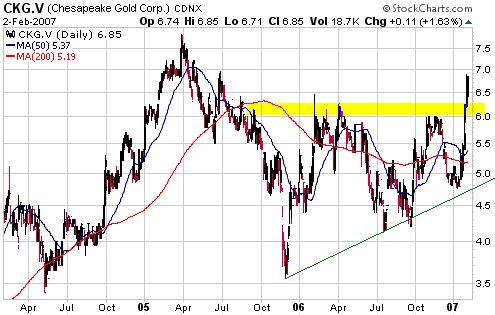
CKG broke-out to the upside last week (see chart below), which
naturally gave AAU shares a boost since AAU is effectively a CKG
derivative. By our calculations, though, AAU ended last week at a
significant discount to the agreed merger consideration. Specifically,
we estimate that Friday's closing bid of C$6.70 for CKG implies a value
of around C$3.20 for AAU, yet AAU ended the week at only C$2.55. This
is reminiscent of the discount at which Aflease was trading in
November-2005, just prior to its merger with SXR (the merger that
created SXR Uranium One).
AAU is a buy at the current price.
Apogee Minerals (TSXV: APE). Shares: 39M issued, 52M fully diluted. Recent price: C$0.64
APE, an exploration-stage silver/zinc miner with projects in Bolivia,
just can't seem to get any respect. The company reported very good
drilling results from its Paca-Pulacayo project last week, including
intercepts of 151m grading 120g/t silver and 33m grading 313g/t silver,
but the market just yawned.
Political risk-related fears are almost certainly responsible for the
stock's sluggishness and low valuation. It would be economically
illogical for the Bolivian Government to do anything to discourage a
company such as APE from progressing its projects since these projects
will not be developed in the absence of foreign investment; but, as
evidenced by the US Government's ethanol subsidies, economic logic is
often overwhelmed by misguided political aspirations.
We don't think the Bolivian Government will end up taking any actions
that have the potential to kill-off foreign investment in the mining
sector, but it is certainly a risk that investors/speculators need to
keep in mind. The good thing about obvious risks, though, is that they
can lead to excellent speculations because the stock market will
sometimes apply an excessive risk discount. This, we think, is the
current situation with APE.
The main reason for mentioning APE again in today's report is that the
initial NI43-101 resource calculation for the Paca project is scheduled
to be complete by the middle of this month. The market has been largely
ignoring APE's drilling results, but in the absence of a worsening
political situation in Bolivia the independent confirmation -- the
resource estimate is being put together by Micon International -- of a
sizeable in-ground resource could grab the market's attention. If
nothing else it should allow analysts (us included) to do preliminary
estimates of the project's value, thus shining a spotlight on the large
gap between the company's low market capitalisation (US$27M at Friday's
closing price) and the potential value of its assets.
With reference to the below chart, the stock has dropped back to near
the 52-week low reached in October. However, the slide since the
early-November peak has the look of a consolidation as opposed to a new
leg down. If so then the next move of note should be a rally up to
resistance in the C$0.90-C$1.00 range. Breaking through this resistance
range would then set the stage for a test of the 2006 peak.
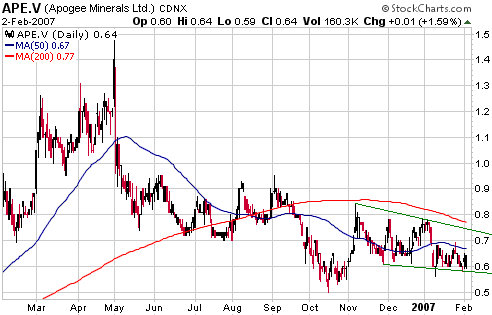
Chart Sources
Charts appearing in today's commentary
are courtesy of:
http://stockcharts.com/index.html
http://www.futuresource.com/
http://www.decisionpoint.com/

|









