|
-- Weekly Market Update for the Week Commencing 5th March 2012
Big Picture
View
Here is a summary of our big picture
view of the markets. Note that our short-term views may differ from our
big picture view.
In nominal dollar terms, the BULL market in US Treasury Bonds
that began in the early 1980s will end by 2013. In real (gold)
terms, bonds commenced a secular BEAR market in 2001 that will continue
until 2014-2020. (Last
update: 23 January 2012)
The stock market, as represented by the S&P500 Index, commenced
a secular BEAR market during the first quarter of 2000, where "secular
bear market" is defined as a long-term downward trend in valuations
(P/E ratios, etc.) and gold-denominated prices. This secular trend will bottom sometime between 2014 and 2020. (Last update: 22 October 2007)
A secular BEAR market in the Dollar
began during the final quarter of 2000 and ended in July of 2008. This
secular bear market will be followed by a multi-year period of range
trading. (Last
update: 09 February 2009)
Gold commenced a
secular bull market relative to all fiat currencies, the CRB Index,
bonds and most stock market indices during 1999-2001. This secular trend will peak sometime between 2014 and 2020. (Last update: 22 October 2007)
Commodities,
as represented by the Continuous Commodity Index (CCI), commenced a
secular BULL market in 2001 in nominal dollar terms. The first major
upward leg in this bull market ended during the first half of 2008, but
a long-term peak won't occur until 2014-2020. In real (gold) terms,
commodities commenced a secular BEAR market in 2001 that will continue
until 2014-2020. (Last
update: 09 February 2009)
Copyright
Reminder
The commentaries that appear at TSI
may not be distributed, in full or in part, without our written permission.
In particular, please note that the posting of extracts from TSI commentaries
at other web sites or providing links to TSI commentaries at other web
sites (for example, at discussion boards) without our written permission
is prohibited.
We reserve the right to immediately
terminate the subscription of any TSI subscriber who distributes the TSI
commentaries without our written permission.
Outlook Summary
Market
|
Short-Term
(0-3 month)
|
Intermediate-Term
(3-12 month)
|
Long-Term
(1-5 Year)
|
| Gold
|
Neutral
(22-Feb-12)
|
Neutral
(24-Jan-11)
|
Bullish
|
| US$ (Dollar Index)
|
Neutral
(22-Nov-11)
| Neutral
(09-Jan-12)
|
Neutral
(19-Sep-07)
|
| Bonds (US T-Bond)
|
Bearish
(05-Mar-12)
|
Neutral
(18-Jan-12)
|
Bearish
|
| Stock Market (S&P500)
|
Bearish
(23-Jan-12)
|
Bearish
(28-Nov-11)
|
Bearish
|
| Gold Stocks
(HUI)
|
Neutral
(29-Feb-12)
|
Bullish
(23-Jun-10)
|
Bullish
|
| Oil | Neutral
(31-Jan-11) | Neutral
(31-Jan-11)
| Bullish
|
| Industrial Metals
(GYX)
| Neutral
(22-Nov-11)
| Neutral
(29-Aug-11)
| Neutral
(11-Jan-10)
|
Notes:
1. In those cases where we have been able to identify the commentary in
which the most recent outlook change occurred we've put the date of the
commentary below the current outlook.
2. "Neutral", in the above table, means that we either don't have a
firm opinion or that we think risk and reward are roughly in balance with respect to the timeframe in question.
3. Long-term views are determined almost completely by fundamentals,
intermediate-term views by giving an approximately equal weighting to
fundamental and technical factors, and short-term views almost
completely by technicals.
Trading news-related
plunges
Last week's price action in Batero Gold (TSXV: BAT) has prompted us to re-visit a topic we've covered several times in TSI commentaries over the years, which is how to deal with plunges in stock prices that happen in response to unexpected bad news. In this discussion we are assuming that the news doesn't alter the fundamentals in a way that eliminates all reasons for having some exposure to the stock in question. For example, news that mining costs are higher than expected or that a resource estimate is lower than expected wouldn't necessarily be a deal breaker, whereas news that a mining company's only project had been confiscated by the government would probably destroy the entire basis for owning the company's shares.
The first point is that it is almost never a good idea to buy on Day 1 (the day the bad news hits the market), especially during the first post-news hour of trading. It usually takes more than a few hours for most existing shareholders to get the news and react. Also, price weakness causes more selling, which leads to more weakness, and so on, up to the time when new buying from value investors outweighs selling by those who were holding the stock prior to the news and those who bought the initial price dip.
The second point is that it is usually not a good idea to buy near the start of trading on Day 2 if the price immediately begins to rebound. The reason is that a rebound at this early stage is likely to bring out more sellers, partly because some existing shareholders wouldn't have found out about the news until after the end of trading on Day 1. However, buying after the first few hours of trading on Day 2 can work well, especially if the price has fallen below the low of Day 1.
The final point is that whatever low is made during the first three post-bad-news trading days is often tested or breached prior to the start of a sustained advance. For example, the most common sequence of events is: a low on Day 2 or Day 3 (usually Day 2), followed by a rebound that lasts anywhere from a few days to a few weeks, followed by a decline to test the Day 2-3 low, followed by a tradable rally.
When is a default not a
default?
The answer to the above question is: when the default would force major US banks to pay out on the credit insurance (Credit Default Swaps) they sold to buyers of government bonds.
In the arcane world of over-the-counter derivatives, the International Swaps and Derivatives Association (ISDA) determines whether or not a failure by a borrower constitutes a default that requires payments on Credit Default Swaps (CDSs). The ISDA said last Thursday that based on current evidence the Greek government had not defaulted and that payments would therefore not have to be made on the CDSs purchased by bond investors to protect themselves from default.
The ISDA decision is not surprising given that the ISDA is dominated by the banks that sold a lot of CDSs linked to the government bonds of Greece and the other "PIIGS". However, it will be difficult for the ISDA to stick with this decision if the voluntary rate of private sector participation in the recently 'agreed' bond swap (the swapping of existing Greek bonds for new Greek bonds with much lower interest payments) turns out to be less than 75%. In this case Collective Action Clauses (CACs) would come into play, the exchange of bonds would become blatantly involuntary, and the evidence upon which the ISDA based its non-default determination would be negated. The banks would then have to pay out on the insurance they sold.
Whatever happens, there will be a problem. If the banks get away with not paying-out on the Greek bond insurance despite the fact that a default has clearly occurred, aspersions will be cast on all CDSs associated with government bonds. This would be a long-term issue. Alternatively, if banks are forced to pay-out on the CDSs related to Greek government bonds then several important banks will incur large losses. This would be a short-term issue that would likely give an immediate boost to the demand for safe havens such as gold and US Treasury Bonds.
In situations such as this you will usually be correct if you bet that the short-term pain will be avoided at all cost.
T-Bond Update
T-Bond futures have moved within a narrow horizontal range over the past 4 months. This sort of stability is rare nowadays in any major futures market, probably because the currencies in which prices are quoted are so unstable.
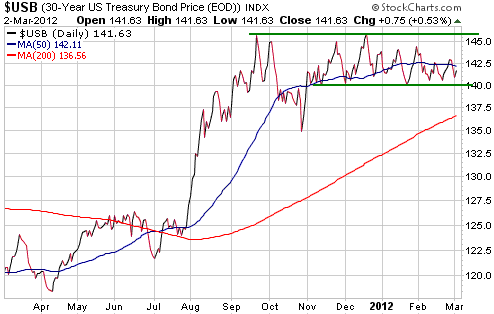
Just as bull markets are followed by bear markets (and vice versa), periods of low volatility are followed by periods of high volatility. There's a good chance, then, that the T-Bond 'flat-line' of the past few months will give way to a period during which a big move occurs. Nothing in the sentiment indicators or the recent price action clearly points to the direction of the coming big move, but our guess is that it will be to the downside.
Due to the increased risk of a sizeable decline within the next three months, we have downgraded our short-term T-Bond outlook from "neutral" to "bearish".
We almost never attempt to trade T-Bond trends. In fact, it has been at least a few years since we made any sort of speculative bet on the Treasury market. However, we find the current risk/reward sufficiently enticing to purchase a small position in TBT (Ultra-Short 20+ Treasury ETF) $20 call options expiring in June-2012. This is a highly speculative trade that we intend averaging into for our own account over the next couple of weeks, but isn't a formal TSI recommendation.
Economic Numbers Update
February's ISM (Institute of Supply Management) data were a little weaker than January's, with the headline index dropping from 54.1 to 52.4 and the New Orders index dropping from 57.6 to 54.9. However, these movements weren't significant.
As advised in previous commentaries, we would take a single-month decline to 48 or lower in the New Orders Index or consecutive monthly readings of 48 or lower in the headline ISM Index as positive confirmation of a US recession, while a single-month rise to 60 in the New Orders Index or consecutive months above 55 in the headline ISM Index would cast considerable doubt upon our recession forecast.
The Stock
Market
Although the senior US stock indices (the SPX, the NDX and the Dow) have continued to trend upward, by some measures the US stock market has been in 'correction mode' since the beginning of February. For example, the number of individual stocks making new 52-week highs has been trending lower since early February. For another example, the Russell2000 Small Cap Index (RUT) peaked in early February and ended last Friday's trading session at a new 4-week low.
An effect of the recent relative weakness in small-cap stocks is illustrated by the following chart. The top section of the chart shows that the SPX (a proxy for large-cap stocks) made a new 12-month high late last week, while the bottom section of the chart shows that the RUT/SPX ratio has plummeted over the past few weeks and is now closer to a 12-month low than a 12-month high.
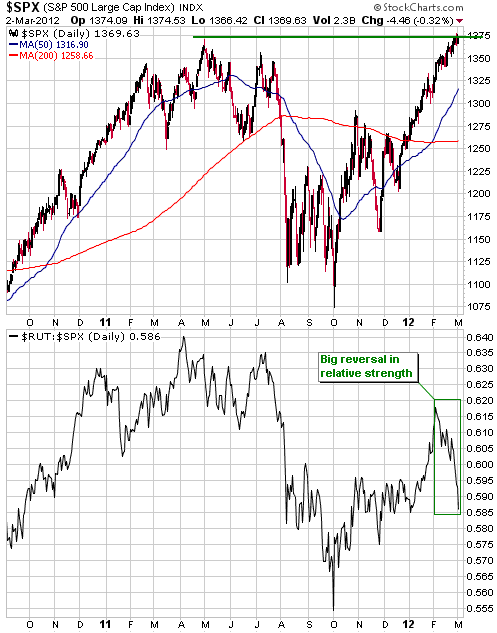
The recent divergence between the small cap stocks and the large cap stocks is bearish, but the RUT/SPX ratio is now almost as 'oversold' as it usually gets on a short-term basis. This suggests to us that there isn't going to be anything more serious than a 3-week pullback in the senior indices prior to resumptions of their upward trends.
A similar conclusion can be drawn from the following chart showing the NASDAQ Composite Index and the NASDAQ's McClellan Oscillator (MO). The very slow upward drift in the NASDAQ Composite Index since early February has been accompanied by a decline in the NASDAQ's MO that has almost pushed the MO into 'oversold' territory. This suggests that if a downturn were to commence within the next few days it would probably do no worse than take the NASDAQ back to the support that extends from 2900 down to 2750.
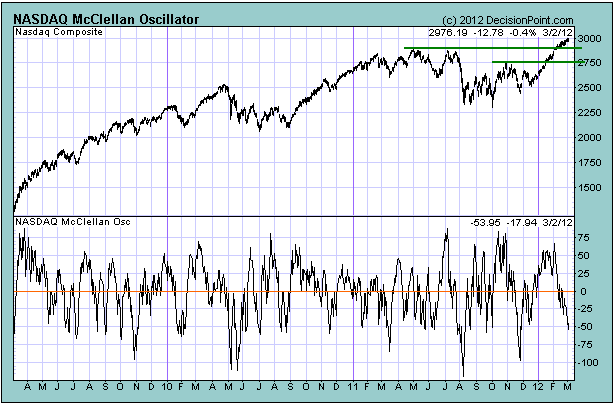
When we turned short-term bearish on the US stock market (as represented by the SPX) we thought that the SPX's upside potential was limited by resistance at 1340-1370. It is now clear that we under-estimated the upside potential, because a pullback over the next few weeks will probably be followed by a rally to a new multi-year high.
Although we appear to have under-estimated the market's short-term upside potential, the overall performance has roughly been in line with our expectations for 2012 as outlined in our Yearly Forecast. Just to recap, in our 2012 Forecast we wrote:
"We expect the market to hold up fairly well during the first few months of this year and then roll over into a major downward trend. To be more specific, we expect that the stock market will be supported over the first few months of the year by loose monetary policy and the fact that two of the most obvious threats (Europe's debt predicament and China's slowdown) have already been discounted. However, spreading realisation that the US economy is in recession will probably cause a major downward trend to begin after the aforementioned period of relative stability has run its course."
At this stage it doesn't look like the "period of relative stability" will end until at least May. However, all of our views are based on risk versus future reward, so even though the senior stock indices will probably make new multi-year highs during April-May we remain short-term "bearish" on the basis that the remaining upside potential is materially less than the downside risk.
We may upgrade our short-term outlook to "neutral" if a pullback over the next couple of weeks pushes the NASDAQ's MO below -75.
This week's
important US economic events
| Date |
Description |
| Monday Mar 05 | Factory
Orders
ISM Non-Manufacturing Index
| | Tuesday Mar 06 | No
important events scheduled
| | Wednesday Mar 07 | Q4
Productivity and Costs (revised)
Consumer Credit | | Thursday
Mar 08 |
No
important events scheduled
|
| Friday Mar 09 | Monthly
Employment Report
International Trade Balance
|
Gold and
the Dollar
Gold
Here is an excerpt from the 13th February Weekly Update:
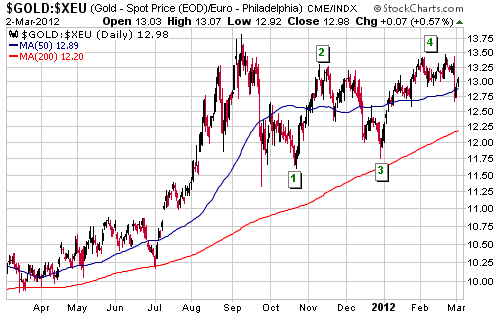
"The numbering on the following chart of the euro-denominated gold price (gold/euro) shows that all intermediate-term corrections since 2005 have tracked a certain pattern. In each case there has been an initial decline ending at the point labeled "1", a rebound to point "2", a pullback to point "3", a second rebound to point "4", a pullback to point "5", and then a strong multi-month upward trend to a new all-time high. Also, with the exception of the 2009-2010 correction point "5" has always been at or just below the 200-day moving average.
At this stage it looks like gold/euro's current correction is tracking the pattern of the earlier corrections. If the similarities persist then the top of the second rebound (point "4") has either just been put in place or will be put in place within the next few weeks. There would then be a pullback that most likely bottomed near the 200-day moving average followed by a strong rally to a new all-time high."
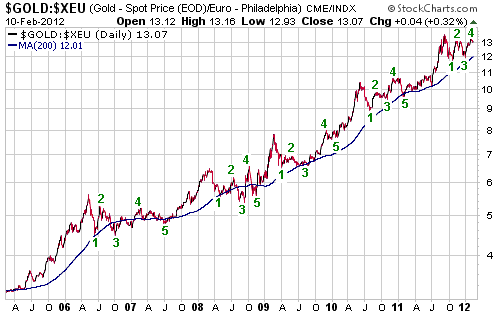
The next chart uses the same numbering but zooms in on the price action of the past 12 months. The current correction is still tracking the pattern of the earlier corrections, with point "4" having been put in place last month and a decline to the vicinity of the 200-day moving average now in progress. This decline should -- assuming that the pattern holds -- be followed by a strong rally to a new all-time high.
Silver
Silver broke above lateral resistance at $35.50-$36.00 early last week. It then reversed downward and ended the week below this resistance. At this stage it therefore looks like last week's upside breakout was false.
As far as bearish price signals go, a false upside breakout is more reliable than a downside breakout. Consequently, we think it is reasonable to assume that silver has commenced a multi-week decline.
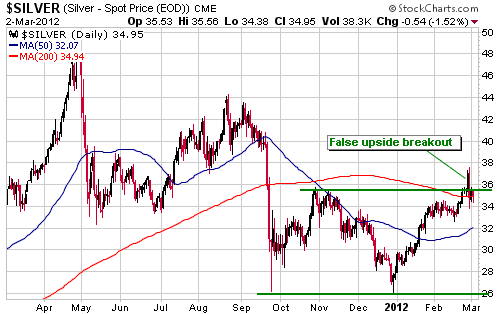
The 50-day moving average (around $32) is the most plausible target for the current decline, but the maximum short-term downside risk is defined by support at $26-$28.
Gold Stocks
Current Market Situation
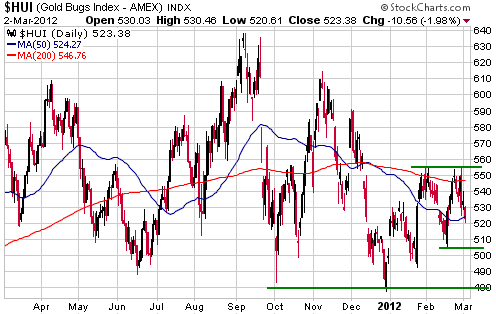
The HUI is clearly not 'overbought'. At the same time, it is not yet 'oversold' on a short-term basis. Also, the price chart doesn't point to any particular short-term outcome. We therefore have no good reason to be anything other than "neutral" with regard to the HUI's short-term prospects.
With reference to the following daily chart, the HUI has short-term resistance in the 550s and short-term support at 505. There's a reasonable chance that this support will hold during any further weakness over the coming fortnight, but the risk is defined by the more important support that lies in the 480s. It is very unlikely that this lower support will be breached in the near future.
A better way for junior miners to raise money
Something we have suggested in the past is that Canadian junior resource companies follow in the footsteps of their Australian brethren and do equity financings via rights offerings rather than private placements. If a financing is done via a rights issue then all existing shareholders get the opportunity to participate, which means that existing shareholders can avoid having their stakes diluted regardless of how low the financing is priced.
A "Portfolio Strategy" letter sent out by Hallgarten & Company last week made the same point. Here's the relevant excerpt from the Hallgarten letter:
"With the financing markets still not returning to robust health, it might be time for Canadian mining companies to ditch their long-held fondness for bought deals and ad hoc financings and use the long dust-encrusted rights offering provisions enshrined in TSX rules and Canadian securities law. As we mentioned earlier, Virgin Metals went into (near-) virgin territory in reviving this ignored financing method, but they stated that they had heard of several other companies also launching such offers. One of the problems with rights offerings though is the long lead time on these events and the paperwork cost (sending something to all shareholders no matter how small the holding). Rights offerings do not mean that investment bankers do not get to make some money (underwriting of the offerings being a lucrative business in London and Melbourne financial circles).
An added twist is that in renounceable rights offerings the long gestation period can be made interesting by the shares trading ex-rights and the rights having a trading life of their own (trading like listed shortterm warrants). In this mode, shareholders who cannot or will not take up their rights can realize something from the discount at which the shares are sold to others.
We can see some reasons why small miners like to see placings to new investors instead of the "same old, same old." However, for routine financing for majors and mid-tier miners, our view is that there is almost NO justification (excepting an acquisition that needs to be financed rapidly) that a rights issue should not be the compulsory means of undertaking financings. Shareholders won't be complaining, only their bankers."
Currency Market Update
The Euro
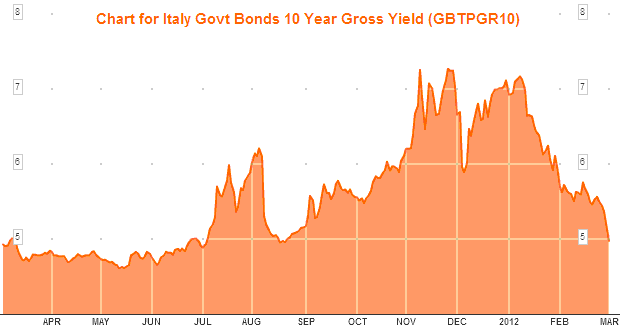
The reason that money-pumping is such a popular central bank response to problems is that the immediate superficial effects of the pumping are almost always positive. For example, one of the immediate superficial effects of the ECB's recent injections of new money is the plunge in the Italian Government Bond yield illustrated below. After being above 7% just two months ago, the yield is now below 5%.
A good economist understands the principle of "TANSTAAFL" (There Ain't No Such Thing As A Free Lunch) and looks beneath the surface in an effort to identify all the costs of using a flood of new money to prop-up some prices. He understands that using monetary inflation to lower the yields on Italian government bonds is effectively a transfer of wealth from euro savers to the holders of these bonds. Punishing savers to help people who made bad investments is not just ethically wrong, it will slow the long-term rate of economic progress. The good economist also understands that the new money will distort relative prices throughout the economy, prompting resources to be allocated in an inefficient way and changing the structure of the economy for the worse.
Another of the immediate superficial effects of the ECB's recent monetary largesse is stock market strength. With Italian Government bond yields falling and stock markets rallying, the demand for 'safe havens' has diminished; hence, the strength in the euro relative to the US$. This euro strength should continue, in fits and starts, until the stock market nears an intermediate-term peak and the speculative net-short position in euro futures has shrunk to a more normal size.
The euro is in the process of consolidating its recent gains, but we suspect that it will maintain an upward bias for another 1-2 months.
The Pound
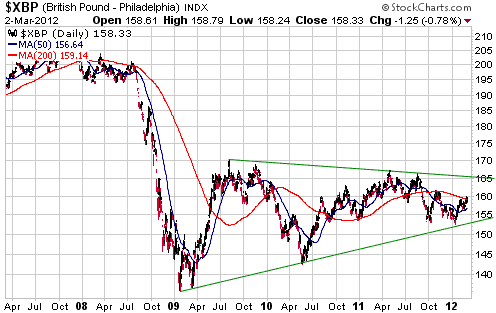
The British Pound has spent the past three years in a contracting triangle that will probably end up breaking to the downside, but perhaps not before the top of the triangle is challenged. The chart-based targets following a downside breakout would be the 2010 low (around 143) and the 2009 low (around 137).
The one thing of importance that the Pound currently has in its favour is its slow rate of supply growth. As evidenced by the following chart from
Michael Pollaro's blog, the year-over-year growth rate in UK TMS (True Money Supply) is now just above zero after spending the bulk of the past year below zero.
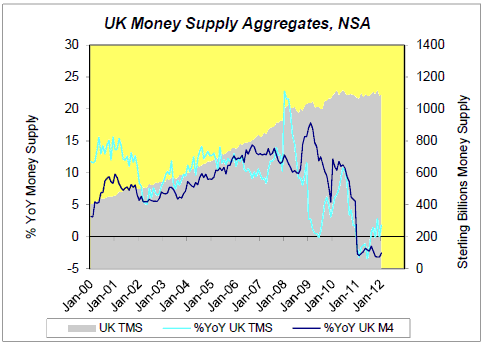
The BOE is doing its best to negate the positive influence of the Pound's slow rate of supply growth (Michael Pollaro calculates that BOE credit is up 25% year-over-year and 92% (annualised) over the latest 3-month period), and it stands a good chance of being successful.
Update
on Stock Selections
Notes: 1) To review the complete list of current TSI stock selections, logon at
http://www.speculative-investor.com/new/market_logon.asp
and then click on "Stock Selections" in the menu. When at the Stock
Selections page, click on a stock's symbol to bring-up an archive of
our comments on the stock in question. 2) The Small Stock Watch List is
located at http://www.speculative-investor.com/new/smallstockwatch.html
 Clifton Star Resources (TSXV: CFO). Shares: 36M issued, 40M fully diluted. Recent price: C$2.90 Clifton Star Resources (TSXV: CFO). Shares: 36M issued, 40M fully diluted. Recent price: C$2.90
After many months of almost complete silence from CFO, the news came thick and fast last week. The updated resource estimate issued on Tuesday was followed on Thursday by a batch of good drilling results, but the most important news was Friday's report of metallurgical test results.
Two of the biggest risks associated with CFO's Duparquet project were generally considered to be low gold recovery due to the metallurgy and the potential for environmental problems due to high arsenic levels, but Friday's news suggests that these risks have been greatly overstated. In particular, laboratory tests conducted on six representative samples showed that an average gold recovery of 93% could be achieved via a process involving 1) flotation (to recover pyrite and gold), 2) pressure oxidation (to oxidize the pyrite and liberate the gold), and 3) carbon-in-leach cyanidation. Also, the arsenic levels were low in all six samples.
There is still likely to be a flurry of selling when the stock resumes trading, but Friday's news probably means that value-oriented speculators will be tempted to buy sooner and at a higher price than would otherwise have been the case.
Sabina Gold and Silver (TSX: SBB). Shares: 161M issued, 170M fully diluted. Recent price: C$3.10
SBB broke through support at C$3.50 and is now testing support at around C$3.00. It has obviously been weaker than we expected, for -- as far as we can tell -- no reason other than sentiment. The negative sentiment is at least partly due to difficulties being experienced by other mining companies with projects in the same region.
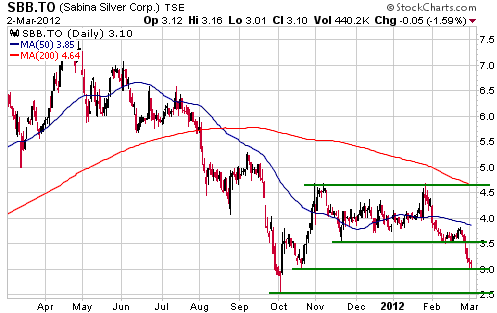
This isn't the most likely outcome, but recent price action opens up the possibility of SBB testing last year's low of C$2.50. If this happens you should mortgage the final forty acres and invest the proceeds in SBB shares.
In case it isn't clear, the above sentence is an exaggeration. You should never put money into an exploration-stage gold mining stock that you can't afford to lose. The point we want to make is that SBB would be absurdly cheap at such a price. At C$2.50 per share you would be getting entry to the high-quality Back River gold project at a very attractive price AND you would effectively be getting the valuable Hackett River silver royalty for free.
Greenscape Capital (TSXV: GRN). Shares: 78M issued, 96M fully diluted (assuming completion of the financing announced in January). Recent price: C$0.11
GRN isn't a TSI stock selection. It is, however, in the TSI Small Stocks Watch List (SSWL). We've been meaning to update GRN for the past several months, but we wanted to see the latest quarterly financial results before doing so. Last week the company finally published its results for the quarter ended 31st October 2011.
GRN owns 81% of the new DIA (Denver International Airport) parking facility, which is apparently the world's "greenest" parking facility. It also operates an energy retrofitting business for commercial buildings.
The ramp-up of the parking facility ("Canopy Parking") has gone quite well. The problem is that during the period when "Canopy Parking" was cash flow negative the company regularly issued new shares to fund its operations. It also continued to invest in other early-stage businesses and these investments were also funded by issuing new shares. The result is that the size of the underlying business is only slightly bigger today than it was 12 months ago, but the share count has approximately doubled.
According to a press release issued last Wednesday, GRN has hired an independent corporate finance advisory firm to explore options for maximising shareholder return on Canopy Parking. This probably means that GRN is looking to sell its 81% stake in the carpark. Such a sale could bring in as much as $32M, resulting in the company having about $0.21/share of net cash (cash minus debt).
If there was a good reason to be confident that GRN's stake in the parking facility will be sold in the near future for more than $30M, then GRN would be an interesting speculation at its current price of C$0.11. The problem is that we don't see a good reason to be confident, and a failure to sell would likely mean that the company's per-share value continues to steadily shrink in response to low-priced equity financings.
We are going to remove GRN from the SSWL. However, if we owned the shares (we do have a small position) we would be inclined to hold for another couple of months in case the company's efforts to monetise its "Canopy Parking" investment are successful.
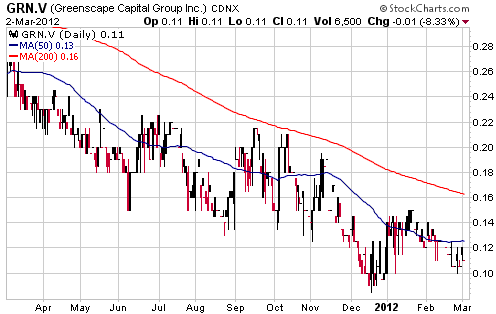
Chart Sources
Charts appearing in today's commentary
are courtesy of:
http://stockcharts.com/index.html
http://www.decisionpoint.com/
http://www.bloomberg.com/

|









