|
-- Weekly Market Update for the Week Commencing
5th August 2013
Big Picture
View
Here is a summary of our big picture
view of the markets. Note that our short-term views may differ from our
big picture view.
In nominal dollar terms, the BULL market in US Treasury Bonds
that began in the early 1980s will end by 2013. In real (gold)
terms, bonds commenced a secular BEAR market in 2001 that will continue
until 2014-2020. (Last
update: 23 January 2012)
The stock market, as represented by the S&P500 Index,
commenced
a secular BEAR market during the first quarter of 2000, where "secular
bear market" is defined as a long-term downward trend in valuations
(P/E ratios, etc.) and gold-denominated prices. This secular trend will bottom sometime between 2014 and 2020.
(Last update: 22 October 2007)
A secular BEAR market in the Dollar
began during the final quarter of 2000 and ended in July of 2008. This
secular bear market will be followed by a multi-year period of range
trading.
(Last
update: 09 February 2009)
Gold commenced a
secular bull market relative to all fiat currencies, the CRB Index,
bonds and most stock market indices during 1999-2001.
This secular trend will peak sometime between 2014 and 2020.
(Last update: 22 October 2007)
Commodities,
as represented by the Continuous Commodity Index (CCI), commenced a
secular BULL market in 2001 in nominal dollar terms. The first major
upward leg in this bull market ended during the first half of 2008, but
a long-term peak won't occur until 2014-2020. In real (gold) terms,
commodities commenced a secular BEAR market in 2001 that will continue
until 2014-2020.
(Last
update: 09 February 2009)
Copyright
Reminder
The commentaries that appear at TSI
may not be distributed, in full or in part, without our written permission.
In particular, please note that the posting of extracts from TSI commentaries
at other web sites or providing links to TSI commentaries at other web
sites (for example, at discussion boards) without our written permission
is prohibited.
We reserve the right to immediately
terminate the subscription of any TSI subscriber who distributes the TSI
commentaries without our written permission.
Outlook Summary
Market
|
Short-Term
(1-3 month)
|
Intermediate-Term
(6-12 month)
|
Long-Term
(2-5 Year)
|
|
Gold
|
Bullish
(17-Oct-12)
|
Bullish
(26-Mar-12)
|
Bullish
|
|
US$ (Dollar Index)
|
Neutral
(24-Dec-12)
|
Bullish
(01-May-13)
|
Neutral
(19-Sep-07)
|
|
Bonds (US T-Bond)
|
Bullish
(24-Jun-13)
|
Neutral
(18-Jan-12)
|
Bearish |
|
Stock Market
(DJW)
|
Bearish
(15-Jul-13)
|
Bearish
(28-Nov-11)
|
Bearish
|
|
Gold Stocks
(HUI)
|
Bullish
(24-Dec-12)
|
Bullish
(23-Jun-10)
|
Bullish
|
|
Oil |
Neutral
(30-Jul-12)
|
Neutral
(31-Jan-11)
|
Bullish
|
|
Industrial Metals
(GYX)
|
Neutral
(30-Jul-12)
|
Neutral
(29-Aug-11)
|
Neutral
(11-Jan-10)
|
Notes:
1. In those cases where we have been able to identify the commentary in
which the most recent outlook change occurred we've put the date of the
commentary below the current outlook.
2. "Neutral", in the above table, means that we either don't have a
firm opinion or that we think risk and reward are roughly in balance with respect to the timeframe in question.
3. Long-term views are determined almost completely by fundamentals,
intermediate-term views by
fundamentals, sentiment and technicals, and short-term views by sentiment and
technicals.
US Economic Numbers
The GDP Numbers
Last week was a big week for US economic data, beginning on Wednesday with the
first estimate of second quarter (Q2) GDP growth and re-estimates of all GDP
numbers back to 1929.
The first estimate of the annualised rate of "inflation"-adjusted GDP growth in
Q2 was +1.67%, which is low but was apparently about 0.7% above the average
expectation. At the same time, the estimated GDP growth rates in Q1-2013 and
Q4-2012 were reduced from 1.8% to 1.14% and 0.36% to 0.14%, respectively. Also,
real GDP is estimated to have risen by only 1.4% over the past 12 months (from
Q2-2012 to Q2-2013).
These are all very low numbers, especially considering that they have been
artificially boosted by the chronic understating of "price inflation" (real GDP
is nominal GDP minus the estimated increase in the "general price level") and
that the US money supply rose by about 9% over the past 12 months. A 9% increase
in money supply combined with an estimated increase of only 1.5% in the "general
price level" would normally result in real GDP growth of well over the reported
1.4%.
The almost non-existent GDP growth reported by the BLS (Bureau of Labor and
Statistics) for the past 12 months is, however, consistent with the almost
non-existent revenue growth reported by corporate America over the same period.
At this stage the main superficial effect of the monetary inflation is a more
expensive stock market.
One reason for the extensive historical GDP revisions reported last week was to
include spending on R&D (Research and Development). Conspiracy theorists will no
doubt claim that this was done with the sole aim of reducing debt/GDP ratios by
boosting the denominator in the ratios. It probably was done with this aim in
mind, but it doesn't have much effect (the addition to overall GDP is only about
3% and the growth numbers aren't significantly changed) and, coincidentally, it
actually makes the GDP number a bit less unrealistic.
One of the many problems with the calculation method for GDP is that it omits
all intermediate stages of production. It therefore substantially understates
the size of the US economy and substantially overstates consumer spending as a
percentage of the economy. A more accurate calculation of GROSS domestic product
would reveal that the economy is at least twice as big as suggested by the
current GDP number and, consequently, that consumer spending is no more than 35%
of the economy (as opposed to the 70% figure that is often bandied about). In
other words, adding R&D expenditure is a small step in the right direction.
By the way, correctly including intermediate stages of production in GDP
probably wouldn't have much effect on the average calculated growth rate over
the long-term, but it would more accurately reflect the large swings in the
economy stemming from the central-bank-sponsored boom/bust cycle. There would
routinely be sizeable (>5%) annual declines in GDP during the bust phase and
similar annual rises in GDP during the boom phase.
The ISM Numbers
The best coincident indicator of US economic performance is the monthly ISM
(Institute of Supply Management) report on the manufacturing sector. The monthly
ISM manufacturing numbers for July were published last week.
The headline ISM Index was 55.4, which was a little better than expected and up
by a significant 4.5 points from June. Of greater importance, however, was the
unexpectedly-large rise in the New Orders Index -- from 51.9 in June to 58.3 in
July. This is the highest level for "New Orders" since April of 2011.
Here is a chart of the ISM Manufacturing New Orders Index. Notice that although
July's surge reversed the losses of the preceding four months in one fell swoop,
it didn't change the overall pattern.
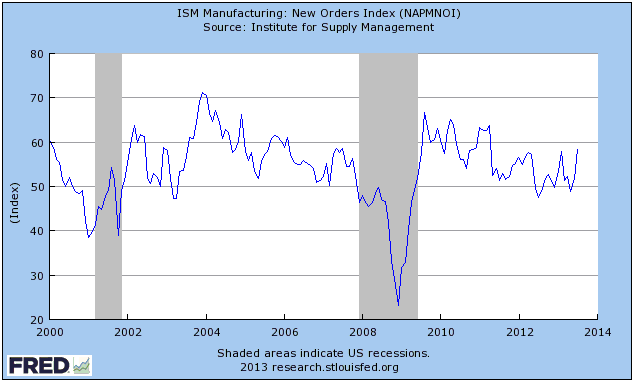
As far as we can tell, the US economy has never officially been in recession
while the ISM New Orders Index has been at 58 or above. Therefore, despite the
US having just experienced three consecutive quarters of lousy GDP growth,
ECRI's recession call is almost certainly still wrong.
We reiterate that the ISM Manufacturing report is a good COINCIDENT indicator.
It is not a leading indicator. The implication is that while the latest ISM
numbers tell us that economic growth picked up in July, they tell us very little
about what's going to happen over the months ahead. For example, the ISM New
Orders Index was 58.6 in July of 2007, but a major equity bear market began in
October of 2007 and the US economy was officially in recession by December of
2007.
Other Numbers
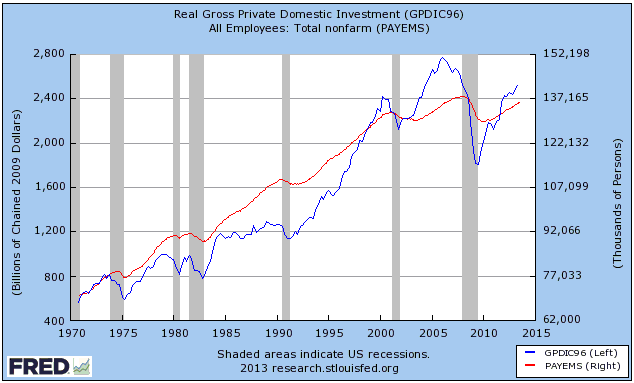
The following chart contains a lagging economic indicator (the red line) and a
leading economic indicator (the blue line). The lagging indicator is Non-Farm
Employment, which is updated monthly, and the leading indicator is Gross Private
Domestic Investment (GPDI), which is updated quarterly.
Employment never turns downward until after a recession has begun. It is
completely useless as a leading indicator of the economy and almost completely
useless as a coincident indicator of the economy. However, the idiots at the Fed
focus intensely on the employment numbers, which means that the markets are
forced to focus intensely on the employment numbers. As a consequence,
meaningless fluctuations in the monthly employment data often lead to
significant price changes in the financial markets. This was seen last Friday,
with T-Bond and gold prices rebounding after it was reported that the US economy
added slightly fewer jobs than expected during the month of July.
In the past, GPDI has always turned downward prior to the start of a recession.
It looked, for a while, as if GPDI had begun to roll over in the second quarter
of last year, but it clearly resumed its upward trend during the first two
quarters of this year. GPDI's performance suggests that the next official US
recession won't begin prior to the end of this year.
This time it really is
different
A mistake made by almost all 'deflationists' is
to conflate money and debt. Although under the current monetary system money
comes into being via the expansion of commercial bank credit or central bank
credit, money and debt are two very different entities. The fact is that
regardless of the amount of debt within the economy, a large rise in the money
supply WILL lead to large price rises somewhere in the economy. The only
question is: Which prices will rise first and the most in response to the
increased money supply?
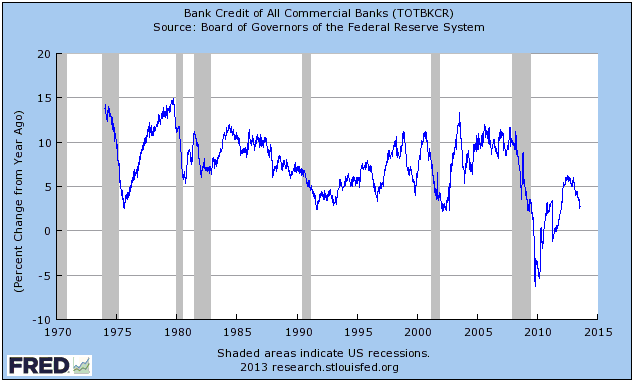
A mistake often made by 'inflationists' is to assume that the current cycle is
similar to the preceding cycles. The following long-term chart of the annual
percentage change in US commercial bank credit clearly shows that this is not
the case; the current cycle is actually very different. Whereas the annual rate
of increase in commercial bank credit bottomed at around +2.5% during previous
cycles, in the current cycle it bottomed at around -5% and four years into a
recovery is rising at only 2.5%. That is, although the rate of increase in bank
credit has rebounded strongly from its 2008 low, the current rate of increase
matches what would have been a 50-year low prior to 2008.
Over the past 5 years, growth in the US money supply has been heavily reliant on
the expansion of central bank credit. We think that this unusual situation will
persist, even after the Fed decides to 'taper' its QE. In other words, although
the pace of the Fed's QE will probably be scaled back ('tapered') within the
next few months, we think that the Fed will be monetising assets at an unusually
fast pace for a long time to come.
The Stock
Market
The S&P500 Index made a marginal new high
late last week, which means that the US stock market is continuing to defy
gravity. This is not a big surprise. It also doesn't improve the reward/risk
ratio. In fact, every additional percent gained without a meaningful correction
effectively stretches the rubber-band a little more.
Provided that the market has a significant correction over the next few weeks, a
rebound to new (marginal) highs during October-November will remain likely.
However, continuing to grind upward for another 2-3 weeks would alter the
expected pattern and potentially set the stage for a traditional October crash.
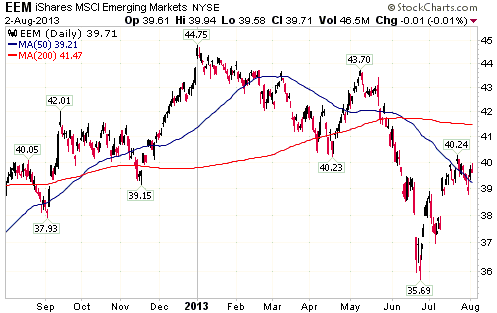
In last week's Interim Update we mentioned the iShares MSCI Emerging Markets
Fund (EEM) as a candidate for a bearish speculation. We are mentioning it again
in today's report because it rose to resistance at $40 on Friday before
reversing course, thus re-confirming its candidacy. A daily chart is displayed
below.
A bearish EEM speculation interests us at this time for two reasons. First, EEM
is potentially completing a short-term rebound within a bear market. Second, it
should be possible to limit the downside risk to a small percentage by placing a
'stop' just above the July high ($40.24). For example, a trade in the form of a
short position in EEM or a long position in EEV (ProShares UltraShort MSCI
Emerging Markets) could be entered near the current price with the plan to make
a quick exit for a small loss if EEM achieves one or two daily closes above
$40.24.
This week's
important US economic events
| Date |
Description |
| Monday Aug 05 |
ISM Non-Mfg Index | | Tuesday
Aug 06 |
International Trade Balance | | Wednesday
Aug 07 |
Consumer Credit | | Thursday
Aug 08 |
No important events scheduled
|
| Friday Aug 09 |
No important events scheduled |
Gold and
the Dollar
Gold
When the gold price was bottoming in late June, a number of sentiment indicators
were at or close to their most extreme levels in decades. This meant that a
sentiment platform capable of supporting a major advance had been put in place,
although it didn't preclude some additional weakness (following a 1-2 month
rebound) and perhaps a final price low during October-November.
Since late June there have been some subtle bullish changes. While the potential
for a final October-November low still exists, evidence has emerged that a major
bottoming process is underway. For example, gold managed to make it to the top
of the $1320-$1350 resistance range before consolidating, thus differentiating
the latest rebound from this year's earlier rebounds. For another example,
although the gold price is now about $130 above its June low, sentiment
indicators such as the COT data and the CEF/gold ratio reveal just as much
negativity today as they did when the price was bottoming in June. This is a
bullish divergence between price and sentiment.
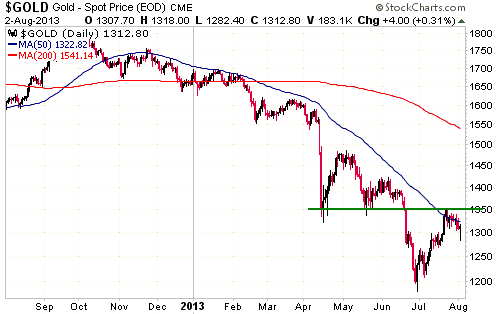
Last Friday gold initially fell to the $1280s as traders sold the ultimate
counter-cyclical investment in anticipation of strong US employment data. The
price then quickly returned to the low-$1300s after the employment data came in
a little weaker than expected. This price action tells us only that short-term
traders are skittish and are flip-flopping in reaction to the latest piece of
news.
We doubt that the short-term rebound from the June low is over, but we don't
have an opinion on whether or not there will be some additional consolidation
over the coming 1-2 weeks.
Gold Stocks
In the 24th July Interim Update we noted that the HUI had overcome obstacles,
including lateral resistance and the 50-day MA, that were not overcome during
earlier rebounds, suggesting that the major trend was in the process of
reversing. In the same commentary we also noted that some near-term corrective
activity and a decline by the HUI to below its 50-day MA would not negate the
evidence that the major trend was in the process of reversing.
In the 29th July Weekly Update we said that if the coming week's US economic
news was much worse than expected or if the FOMC announcement was more 'dovish'
than expected then the HUI could quickly rise to the 290s, but that in the
absence of a news-related upside catalyst there would probably be some
consolidation over the ensuing week or two.
It turned out that the FOMC announcement was marginally more 'dovish' than
expected/feared, but that the overall news flow over the past week was modestly
bearish for gold and gold-related investments. As a result, the HUI continued
its consolidation and slipped back below its 50-day MA in the process.
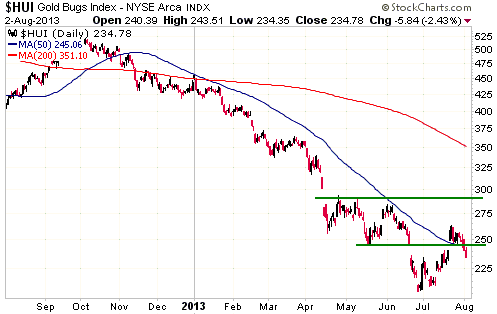
There have now been 8 trading days of 'corrective activity', including 5
down-days in a row. This creates the potential for an upward reversal on Monday
5th August, since routine consolidations within short-term upward trends
regularly last 5-8 trading days. However, there's no way of knowing whether we
are seeing a routine 5-8 day consolidation or something more substantial. Also,
the 1968-1970 Model suggests that the upward trend won't resume until the second
half of August.
Our view is simply that a major bottoming process is underway. There is no way
to predict the exact path that the process will follow.
Currency Market Update
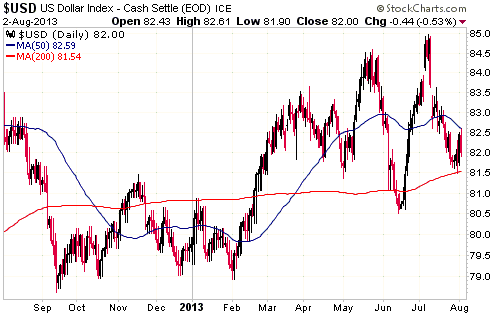
The Dollar Index is now extended to the downside, but not sufficiently so to
make it clear that a turning point is at hand. Momentum indicators have not yet
reached 'oversold' territory and sentiment indicators suggest that speculators
still prefer the US$ to the euro despite the former's recent sharp decline. This
doesn't necessarily mean that the dollar's short-term decline will continue, but
it does mean that there is not yet a good reason to anticipate an imminent
reversal.
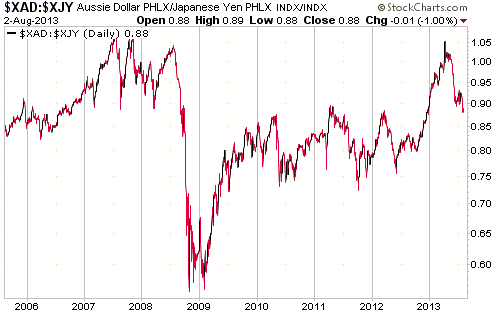
The following daily chart shows the Australian Dollar (A$) relative to the Yen.
The recent decline by A$/Yen to a new low for the year means that the A$ now has
the honour of being 2013's weakest major currency.
The A$/Yen decline of the past three months is probably not just a short-term
correction; it is probably the first leg of a 1-2 year cyclical bear market.
Interestingly, it began from the same level as the 2007-2008 bear market.
Update
on Stock Selections
Notes: 1) To review the complete list of current TSI stock selections, logon at
http://www.speculative-investor.com/new/market_logon.asp
and then click on "Stock Selections" in the menu. When at the Stock
Selections page, click on a stock's symbol to bring-up an archive of
our comments on the stock in question. 2) The Small Stock Watch List is
located at http://www.speculative-investor.com/new/smallstockwatch.html
 Company
news/developments for the week ended Friday 2nd August 2013: Company
news/developments for the week ended Friday 2nd August 2013:
[Note: FS = Feasibility Study, IRR = Internal Rate of Return, MD&A =
Management Discussion and Analysis, M&I = Measured and Indicated,
NAV = Net Asset Value, NPV(X%) = Net Present Value using a discount
rate of X%, P&P = Proven and Probable, PEA = Preliminary Economic
Assessment, PFS = Pre-Feasibility Study]
*Batero Gold (BAT.V) issued its MD&A and Financial Statements for
the 3-month period ended 31st May 2013.
As at 31st May the company had working capital of about C$16M. Due
to subsequent expenditure we estimate that the company's working
capital is presently about C$14M. At the current share price of
C$0.17, this is only $1M less than the market capitalisation. The
implication is that BAT's multi-million ounce exploration-stage gold
project in Colombia is being valued by the market at only slightly
more than zero.
Financially, BAT is in reasonable shape. This is because in addition
to its $14M of working capital it has access to a $2.2M loan from
Consorcio Minero Horizonte S.A, a private Peruvian 200K-oz/yr gold
producer and BAT's major shareholder. It therefore looks like BAT is
fully funded for at least the next 12 months or until it makes a
mine-construction decision.
Whether or not BAT makes a mine-construction decision within the
coming 12 months will be determined by the economics of its
Batero-Quinchia gold project, the first indication of which will be
provided via a PEA due soon (September at the latest). We doubt that
the project economics will look attractive at the current gold
price.
*Dragon Mining (DRA.AX) is one of the few gold producers to have
reported better-than-expected financial performance during the
latest quarter. Last week, DRA reported production of 17.2K ounces
at a cash cost of US$928/oz during the June-2013 quarter. This
compares with 14.4K ounces at a cash cost of US$1,045/oz for the
March-2013 quarter and 13.7K ounces at a cash cost of US$1,219/oz
for the December-2012 quarter.
DRA's cost control was good enough during the recently-completed
quarter that it was able to add cash to its balance sheet for the
first time in more than a year.
If the company shows that the improvement demonstrated in Q2-2013
wasn't a one-off, then the stock will again become a strong
candidate for new buying.
*Evolution Mining (EVN.AX) issued its Quarterly Report for the
June-2013 quarter, the final quarter of the 2013 Financial Year for
Australian companies.
We already knew that the company had achieved a very good production
result of 112.5K gold ounces in the latest quarter as this
information was previously reported. What we didn't know were the
costs.
On the cost front it was another disappointing performance by EVN,
as despite the record production quantity the all-in cost of
production was still far too high at A$1266/oz. The all-in cost
includes pretty much everything except growth-related expenditure.
Due to its high all-in production cost and the money it spent on
growth-related projects, the June-2013 quarter was yet another
period of cash consumption for EVN. Specifically, based on the
information provided in last week's Quarterly Report we estimate
that the company consumed about $15M of cash during the period,
leaving it with about $14M of cash and $73M of unused credit.
The company's guidance for the 2014 Financial Year is for production
of 400K-450K ounces at a much-improved all-in cost of
A$1080-$1130/oz. Considering that EVN produced 390K gold ounces over
the past 12 months and that a new 70K-oz/yr mine has just been
brought into production, the company SHOULD produce about 450K
ounces over the coming 12 months. But as always, cost will be the
most important measure of performance. If EVN can meet its all-in
cost guidance and rein-in its expenditure on growth-related projects
as management has promised, substantial cash should be generated
over the next 12 months as long as the gold price averages at least
US$1300/oz.
Along with many other gold producers, EVN will be taking a
substantial non-cash impairment charge due to the decline in the
gold price. EVN's write-off is expected to be in the $350M-$400M
range. Negative accounting adjustments such as this generally aren't
a big deal unless they cause existing loan covenants to be violated
or adversely affect the ability to obtain sufficient financing,
which isn't the case here.
*Golden Star Resources (GSS) advised that it has taken two
measures to bolster its financial position. First, it added about
$7M to its cash reserve by selling the shares it owned in another
gold miner (True Gold). Second, it arranged a US$50M secured loan
facility with Ecobank Ghana.
GSS should now have about $57M of cash and access to $50M of
additional debt. This makes it likely that the company will get
through the next 12 months without resorting to a highly-dilutive
equity financing.
*Premier Gold (PG.TO) reported the results from the on-going
drilling program at its Trans-Canada (TC) project (Ontario). The
drilling was focused on the Hardrock deposit, the largest of four
gold deposits that make up the TC project. Just a reminder that the
TC project's resource is presently estimated to be 4.12M ounces M&I
plus 3.65M ounces Inferred, the bulk of which is contained in the
Hardrock deposit.
Overall, the drilling results were very good. Highlights included:
- 62.54 grams per tonne gold (g/t Au) across 3.0 metres (m) and 95.32 g/t
Au across 2.0 m within the existing pit shell.
- 3.70 g/t Au across 22.0 m, 2.30 g/t Au across 21.0 m and 2.13 g/t
across 15.0 m in new zones discovered during condemnation drilling.
- 5.27 g/t Au across 22.5 m and 1.96 g/t Au across 42.8 m in step-out
drilling.
The company's press release states that work is underway to update
the gold resource at Hardrock in advance of completing a PEA in
H2-2013. A separate PEA for the Brookbank deposit (one of the other
three deposits at the TC project) is also being done. The Hardrock
PEA is assessing potential open pit, underground, and combined
scenarios.
*Pretium Resources (PVG) issued its MD&A and Financial Statements
for the June quarter.
The most important work currently being carried by PVG is the
"Valley of the Kings Bulk Sample Program". According to a recent PVG
press release: "...the "Program" consists of two elements: the
excavation of a 10,000-tonne bulk sample, which is expected to
conclude in August, and an approximately 15,000-meter underground
drill program, which is also expected to conclude in August. The
Program has been designed to test the full widths of two of the
domains of mineralization used to estimate the November 2012 Valley
of the Kings Mineral Resource. By testing the two domains of
mineralization, the Program will confirm that the resource model is
accurately projecting the range of the grade distribution in the
10-meter blocks that make up the Mineral Resource estimate within
the bulk sample area."
About 7,000 of the 10,000 tonnes have now been excavated.
PVG had about $38M of working capital at 30th June. This means that
it has enough cash to complete the Bulk Sample Program and the other
work planned for 2013. Provided that the results of the Bulk Sample
Program are positive (we will be very surprised if they aren't), it
won't have trouble raising additional money as needed in the future.
*Ramelius Resources (RMS.AX) announced that gold production during
the 2014 Financial Year (July-2013 through to June-2014) is expected
to be 107K ounces, or 34% higher than production during the
just-completed Financial Year. No information about the expected
cost of this production was provided.
In its efforts to get its costs down to a level where it generates a
meaningful amount of cash, RMS would be helped by additional
weakness in the A$. There's a good chance that it will get help of
this nature.
RMS also announced that it is joining the ranks of gold producers
taking substantial non-cash impairment charges in response to the
fall in the gold price. In RMS's case, the total write-off is
expected to be about A$65M, which shouldn't cause any problems
because the company has plenty of cash and no debt.
Interesting
price action among the uranium-mining juniors
The spot uranium price fell again last week, to a new 7-year low. This led to a
pullback in the Global X Uranium Fund (URA), but the recent bullish divergence
between the uranium-mining equities (represented by URA) and the underlying
commodity remains intact.
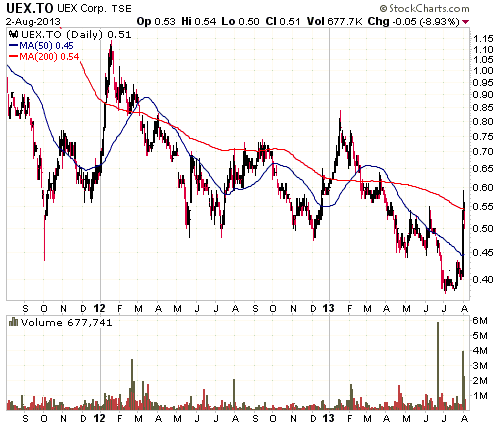
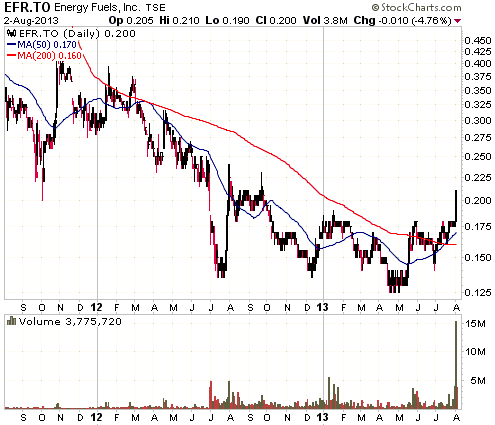
EFR.TO and UEX.TO, the two junior uranium miners in the TSI Stocks List, both
had significant stock-price bounces last week. These bounces could be written
off as simply the exhaustion of selling in ultra-depressed stocks, if not for
the huge increases in volume that accompanied the price rises. As illustrated by
the following daily charts, UEX rebounded strongly last Wednesday on the
second-highest daily volume of the past two years and EFR rebounded strongly
last Thursday on by far the highest daily volume of the past two years.
The demand for uranium-related investments appears to be turning the corner even
though the spot uranium price is still trending downward.
Value
comparison: Agnico Eagle (AEM) versus Kinross Gold (KGC)
18 months ago a valid argument could be made for AEM to trade at a huge
valuation premium to KGC. That was because AEM was a low-cost gold producer with
strong organic growth potential and low political risk, whereas KGC was a
high-cost producer with relatively high political risk that was relying on
dubious development-stage projects and high-priced acquisitions for its growth.
AEM still trades at a huge valuation premium to KGC, but the premium no longer
appears to be warranted. AEM still has a significant advantage over KGC in terms
of political risk, but it no longer has a production-cost or growth advantage.
Furthermore, AEM's political-risk advantage is partly offset by its greater
reliance on base-metal revenue.
When we say that AEM trades at a huge premium to KGC we are referring to the
fact that the stock market is valuing AEM's production at around $5,040/oz and
valuing KGC's production at $2,370/oz. This means that AEM's production is being
valued 113% higher than KGC's production. This would probably be justified if
AEM's cost of production was much lower than KGC's, but both companies are
likely to have all-in costs of about $1,100/oz during 2013. The premium could
also be at least partly justified if AEM had a strong balance sheet and KGC had
a weak balance sheet, but KGC now has a stronger balance sheet than AEM.
There was a time when KGC's management could be relied upon to damage its
balance sheet by making large and ill-conceived acquisitions, but last week the
company announced that it was focused on maintaining its financial strength and
would therefore not be proceeding with the high-cost expansion of the Tasiast
mine until 2015 at the earliest. This is evidence that lessons have been learned
from past failures.
The sole justification for AEM's valuation premium now appears to be its lower
political risk, given that AEM is focused on North America and KGC has important
assets in Russia, West Africa, North America and South America. The question is
whether AEM's lower political risk warrants a 113% higher valuation. We don't
think it does.
In our opinion, KGC currently trades at an unjustifiably low valuation relative
to AEM. It is also our opinion that AEM is fairly valued at current metal
prices, meaning that we view AEM's excessive valuation premium as being due to
KGC trading too low rather than AEM trading too high.
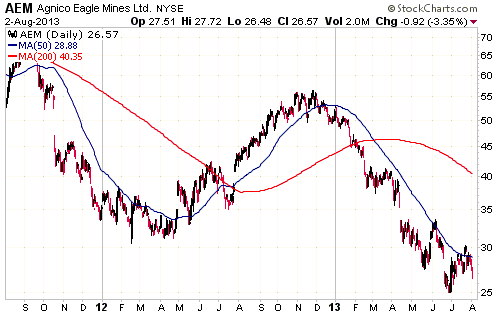
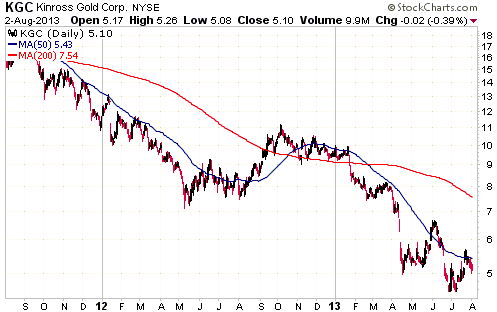
The following charts show that both stocks have performed poorly. Both made
lower-lows for the year in June and need to close above their July rebound highs
to provide preliminary signals that major trend reversals have taken place.
The TSI Stocks List contains exposure to both AEM and KGC via long-dated
out-of-the-money call options.
Candidates
for new buying
From within the ranks of TSI stock selections, the best candidates for new
buying at this time are:
- AKG (Note: The decline from the July high of US$3.00 to last week's
close of US$2.48 has brought the stock back to a suitable level for new buying.)
- EDV.TO/EVR.AX
- PG.TO (Note: We mentioned last week that the stock would be a buy
following a decline to around C$2.05. It ended last week at C$1.98.)
- PVG, ideally following a pullback to the mid-US$7 area
- RIO.TO/RIOM (Note: We mentioned last week that the stock would be a buy
following a decline to around C$2.10. Unfortunately, it didn't trade any lower
than C$2.16 and ended the week at C$2.26. With positive news in the form of
better-than-expected quarterly financials potentially happening this week, it
could still be a buy in the $2.20s.)
- SBB.TO
Hopefully it won't be too long before we can start mentioning selling ideas in
addition to buying ideas.
Chart Sources
Charts appearing in today's commentary
are courtesy of:
http://stockcharts.com/index.html
http://research.stlouisfed.org/

|









