|
-- Weekly Market Update for the Week Commencing 5th December 2011
Big Picture
View
Here is a summary of our big picture
view of the markets. Note that our short-term views may differ from our
big picture view.
In nominal dollar terms, the BULL market in US Treasury Bonds
that began in the early 1980s ended in December of 2008. In real (gold)
terms, bonds commenced a secular BEAR market in 2001 that will continue
until 2014-2020. (Last
update: 4 April 2011)
The stock market, as represented by the S&P500 Index, commenced
a secular BEAR market during the first quarter of 2000, where "secular
bear market" is defined as a long-term downward trend in valuations
(P/E ratios, etc.) and gold-denominated prices. This secular trend will bottom sometime between 2014 and 2020. (Last update: 22 October 2007)
A secular BEAR market in the Dollar
began during the final quarter of 2000 and ended in July of 2008. This
secular bear market will be followed by a multi-year period of range
trading. (Last
update: 09 February 2009)
Gold commenced a
secular bull market relative to all fiat currencies, the CRB Index,
bonds and most stock market indices during 1999-2001. This secular trend will peak sometime between 2014 and 2020. (Last update: 22 October 2007)
Commodities,
as represented by the Continuous Commodity Index (CCI), commenced a
secular BULL market in 2001 in nominal dollar terms. The first major
upward leg in this bull market ended during the first half of 2008, but
a long-term peak won't occur until 2014-2020. In real (gold) terms,
commodities commenced a secular BEAR market in 2001 that will continue
until 2014-2020. (Last
update: 09 February 2009)
Copyright
Reminder
The commentaries that appear at TSI
may not be distributed, in full or in part, without our written permission.
In particular, please note that the posting of extracts from TSI commentaries
at other web sites or providing links to TSI commentaries at other web
sites (for example, at discussion boards) without our written permission
is prohibited.
We reserve the right to immediately
terminate the subscription of any TSI subscriber who distributes the TSI
commentaries without our written permission.
Outlook Summary
Market
|
Short-Term
(0-3 month)
|
Intermediate-Term
(3-12 month)
|
Long-Term
(1-5 Year)
|
| Gold
|
Neutral
(22-Sep-11)
|
Neutral
(24-Jan-11)
|
Bullish
|
| US$ (Dollar Index)
|
Neutral
(22-Nov-11)
| Bullish
(12-Oct-11)
|
Neutral
(19-Sep-07)
|
| Bonds (US T-Bond)
|
Neutral
(19-Sep-11)
|
Bearish
(24-Aug-11)
|
Bearish
|
| Stock Market (S&P500)
|
Neutral
(22-Nov-11)
|
Bearish
(28-Nov-11)
|
Bearish
|
| Gold Stocks
(HUI)
|
Neutral
(28-Nov-11)
|
Bullish
(23-Jun-10)
|
Bullish
|
| Oil | Neutral
(31-Jan-11) | Neutral
(31-Jan-11)
| Bullish
|
| Industrial Metals
(GYX)
| Neutral
(22-Nov-11)
| Neutral
(29-Aug-11)
| Neutral
(11-Jan-10)
|
Notes:
1. In those cases where we have been able to identify the commentary in
which the most recent outlook change occurred we've put the date of the
commentary below the current outlook.
2. "Neutral", in the above table, means that we either don't have a
firm opinion or that we think risk and reward are roughly in balance with respect to the timeframe in question.
3. Long-term views are determined almost completely by fundamentals,
intermediate-term views by giving an approximately equal weighting to
fundamental and technical factors, and short-term views almost
completely by technicals.
A story of inflation set
in the future in a different part of the Galaxy
An excerpt from "The Restaurant at the End of the Universe" by Douglas Adams:
...the management consultant had been sitting in stony silence, his fingertips pressed to his temples to indicate that he was waiting and would wait all day if it was necessary.
At this point he decided he would not wait all day after all, he would merely pretend that the last half hour hadn't happened.
He rose to his feet.
"If," he said tersely, "we could for a moment move on to the subject of fiscal policy …"
"Fiscal policy!" whooped Ford Prefect. "Fiscal policy!"
The management consultant gave him a look that only a lungfish could have copied.
"Fiscal policy ..." he repeated, "that is what I said."
"How can you have money," demanded Ford, "if none of you actually produces anything? It doesn’t grow on trees you know."
"If you would allow me to continue ..."
Ford nodded dejectedly.
"Thank you. Since we decided a few weeks ago to adopt the leaf as legal tender, we have, of course, all become immensely rich."
Ford stared in disbelief at the crowd who were murmuring appreciatively at this and greedily fingering the wads of leaves with which their track suits were stuffed.
"But we have also," continued the management consultant, "run into a small inflation problem on account of the high level of leaf availability, which means that, I gather, the current going rate has something like three deciduous forests buying one ship's peanut."
Murmurs of alarm came from the crowd. The management consultant waved them down.
"So in order to obviate this problem," he continued, "and effectively revalue the leaf, we are about to embark on a massive defoliation campaign, and ... er, burn down all the forests. I think you'll all agree that’s a sensible move under the circumstances."
The crowd seemed a little uncertain about this for a second or two until someone pointed out how much this would increase the value of the leaves in their pockets whereupon they let out whoops of delight and gave the management consultant a standing ovation. The accountants among them looked forward to a profitable autumn.
The Economic Numbers
In TSI commentaries we almost never discuss the economic numbers that get reported on a weekly or monthly basis. There are three reasons for this. First, the financial markets will usually discount a change in the economy's trend well before the change is reflected by the economic data. One consequence is that even though markets often bounce around in reaction to the latest news on the economy, the news almost never causes a trend reversal. Second, many of the highest-profile economic numbers are calculated by the government, which means that they are created for propaganda purposes rather than for the purpose of measuring/assessing what's really happening. Third, some of the most important aspects of the economy's performance cannot be measured in the simplistic way that the government and most economists try to measure them. The change in the purchasing power of money (the change in the so-called "general price level") and the economy's rate of growth are two good examples, in that these things cannot be sensibly represented by single numbers.
Having said that, if our economic outlook is correct then at some point along the way the economic data should corroborate this outlook. In other words, our macro-economic views should receive belated confirmation from the weekly and monthly economic numbers. By the same token, if the economic data hasn't begun to confirm our intermediate-term economic outlook after, say, 9 months, then we should acknowledge the likelihood that we've missed something.
Our current view is that the US economy is in recession and stands a good chance of remaining in recession over the next 12 months. Recent economic data neither confirms nor denies this view, but we suspect that validation or invalidation will occur by the end of Q1-2012.
The economic numbers that we will be paying closest attention to over the months ahead are the ones published at the beginning of each month by the Institute of Supply Management (ISM). These numbers are diffusion indices based on a nationwide survey of purchasing managers, meaning that they tell us the health of the US manufacturing sector as perceived by purchasing managers.
Levels above 50 in the ISM indices suggest expansion in the manufacturing sector of the economy (the further above 50, the faster and/or more broad-based the growth) and levels below 50 suggest contraction. Also, the ISM indices are coincident (as opposed to lagging) indicators and have the advantage of being determined by the private sector (as opposed to being concocted by the Ministry of Truth). The
latest ISM indices are for November and were published last Thursday (1st December).
The headline "ISM Index" ticked up to 52.7 in November from 50.8 in October, which is not a meaningful change. As illustrated by the following chart, the Index has spent the past few months in the low-50s after plunging during the first half of this year.
The current position and recent performance of the ISM Index is consistent with our bearish economic outlook, especially given that it is in a similar position now to where it was at the start of the last official recession (the shaded areas on the following chart indicate the periods when the US economy was officially in recession). However, the Index's performance and current position would also be consistent with an economic backdrop that could be described as lacklustre but not recessionary. It is therefore fair to say that the ISM Index hasn't yet positively confirmed our outlook. To do that it would have to drop to 48 or lower and remain there for at least two months. Alternatively, consecutive monthly closes above 55 would be a clear sign that our economic outlook was too bearish.
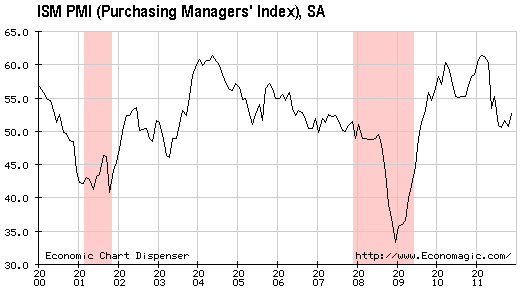
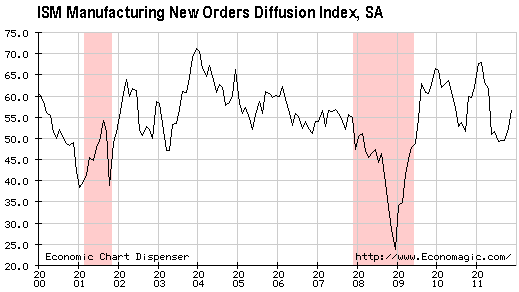
The ISM Index hovered around 50 for about the first 8 months of the 2007-2009 recession, so it possibly won't provide us with anything definitive over the next few months even if our recession call is 'on the mark'. However, if the US economy is in recession or just about to enter a recession then we should see significant additional weakness in the "ISM Manufacturing New Orders Index" over the coming few months.
We would take a single-month decline to 48 or lower in the New Orders Index (see chart below) as positive confirmation of a recession, while a rise in this index to 60 or above would cast considerable doubt upon our recession forecast.
The Stock
Market
Despite last week's decision by the Bank of China to reduce reserve requirements (the first move towards monetary easing in China in a long time), the Shanghai Stock Exchange Composite Index (SSEC) lost ground over the course of the week. This was an interesting market reaction (or non-reaction) considering that the SSEC is 'oversold' and just above major support at 2300.
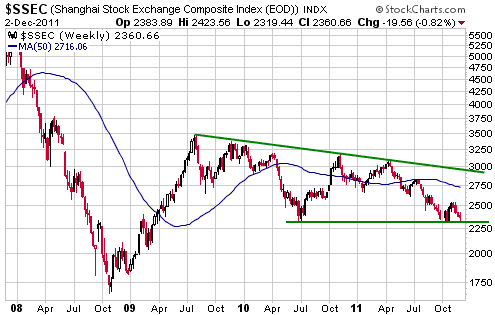
Although we remain bearish on China's economy, at current prices we are neither bearish nor bullish on China's stock market. In China, the stock market is not an indicator of anything other than the public's desire to gamble on stocks and the government's desire for stock prices to rise or fall. Stock prices have essentially gone nowhere in China over the past three years because the general desire to gamble in this market has remained at a low level and the government's focus has been elsewhere.
If the SSEC breaks below support at 2300 and continues to decline then at some point the government will almost certainly take action to reverse the trend. This could create a good buying opportunity.
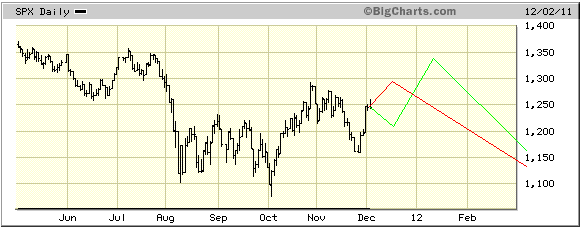
In last week's Interim Update we outlined two short-term scenarios for the US stock market, as follows:
"Most traders are probably now expecting the rally to continue until early next year in response to positive seasonal factors, which is definitely a plausible scenario. This scenario would be bolstered by an interim peak this week or early next week followed by a 1-2 week pullback to a higher low. Alternatively, if the market continues its upward ramp beyond the next few days then the next important peak could occur as soon as the middle of December."
These scenarios are drawn on the daily S&P500 chart displayed below.
This week's
important US economic events
| Date |
Description |
| Monday Dec 05 | Factory
Orders
ISM Non-Manufacturing
| | Tuesday Dec 06 | No
important events scheduled
| | Wednesday Dec 07 | Consumer
Credit | | Thursday
Dec 08 | No important events
scheduled
| | Friday Dec 09 | Consumer
Sentiment
International Trade Balance
|
Gold and
the Dollar
Gold and Silver
Gold's present chart pattern can aptly be termed "neutral". As illustrated below, gold's price is under a downward-sloping trend-line drawn from the early-September peak and over an upward-sloping trend-line drawn from the late-September trough.
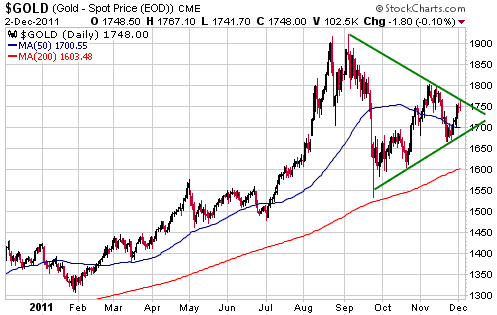
Sentiment indicators such as the COT report suggest that most of the weak-handed 'longs' have already exited the gold futures market. This should mean that in the absence of an important fundamental change, a downside breakout by gold from its contracting range would be followed by a decline to no lower than the mid $1500s. Falling much further than that would probably require a big adverse change in the monetary backdrop, which seems unlikely in the extreme given that most Fed governors are on the lookout for an excuse to introduce another round of QE. In other words, there could be an opportunity to buy gold at $1550-$1600 within the next few weeks, but anyone expecting to buy at a much lower level will almost certainly be disappointed.
Drop to the mid-$1500s is what gold COULD do IF it broke out to the downside from its contracting range, but our short-term views on other markets suggest that an upside breakout is more likely than a downside breakout. The August-September peak ($1920) would become a reasonable near-term target following an upside breakout.
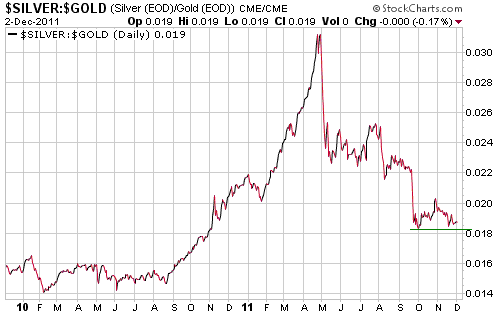
Moving along, the silver/gold ratio has done very little since reaching a multi-month bottom at the end of September. The current market environment is mildly supportive for the ratio in that there has been a slight shift back towards risk over the past two months (silver usually does better than gold during periods when market participants are becoming more willing to take-on risk), so it is interesting that silver/gold is languishing near its low for the year.
We don't know if silver/gold's lack of strength means anything. We expect that this ratio will drop to much lower levels next year, but an immediate downside breakout would be contrary to our short-term outlook and would therefore be somewhat confusing.
Gold Stocks
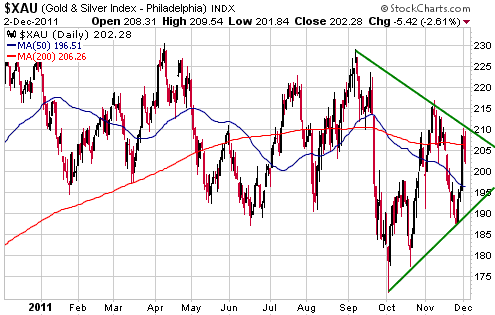
There is always more than one way to interpret the price action in any market. For example, the contracting range drawn on the gold chart above is just one interpretation of what's happening in the gold market. Perhaps not surprisingly, a similar interpretation can be made of the XAU's price action. Specifically, and as illustrated below, the XAU's performance over the past three months can be viewed as a contracting range defined by sequences of declining tops and rising bottoms.
As is the case with gold bullion, the magnitude of any decline that followed a downside breakout by the XAU would probably be limited by the October low. As is also the case with gold bullion, the odds appear to favour an upside breakout from the contracting range with the early-September peak becoming a reasonable near-term target following such a breakout.
After the gold sector bottomed in early October, one plausible scenario involved the indices/ETFs dominated by senior gold miners (the HUI, the XAU and GDX) making a sequence of rising lows while the combination of tax-loss selling and risk aversion pushed the indices/ETFs dominated by junior gold miners (CDNX, GLDX and GDXJ) to a lower low during November or December. Up until now, however, the juniors have held up quite well. Some juniors have made lower lows over the past couple of weeks, but the indices and ETFs that act as proxies for the junior end of the gold universe have not weakened relative to the HUI since the early-October bottom. The juniors are therefore showing more relative strength/resilience than expected.
The full effects of tax-loss selling are yet to be seen, so it is certainly possible that the junior end of the market will become relatively weak over the coming fortnight. If so and if this weakness leads to high-potential juniors dropping to new lows for the year, it should be viewed as an excellent buying opportunity on both a short-term and a long-term basis. With regard to the short-term situation, high-potential juniors that get pushed downward by tax-loss selling during the first three weeks of December will stand a good chance of rebounding strongly during the final week of December and the first half of January.
In addition to some of the beaten-down gold/silver microcaps in the TSI Stocks List and the TSI Small Stocks Watch List, some tiny stocks that could be reasonable speculations in anticipation of a rebound from a pre-Christmas low -- especially if they drop by an additional 10%-20% over the next couple of weeks -- are (in alphabetical order): GPD.TO, GV.V, NCG.V, RN.TO and VTR.TO.
Currency Market Update
The stock market rebound and the efforts by central banks to ease monetary conditions caused a lull in the eurozone's debt crisis last week, as evidenced by the sharp decline in the yield on 10-year Spanish Government bonds (see chart below). Unfortunately, when there is a pullback in eurozone government bond yields there is usually no way of knowing how much of the yield reduction was due to market forces and how much was due to the ECB's support operations. Since July, the ECB -- which has been widely criticised for not doing enough -- has purchased about 120B euros of sovereign bonds and increased its loans to eurozone banks by about 220B euros, all as part of the overall effort by policy-makers to kick the proverbial can down the road.
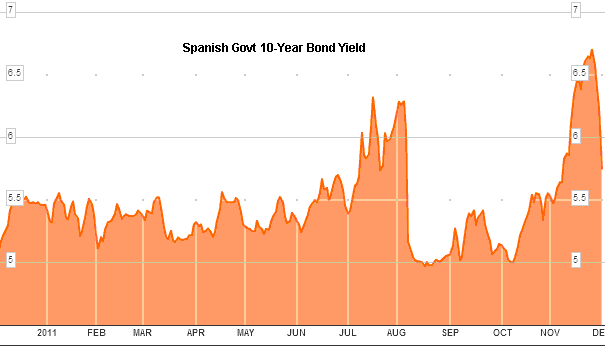
What we do know is that nothing happened last week to either improve the lots of financially-stressed eurozone governments or postpone the 'day of reckoning' by more than a few weeks. The Fed's offer to provide "liquidity" at a reduced rate certainly didn't change anything.
Aside from the likelihood of additional strength in the stock market and the negative correlation between the stock market and the Dollar Index, the best reason to expect some near-term weakness in the Dollar Index is the substantial speculative short position in euro futures. Last week, the total speculative net-short position in euro futures hit an all-time high of 138K contracts (the total speculative net short position equals the commercial net-long position). Based on their positioning in the futures market, speculators, as a group, are more bearish on the European currency today than they were in May-June of 2010 when this currency was trading 10% below its current level. This is a bullish sentiment mismatch, although it doesn't preclude a quick additional decline in reaction to a worsening of the debt crisis. What it means is that the euro could just as easily move up by 5% as decline by 5% and that the euro's risk/reward has improved to the point where it no longer makes sense to maintain short-term bets against it.
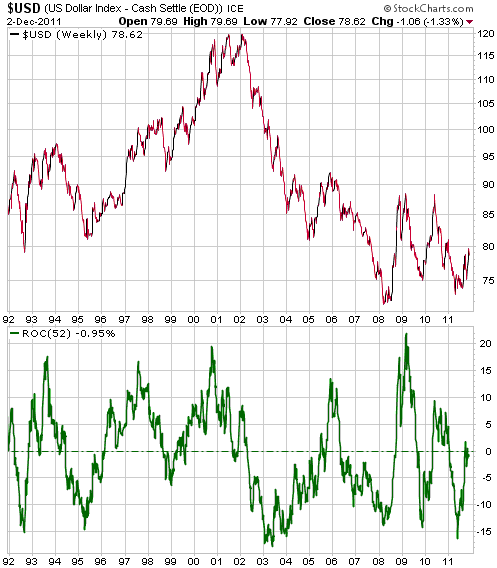
On a longer-term basis the euro's risk/reward continues to be skewed toward risk due to the strong potential for a more concerted flight to safety -- driven by a global equity bear market and a worsening of the eurozone's debt predicament -- within the next 12 months. Also worthy of consideration is that when the US$ commences an intermediate-term rally the rally almost never ends until after the Dollar Index's 52-week Rate of Change (ROC) rises to at least 10%. As illustrated below, the Dollar Index rally that began earlier this year has, up until now, only taken the 52-week ROC to around zero.
Update
on Stock Selections
Notes: 1) To review the complete list of current TSI stock selections, logon at
http://www.speculative-investor.com/new/market_logon.asp
and then click on "Stock Selections" in the menu. When at the Stock
Selections page, click on a stock's symbol to bring-up an archive of
our comments on the stock in question. 2) The Small Stock Watch List is
located at http://www.speculative-investor.com/new/smallstockwatch.html
Chart Sources
Charts appearing in today's commentary
are courtesy of:
http://stockcharts.com/index.html
http://bigcharts.marketwatch.com/
http://www.economagic.com/
http://www.bloomberg.com/

|









