|
-- Weekly Market Update for the Week Commencing
6th January 2014
Big Picture
View
Here is a summary of our big picture
view of the markets. Note that our short-term views may differ from our
big picture view.
In nominal dollar terms, the BULL market in US Treasury Bonds
that began in the early 1980s will end by 2013. In real (gold)
terms, bonds commenced a secular BEAR market in 2001 that will continue
until 2014-2020. (Last
update: 23 January 2012)
The stock market, as represented by the S&P500 Index,
commenced
a secular BEAR market during the first quarter of 2000, where "secular
bear market" is defined as a long-term downward trend in valuations
(P/E ratios, etc.) and gold-denominated prices. This secular trend will bottom sometime between 2014 and 2020.
(Last update: 22 October 2007)
A secular BEAR market in the Dollar
began during the final quarter of 2000 and ended in July of 2008. This
secular bear market will be followed by a multi-year period of range
trading.
(Last
update: 09 February 2009)
Gold commenced a
secular bull market relative to all fiat currencies, the CRB Index,
bonds and most stock market indices during 1999-2001.
This secular trend will peak sometime between 2014 and 2020.
(Last update: 22 October 2007)
Commodities,
as represented by the Continuous Commodity Index (CCI), commenced a
secular BULL market in 2001 in nominal dollar terms. The first major
upward leg in this bull market ended during the first half of 2008, but
a long-term peak won't occur until 2014-2020. In real (gold) terms,
commodities commenced a secular BEAR market in 2001 that will continue
until 2014-2020.
(Last
update: 09 February 2009)
Copyright
Reminder
The commentaries that appear at TSI
may not be distributed, in full or in part, without our written permission.
In particular, please note that the posting of extracts from TSI commentaries
at other web sites or providing links to TSI commentaries at other web
sites (for example, at discussion boards) without our written permission
is prohibited.
We reserve the right to immediately
terminate the subscription of any TSI subscriber who distributes the TSI
commentaries without our written permission.
Outlook Summary
Market
|
Short-Term
(1-3 month)
|
Intermediate-Term
(6-12 month)
|
Long-Term
(2-5 Year)
|
|
Gold
|
Neutral
(04-Nov-13) |
Bullish
(26-Mar-12) |
Bullish
|
|
US$ (Dollar Index)
|
Bullish
(11-Dec-13) |
Neutral
(18-Sep-13) |
Neutral
(19-Sep-07) |
|
Bonds (US T-Bond)
|
Bullish
(11-Dec-13)
|
Neutral
(18-Jan-12)
|
Bearish |
|
Stock Market
(DJW)
|
Neutral
(23-Dec-13)
|
Bearish
(28-Nov-11) |
Bearish
|
|
Gold Stocks
(HUI)
|
Neutral
(04-Nov-13) |
Bullish
(23-Jun-10) |
Bullish
|
|
Oil |
Neutral
(30-Jul-12) |
Neutral
(31-Jan-11) |
Bullish
|
|
Industrial Metals
(GYX)
|
Neutral
(24-Dec-13) |
Neutral
(06-Jan-14) |
Neutral
(11-Jan-10) |
Notes:
1. In those cases where we have been able to identify the commentary in
which the most recent outlook change occurred we've put the date of the
commentary below the current outlook.
2. "Neutral", in the above table, means that we either don't have a
firm opinion or that we think risk and reward are roughly in balance with respect to the timeframe in question.
3. Long-term views are determined almost completely by fundamentals,
intermediate-term views by
fundamentals, sentiment and technicals, and short-term views by sentiment and
technicals.
Chiang Mai
When we lived in China and HK we would
almost always choose a tropical beach resort for vacations, but now that we live
at a tropical beach resort we have no desire to travel to one. For our
just-completed vacation we therefore opted for Chiang Mai, a bustling town
located in the mountains of northern Thailand.
It was an excellent choice. Kota Kinabalu, our current home town in Malaysian
Borneo, offers a great lifestyle, but the town itself is not very interesting.
It is a hotchpotch of buildings that have mostly sprung up over the past 20
years and doesn't have much character. Chiang Mai, on the other hand, is a
fascinating place to walk around. It is packed with interesting eating/drinking
places, shops, galleries, museums, markets, and Buddhist temples.
The central part of the town, which is where we stayed, is surrounded by a moat
and the remnants of a wall that obviously provided protection from invaders in
the distant past. We stayed in a renovated old terrace house that was recently
converted into a boutique hotel.
Although you would never know it to look at me, I like eating. This is one of
the reasons I like Thailand. As is the case throughout Thailand, the food in
Chiang Mai is generally top notch. Regardless of whether we ate on the street,
at a small local restaurant in the town centre, at a village in the mountains,
at a trendy cafe or at a 5-star hotel, we didn't have a meal that wasn't
enjoyable.
For anyone who likes adventure and/or being close to nature, there are many
attractions in the forests and mountains around Chiang Mai. We tried and can
recommend ziplining through the rainforest
and a one or two day experience with elephants. The elephant experience is
definitely worthwhile, especially if you can do it with one of the better
organisations such as Baan Chang or Patara. It involves accompanying an elephant
for a day or two (usually two people per elephant) and includes feeding the
animal, riding bareback through the forest (the only acceptable way to ride an
elephant, as the seats that are sometimes installed on elephants' backs at
popular tourist destinations are uncomfortable for both animal and rider), and
bathing with the elephant in a river (almost all elephants love the water).
After wading into the river the elephant that my son and I were riding slowly
began to sit down. It then decided that it wanted to speed up the process and
suddenly toppled over onto its side, causing its riders to be flung back-first
into the water. Our guide thought it was hilarious.
Elephants are one of my favourite animals. They are intelligent and despite
their immense size are usually gentle if treated well. Tigers are another
favourite, but I was not impressed with "Tiger Kingdom" in Chiang Mai. At this
place you can have a very close encounter with tigers (you can stroke them and
even lie down next to them), but I have no desire to see large, wild cats kept
in unnatural environments (small enclosures) and trained to behave in unnatural
ways for the entertainment of humans.
Chiang Mai has a lot to offer in addition to the more adventurous activities
involving forests, rivers, mountains, and large animals. For example, while my
son and I were swinging through the treetops and interacting with elephants, my
wife was taking courses in Thai cooking and traditional Thai massage. I'll
hopefully get to see some benefit from that.
As is the case with many Asian towns and cities, traffic can be problematic in
Chiang Mai. We found that the best way to get around the congested roads was via
"tuk-tuk".
These things are motorcycles that have been modified to incorporate a carriage
and roof. In effect, they are motorised rickshaws. They are popular throughout
Thailand (and many other developing nations) and are able to weave through
traffic in similar fashion to a motorbike.
One last thought about Thailand before we move along to the financial markets.
While we were in Chiang Mai we went to the cinema. After the scheduled time for
the movie to begin there was about 25 minutes of advertisements. This was
annoying, but not a big deal. A message to switch off all mobile phones then
came up on the screen. Just as I was thinking "OK, the movie is finally going to
start", everyone in the cinema suddenly stood up. Music that I assume was the
Thai national anthem then began to play and photographs of Thailand's King (Bhumibol
Adulyadej) appeared on the screen. There was a sequence of photos showing the
king from boyhood through to the present day (he is currently 86 years old)
while the people stood silently and the stirring music played. This lasted a few
minutes, following which everyone sat down and the movie began.
Outpourings of nationalism and blind devotion to a government or political
leader -- regardless of whether the leader attained power by birth/ancestry or
by military force or by winning a popularity contest -- always make us
uncomfortable. More to the point, the overt king-worship that occurred at
something as mundane as a public movie screening highlights a country risk of
which we were already aware.
The respect in Thailand for the country's present king is immense. He has
reigned for 67 years, so most Thais have never known any other monarch.
Furthermore, while Thailand is a democracy, it is not uncommon for the
democratically elected government to be evicted by the military. The most recent
military coup occurred in 2006 and another is distinctly possible within the
next few months in response to violent protests in the streets of Bangkok (note:
there was no outward evidence of political tension in Chiang Mai). But despite
the topsy-turvy political situation and the regular political intervention of
the military, overall stability is maintained by the fact that almost everyone
has great respect for the King.
The risk is that Thailand's tenuous grip on stability will break when the
current king dies. The king will most likely be succeeded by his son, but the
replacement, whoever he may be, will not command anywhere near as much respect
as Bhumibol Adulyadej.
Chiang Mai is on my list of places to go back to, ideally while the current king
is still alive.
The financial markets
while we were away
We like the way 2014 has started. If the first
two days of January set the tone for the year then our current stock selections
will generally fare very well. If not, we will deal with the situation better
than we did last year.
Apart from the pleasing rebound in gold and gold mining over the final three
trading days of last week, not much happened in the markets while we were away.
The US$ essentially went sideways against most other major currencies, the
'overbought' broad stock market became slightly more extended (the rubber band
stretched a little tighter), and the T-Bond chopped around near its low for the
year. However, there was some interesting price action in the commodity markets,
with -- as discussed below -- the oil price dropping about 6% last week and the
copper price breaking out to the upside during the week before last.
US Economic Numbers
The latest ISM (Institute of Supply
Management) numbers reveal that the US manufacturing sector continues to do
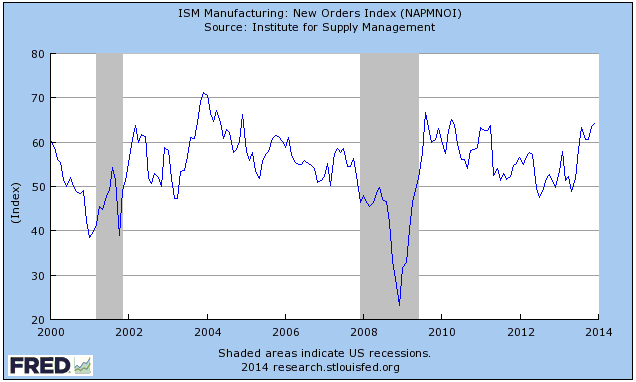
well. Of particular note is the on-going strength in the New Orders Index, which
rose to a new 3.5-year high in November (see chart below).
The good manufacturing performance is largely due to 'bubble activities'
prompted by the Fed's easy money and will therefore end with 'surprising' speed
at some point, but a reversal obviously hasn't yet occurred. Furthermore,
although the ISM report is a coincident rather than a leading indicator of
economic performance, its current message is that the start of the next US
recession is probably at least 6 months away.
Industrial Commodities
Copper Update
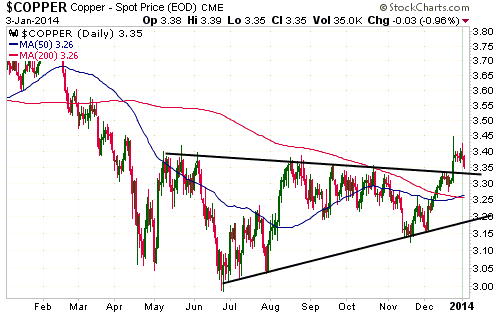
After breaking out to the downside from a short-term trading range in early
November and appearing to be on its way to test long-term support at $3.00, the
copper price abruptly reversed course during the second half of November and
broke out to the upside on 24th December. Refer to the following daily chart for
details. The upside breakout suggests a target of around $3.80.
Will December's upside breakout mean more than November's downside breakout?
There's no way of knowing, but the price action should be respected given that
the market is not 'overbought' and the obvious fundamentals are bullish (the
global copper inventory has recently plunged, the US economy and stock market
are still being levitated by monetary inflation, China's economy is
superficially stable at this time, and improved economic numbers have recently
been coming out of Europe). Our concern is that the obvious fundamentals won't
stay bullish for long.
The 24th December upside breakout automatically shifted our short-term
industrial metals outlook from "bearish" to "neutral". Due to our uncertainty as
to how long the obvious fundamentals will remain supportive and the potential
for the upward price bias to be maintained for a few more months, our
intermediate-term industrial metals outlook has also shifted from "bearish" to
"neutral".
Oil Update
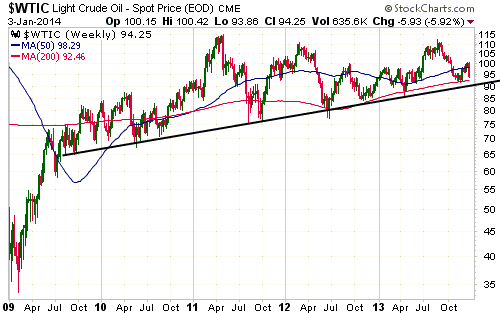
Although the oil price fell sharply last week, the decline doesn't look
threatening on the 5-year weekly chart displayed below. However, it would only
take a few dollars of additional weakness to break the oil price below long-term
support and potentially complete a major topping pattern.
Oil has been and continues to be very expensive relative to most other
industrial commodities. This fact alone suggests that there is a lot of downside
risk in the oil price, especially with new technology unleashing large
additional supplies of this commodity. The only fundamental justification for
our "bullish" long-term outlook and our "neutral" intermediate-term outlook for
this market is the potential for a major oil-supply disruption due to war in the
Middle East. If not for this potential, our long-term outlook would have shifted
to "neutral" many years ago and our intermediate-term outlook would now be
"bearish".
The Stock
Market
The US Presidential Cycle
The following chart was taken from
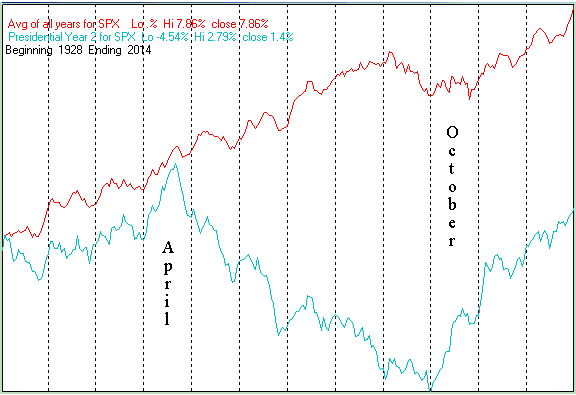
Mike Burk's free weekly report. The red line on the chart shows the average
performance of the S&P500 Index (SPX) during all years since 1928 and the blue
line on the chart shows the average performance of the SPX during the second
year of the US Presidential Cycle (2014 will be the second year of the current
cycle) over the same period.
The Presidential Cycle (PC) Model predicts that the US stock market will
maintain its upward trend into April and then embark on a 5-6 month downward
trend.
During any given year the market can deviate in a big way from its average
historical performance, and there are good reasons to be concerned about
short-term downside risk right now. We should therefore not assume that the
market will track the PC Model and maintain its upward trend for a few more
months. However, IF the market maintains its upward trend into April it will
probably mean that the PC Model is overriding other influences and that a
bearish speculation will be appropriate at that time.
Current Market Situation
The December close for the S&P500 Index (SPX) was bullish, or, at least, not
bearish, in that December turned out to be an 'up' month. Based on the
historical record, an 'up' December doesn't mean much, but a 'down' December is
a bearish omen for the year ahead.
The US stock market is clearly overbought and over-valued with sentiment at an
optimistic extreme, but at this stage the upward price trend is intact.
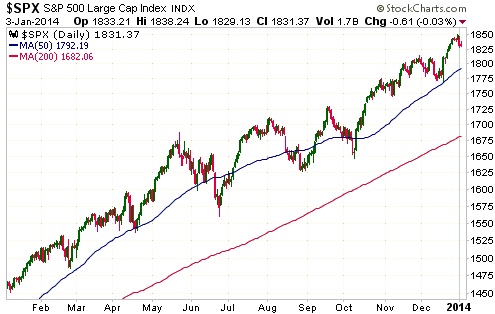
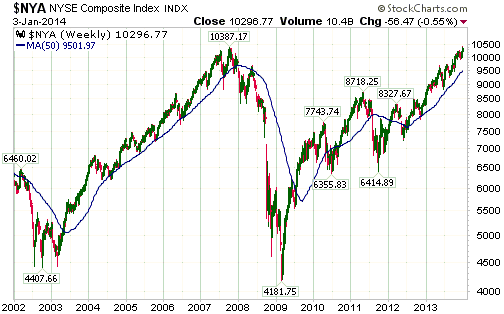
The SPX and the Dow Industrials Index broke above their respective 2007 highs
during the first half of 2013, but the NYSE Composite Index (NYA) has not yet
done the same. As illustrated by the following weekly chart, a test of the 2007
peak is currently underway.
It will be interesting to see if the NYA is able to confirm the new highs
achieved by the SPX and the Dow.
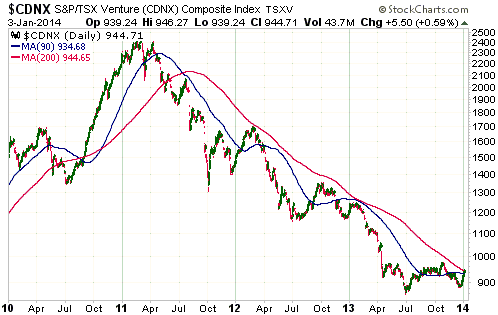
Our final stock-market chart shows the TSX Venture Exchange Composite Index (CDNX).
The CDNX is a proxy for small-cap Canadian stocks (mostly resource stocks) and
has just risen to the point where any significant additional strength will
signal an intermediate-term upward trend reversal.
Notice that every CDNX rally since mid-2011 has ended at or below the 200-day MA
(the red line on the chart) and that the CDNX ended last week right at this MA.
Additional strength from here would therefore be different from anything that
has happened over the past 2.5 years.
This week's
important US economic events
| Date |
Description |
| Monday Jan 06 |
Factory Orders
ISM Non-Manufacturing | | Tuesday
Jan 07 |
Trade Balance | | Wednesday
Jan 08 |
FOMC Minutes
Consumer Credit | | Thursday
Jan 09 |
No important events scheduled
|
| Friday Jan 10 |
Monthly Employment Report |
Gold and
the Dollar
Gold
Overview of Gold Fundamentals
The intermediate-term gold fundamentals that matter are the trend in credit
spreads, the trend in the spread between the yields on long-term and short-term
US Treasury securities (the "yield spread"), inflation expectations, the real
interest rate (the nominal interest rate minus the expected rate of currency
depreciation), the relative performance of the banking sector, and the US
dollar's performance on the foreign exchange market. Not coincidentally, most of
these fundamentals are measures of confidence in the world's most important
economy and central bank.
Gold's fundamentals turned more bullish in mid-2013 and in our opinion will
become increasingly so over the next 6 months, but right now the fundamental
backdrop for gold can best be described as mixed. The reason, in a nutshell, is
that there is still a lot of economic optimism and confidence in both the Fed
and the ECB. That's why credit spreads have been relentlessly narrowing since
June of 2012 and are now almost as narrow as they ever get.
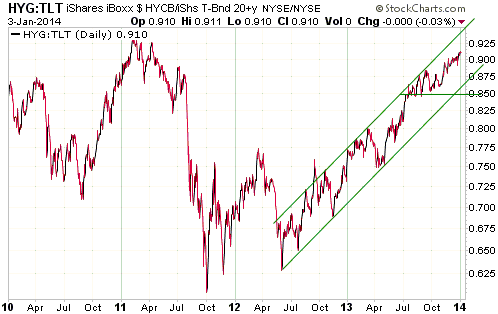
The narrowing of credit spreads is indicated on the first of the following
charts by the upward trend in the HYG/TLT ratio (high-yield bonds relative to
Treasury bonds), because HYG outperforms TLT when investors become less risk
averse and bid-up high-yield (junk) bonds relative to US government bonds. The
HYG/TLT ratio probably can't go much higher, but it needs to start trending
lower to become 'gold bullish'. A break below 0.85 would confirm a downward
trend reversal.
Another sign that confidence remains high is the performance of the "Expected
CPI", a measure of inflation expectations. The version of the Expected CPI shown
on the following chart was calculated by subtracting the yield on the 10-year
inflation-indexed Treasury note from the yield on the standard 10-year Treasury
note.
As shown below, the Expected CPI dropped sharply during the first half of 2013
and has since stabilised just below the mid-point of its 4-year range.
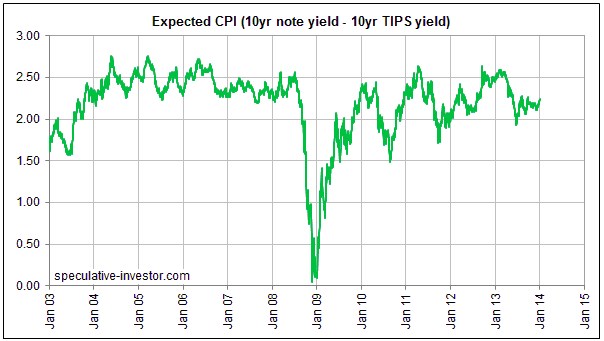
We suspect that inflation expectations, as indicated by the Expected CPI, will
not move decisively in gold's favour until at least 2015. Note, though, that the
entire rally in gold from $250/oz in 2001 to $1900/oz in 2011 happened in the
absence of a large rise in inflation expectations. In other words, a large rise
in inflation expectations is not a prerequisite for a major gold rally.
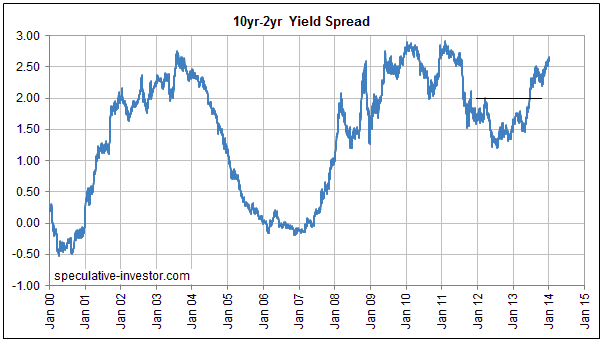
One important fundamental that has already moved decisively in gold's favour is
the 10year-2year yield-spread, depicted below. This factor became 'gold bullish'
when it broke out to the upside in June of 2013.
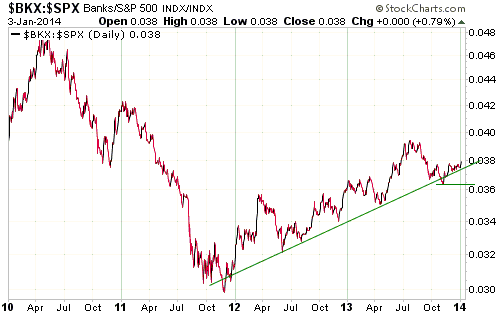
The relative performance of the banking sector, illustrated on the following
chart by the BKX/SPX ratio, also started to move in gold's favour in June-July
of 2013, although the movement can't yet be called decisive. To become decisive
the BKX/SPX ratio will have to break below its Q4-2013 low.
Note that the performance of the BKX/SPX ratio has been the dominant gold
fundamental over the past 4 years. It hasn't always been this way and it won't
necessarily be this way in the future, although we expect that the banking
sector's relative strength will continue to be among the most important drivers
of gold's intermediate-term trend over the next 12 months.
The most notable omission from our list of important gold fundamentals is the
increase in China's gold demand. Assertions that increasing demand for gold
within China is a major plus for the gold price are based on flawed
supply-demand analysis. In general, such analysis compares the flow of gold into
China with the amount of gold produced each year by the gold-mining industry, as
if the amount of gold produced by the mining industry represented the total
supply rather than just a small addition to the total supply. The reality is
that changes in the global investment demand for gold that are influenced by the
factors mentioned above are vastly more important at this time than changes in
the flow of gold into China.
Current Market Situation
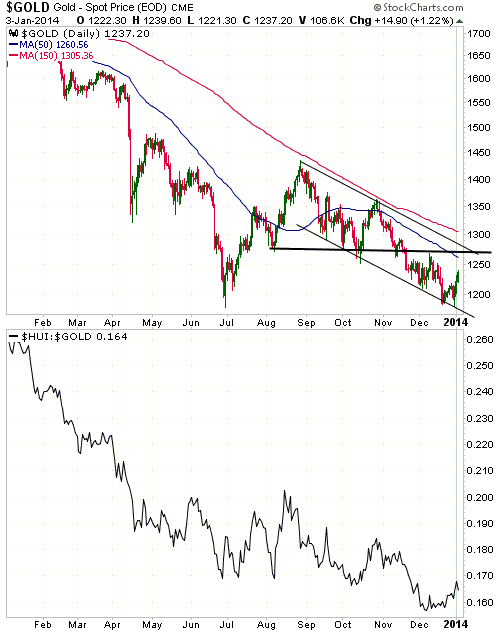
Gold tested its June-2013 low ($1179) on 31st December and then quickly
rebounded to the $1230s. Furthermore, the following daily chart shows that there
has been a bullish divergence between the gold price and the HUI/gold ratio
since early December, in that the HUI/gold ratio began to edge upward while the
gold price continued to make new multi-month lows. This constitutes evidence
that a sustainable 'double bottom' is now in place, but a daily close above
resistance at $1275 is still needed to confirm a tend reversal.
As previously advised, our short-term gold outlook will shift to "bullish" if
the gold price closes above $1275 or if our short-term gold-stock outlook shifts
to "bullish" (as discussed below).
Gold Stocks
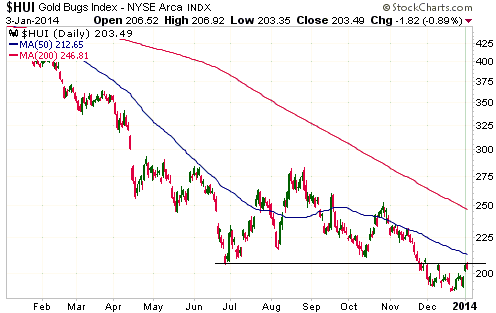
Last week's price action underlined the significance of HUI resistance at 207.
This is because the HUI's rebound peaked at 206.9 last Friday.
As previously advised, our short-term gold-stock outlook will shift to "bullish"
if the HUI achieves a daily close above 207.
The gold-stock indices have generally trended counter to the senior US stock
indices over the past 2.5 years. This means that the gold-stock indices could
benefit from general stock-market weakness like they did during 1973-1974 and
2001-2002, but it doesn't mean that a cyclical bear market in general equities
is a prerequisite for the next cyclical bull market in gold-mining equities. A
lot will depend on the currency market and the relative strength of the banking
sector. For example, the gold-mining sector would likely perform extremely well
if continuing strength in the broad stock market were accompanied by weakness in
the Dollar Index and weakness in the BKX/SPX ratio.
Currency Market Update
The Dollar Index confirmed its recent upside breakout last week. This doesn't
suggest that a major US$ rally has begun, as the breakout doesn't even register
on long-term charts, but as noted in our 23rd December commentary it does
suggest a short-term target of around 83.
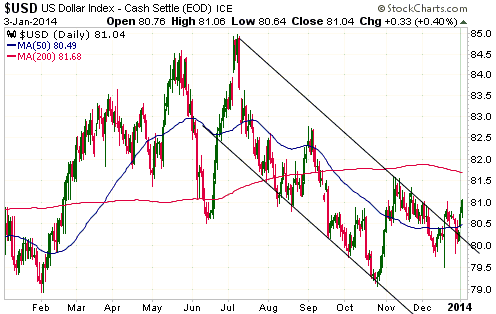
Interestingly, the Dollar Index is breaking out to the upside at the same time
as early signs are appearing of an upward reversal in the gold market. A
strengthening US dollar on the foreign exchange market is usually a head-wind
for the gold market, but the US dollar's exchange rate is just one of several
drivers of the gold price (see discussion above). That's why some of the best
gold rallies of the past 40 years were able to occur in parallel with a stable
or strengthening Dollar Index.
Update
on Stock Selections
Notes: 1) To review the complete list of current TSI stock selections, logon at
http://www.speculative-investor.com/new/market_logon.asp
and then click on "Stock Selections" in the menu. When at the Stock
Selections page, click on a stock's symbol to bring-up an archive of
our comments on the stock in question. 2) The Small Stock Watch List is
located at http://www.speculative-investor.com/new/smallstockwatch.html
 Company
news/developments for the week ended Friday 3rd January 2014: Company
news/developments for the week ended Friday 3rd January 2014:
[Note: AISC = All-In Sustaining Cost, FS = Feasibility Study, IRR =
Internal Rate of Return, MD&A = Management Discussion and Analysis,
M&I = Measured and Indicated, NAV = Net Asset Value, NPV(X%) = Net
Present Value using a discount rate of X%, P&P = Proven and
Probable, PEA = Preliminary Economic Assessment, PFS =
Pre-Feasibility Study]
*Dragon Mining (DRA.AX) advised that a shareholders' meeting has
been scheduled for 7th February to consider the request of Eurogold,
DRA's largest shareholder, to remove three existing directors
(including the chairman and the managing director) and appoint two
new directors. If these changes are made, Eurogold will gain control
of the Board.
Although we aren't happy with DRA's performance, based on what we
know right now we would vote against these proposed changes to the
board of directors. The main reason is that Eurogold's intentions
are unclear. Eurogold has not, at this time, outlined its strategy.
Emerging
evidence of price bottoms
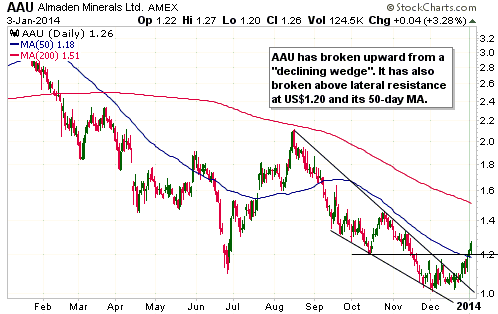
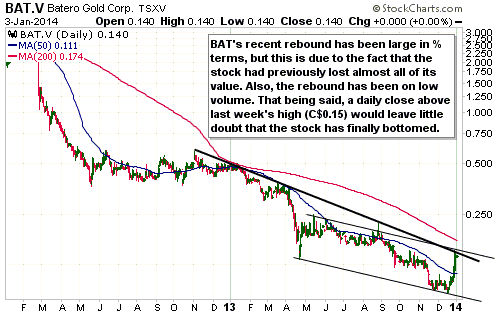
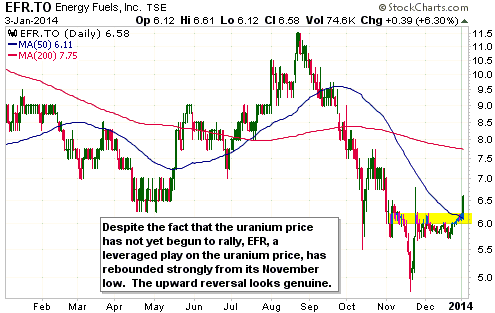
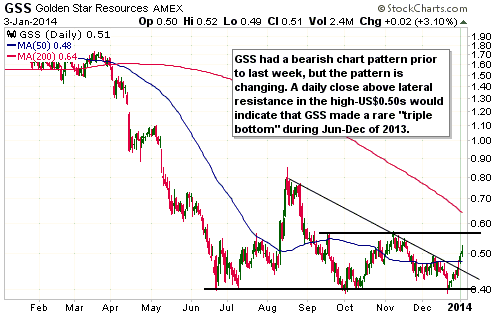
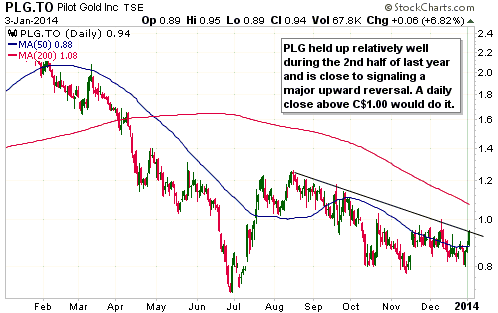
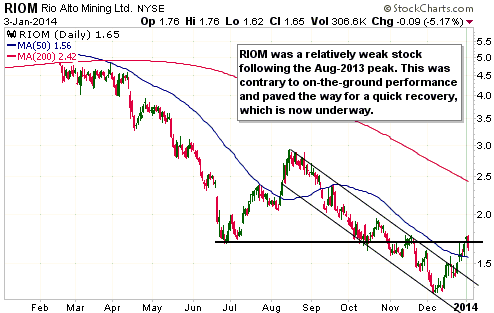
Below are daily charts of the TSI stock selections that provided evidence of a
price bottom over the past two weeks. Refer to the comments on the charts. Note
that Pretium Resources (PVG) provided evidence of a price bottom -- in reaction
to company-specific factors -- a month earlier and is therefore not included is
this list of charts.
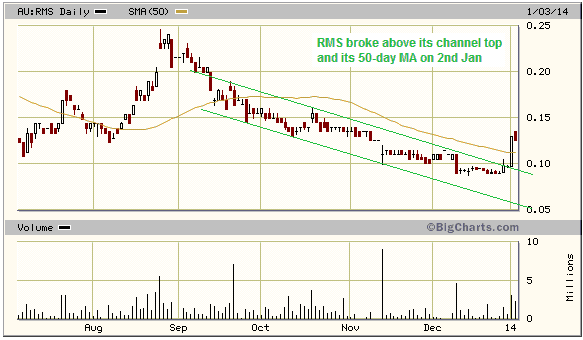
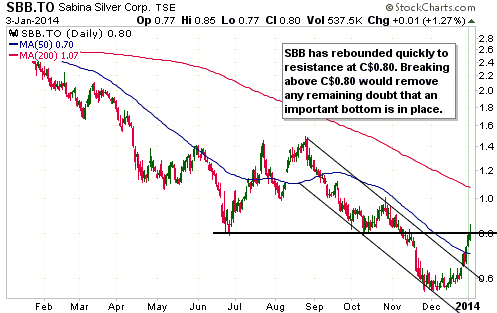
List
of candidates for new buying
From within the ranks of TSI stock selections, below is a list of the best
candidates for new buying at this time.
1) AKG (last Friday's closing price: US$1.67). Assuming that the merger with PMI
Gold happens as presently proposed, buyers of AKG shares near the current price
are effectively getting two ready-for-construction 200K-oz/yr Ghana-based gold
projects for nothing.
2) EDV.TO/EVR.AX (last Friday's closing price: C$0.54).
3) PG.TO (last Friday's closing price: C$1.56)
4) PLG.TO (last Friday's closing price: C$0.94), ideally near the 50-day MA in
the high C$0.80s.
5) RIO.TO/RIOM (last Friday's closing price: C$1.75/US$1.65) following a
pullback to the vicinity of the 50-day MA (about $0.10 below the current price).
Chart Sources
Charts appearing in today's commentary
are courtesy of:
http://stockcharts.com/index.html
http://bigcharts.marketwatch.com/

|









