|
-- Weekly Market Update for the Week Commencing
6th May 2013
Big Picture
View
Here is a summary of our big picture
view of the markets. Note that our short-term views may differ from our
big picture view.
In nominal dollar terms, the BULL market in US Treasury Bonds
that began in the early 1980s will end by 2013. In real (gold)
terms, bonds commenced a secular BEAR market in 2001 that will continue
until 2014-2020. (Last
update: 23 January 2012)
The stock market, as represented by the S&P500 Index,
commenced
a secular BEAR market during the first quarter of 2000, where "secular
bear market" is defined as a long-term downward trend in valuations
(P/E ratios, etc.) and gold-denominated prices. This secular trend will bottom sometime between 2014 and 2020.
(Last update: 22 October 2007)
A secular BEAR market in the Dollar
began during the final quarter of 2000 and ended in July of 2008. This
secular bear market will be followed by a multi-year period of range
trading.
(Last
update: 09 February 2009)
Gold commenced a
secular bull market relative to all fiat currencies, the CRB Index,
bonds and most stock market indices during 1999-2001.
This secular trend will peak sometime between 2014 and 2020.
(Last update: 22 October 2007)
Commodities,
as represented by the Continuous Commodity Index (CCI), commenced a
secular BULL market in 2001 in nominal dollar terms. The first major
upward leg in this bull market ended during the first half of 2008, but
a long-term peak won't occur until 2014-2020. In real (gold) terms,
commodities commenced a secular BEAR market in 2001 that will continue
until 2014-2020.
(Last
update: 09 February 2009)
Copyright
Reminder
The commentaries that appear at TSI
may not be distributed, in full or in part, without our written permission.
In particular, please note that the posting of extracts from TSI commentaries
at other web sites or providing links to TSI commentaries at other web
sites (for example, at discussion boards) without our written permission
is prohibited.
We reserve the right to immediately
terminate the subscription of any TSI subscriber who distributes the TSI
commentaries without our written permission.
Outlook Summary
Market
|
Short-Term
(1-3 month)
|
Intermediate-Term
(6-12 month)
|
Long-Term
(2-5 Year)
|
|
Gold
|
Bullish
(17-Oct-12)
|
Bullish
(26-Mar-12)
|
Bullish
|
|
US$ (Dollar Index)
|
Neutral
(24-Dec-12)
|
Bullish
(01-May-13)
|
Neutral
(19-Sep-07)
|
|
Bonds (US T-Bond)
|
Neutral
(12-Nov-12)
|
Neutral
(18-Jan-12)
|
Bearish |
|
Stock Market
(DJW)
|
Neutral
(06-May-13)
|
Bearish
(28-Nov-11)
|
Bearish
|
|
Gold Stocks
(HUI)
|
Bullish
(24-Dec-12)
|
Bullish
(23-Jun-10)
|
Bullish
|
|
Oil |
Neutral
(30-Jul-12)
|
Neutral
(31-Jan-11)
|
Bullish
|
|
Industrial Metals
(GYX)
|
Neutral
(30-Jul-12)
|
Neutral
(29-Aug-11)
|
Neutral
(11-Jan-10)
|
Notes:
1. In those cases where we have been able to identify the commentary in
which the most recent outlook change occurred we've put the date of the
commentary below the current outlook.
2. "Neutral", in the above table, means that we either don't have a
firm opinion or that we think risk and reward are roughly in balance with respect to the timeframe in question.
3. Long-term views are determined almost completely by fundamentals,
intermediate-term views by
fundamentals, sentiment and technicals, and short-term views by sentiment and
technicals.
When zero is not low
enough
The European Central Bank (ECB) cut its main
Refinancing Rate, which is the rate at which euro-zone (EZ) banks can borrow
overnight money from the ECB, from 0.75% to 0.50% last Thursday. This move was
widely expected and didn't provoke much reaction in the currency market.
However, Mario Draghi, the ECB President, then announced at a press conference
that Europe's central bank was open to making a future cut in its Deposit Rate,
which is the rate that commercial banks receive when they park money at the
central bank. Since the Deposit Rate is presently zero, this means that the ECB
is prepared, if conditions are deemed to warrant it, to set a NEGATIVE nominal
interest rate. This provoked more of a reaction from the currency market,
although the reaction was still small considering the implication. The
implication is that if economic conditions don't show a marked improvement --
and how could they possibly show a marked improvement with central banks and
governments implementing one stupid market-distorting policy after another --
then charges will start being levied on 'excess' cash. It looks like another
shot has just been fired in the war on saving.
Perhaps someone should point out to Draghi that if economic weakness persists
after years of near-zero interest rates, then a too-high interest rate is not a
constraint on the economy. On second thoughts, that would be a waste of time.
You don't go into central-banking unless you have total belief in, or are at
least prepared to pay unswerving lip service to, the proposition that the
economy can be strengthened via the artificial lowering of interest rates.
The reality is that interest rates could never be too high or too low if they
were set by the market; they would always be at the level that balanced the
demand for loanable funds with the supply of loanable funds. We have never been
able to figure out why this isn't obvious to everyone with at least a modicum of
economics knowledge. Most people with such knowledge know why it wouldn't make
sense to have a committee set the price of eggs, and yet they seem incapable of
seeing that it doesn't make sense to have a committee set the price of credit.
The optimum price of eggs is the price that balances supply and demand, which is
the price that eggs would trade at in the absence of a price-setting body. By
the same token, the optimum price of credit is the price that would exist in the
absence of a central bank or other credit-price-fixing body. This isn't rocket
science.
It is also the case that setting interest rates lower than they would be in a
free market is at best a zero-sum game, even if we ignore all the bad knock-on
effects -- chiefly, the artificial booms and the resultant busts -- of
interfering with interest rates. It is simply a forced transfer of wealth from
savers and non-bank lenders to borrowers and banks. Someone's gain from a lower
interest rate will always be someone else's loss.
The second-last sentence of the preceding paragraph is a clue as to why interest
rates are often kept too low for too long. The central bank exists to support
the government and the private banks, and the government is usually the
economy's biggest borrower.
Economic Numbers Update
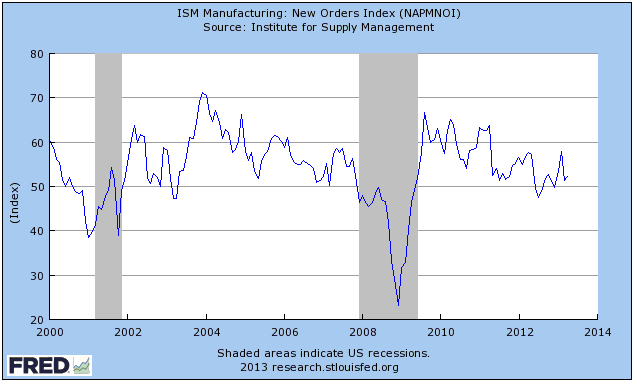
We consider the monthly ISM data to be the most
useful of the regular US economic data. This is what we wrote in early April
about the ISM data for March:
"In terms of providing information about what's currently happening and
what's likely to happen, the most useful component of the ISM data is the New
Orders Index. After rebounding to its highest level since H1-2011 during the
first two months of this year, the New Orders Index fell sharply in March to
just above its low of the past three years. However, the following chart shows
that the overall pattern has not changed. The New Orders Index has had a
downward bias since early-2010, but it is still -- marginally -- in expansion
territory (>50).
A solid break below last year's low would signal that a recession had begun."
The following updated version of the same chart shows that nothing has changed
in mean time. The New Orders Index edged sideways in April and is still in
'expansion territory' by a slim margin.
With regard to the US economic numbers, the bottom line is that four years into
an economic expansion and an equity bull market the economy continues to be
sluggish despite massive monetary accommodation (actually, largely because of
massive monetary accommodation, because the relentless monetary stimulus slows
or prevents the liquidation of mal-investments). However, while at times over
the past year the US economy's performance has been indistinguishable from what
would be seen in a recession, it is clear that an 'official' recession has been
avoided and is still being avoided. This puts the first blemish on the ECRI's
recession-calling record.
The Stock
Market
The headline last Friday was "Stocks rally
on strong US jobs number". The US jobs number wasn't particularly strong, but
that's beside the point. If the jobs number had been weaker than expected, the
headline would have been "Stocks rally as weak jobs number suggests more Fed
stimulus". If stocks had fallen following Friday's 'strong' jobs number then the
headline would have been "Stock market slides as improving employment reduces
need for additional stimulus", and if a weak jobs number had been followed by a
stock market decline then the headline would have been "Stocks fall as
employment data indicate slowing economy".
The point is that any economic number can be used by the financial press to
justify any change in the stock market. Most of the economic numbers actually
don't matter, but information regarding the stock market's trend can often be
gleaned by the market's reaction to data. Regardless of whether the data are
weak or strong, if the stock market's trend is up then most data will be an
excuse for stock prices to rise, and if the stock market's trend is down then
most data will be an excuse for stock prices to fall.
The reaction to the latest US employment data therefore tells us that as of
Friday 3rd May, the direction of the US stock market's short-term trend was
still up. If we were short-term trend followers we would therefore have to be
bullish. However, on both a short-term basis and an intermediate-term basis we
view the markets more as pendulums than as trending mechanisms.
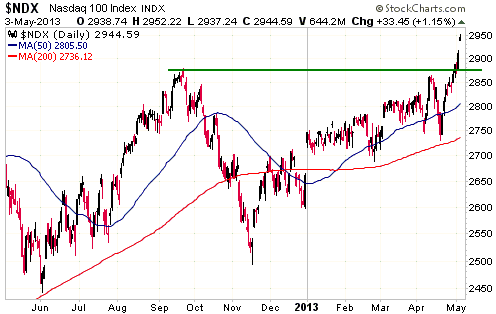
That being said, last week's price action eliminated a potentially-important
bearish divergence and much of the support for a short-term bearish stance.
The divergence to which we are referring is the failure, prior to last Thursday,
of the NASDAQ100 Index (NDX) to confirm the breaks above last year's highs by
the Dow Industrials Index and the S&P500 Index. This divergence was thought to
be bearish due to the NDX's tendency to lead the other senior US stock indices
at intermediate-term turning points.
The following chart shows that the NDX has just broken decisively above
resistance defined by last year's high, thus removing the aforementioned
divergence. It is very 'overbought' on a short-term basis, but former strong
resistance at 2850-2870 should now provide support and limit the downside during
the next pullback.
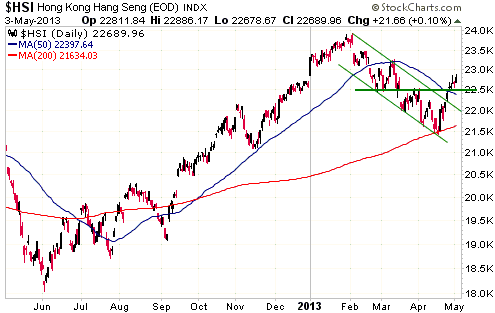
We don't consider the US stock market to be representative of stocks on a global
basis, but the recent price action in other parts of the world also removes
support for the short-term bearish case. For one example, Hong Kong's Hang Seng
Index (HSI) didn't quite fall far enough during its February-April correction to
signal the beginning of an intermediate-term decline and has since broken above
short-term resistance.
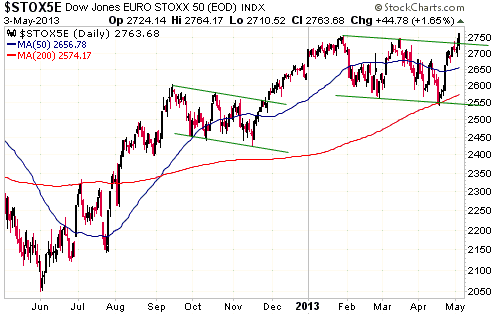
For another example, the EURO STOXX 50 (STOX5E), Europe's equivalent of the Dow
Jones Industrials Index, did enough last week to suggest that its downward bias
during February-April was a consolidation within an upward trend rather than the
start of a new downward trend.
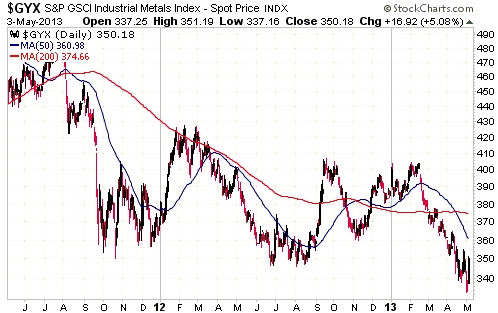
Lastly, after ending last Thursday's trading session at a new multi-year low,
the Industrial Metals Index (GYX) had its best day of the year on Friday. This
could turn out to be just a short-lived reaction to an extremely 'oversold'
condition, but it also opens up the possibility that the preceding break below
major support was false. If the latter possibility is confirmed by subsequent
price action then a rebound in beaten-down mining-related stocks could lend
support to the broad market while some of the 'overbought' sectors pull back.
Further to the above, the upside potential of the senior US stock indices is
limited by the extent to which they are 'overbought', but it looks like
substantial stock market weakness is not going to be seen over the next few
months. Our short-term stock market outlook has therefore shifted from "bearish"
to "neutral".
It would be reasonable for traders to take positions in some of the 'oversold'
mining-related ETFs, such as KOL and XME, placing initial stops slightly below
the lows of the past month. The gold-mining stocks are in a separate category,
but are also poised to rebound from an 'oversold' extreme of historic
proportions.
This week's
important US economic events
| Date |
Description |
| Monday May 06 |
No important events scheduled | | Tuesday
May 07 |
Consumer Credit | | Wednesday
May 08 |
No important events scheduled | | Thursday
May 09 |
No important events scheduled
|
| Friday May 10 |
Treasury Budget |
Gold and
the Dollar
Gold
Based on responses to our recent gold-market commentary, it seems that some
clarification is required on our part.
We fully understand that the gold price can be driven by the futures or other
"paper" markets. In fact, we noted in a TSI commentary that aggressive selling
of GLD shares appears to have been one of the drivers of the recent price
decline. Our question, therefore, isn't related to how a price decline could be
driven by the "paper" markets.
We take issue with the widely-made claim that there was a large increase in the
total demand for physical gold relative to the total supply of physical gold
while the price was plunging last month. Our specific question is: How is this
possible, since demand for physical gold cannot be satisfied by "paper gold"? If
someone can explain to us how physical demand can be satisfied by paper supply,
the follow-on question is: Why didn't the supposed disconnect between the paper
and physical markets reveal itself in meaningful gold-market backwardation?
Our interpretation of the evidence is that in both the paper and the liquid
physical (as opposed to the thinly-traded retail physical) markets, metal supply
temporarily overwhelmed metal demand. The substantially lower price resulting
from this temporary supply-demand imbalance prompted bargain hunters to buy and
short-sellers to cover, causing the opposite type of temporary imbalance: demand
temporarily exceeded supply in both the paper and the liquid physical markets.
The price then quickly rebounded to the point where an approximate balance was
achieved.
In our opinion, many people involved in the gold and silver markets spend much
of their time focusing on irrelevancies. They concentrate on daily or even
minute-by-minute price fluctuations and on trivial fundamentals (meaning:
fundamentals that have no bearing on whether or not gold's bull market is
intact) such as the COMEX gold inventory, mine supply, gold imports into Hong
Kong and the weather in India.
Last week we saw two good examples of fundamentals that really do matter;
fundamentals that all but guarantee the continuation of gold's bull market. We
are referring to confirmation from the Fed that it stands ready to INCREASE
monetary accommodation if the economy fails to show significant real strength
(the current monetary accommodation pretty much ensures that the economy will
fail to show significant real strength) and an admission from the head of the
ECB that a NEGATIVE nominal interest rate is under consideration in the
euro-zone. In a nutshell, last week we got more evidence that the world's senior
central banks remain hell-bent on destroying the official money. This is the
sort of information that gold investors should be focused on. By the same token,
if reliable evidence happened to emerge that "QE" and all other
counter-productive monetary policies were being abandoned it would be time to
turn long-term bearish on gold, regardless of what was happening at the time
with all the minutiae upon which many gold-market participants and commentators
fixate.
By the way, as long as gold's bull market is intact the reasons for being
bullish won't matter. As long as he is bullish an investor will be positioned
correctly and will look right, even if his reasoning is completely wrong. It's
only after a bull market ends that the reasons for being bullish become
critical. Someone who is bullish for the wrong reasons will likely ride the
market all the way up and then all the way back down.
Another point worth making is that free financial markets, which don't exist
today, would be just as confusing as today's government-manipulated ones. A
major financial market involves thousands or perhaps even millions of individual
buy/sell decisions every day, with each decision based on personal
considerations and guesses about the future. Even without government
intervention, a major financial market will often do things that you don't
understand. Furthermore, manipulation or no manipulation, every financial market
will usually be either over-valued or under-valued. In other words, 'free
market' doesn't mean 'easily understood market' or 'perfectly logical market'.
It is also worth mentioning that in a truly free financial market there would be
plenty of attempts to manipulate prices, some of which would be successful in
the short-term; there just wouldn't be manipulation by the government. On a
related matter, most people are conditioned to believe that the "nanny state"
should be involved in the markets to ensure a 'level playing field', which is
why anti-manipulation campaigners often go down the absurd path of working with
government agencies (working with government in an effort to make the markets
freer is like working with a gang of foxes to make the henhouse more secure).
The one area in which the playing field should be level is the law, and the
law's only legitimate purpose is to make sure that property rights are respected
and promises are kept. Outside the requirement for there to be equality under
the law, the only way that a level playing field could ever be achieved is by
bringing everyone down to the lowest level. This is the last thing that any
decent person should want.
With our rant out of the way, let's take a look at the current market situation.
Just for a change we'll include a chart of GLD, the main gold bullion ETF,
rather than the US$ gold price. Each GLD share represents slightly less than
one-tenth of an ounce of gold, which is why the price of a GLD share is slightly
less than one-tenth the spot price of gold.
The following chart shows that GLD plunged from about $144 to $131 on 15th April
and that by 26th April it had recouped this loss. It has since traded sideways
within a narrow range.
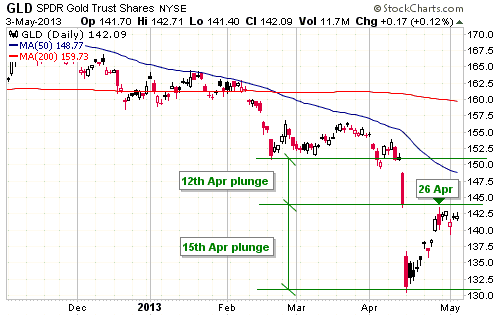
Gold's historical performance record suggests that the 15th April low will be
tested, but traders were quick to buy dips in the gold market last week and gold
showed resilience on Friday after a stronger-than-expected US employment report
generated a burst of enthusiasm for anything linked to the growth theme (gold is
linked to the counter-cyclical safe-haven theme). This casts doubt on whether
the April low will be tested in the near future. After all, if bearish gold
traders weren't able to capitalise on Friday's new stock-market high and the
general enthusiasm that went with it, then upward could be the near-term
direction of least resistance for the gold price.
It still makes sense to be financially and emotionally prepared for gold to drop
back to the mid-$1300s in a test of its recent low, but last week's price action
reduces the probability that the test of the low will happen in the near future.
Before leaving gold's current market situation it is appropriate for us to
devote some words to the Commitments of Traders (COT) numbers, which continue to
react counter-intuitively to changes in the gold price.
In the short-term, the speculative net-long position in COMEX gold futures
normally rises and falls with the gold price. It was therefore very surprising
that gold's largest 5-day price decline in more than three decades (from the 9th
through to the 16th of April) coincided with almost no change in the speculative
net-long position. A $47 rebound in the gold price from the 16th through to the
23rd of April, which would normally be accompanied by an increase in the
speculative net-long position, was then accompanied by a huge decrease in the
speculative net-long position. The behaviour of the COT data during each of
these two weeks was downright strange, but the net result was that over the
two-week period ended 23rd April the change in the speculative net-long position
was roughly what we would have expected given the change in price.
The counter-intuitive behaviour of the COT data continued into last week. During
the one-week period ended 30th April (the date of the latest COT report), the
gold price rose $62. A price gain of this magnitude would normally be associated
with a sizeable increase in the speculative net-long position, but the
speculative net-long position fell over the course of the week.
One possible explanation is that trend-following speculators are assuming that
gold's current rebound will not get much further and that a test of the April
low is coming up. A near-term test of the April low would be typical price
action, but it is less likely to happen if a lot of speculators are anticipating
it. In fact, a reasonable argument could be made that the current reluctance of
speculators to collectively respond in the normal way to the rising price
greatly improves gold's near-term risk/reward.
Gold Stocks
The HUI has short-term support at around 270 and short-term resistance at
290-300.
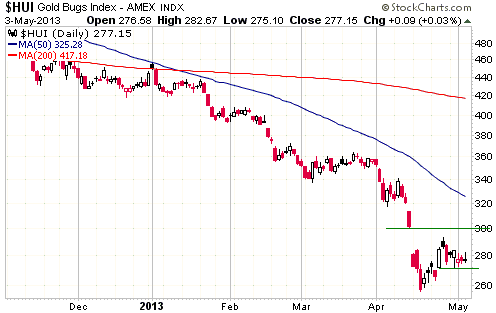
From a longer-term perspective it would be most bullish if the HUI were to spike
to a new low within the next couple of weeks, thus adding to its long line of
intermediate-term May turning points. However, gold's recent resilience in the
face of stock market exuberance could mean that this time around an
intermediate-term HUI reversal occurred in April.
A daily close above 300 would be evidence that an intermediate-term bottom is in
place, while a close below 270 would warn that a decline to new lows was in
progress.
A question we occasionally get is: Which is the better ETF for exposure to
junior gold mining stocks, GDXJ or GLDX?
The answer is: It depends on whether you want exposure to junior producers or
junior explorers.
Most of GDXJ's holdings are
producers, whereas all of GLDX's
holdings are exploration/development-stage miners. In a market environment
characterised by a shift away from the riskiest stocks, the producers will, on
average, do better than the explorers. That's why the following chart shows a
relentless decline in the GLDX/GDXJ ratio over the past two years. However, a
production-stage gold mining company isn't necessarily riskier than an
exploration-stage gold mining company. Relative risk depends on production cost,
balance sheet and project location. For example, an exploration-stage junior
with a strong balance sheet is probably less risky than a production-stage
junior with high costs and a weak balance sheet.
Another consideration is what the market has already discounted. For example,
the fact that the stock market has spent the past two years discounting the
higher risk of exploration-stage juniors could mean that the shift away from the
relatively risky stocks is now overdone.
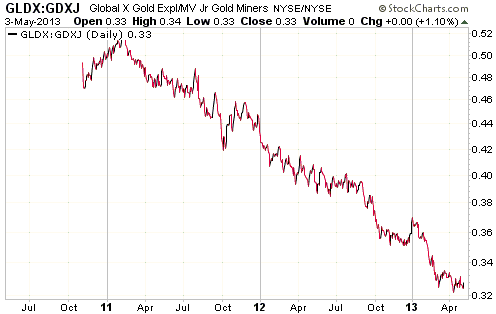
At current prices we don't have a strong preference for GDXJ or GLDX. They could
both trade at new lows within the next couple weeks, but they are both likely to
trade at much higher levels at some point over the next three months.
Currency Market Update
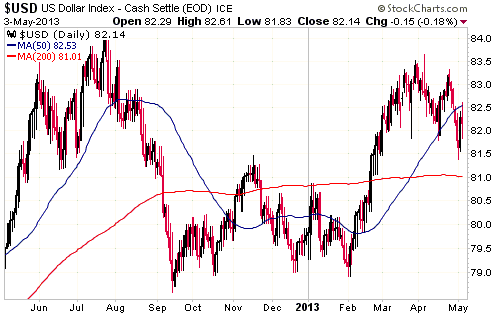
The Dollar Index rallied last Thursday after Mario Draghi mentioned the
possibility that one of the euro-zone's official interest rates could be pushed
into negative territory. It then gained a little more ground in the immediate
aftermath of the US employment news on Friday before reversing course and ending
the day with a small loss.
The type of news that emerged late last week isn't likely to be the catalyst for
a large and sustained rise in the Dollar Index. The reason is that the US$ is
essentially a safe-haven currency and as such will tend to do best during
periods of rising fear and falling economic confidence. In other words, the next
multi-month rally in the Dollar Index will probably happen in parallel with
blatantly negative US economic data and/or the emergence of major financial
problems.
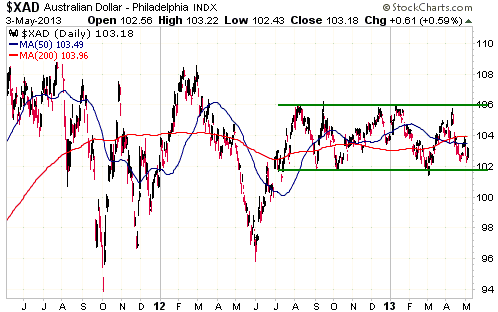
The Australian Dollar (A$) has now spent almost 12 months oscillating within a
4-point horizontal range. A break-out from the range would imply four points of
additional movement in the direction of the break, but there are currently no
clues in sentiment indicators or inter-market relationships as to which
direction this is most likely to be.
Update
on Stock Selections
Notes: 1) To review the complete list of current TSI stock selections, logon at
http://www.speculative-investor.com/new/market_logon.asp
and then click on "Stock Selections" in the menu. When at the Stock
Selections page, click on a stock's symbol to bring-up an archive of
our comments on the stock in question. 2) The Small Stock Watch List is
located at http://www.speculative-investor.com/new/smallstockwatch.html
 Company
news/developments for the week ended Friday 3rd May 2013: Company
news/developments for the week ended Friday 3rd May 2013:
[Note: FS = Feasibility Study, IRR = Internal Rate of Return, MD&A =
Management Discussion and Analysis, M&I = Measured and Indicated,
NAV = Net Asset Value, NPV(X%) = Net Present Value using a discount
rate of X%, P&P = Proven and Probable, PEA = Preliminary Economic
Assessment, PFS = Pre-Feasibility Study]
*Asanko Gold (AKG) announced that Patrick Kpekpena, a Ghanaian
national, has been appointed as General Manager of Operations at
AKG's flagship Esaase Gold Project in Ghana. Mr. Kpekpena was most
recently Mine Manager and relief General Manager for Endeavour
Mining's Nzema Gold Project in Ghana through its start-up,
commissioning and into operations. The Nzema mine has been operating
well, so AKG appears to have recruited a capable person to manage
the development of Esaase.
The results of the Esaase PFS were due to be published early in
Q2-2013, which means that the PFS results are now overdue. We
eagerly await the PFS so that we can update our AKG valuation.
AKG has about $2.30/share of cash, so at Friday's closing price of
$2.53 the market's valuation of the company is very low.
Unrealistically low, in our opinion, but the proof will be in the
PFS.
*Dragon Mining (DRA.AX) issued its Quarterly Activities report for
the March-2013 quarter.
Quarterly production from the company's mines in Sweden and Finland
totaled 14.4K ounces at a "cash cost" of US$1,045/oz. This was the
highest production of the most recent four quarters and a
significant improvement over the December-2012 quarterly result
(13.7K ounces at a cash cost of $1,219/oz). However, costs were
still too high to enable the company to be cash-flow positive.
A cash cost of $1,045/oz probably results in an "all-in cost" of
around $1,400/oz, making DRA a roughly break-even producer at the
current gold price. Unfortunately, there doesn't seem to be scope
for the company to reduce its operating expenses by enough to become
consistently profitable in the absence of a multi-hundred-dollar
increase in the gold price. Furthermore, from the limited financial
information provided in the quarterly report we estimate that DRA's
working capital is now down to around $7M. This means that DRA has
very little margin for error. If its costs remain near the current
level or lower and the gold price averages more than $1450/oz then
DRA should be fine, but it is in a position where sustained gold
price weakness or minor production problems could quickly lead to a
cash shortage.
DRA is similar to Ramelius (RMS.AX), in that both companies are
small gold producers operating in politically-secure jurisdictions
that are struggling to get their costs down to a level that results
in the consistent addition of cash to the balance sheet. The stocks
of both companies have fallen a long way from last year's highs and
both now have very low valuations. An important difference is that
RMS appears to have enough cash to weather difficult conditions for
at least another 12 months. If we were looking to increase our
exposure to highly-leveraged gold production we would therefore
choose RMS shares ahead of DRA shares.
*Endeavour Mining (EDV.TO, EVR.AX) announced that it sold its stake
in Namibia Rare Earths (NRE.TO), a non-core asset, for $5.3M in
cash. This is a plus, but obviously not a big deal for a company of
EDV's size.
*Golden Star Resources (GSS) reported the results from 32,000m of
drilling carried out at its Wassa gold mine during the first quarter
of this year. The results were generally very good and add to the
expansion potential of the mine. The results of drilling conducted
at Wassa from September of last year through to June of this year
will be used in a resource re-estimate during the third quarter of
this year.
Wassa's expansion potential adds to GSS's value, but in terms of
importance it pales in comparison to the company's current
production and production cost. Our next glimpse at GSS's operating
performance will be on 8th May, when the financial results for the
first quarter are reported.
*Sabina Gold and Silver (SBB.TO) reported the first results from
its 2013 drilling program at the Back River gold project (Nunavut,
northern Canada). As usual for Back River, there were some very good
intersections among the reported results. However, these results
probably won't significantly expand the total defined resource. The
reason is that the main purpose of this year's drilling is to
support the PFS, which is scheduled to be complete during the third
quarter of this year, and the subsequent FS, which is currently
expected to take 12 months following the PFS.
*Sandspring Resources (SSP.V) issued its financial statements and
MD&A for the year ended 31st December 2012. The financial statements
showed that SSP had $8M of working capital at the end of last year.
This is about $1M more than we expected.
Based on its 2013 budget, SSP could make it to the end of this year
using its existing financial resources. However, that would
certainly be cutting it fine. It would be much better if the company
found a cost-effective way of raising additional money within the
next few months, thus removing the short-term financing risk and
enabling the exploration-stage Toroparu gold project (Guyana) to be
moved forward at a reasonable pace. With the stock price at such a
low level the best solution would be to enter a JV agreement with a
financially-strong partner.
*UEX Corp. (UEX.TO) issued its MD&A and financial statements for
the quarter ended March-2013. Of prime importance while we await the
start of an intermediate-term rally in the uranium price, UEX had
about $11.5M of working capital at the end of March. This
constitutes a reduction of only $0.5M since the end of last year and
means that UEX is not in danger of running out of cash this year.
Chart Sources
Charts appearing in today's commentary
are courtesy of:
http://stockcharts.com/index.html
http://research.stlouisfed.org

|









