|
-- Weekly Market Update for the Week Commencing 6th August 2007
Big Picture
View
Here is a summary of our big picture
view of the markets. Note that our short-term views may differ from our
big picture view.
Bonds commenced a secular BEAR market in
June of 2003. (Last
update: 22 August 2005)
The stock market, as represented by the S&P500 Index, commenced a secular BEAR market during the first quarter of 2000. The rally
that
began in October of 2002 will end during the first half of 2007. The ultimate bottom of
the secular bear market won't occur until the next decade. (Last update: 02 October 2006)
The Dollar commenced a secular BEAR market during the final quarter of 2000. The
first major downward leg in this bear market ended during the first
quarter of 2005, but a long-term bottom won't occur until 2008-2010. (Last update: 28 March 2005)
Gold commenced a
secular bull market relative to all fiat currencies, the CRB Index,
bonds and most stock market indices during 1999-2001. The first major
upward leg in this secular bull market ended in December of 2003, but a
long-term peak won't occur until at least 2008-2010. (Last update: 13
February 2006)
Commodities, as
represented
by the CRB Index, commenced a secular BULL market in 2001. The first
major upward leg in this bull market ended during the second quarter of
2006, but a long-term
peak won't occur until at least 2008-2010. (Last update: 08 January 2007)
Copyright
Reminder
The commentaries that appear at TSI
may not be distributed, in full or in part, without our written permission.
In particular, please note that the posting of extracts from TSI commentaries
at other web sites or providing links to TSI commentaries at other web
sites (for example, at discussion boards) without our written permission
is prohibited.
We reserve the right to immediately
terminate the subscription of any TSI subscriber who distributes the TSI
commentaries without our written permission.
Outlook Summary
Market
|
Short-Term
(0-3 month)
|
Intermediate-Term
(3-12 month)
|
Long-Term
(1-5 Year)
|
Gold
|
Bullish
(27-Jul-07)
|
Bullish
(27-Jul-07)
|
Bullish
|
US$ (Dollar Index)
|
Bullish
(11-Jun-07)
| Bullish
(31-May-04)
|
Bearish
|
Bonds (US T-Bond)
|
Bullish
(23-Jul-07)
|
Neutral
(23-Jul-07)
|
Bearish
|
Stock Market (S&P500)
|
Bearish
(23-July-07)
|
Neutral
(26-Mar-07)
|
Bearish
|
Gold Stocks (HUI)
|
Bullish
(27-Jul-07)
|
Bullish
(27-Jul-07)
|
Bullish
|
| Oil | Bearish
(23-July-07)
| Neutral
(25-Sep-06)
| Bullish
|
Industrial Metals (GYX)
| Bearish
(11-Jun-07)
| Bearish
(09-July-07)
| Bullish
|
Notes:
1. In those cases where we have been able to identify the commentary in
which the most recent outlook change occurred we've put the date of the
commentary below the current outlook.
2. "Neutral", in the above table, means that we either don't have a
firm opinion on which way the market will move or that we expect the
market to be trendless during the timeframe in question.
3. Long-term views are determined almost completely by fundamentals,
intermediate-term views by giving an approximately equal weighting to
fundmental and technical factors, and short-term views almost
completely by technicals.
The Emerging Liquidity Crisis
...the
global supply of money continues to expand at a rapid rate, but the
substantial widening of credit spreads and the inability to find buyers
for high-yield debt deals indicate that financial market liquidity is
contracting at a rapid rate. And in today's world, every substantial
liquidity contraction is met by calls for the central bank to do
something to restore liquidity.
From an article in the latest issue of Barrons magazine about ACA
Capital, a company that insures debt securities such as CDOs
(Collateralised Debt Obligations):
"...the firm's [ACA
Capital's] CDO exposure, including subprime and instruments backed by
various corporate and commercial mortgage debt, totals an imposing $61
billion of value -- on a capital base, or shareholder net worth, of
just $326 million. A leverage ratio, in other words, of over 180-to-1.
Not surprisingly, the
stock ACA Capital (ticker: ACA) has been clobbered in the last month
and a half, falling from over 15 on June 19 to a low of 5.17 on July
24. It rallied to back over 7 last week, after management worked to
calm market jitters over the company's liquidity and asset quality
during the second-quarter analyst call. "ACA's stock has become the
ultimate derivative for the subprime-mortgage market, allowing those
with bearish views to pound it on the short side," says Standard &
Poor's analyst Dick P. Smith, who recently reaffirmed his single-A
rating on the company.
Various doomsday
scenarios are revolving around ACA, which has a market value of about
$260 million. Some critics depict the insurer as a giant warehouse in
which various Wall Street securitizers such as Bear Stearns (BSC),
which holds 27.7% of the company's stock, Merrill Lynch (MER), Lehman
Brothers (LEH), Citigroup (C) and RBS Greenwich Capital have parked
billions of dollars of risky obligations in order to obtain capital
relief, avoid earnings volatility and gussy up their balance sheets.
Bear Stearns, for its part, has said it has confidence in ACA's
management.
Yet, should
ACA buckle under this outsized burden, all $61 billion of the exposure
it has insured would come cascading back on the balance sheets of the
aforementioned firms and some 25 other Wall Street counterparties with
which ACA deals. The possibility of hefty losses likewise looms, particularly in the subprime CDOs." [Emphasis added]
And this, from another article in the latest issue of Barrons:
"The cost of capital has
risen sharply since the start of the year. The yield on the Merrill
Lynch High Yield index has jumped to 8.93% from 7.73% at the start of
'07, as spreads over Treasuries have almost doubled to 4.17 percentage
points. Likewise, the spread on commercial-mortgage-backed securities
rated triple-B has soared to 3.75 percentage points over swaps, versus
0.75% at the start of the year.
On Friday the latest
large financing deal was pulled: Lenders to the Kohlberg Kravis Roberts
buyout of Alliance Boots decided not to sell their loans, but instead
hold them on their books. Forty-six
leveraged-financing deals -- valued at more than $60 billion -- around
the world have been pulled since the end of June, according to Dow Jones Newswires.
New financing will remain
expensive and tough to come by now that collateralized debt
obligations, the marginal buyer of the riskiest debt products in many
categories, such as residential real estate, commercial real estate and
commercial loans, have been tarnished. All of this will weigh on
economic growth in the quarters to come.
If the capital markets
don't start humming again, one could easily see Wall Street needing to
pare back its legions of investment bankers and traders. If that
happens, the biggest bastion of strength in the consumer market --
spending on luxury goods -- may start to decline. Even New York City
real estate could falter if Wall Street bonuses fail to come through.
Add to that the decline
in home prices, the approaching reset of billions of dollars of
mortgage rates, and higher oil prices, and the consumer is facing a
headwind of tremendous proportions." [Emphasis added]
The above excerpts encapsulate the dilemma currently facing the credit
market and, by extension, every other market because the availability
and price of credit affects everything. In particular, note the
comments about financing deals having to be 'pulled' and the widening
of credit spreads. What is happening, in a nutshell, is a rapid
contraction of liquidity.
The words 'money' and 'liquidity' often appear to be interchangeable in
financial market commentaries, but when we refer to expanding or
contracting liquidity we are not talking about increases or reductions
in the rate of money-supply growth. As explained in our "What is
Liquidity" article at http://www.speculative-investor.com/new/article020806.html: "...while
liquidity is definitely linked to the quantity of money it is, more
than anything, a psychological phenomenon. As such, it can disappear
very quickly even if the money supply continues to increase. To take an
extreme example, financial market liquidity went from high to zero
within the space of a few weeks in 1914 as the markets went from being
unconcerned about the prospect of war to the realisation that a major
war was about to begin. To take a less extreme and more recent example,
Asian and Russian debt crises caused financial market liquidity to
collapse between July and October of 1998 while the money supply
continued to expand at a robust rate."
The current situation is that the global supply of money continues to
expand at a rapid rate, but the substantial widening of credit spreads
and the inability to find buyers for high-yield debt deals indicate
that financial market liquidity is contracting at a rapid rate. And in
today's world, every substantial liquidity contraction is met by calls
for the central bank to do something to restore liquidity. For example,
on CNBC last Friday a crazed Jim Cramer literally screamed for Bernanke
to slash interest rates and "open the discount window" to 'fix' the
problems in the debt market (Cramer's rant can be witnessed at http://www.youtube.com/watch?v=rOVXh4xM-Ww).
A reasonable person might wonder where Jim Cramer's indignation was
when the Fed's ultra-easy monetary policies were setting the scene for
the current debacle in the debt market, but that's another issue.
Cramer's inconsistency aside, the current story is following a very
familiar plot: The central bank promotes the rapid expansion of credit,
leading to a boom and the widespread belief that all is right with the
world. The careless risk-taking and misdirected investment brought
about by the inflation-fueled boom then leads to a bust, generating
frenzied calls for the central bank to make things right by promoting a
further expansion of credit. The central bank then heeds these calls
and the next round of inflation begins.
The only real questions we have at this time are:
1. How long will it be before the Fed and other central banks spring
into action in an effort to 'paper over' the problems caused by their
earlier policies?
2. Will the efforts to 'paper over' the problems be successful?
3. What will be the ramifications of the central banks' efforts to restore order via more inflation?
As far as how much time will elapse before the central banks take
action, our guess is that they won't act this month but will act within
three months if the crisis continues to build (it probably will
continue to build).
We think that they will ultimately be successful in 'papering-over' the
problems, but we won't even attempt to guess at how long it will be and
how much money-supply growth will occur before their 'success' becomes
apparent. The reason they will ultimately be successful this time
around is that the current crisis, like the crises that preceded it
over the past decade, is causing a flight to the perceived safety of
government bonds. That government bonds are benefiting from a
flight-to-safety bid is important because the Fed will have the freedom
to inflate to whatever extent is required -- with longer-term adverse
ramifications, of course -- as long as the government bond market is
strong. The corollary is that attempts by the Fed to inflate its way
out of difficult situations will become counter-productive once bonds
finally break out to the downside.
From the perspective of the central bank, inflating its way out of the
current mess will undoubtedly have adverse consequences. One of these
adverse consequences will be immense downward pressure on bond prices
(upward pressure on bond yields) once the effects of the inflation
become apparent in the prices of commodities and everyday things.
Another adverse consequence will be a large rise in the price of gold.
The Stock
Market
Current Market Situation
Given
that the problems in the debt market are not going to suddenly
disappear -- in fact, the situation in the debt market is likely to get
worse before it gets better -- it is reasonable to expect that the
broad stock market's downturn will last at least two more months.
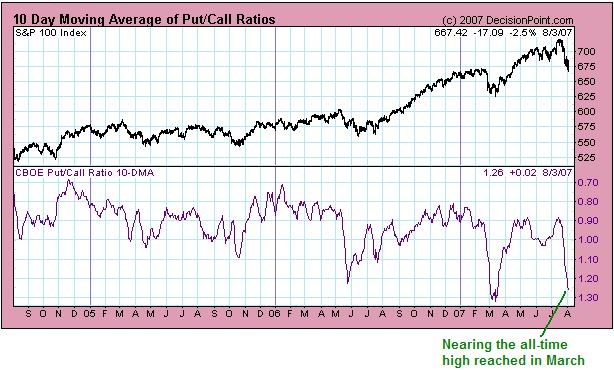
The stock market correction has already generated a considerable amount
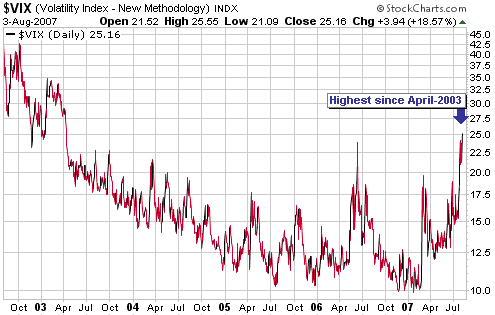
of fear. For example, the first of the following charts shows that the
10-day moving average of the CBOE put/call ratio is nearing the
all-time high reached earlier this year (note that the chart's scale is
inverted so a falling line indicates a rising put/call); and the second
of the following charts shows that the Volatility Index (VIX) just hit
its highest level since April of 2003. Also worth mentioning is that
the number of shares sold-short by the US public zoomed higher over the
past few weeks.
One problem with
sentiment indicators is that there aren't really any benchmarks. The
VIX, for instance, is presently high relative to where it has been over
the past 4 years, but prior to the past 4 years the VIX tended to peak
above 40 near the ends of medium-term corrections. In other words,
there's no way of knowing whether sentiment indicators are now close to
extremes or whether a lot more fear will be generated before the
correction comes to an end. What we do know is that there are now more
than enough people on the bearish 'side of the fence' to pave the way
for a spirited short-covering rally.
A short-covering rally beginning within the next few days and lasting
1-3 weeks is, we think, a good bet, but we doubt that the overall
downturn is about to end. The interest-rate sensitive sectors of the
market have been trending lower in relentless fashion for many months
and are oversold on an intermediate-term basis, but the problems that
have plagued these sectors for a long time only started to affect the
rest of the market about two weeks ago. The Dow Industrials Index, for
example, hit an all-time high as recently as 19th July.
Given that the problems in the debt market are not going to suddenly
disappear -- in fact, the situation in the debt market is likely to get
worse before it gets better -- it is reasonable to expect that the
broad stock market's downturn will last at least two more months. We
therefore expect that any rebound over the next couple of weeks will be
followed by a decline to new correction lows during September-October.
We will now take a look at how three important sectors of the market are doing.
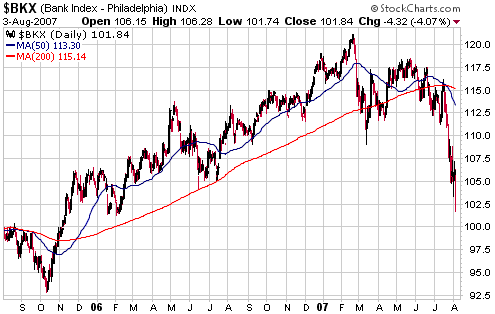
First, the following chart shows that the Bank Index (BKX) ended last
week at an 18-month low. The commercial banks have been close to the
centre of the mortgage-related debt crisis, so it's not surprising that
the BKX has been such a poor performer this year. Investment banks such
as Bear Stearns have been even closer to the centre of the crisis and,
as a result, have generally fared even worse than the commercial banks
(Bear Stearns' stock price is down by 37% from its January-2007 peak).
The BKX is obviously very oversold and could rebound to around 108 before resuming its decline.
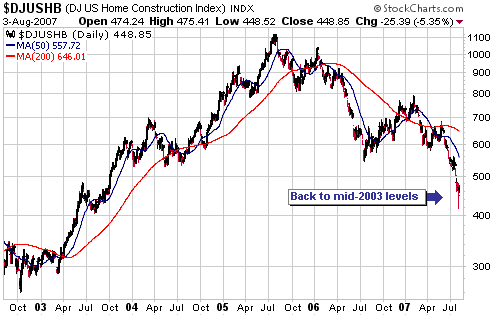
Next, the following
chart shows that the downturn in the homebuilding sector is now two
years old. The bear market has taken the Dow Jones US Home Construction
Index back to mid-2003 levels, but this particular bear might be about
to die or hibernate because an additional 1-2 years of property market
doldrums have probably been factored into current stock prices.
We aren't interested in buying the homebuilders at this time, but we
may become interested if they rebound over the next few weeks and then
complete a successful test of the 1st August low during
September-October.
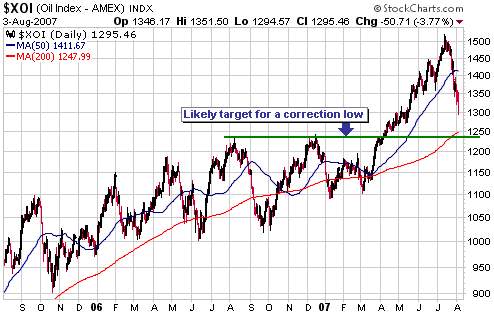
Last, the following
chart shows that the AMEX Oil Index (XOI) dropped sharply in sympathy
with the recent downturn in the broad stock market. Most people who buy
oil stocks do so to gain exposure to oil, but as we've noted in the
past the major oil stocks are influenced as much or more by the
performance of the broad stock market as by the performance of the oil
price.
Almost regardless of what happens to the oil price, the XOI will probably bottom with the broad stock market.
This week's
important US economic events
| Date |
Description |
Monday Aug 06
| Canadian markets closed
|
| Tuesday Aug 07 | Q2 Prodictivity (revised)
FOMC Policy Statement
Consumer Credit
| | Wednesday Aug 08
| No important events scheduled
| | Thursday Aug 09
| No important events scheduled | | Friday Aug 10
| Import / Export Prices
|
Gold and
the Dollar
Currency Market Update
If we are bullish on gold then we are, by definition, bearish on the
US$ relative to gold. And if we are bullish on gold and bullish on the
Dollar Index, as is presently the case for the short and intermediate
terms, then we are bearish on the US$ relative to gold and even more
bearish on the euro relative to gold (the USD/EUR exchange rate is
almost 60% of the Dollar Index); in other words, we expect the euro to
fall further than the US$ relative to gold.
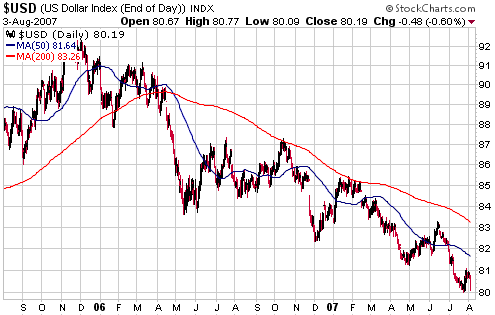
Being bullish on the US$ relative to the euro is not a comfortable
position right now because the Dollar Index is having such a hard time
mounting any sort of rally. In fact, the most recent rebound appears to
have ended following a gain of only one point (refer to the chart
included below). However, the close proximity to major support combined
with the extreme negativity towards the dollar suggests to us that the
US currency has more upside potential than downside risk at this time.
Also of note is that the US$ continues to maintain an interest rate
advantage over the euro, albeit a small and shrinking one. The market
expects short-term interest rates to fall in the US in response to the
on-going debacle in the world of mortgage financing, and has thus gone
a long way towards discounting the elimination of the dollar's interest
rate advantage. However, we think it's unreasonable to expect there to
be enough additional trouble in the US financial markets to warrant Fed
rate cuts and to simultaneously expect the ECB to continue its
rate-hiking campaign.
Gold and Gold Stocks
Gold
tends to be a top performer when the financial environment is becoming
less liquid, so the recent strength in gold relative to other
investments is undoubtedly related to reduced liquidity within the
financial markets in general and the credit market in particular.
In our 30th July commentary we wrote the following regarding the gold sector's short-term prospects:
"Last week's low might
have to be tested at some point over the next two weeks, but we suspect
that the correction is essentially complete. At least, if we are right
that the intermediate-term outlook has turned more positive then the
correction should now be complete in terms of price, with a period of
'testing' possibly occurring over the coming weeks before the next
rally begins in earnest."
The HUI made a couple of attempts to bounce over the past week, but
kept getting dragged back to near the prior week's low due to weakness
in the broad stock market. We therefore think it's fair to say that the
period of testing mentioned above is in progress.
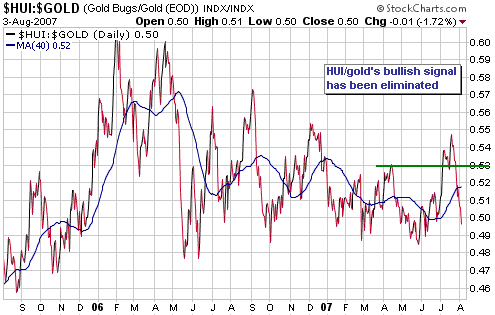
Although the HUI ended last week at roughly the same level at which it
began the week, big things happened beneath the surface. For example,
the following chart shows that the HUI/gold ratio has just plunged from
its highest level of the year to near its lows of the year. This
effectively cancels-out the earlier bullish signal generated by this
ratio.
The surge in the
HUI/gold ratio during the first three weeks of July never really made
sense given that it was not accompanied by a significant improvement in
the real gold price (gold relative to other commodities and
investments). Interestingly, though, even while gold stocks were
weakening considerably relative to gold bullion over the past fortnight
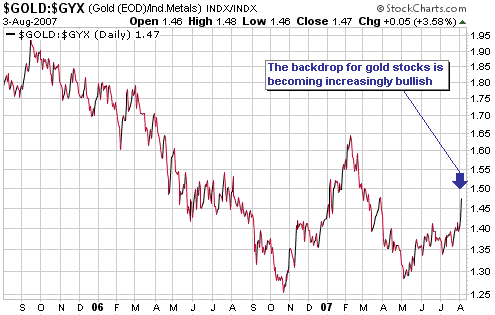
the backdrop for gold stocks was becoming more bullish. To illustrate
what we mean by this we've included, herewith, a chart of gold relative
to the Industrial Metals Index (GYX) and a chart comparing the HUI with
the gold/SPX ratio (gold relative to the S&P500 Index).
The first of the following charts shows that the gold/GYX ratio has
just moved to a 4-month high. This, in turn, suggests that the May-2007
low for this ratio was a successful test of the October-2006 low.
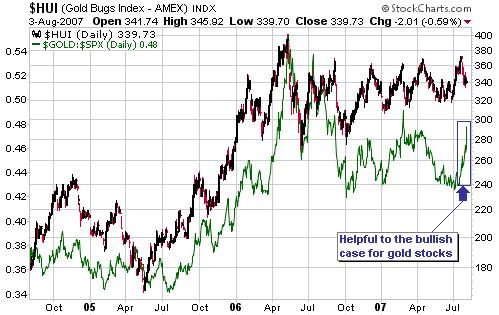
The second of the following charts makes the point that there is a
strong positive correlation between the HUI and the gold/SPX ratio (the
green line on the chart). This relationship makes sense because there
would be no good reason for stock market participants to bid-up the
prices of gold stocks unless gold bullion were out-performing the broad
stock market; or, to put it another way, it would be unreasonable to
expect investors to become enthusiastic about gold-related investments
unless they could see that gold was out-performing the S&P500.
Of importance at this time is that gold has moved sharply higher
relative to the S&P500 Index over the past fortnight. If gold's
out-performance continues then the investment demand for gold-mining
stocks should increase.
Gold tends to be a
top performer when the financial environment is becoming less liquid,
so the recent strength in gold relative to other investments is
undoubtedly related to reduced liquidity within the financial markets
in general and the credit market in particular. Gold should also
benefit in a big way from the actions that will inevitably be taken by
the US Fed and its central banking cohorts to counteract the reduced
financial market liquidity. Note, though, that it would not be
unprecedented for gold stocks to trend lower for an inconveniently long
time while the financial backdrop was becoming increasingly 'gold
bullish'. During the second half of 2000, for instance, the HUI moved
relentlessly lower for a few months while the stage was clearly being
set for a major gold bull market. It will therefore be prudent to use
price action as a filter.
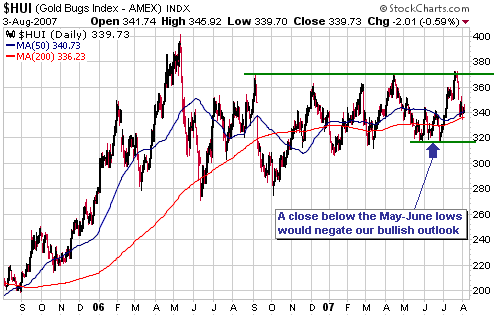
As mentioned in last week's commentary, the HUI's pullback from its
20th July peak should be essentially complete IF an intermediate-term
rally has begun. This means that the HUI shouldn't close below the
mid-330s if things really have turned for the better, although the
ultimate area of support for our bullish outlook is the cluster of lows
at 317-320 (refer to the following HUI chart for details).
Update
on Stock Selections
(Note: To review the complete list of current TSI stock selections, logon at http://www.speculative-investor.com/new/market_logon.asp
and then click on "Stock Selections" in the menu. When at the Stock
Selections page, click on a stock's symbol to bring-up an archive of our comments on the stock in question)
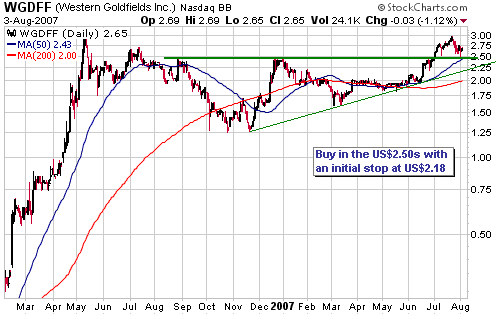
 Western Goldfields (OTC: WGDFF, TSX: WGI). Shares: 117M issued, 143M fully diluted. Recent price: US$2.65 Western Goldfields (OTC: WGDFF, TSX: WGI). Shares: 117M issued, 143M fully diluted. Recent price: US$2.65
We added WGDFF to the TSI Stocks List at US$1.95 on 18th April as a
trade with an upside target of around US$3.00. We then exited on 23rd
July after this target was essentially reached (we exited at US$2.94),
but stated that we would return WGDFF to the Stocks List if it pulled
back to support in the US$2.50s within the ensuing few weeks.
WGDFF traded as low as US$2.50 over the past week so we have returned
it to the List at US$2.55 (the middle of our suggested buy range). This
is a trade with an initial 'stop' at US$2.18 and an upside target of
US$3.50-US$4.00.
A chart is included below and our previous comments on the stock can be read at http://www.speculative-investor.com/new/WGDF.html.
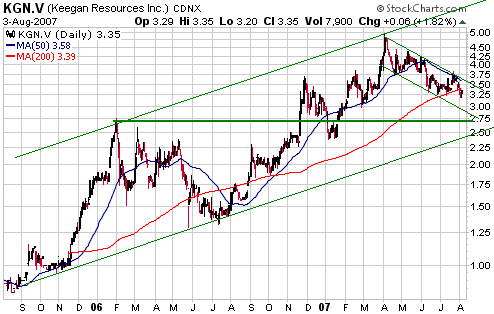
Keegan Resources (TSXV: KGN). Shares: 23M issued, 30M fully diluted. Recent price: C$3.35
In the 23rd July Weekly Update we explained why exploration-stage gold
miner KGN was a potential addition to the TSI Stocks List. At that time
it was priced at C$3.72 and we said we would add it to the List if, and
only if, it pulled back to the C$3.30s at some point over the ensuing 4
weeks. It traded as low as C$3.20 over the past week and ended the week
at C$3.35, so it has been added to the List at C$3.35.
Assuming that the HUI continues to hold above its May-June lows, the
worst we can envisage for KGN would be a drop back to intermediate-term
support at C$2.75 (refer to the following chart).
Our intention is for KGN to be a longer-term speculation.
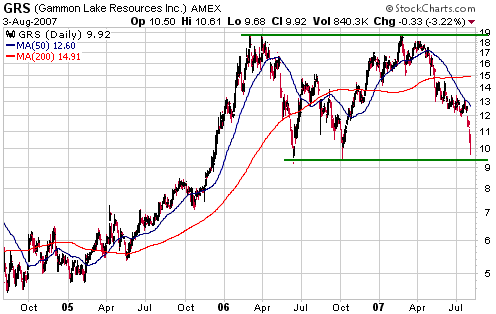
Gammon Gold (AMEX: GRS). Shares: 115M issued, 126M fully diluted. Recent price: US$9.92
GRS is scheduled to issue its next set of quarterly results after the
close of trading on Thursday 9th August. Clearly, a lot of people have
been panicking out of the stock in anticipation of some more bad news
to go along with the bad news contained in the company's previous
quarterly results.
We have no idea what GRS will report on Thursday and, in all
likelihood, neither do any of the people who have panicked out of the
stock over the past couple of weeks. Uncertainty is a big part of
investing in that it creates both risk and opportunity.
Because the stock has fallen so far in anticipation of bad news it is
now much less vulnerable than it was a few months ago; that is, there
is now much less scope for the stock to be hurt by a negative surprise
because the market has already gone a long way towards discounting bad
news. However, the company will not regain its premium stock market
rating until/unless it can demonstrate that it is capable of hitting
the gold/silver production run-rates that were forecast at the
beginning of the year.
From a technical perspective (see chart below) GRS is now close to major support defined by last year's 'double bottom'.
We are buyers of GRS at this time. We acknowledge that the current GRS
buying opportunity is better than we thought it would be (we didn't
think the stock would drop below the mid-$11 area), but the tendency of
stocks to 'overshoot' in both directions is one of the reasons we
prefer to scale into and out of investment positions over time.
Lion Selection (ASX: LST). Shares: 190M issued, 196M fully diluted. Recent price: A$1.67
LST, an Australian company that invests in junior gold and other metal miners, was hit by the market-wide correction last week.
The most recent net asset value (NAV) reported by LST was A$2.28 as at
30th June. The NAV would have fallen in response to the recent stock
market downturn, but should still be at least A$2.00. If so then
Friday's closing price of $1.67 represents a discount to NAV of more
than 15%.
LST is a relatively low-risk buy near the current price.
Chart Sources
Charts appearing in today's commentary
are courtesy of:
http://stockcharts.com/index.html
http://www.decisionpoint.com/

|