|
-- Weekly Market Update for the Week Commencing 6th August 2012
Big Picture
View
Here is a summary of our big picture
view of the markets. Note that our short-term views may differ from our
big picture view.
In nominal dollar terms, the BULL market in US Treasury Bonds
that began in the early 1980s will end by 2013. In real (gold)
terms, bonds commenced a secular BEAR market in 2001 that will continue
until 2014-2020. (Last
update: 23 January 2012)
The stock market, as represented by the S&P500 Index, commenced
a secular BEAR market during the first quarter of 2000, where "secular
bear market" is defined as a long-term downward trend in valuations
(P/E ratios, etc.) and gold-denominated prices. This secular trend will bottom sometime between 2014 and 2020. (Last update: 22 October 2007)
A secular BEAR market in the Dollar
began during the final quarter of 2000 and ended in July of 2008. This
secular bear market will be followed by a multi-year period of range
trading. (Last
update: 09 February 2009)
Gold commenced a
secular bull market relative to all fiat currencies, the CRB Index,
bonds and most stock market indices during 1999-2001. This secular trend will peak sometime between 2014 and 2020. (Last update: 22 October 2007)
Commodities,
as represented by the Continuous Commodity Index (CCI), commenced a
secular BULL market in 2001 in nominal dollar terms. The first major
upward leg in this bull market ended during the first half of 2008, but
a long-term peak won't occur until 2014-2020. In real (gold) terms,
commodities commenced a secular BEAR market in 2001 that will continue
until 2014-2020. (Last
update: 09 February 2009)
Copyright
Reminder
The commentaries that appear at TSI
may not be distributed, in full or in part, without our written permission.
In particular, please note that the posting of extracts from TSI commentaries
at other web sites or providing links to TSI commentaries at other web
sites (for example, at discussion boards) without our written permission
is prohibited.
We reserve the right to immediately
terminate the subscription of any TSI subscriber who distributes the TSI
commentaries without our written permission.
Outlook Summary
Market
|
Short-Term
(1-3 month)
|
Intermediate-Term
(6-12 month)
|
Long-Term
(2-5 Year)
|
| Gold
|
Bullish
(26-Mar-12)
|
Bullish
(26-Mar-12)
|
Bullish
|
| US$ (Dollar Index)
|
Neutral
(28-May-12)
| Neutral
(09-Jan-12)
|
Neutral
(19-Sep-07)
|
| Bonds (US T-Bond)
|
Bearish
(02-Jul-12)
|
Neutral
(18-Jan-12)
|
Bearish
|
| Stock Market
(DJW)
|
Bearish
(30-Jul-12)
|
Bearish
(28-Nov-11)
|
Bearish
|
| Gold Stocks
(HUI)
|
Bullish
(26-Mar-12)
|
Bullish
(23-Jun-10)
|
Bullish
|
| Oil | Neutral
(30-Jul-12)
| Neutral
(31-Jan-11)
| Bullish
|
| Industrial Metals
(GYX)
| Neutral
(30-Jul-12)
| Neutral
(29-Aug-11)
| Neutral
(11-Jan-10)
|
Notes:
1. In those cases where we have been able to identify the commentary in
which the most recent outlook change occurred we've put the date of the
commentary below the current outlook.
2. "Neutral", in the above table, means that we either don't have a
firm opinion or that we think risk and reward are roughly in balance with respect to the timeframe in question.
3. Long-term views are determined almost completely by fundamentals,
intermediate-term views by
fundamentals, sentiment and technicals, and short-term views by sentiment and
technicals.
The senior central banks
choose not to do more damage immediately
As expected, the Fed took no action last week. At the moment it is offering only words. For example, the statement issued last Wednesday after the FOMC Meeting included the words "The Committee will closely monitor incoming information on economic and financial developments and will provide additional accommodation as needed". This is just a statement of the obvious, because "the committee" is always closely monitoring incoming economic information and will always provide additional accommodation as needed. After all, there is no limit to the amount of so-called accommodation that can be provided by the Fed.
In this case, "accommodation" is such a poor choice of word it is almost Orwellian. When the Fed plays around with interest rates and the money supply in its efforts to "accommodate" the economy, it damages the economy. The more it tries to accommodate, the more inaccurate the interest rate and other price signals become. This leads to a greater number of wrongheaded decisions being made by businessmen and investors. If the accommodation happens during normal times it will lead to an obvious "price inflation" problem within a few years, but if it happens during a major de-leveraging (a period when the private sector is attempting to clean-up its collective balance sheet) it will get in the way of the corrective process and delay the start of a sustainable recovery.
The day after the US central bank promised to do more if necessary but nothing immediately, the euro-zone (EZ) central bank did the same. The ECB's decision not to immediately boost its "accommodation" was more surprising than the Fed's, because a week earlier Mario Draghi had excited the markets by saying that the ECB was ready to do whatever it takes to reduce the borrowing costs of financially-stressed EZ governments and support the euro. At this stage, doing whatever it takes apparently means taking no immediate action.
Things are more complicated for the ECB than for the Fed. The Fed can essentially do whatever it likes as long as what it likes isn't in conflict with the short-term goals of the US federal government, but the ECB can't support the bonds of one EZ government without blatantly imposing additional costs on the taxpayers of other EZ governments. It therefore often finds itself torn between the conflicting goals/desires of different governments.
Right now the best indicator of financial stress within the EZ is the yield on the 10-year Spanish Government Bond (see chart below). When no immediate action was announced at the conclusion of last Thursday's ECB meeting, the yield on the 10-year Spanish government bond moved above 7%. This prompted declines in the euro and most stock markets. For some unknown (to us) reason, however, the yield on this bond dropped back below 7% on Friday, prompting strong up-moves in the euro and most stock market indices. Perhaps the ECB took some action after all.

Economic Numbers Update
For July, the headline ISM Index was 49.8 and the ISM New Orders sub-index was 48.0. Both of these are slightly higher than the previous month's numbers, but they are still weak (a reading below 50 indicates that conditions in the manufacturing sector of the US economy are worsening).
The monthly ISM report is a better indicator of present economic conditions than the monthly employment report, but the financial markets usually pay more attention to the employment numbers. The US Labor Department reported last Friday that the US economy added 163,000 jobs in July, which, according to a Bloomberg survey of economists, was at the top end of the expected range. At the same time, the estimate for jobs growth during June was revised downward from an already-low 80,000 to only 64,000.
Although July's jobs growth number came in ahead of the consensus expectation, it doesn't mean that the economy is doing better than expected. This is because the employment numbers are lagging indicators. Also of note is that these numbers often get revised in a big way over the ensuing two months.
The Stock
Market
The stock market and the central bank
The slowing growth or accelerating contraction in Europe, the US, China and many other parts of the world is due to real problems. It isn't due to depressed confidence and therefore it can't be permanently reversed by boosting confidence. In fact, boosting confidence to the point where the problems are ignored could only lead to imprudent decisions, thus destroying more wealth and further weakening the economy. In other words, the problems that are weighing on economic growth wouldn't magically disappear if everyone were injected with 'happy juice' or visited by the 'confidence fairy'.
In addition, the problems couldn't possibly disappear as a consequence of central bank money creation. Money is just the general medium of exchange, so manipulating the supply of money can only act to distort the price signals upon which the economy relies. Causing distortions to price signals prompts bad decisions and the destruction of real wealth. In fact, rather than being a potential solution, monetary inflation is the most important CAUSE of the current problems.
That's economic reality. Economic reality dictates what SHOULD happen on the policy-making front, but due to a combination of ignorance and Machiavellian politics there's often a big difference between what should happen and what will happen. The sad truth is that there WILL be a lot more monetary inflation in the future. The only question is: when? The best answer that we can come up with is: within the next two months for ECB-sponsored inflation and after the stock market tanks or the backward-looking economic data gets much weaker for Fed-sponsored inflation.
In the mean time, expectations regarding central bank machinations are by far the most important drivers of stock market performance. The performances of individual shares can still be affected by company-specific developments, but the overall market is rising and falling in reaction to changes in expectations regarding what the central banks will do and when they will do it. To put it another way, the stock market no longer serves as a vehicle for the efficient allocation of capital to businesses. It is now almost solely an instrument for speculating on the decisions of a small group of official price manipulators. That's one reason why the bull market in gold is not remotely close to being over.
Current Market Situation
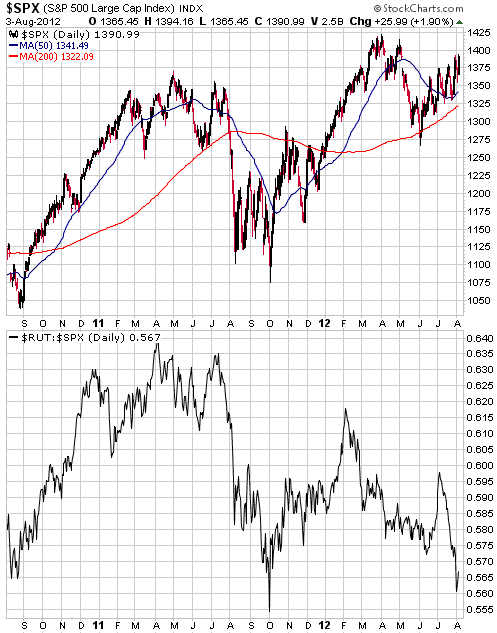
The top section of the following chart shows that the S&P500 Index (SPX) closed at a new 3-month high last Friday. The bottom section of the same chart shows that the RUT/SPX ratio (small-cap stocks relative to large-cap stocks) closed at a new 9-month LOW last Thursday before rebounding a little on Friday. We therefore have a glaring divergence on our hands. The divergence is bearish, because over the past few years small-cap stocks have tended to be relatively strong during intermediate-term advances and relative weak during intermediate-term declines.
The performance of the RUT/SPX ratio suggests that an intermediate-term downward trend began in March and that the rally since the early-June low will prove to be the counter-trend variety. Aggressive inflationary actions on the part of the Fed or the ECB could change the picture, but right now it is appropriate to be short- and intermediate-term bearish.
This week's
important US economic events
| Date |
Description |
| Monday Aug 06 | No
important events scheduled
| | Tuesday Aug 07 | Consumer
Credit
| | Wednesday Aug 08 | Q2
Productivity and Costs | | Thursday
Aug 09 |
International Trade Balance
|
| Friday Aug 10 | Import
and Export Prices
Treasury Budget
|
Gold and
the Dollar
Gold and Silver
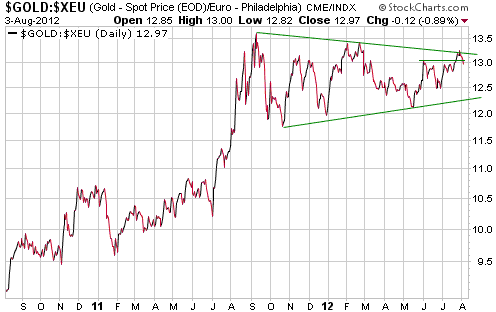
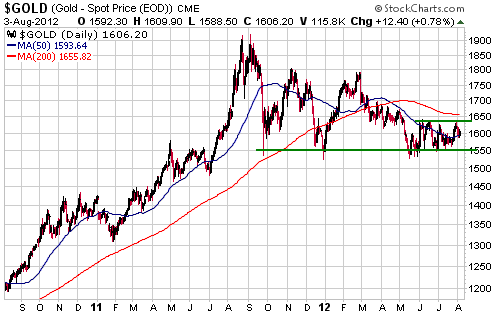
The past week turned out to be a good week for us to be away from the office, because it was a week during which very little happened in the financial markets. It appeared, for a short while, that gold had broken out in euro terms, but the first of the following daily charts shows that a breakout hasn't yet occurred. The second of the following daily charts shows that in US$ terms gold continued to trade within a narrow horizontal range. Is anyone still awake?
Over the past several weeks there has been even less movement in the silver market than in the gold market. As evidenced by the daily chart displayed below, since late June silver has essentially flat-lined just above important support.
It's typical for silver to top via a vicious upward spike and to bottom via a gradual base-building process. That doesn't guarantee that the recent sideways movement is part of a bottoming process, but the recent price action is consistent with the idea that silver is in the process of bottoming.
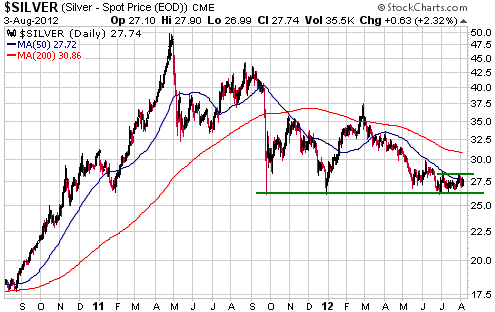
It would make sense for us to refrain from commenting on the current market action in gold or silver until gold either closes above $1640 or below $1550, because oscillations within the $1550-$1640 range are just noise. Regardless, we will continue to comment.
The odds continue to be in favour of the next $100 move in the gold price being to the upside.
Gold Stocks
Current Market Situation
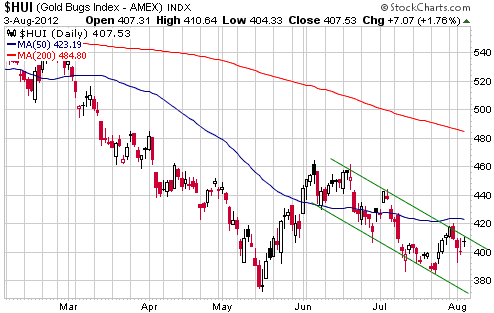
We interpret the HUI's downward drift since its early June peak as a correction within a new intermediate-term upward trend. However, for this interpretation to be right it will soon have to receive some price-related confirmation in the form of a daily close above 425, because continuing to drift within the channel that began to form in June would lead to a new 52-week low within the next month or so.
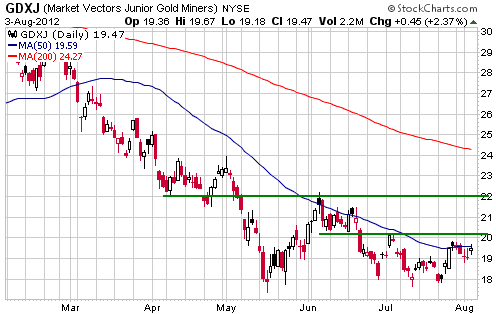
GDXJ's chart pattern looks a little different from the HUI's. We think it looks slightly more bullish, in that a rounded base appears to be nearing completion. There is resistance just above $20.00 and then at $22.00. For what it's worth, a break above $22 would create a chart-based objective of $26.
We think it makes sense to scale into GDXJ below $20.
Avoiding a mistake
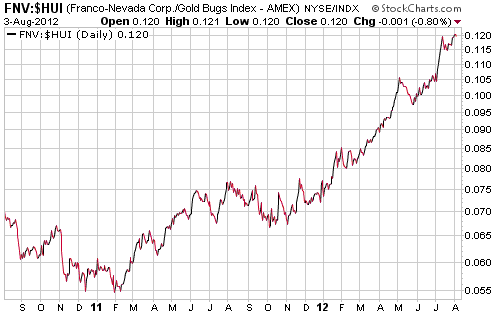
A common investing/speculating mistake is to do in the present what you should have done, or wish you had done, over the preceding 1-2 years. We are referring to the tendency to jump into an investment that has performed relatively well in the past simply because it has performed relatively well, based on the misguided notion that what worked best in the past stands a good chance of working best in the future. The notion is misguided because -- due to the principle of ever-changing cycles -- the stronger an investment's past relative performance the LOWER the probability of this investment being a relatively strong performer in the future. It happens this way because unless the relative fundamentals are also improving at a rapid rate, strong out-performance by an investment will lead to the investment having a less attractive valuation.
The above paragraph's message currently applies to the gold royalty stocks, which, in general, have been very strong over the past 18 months relative to the stocks of companies directly engaged in the business of mining gold. To illustrate what we are talking about we present, below, a chart of the FNV/HUI ratio (the stock price of gold royalty company Franco Nevada relative to the HUI).
There are good reasons for the relative strength of royalty stocks over the past 18 months, but this past performance makes it very unlikely that royalty stocks, as a group, will be relatively good performers over the next 18 months.
Currency Market Update
Why do currencies trend up and down relative to each other?
Changes in currency exchange rates are ultimately determined by changes in relative purchasing power, which, in turn, are determined by differences in money-supply growth rates. However, it can take a few years for a monetary inflation differential between two currencies to lead to a significant change in relative purchasing power, and it will sometimes take a few additional years for a change in relative purchasing power to affect the primary exchange rate trend. Factors other than the difference in the monetary inflation rate must therefore be more important over the timeframes that are of more interest from a practical speculation standpoint.
To identify these factors it must first be understood that the monetary value of global trade in goods and services is now dwarfed by international money flows relating to investment and speculation. Therefore, when attempting to explain movements in currency exchange rates over the preceding 1-2 years and attempting to predict what will happen to currency exchange rates over the ensuing 1-2 years, the questions that need to be answered are: Why did investors/speculators favour a particular currency in the past and which currencies will they favour in the future?
The answer never involves currency reserves. The reserves held by a central bank have no influence on the associated currency's purchasing power and very little influence on its exchange rate. Today's currencies are not 'backed' by central bank reserves. The reserves are holdovers from a previous monetary system and are anachronistic under today's system. This is a subject that we addressed in an earlier commentary and will re-visit within the next two weeks.
To come up with an answer, think about why you would want to own a particular currency or invest in assets denominated in a particular currency. A popular motivation is to generate a higher return, which means that interest rate differentials and relative stock market performance can be important. Note that long-term investors will generally take into account the expected rate of purchasing-power change along with interest rate differentials and relative stock market performance, because what a rational investor wants is a higher REAL return. Short-term speculators, however, will often focus on nominal returns, because "inflation" will typically be immaterial over timeframes ranging from a few days to a few months. Safety is another motivator, in that investors and speculators are sometimes willing to forego a higher return ON capital in exchange for greater assurance of return OF capital.
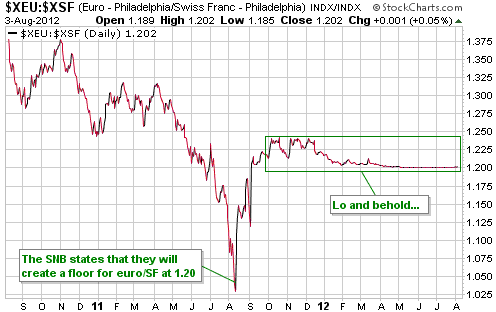
Central bank policy is usually an important factor and sometimes the only factor that matters to an exchange rate. The Yuan-US$ exchange rate is an obvious example. Another example is the Swiss Franc relative to the euro. In August of last year the Swiss National Bank (SNB) decided that it would create whatever amount of money was needed to prevent the euro/SF exchange rate from falling below 1.20. As evidenced by the following chart, since that time nothing else has mattered. Naturally, there will be adverse consequences to such a policy. In Switzerland's case, the decision to suppress the SF's relative value in order to help some exporting companies is already showing signs of creating an inflation problem that will wreak havoc with the Swiss economy if left unchecked.
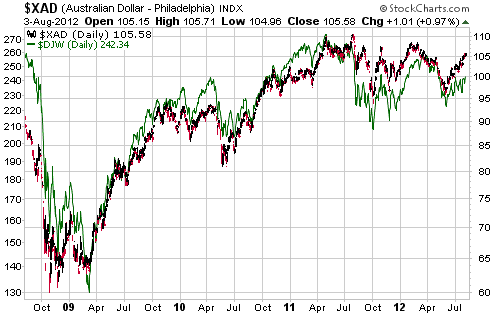
Sometimes speculators will fixate to such an extent on an inter-market relationship that this relationship becomes the only thing that matters to a currency exchange rate. An example is the relationship between the Australian Dollar (A$) and the global stock market (DJW) illustrated by the following chart. Almost regardless of what's happening in Australia, the A$ trends up and down with a global equities index.
Current Market Situation
The euro is rebounding. The speculative short position in euro futures remains large enough to support a rebound to at least 1.30 and possibly as high as 1.40, but a euro rebound of more than a few points will almost certainly require stock market strength or stability. The problem is that the next big (10%+) move in the stock market will more likely be to the downside than the upside.
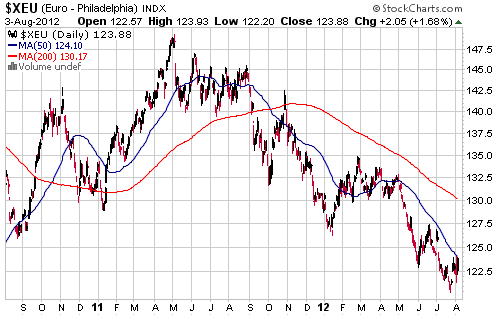
Our view is that the euro's short-term downside potential is limited by the extent to which it is 'oversold' and that its short-term upside potential will probably be limited by stock market weakness. At this time we therefore don't see a euro trade with a sufficiently attractive risk/reward. If we were going to do a currency-market trade at this time we would opt for a bearish A$ position. The A$ is over-valued and will very likely suffer a large decline in parallel with the next sizeable stock market downturn.
Update
on Stock Selections
Notes: 1) To review the complete list of current TSI stock selections, logon at
http://www.speculative-investor.com/new/market_logon.asp
and then click on "Stock Selections" in the menu. When at the Stock
Selections page, click on a stock's symbol to bring-up an archive of
our comments on the stock in question. 2) The Small Stock Watch List is
located at http://www.speculative-investor.com/new/smallstockwatch.html
 Company news/developments for the week
ended Friday 3rd August 2012: Company news/developments for the week
ended Friday 3rd August 2012:
*Dragon Mining (DRA.AX) issued its results for the June quarter. The production results achieved by its operating mines in Sweden and Finland were poor, in that production was moderately lower and costs were substantially higher. Specifically, in the latest quarter the company produced 13.8K ounces of gold at a cash cost of $1469/oz, which contrasts with the previous quarter's 16K ounces at the much lower cash cost of $936/oz.
DRA's quarterly results tend to be lumpy and the latest quarter's results were greatly affected by the movement of waste rock at the Svartliden mine in Sweden (the $1555/oz cash cost for the 8.2K ounces produced at this mine included $777 of waste movement costs). Costs should be a lot lower over the remainder of this year and production should be higher. If not then there is a longer-term problem. Currently, the high costs incurred during the latest quarter appear to be a temporary setback.
DRA has a strong balance sheet, with $26M of cash and bullion. However, the combination of investment in future expansion and high production costs caused the cash balance to contract by about $8M in the June quarter.
DRA is extremely under-valued at its current stock price of A$0.71, but it will remain extremely under-valued unless it can substantially reduce its production costs.
*Elgin Mining (ELG.TO) announced the appointment of Jim Currie as Chief Operating Officer (COO), to replace interim COO Bob Wasylyshyn. Currie was formerly the COO of New Gold and, before that, the Operations VP of Mirimar Mining. Due to Currie's wealth of experience we view this management change as a plus.
*International Tower Hill Mines (THM) reported that it has completed the first tranche of the equity financing announced in July. The company has issued about 9.5M shares at C$2.60/share for gross proceeds of C$24.6M. According to THM's press release, the participants in the first tranche included Paulson & Co., Tocqueville Asset Management, AngloGold Ashanti, and THM management and insiders. We like the fact that Tocqueville and company insiders participated, as they can be classified as knowledgeable investors. The financial support of John Paulson is interesting, although his gold mining investment record is unimpressive. One of the participants in the first tranche (Paulson?) has committed to buy an additional C$5M of shares in September at a yet-to-be-determined price.
*Jaguar Mining (JAG) announced a new resource estimate for its exploration-stage Gurupi project in Brazil. The new estimate incorporates the results of about 24,000m of additional drilling.
The previous estimate for this project comprised 2.5M ounces of gold in the Measured and Indicated category (all Indicated). Using the same average grade, the new estimate contains 2.8M ounces of gold in the Measured and Indicated category (1/3 Measured, 2/3 Indicated).
While clearly a plus, the magnitude of the resource increase is too small to be significant. The stock price rose sharply in the wake of the news, but this probably had a lot more to do with the extent to which the stock had been sold down during the weeks prior to the news than the news itself. Furthermore, last week's resource update undoubtedly reminded the market that JAG owns a valuable exploration-stage project in addition to the production-stage projects that have caused shareholders so much angst.
It would make sense for JAG to sell the Gurupi project as long as it could do so for at least $200M in cash, especially considering that the asset will be a constant drain on the company's cash (it will be years before Gurupi goes into production) and is currently being assigned almost no value as part of JAG. Such a transaction would substantially strengthen JAG's balance sheet and give the company the breathing space it needs to sort out the problems at its operating mines.
*Pretium Resources (PVG.TO, PVG): Another week, another round of excellent drilling results from PVG's Brucejack project. We expect that the next piece of PVG news to really excite the market will be an updated resource estimate later this quarter.
At this time the only thing about PVG that worries us is its high cash burn rate. The company's aggressive drilling program will lead to a bigger resource estimate, but the drilling is expensive. During the first half of 2012 PVG burned through about $40M of cash. We estimate that it currently has about $65M of cash, so if it keeps spending at this rate then another sizeable equity financing will be required by early next year.
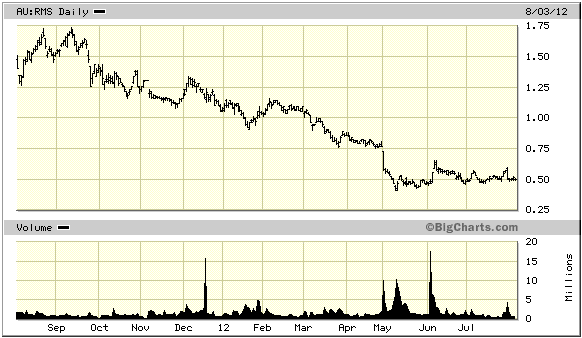
*Ramelius Resources (RMS.AX) reported its results for the June quarter. An update on this company's progress is presented below.
Ramelius Resources (ASX: RMS). Shares: 336M. Recent price: A$0.50
As per the quarterly activities report issued by the company last week, during the June quarter RMS's Wattle Dam mine produced 11K ounces at $931/oz and its Mt Magnet mine produced 10.5K ounces at $1551/oz.
Wattle Dam is expected to be fully depleted by mid-2013, but in the mean time it should contribute significant cash flow. Production should be about 10K ounces in the current (September) quarter.
Mt Magnet is scheduled to reach its design production rate of 80K ounces/year (20K ounces/quarter) in December 2012. Production is expected to be 12K-14K ounces during the September quarter.
RMS's stock price fell 10% in reaction to the quarterly results, probably because of the high per-ounce cost reported for Mt Magnet's production. The high production cost is partly due to low-grade ore being used to top-up mill feed while mining works towards the deeper, higher-grade ore. The proportion of higher-grade ore is expected to gradually increase over the months ahead, leading to full production and much lower costs by year-end.
The low-grade ore situation was planned and should therefore have been expected, but the market's reaction indicates that the results were worse than expected. If we go back to the corporate presentation issued in June we see that April and May production for Mt Magnet were 2400 ounces and 5000 ounces, respectively. The quarterly report published last week indicates that total Q2 production for Mt Magnet was 10500 ounces, which means that production must have been 3100 ounces in June. The production results should be steadily improving from month to month as the project is ramped up to design capacity, so the fact that June production was 1900 ounces (almost 40%) less than May production was viewed as a bad omen.
Contributing to the market's negative reaction was advice from RMS that Mt Magnet will reach full production a few months later than previously forecast.
The lower-than-expected production in June and the extension of the time to full capacity are due to the sorts of commissioning problems that regularly occur after a new mine comes on line. Provided that the mining company has a strong balance sheet these problems can usually be worked through without adverse long-term consequences, but if the company goes into production with a weak balance sheet the commissioning problems can end up destroying a lot of value due to the company being forced to pay a high price for additional funds. Fortunately, RMS has no debt, about $60M of cash and another operation (Wattle Dam) that is cash-flow positive. It is therefore well placed to work its way through these commissioning issues.
RMS will be risky until the Mt Magnet commissioning issues are resolved, but postponing new buying until after these issues are resolved probably isn't the best approach because by then the stock price would likely be about 100% higher. In our opinion, RMS is a good candidate for new buying near its current price.
Junior gold stocks appear to be 'coiling' and could soon spring upward
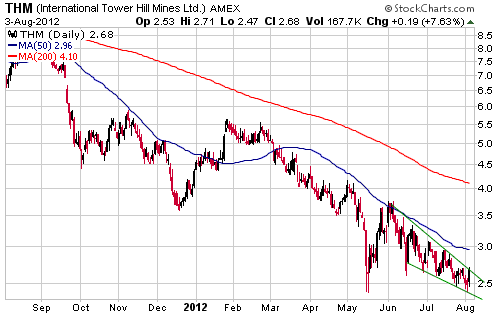
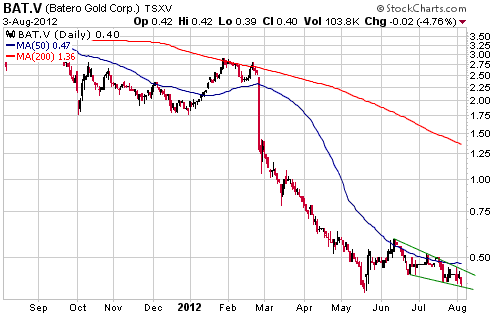
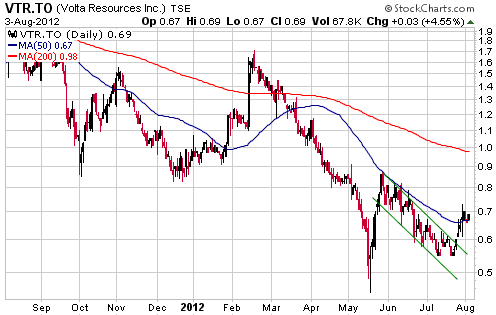
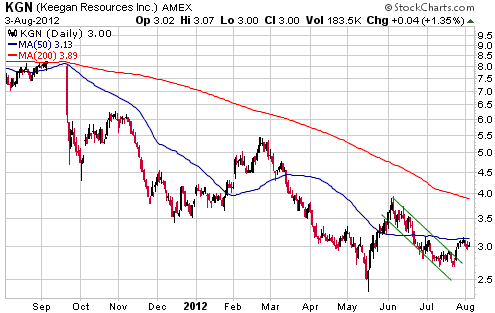
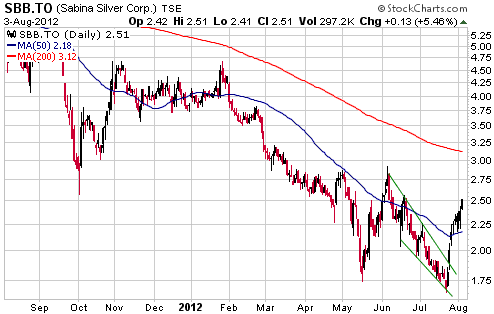
Many junior gold mining stocks currently have similar chart patterns. They had sharp rebounds from mid May through to early June and have since headed back to just above or just below their May lows in what technical analysts refer to as wedges or flags. Some stocks have already broken out to the upside from these wedge/flag patterns while others appear to be 'coiling' in preparation for upside breakouts. Here are examples from the TSI Stocks List:
a) THM has moved lower in a "declining wedge" and could be about to spring upward.
b) It is a similar story with BAT.V, a microcap that has recently pulled back to near its May bottom on minimal volume and declining interest. BAT is currently being given almost no credit for its 4M-oz gold resource.
c) VTR.TO and KGN have already broken out to the upside from "flag" patterns, but are still low enough to be candidates for new buying.
d) SBB.TO surged after breaking upward from a "declining wedge" late last month. It remains very under-valued at around C$2.50, but it is 'overbought' on a short-term basis and is not one of the best candidates for new buying right now.
Speculation idea: Gold Standard Ventures (TSXV: GSV, NYSE: GSV). Shares: 84M. Recent price: C$1.85
After GSV dropped to the mid-$1.60s last Thursday we decided that we would briefly write it up in the Weekly Market Update. Unfortunately it rebounded to the mid-$1.80s on Friday, but we have decided to do the brief write-up anyway. It's a little more risky in the $1.80s than in the $1.60s, but it still has a lot of upside potential.
We have been following (and have owned) GSV since shortly after the company went public in mid 2010, when it was trading at around C$0.70/share. Although it has never been a TSI stock, we mentioned it last December (along with a few other low-priced/high-risk gold stocks) after it had dropped back to the C$0.70s. At that time its exploration-stage Railroad gold project on Nevada's Carlin Trend was nothing more than a twinkle in the eye of exploration VP Dave Mathewson, but Mathewson's vision has since been given some validation by drilling results that include 164m of 3.38-g/t gold, 56.4m of 4.29-g/t gold, and 109.8m of 2.0-g/t gold. It's still way too early in the exploration process to do a resource estimate or arrive at a sensible valuation for the company, but these results suggest the potential for a large gold deposit with economic grade in a part of the world that is famous for such deposits.
The stock traded as high as $3.00 in early May, but has since trended downward due to an absence of news and a financing. June's equity financing raised $20M at C$2.00/share (no warrants). The company now has about $25M of cash, which should be more than enough to fund an aggressive exploration program over the coming 6 months.
Despite the excellent drilling results reported over the past 6 months, GSV is still a high-risk proposition. It is purely a drill play that will likely do extremely well from here -- almost regardless of what happens to the gold price and the gold mining sector -- if future drilling results are as good as past drilling results. On the other hand, it will do poorly -- again, almost regardless of what happens to the gold price and the gold mining sector -- if future results fail to confirm Mathewson's vision.
At this time we are mentioning GSV as an idea that could be of interest to risk-tolerant speculators. We have no intention of adding it to the TSI Stocks List.
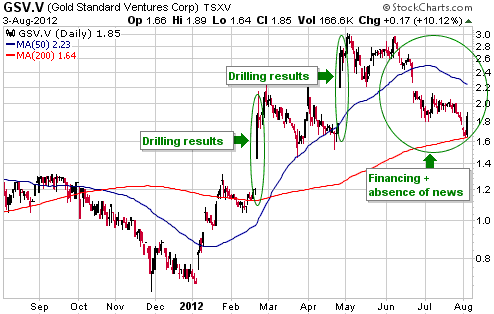
Chart Sources
Charts appearing in today's commentary
are courtesy of:
http://stockcharts.com/index.html
http://bigcharts.marketwatch.com/
http://www.bloomberg.com/

|









