|
-- Weekly Market Update for the Week Commencing 7th January 2008
Big Picture
View
Here is a summary of our big picture
view of the markets. Note that our short-term views may differ from our
big picture view.
Bonds commenced a secular BEAR market in
June of 2003. (Last
update: 22 August 2005)
The stock market, as represented by the S&P500 Index, commenced
a secular BEAR market during the first quarter of 2000, where "secular
bear market" is defined as a long-term downward trend in valuations
(P/E ratios, etc.) and gold-denominated prices. This secular trend will bottom sometime between 2014 and 2020. (Last update: 22 October 2007)
The Dollar commenced a secular BEAR market during the final quarter of 2000. The
first major downward leg in this bear market ended during the first
quarter of 2005, but a long-term bottom won't occur until 2008-2010. (Last update: 28 March 2005)
Gold commenced a
secular bull market relative to all fiat currencies, the CRB Index,
bonds and most stock market indices during 1999-2001. This secular trend will peak sometime between 2014 and 2020. (Last update: 22 October 2007)
Commodities, as
represented
by the CRB Index, commenced a secular BULL market in 2001. The first
major upward leg in this bull market ended during the second quarter of
2006, but a long-term
peak won't occur until at least 2008-2010. (Last update: 08 January 2007)
Copyright
Reminder
The commentaries that appear at TSI
may not be distributed, in full or in part, without our written permission.
In particular, please note that the posting of extracts from TSI commentaries
at other web sites or providing links to TSI commentaries at other web
sites (for example, at discussion boards) without our written permission
is prohibited.
We reserve the right to immediately
terminate the subscription of any TSI subscriber who distributes the TSI
commentaries without our written permission.
Outlook Summary
Market
|
Short-Term
(0-3 month)
|
Intermediate-Term
(3-12 month)
|
Long-Term
(1-5 Year)
|
Gold
|
Bullish
(19-Nov-07)
|
Bullish
(12-Nov-07)
|
Bullish
|
US$ (Dollar Index)
|
Bullish
(11-Jun-07)
| Bullish
(31-May-04)
|
Neutral
(19-Sep-07)
|
Bonds (US T-Bond)
|
Neutral
(02-Jan-08)
|
Neutral
(23-Jul-07)
|
Bearish
|
Stock Market (S&P500)
|
Neutral
(02-Jan-08)
|
Neutral
(26-Mar-07)
|
Bearish
|
Gold Stocks (HUI)
|
Neutral
(17-Dec-07)
|
Neutral
(17-Dec-07)
|
Bullish
|
| Oil | Neutral
(02-Jan-08)
| Bearish
(22-Oct-07)
| Bullish
|
Industrial Metals (GYX)
| Neutral
(28-Nov-07)
| Bearish
(09-July-07)
| Bullish
|
Notes:
1. In those cases where we have been able to identify the commentary in
which the most recent outlook change occurred we've put the date of the
commentary below the current outlook.
2. "Neutral", in the above table, means that we either don't have a
firm opinion or that we think risk and reward are roughly in balance with respect to the timeframe in question.
3. Long-term views are determined almost completely by fundamentals,
intermediate-term views by giving an approximately equal weighting to
fundmental and technical factors, and short-term views almost
completely by technicals.
Random speculations about the year ahead
*The US stock market's
upside will be limited by falling corporate profits (and profit
margins), continued pressure on the financial sector, political
uncertainty, inflation fears, and a lack of growth in consumer spending.
*The stock market's downside will be mitigated by the beating
already dished out to housing-related and financial stocks, as well as
by the fact that the investing public is already very pessimistic.
*The upward trend in the US yield-spread that began in 2007 will
persist through 2008, due initially to long-term interest rates falling
less than short-term rates and then, later in the year, to long-term
interest rates rising faster than short-term interest rates. This will
create a generally positive environment for gold, although gold's bull
market will be interrupted by a substantial 2-4 month correction that
begins during the first two months of the year.
*Gold's H1-2008 correction will be driven by a strong US$ rally
as currency speculators belatedly come to the realisation that the
dollar's large purchasing-power discount to the euro is unwarranted.
*In a desperate effort to revive the economy and the electoral
chances of the Republican Party, the US Federal Government will become
the primary engine of debt/money expansion (inflation) during 2008. As
a result, the people who doubt the ability of the powers-that-be to
maintain a high level of monetary expansion in the face of a 'tapped
out' consumer will receive an "Inflation 101" course. They will learn
that there is no limit to the amount of bonds that the US government
can issue to the Fed in exchange for newly-created currency.
Note: The "pushing on a string" analogy often cited in discussions
about the inflationary abilities of governments and central banks is
based on the patently false assumption that every increase in money
supply will be met by an equivalent increase in money demand with no
change in the price (purchasing power) of money. This assumption goes
against basic economic law. Until the law of supply and demand is
repealed there will be no question that an entity with the power to
expand the supply of money ad infinitum will also have the power to
reduce the purchasing power of the money (bring about a general
increase in prices, that is). The challenge facing the monetary
authorities isn't to maintain a high level of inflation; it's to do so
whilst keeping inflation FEARS in check.
*Weakness in the economy will result in a deflation scare during
the first half of 2008 (a "deflation scare" involves widespread fear
that deflation is a threat, as opposed to something resembling actual
deflation), but the nature of the current monetary system and political
environment will ensure that the weaker the economy the greater the
INFLATION.
Base Metals Update
We've been expecting that copper and the other base metals would
experience counter-trend rebounds (rebounds within on-going cyclical
bear markets) during the first few months of 2008. Price action has
given a preliminary indication that the anticipated rebounds have
begun, but there are some good reasons to remain cautious. For one
thing, the base metals are still in "contango" (3-month futures prices
are higher than current spot prices), which indicates that there is
ample supply to meet demand at this time. For another thing, the strong
positive correlation between the copper price and the S&P500 Index
discussed in our 17th December commentary suggests that a tradable
rally in the base metals market won't begin until after a short-term
bottom has been put in place in the US stock market. A short-term stock
market bottom is probably close at hand, but there is no evidence that
a bottom is already in place.
China will be one of the main determinants of whether the base metals
soon commence tradable rallies. China has been running down its
inventories of some metals, most notably copper, and could begin to
re-stock in the near future by increasing its imports. When this
happens it will cause metal to be taken out of LME inventories and
probably return the metals markets to "backwardation", thus setting the
stage for 1-3 month price rebounds.
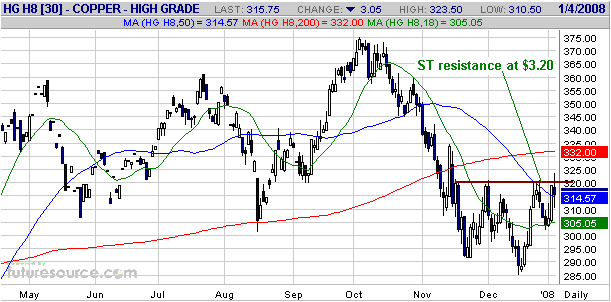
The following daily chart shows that March copper futures have clearly
defined resistance at $3.20. A daily close above this resistance would
suggest that the price was headed back to around $3.50.
The Stock
Market
2008 Outlook for the US Stock Market
There's a lot of discussion in the press about whether the US economy
will go into recession during 2008, but we think such discussions are
irrelevant because the US economy is ALREADY in recession. The US
government reported strong GDP growth for the third quarter of last
year and might report some additional growth for the fourth quarter,
but these government-produced numbers seldom reflect reality.
Properly accounting for the effects of inflation would, we strongly
believe, reveal that the US economy has been contracting in real terms
for many months. This makes intuitive sense given a) the depression in
the residential housing sector and the effect that the
housing/construction-related downturn must be having on consumer
spending, and b) the deleterious effects on non-energy-related spending
of the sharp rise, over the past 12 months, in the price of energy.
Recession-like economic conditions combined with the currency's loss of
purchasing power have caused corporate profit margins to contract and
the S&P500's rate of earnings growth to fall over the past six
months, and more of the same is likely over the coming 2-3 quarters. In
fact, there's a good chance that S&P500 earnings will be lower in
2008 than they were in 2007. But as far as the stock market is
concerned the relevant question is: how much of this downturn in
corporate profitability is factored into current stock prices?
Even though the overall market's relatively high P/E ratio suggests
that the aforementioned downturn in corporate profitability has not yet
been fully discounted, the above question is difficult to answer due to
the huge disparities between different sectors. For example, the
housing depression will most likely extend through 2008 and cause the
homebuilding business to become even worse than it is today, but the
homebuilding sector has already lost 75% of its collective market
capitalisation (as measured by the Dow Jones US Home Construction Index
-- DJUSHB). One or two major homebuilders will probably go bankrupt
before the depression runs its course, but the entire industry is not
going to disappear. Considering that the homebuilding sector's decline
is already in the same league as the NASDAQ's 2000-2002 bust it is
reasonable to assume that the stock market has come close to
discounting the worst in this case. It's a similar story in the
financial sector in that almost every company involved in the
originating, intermediating, packaging and/or insuring of
mortgage-related debt has already been taken out back and shot. The
stock prices of some high-profile financial companies could go to zero
during 2008, but the entire industry is not going to disappear.
Furthermore, it is reasonable to expect that at some point this year
the better-managed financial companies (and their stocks) will begin to
rebound strongly.
In general, it seems to us that the sectors that have suffered due to a
substantial deterioration in business fundamentals -- whether it be the
homebuilding sector due to the obvious problems in the housing market
or the financial sector due to the rampant mispricing of credit risk or
the airline sector due to the dramatic increase in the price of oil --
have already been pummeled to levels where the negatives are close to
being fully discounted. On the other hand, the sectors in which
business conditions remain firm do not appear to have much downside
risk. For example, although we expect the price of oil to drop back to
the 70s during 2008 we don't think this will lead to substantial
weakness in the major oil stocks because valuations remain low and
because oil-related equities generally didn't react in a meaningful way
to the final $20 increase in the oil price.
Another point worth noting is that long-term interest rates (bond
yields) are currently at levels that should be supportive for equities.
We perceive significant upside risk in bond yields, but while they
remain low the effects on stock prices of the ramping down of earnings
expectations will be mitigated. By the same token, if bond yields
establish a strong upward trend then the stock market's situation will
take a dramatic turn for the worse.
The bottom line is that the conditions are not in place to make 2008 a
good year for the stock market, but, on the other hand, we can't see
where the downside leadership is going to come from to make it a
particularly bad year. Our guess is that the S&P500 will end the
year with a small loss due primarily to the continuation of downward
pressure in the financial sector and weakness in the stocks of
companies that rely on discretionary consumer spending, offset by
stability or modest strength elsewhere.
The biggest risk is that inflation fears propel bond yields sharply
higher. A sharp rise in bond yields would lead to P/E-ratio-compression
in the stock market and limit the Fed's ability to provide monetary
stimulus.
Current Market Situation
The price action has become more bearish. For example, the S&P500
Index and the Dow Industrials Index ended last week marginally above
their November lows, but the NASDAQ100 and NASDAQ Composite indices did
not. This is a bearish divergence since the NASDAQ tends to lead at
important turning points. Furthermore, the Russell2000 Index, the
Semiconductor Index, the Dow Transportation Index and the S&P600
Small Cap Index ended last week below their November lows AND their
August lows. Worst of all, the Bank Index (BKX) ended the week at its
lowest level since the second quarter of 2003!
That's the bad news.
The good news is that regardless of whether or not a cyclical bear
market has begun, the US stock market is now sufficiently oversold and
sentiment sufficiently pessimistic that a short-term bottom will very
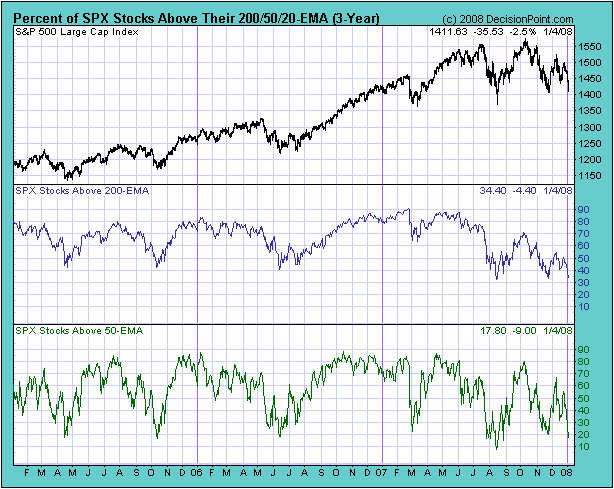
likely be in place by the end of this week. We note, in particular,
that at 25.7% the bullish consensus indicated by the latest AAII
sentiment survey is close to its lows of the past decade, and that the
percentages of S&P500 stocks trading above their 200-day and 50-day
moving averages are near their lows of the past 4 years (refer to the
following chart for details).
It will be
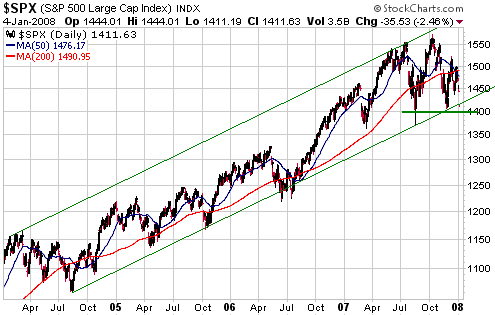
interesting to see whether the S&P500 can hold above 1400. The
S&P500 hasn't closed below 1400 since 16th March of last year, and,
as evidenced by the following chart, a close below 1400 would breach
significant lateral and channel support.
We suspect that if a break below 1400 were to occur this week it
wouldn't be sustained because it would be occurring with the market
near an oversold extreme. However, it would still have bearish
implications beyond the next few weeks in that it would be evidence
that the market's intermediate-term trend had turned downward.
This week's
important US economic events
| Date |
Description |
Monday Jan 07
| No important events scheduled
|
| Tuesday Jan 08 | Consumer Credit
| | Wednesday Jan 09
| No important events scheduled
| | Thursday Jan 10
| No important events scheduled
| | Friday Jan 11
| Trade Balance
Import and Export Prices
|
Gold and
the Dollar
Currency Market Update
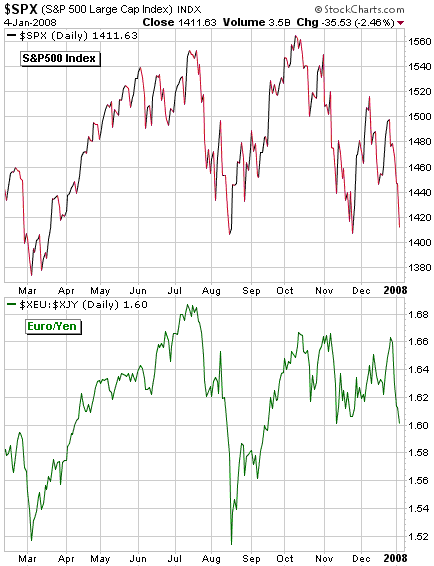
Although the relationship between the US stock market and the euro/yen
exchange rate has weakened a little over the past two months, the
following chart shows that euro/yen and the S&P500 are still moving
together. That is, the Yen is still tending to strengthen against the
euro when the stock market declines and weaken against the euro when
the stock market rallies.
The euro/yen-SPX relationship suggests that if the stock market is
close to a short-term bottom then the Yen is close to a short-term
peak. If we were long the Yen we would therefore be looking to take
profits over the coming week or so.
The US employment
numbers reported last Friday were very weak, but we pay almost no
attention to economic data produced by the US government because the
data are lagging indicators at best and often bear little resemblance
to what's really happening. Our only interest is in the way the
financial markets react to the data.
Friday's market reaction -- a knee-jerk sell-off in the US$ in the
immediate aftermath of the employment report followed by the retracing
of the knee-jerk reaction -- suggests that the Dollar Index is going to
move higher over the coming 1-2 weeks.
Gold
2008 Outlook
We are presently short-term bullish on both gold and the US$, but this
does not mean that we expect gold and the Dollar Index to rally
together over the next few months. Rather, it means that we think the
upside potential outweighs the downside risk in both markets. In the
case of the Dollar Index we think that a bottoming process is underway
and that while this process continues the downside risk will be limited
to a test of the November low (74-75). In gold's case, the potential
will exist for significant additional gains until the dollar's
bottoming process is almost complete, following which a sizeable
gold-market correction is likely to begin.
If the dollar's current bottoming process follows the typical
historical pattern then it will take 3-4 months to complete, after
which a strong multi-month rebound should begin. This suggests to us
that intermediate-term US$ rally will start before the end of March and
that gold will reach an intermediate-term peak during the first two
months of the year (since turning points in the gold market usually
lead turning points in the currency market).
We expect that yield and credit spreads will continue to widen during
2008; that real interest rates will remain low; and that financial
market volatility will increase. If so then the backdrop will remain
'gold bullish' and a US$-inspired 2-4 month downturn in the gold market
during the first half of the year will be followed by another powerful
advance. Our guess is that gold will end 2008 above $1000, but will
trade below $750 at some point during the first half of the year.
Gold's upward trend relative to the base metals should continue during
2008. Also, we expect that gold will move sharply higher relative to
oil.
Current Market Situation
Further to the above discussion, we suspect that gold is within about 6
weeks of an important peak. In the mean time, however, significant
additional gains are likely.
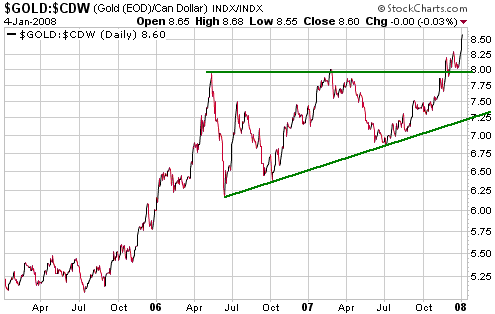
The following chart shows that in C$ terms gold broke out to the upside
from an 18-month consolidation late last year. It then pulled back to
'test' the breakout before resuming its advance. This price action
suggests additional upside of 10-20% over the coming 1-2 months.
Gold Stocks
2008 Outlook
With one exception (Gold Fields Ltd), we perceive considerably more
downside risk in the major gold stocks than in gold bullion and only
slightly more upside potential. As a result, we don't see a good reason
to take long-term investment positions in the major gold stocks. This
has, in fact, been our view for at least four years. The major gold
stocks periodically become oversold relative to gold bullion and at
such times they make good trading vehicles, but on a longer-term basis
they are not worth the hassle. There are simply too many things that
can go wrong with them compared to the amount of additional upside
potential they offer. In our opinion, if you are risk-tolerant and
looking for ways to leverage gains in the price of gold bullion then
you should own a portfolio comprising mid-tier and junior gold mining
equities, but if you are risk averse you should focus on gold bullion
or gold bullion surrogates such as GLD.
The gold-stock indices can be expected to track gold bullion during
2008, falling further during gold-market corrections and rebounding
faster thereafter. However, if the broad stock market were to become
very weak then we could encounter a period during which the gold sector
falls while gold bullion rises.
We expect to see an increase in takeover activity in the gold sector
during 2008, with mid-tier miners seeking to acquire juniors and majors
seeking to acquire mid-tiers.
Possible surprises:
1) Barrick Gold makes a takeover bid for Kinross Gold
2) A major diversified miner (BHP, Rio Tinto, Xstrata, etc.) decides to
increase its exposure to gold by making a takeover bid for a major gold
mining company
Current Market Situation
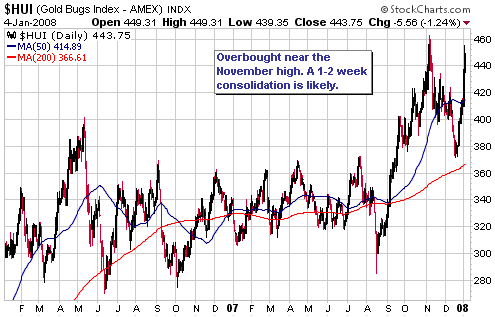
The following chart shows that the HUI has rocketed upward over the
past couple of weeks. As a result, there will probably be some
consolidation over the coming days as traders take profits.
Note that a bearish divergence between gold stocks and gold bullion
will remain in place until the HUI closes above its early-November high
of 463 (as things currently stand, gold bullion's recent move to a new
all-time high has not been confirmed by the gold-stock indices). The
current divergence between the stocks and the metal is bearish because
the stocks tend to lead at important turning points.
Chances are that this bearish divergence will be eradicated within the
next couple of weeks, but until/unless that happens it will be prudent
to take precautions (boost cash reserves or perhaps purchase some
insurance in the form of GDX put options).
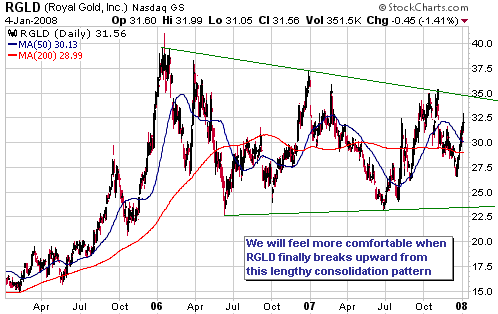
Even though we don't
have any financial interest in the stock, one thing that continues to
bother us is the failure of Royal Gold (NYSE: RGLD) to break upward
from the drawn-out consolidation pattern shown on the following chart.
RGLD is the purest play on gold within the universe of gold-mining
equities, so the fact that it has made a sequence of declining tops
since January of 2006 is more than a little strange given the
performance of the bullion market.
As has been the case
for the past few years, our main focus for 2008 will almost certainly
remain on the junior end of the gold mining sector. The juniors,
especially the exploration-stage miners, were a source of considerable
frustration during the second half of last year because they generally
failed to respond in a meaningful way to the strong advance in the gold
price. However, the nature of the junior end of the resource market is
that all of the gains tend to occur in 10% of the time, with prices
drifting lower or going nowhere over the remaining 90% of the time.
Also, the prices of junior mining stocks are often poorly correlated in
the short-term with the prices of the underlying commodities. As a
result, to be a successful speculator in junior gold and other resource
shares you need a lot of patience and foresight.
We imagine that people who only became involved with junior gold shares
over the past year are feeling disgruntled because they haven't yet
experienced, first hand, what happens to these stocks when the
speculative juices begin to flow, whereas those who have been involved
in the sector for at least 2-3 years will realise just how quickly
prices rise once the rise begins.
Update
on Stock Selections
(Note: To review the complete list of current TSI stock selections, logon at http://www.speculative-investor.com/new/market_logon.asp
and then click on "Stock Selections" in the menu. When at the Stock
Selections page, click on a stock's symbol to bring-up an archive of our comments on the stock in question)
 Friday's
stock market plunge took the Semiconductor HOLDRS Trust (SMH) below our
'stop'. SMH will therefore be removed from the Stocks List at a loss of
around 11%. However, with the semiconductor sector having just fallen
for six trading days in a row and with the overall market now at an
oversold extreme there is a good chance that SMH will soon begin to
rebound. Therefore, instead of exiting immediately it probably makes
sense for those who are still 'long' to retain their position in
anticipation of at least a 5-10% bounce. Friday's
stock market plunge took the Semiconductor HOLDRS Trust (SMH) below our
'stop'. SMH will therefore be removed from the Stocks List at a loss of
around 11%. However, with the semiconductor sector having just fallen
for six trading days in a row and with the overall market now at an
oversold extreme there is a good chance that SMH will soon begin to
rebound. Therefore, instead of exiting immediately it probably makes
sense for those who are still 'long' to retain their position in
anticipation of at least a 5-10% bounce.
Chart Sources
Charts appearing in today's commentary
are courtesy of:
http://stockcharts.com/index.html
http://www.futuresource.com/
http://www.decisionpoint.com/

|