-- Weekly Market Update for the Week Commencing 7th March 2016
Big Picture
View
Here is a summary of our big picture
view of the markets. Note that our short-term views may differ from our
big picture view.
The BULL market in US Treasury Bonds
that began in the early 1980s ended in early-2015, but there will be many years
of topping action in bond prices and bottoming action in bond yields before
major new trends get underway. (Last update: 29 June 2015)
The stock market, as represented by the S&P500 Index,
commenced
a secular BEAR market during the first quarter of 2000, where "secular
bear market" is defined as a long-term downward trend in valuations
(P/E ratios, etc.) and gold-denominated prices. This secular trend will bottom sometime between 2018 and 2020.
(Last update: 29 June 2015)
A secular BEAR market in the
US
Dollar
began during the final quarter of 2000 and ended in July of 2008. This
secular bear market will be followed by a multi-year period of range
trading.
(Last
update: 09 February 2009)
Gold commenced a
secular bull market relative to all fiat currencies, the CRB Index,
bonds and most stock market indices during 1999-2001.
This secular trend will peak sometime between 2018 and 2020.
(Last update: 29 June 2015)
Commodities,
as represented by the CRB Index, commenced a
secular BULL market in 2001 in nominal dollar terms. The first major
upward leg in this bull market ended during the first half of 2008, but
a long-term peak won't occur until 2018-2020.
(Last
update: 29 June 2015)
Copyright
Reminder
The commentaries that appear at TSI
may not be distributed, in full or in part, without our written permission.
In particular, please note that the posting of extracts from TSI commentaries
at other web sites or providing links to TSI commentaries at other web
sites (for example, at discussion boards) without our written permission
is prohibited.
We reserve the right to immediately
terminate the subscription of any TSI subscriber who distributes the TSI
commentaries without our written permission.
Outlook Summary
Market
|
Short-Term
(1-3 month)
|
Intermediate-Term
(6-18 month)
|
Long-Term
(2-5 Year)
|
|
Gold
|
N/A |
Bullish
(26-Mar-12) |
Bullish
|
|
US$ (Dollar Index)
|
N/A |
Bullish
(29-Feb-16) |
Neutral
(19-Sep-07) |
|
US Treasury Bonds (TLT)
|
N/A |
Bearish
(19-Oct-15)
|
Bearish |
|
Stock Market
(DJW)
|
N/A |
Bearish
(30-Dec-15) |
Bearish
|
|
Gold Stocks
(HUI)
|
N/A |
Bullish
(23-Jun-10) |
Bullish
|
|
Oil |
N/A |
Neutral
(26-Oct-15) |
Bullish
|
|
Industrial Metals
(GYX)
|
N/A |
Neutral
(09-Nov-15) |
Bullish
(28-Apr-14) |
Notes:
1. Our short-term expectations are discussed in the commentaries, but except in
special circumstances we won't attempt to assign a "bullish", "bearish" or
"neutral" label to these expectations.
2. The date shown below the current outlook is when the most recent outlook change occurred.
3. "Neutral" means that we think risk and reward are roughly in balance with respect to the timeframe in question.
4. Long-term views are determined almost completely by fundamentals and intermediate-term views
are determined by a combination of fundamentals, sentiment and technicals.
Last week's posts at the TSI Blog
Gold and Confidence
Latest thoughts on BitGold/Goldmoney
The commodity bear
market is over!
Overview
Despite the title of this section, which includes an exclamation mark for
dramatic effect, we don't know that the commodity bear market is over. There has
been a short-term reversal that could evolve into a long-term reversal, but it
is far too soon for a rational observer to be sure.
As mentioned in previous TSI commentaries*, the most important sign pointing to
a sustained turnaround in the commodity world is the evidence of a sustained
turnaround in the US$ gold price. Gold tends to lead the commodity indices and
the industrial metals at major price bottoms, so gold's ability to breach
long-term moving averages and resistance levels during the rally that got
underway last December differentiates the latest rebound in the commodity world
from the counter-trend moves of the past few years.
If a major commodity-price reversal is, indeed, in progress, then we've seen the
peak in irrational deflation fear and the entire deflation-centric trade that
involved, amongst other things, absurdly-low yields for government bonds.
*For example, refer to the "Anticipating a copper
turnaround" section in the 15th February Weekly Update.
Commodities and emerging-market equities
The performance of the gold market differentiates the latest short-term rally in
the commodity world from the bear-market rebounds of the past few years, but in
isolation it isn't enough to ensure a different intermediate-term outcome. For
example, although it wasn't supported by a decisive reversal in the gold market,
a commodity-price rally during the first half of last year also showed early
signs of being sustainable but turned out to be just another correction within a
bear market.
Based on the historical record, a confirmed long-term reversal in the relative
strength of emerging-market equities would be the most definitive evidence of a
major upward reversal in the commodity world that would be timely enough to
still be useful. The following weekly chart provides more detail.
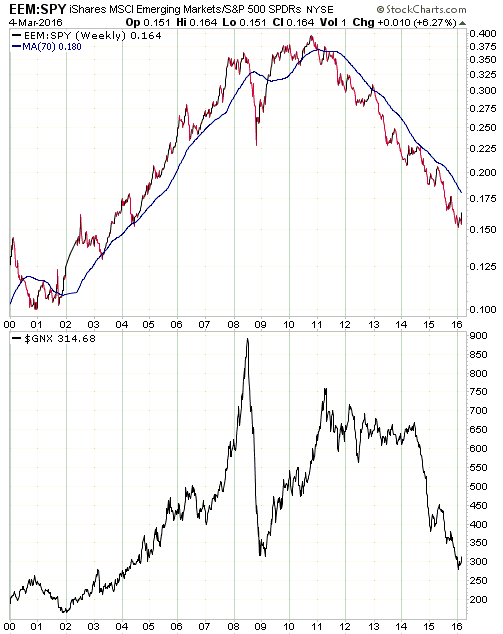
The chart compares the EEM/SPY ratio (the Emerging Markets ETF relative to the
S&P500 ETF) with the Goldman Sachs Spot Commodity Index (GNX). The blue line on
the top section of the chart is EEM/SPY’s 70-week MA. The EEM/SPY ratio trends
in the same direction as GNX and generally leads the commodity index at major
turning points, with trend reversals confirmed by EEM/SPY breaking above/below
its 70-week MA.
We will therefore take a weekly close in the EEM/SPY ratio above its 70-week MA
as confirmation that the commodity bear market is over. However, we aren't
waiting for that to happen before starting to average into non-gold commodity
stocks. Instead and as per the comments in TSI reports over the past few weeks,
the averaging-in process has begun. It's just that the process will end
prematurely if the price action stops pointing in the right direction.
Commodity indices and commodity shipping
The current situation of the dry bulk shipping industry (the business of
transporting dry commodities such as grains and iron-ore across the oceans) is
so bad it seems hopeless. Weighed down by a glut of shipping capacity and the
slowing of economic activity in China, the start of a recovery in the
ocean-going freight rates that comprise the Baltic Dry Index (BDI) would appear
to be years away. However, IF we are seeing the early signs of a sustained
turnaround in commodity prices (a big if, obviously) then the start of a
recovery in the BDI is a lot closer than generally believed.
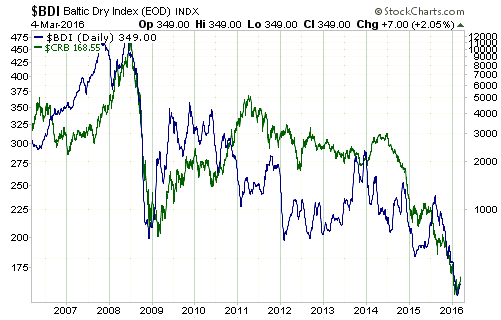
The reason is the positive correlation between the BDI and the CRB Index
illustrated by the following chart. Both indexes plunged from August of last
year through to mid-February of this year and then turned upward. The up-turns
have been minor to date, but the point is that a sustained recovery in one would
very likely go hand-in-hand with a sustained recovery in the other.
Oil
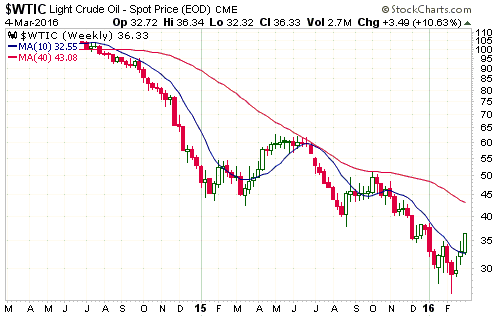
Last week we got preliminary evidence of an intermediate-term oil-price reversal
in the form of a weekly close above the 10-week MA (the blue line on the
following chart). A weekly close above the 40-week MA (the red line on the
following chart) would be more conclusive evidence of such a reversal. Notice
that the 40-week MA capped last year's rallies in the oil market.
A 'V' bottom in the oil market is unlikely, especially if the stock market is
destined to make new lows later this year. This is because the oil and stock
markets have been positively correlated and are likely to remain so. Rather than
a consistent upward trend, what we expect from here is a rebound top within the
next two months and then a decline to test the January low.
Copper
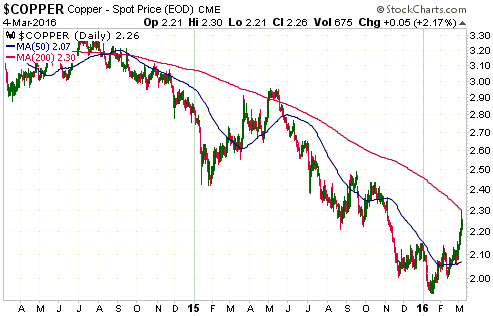
The copper price moved quickly up to its 200-day MA at $2.30 last week. There
could be some consolidation over the coming week or two, but the latest
Commitments of Traders (COT) numbers suggest that additional price gains will be
made prior to a short-term top. As mentioned in previous commentaries over the
past year, the COT situation has been a useful indicator of short-term tops and
bottoms in the copper price.
Our guess is that copper's rebound will peak at around $2.40, after which there
will be a decline to test the January low. We'll try to be flexible and take the
evidence as it comes, but at this stage we expect that a decline to test the
January low will create the next good opportunity to purchase exposure to
copper.
The Stock Market
The US
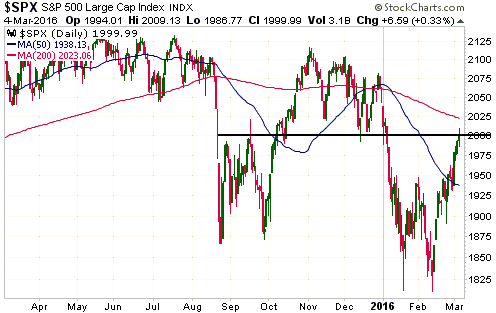
For the SPX's short-term rebound from its January-February double bottom we have
cited lateral resistance at 1990-2000 as the minimum target, the 200-day MA in
the 2020s as the most likely target and lateral resistance at 2075 as the
maximum target. 2075 is as far as a rally could go without invalidating the
bear-market scenario.
Last week's intra-day peak was 2009 and last week's close was 2000. This means
that the first target area has been thoroughly tested and that the price has
already come within 1% of the most likely target.
For the reason discussed in last week's Interim Update (the unusually high level
of the McClellan Oscillator), a large decline probably won't happen over the
next few weeks. In fact, the historical record suggests that the market will
trade sideways or drift higher over the next few weeks. However, our assessment
of risk relative to reward suggests that now is the right time to start building
a new US stock market bearish position. That's what we are doing, both in our
own account and for TSI record purposes.
In the 2nd March Interim Update we said that the QID July-2016 $40 call option
would be added to the TSI List if it traded at US$1.50 (QID is a leveraged bear
fund). The option traded as low as $1.45 on Friday and has therefore been added
to the List at $1.50.
If the market maintains an upward bias for a few more weeks without invalidating
the bear-market scenario then we will probably add a second QID call option
position to the List, but we think it's important to take an initial position
now to be covered against the risk of the next downward leg beginning sooner
than expected.
This week's
significant US economic events
[Notes:
1) The most important events
(to the markets) are shown
in bold. 2) A list of global economic events can be found
HERE]
| Date |
Description |
| Monday Mar 07 |
Consumer Credit |
| Tuesday
Mar 08 |
No important events
scheduled |
| Wednesday
Mar 09 |
No important events
scheduled |
| Thursday
Mar 10 |
Treasury Budget |
| Friday
Mar 11 |
Import and Export Prices |
Gold and the Dollar
Gold
The Fundamentals
The US$ gold price bottomed in early-December, but an upward trend didn't get
underway until the low was successfully tested in mid-December. The upward trend
actually began the day after the Fed's first rate hike.
It was certainly not a surprise to us that a substantial gold rally began one
day after the Fed took a baby step away from ZIRP (Zero Interest Rate Policy).
It was exactly in line with what we were writing in TSI commentaries during the
weeks leading up to the rate hike.
That such a strong gold rally occurred during the months immediately following a
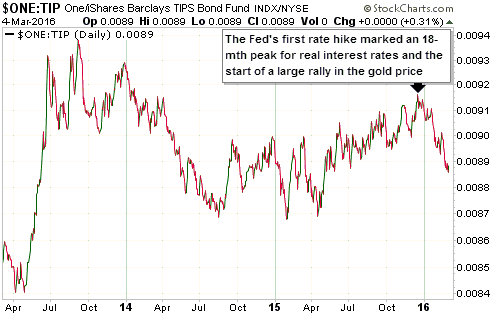
Fed rate hike can be explained by the behaviour of real US interest rates. As
illustrated by the following chart of 1/TIP (the reciprocal of the iShares TIPS
Bond Fund -- a proxy for the real US long-term interest rate), the Fed's first
hike coincided with an 18-month peak and the start of a multi-month decline in
the real interest rate. The real US interest rate is one of the six main
fundamental drivers of the US$ gold price, with a downward trend being bullish
and an upward trend being bearish.
We noted in mid-January that from gold's perspective the fundamental backdrop
had shifted from neutral to bullish. Despite the real interest rate turning
gold-bullish, the overall fundamental backdrop has just shifted back to neutral.
The reason is the reversal from relative weakness to relative strength in the
banking sector along with the reversal from widening to narrowing in our
favourite indicator of credit spreads.
This doesn't imply anything about the short-term performance of the gold price,
although there are reasons that are unrelated to the fundamentals to expect a
correction over the weeks ahead.
The Price Action
Over the past two weeks our assessment of gold's current market situation can be
summarised as follows:
a) On a short-term basis the market is almost as 'overbought' as it ever gets,
which suggests that the start of a downward correction is not far away and that
the short-term risk/reward is no better than neutral.
b) Until a short-term reversal is confirmed via a daily close below the 20-day
MA, a quick move to a new high for the year will remain a realistic possibility.
We noted that round-number resistance at $1300 and the January-2015 peak at
$1308 would be near-term targets if the February top of $1264 was breached.
Based on the gold market's initial reaction to the US employment news last
Friday it looked like a rise to the $1300-$1308 resistance range was about to
happen (the downward spike and then upward reversal following the
stronger-than-expected jobs growth number was bullish price action). However,
after trading as high as $1281 the price reversed course and ended the day $4
below its 11th February top.
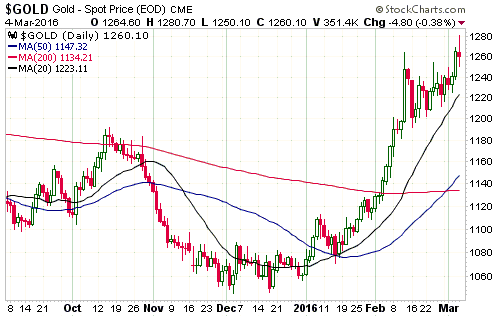
At the end of the day, Friday's price action was slightly bearish. However, a
short-term top still hasn't been signaled. Such a signal will be generated when
the gold price closes below its 20-day MA, which ended last week at $1223 and
will be in the $1230s by the end of this week.
When we zoom out to look at the bigger picture it becomes clear that the gold
price is only stretched to the upside on a short-term basis. The following
monthly chart suggests that on a long-term basis a gold rally has only just
begun.

Gold Stocks
Revisiting our 2016 forecast
Our 2016 forecast was for the HUI to gain at least 50% within two months of a
major Q1 bottom and end the year at least 100% above whatever low it made during
the first quarter. Given that the bottom turned out to be near 100 in January,
our forecast was for the HUI to move up to at least 150 by March and to end the
year above 200.
This forecast probably seemed overly optimistic to many of our readers when it
was published, but it was based on the historical record. In particular, the
leading gold-mining index had never experienced a gain of less than 50% within
the first two months of a cyclical bull market. However, the actual rally since
the January bottom was even faster than predicted by the historical record. In
fact, it resulted in the fastest 70% gain from a multi-year bottom in history,
although the current rally will fall behind the pace of the record-setting (at
the time) late-2008 rally unless the HUI rockets up to 200 this week.
The extreme speed of the rise from this year's low is evidence that we are
dealing with the start of a bull market, but there is no need to alter our 2016
forecast since our forecast assumed that a bull market would start during the
first quarter.
Our guess, at this time, is that the HUI's 2016 peak will be around 250.
Considering what happened over the past few weeks this will probably seem overly
pessimistic to many of our readers, but, again, it is based on the historical
record. The first intermediate-term upward trend during a gold-mining bull
market tends to peak near the 200-week MA, which is presently near 250.
Current Market Situation
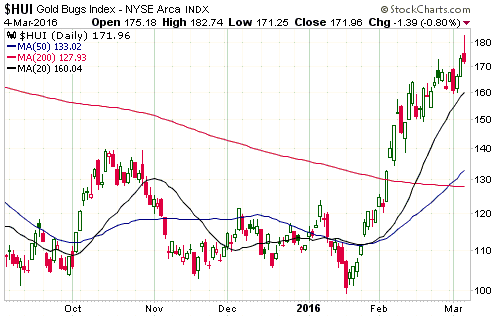
As is the case with gold, the HUI rose sharply to a new high for the year last
Friday before giving up all of its gain and then some. This is slightly bearish,
but as is also the case with gold the HUI hasn't yet signaled a short-term top.
We would now view a daily close below 160 as evidence that a short-term top was
in place and that a decline to the 50-day MA was underway.
On a related matter, we won't be surprised if it turns out that the non-gold
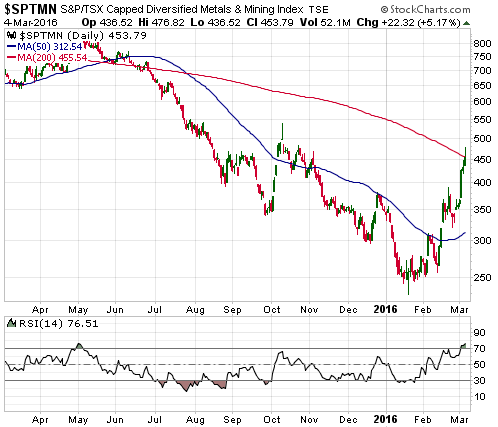
mining sector, as represented by the Diversified Metals and Mining Index (SPTMN),
made a short-term top last Friday. As illustrated by the following chart, SPTMN
is now very stretched to the upside and spiked above its 200-day MA on Friday
before giving up enough of its gain to end the day below this MA.
The Currency Market
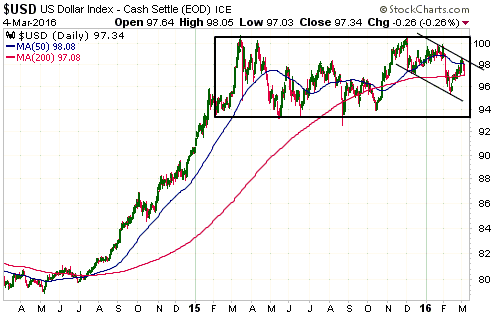
The Dollar Index broke above short-term lateral resistance during the week
before last and pulled back to its 200-day MA last week. This left it just above
the middle of the horizontal range in which it has spent the past 12 months. An
upside breakout from this range is likely, but could still be a few months away.
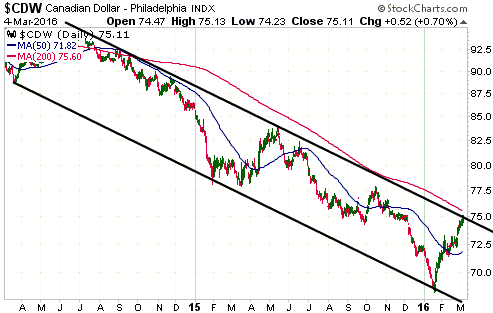
The rebounds in commodity prices have unsurprisingly been accompanied by a
rebound in the Canadian Dollar (C$). In fact, the rebound in the C$ led the
recent commodity upturn.
The C$ is now 'overbought' on a short-term basis and, as illustrated below, at
the top of a well-defined 2-year channel. Consequently, even if it made a
long-term bottom in January it probably won't make significant additional
headway in the near future. In other words, it is reasonable to expect a
downward correction to soon begin.
If the C$ corrects/consolidates for a few weeks and then breaks above its
channel top we would have solid evidence that a reversal of at least
intermediate-term importance had occurred.
Updates
on Stock Selections
Notes: 1) To review the complete list of current TSI stock selections, logon at
http://www.speculative-investor.com/new/market_logon.asp
and then click on "Stock Selections" in the menu. When at the Stock
Selections page, click on a stock's symbol to bring-up an archive of
our comments on the stock in question. 2) The Small Stock Watch List is
located at http://www.speculative-investor.com/new/smallstockwatch.html
 Company
news/developments for the week ending Friday 4th March 2016:
Company
news/developments for the week ending Friday 4th March 2016:
[Note: AISC = All-In Sustaining Cost, FS = Feasibility Study, FY = Financial
Year, IRR = Internal Rate of Return, MD&A = Management Discussion and Analysis,
M&I = Measured and Indicated, NAV = Net Asset Value, NPV(X%) = Net Present Value
using a discount rate of X%, P&P = Proven and Probable, PEA = Preliminary
Economic Assessment, PFS = Pre-Feasibility Study]
*Endeavour Mining (EDV.TO) made four noteworthy announcements last
week.
First, it announced its year-end reserves and resources. There were substantial
increases, but these were almost entirely due to the purchase of the Ity mine in
Cote d'Ivoire. Resources and reserves were roughly unchanged across EDV's other
mines, which means that the company replenished what it produced.
Second, it announced that it has sold its Youga mine (Burkina Faso) to a private
Turkish company for about US$25M in cash and a 1.8% Net Smelter Return (NSR)
royalty on future production. The Youga mine is forecast to produce about 40K
ounces of gold in 2016 and is in the final two years of its expected life.
We would have preferred that EDV had expanded Youga's life via exploration or
acquisition instead of selling the operation. However, the NSR royalty allows
the company to retain some exposure to the potential extension of Youga's life
and the cash injection further strengthens EDV's balance sheet.
With the improvement in the gold price and the strengthening of its balance
sheet it's likely that EDV will soon announce that it is moving the Hounde gold
project, which is also in Burkina Faso, into the construction phase.
Hounde is expected to have average annual production of 190K ounces at a low
AISC of around US$720/oz and an after-tax IRR of 31.4% at $1250/oz. The initial
capital cost is estimated at US$325M. Assuming that a construction decision is
made within the next couple of months, Hounde could be in production by the end
of next year.
EDV's third announcement for the week was its 2015 financial results and updated
guidance. Most of the salient financial numbers had been reported in January,
but the new information included a net profit of US$0.99 (C$1.34) per share. Due
to the sale of the Youga mine, 2016 production guidance was reduced from
575K-600K ounces to 535K-560K ounces. The AISC is expected to be about
US$900/oz.
We have previously estimated fair value for EDV to be around C$15/share at a
gold price of US$1200/oz. Some quick calculations reveal that the estimated fair
value rises to around C$20/share at a gold price of US$1300/oz and a C$/US$
exchange rate of 0.74, but these calculations were made prior to the news
contained in EDV's fourth announcement of the week. We haven't yet had time to
assess the effect on EDV's valuation of the news discussed below, although we
suspect that the effect will be slightly negative.
EDV's final and also most important announcement of the week came prior to the
start of trading on Friday 4th March. The announcement was EDV's agreement to
purchase True Gold Mining (TGM.V) in an all-stock deal (0.044 shares of EDV for
each share of TGM).
For two reasons, this deal is a little irksome for us. The first reason is that
although TGM's newly-constructed Karma gold mine in Burkina Faso is a good asset
and probably worth what EDV has agreed to pay, TGM comes with significant
financial baggage in the form of a streaming deal. Gold streaming deals are like
debt that becomes more burdensome as the gold price rises. They reduce the
earnings leverage to the gold price.
The second reason we were irked by Friday's news is that TGM was removed from
the TSI Stocks List only a few weeks ago and had originally been added to the
List partly to mitigate the risk that EDV would buy it. We thought that if TGM
were going to be bought, it would have happened well before now. We were
obviously wrong.
Due to the "streaming" liability we currently view the takeover of TGM
unfavourably, but it isn't a deal-breaker for us and probably won't cause
significant weakness in the stock price beyond last Friday's sharp pullback. Our
guess is that EDV will hold at former long-term resistance (now major support)
at C$9.50-$10.00 during the coming sector-wide correction and make its way up to
C$15-C$20 later this year.
*Energy Fuels (EFR.TO, UUUU) announced that it is purchasing the
40% of the Roca Honda uranium project (New Mexico) it doesn't already own at a
cost of $2.5M in stock and cash. Roca Honda will probably require a uranium
price of $70/pound to become viable, but this looks like a reasonable deal for
EFR as it adds about 10M pounds to the company's in-ground uranium inventory at
a small cost.
*Petrus Resource (PRQ.TO) has drifted lower since being added to
the TSI List a couple of weeks ago. This is despite the rebound in the oil price
and the O&G sector of the stock market.
PRQ was added as a long-term position, meaning that if the story unfolds roughly
as expected it could be in the TSI List for years. Short-term fluctuations in
the stock price therefore aren't important assuming they aren't the result of
negative fundamental changes. Such fluctuations to the downside simply create
opportunities to average into a position and generally don't require any
analysis or explanation. In this case, however, we think we can provide the
explanation.
Due to PRQ's takeover of Phoscan (FOS.V) earlier this year, FOS shareholders
received a total of 6.9M PRQ shares. Many of these former FOS shareholders are
probably now selling. With PRQ still being relatively unknown and illiquid, the
selling by these former FOS shareholders that ended up with PRQ shares by
default is probably what's keeping the stock under pressure.
This has led to a better buying opportunity than we expected.
*Pretium Resource (PVG) closed its latest equity financing last
week. The over-allotment option was exercised in full by the underwriters,
meaning that the company ended up issuing 28M new shares to raise US$130M as
opposed to the originally-slated 26M new shares to raise US$120M. Although the
exercising of the over-allotment option marginally lowers the per-share value,
it is a net plus because it indicates strong demand for PVG shares in the
mid-US$4 area.
*Resolute Mining (RSG.AX) published its half-year report for the
2016 Financial Year (FY).
The results were very good and included a net half-year profit of A$62M*
(A$0.097/share), operating cash flow of A$70M, and a reduction in net debt from
A$64M to A$22M. Production during the half was 153K ounces at an AISC of A$1247
(US$902) per ounce.
RSG remains on track to achieve its 315K-oz production guidance for the 2016 FY
and has the financial capacity to invest in future growth. Future growth is
expected to come mostly from the Syama underground gold project (Mali) and the
Bibiani gold project (Ghana). Feasibility Studies for these projects are
scheduled to be completed within the next few months.
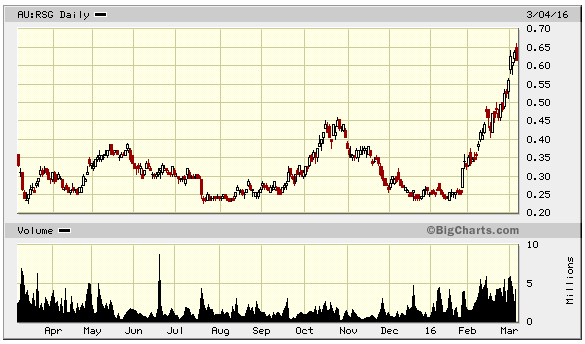
RSG's stock price gained more than 170% from its January low to its February high.
Even at last Friday's high of A$0.66 the stock offered good value (at the
current gold price our valuation is north of A$1.00), but sharp rallies are
almost always at least partially retraced regardless of value.
Assuming that the evidence of a sustained upturn in the gold price stays intact,
a pullback in the RSG stock price to A$0.45-$0.50 would create a new buying
opportunity.
*Excluding a one-off non-cash accounting adjustment that
added A$45M to the headline profit result.
*Timmins Gold (TGD) has been one of the biggest percentage gainers
since the January bottom in the gold-mining sector. It ended last week up 250%
from its January low and at last Friday's peak it was up by 300% from its
January low.
These large percentage gains are mostly due to the extent to which the stock
under-performed over the preceding 12 months and have not come close to
returning the stock to 'fair value', although what constitutes fair value in
this case is vastly different with gold above $1250/oz than it would be with
gold below $1150/oz. A sustained move above $1250/oz in the gold price would add
several years to the life of TGD's San Francisco gold mine (Mexico) and mean
that fair value was probably at least three times the current price, whereas a
return to a gold price of $1150/oz or lower would mean that the company's
flagship asset was worth very little.
Another consideration is that the rising demand for gold-mining shares is
creating the opportunity for TGD to do an equity financing without diluting
existing shareholders to oblivion. We suspect that the company will soon grab
this opportunity.
*UEX Corp. (UEX.TO) advised that it has commenced exploration
drilling at the Christie Lake uranium project in Canada's Athabasca Basin. The
$2.75M drilling program will consist of 13-18 holes totaling approximately
10,000m and will be completed by late July or early August 2016.
UEX has an option to earn 70% of Christie Lake at a cost of C$22M over the
coming four years. Christie Lake has the potential to host an economic uranium
deposit and could add substantial value to UEX.
List
of candidates for new buying
From within the ranks of TSI stock selections the best candidates for new buying
at this time, listed in alphabetical order, are:
1) FCG at US$3.80-$4.00 (last Friday's closing price: US$4.28)
2) IVN.TO below C$0.75 (last Friday's closing price: C$0.81)
3) PRQ.TO (last Friday's closing price: C$2.70)
Note that the above list is limited to five stocks. It will sometimes contain
less than five, but it will never contain more than five regardless of how many
stocks are attractively priced for new buying.
The
FCG short-term trade
Despite the natural gas (NG) price hitting a 15-year low last week and ending
the week near its low, FCG, an ETF that holds the stocks of NG-producing
companies, gained about 25%. The reason is that FCG is being influenced more by
the performances of oil and oil-related equities than by NG. This is not
uncommon.
We will exit this trade within the coming two months. If all goes according to
plan then we will exit near the 200-day MA. If not, we will exit at a lower
level.
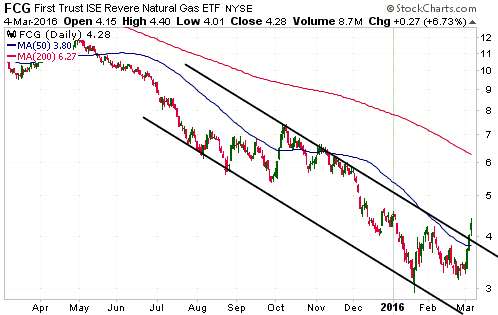
Chart Sources
Charts appearing in today's commentary
are courtesy of:
http://stockcharts.com/index.html
http://bigcharts.marketwatch.com/