|
-- Weekly Market Update for the Week Commencing 7th April 2008
Big Picture
View
Here is a summary of our big picture
view of the markets. Note that our short-term views may differ from our
big picture view.
Bonds commenced a secular BEAR market in
June of 2003. (Last
update: 22 August 2005)
The stock market, as represented by the S&P500 Index, commenced
a secular BEAR market during the first quarter of 2000, where "secular
bear market" is defined as a long-term downward trend in valuations
(P/E ratios, etc.) and gold-denominated prices. This secular trend will bottom sometime between 2014 and 2020. (Last update: 22 October 2007)
The Dollar commenced a secular BEAR market during the final quarter of 2000. The
first major downward leg in this bear market ended during the first
quarter of 2005, but a long-term bottom won't occur until 2008-2010. (Last update: 28 March 2005)
Gold commenced a
secular bull market relative to all fiat currencies, the CRB Index,
bonds and most stock market indices during 1999-2001. This secular trend will peak sometime between 2014 and 2020. (Last update: 22 October 2007)
Commodities, as
represented
by the CRB Index, commenced a secular BULL market in 2001. The first
major upward leg in this bull market ended during the second quarter of
2006, but a long-term
peak won't occur until at least 2008-2010. (Last update: 08 January 2007)
Copyright
Reminder
The commentaries that appear at TSI
may not be distributed, in full or in part, without our written permission.
In particular, please note that the posting of extracts from TSI commentaries
at other web sites or providing links to TSI commentaries at other web
sites (for example, at discussion boards) without our written permission
is prohibited.
We reserve the right to immediately
terminate the subscription of any TSI subscriber who distributes the TSI
commentaries without our written permission.
Outlook Summary
Market
|
Short-Term
(0-3 month)
|
Intermediate-Term
(3-12 month)
|
Long-Term
(1-5 Year)
|
Gold
|
Neutral
(04-Feb-08)
|
Bullish
(12-Nov-07)
|
Bullish
|
US$ (Dollar Index)
|
Bullish
(10-Mar-08)
| Bullish
(31-May-04)
|
Neutral
(19-Sep-07)
|
Bonds (US T-Bond)
|
Neutral
(03-Mar-08)
|
Bearish
(23-Jan-08)
|
Bearish
|
Stock Market (S&P500)
|
Bullish
(18-Mar-08)
|
Neutral
(26-Mar-07)
|
Bearish
|
Gold Stocks (HUI)
|
Neutral
(04-Feb-08)
|
Bullish
(14-Jan-08)
|
Bullish
|
| Oil | Bearish
(14-Jan-08)
| Bearish
(22-Oct-07)
| Bullish
|
Industrial Metals (GYX)
| Neutral
(28-Nov-07)
| Bearish
(09-Jul-07)
| Bullish
|
Notes:
1. In those cases where we have been able to identify the commentary in
which the most recent outlook change occurred we've put the date of the
commentary below the current outlook.
2. "Neutral", in the above table, means that we either don't have a
firm opinion or that we think risk and reward are roughly in balance with respect to the timeframe in question.
3. Long-term views are determined almost completely by fundamentals,
intermediate-term views by giving an approximately equal weighting to
fundmental and technical factors, and short-term views almost
completely by technicals.
Commodities
Natural Gas
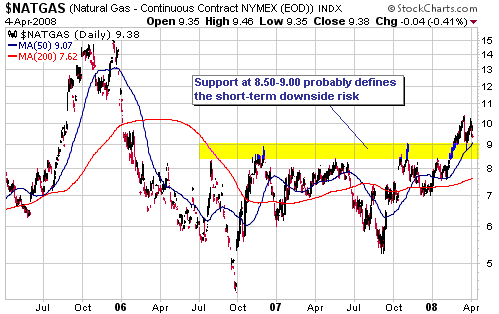
The following daily chart shows that natural gas (NG) broke out to the
upside from a 2-year base last month. This upside breakout was
primarily driven by a reduction in the US gas inventory. As evidenced
by the chart and table displayed at http://www.eia.doe.gov/oil_gas/natural_gas/ngs/ngs.html,
the US gas inventory is now very close to its 5-year moving average
(after being well above this moving average just four months ago) and
is about 20% lower than it was at the same time last year.
Interestingly, speculators in NG futures have maintained a sizeable
net-short position despite the bullish price action. This limits the
short-term downside risk and also adds to the potential upside.
From a
cyclical/seasonal perspective it is reasonable to expect the NG price
to reach a short-term peak within the coming month or so and to then
trend lower into July-September. We therefore think it will make sense
to scale out of NG trading positions as opportunities arise over the
next few weeks. From our perspective, this will entail looking for an
opportunity to take profits on the Chesapeake Energy call options that
were added to the TSI Stocks List in January.
We have long-term exposure to NG in the form of Canadian 'gassy' energy
trusts and currently expect to maintain this exposure, in line with our
very bullish long-term outlook for this commodity, for another 1-2
years.
Industrial Metals
We upgraded our short-term view on industrial metals (aluminium,
copper, lead, nickel and zinc) from "bearish" to "neutral" at the end
of November last year in anticipation of a Q1-2008 rally in this
commodity group. We never shifted all the way to "bullish" because: a)
our opinion was (and is) that the rally would be the counter-trend
variety (a rebound within the context of a cyclical bear market), and
b) most of the metals -- copper being a notable exception -- have never
really looked bullish during the intervening period from either
technical or fundamental perspectives.
We have been short-term bullish on copper over much of the past three
months due to the combination of constructive price action, increasing
backwardation in the copper futures market, and shrinking inventories.
These bullish factors remain in place so in all likelihood the copper
price has not yet reached a short-term peak, although the risk of a
downward reversal is building due to the imminent ending of the
seasonally strong period and the fact that the price is nearing
important resistance defined by the May-2006 high.
Our intermediate-term outlook for the industrial metals group remains
bearish due to the expected ramifications of slower growth in China,
the US housing depression, an additional contraction of
financial-market liquidity, and a rebound in the US$ relative to the
euro.
Palladium
Palladium is beginning to look interesting again. We featured the metal
and North American Palladium (AMEX: PAL), one of only two North
America-based companies with significant palladium production, in two
TSI commentaries in January. Palladium at the time was trading in the
$370s and PAL was trading at $3.70-$3.80. Thanks largely to the
power-supply problems that disrupted mining in South Africa, both the
metal and the featured mining stock did even better than we had
expected (the palladium price subsequently surged to $600 and PAL
rocketed up to around $9.50).
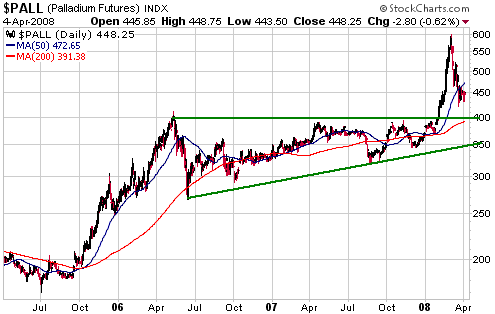
The speculative frenzy engulfing all things palladium (and platinum)
culminated in early March and a very sharp correction ensued. As
illustrated by the following chart, this correction has, to date,
retraced most of the gains that were made by palladium following its
upside breakout from a lengthy consolidation. The correction might not
be over, but with speculative enthusiasm having been wrung out of the
market and with the price approaching former long-term resistance (now
support) the downside risk appears to be quite low. At the same time
there appears to be considerable upside potential due to palladium's
extreme cheapness relative to platinum and the significant risk of
another supply disruption.
Further to the above,
traders should consider averaging into palladium in the low-to-mid
$400s and/or PAL in the $5-$6 range (PAL closed at US$5.98 on Friday).
The Stock
Market
Current Market Situation
The stock market is rebounding following March's successful test of the
January low, but because it is doing so in a gradual way most sentiment
indicators still reveal considerable negativity. For example, the
10-day moving average of the equity put/call ratio remains at a very
high level (0.80) and both the Investors Intelligence and AAII
sentiment surveys still show bears outnumbering bulls. This suggests to
us that the rebound is not yet anywhere near complete in terms of
either price or time.
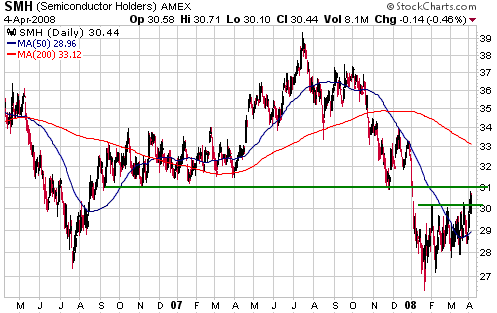
Furthermore, the charts of most stock market sectors, even the sectors
that don't appear to have much going for them on a fundamental level,
either look bullish or are beginning to turn bullish. For example, take
a look at the charts of the Homebuilders ETF (XHB) and the
Semiconductor ETF (SMH) displayed below. These ETFs seem to have
completed, or to be in the process of completing, basing patterns
capable of supporting significant additional gains over the coming 2-4
months.
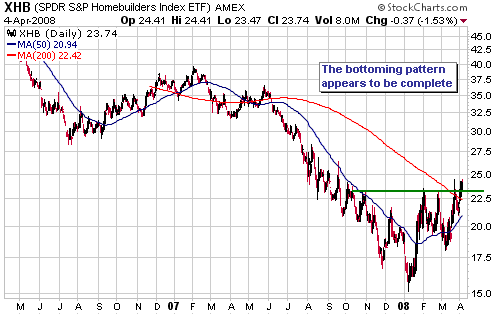
XHB's rebound might
seem strange in light of the horrible news backdrop for the
homebuilding industry, but it is quite normal for equities to bottom
well before underlying business conditions start to improve. This
happens because equity valuations inevitably get pushed to levels where
the bad news to come has been discounted in current prices. As we wrote
in our 7th January commentary: "...the
housing depression will most likely extend through 2008 and cause the
homebuilding business to become even worse than it is today, but the
homebuilding sector has already lost 75% of its collective market
capitalisation (as measured by the Dow Jones US Home Construction Index
-- DJUSHB). One or two major homebuilders will probably go bankrupt
before the depression runs its course, but the entire industry is not
going to disappear. Considering that the homebuilding sector's decline
is already in the same league as the NASDAQ's 2000-2002 bust it is
reasonable to assume that the stock market has come close to
discounting the worst in this case."
There is always something to worry about, though, and right now the
worry -- if you happen to be positioned for a bullish outcome in the
short-term -- is that the inter-market evidence has not yet confirmed
the stock market's upward reversal. To be specific, an upward
stock-market reversal with staying power should be confirmed by an
upward reversal in the US$ and downward reversals in the gold and bond
markets. There has, to date, been a decent-sized downward reversal in
gold, but bonds and the Dollar Index remain uncomfortably close to
their mid-March extremes. We think the most likely scenario is that the
stock market has completed its bottoming process and commenced an
upward trend that will last a minimum of two more months, but until the
bond and currency markets confirm the trend change we will have to
allow for the possibility of there being one more test of the January
low prior to the start of the anticipated multi-month advance.
Re-visiting the "1973 Model"
When we look back over the past 40 years of US stock market history we
come to the conclusion that 1973 contains the most similarities to the
present day. On a number of occasions over the past few months we have
therefore referred to 1973's market action in our analyses of both the
gold and stock markets. An example is the following excerpt from the
10th March Weekly Update:
"The "1973 Model", which we are applying in our analysis of the gold
sector, could also have relevance to the broad stock market. We have
therefore presented, below, a decisionpoint.com chart showing the US
stock market's performance during 1972-1974 (the top section of the
chart shows the NYSE Composite Index and the bottom section shows the
number of NYSE stocks making new lows).
Our thinking is that the May-1973 day on which there were more than
1100 new lows could be akin to 22nd January-2008 -- a day on which, for
only the fifth time in the past 40 years, there were also 1100+ new
lows. If we take the "1973 Model" literally then the current test of
the January low will be followed by a short rally and a second test of
the low next month, but the main point is that the May-1973 panic low
-- the equivalent of the 22nd January low -- was not decisively
breached for more than 5 months, even though a major bear market was in
progress."
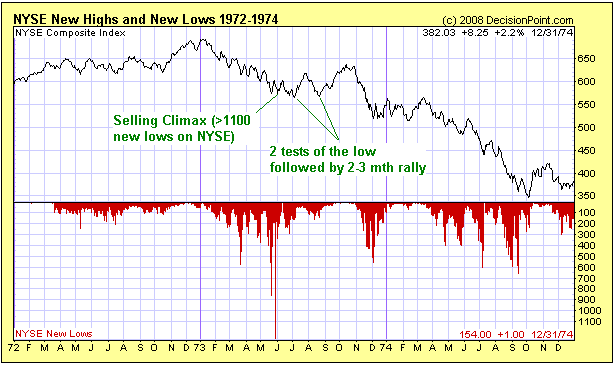
The "1973 Model"
continues to look like a reasonable representation of the current
situation in that a 2-4 month rebound is probably underway (as per
July-October of 1973), which will, we think, be followed by another
substantial decline (as per October of 1973 through to October of 1974).
We expect that two factors in combination will set the stage for a
decline to new lows once the current rebound runs its course. The first
of these factors is the S&P500's relatively high current valuation
(high price/earnings, price/sales, price/book and price/dividend
ratios). The stock market is quite capable of trending upward in the
face of a relatively high valuation, but only in a market environment
characterised by high (or rising) liquidity and increasing risk
tolerance. This is where the second factor comes into play. The second
factor is the expected continuation, following a 2-4 month respite, of
the great liquidity contraction and shift away from risk that began
last year.
This week's
important US economic events
| Date |
Description |
Monday Apr 07
| Consumer Credit
|
Tuesday Apr 08
| FOMC Minutes
| | Wednesday Apr 09
| No important events scheduled
| | Thursday Apr 10
| Trade Balance
| | Friday Apr 11
| Import and Export Prices
|
Gold and
the Dollar
Currency Market Update
Like the Yen, the Swiss Franc was a popular "carry trade" currency over
the past 1-2 years (it was borrowed in large quantities to finance
speculations in higher-yielding currencies). Therefore, like the Yen,
the SF became relatively strong once the equity markets of the world
began to trend lower and peaked in mid March concurrently with the
bottom for equities (carry trades were closed, putting upward pressure
on carry-trade currencies such as the Yen and the SF, when the
speculations they financed began to turn sour).
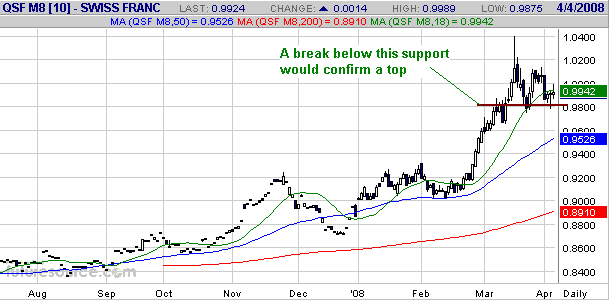
The June SF futures contract has pulled back quite sharply since its
mid-March peak, but still needs to close below the support drawn on the
following daily chart to confirm a downward trend reversal. We expect
such a trend change to be confirmed within the coming few weeks.
If the euro spikes to
a new high over the coming 1-2 weeks it will be interesting to see if
the new high is confirmed by the oil price and the SF. Oil and the euro
have moved in lock-step over the past year (a relationship most
recently discussed in the 31st March Weekly Update), so a genuine break
to a new high by the euro should coincide with the same outcome in the
oil market. Also, it's worth recalling that at the December-2004
intermediate-term turning point in the currency market there was a
divergence between the euro and the SF: both currencies peaked together
in early December of 2004 and then pulled back, after which the euro
rallied to a new high while the SF 'double topped'.
Gold
The following paragraph from last week's Interim Update remains applicable:
"We don't think gold's
correction is over, primarily because the rebounds in the US$ and the
US stock market have only just begun. However, we suspect that the
ultimate correction low won't be far below this week's low (we continue
to view the 850s as probable and the low-800s as a worst-case
possibility)."
Gold has rebounded after trading as low as the $870s early last week
and could rebound further over the coming 1-2 weeks, but we expect a
drop to a new correction low to precede the start of the next
multi-month advance.
Gold Stocks
An example of how large divergences can lead to large 'snap-backs'
In the 18th February Weekly Update and again in last week's Interim
Update we highlighted the large divergence between the US yield-spread
and the performance of the gold sector relative to gold bullion. To be
more specific, we noted that the huge widening of the US yield-spread
that had occurred over the past several months was very supportive of
gold stocks relative to gold bullion; and, therefore, that the extreme
current weakness in most gold stocks relative to gold bullion
constituted a divergence that would eventually be closed by substantial
relative strength in the stocks.
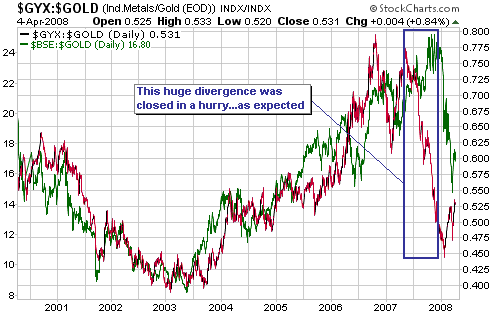
The following chart-based comparison of the GYX/gold ratio (the
Industrial Metals Index in gold terms) and the BSE/gold ratio (the
Indian stock market in gold terms) is a good example of how divergences
between fundamentally correlated markets can continue to build for some
time and then get resolved in a big hurry. In the 19th November 2007
Weekly Market Update we noted that a huge divergence had developed
between the GYX/gold ratio and the BSE/gold ratio, and concluded that: "...at
some point over the next several months the BSE/gold ratio will plunge
to a sufficient extent to bring itself back into line with the GYX/gold
ratio." This is exactly what happened.
Current Market Situation
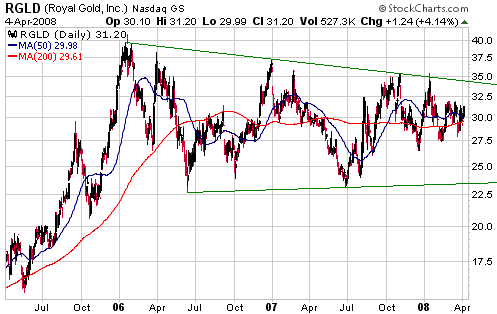
Regular TSI readers will be aware that we use Royal Gold (RGLD) as a
leading indicator of the overall gold sector. RGLD's failure over the
past 7 months to break its sequence of declining tops is an important
non-confirmation of the upside breakouts in the popular gold-stock
indices. We look forward to the day when RGLD moves decisively above
$35, thus signaling the beginning of a BROAD-BASED rally in the gold
sector.
The following excerpt from last week's Interim Update remains applicable:
"Wednesday's rebound
means that a low could have been put in place a little higher than
expected (we had suggested that the HUI would drop to test
intermediate-term support in the low-400s), but it is more likely that
a correction low is not yet in place. We suspect that more time, rather
than a significant amount of additional price weakness, will be needed
to bring the correction to an end.
Turning points in the
gold sector regularly occur during May-June, so it is probably
reasonable to expect the next correction low to occur during this time
window. In the mean time, we would view a HUI rebound to around 480 as
an opportunity to take some money off the table and/or buy some
insurance in the form of GDX put options."
Update
on Stock Selections
(Note: To review the complete list of current TSI stock selections, logon at http://www.speculative-investor.com/new/market_logon.asp
and then click on "Stock Selections" in the menu. When at the Stock
Selections page, click on a stock's symbol to bring-up an archive of our comments on the stock in question)
 NewNGD -- the company that will be formed by the merging of MRB, NGD and PIK.V NewNGD -- the company that will be formed by the merging of MRB, NGD and PIK.V
The following tables summarise the reserves/resources and forecast
annual production of the company we are presently calling NewNGD (to
differentiate it from the existing NGD).
|
|
Reserves and Resources
|
|
|
Gold (Moz)
|
Copper (Mlb)
|
| Company |
Project |
P&P
reserve |
M&I
Resource |
Inferred
Resource |
P&P
reserve |
M&I
Resource |
Inferred
Resource |
| NGD |
New Afton (Canada) |
1 |
1.6 |
0 |
1000 |
1500 |
0 |
| MRB |
Cerro San Pedro (Mexico) |
1.5 |
2 |
0 |
0 |
0 |
0 |
| |
El Morro (Chile) |
0 |
2.1 |
0.7 |
0 |
1650 |
531 |
| PIK |
Peak (Australia) |
0.4 |
0.5 |
0.4 |
0 |
0 |
0 |
| |
Amapari (Brazil) |
0.3 |
1 |
1.4 |
0 |
0 |
0 |
| |
|
|
|
|
|
|
|
| TOTAL |
|
3.2 |
7.2 |
2.5 |
1000 |
3150 |
531 |
|
|
Forecast Production
|
|
|
Gold (Koz)
|
Copper (Mlb)
|
| Company |
Project |
2008 |
2009 |
2010 |
2008 |
2009 |
2010 |
| NGD |
New Afton (Canada) |
0 |
0 |
82 |
0 |
0 |
78 |
| MRB |
Cerro San Pedro (Mexico) |
80 |
90 |
90 |
0 |
0 |
0 |
| |
El Morro (Chile) |
0 |
0 |
0 |
0 |
0 |
0 |
| PIK |
Peak (Australia) |
120 |
120 |
120 |
0 |
0 |
0 |
| |
Amapari (Brazil) |
100 |
150 |
200 |
0 |
0 |
0 |
| |
|
|
|
|
|
|
|
| TOTAL |
|
300 |
360 |
492 |
0 |
0 |
78 |
Table Notes:
1) The figures stated for M&I (Measured and Indicated) resources include P&P (Proven and Probable) reserves
2) We haven't included Cerro San Pedro's 62M ounces of silver reserves
and 2.1M ounces/year of silver production in the above tables because
we are assuming that this silver production will be accounted for as a
byproduct of the mine's gold production. That is, we are assuming that
money received from the sale of silver will be subtracted from the
company's production costs rather than added to its revenue. We haven't
included the Peak Mine's copper resources and production for the same
reason.
3) The El Morro resource included in the table is 30% of the total
project resource (since MRB owns 30%) and is based on a 0.40% copper
cut-off grade.
4) In some cases the figures included in our table differ from the
figures reported in the press release announcing the 3-way merger, but
the differences aren't material.
Estimated valuation of the new company:
We came up with a back-of-the-envelope valuation for NewNGD as follows:
a) We assigned a value of $4000/ounce (about 20% below the current
industry average) to gold production and a value of 1.5-times annual
revenue to copper production. Also, we assumed a $3/ounce copper price
(about 20% below the current price). Based on these assumptions and
using the forecast 2010 production we ended up with a valuation of
US$2.3B for NewNGD. Using forecast 2010 production might seem overly
aggressive, but we think it is reasonable because some of our other
assumptions are very conservative and because the company's actual
growth is likely to be greater than the growth we've anticipated.
b) We valued the M&I gold resources at $200/ounce, the M&I
copper resources at 10% of the metal value assuming a copper price of
$3/pound, and the Inferred resources at zero. This gave us a valuation
of US$2.4B for NewNGD.
c) The combined company's share count will be 235M. There will also be
78M warrants and options, 46M of which will be a long way out of the
money. For valuation purposes we have therefore decided to use 257M as
the fully diluted share count.
d) The average of the valuations calculated above is $2.35B, or
US$9.14/share based on the above-mentioned fully diluted share count
(equivalent to US$8.20/share for MRB at the proposed exchange ratio).
This compares to Friday's closing price of US$7.40 for NGD.
We think the actual valuation-related upside potential is greater than
the roughly $1.80/share implied by the above calculations because we
haven't allowed anything for the company's strong balance sheet or its
strong board of directors (sitting on the board will be Ian Telfer and
Pierre Lassonde, the latter of whom will have a substantial stake in
the new company). Furthermore, there is a high probability of the stock
being assigned a valuation premium by investors due to its growth
profile, liquidity, and low political risk.
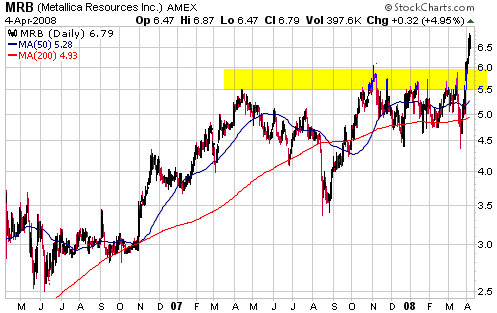
With reference to the following chart, one of the immediate
consequences of last week's merger news was that MRB rocketed to a new
all-time high. We wouldn't seriously consider taking profits at this
time, unless profit taking was required for money-management reasons (a
large run-up in price can result in a stock becoming an excessively
large part of a portfolio, thus necessitating some profit-taking even
if the outlook for the stock remains very bullish). We do, however,
think that a move to $7.50 or higher within the coming few weeks would
present a good opportunity to take PARTIAL profits.
Beaten-down low-priced metal stocks
Don't make the mistake of thinking that stock price weakness indicates
fundamental problems, especially with regard to relatively illiquid
junior resource stocks. Weakness in a company's stock price will
sometimes be a signal that something is wrong with the company, but
more often than not it won't have any fundamental basis. At the moment,
for example, most small exploration/development-stage metal stocks are
performing poorly despite generally strong metal prices, but this is
just a function of the current market environment. In the current
environment, the stocks of companies that aren't issuing very good news
on a regular basis are tending to drift lower as one small shareholder
after another loses interest and throws in the proverbial towel. To put
it another way, it is taking an almost constant stream of very bullish
news on the exploration front, such as the news flow generated by our
Keegan Resources (TSXV: KGN), to maintain investment/speculative demand
for these types of stocks.
Here are quick updates on low-priced metal stocks that we are following that are currently languishing near 52-week lows:
1. Apogee Minerals (TSXV: APE). Shares: 53M issued, 67M fully diluted. Recent price: C$0.33
APE is having a hard time garnering any new buying interest DESPITE
having reported good drilling-related news over the past few months
(most recently last Thursday). The drilling results achieved to date
suggest that APE's Paca-Pulacayo project in Bolivia contains a valuable
silver-zinc-lead deposit.
The current drilling program is expected to continue until next month,
following which a resource estimate will be done. APE should therefore
generate good news-flow over the next couple of months. A concern/risk
is that the company will need to raise more cash in the near future via
an equity financing.
Speculators who currently don't have exposure to APE should consider
taking a small position in the low-C$0.30s in anticipation of the
aforementioned exploration news and because the company's current
market capitalisation is extremely low relative to the potential value
of its assets.
2. Copper Fox (TSXV: CUU). Shares: 83M issued, 91M fully diluted. Recent price: C$0.44
CUU is progressing well 'on the ground', but not in the stock market.
The next significant news event related to the company's Schaft Creek
copper/gold project in British Columbia (M&I resource comprising
7.7B pounds of copper, 8.1M ounces of gold and 584M pounds of moly) is
expected to be the Pre-Feasibility Study (PFS) due to be completed in
the near future.
The company is in the process of doing a poorly-timed equity financing
(why on earth do these companies do substantial equity financings when
their stock prices are near 52-week lows?), but, interestingly, last
Monday's announcement of this financing didn't have a significant
adverse effect on the stock price. This suggests that the stock is
close to being 'sold out' (almost everyone who is likely to sell at a
low price has already sold).
CUU is one of the most under-valued exploration-stage resource stocks
we know of, but it may not do much until speculative enthusiasm returns
to the overall sector or until the company completes the Schaft Creek
Feasibility Study (the FS is scheduled to be complete by year-end),
whichever happens first. We expect that CUU will prove to be a very big
winner, but considerable patience may be required.
3. European Minerals (TSX: EPM). Shares: 303M issued, 457M fully diluted. Recent price: C$0.89
EPM has a much larger market capitalisation and is at a much more
advanced stage of project development than the other beaten-down stocks
we'll update today, but it warrants a mention due to its recent price
action. Unlike the other stocks, which are at depressed levels due to
an absence of buying, there has been some concerted selling in the
market for EPM shares over the past week.
EPM issued a press release last Monday announcing that commercial
gold/copper production would not be achieved until September of this
year, a few months later than previously scheduled. This obviously
wasn't good news, but commissioning delays are common and this news, in
itself, is not a reason to be overly concerned. There is always a risk,
however, that a mine will not be able to achieve its design parameters,
so nagging doubts will persist within the investment world until EPM's
mine gets to the point where it is producing gold and copper at the
expected rates/costs. Last week's sell-off could be related to such
doubts.
The other potential problem area for EPM is its forward sales book.
About 50% of EPM's gold production (less than 20% of its gold reserve)
has been sold forward at $575/ounce, which seemed like an attractive
price at the time the sale was arranged (December-2005), but is very
low relative to today's spot price. The gold hedge book shouldn't
create a big problem for EPM because it will still be selling 50% of
its gold production into the spot market and because its copper
production is unhedged, PROVIDED that it is able to deliver the gold it
has contracted to deliver. The main concern we have at this time is
that the commissioning delays will prevent the company from meeting the
obligations under its forward sales contracts. This concern of ours may
not have any validity, but it will remain a concern until it is
specifically addressed by the company.
On the positive side of the ledger, the company has said that it is
completing an internal update of estimated mineral resources at
Varvarinskoye, which will be announced shortly and is expected to
result in an increase to resource estimates. Depending on the size of
the upward revision this could give the stock price a significant
boost.
The bottom line: IF we are only dealing with a delay of a few months to
project commissioning and deliveries into the hedge book can be
adjusted to fit the revised commissioning timetable then EPM is a
strong buy near Friday's closing price. The problem is, we can't be
certain that this is the case. At this time it is therefore not
possible for us to make a definitive buy or sell recommendation.
4. Geovic Mining Corp. (TSX: GMC). Shares: 101M issued, 134M fully diluted. Recent price: C$1.14
GMC is a very under-valued development-stage cobalt miner (as noted in
previous commentaries, we can easily justify a C$7/share valuation for
the stock). Its main asset, the Nkamouna project in Cameroon, is
expected to be developed into a very profitable mining operation over
the coming two years.
As far as these types of stocks go, GMC is relatively low-risk because
it has about $75M (more than C$0.70/share) of cash. As a result of this
cash hoard the company shouldn't have any problem financing the
construction of the Nkamouna mine. In particular, the current cash
hoard should cover virtually all of GMC's equity contribution to the
mine financing.
We don't expect any significant developments on the news front until
the optimised Feasibility Study is completed in the third quarter of
this year, so stock price improvement will probably depend on the
market recognizing the stock's dramatic under-valuation.
5. Gryphon Gold (TSX: GGN). Shares: 64M issued, 87M fully diluted. Recent price: C$0.41
In response to the decline in its stock price, GGN announced on 27th March
that it would be reporting a new (upwardly revised) resource estimate
for its Borealis gold project before the end of April and that former
CEO Albert Matter had been retained "as a Financial Advisor with the objective of optimizing the company's value and share price over the next twelve months."
GGN is a buy at the current price due to under-valuation and in anticipation of the aforementioned resource re-estimate.
6. Sabina Silver (TSXV: SBB). Shares: 66M issued, 83M fully diluted. Recent price: C$1.48
SBB rivals CUU as the most under-valued exploration-stage mining stock
we know of. It has been drifting lower in response to a lack of news, a
fairly normal occurrence over the past few months in the world of
junior mining stocks.
It is a buy near the current price.
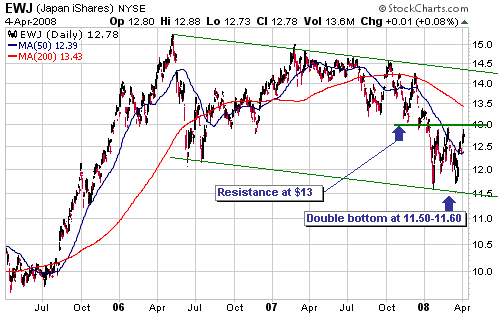
iShares Japan (NYSE: EWJ). Recent price: US$12.78
The daily EWJ chart displayed below makes it clear that the Japanese
stock market has been in a cyclical decline for almost 2 years. Our
view is that this cyclical decline is a major correction within a
long-term bull market. This view is supported by the fact that it has
taken EWJ almost 2 years to retrace 65% of the gains it achieved
during only 10 months between July-2005 and May-2006.
The TSI Stocks List contains some exposure to EWJ in the form of
January-2009 US$15 call options (ZAMAO). We are now going to add a
second January-2009 EWJ call-option position to the List, but this time
with a strike price of US$13.00 (ZAMAM). These options closed at
$1.15-$1.30 on Friday and will be added to the List at $1.25.
Chart Sources
Charts appearing in today's commentary
are courtesy of:
http://stockcharts.com/index.html
http://www.futuresource.com/
http://www.decisionpoint.com/

|