|
-- Weekly Market Update for the Week Commencing
7th April 2014
Big Picture
View
Here is a summary of our big picture
view of the markets. Note that our short-term views may differ from our
big picture view.
In nominal dollar terms, the BULL market in US Treasury Bonds
that began in the early 1980s ended in 2012. In real (gold)
terms, bonds commenced a secular BEAR market in 2001 that will continue
until 2018-2020. (Last
update: 20 January 2014)
The stock market, as represented by the S&P500 Index,
commenced
a secular BEAR market during the first quarter of 2000, where "secular
bear market" is defined as a long-term downward trend in valuations
(P/E ratios, etc.) and gold-denominated prices. This secular trend will bottom sometime between 2014 and 2020.
(Last update: 22 October 2007)
A secular BEAR market in the Dollar
began during the final quarter of 2000 and ended in July of 2008. This
secular bear market will be followed by a multi-year period of range
trading.
(Last
update: 09 February 2009)
Gold commenced a
secular bull market relative to all fiat currencies, the CRB Index,
bonds and most stock market indices during 1999-2001.
This secular trend will peak sometime between 2014 and 2020.
(Last update: 22 October 2007)
Commodities,
as represented by the Continuous Commodity Index (CCI), commenced a
secular BULL market in 2001 in nominal dollar terms. The first major
upward leg in this bull market ended during the first half of 2008, but
a long-term peak won't occur until 2014-2020. In real (gold) terms,
commodities commenced a secular BEAR market in 2001 that will continue
until 2014-2020.
(Last
update: 09 February 2009)
Copyright
Reminder
The commentaries that appear at TSI
may not be distributed, in full or in part, without our written permission.
In particular, please note that the posting of extracts from TSI commentaries
at other web sites or providing links to TSI commentaries at other web
sites (for example, at discussion boards) without our written permission
is prohibited.
We reserve the right to immediately
terminate the subscription of any TSI subscriber who distributes the TSI
commentaries without our written permission.
Outlook Summary
Market
|
Short-Term
(1-3 month)
|
Intermediate-Term
(6-12 month)
|
Long-Term
(2-5 Year)
|
|
Gold
|
Bullish
(26-Mar-14) |
Bullish
(26-Mar-12) |
Bullish
|
|
US$ (Dollar Index)
|
Neutral
(26-Mar-14) |
Bearish
(27-Jan-14) |
Neutral
(19-Sep-07) |
|
Bonds (US T-Bond)
|
Bullish
(11-Dec-13)
|
Neutral
(18-Jan-12)
|
Bearish |
|
Stock Market
(DJW)
|
Bearish
(07-Apr-14) |
Bearish
(28-Nov-11) |
Bearish
|
|
Gold Stocks
(HUI)
|
Bullish
(03-Mar-14) |
Bullish
(23-Jun-10) |
Bullish
|
|
Oil |
Bearish
(12-Mar-14) |
Neutral
(31-Jan-11) |
Bullish
|
|
Industrial Metals
(GYX)
|
Neutral
(17-Feb-14) |
Neutral
(06-Jan-14) |
Neutral
(11-Jan-10) |
Notes:
1. The date shown below the current outlook is when the most recent outlook change occurred.
2. "Neutral", in the above table, means that we either don't have a
firm opinion or that we think risk and reward are roughly in balance with respect to the timeframe in question.
3. Long-term views are determined almost completely by fundamentals,
intermediate-term views by
fundamentals, sentiment and technicals, and short-term views by sentiment and
technicals.
The Stock
Market
The stock market is not a zero-sum game
One of the common complaints about High-Frequency Trading (HFT) goes something
like this: trading is a zero-sum game, so the profits stemming from HFT must be
associated with losses sustained by other market participants, including moms,
pops, widows and orphans. For example, in a
recent article John Mauldin wrote: "High-frequency trading is a zero-sum
game. It takes money from "us" and gives it to funds with instant access to the
exchanges." For another example, in a
recent blog post Barry Ritholtz wrote: "The math on trading is simple: It
is a zero-sum game. One trader's gain is another trader's loss. Only in the case
of HFT, the losers are the investors -- by way of their pension funds,
retirement accounts and institutional funds. The HFT's take -- the "skim" --
comes out of these large institution's trade executions". Putting aside the
fact that traders who use limit orders won't be adversely affected by HFT and
that traders who hold stocks for months or years with the aim of making
double-digit or triple-digit percentage gains won't be adversely affected by
traders who hold for no more than a few seconds with the aim of making a small
fraction of one percent, the main point we want to make now is that the stock
market is NOT a zero-sum game.
The futures market is a zero-sum game. In the futures market the result on one
side of a trade will always be the opposite of the result on the other side of a
trade, and the sum of all profits and losses will always be zero. This is
because every long position is exactly offset by a short position. The stock
market is different, however, because the quantity and dollar value of shares
bought/held is always vastly greater than the quantity and dollar value of
shares sold short. In the stock market, the buyer and the seller can both make a
profit or the buyer and the seller can both make a loss. Trader A can sell
shares to Trader B for a profit, Trader B can then sell the same shares to
Trader C for a profit, Trader C can then sell the same shares to Trader D for a
profit, and so on.
It therefore doesn't follow that the profits made by HF Traders operating in the
stock market must come at the expense of other traders/investors.
Although it is clear that the stock market is not a zero-sum game and,
therefore, that the profits made by HF Traders do not have to come out of the
pockets of other traders and investors, let's assume, for argument sake, that
Barry Ritholtz is right and that everyone else suffers worse performance as a
result of HFT. What would this worse performance look like?
To answer the question we note that the total of all profits generated by HFT in
the US stock market is currently estimated to be in the $1B-$2B/year range and
falling. This compares to the current total market capitalisation of around $20
trillion, which means that total HFT profits amount to less than one-hundredth
of one percent of stock market capitalisation.
Surely there are more important things to worry about?
Current Market Situation
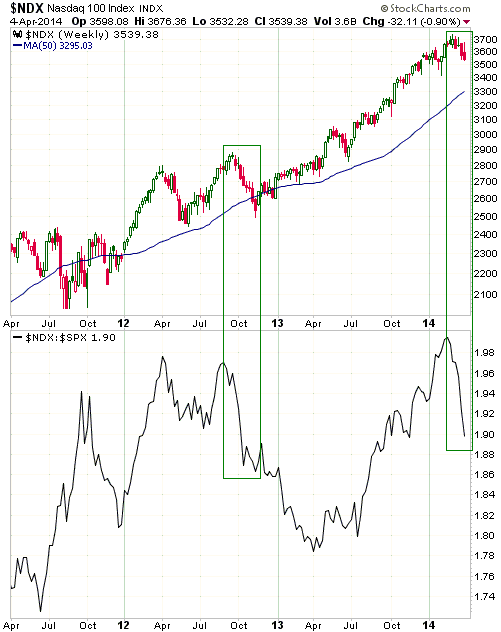
Below is a 3-year weekly chart comparing the NASDAQ100 Index (NDX) with the NDX/SPX
ratio. The recent pullback in the NDX from a multi-year high has been minor, but
the decline in this index's relative strength -- as indicated by the plunge in
the NDX/SPX ratio -- has been substantial.
The past year's upward surge in the US stock market was characterised by
relative strength in the NDX, so the recent dramatic shift in relative strength
could be an early warning of a major market-wide trend change. However, even if
it is only due to sector rotation within the context of an on-going bull market
it is likely a warning of additional weakness over the next two months. As
evidence we point out that a similar downward reversal in the NDX/SPX ratio
during September-October of 2012 signaled a decline in the NDX to below its
50-week MA (the blue line on the following chart). A similar outcome this time
around would result in the NDX trading about 10% below its current price within
the next two months.
In addition to being a warning that significantly lower prices could be in
store, the recent relative weakness in the NDX increases the probability that if
there is a move to a new high in the SPX later this month (in line with the
Presidential Cycle Model) it will not be confirmed by the NDX. As mentioned in
last week's Interim Update, such divergences inevitably occur at major market
tops.
Due to the rising downside risk and the comparatively small (as far as we can
tell) additional upside potential, our short-term stock market outlook has
shifted back to "bearish".
Moving on, one of our expectations is that relative strength in most things
commodity-related (commodities, commodity currencies and the stocks of commodity
producers) will be a general theme in 2014. During the year to date the markets
have mostly been in synch with this theme, although it is obviously still early
days and the evidence isn't yet conclusive.
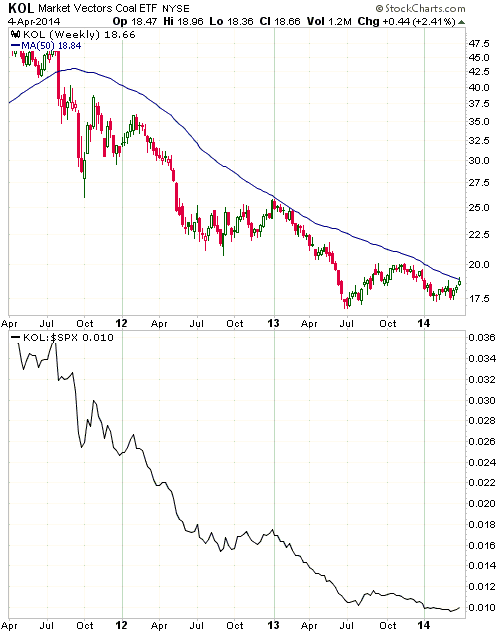
The coal sector of the stock market, represented by the Market Vectors Coal ETF
(KOL), is close to providing another piece of evidence in support of the
aforementioned theme. As illustrated by the top half of the following weekly
chart, KOL has just moved up to its 50-week MA. If it manages to achieve a
weekly close above this MA it will have done something it hasn't been able to do
since mid-2011, thus suggesting that an important transition (from cyclical bear
to cyclical bull) is underway. As illustrated by the bottom half of the chart,
the KOL/SPX ratio (coal stocks relative to the broad market) lost downward
momentum in mid-2013 and is now showing signs of turning higher.
While we are confident that commodity-related equities will be relatively strong
in 2014, we are well aware of the fact that only the gold-mining sector would
stand a good chance of rising in nominal dollar terms in the face of a
broad-based equity bear market.
This week's
important US economic events
| Date |
Description |
| Monday Apr 07 |
Consumer Credit | | Tuesday
Apr 08 |
No important events scheduled | | Wednesday
Apr 09 |
FOMC Minutes | | Thursday
Apr 10 |
Treasury Budget
Import and Export Prices
|
| Friday Apr 11 |
PPI
Consumer Sentiment |
Gold and
the Dollar
Gold
Confusing trading volume with demand
The vast majority of the gold-market supply/demand analysis that gets published
is completely off-track and irrelevant. One reason is that most analysts confuse
trading volume with demand.
The mixing-up of trading volume and demand explains why the increase in China's
gold imports over the past three years was wrongly viewed by many analysts as a
major bullish influence on the gold market. It also goes part of the way to
explaining why so many bullish-leaning gold analysts complain about price
manipulation. After all, if you are certain that the fundamentals are bullish
and becoming increasingly so, and yet the price is mired in a large multi-year
decline, you will be inclined to conclude that the price is being manipulated
downward. The alternative would be to discard your dearly-held premise (that the
fundamentals are bullish), which is psychologically difficult to do.
The reality is that the increasing quantity of gold imports by China is neither
inherently bullish nor inherently bearish. It is simply a measure of trading
volume that says nothing about past or likely-future price movement. To
understand why this is the case, think of the global gold market as containing
only two traders: China and World Excluding China (WEC). If one of these traders
wants to reduce the amount of gold it holds it can only do so if the other
trader agrees to increase the amount of gold it holds. In other words, for WEC
to reduce its gold holdings it is mathematically necessary for China to increase
its gold holdings. Furthermore, if the amount of gold that WEC wants to sell is
more than the amount of gold that China wants to buy at the current price, the
price will fall to the point where a balance is achieved.
Supply and demand must always be equal, with the price continually adjusting to
maintain the equivalence. As a consequence, the change in price is the only
reliable measure of whether demand is trying to rise relative to supply or
supply is trying to rise relative to demand. The amount of trading generally
doesn't indicate anything useful about price, because a rise in trading volume
could go with a rising or a falling price, as could a fall in trading volume. In
fact, it's conceivable that at some point over the next few years the volume of
gold being traded, including the volume of gold being imported by China, will
plunge in parallel with a large and rapid increase in price due to most existing
holders of gold refusing to sell at any price.
To further explain why most analyses of gold supply/demand are completely off
track, we'll revisit an analogy we've used in the past: we'll liken the gold
market to a publicly-traded company.
Our hypothetical company (stock symbol ABC) currently has 100M shares
outstanding and is guaranteed to increase its total share count by about 1% this
year and every year thereafter, meaning that at the end of this year it will
have 101M shares. Now assume that Fred Smith, an investor, buys 500K shares of
ABC. Will any financial journalist or analyst reporting on this event compare
the amount of shares bought by Fred Smith with the amount of new shares due to
be issued by ABC during the current year and say something along the lines of
"Fred Smith has just bought 50% of ABC's shares!"? Of course not. Any analyst or
journalist with at least half a brain will realise that Fred Smith's purchase
represents only 0.5% of the outstanding shares. And if Fred Smith subsequently
sells his shares to Bill Jones, will any rational observer exclaim that Bill
Jones' purchase constitutes a 500K-share increase in demand? Again, of course
not; the transfer of shares from Smith to Jones obviously doesn't say anything
about overall demand for the shares.
As is the case with our hypothetical company and its total share count, the
gold-mining industry adds a tiny percentage (about 1.5%) to the total supply of
gold every year. Therefore, comparing the quantity of ABC shares purchased by
Fred Smith with the quantity of new shares issued during the year and concluding
that Smith's purchase represents 50% of the company is effectively what
gold-market analysts do when they compare the amount of gold purchased by some
traders or regions (e.g. China) with the gold-mining industry's annual
production. Such comparisons are worse than meaningless, they are misleading.
Also, concluding that Bill Jones' purchase of Fred Smith's shares represents an
increase in the overall demand for the shares is effectively what gold-market
analysts do when they assume that the gold flowing into China represents an
increase in the overall demand for gold.
The bottom line is that any gold-market analysis will be fatally flawed if it is
based on the premise that demand and supply can be determined by looking at the
amounts of gold being traded between different parts of the overall market. It
will be fatally flawed because the underlying premise is wrong.
Current Market Situation
The low of what we think will turn out to be the initial leg of gold's
correction was put in place last Tuesday (1st April). That this low would soon
be in place was signaled during the week before last by strength in gold-mining
stocks relative to gold bullion.
With the initial decline having gone a little further than expected, the final
decline (the decline that follows the current rebound) probably won't do
significantly worse than test last week's low.
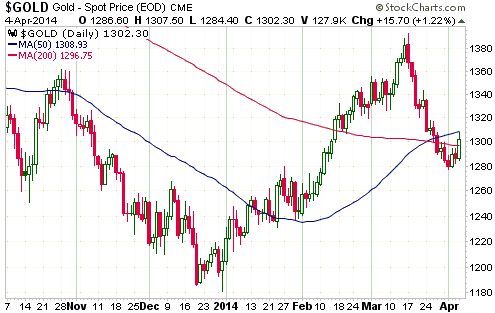
We don't have an opinion regarding the extent of the current rebound. A fairly
normal 50% retracing of the initial decline would take the price up to the
$1330s, but the rebound could end anywhere from the low$1300s to the $1350s.
The Commitments of Traders (COT) data, a short-term sentiment indicator, is
slightly bearish for gold in that the recent $100 price decline led to a
relatively minor reduction in the speculative net-long position. Small traders
actually increased their long exposure to gold futures during the price decline.
This is consistent with our view that the overall correction is not over.
However, long-term sentiment indicators remain supportive of the view that a
major bottom was put in place late last year. For example, the bottom half of
the following chart shows that the premium to net asset value of the Central
Fund of Canada (CEF), a closed-end fund that holds gold and silver bullion,
reached its lowest level since 2001 last year and remains near this 12-year low
despite this year's price recovery.
By the way, the large downward spike in the CEF premium in early-May of 2011 was
due to extreme intra-day price volatility, not pessimistic sentiment. The
calculation of the CEF premium is based on the "London Fix" price for bullion
and the closing price of CEF on the NYSE, which means that it is based on a
comparison of price snapshots taken at different times. If the price of gold
and/or silver makes a big move between the "London Fix" time and the close of
trading on the NYSE, the calculated CEF premium will be artificially high or
low.

Gold Stocks
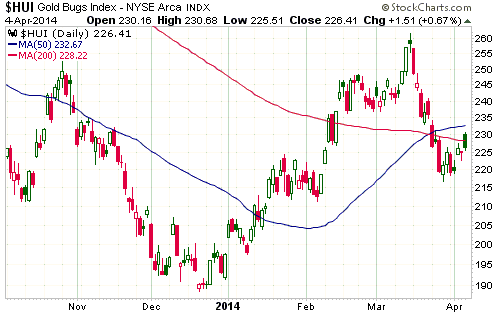
The HUI made some sort of bottom 7 trading days ago (on 27th March) when it
traded at 216.7. This bottom either marked the end of the correction or the end
of the first leg of the correction (the end of the 'A' wave in an A-B-C
decline). At this stage we favour the latter. Also, we suspect that the
correction's final decline (the 'C' wave that follows a 'B' wave rebound) will
do no worse than test the low of the initial decline.
A weekly HUI close above 250 would indicate that our favoured scenario is wrong
and that the correction ended on 27th March.
The Currency Market
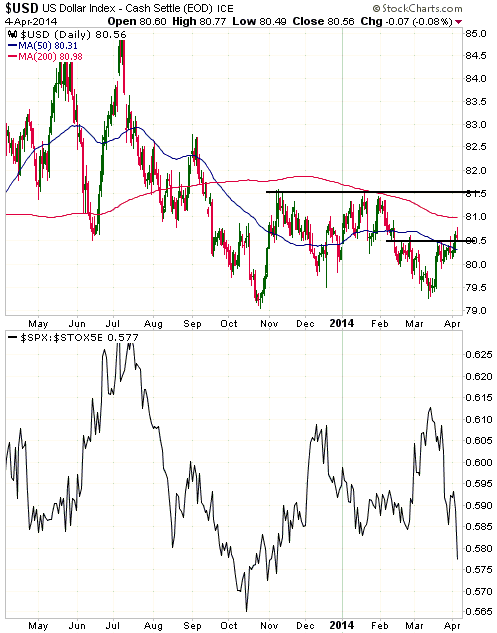
The Dollar Index broke above resistance at 80.5 last week. This is of only
slight interest to us, because the critical resistance as far as the
intermediate-term trend is concerned is a point higher at 81.5. A solid weekly
close above 81.5 would certainly cause us to seriously question and would
probably cause us to change our intermediate-term bearish view of the Dollar
Index.
The top section of the following daily chart shows the performance of the Dollar
Index, with lines drawn to indicate the resistance at 80.5 that was overcome
last week and the more important resistance at 81.5. The bottom section of the
chart shows the SPX/STOX5E ratio, a measure of how large-cap US stocks are
performing relative to their European counterparts.
The recent performance of the SPX/STOX5E ratio relative to the Dollar Index is a
lot more interesting than the recent performance of the Dollar Index in
isolation. This is because the inter-market relationship has become
counterintuitive. Prior to last December, strength in the Dollar Index was
generally accompanied by strength in US stocks relative to European stocks. This
makes intuitive sense. However, since December of last year and especially since
mid-February of this year, the Dollar Index has generally strengthened when US
stocks were relatively weak and weakened when US stocks were relatively strong.
In other words, over the past few months the correlation between the Dollar
Index and SPX/STOX5E has shifted from strongly positive to strongly negative.
At this time we aren't going to use up much commentary space trying to explain
the change in the relationship between the currency market and relative
equity-market strength, because the change could turn out to be nothing more
than a short-lived anomaly. Suffice to say for now that fears about euro-zone
deflation could be evolving into the primary driver of the US$/euro exchange
rate. For example, rising fear that the euro-zone was moving towards deflation
would tend to simultaneously put upward pressure on the euro/US$ rate and
downward pressure on European equity prices.
Updates
on Stock Selections
Notes: 1) To review the complete list of current TSI stock selections, logon at
http://www.speculative-investor.com/new/market_logon.asp
and then click on "Stock Selections" in the menu. When at the Stock
Selections page, click on a stock's symbol to bring-up an archive of
our comments on the stock in question. 2) The Small Stock Watch List is
located at http://www.speculative-investor.com/new/smallstockwatch.html
 Company
news/developments for the week ended Friday 4th April 2014: Company
news/developments for the week ended Friday 4th April 2014:
[Note: AISC = All-In Sustaining Cost, FS = Feasibility Study, IRR =
Internal Rate of Return, MD&A = Management Discussion and Analysis,
M&I = Measured and Indicated, NAV = Net Asset Value, NPV(X%) = Net
Present Value using a discount rate of X%, P&P = Proven and
Probable, PEA = Preliminary Economic Assessment, PFS =
Pre-Feasibility Study]
*Almaden Minerals (AAU) provided a summary of its 2014 work plans
for its 100%-owned Tuligtic gold-silver project (Mexico). The
company plans to complete a PEA for the project's Ixtaca zone within
the next few months. The Ixtaca zone is presently estimated to
contain a total gold-equivalent resource of 4.2M ounces (3.5M M&I
plus 0.7M inferred). The company also plans to drill high-priority
epithermal targets outside of the Ixtaca Zone but within the
project's claim boundaries.
*Asanko Gold (AKG) announced that it has received the
environmental invoice and water use permits for the Esaase deposit,
part of the Asanko gold mine project, from the relevant Ghanaian
regulatory authorities. This is the penultimate stage of the
environmental approval process and gives the company the option to
immediately apply for a temporary mining permit and commence
earthworks for the Esaase deposit. This is obviously good news,
although it isn't significant as far as AKG's 2014 work plans are
concerned. The reason is that AKG's current plan is to bring the
Nkran deposit into production (Phase 1 of the overall development)
before building a mine at the Esaase deposit.
AKG also announced that it has appointed DRA, a company based in
South Africa, as the engineering, procurement, construction and
management (EPCM) contractor for Phase 1 of the Asanko Gold Mine
development. DRA has a lot of experience building mines in West
Africa.
The completion of Phase 1 is expected to result in gold production
of 220K ounces per year beginning in Q1-2016. The cost estimates for
this phase are based on the FS completed by PMI Gold in
September-2012 and are in the process of being updated. Phase 2 will
likely involve developing the Esaase deposit to bring the company's
total production up to around 400K ounces/year. Phase 2 will be
planned in detail during the Phase 1 construction period.
*Energy Fuels (EFR.TO, UUUU) provided its guidance for 2014.
First, EFR forecasts 2014 sales to be approximately 800K pounds of
U3O8, all of which will be sold into long-term contracts at a price
of around $58/pound (65% above the current spot price). 300K pounds
of the 800K total will be purchased in the spot market for sale into
one contract. That is, if there is no change in the spot price then
EFR will buy 300K pounds at around $35/pound for delivery into a
long-term contract at $58/pound, resulting in a zero-risk profit of
about $7M.
Second, the company expects to produce about 500K pounds of U3O8
during 2014. However, mining and milling operations (aside from some
toll milling) will be placed on standby in August 2014 unless there
is a significant increase in the spot uranium price in the meantime.
Third, at the end of last year the company had about 450K pounds of
U3O8 in inventory. This inventory could be used to fulfill long-term
contract obligations in the event that there wasn't a sufficient
improvement in the uranium market to warrant the resumption of
production during the final few months of this year.
Fourth, EFR will have considerable flexibility to adjust production
in response to changes in the uranium market. For example, mines put
on standby will kept ready for a quick restart.
Fifth, EFR has a number of development-stage projects that will be
advanced towards production in response to a large and sustained
increase in the uranium price. We think that a long-term uranium
price of at least $65/pound would be needed to justify bringing
these projects into production.
*Golden Star Resources (GSS) announced drilling results that
establish the continuity of, and will likely increase the size of, a
high-grade resource below its Wassa open-pit gold mine (Ghana). This
resource has the potential to be developed into a profitable
underground mine.
The first look at the economics of an underground mine at Wassa will
come via a PEA currently being prepared by SRK Consulting and
scheduled to be complete this quarter.
*Premier Gold (PG.TO) issued its financial statements and MD&A for
the year ended 31st December 2013.
At the end of last year PG's working capital was about $58M,
including 3.7M shares of Sandstorm Gold (SSL.TO) that are held for
sale. Due to the subsequent increase in the market price of SSL.TO,
PG's current working capital is probably still around $58M (the
increase in the value of the SSL shares probably offset spending
over the past three months). This should be enough to fully fund the
company for the next 18 months.
*Ramelius Resources (RMS.AX) announced a small (16%) increase in
the estimated resource at its exploration-stage Vivien gold project.
The new resource is estimated to contain 185K ounces at an average
grade of 7.1-g/t.
RMS plans to commence the development of an underground mining
operation at Vivien during the second half of this year.
List
of candidates for new buying
From within the ranks of TSI stock selections, the best candidates for new
buying at this time are:
1) PG.TO below $2.00 (last Friday's closing price: C$2.05).
2) PLG.TO in the low-C$1.30s (last Friday's closing price: C$1.44).
3) RIOM (last Friday's closing price: US$2.03). The following chart shows that
RIOM has lateral resistance at US$2.10. The 50-day MA in the $2.15-$2.20 range
is also likely to offer some resistance. A daily close above $2.20 would
therefore leave little room for doubt that a correction low is in place, but we
think it makes more sense to buy at $2.00 or lower than to buy above $2.20.
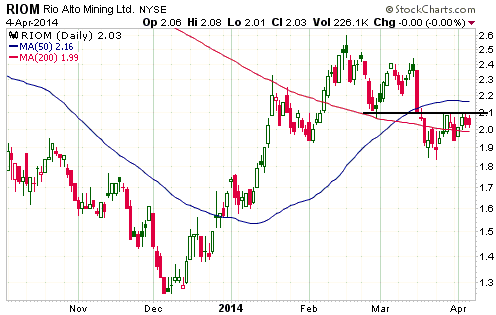
Chart Sources
Charts appearing in today's commentary
are courtesy of:
http://stockcharts.com/index.html

|









