|
-- Weekly Market Update for the Week Commencing 7th May 2012
Big Picture
View
Here is a summary of our big picture
view of the markets. Note that our short-term views may differ from our
big picture view.
In nominal dollar terms, the BULL market in US Treasury Bonds
that began in the early 1980s will end by 2013. In real (gold)
terms, bonds commenced a secular BEAR market in 2001 that will continue
until 2014-2020. (Last
update: 23 January 2012)
The stock market, as represented by the S&P500 Index, commenced
a secular BEAR market during the first quarter of 2000, where "secular
bear market" is defined as a long-term downward trend in valuations
(P/E ratios, etc.) and gold-denominated prices. This secular trend will bottom sometime between 2014 and 2020. (Last update: 22 October 2007)
A secular BEAR market in the Dollar
began during the final quarter of 2000 and ended in July of 2008. This
secular bear market will be followed by a multi-year period of range
trading. (Last
update: 09 February 2009)
Gold commenced a
secular bull market relative to all fiat currencies, the CRB Index,
bonds and most stock market indices during 1999-2001. This secular trend will peak sometime between 2014 and 2020. (Last update: 22 October 2007)
Commodities,
as represented by the Continuous Commodity Index (CCI), commenced a
secular BULL market in 2001 in nominal dollar terms. The first major
upward leg in this bull market ended during the first half of 2008, but
a long-term peak won't occur until 2014-2020. In real (gold) terms,
commodities commenced a secular BEAR market in 2001 that will continue
until 2014-2020. (Last
update: 09 February 2009)
Copyright
Reminder
The commentaries that appear at TSI
may not be distributed, in full or in part, without our written permission.
In particular, please note that the posting of extracts from TSI commentaries
at other web sites or providing links to TSI commentaries at other web
sites (for example, at discussion boards) without our written permission
is prohibited.
We reserve the right to immediately
terminate the subscription of any TSI subscriber who distributes the TSI
commentaries without our written permission.
Outlook Summary
Market
|
Short-Term
(0-3 month)
|
Intermediate-Term
(3-12 month)
|
Long-Term
(1-5 Year)
|
| Gold
|
Bullish
(26-Mar-12)
|
Bullish
(26-Mar-12)
|
Bullish
|
| US$ (Dollar Index)
|
Neutral
(22-Nov-11)
| Neutral
(09-Jan-12)
|
Neutral
(19-Sep-07)
|
| Bonds (US T-Bond)
|
Neutral
(11-Apr-12)
|
Neutral
(18-Jan-12)
|
Bearish
|
| Stock Market
(DJW)
|
Neutral
(25-Apr-12)
|
Bearish
(28-Nov-11)
|
Bearish
|
| Gold Stocks
(HUI)
|
Bullish
(26-Mar-12)
|
Bullish
(23-Jun-10)
|
Bullish
|
| Oil | Neutral
(31-Jan-11) | Neutral
(31-Jan-11)
| Bullish
|
| Industrial Metals
(GYX)
| Neutral
(22-Nov-11)
| Neutral
(29-Aug-11)
| Neutral
(11-Jan-10)
|
Notes:
1. In those cases where we have been able to identify the commentary in
which the most recent outlook change occurred we've put the date of the
commentary below the current outlook.
2. "Neutral", in the above table, means that we either don't have a
firm opinion or that we think risk and reward are roughly in balance with respect to the timeframe in question.
3. Long-term views are determined almost completely by fundamentals,
intermediate-term views by giving an approximately equal weighting to
fundamental and technical factors, and short-term views almost
completely by technicals.
Commodities
The Continuous Commodity Index (CCI)
The CCI hit a new 18-month low last Friday.
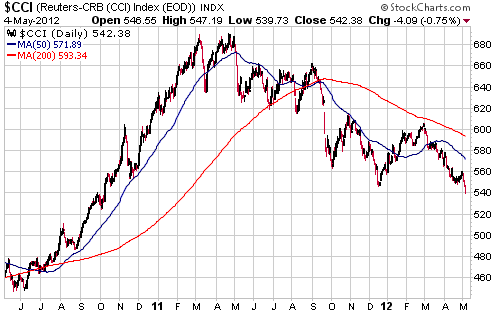
Commodities have under-performed equities by a wide margin since early October of last year. This is most likely due to weakness and/or the anticipation of weakness in China's economy.
If the market is reducing the prices of commodities due to a bearish outlook for China's economy then the market is on the right track. In our opinion, there is no good reason to be anything other than bearish on China's economy when considering any period longer than 12 months.
We intend to re-visit the bearish case for China within the next couple of weeks, but it boils down to this: Many years of rapid monetary inflation in China has led to unprecedented mal-investment in property and infrastructure. The monetary inflation has also led to large increases in prices for the basic necessities of life. Due to the second of these effects of inflation, the government's ability to postpone severe economic weakness stemming from the first of these effects has been greatly reduced. To put it more succinctly, to avoid socially destabilising increases in the prices of food and other necessities, China's government will have to curtail the monetary inflation that is presently keeping investment booms from imploding.
The Communist Party's next major power transition is scheduled for late this year, so there could be another burst of government-sponsored inflation in China as part of an effort to maintain the illusion of economic strength until after this event. If this happens it will pave the way for a strong counter-trend rebound in the commodity markets from whatever lows they make this month or next.
Copper
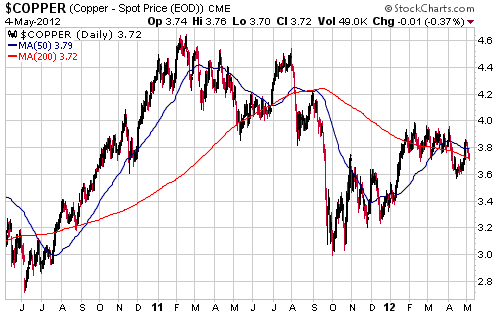
As is the case with the CCI, copper peaked during the first quarter of last year. But unlike the CCI, the copper market rebounded strongly from an early-October-2011 bottom and has since managed to hold onto the bulk of its rebound.
As illustrated by the following chart, the worldwide copper inventory has been stable over the past 18 months. This apparent stability results from a large decline in the London Metal Exchange (LME) inventory and a large offsetting rise in the Shanghai copper inventory.
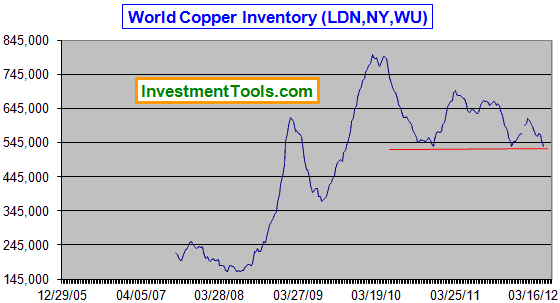
Like most industrial commodities, copper is influenced by what is happening in China. It is also positively correlated with global equities. At some point within the next 12 months both of these influences are likely to become decidedly negative. We therefore suggest viewing any strength over the next few months as an opportunity to reduce speculative exposure to this metal.
Oil
The oil market's underlying supply/demand fundamentals are bearish. Real (meaning: not due to monetary inflation) demand probably won't increase by much over the next two years and could even decline as several of the largest economies stagnate or contract. At the same time, the market is well supplied and is likely to remain so in the absence of a war-related disruption. Unfortunately, the risk of a war-related disruption is uncomfortably high.
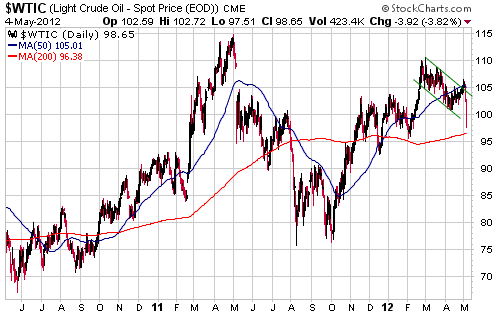
The following daily chart shows that oil dropped sharply during the final two days of last week -- from $105 to $98. The chart also shows that two days before this plunge the price broke out to the upside. This sort of price action is not uncommon.
Significant additional weakness in the oil price would create a short-term buying opportunity, but we aren't there yet.
The Stock
Market
The US monthly employment report was more of the same
The US stock market suffered a sizeable decline on Friday in the aftermath of the monthly employment numbers, but we doubt that the employment numbers caused the decline. The reported jobs growth for April wasn't far enough below expectations to be significant, and while the overall tenor of the report was weak it wasn't surprisingly so.
The official unemployment rate ticked downward, but this was due to a reduction in the "participation rate". The percentage of the available workforce now officially participating in the US labour market hit a new 30-year low in April, a circumstance that reduces the unemployment rate because if you are out of work you are not considered to be unemployed unless you are applying for jobs. Every person in the US could be out of work, but if nobody had actively searched for a job over the past month then the government would report an unemployment rate of zero% and the President would stand up in front of the cameras and exclaim: "Vote for me! Due to my wonderful policies, the unemployment rate has fallen to zero!"
Current Market Situation
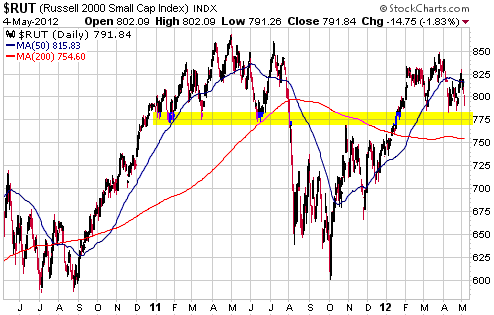
Although the senior US stock indices trended upward into early April before beginning to 'correct', the broad US stock market has been in 'correction mode' since early February. As evidence we present the following two charts.
The first chart shows the Russell2000 Small Cap Index (RUT). Although the RUT made a marginal new high for the year in March, its short-term upward trend ended in early February. Since then it has oscillated between support at 780 and resistance at 830-850.
A clear-cut break below 770 would suggest that an intermediate-term peak was in place.
The second chart shows the Dow Transportation Average (TRAN). TRAN has traded sideways over the past three months.
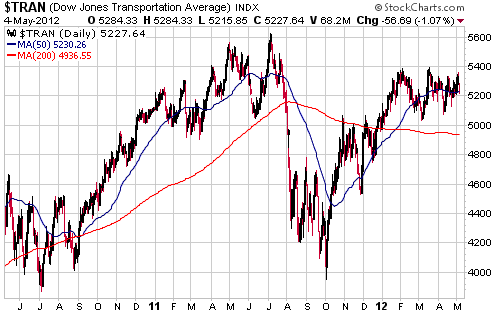
TRAN's inability to confirm the new 52-week highs achieved by the Dow Industrials Index during February and March undoubtedly drew the attention of Dow Theorists. Followers of Dow Theory tend to place a lot of importance on non-confirmations between the Transports and the Industrials, but in our experience such non-confirmations are too common to be useful.
There are good reasons to be cautious right now, but the Transports-Industrials non-confirmation isn't one of them. Actually, we see the potential for a bullish confirmation under Dow Theory to mark an important top in 2012 just as it did in 2007. This would happen if the current correction were followed by moves to marginal new 52-week highs by both the Industrials and the Transports. Such an event could mark an important top by causing many bears to capitulate at a time when valuations were high and the economic backdrop was deteriorating.
As things stand right now, the correction doesn't appear to be over. The senior indices probably won't fall a lot further over the next few weeks, but there's a good chance that the April lows will be breached.
This week's
important US economic events
| Date |
Description |
| Monday May 07 | Consumer
Credit
| | Tuesday May 08 | No
important events scheduled
| | Wednesday May 09 | No
important events scheduled | | Thursday
May 10 |
International Trade Balance
Import and Export Prices
Treasury Budget
|
| Friday May 11 | PPI
Consumer Sentiment
|
Gold and
the Dollar
Gold
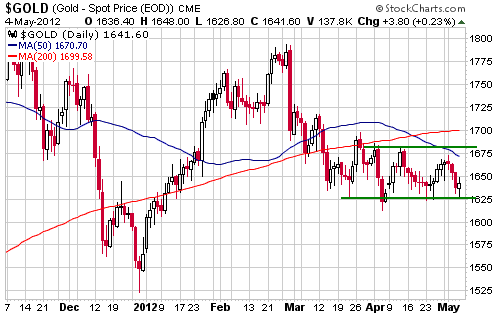
The following chart shows that the US$ gold price has spent the past 8 weeks in a narrow horizontal range. Whenever it looked like an upside breakout was about to happen the gold price reversed lower, and whenever it looked like a downside breakout was about to happen the gold price reversed higher.
We can't rule out the possibility that support in the $1620s will give way, but considering the bullish fundamentals (genuine fundamentals such as real interest rates, credit spreads, monetary policy and government policy) and the depressed sentiment, it's unlikely that a break below short-term support would lead to additional downside of more than about $50/oz. The depressed sentiment is important because it suggests that the market is currently ignoring the bullish fundamentals.
Gold Stocks
Current Market Situation
There were two positives associated with last Thursday's plunge by the HUI to a new low for the move. The first was that people who weren't already 'up to their eyeballs' in gold stocks had a chance to do some buying at the best prices in years. The second was that it improved the chances of a traditional May turning point.
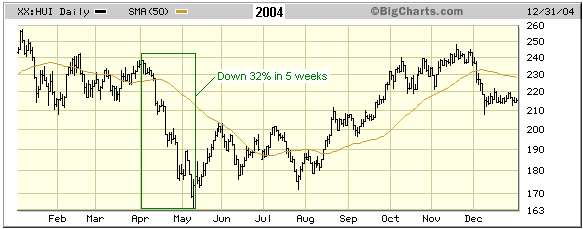
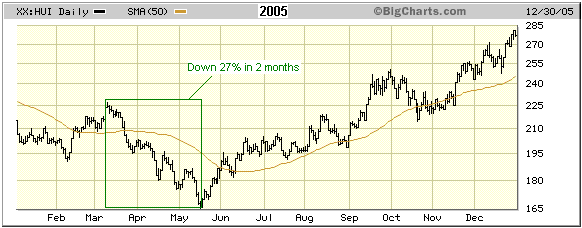
There were important turning points during the month of May in 5 of the first 6 years of the long-term bull market (2001, 2002, 2004, 2005 and 2006). Of these, the ones that occurred in May of 2004 and 2005 were turns from down to up. We therefore thought that it would be an interesting exercise to compare this year's price action with that of 2004 and 2005.
The first of the following two daily charts shows the HUI's price action from the beginning to the end of 2004. In 2004, the HUI fell 32% during the 5-week period leading up to its May turnaround. The second chart covers 2005. In 2005, the HUI fell 27% over the 2 months leading up to its May turnaround.
The next chart shows 2012 to date. At last Thursday's intra-day low the HUI had fallen by 25% over the course of about 2 months.
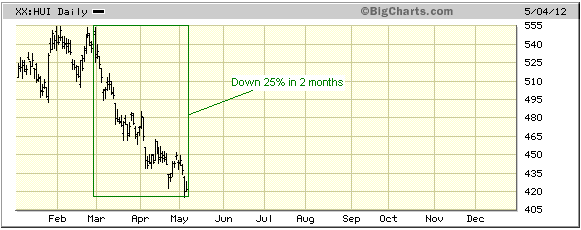
In both 2004 and 2005, the HUI returned to its Q1 high by early October. In 2004 a test of the Q1 high was the best the market could achieve, whereas in 2005 the market moved well above its Q1 high (the rally that began in May of 2005 continued until May of 2006).
This year's price action looks most similar to that of 2005. As was the case in March-May of 2005, this year's decline has been a relentless grind rather than a scary plunge.
If the rebound from the May-2012 low turns out to be similar to the rebound from either the May-2004 or May-2005 low then the HUI will return to the 550s by early October at the latest. However, we obviously don't KNOW that this will happen. The main point we want to make is that this long-term bull market has been in similar predicaments in the past and has recovered.
Two additional points before moving on:
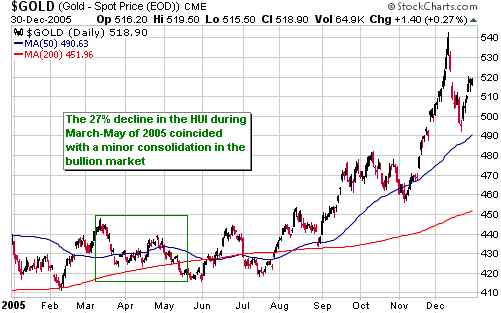
1. While the HUI was experiencing a 27% peak-to-trough decline during March-May of 2005, gold bullion was experiencing a minor consolidation (refer to the following chart for details). This is another similarity between 2012 and 2005.
2. The HUI needs a daily close above 452 to confirm that a low is in place.
Comparing development-stage gold projects
Last Thursday Volta Resources (TSX: VTR) reported the results of the Pre-Feasibility Study (PFS) for its Kiaka gold project. Considering that Volta's project is similar in size, type, location and stage of development to the Esaase project of Keegan Resources (TSX and NYSE: KGN), we thought it would be worth doing a side-by-side comparison of the projects to see if one offered a materially better investment opportunity than the other. Here's our comparison:
|
Keegan
Resources (KGN) |
Volta
Resources (VTR.TO) |
| Project
Name |
Esaase |
Kiaka |
| Location |
Ghana, West Africa |
Burkina Faso, West Africa |
| Planned
Mine Type |
Open pit |
Open pit |
| M&I
Resource (oz) |
3.64M |
4.0M |
| P&P
Reserve (oz) |
2.9M |
3.9M |
| Metallurgical
Recovery |
About 90% |
About 90% |
| Strip
Ratio |
4:1 |
3:1 |
| Avg
Annual Production (oz) |
258K |
340K |
| Cash
Cost (per oz) |
$693 |
$671 |
| Mine
Life |
10.2 years |
10.3 years |
| Initial
Capital Cost |
$506M |
$610M |
| NPV
at $1372/oz |
$470M |
$548M |
| Project
Ownership Percent |
90% |
81% |
| NPV
of Company Stake ($M) |
423 |
444 |
| Current
Stock Price (US$) |
3.03 |
0.80 |
| Share
Count (M) |
77 |
155 |
| Current
Market Cap ($M) |
233 |
124 |
| Net
Cash ($M) |
200 |
45 |
| Current
Enterprise Value ($M) |
33 |
79 |
| EV/NPV |
8% |
18% |
| Current
Discount to NPV |
92% |
82% |
Notes:
1) The above table draws from the September-2011 Esaase PFS and the May-2012 Kiaka PFS.
2) VTR reported a net present value (NPV) assuming a gold price of $1372/oz, whereas KGN reported NPVs assuming gold prices of $1300/oz and $1500/oz. To get an "apples to apples" comparison we used the $1300/oz and $1500/oz figures reported by KGN to derive a $1372/oz NPV, but note that even after doing this adjustment the NPVs aren't directly comparable. This is because VTR used a discount rate of 8% and didn't include tax, whereas KGN used a discount rate of 5% and did include tax (gold mining companies and their consultants really should standardise on such things, but that's a separate issue). So, for the purposes of this comparison we have assumed that VTR's use of a significantly higher discount rate counter-balances its non-inclusion of taxation in the NPV calculation.
The comparison tells us that Volta's project is currently the bigger of the two. In particular, its P&P reserve total is about 1M ounces higher and it is expected to produce about 80K more ounces per year. However, at the assumed gold price of $1372/oz the greater size doesn't translate into better economics, thanks mostly to the higher capital cost associated with the bigger project. The calculated values of each company's stake in its project are, in fact, almost identical.
The comparison also tells us that KGN offers the better value based solely on current enterprise value (EV) relative to project NPV at $1372/oz. This is evidenced by the final row of the Table, which shows that KGN is presently trading at a 92% discount to project NPV whereas VTR is presently trading at a discount of 82% to project NPV. Note that if everything remained the same except for KGN's stock price then both stocks would trade at roughly the same discount to NPV if KGN were priced at $3.60/share (about 20% above its current price).
By the way, the large current discounts of both KGN and VTR to the values established in their respective pre-feasibility studies are not out of the ordinary in today's extraordinary market environment. Due to the huge decline in valuation that has occurred at the junior end of the gold sector over the past nine months, such discounts have actually become the norm. This prompted Rick Rule, a very successful investor in natural resource companies who normally focuses on early-stage exploration, to make the following comment in a
recent interview
with Casey Research's Louis James:
"Right now you are seeing the broadest discrepancy between the valuations established in scoping and pre-feasibility studies to enterprise value that I've seen in 35 years in the business. As a consequence of the opportunity available to me in the development space, given the fact that the market is on sale, I have diverted some of my traditional focus on earlier-stage exploration to come into a sector that normally is denied to me by wealthier, I would say, less-rational participants. They just seem to have gone on strike, and so I've decided to show up and go to work."
While the above table suggests that at current prices KGN is about 20% under-valued relative to VTR (with both stocks being very under-valued relative to the NPVs of their respective projects), there are some other important considerations. On the plus side for KGN, Ghana is probably a better (meaning: lower risk) location than Burkina Faso. On the plus side for VTR, the Kiaka project's larger size and capital cost mean that it offers more leverage to the gold price. As a consequence, whereas the net present values are roughly the same at a gold price of $1372/oz, VTR would have the much higher NPV at a gold price of, say, $1800/oz. Also on the plus side for VTR, the recent high-grade gold discovery at the southern end of the Kiaka deposit was not included in the PFS reported last week. This recent discovery has the potential to substantially improve Kiaka's already-robust economics and should generate good news-flow over the next few months.
Our conclusion is that both stocks are very attractive speculations near their current prices. If you already have significant exposure to one, then focus on the other for new buying.
Currency Market Update
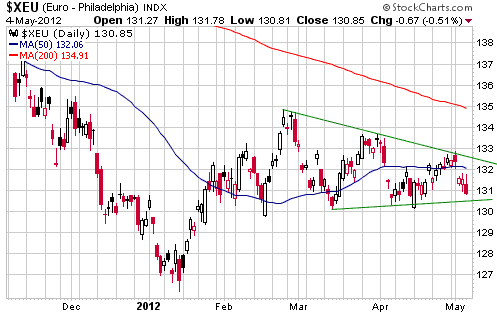
We drew lines on the following daily chart to illustrate that the euro has been oscillating within a narrowing range over the past two months. The knock-on effects of additional downside in the stock market over the next couple of weeks could push the euro through the bottom of its range, but the short-term downside risk continues to be mitigated by the huge speculative short position in euro futures.
Our opinion continues to be that the direction of the euro's next meaningful move, where "meaningful" means 4 points or more, will be to the upside. However, we probably won't downgrade our short-term US$ outlook to "bearish" (upgrade our short-term euro outlook to "bullish") until/unless we see clear evidence that the stock market's downward correction is complete.
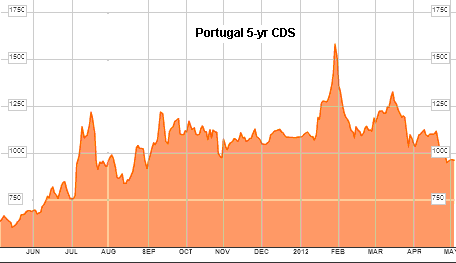
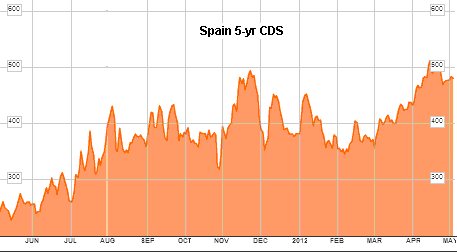
We continue to pay close attention to the yields and CDSs (Credit Default Swaps) associated with the bonds issued by the financially-stressed governments of Europe. Moves to new highs in these yields and CDSs would suggest that the euro-zone's sovereign debt predicament was entering another crisis phase. Such a development could override all other considerations.
The first of the following Bloomberg charts shows that CDSs linked to 5-year Portuguese government bonds have been trending downward since January. This indicates that fear of Portuguese debt default has been declining, which is bullish. However, the second chart shows that CDSs linked to 5-year Spanish government bonds are not far below the all-time high reached last month. This indicates that fear of Spanish debt default has not yet begun to abate.
Update
on Stock Selections
Notes: 1) To review the complete list of current TSI stock selections, logon at
http://www.speculative-investor.com/new/market_logon.asp
and then click on "Stock Selections" in the menu. When at the Stock
Selections page, click on a stock's symbol to bring-up an archive of
our comments on the stock in question. 2) The Small Stock Watch List is
located at http://www.speculative-investor.com/new/smallstockwatch.html
 Clifton Star Resources (TSXV: CFO). Shares: 36M issued, 40M fully diluted. Recent price: C$1.34 Clifton Star Resources (TSXV: CFO). Shares: 36M issued, 40M fully diluted. Recent price: C$1.34
A video that can be downloaded HERE
uses computer graphics to show the structure and layout of the gold deposit that runs through CFO's Duparquet project.
Metallurgical tests continue to yield positive results for CFO. This is important because it mitigates what was previously considered to be a large risk, but market sentiment is so negative at the moment that junior gold stocks aren't moving higher in response to good news unless the news is spectacularly good.
Additional important news in the form of a comprehensive resource estimate is scheduled for later this month. The fact that completion of the resource estimate has been delayed by a few weeks (it was originally scheduled for April) could turn out to be a blessing in disguise if it results in the announcement being made after the sector has reversed upward and sentiment has begun to improve.
Like many exploration-stage gold mining stocks, CFO is now dirt cheap.
Elgin Mining Warrants (TSX: ELG.WT)
For record purposes we have assumed that the Elgin warrants received 'for free' in the GOZ.TO takeover had an initial value of C$0.10. This is slightly higher than our calculation of fair value and slightly below the current market price.
Since one warrant was received for every two shares held, we have accounted for receipt of the warrants by adjusting our ELG (formerly GOZ) entry price downward by C$0.05.
Volta Resources (TSX: VTR). Shares: 155M issued, 165M fully diluted. Recent price: C$0.80
We added VTR to the TSI Stocks List as a short-term trade last December at C$0.86. It initially performed very well on the back of a rebound in the gold sector and some excellent drilling results, but despite improving company-specific fundamentals the stock subsequently lost all of its price gains (and then some) due to the sector-wide downward trend.
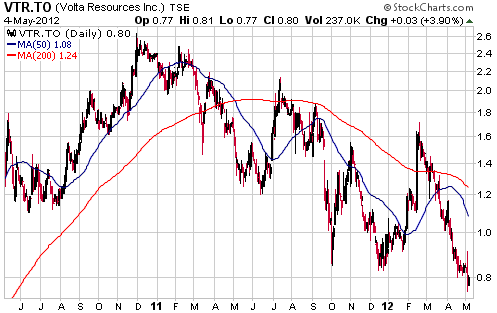
In the short time we've been following this company it has become apparent to us that its gold project and its valuation make it suited to being a long-term speculation rather than just a short-term trade. We have therefore shifted its position in the TSI Stock Selections List accordingly, but in doing so we have added to the existing problem of having too many stocks in the List.
Our goal is to reduce the size of the TSI Stocks List by at least 5 stocks within the next two months.
Chart Sources
Charts appearing in today's commentary
are courtesy of:
http://stockcharts.com/index.html

|









