|
-- Weekly Market Update for the Week Commencing 8th April 2013
Big Picture
View
Here is a summary of our big picture
view of the markets. Note that our short-term views may differ from our
big picture view.
In nominal dollar terms, the BULL market in US Treasury Bonds
that began in the early 1980s will end by 2013. In real (gold)
terms, bonds commenced a secular BEAR market in 2001 that will continue
until 2014-2020. (Last
update: 23 January 2012)
The stock market, as represented by the S&P500 Index,
commenced
a secular BEAR market during the first quarter of 2000, where "secular
bear market" is defined as a long-term downward trend in valuations
(P/E ratios, etc.) and gold-denominated prices. This secular trend will bottom sometime between 2014 and 2020.
(Last update: 22 October 2007)
A secular BEAR market in the Dollar
began during the final quarter of 2000 and ended in July of 2008. This
secular bear market will be followed by a multi-year period of range
trading.
(Last
update: 09 February 2009)
Gold commenced a
secular bull market relative to all fiat currencies, the CRB Index,
bonds and most stock market indices during 1999-2001.
This secular trend will peak sometime between 2014 and 2020.
(Last update: 22 October 2007)
Commodities,
as represented by the Continuous Commodity Index (CCI), commenced a
secular BULL market in 2001 in nominal dollar terms. The first major
upward leg in this bull market ended during the first half of 2008, but
a long-term peak won't occur until 2014-2020. In real (gold) terms,
commodities commenced a secular BEAR market in 2001 that will continue
until 2014-2020.
(Last
update: 09 February 2009)
Copyright
Reminder
The commentaries that appear at TSI
may not be distributed, in full or in part, without our written permission.
In particular, please note that the posting of extracts from TSI commentaries
at other web sites or providing links to TSI commentaries at other web
sites (for example, at discussion boards) without our written permission
is prohibited.
We reserve the right to immediately
terminate the subscription of any TSI subscriber who distributes the TSI
commentaries without our written permission.
Outlook Summary
Market
|
Short-Term
(1-3 month)
|
Intermediate-Term
(6-12 month)
|
Long-Term
(2-5 Year)
|
|
Gold
|
Bullish
(17-Oct-12)
|
Bullish
(26-Mar-12)
|
Bullish
|
|
US$ (Dollar Index)
|
Neutral
(24-Dec-12)
|
Neutral
(09-Jan-12)
|
Neutral
(19-Sep-07)
|
|
Bonds (US T-Bond)
|
Neutral
(12-Nov-12)
|
Neutral
(18-Jan-12)
|
Bearish |
|
Stock Market
(DJW)
|
Bearish
(30-Jul-12)
|
Bearish
(28-Nov-11)
|
Bearish
|
|
Gold Stocks
(HUI)
|
Bullish
(24-Dec-12)
|
Bullish
(23-Jun-10)
|
Bullish
|
|
Oil |
Neutral
(30-Jul-12)
|
Neutral
(31-Jan-11)
|
Bullish
|
|
Industrial Metals
(GYX)
|
Neutral
(30-Jul-12)
|
Neutral
(29-Aug-11)
|
Neutral
(11-Jan-10)
|
Notes:
1. In those cases where we have been able to identify the commentary in
which the most recent outlook change occurred we've put the date of the
commentary below the current outlook.
2. "Neutral", in the above table, means that we either don't have a
firm opinion or that we think risk and reward are roughly in balance with respect to the timeframe in question.
3. Long-term views are determined almost completely by fundamentals,
intermediate-term views by
fundamentals, sentiment and technicals, and short-term views by sentiment and
technicals.
Important note regarding
TSI schedule
We're going to be taking a short vacation,
which means there will be no Interim Update on Thursday 11th April and no Weekly
Update on Sunday 14th April. Our next scheduled commentary will be the Interim
Update on 18th April, although we will send out an email alert in the meantime
if something important happens in the markets that demands immediate attention.
Based on the way the markets are currently positioned, there's a better than
average chance that an email alert will be required.
Inflation Expectations
Every now and then someone will tell us that
there is no "inflation" evident in consumer prices. We immediately conclude that
this person either has a spouse who does all the shopping and pays all the bills
or takes government propaganda over the evidence of his/her own eyes. That being
said, it is clear that "inflation expectations" are not yet high enough to pose
a problem for policy-makers. This is actually a bad thing, because it means
there is currently nothing in the way of more stupid pro-inflation policies.
With regard to the supposed absence of "inflation" in consumer prices, we note
the following: First, non-government surveys suggest that living costs in the US
have been rising at more than 5% per year over the past few years. Second, the
'sticker shock' we always feel on our occasional visits suggests to us that
consumer prices in Australia have been rising at around 10% per year for many
years. Third, during our years in China the rate of "price inflation" was always
well into double digits. Fourth, the annual rate of "price inflation" in Hong
Kong has been at least 10% over the past few years. And fifth, here in Malaysia
we estimate that prices are rising at 5%-10%/year, despite the official
calculation showing "inflation" of only 1.5%/year.
It is true that in some parts of the world the pace of the currency's
purchasing-power loss has been slow. For example, Japan and some European
countries have experienced minimal "price inflation" over recent years. However,
the cases of minimal "price inflation" have been associated with slow
money-supply growth.
There is no great mystery here. The countries/regions that have experienced
rapid money-supply growth over the past few years now have plenty of "price
inflation" to show for it, whereas there is a lot less "price inflation" in the
places that have experienced slow money-supply growth. When the evidence of your
own eyes and the experiences of real people don't match the official statistics,
it's a good bet that the statistics are wrong.
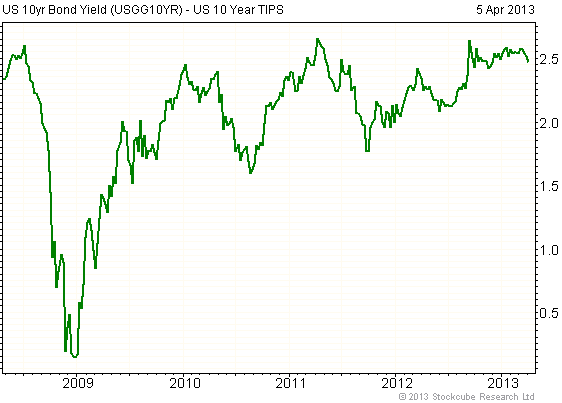
Zooming-in on the US, even though there is abundant evidence of meaningful
"price inflation", the yield difference between the 10-year T-Note and the
10-year TIPS (the "Expected CPI") tells us that US inflation expectations are
presently under control. As illustrated by the following weekly chart, the
Expected CPI rose sharply in mid-September of last year in reaction to the Fed's
announcement of "QE3" but has since drifted sideways. Of particular interest is
that the Expected CPI did not react to the announcement of "QE4" in December,
despite the acceleration in all types of "inflation" that the latest QE program
will inevitably bring about.
The absence of any negative reaction to "QE4" reflects a general lack of
understanding of how monetary inflation affects the economy. However, if this
general lack of understanding didn't exist then central bankers around the world
wouldn't have the political freedom to do what they have been doing and continue
to do. They would have been figuratively -- perhaps even literally -- tarred and
feathered long ago.
We know what will happen. The continuation of current central bank strategies
will cause such an obvious "price inflation" problem that the problem will be
impossible to deny or hide. However, we don't know when it will happen.
The latest US economic
numbers give us more of the same
The only regular US economic numbers that we
care about were reported last week. We are referring to the monthly ISM
(Institute of Supply Management) indices and the monthly employment data. The
former are useful because they provide an accurate reflection of how the US
manufacturing sector is performing and timely confirmation that the US economy
is entering/exiting recession. The latter (the employment numbers), on the other
hand, are almost completely useless as economic indicators, because the numbers
that are initially reported often undergo large revisions and because employment
lags the overall economy by many months. We pay attention to the monthly
employment numbers, though, because the financial markets and the Fed pay a lot
of attention to them. As has been the case with most of the US economic data
published over the past several months, the latest sets of ISM and employment
numbers can aptly be described by the phrase: not good, but not terrible.
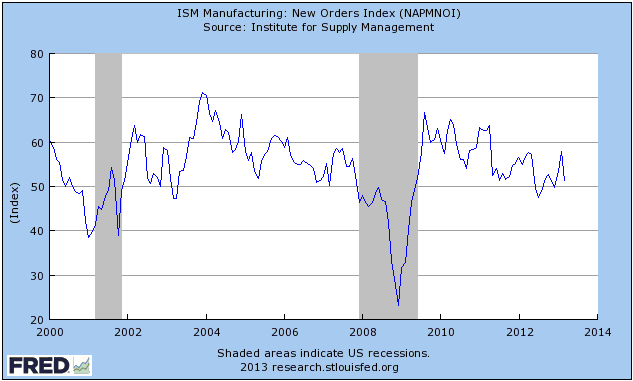
In terms of providing information about what's currently happening and what's
likely to happen, the most useful component of the ISM data is the New Orders
Index. After rebounding to its highest level since H1-2011 during the first two
months of this year, the New Orders Index fell sharply in March to just above
its low of the past three years. However, the following chart shows that the
overall pattern has not changed. The New Orders Index has had a downward bias
since early-2010, but it is still -- marginally -- in expansion territory (>50).
A solid break below last year's low would signal that a recession had begun.
Government Bonds Update
The Bank of Japan (BOJ) ups the ante
There was a lot of action in the world's two largest and most important
government bond markets last week. First and foremost, there was extreme
volatility in the Japanese Government Bond (JGB) market in reaction to the BOJ's
new plan to rescue the economy.
The BOJ's 'brilliant' new plan to boost the economy is the same as the old plan,
only much bigger. It's the standard Keynesian modus operandi: If the patient
refuses to recover in response to a dose of medicine, increase the dose. Never
consider the possibility that the wrong medicine is being used. Whereas the
BOJ's old plan involved monetising assets (mostly JGBs) at the rate of 4
trillion Yen per month, the new plan ramps the monthly rate of asset
monetisation up to about 7T Yen (the equivalent of about $74B). A goal of the
new plan is a massive increase in the monetary base -- from 138T Yen at the end
of last year to 200T Yen by the end of this year and 270T Yen by the end of
2014.
Although it was widely expected that the BOJ would step-up the pace of its JGB
monetisation in an attempt to depreciate the Yen, Japan's central bank still
managed to exceed expectations. This is evidenced by the market reaction to the
news. For example, after the new plan was announced last Thursday the yield on
the 10-year JGB immediately plunged from its already ultra-depressed level of
0.56%. It hit a new all-time low of 0.32% on Friday and then suddenly reversed
course and rose to 0.65%, as the market first tried to discount the BOJ's
additional JGB demand and later tried to discount the inflationary effects of
the BOJ's monetisation. The 10-year yield then settled back to end the week at
0.53%. All of these yield changes are tiny in absolute terms, but are huge in
relative percentage terms (Friday's intra-day rise from a low of 0.32% to a high
of 0.65% constitutes a swing of more than 100%).
Almost anything could happen to the JGB market over the days/weeks immediately
ahead. One possibility is that the BOJ's 'cunning plan' will quickly backfire in
a big way, with the JGB market crashing due to bond investors rapidly coming to
the conclusion that the Yen depreciation strategy will be a resounding success.
If the market crashes and bond yields rocket upward, how will the BOJ respond?
Will the BOJ chief come out and say that it was all a big joke?
It's not really a disappointment that the new chief of the BOJ could believe
that creating a huge amount of money out of nothing will help the Japanese
economy. The unfortunate truth is that nowadays it isn't possible to get to the
top of the central banking world unless you are a bad economist, because to get
to the top of the central banking world you must be an advocate of
economically-destructive policies. It is, however, disappointing that so few
economists, financial journalists and other pundits call the central bankers
out. Instead of general outrage, the reaction to the new BOJ plan to rescue the
Japanese economy varied from "Excellent! Japan is finally on the right path!" to
"It's a bold move, but there's a chance it won't work."
What we are dealing with here can be likened to a doctor who has a very sick
patient. Instead of relying on modern medical knowledge to diagnose and treat
the patient, the doctor scatters chicken bones and entrails around the patient's
bed with the aim of driving away evil spirits. On hearing about what this doctor
is doing, the typical reaction of other doctors and medical experts around the
country is: "It's a bold move, but there's a chance it won't work".
The BOJ has come up with a completely harebrained scheme. There's zero chance it
will work, provided that the goal of the scheme is a stronger Japanese economy.
And even if the only goal is to reduce the purchasing power of the Yen, it might
not work. This is due to the difference between the mechanics of the BOJ's QE
and the mechanics of the Fed's QE. To be more specific, for every dollar of
assets monetised by the Fed under its QE programs, one dollar gets added to bank
reserves (not counted as part of the money supply) and one dollar gets added to
demand deposits within the economy (counted in the money supply). Therefore,
regardless of what the commercial banks do with their additional reserves, the
Fed's QE boosts the supply of US dollars within the economy. (As an aside, this
is why arguments along the lines of "the Fed can't depreciate the dollar if the
private banks don't lend" are fallacious. The Fed can, and routinely does,
inject money directly into the US economy.) However, when the BOJ monetises
assets it generally boosts bank reserves to a far greater extent than it boosts
the money supply. That is, the BOJ appears to rely heavily on increased lending
by private Japanese banks to transmit its inflationary actions into the economy.
This means that despite the massive scale of the BOJ's new asset monetisation
program, the program won't depreciate the Yen unless it prompts Japanese
commercial banks to make more loans.
Something worth considering is that the primary goal of the BOJ's new scheme
might not be a stronger economy or a weaker Yen. The primary goal might,
instead, be to provide the government with a politically feasible means of
defaulting on a substantial chunk of its debt. The unstated strategy could be:
transfer a lot of JGBs to the BOJ and then cancel the JGBs, thus inflicting a
huge accounting loss on the BOJ. In this way the costs of a government debt
default could be surreptitiously spread throughout the economy via a reduction
in the Yen's purchasing power.
The BOJ makes the T-Bond look safe
The BOJ's antics and weaker-than-expected US economic data enabled US T-Bond
futures to break above significant resistance late last week. The following
daily chart illustrates the situation.
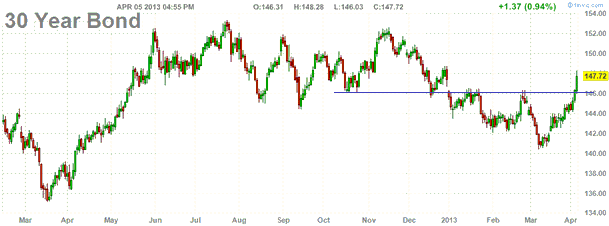
The T-Bond's intermediate-term downward correction might have ended early last
month, but at this stage we don't expect it to do any better than test last
year's high.
The Stock
Market
There was a sharp knee-jerk downward
reaction in the US stock market last Friday when the weaker-than-expected
employment numbers were reported. We don't know why, since a) the monthly
employment report is only relevant to the stock market to the extent that it
affects Fed policy, and b) the weak employment report will encourage the Fed to
persist with its aggressive monetary accommodation. It was probably just a case
of the stock market being very 'overbought' and looking for a reason to fall.
The stock market fell sharply at first, but then recouped enough of its losses
to avoid breaching any support of significance. For example, early in the
trading day it looked like the NDX was going to close below support at 2750, but
it ended the day above this support and also above its 50-day MA.

The large-cap European stocks represented by the EURO STOXX 50 Index also
managed to hold above support on Friday.
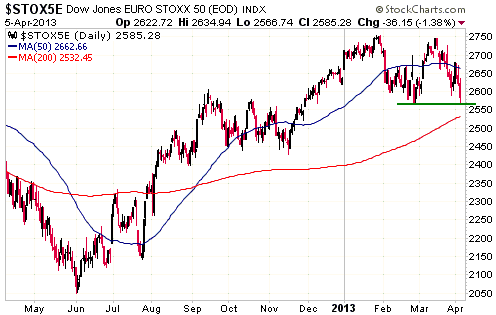
Support held last week in the US and Europe, but it was a close call. It would
only take a small increase in selling pressure to breach support and confirm
that multi-month tops are in place.
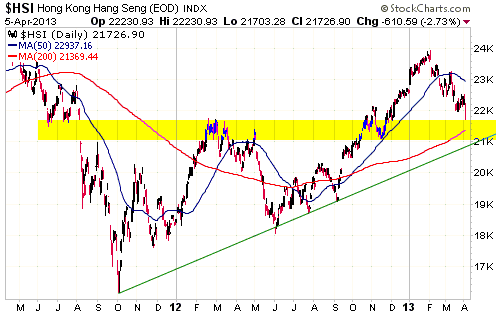
The Hong Kong stock market often leads at important turning points and made a
multi-month top in January. Hong Kong's Hang Seng Index (HSI) dropped to a new
low for the year on Friday in reaction to fears about the effects of a new
strain of the "bird flu" virus (H7N9). We doubt that the virus is anything to
worry about, but the government's reaction/over-reaction to the virus news could
cause economic problems.
In the HSI's favour, it is now very 'oversold' on a short-term basis and at the
top of a 700-point range of strong support (see chart below) that encompasses
the 200-day MA, numerous prior turning points (tops and bottoms), and a
trend-line dating back to the October-2011 low.
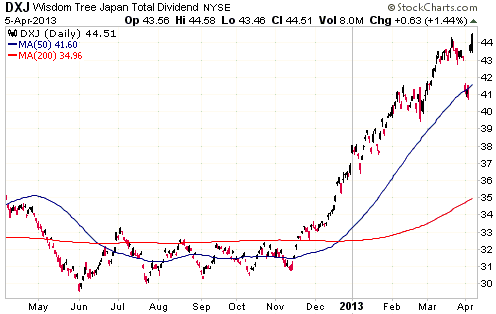
There was wild action in DXJ, an ETF that mimics the Yen-denominated performance
of Japan's stock market, last week. DXJ provided preliminary evidence that a top
was in place by gapping sharply lower at the beginning of last week, but then
negated this evidence by gapping sharply higher on Thursday in response to the
BOJ's new inflation program. A new 52-week high was made on Friday.
For information purposes only, we bought an initial position in DXJ August-2013
$40 put options late in the week before last. When DXJ gapped down at the
beginning of last week we thought we had missed our chance to build up a more
significant position in these puts, but the price action late last week caused
the puts to plummet in price and prompted us to buy some more. We now have what
we consider to be about half of a full position and plan to scale up to a full
position over the next couple of weeks if good opportunities to do so present
themselves.
There's the potential for a large DXJ decline over the next 1-3 months.
This week's
important US economic events
| Date |
Description |
| Monday Apr 08 |
No important events scheduled | | Tuesday
Apr 09 |
No important events scheduled | | Wednesday
Apr 10 |
FOMC Minutes
Treasury Budget | | Thursday
Apr 11 |
Import and Export Prices
|
| Friday Apr 12 |
PPI
Retail Sales
Consumer Sentiment
Business Inventories |
Gold and
the Dollar
Gold
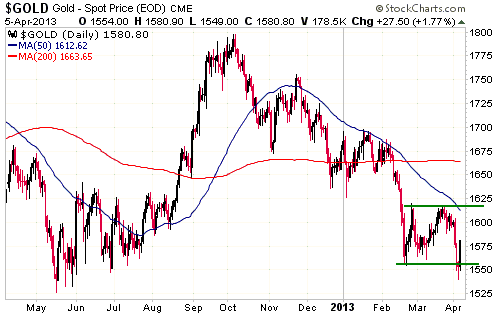
The US$ gold price traded below short-term support at $1550 last week, but
didn't quite make it to major support at $1525-$1535 before reversing upward.
This is bullish price action.
We would now interpret a daily close above short-term resistance at $1620 as
evidence that an important bottom was in place. The equivalent resistance level
for silver lies at $29.50.
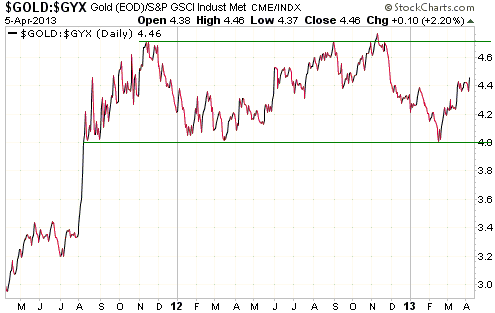
Relative to the Industrial Metals Index (GYX), gold ended last week at a new
high for the year. On a longer-term basis the gold/GYX ratio remains within a
wide horizontal consolidation, but the evidence continues to build that an
intermediate-term reversal occurred in February.
What will it take for gold to rally to new highs?
Gold could rebound well into the $1600s or even into the $1700s in the absence
of any new fundamental developments of significance, but getting to a new
all-time high will probably require an upside breakout in inflation expectations
or the re-emergence of major systemic financial problems in the EZ or blatant
evidence that the US economy is headed into recession. All three are likely to
happen within the next two years, but the second has the highest probability of
happening soon.
Gold Stocks
Last Friday the HUI put in one of its worst performances of the past 12 months.
It only fell by 0.8%, but it fell on a day when the financial-market and
economic backdrop was very positive for the gold mining sector. Specifically, it
fell on a day when the bullion market was strong, the economic data was
negative, and the broad stock market was a little weak -- a day when the scene
was set for a >3% rally. It was, however, just one day.
The only takeaway from Friday's HUI performance is that a bottom has not yet
been signaled. We'll now consider what the HUI needs to do to confirm that an
intermediate-term bottom is in place.
Closing above the top of the channel drawn on the following daily chart would be
a clear sign that a bottom is in place. This channel is now well-defined and has
constrained the HUI's swings throughout the downward trend that began last
September. The channel top is presently near important lateral resistance at 375
and the 50-day MA.
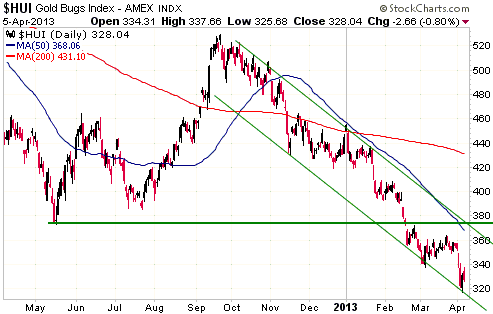
Other signs that a bottom is in place can be gleaned from how the HUI performed
on a weekly basis near previous major turning points from down to up. The HUI is
now as 'oversold' as it was at the major lows of October-2008 and November-2000,
so let's take a look at weekly charts showing the price action in the aftermath
of these lows.
First, notice that there was high volatility on a weekly basis (large percentage
weekly changes) during the weeks following the November-2000 and October-2008
bottoms. It's a good bet that we will see something similar following the next
major low. Second, notice that in both cases the HUI achieved a weekly close of
well above its 10-week moving average (the blue line on the chart) in 5 weeks or
less from the major low.
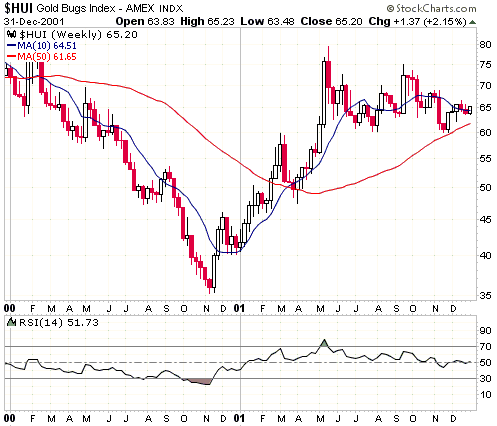
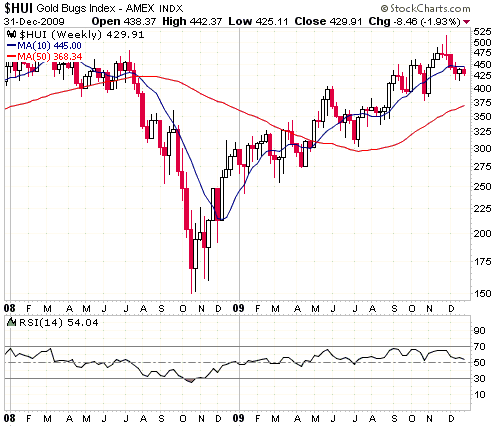
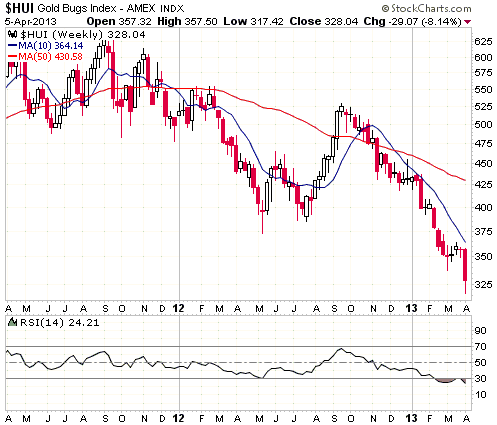
Turning now to the current weekly chart, we can see no evidence that a bottom is
in place, but this doesn't mean that a bottom was not put in place last week.
What we can deduce, based on past performance, is that IF a bottom was put in
place last week then the HUI should end this week in the 340s or higher.
Another sign that a bottom is in place will be provided by the Gold Miners
Bullish Percentage Index (BPGDM), a chart of which is displayed below. A move
above 20% will be clear-cut evidence that a sustainable upward reversal has
occurred.
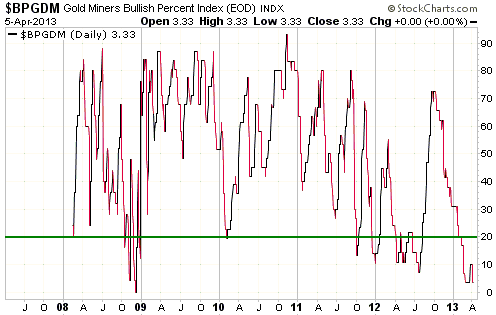
There is likely to be a daily close above the channel top at around the same
time as a weekly close above the 10-week MA and a move above 20% in BPGDM, with
the initial sign of a bottom being high volatility with an upside bias.
Currency Market Update
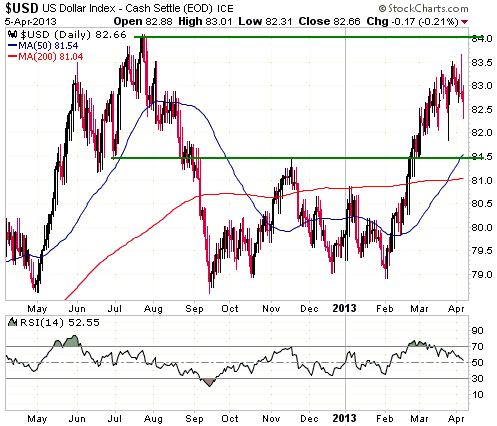
The Dollar Index has essentially been in 'consolidation mode' since becoming
short-term 'overbought' in early March. It tried to continue its upward trend in
response to the Cyprus news and then the BOJ news, but failed to sustain the
news-related gains.
Our view remains that the Dollar Index made an intermediate-term bottom in
February and is likely to trade significantly higher before year-end.
Specifically, we think that it stands a good chance of moving into the 90s
during the second half of this year. However, getting above resistance at 84
(last year's high) will probably require a sizeable stock market decline or
major EZ bank problems. In the absence of some market drama that prompts a
flight to the perceived safety of US$ cash, additional corrective activity is
likely. A normal short-term correction would take the Dollar Index back to
around 81.5.
The BOJ's new Yen-depreciation program pushed the Yen to a multi-year low on the
foreign exchange market. Last week will probably turn out to be the peak of the
Yen-bearish news cycle, especially if JGB yields enter steep upward trends.
Update
on Stock Selections
Notes: 1) To review the complete list of current TSI stock selections, logon at
http://www.speculative-investor.com/new/market_logon.asp
and then click on "Stock Selections" in the menu. When at the Stock
Selections page, click on a stock's symbol to bring-up an archive of
our comments on the stock in question. 2) The Small Stock Watch List is
located at http://www.speculative-investor.com/new/smallstockwatch.html
 Company
news/developments for the week ended Friday 5th April 2013: Company
news/developments for the week ended Friday 5th April 2013:
[Note: FS = Feasibility Study, IRR = Internal Rate of Return, MD&A =
Management Discussion and Analysis, M&I = Measured and Indicated,
NAV = Net Asset Value, NPV(X%) = Net Present Value using a discount
rate of X%, P&P = Proven and Probable, PEA = Preliminary Economic
Assessment, PFS = Pre-Feasibility Study]
*Asanko Gold (AKG) issued its MD&A and financial statements for
the year ended 31st December 2012. The financial statements showed
that the company had $205M of cash and $202M of working capital at
the end of last year. Of all the exploration-stage junior gold
miners we know of, AKG has the strongest balance sheet.
The results of the PFS for AKG's 5M-oz Esaase gold project (Ghana)
are expected to be announced this month. We will update our
valuation of the stock based on these results, but based on what we
know right now AKG is a strong buy.
*Almaden Minerals (AAU) issued its mandatory reports (MD&A +
financial statements) for the year ended 31st December. The
financial statements showed that AAU had about $19M of working
capital at 31st December. This means that its working capital fell
by about $3M over the most recent quarter, which is reasonable
considering the progress made on the company's Tuligtic project.
AAU is in a good financial position, because in addition to having
more than enough money in the bank to fund its exploration
activities over the next 12 months it has $10M of investments in
other listed companies and considerable flexibility regarding the
rate at which it spends money.
*Golden Star Resources (GSS) advised that it produced 81.3K ounces
of gold in the first quarter of this year and is on track to achieve
its 2013 production guidance (320K-350K ounces). This is fine, but
the most important measure of GSS's operating performance will be
the cost of its production.
*Pilot Gold (PLG.TO) announced that a 30,000m drilling program had
commenced at its TV Tower project (Turkey) on 23rd March. 15,000m of
the drilling will continue testing the KCD target, which is where
all of the great results achieved by the previous drilling program
originated. The other 15,000m will test two new targets called
Kayali and Columbaz.
*Sabina Gold and Silver (SBB.TO) issued its MD&A and financial
statements for the year ended 31st December 2012. There was nothing
new here, as the results of the 2012 work program and the company's
plans for 2013 had previously been announced. SBB's primary focus
over the next several months will be the Back River PFS, which is
scheduled to be complete in Q3-2013.
SBB began the year with $120M of working capital and $116M of cash.
Based on the company's 2013 spending plans and assuming a similar
rate of spending in 2014, SBB is fully funded for the next 18
months.
Near current prices, SBB is one of the best candidates for new
buying.
Chart Sources
Charts appearing in today's commentary
are courtesy of:
http://stockcharts.com/index.html
http://stlouisfed.org/
http://finviz.com/
http://www.fullermoney.com/

|









