|
-- Weekly Market Update for the Week Commencing 8th July 2013
Big Picture
View
Here is a summary of our big picture
view of the markets. Note that our short-term views may differ from our
big picture view.
In nominal dollar terms, the BULL market in US Treasury Bonds
that began in the early 1980s will end by 2013. In real (gold)
terms, bonds commenced a secular BEAR market in 2001 that will continue
until 2014-2020. (Last
update: 23 January 2012)
The stock market, as represented by the S&P500 Index,
commenced
a secular BEAR market during the first quarter of 2000, where "secular
bear market" is defined as a long-term downward trend in valuations
(P/E ratios, etc.) and gold-denominated prices. This secular trend will bottom sometime between 2014 and 2020.
(Last update: 22 October 2007)
A secular BEAR market in the Dollar
began during the final quarter of 2000 and ended in July of 2008. This
secular bear market will be followed by a multi-year period of range
trading.
(Last
update: 09 February 2009)
Gold commenced a
secular bull market relative to all fiat currencies, the CRB Index,
bonds and most stock market indices during 1999-2001.
This secular trend will peak sometime between 2014 and 2020.
(Last update: 22 October 2007)
Commodities,
as represented by the Continuous Commodity Index (CCI), commenced a
secular BULL market in 2001 in nominal dollar terms. The first major
upward leg in this bull market ended during the first half of 2008, but
a long-term peak won't occur until 2014-2020. In real (gold) terms,
commodities commenced a secular BEAR market in 2001 that will continue
until 2014-2020.
(Last
update: 09 February 2009)
Copyright
Reminder
The commentaries that appear at TSI
may not be distributed, in full or in part, without our written permission.
In particular, please note that the posting of extracts from TSI commentaries
at other web sites or providing links to TSI commentaries at other web
sites (for example, at discussion boards) without our written permission
is prohibited.
We reserve the right to immediately
terminate the subscription of any TSI subscriber who distributes the TSI
commentaries without our written permission.
Outlook Summary
Market
|
Short-Term
(1-3 month)
|
Intermediate-Term
(6-12 month)
|
Long-Term
(2-5 Year)
|
|
Gold
|
Bullish
(17-Oct-12)
|
Bullish
(26-Mar-12)
|
Bullish
|
|
US$ (Dollar Index)
|
Neutral
(24-Dec-12)
|
Bullish
(01-May-13)
|
Neutral
(19-Sep-07)
|
|
Bonds (US T-Bond)
|
Bullish
(24-Jun-13)
|
Neutral
(18-Jan-12)
|
Bearish |
|
Stock Market
(DJW)
|
Neutral
(06-May-13)
|
Bearish
(28-Nov-11)
|
Bearish
|
|
Gold Stocks
(HUI)
|
Bullish
(24-Dec-12)
|
Bullish
(23-Jun-10)
|
Bullish
|
|
Oil |
Neutral
(30-Jul-12)
|
Neutral
(31-Jan-11)
|
Bullish
|
|
Industrial Metals
(GYX)
|
Neutral
(30-Jul-12)
|
Neutral
(29-Aug-11)
|
Neutral
(11-Jan-10)
|
Notes:
1. In those cases where we have been able to identify the commentary in
which the most recent outlook change occurred we've put the date of the
commentary below the current outlook.
2. "Neutral", in the above table, means that we either don't have a
firm opinion or that we think risk and reward are roughly in balance with respect to the timeframe in question.
3. Long-term views are determined almost completely by fundamentals,
intermediate-term views by
fundamentals, sentiment and technicals, and short-term views by sentiment and
technicals.
Bad gold-bullish arguments
Last week we explained why the most popular
fundamentals-based gold-bearish arguments didn't make sense. In the interest of
even-handedness, in today's report we are going to mention some of the bad
arguments regularly made by gold bulls. It's strange that although the bulls
were on the right side of the market most of the time since the year 2000 and
will probably be proven right over the next few years, the majority of the
popular fundamentals-based gold-bullish arguments are either irrelevant or
wrong.
The most popular of the gold-bullish argument is some version of "the Fed is
printing lots of money". However, although monetary inflation is an important
part of the valid bullish case for gold, monetary inflation is not, by itself,
inherently bullish for gold. As evidence we cite the fact that there was plenty
of monetary inflation during 1980-2000, a two-decade period during which the
gold price trended downward from a peak of around $850 to a bottom of around
$250.
Gold benefits from the negative effects of monetary inflation rather than the
monetary inflation itself. The most important of these negative effects is
economic weakness stemming from mal-investment, which will usually prompt
additional monetary inflation.
For this reason, inflation policy (central bank "money printing") will not be
helpful to gold in real terms while the policy is generally perceived to be
working. Unfortunately, there's no way of knowing ahead of time precisely how
long it will take before the wealth-destroying aspects of the monetary inflation
will become apparent to a critical mass of people.
Another popular argument goes something like "you better invest in gold because
hyperinflation or total monetary collapse is coming soon". However, as far as
the US is concerned these cataclysmic events have a roughly zero percent
probability of happening within the next two years and only a small chance of
happening within the next ten years. The small chance of hyperinflation or total
monetary collapse happening within the next ten years is a good reason to own
some gold for insurance purposes, but not for making a substantial investment in
gold.
In point form, here are some of the other popular gold-bullish arguments that
are either wrong or irrelevant:
a) "Mine supply is going to shrink." We've explained numerous times in the past
why changes in mine supply have almost no effect on the gold price.
b) "Central banks are buying gold." In the gold market the central banks, as a
group, are the dumb money writ large. They tend to be disinterested in gold when
the price is low and interested in adding gold to their reserves when the price
is high.
c) "There is a shortage of physical gold." Due to the quantity of gold produced
each year by the mining industry and the quantity of gold consumed each year in
commercial processes being extremely small relative to the total aboveground
gold inventory, it should always be possible for a price change to bring gold
demand into balance with the existing gold supply. That is, it should always be
possible for price to ration the existing supply. Consequently, it's very
unlikely that there will ever be a shortage of physical gold.
d) "China's demand for gold is rising". A transfer of gold from one part of the
world to another part of the world -- in this case, from outside to inside China
-- provides no information about the current or likely future performance of the
gold price. As far as the gold price is concerned, what counts is the net change
in demand for the total aboveground gold inventory.
e) "Jewellery demand is rising". The gold price is driven by changes in
investment demand, not changes in jewellery demand. Rather than being a price
driver, the non-investment-related demand for gold jewellery is a price follower
in that it tends to rise in reaction to a price decline and fall in reaction to
a price advance.
There are very good reasons to expect gold to do well in nominal and real terms
over the next few years, but, inexplicably, many gold bulls pay minimal
attention to the legitimate reasons for being bullish and instead fixate on
aspects of the market that have no bearing on whether gold's future price trend
will be bullish or bearish.
Oil Update
In last week's Interim Update we mentioned that
oil was within 6% of its mid-2008 all-time high relative to the Industrial
Metals Index (GYX). Due to additional strength in the oil market (on the back of
political upheaval in Egypt) and additional weakness in the industrial metals
markets, the oil/GYX ratio is now testing its all-time high.
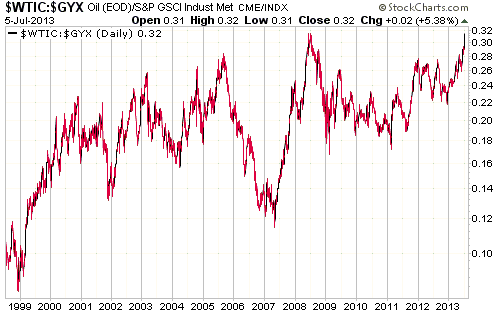
With the Industrial Metals Index more likely to fall than rise over the next 6
months and with oil now very expensive relative to the industrial metals, we
perceive a lot of downside risk in the oil price.
T-Bond Update
Two weeks ago we said that the T-Bond's
short-term risk/reward had tipped towards reward. We also pointed out that
previous intermediate-term bottoms over the past 5 years were put in place after
the T-Bond spiked below its 200-week moving average, which suggested that there
could be as much as five points of additional downside prior to an important
reversal.
The T-Bond has since fallen by 4.7 points and is now slightly below its 200-week
MA (the red line on the following weekly chart). It is now positioned similarly
to how it was positioned at the mid-2009 and early-2011 intermediate-term
bottoms.
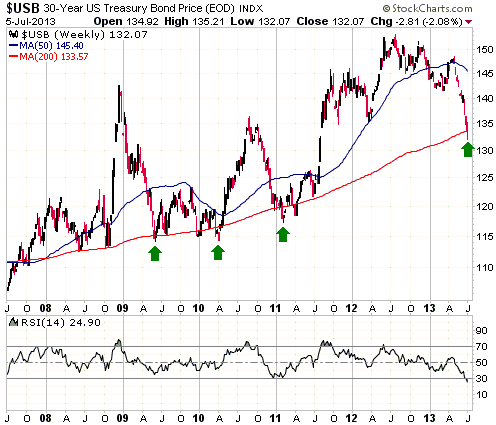
There's a high risk that the T-Bond's secular bull market has finally ended and
a new long-term bear market has begun, but even in this case a sizeable rebound
will probably soon begin. New bear market or continuing bull market, the 50-week
moving average (the blue line on the above chart) is a reasonable upside target
for the next rebound.
The Stock
Market
The US
After almost reaching support at 1550 a couple of weeks ago, the S&P500 Index
(SPX) has since rebounded. It is now a little 'overbought' on a short-term basis
and could pull back or consolidate for a few days, but there's a high
probability of it making a new all-time high within the next two months.
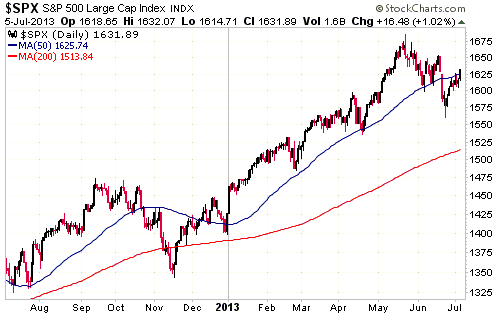
We say that the SPX is likely to make a new all-time high within the next two
months because there is now a lot of evidence indicating that a) the May-June
decline was a correction within an upward trend, and b) the recent downward
correction ended late last month. The evidence includes the following:
1) The Bank Index (BKX) ended last week at a new multi-year high
2) The BKX/SPX ratio ended last week at a new multi-year high
3) The Russell2000 Small Cap Index (RUT) ended last week at a new all-time
closing high
4) The RUT/SPX ratio ended last week at a new 52-week high
5) The HYG/TLT ratio (a credit spread indicator) ended last week at a new
52-week high, meaning that credit spreads are at or near their lows of the past
year
Europe
While the senior US stock indices appear to have completed routine corrections
within continuing upward trends, the same cannot be said about Europe's
equivalent of the Dow Jones Industrials Index: the Dow Jones EURO STOXX50 Index
(STOX5E). At this stage it's an even-money bet as to whether the May-June
decline in the STOX5E was 'corrective' or the first leg of a new
intermediate-term downward trend.
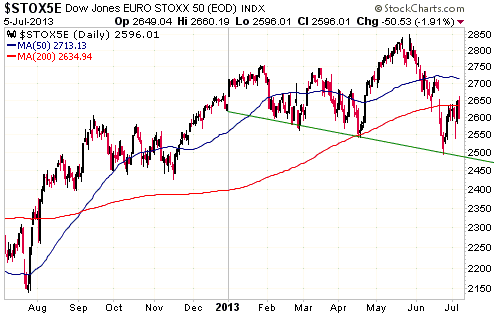
The STOX5E appears to have more short-term downside potential than the SPX, but
the SPX appears to have more intermediate-term and long-term downside potential
than the STOX5E. This is partly because valuations are a lot lower in Europe and
partly because monetary policy in Europe is likely to loosen relative to
monetary policy in the US over the next 12 months.
This week's
important US economic events
| Date |
Description |
| Monday Jul 08 |
Consumer Credit | | Tuesday
Jul 09 |
No important events scheduled | | Wednesday
Jul 10 |
FOMC Minutes | | Thursday
Jul 11 |
Import and Export Prices
Treasury Budget
|
| Friday Jul 12 |
PPI
Consumer Sentiment |
Gold and
the Dollar
Gold
Why gold isn't money today
A recent "Outside the Box"
article at Mauldin Economics contains the assertion: "The source of
gold's meaning, whether you are a market participant in 1895 or 2013, comes from
the Common Knowledge regarding gold. J.P. Morgan said that gold is money, and he
was right, but only because at the time he said it everyone believed that
everyone believed that gold is money. Today that same statement is wrong, but
only because no one believes that everyone believes that gold is money." In
other words, whether gold is or isn't money is determined by what 'everyone'
believes. Is this correct?
No; the logic is actually back-to-front, meaning that cause and effect are
reversed. Everyone in 1895 believed that gold was money because at that time
gold was money. Hardly anyone believes that gold is money today because gold is
not money today. To understand why something is or isn't money you first have to
know the definition of money.
Money is simply the general medium of exchange. If something is the general
medium of exchange within an economy then it is money in that economy. If
something is not the general medium of exchange within an economy then it is not
money. End of story. Good money will be a good long-term store of value, but
something can be money without being a good long-term store of value and
something can obviously be a good long-term store of value without being money.
In 1895, gold was the general medium of exchange. It was therefore money and
everyone believed it was money. Today, gold is not the general medium of
exchange. It therefore isn't money and, consequently, hardly anyone views it as
money.
On an important related matter, the transformation of gold from money to
non-money didn't happen due to a change in the general belief or the common
knowledge. Gold was gradually shifted from its monetary role over many decades
through government coercion. In the US the multi-decade process of changing
money from gold to something that could be created in unlimited amounts at the
whim of the financial establishment began in 1913 with the creation of the
Federal Reserve. Additional steps included the confiscation of gold and the
making of gold ownership illegal in 1933, the Bretton Woods Agreement of 1944
that set up a fixed exchange-rate system with all currencies linked to the US$
and the US$ tenuously linked to gold, and finally the severing, in 1971, of the
last official link between the US$ and gold.
In other words, the common knowledge regarding gold was changed by government
fiat. It wasn't a natural evolution.
We know from history that when people are free to choose their money, gold
and/or silver will usually be money. This makes it likely that at some point in
the distant future gold will, again, be money. However, don't kid yourself that
it is money today.
Current Market Situation
As an economic indicator, the monthly US employment report is not useful. This
is mainly because the employment numbers tend to lag the economy by at least a
few months and also because the employment numbers are susceptible to large
revisions during the months after they are first published. However, the Fed
pays a lot of attention to the employment numbers and, as a result, so do the
financial markets.
The US$ was strong prior to the release of the latest US monthly employment data
last Friday and when the data proved to be better than expected the US$ gained
additional ground. This caused a sharp pullback in the gold price, but the
pullback wasn't big enough to significantly alter gold's short-term prospects.
In fact, gold's ability to hold above its late-June low in the face of positive
US economic data and a rise in the Dollar Index to a new multi-year high should
be viewed as a sign of strength.
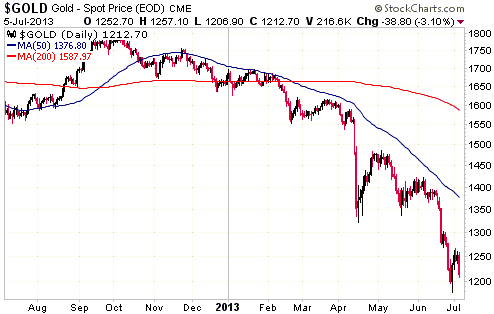
When gold breached its April-May lows during the first half of June it became
likely that the overall gold correction (or cyclical bear market) would continue
until October-November of this year. With US economic data remaining a 'mixed
bag' and with the senior US stock indices seemingly poised to make news highs
for the year within the next two months, there is now an even higher probability
that a major turn to the upside in the gold market will wait until the final
quarter of 2013. However, a tradable rebound remains likely over the coming 1-2
months.
Finally, to reiterate a point we've made in the past, the catalyst for the next
big advance in the gold price is at least as likely to be a crisis of confidence
in the euro as a crisis of confidence in the US$.
Gold Stocks
The cost of producing gold
The average all-in cost of gold production is presently about $1300/oz. This
suggests that at the current gold price at least half the gold-mining industry
is losing money or, at best, breaking even. Does this imply that as much as 50%
of today's gold producers will likely go out of business if the gold price stays
at its current level or moves lower?
No. If the gold price stays at its current level or moves lower then the cost of
mining gold will fall, for two main reasons. First, there will be less demand
for the resources (labour and materials) used by mining companies, leading to
lower prices for these inputs to the mining process. Second, producers will
revise their mining plans to focus on the portions of their deposits that can be
profitably mined at a lower gold price.
On the other hand, if the gold price rises to, say, $3,000/oz over the next
three years, then the average cost of mining gold will probably rise to at least
$2,000/oz. This will be due to increasing demand -- and therefore higher prices
-- for the resources used by mining companies, and the mining of portions of
deposits or entire deposits that wouldn't have been profitable at a lower price.
In general terms, the cost of mining gold is positively correlated with the
price of gold. Consequently, gold producers generally won't benefit as much from
a sustained increase in the price of gold or get hurt as much by a sustained
decrease in the price of gold as most analysts expect.
Due to the way the cost of mining gold responds to large changes in the gold
price, the biggest expansions in gold-mining profit margins result from large
percentage increases in the gold price that immediately follow periods during
which the gold mining industry readied itself for a lower gold price. This is
because it will take time for the cost of mining to respond to the higher gold
price.
Current Market Situation
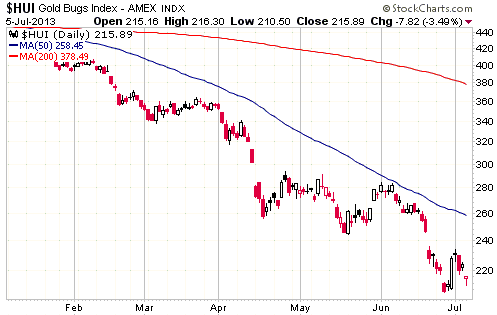
Last week's performance by the HUI almost fully retraced the 28th June surge to
the upside, but neither the short-term nor the intermediate-term outlook has
changed. A strong rebound over the coming 1-2 months remains a likely prospect,
almost regardless of the gold sector's longer-term prospects.
As is the case with gold, the HUI's ability to hold above its late-June low last
Friday could be viewed as a sign of strength.
GDXJ, a proxy for the junior end of the gold sector, is in a similar position to
the HUI.
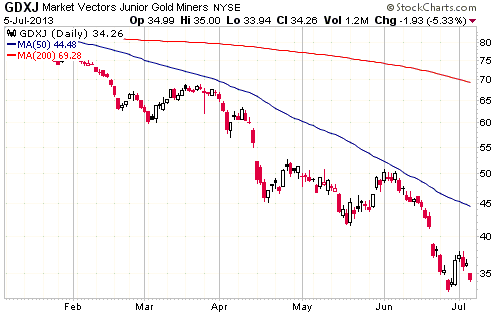
The gold-stock indices and ETFs need to achieve daily closes above their
respective 50-day moving averages to confirm that short-term bottoms are in
place.
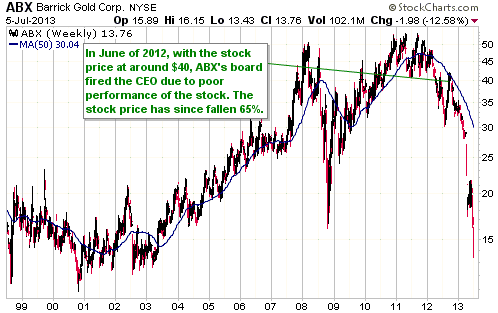
Due to its incredible price action it's worth singling out Barrick Gold (ABX),
the world's largest gold producer, for discussion in today's report.
In June of 2012, with the stock price at around $40, ABX's board of directors
(meaning: Peter Munk, the chairman) fired the company's CEO due to poor
performance of the stock price. This is ironic, because the stock price had held
up reasonably well during the year prior to the CEO firing and has collapsed 65%
during the year since the firing. ABX is now trading in the US$13s -- near its
2001-2002 lows.
The huge delays, cost overruns and legal issues linked to the construction-stage
Pascua Lama project (Chile and Argentina) are obviously part of the reason for
ABX's stock price being where it is today. However, irrational fear-driven
selling has also played a big part.
ABX is going to write-off the bulk of Pascua Lama's value in the quarterly
financial statements due out later this month. This is already known and has
been discounted by the market. Interestingly, this write-off will put ABX in the
position where there will be huge potential upside and very little remaining
downside risk associated with Pascua Lama.
We think that Pascua Lama will eventually become a profitable mining operation
for ABX, but at the current stock price ABX appears to be a reasonable long-term
speculation regardless of the prospects for this one large-scale development.
This is due to the company's stable of high-quality in-production gold mines.
That being said, if we wanted to add exposure to major gold producers we would
buy GDX rather than ABX. This is because with all of the major gold producers
being deeply under-valued there is no need to take the added risk of buying a
single stock.
Currency Market Update
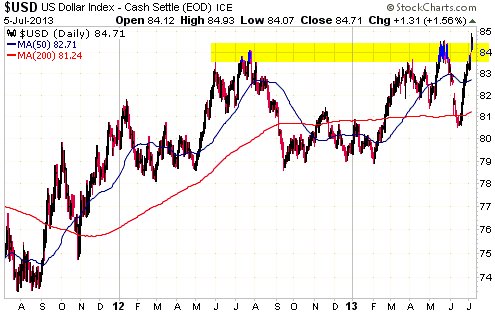
The Dollar Index ended last week at a marginal new multi-year high, having risen
in almost a vertical straight line over the past two weeks. It is now in a
similar position to where it was in mid-May -- at a new high for the move and
'overbought' on a short-term basis.
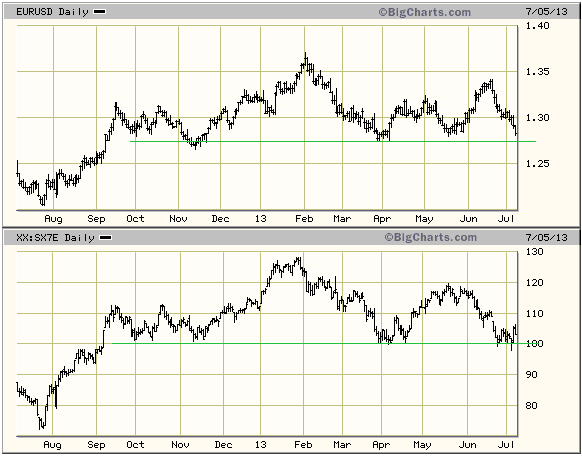
As was the case when the Dollar Index was peaking in mid-May, last Friday's new
2013 high hasn't yet been confirmed by the euro. As illustrated by the top half
of the following daily chart, the euro is now testing its May low and remains
above its March-April lows.
The bottom half of the following chart, however, shows that the euro's current
position is precarious. It shows that the EURO STOXX Banks Index (SX7E) barely
managed to hold above support at 100 last week and is not far from breaking out
to the downside. A downside breakout by SX7E would likely go with a downside
breakout in the euro.
The comments we made in last week's Interim Update therefore still apply. The
Dollar Index is short-term 'overbought' and could easily pull back over the
weeks ahead, but it also has significant short-term upside potential due to the
goings-on in the euro-zone.
Regardless of whether or not the Dollar Index is near a short-term peak, the
intermediate-term advance that began in February is probably not yet close to
complete. The Fed is still inflating the US$ supply faster than the ECB and the
BOJ are inflating their respective money supplies, but short- and
intermediate-term moves in currency exchange rates are often determined to a
greater extent by changes in demand than by changes in supply.
The British Pound is worthy of mention due to its dramatic plunge last Friday.
The Pound is now testing the multi-year low reached in March.
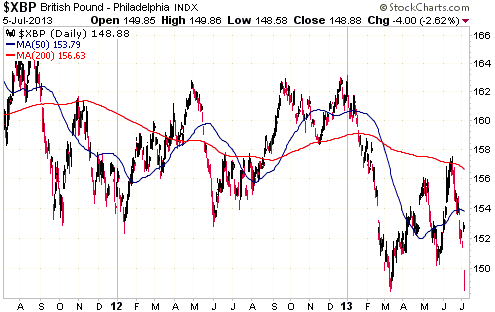
On a fundamental basis the Pound doesn't look as risky as the euro, but its
price action continues to suggest that it will eventually test support defined
by its 2009-2010 lows (the high-130s through to the low-140s).
Update
on Stock Selections
Notes: 1) To review the complete list of current TSI stock selections, logon at
http://www.speculative-investor.com/new/market_logon.asp
and then click on "Stock Selections" in the menu. When at the Stock
Selections page, click on a stock's symbol to bring-up an archive of
our comments on the stock in question. 2) The Small Stock Watch List is
located at http://www.speculative-investor.com/new/smallstockwatch.html
 Company
news/developments for the week ended Friday 5th July 2013: Company
news/developments for the week ended Friday 5th July 2013:
[Note: FS = Feasibility Study, IRR = Internal Rate of Return, MD&A =
Management Discussion and Analysis, M&I = Measured and Indicated,
NAV = Net Asset Value, NPV(X%) = Net Present Value using a discount
rate of X%, P&P = Proven and Probable, PEA = Preliminary Economic
Assessment, PFS = Pre-Feasibility Study]
*Dragon Mining (DRA.AX) provided a brief update on its current
situation. According to this update, production during the
just-completed June quarter exceeded internal expectations (no
further details were offered) and the company had cash plus bullion
receivables totaling $12.4M.
*Evolution Mining (EVN.AX) reported a very good production result
of 112K ounces for the June quarter. Production for the financial
year ended 30th June was 393K ounces, which was in line with
guidance.
The more pertinent financial details, such as production costs,
capital expenditure and the balance-sheet situation, will be
provided on 29th July.
In addition to updating the market on its production, EVN outlined
the cost-reduction plans that have been implemented or will be
implemented at its five operating mines in Australia. These
cost-reduction initiatives and the fact that capital spending has
peaked should enable EVN to be strongly cash-flow positive at the
current gold price, although time will tell. Also, EVN is one of the
two TSI stocks that stand to benefit from continuing weakness in the
Australian Dollar (RMS is the other), the reason being that if all
else remains equal then A$ weakness relative to the US$ will boost
the profit margins of Australia-based commodity producers.
EVN is a prime candidate for new buying.
*Ramelius Resources (RMS.AX) has sold its Spargoville gold project
to a tiny company called ERO Mining in exchange for $400,000 of ERO
shares. The Spargoville project contains the fully-depleted Wattle
Dam mine.
This deal is not significant for RMS.
*Sabina Gold and Silver (SBB.TO) announced a new set of drilling
results from the "George" claim at its Back River project, northern
Canada. The best intercepts were 8.96g/t Au over 18.50m in hole
13GRL103, 13.55g/t Au over 7.00m in hole 13GRL102, and 18.34g/t Au
over 8.75m in hole 13GRL104.
The very good intercepts mentioned above were from holes drilled
outside the existing resource. The results therefore suggest strong
potential for resource expansion.
The next big milestone for SBB is completion of the Back River PFS.
This is scheduled for September-2013.
Chart Sources
Charts appearing in today's commentary
are courtesy of:
http://stockcharts.com/index.html
http://bigcharts.marketwatch.com/

|









