|
-- Weekly Market Update for the Week Commencing 8th September 2014
Big Picture
View
Here is a summary of our big picture
view of the markets. Note that our short-term views may differ from our
big picture view.
In nominal dollar terms, the BULL market in US Treasury Bonds
that began in the early 1980s ended in 2012. In real (gold)
terms, bonds commenced a secular BEAR market in 2001 that will continue
until 2018-2020. (Last
update: 20 January 2014)
The stock market, as represented by the S&P500 Index,
commenced
a secular BEAR market during the first quarter of 2000, where "secular
bear market" is defined as a long-term downward trend in valuations
(P/E ratios, etc.) and gold-denominated prices. This secular trend will bottom sometime between 2014 and 2020.
(Last update: 22 October 2007)
A secular BEAR market in the Dollar
began during the final quarter of 2000 and ended in July of 2008. This
secular bear market will be followed by a multi-year period of range
trading.
(Last
update: 09 February 2009)
Gold commenced a
secular bull market relative to all fiat currencies, the CRB Index,
bonds and most stock market indices during 1999-2001.
This secular trend will peak sometime between 2014 and 2020.
(Last update: 22 October 2007)
Commodities,
as represented by the Continuous Commodity Index (CCI), commenced a
secular BULL market in 2001 in nominal dollar terms. The first major
upward leg in this bull market ended during the first half of 2008, but
a long-term peak won't occur until 2014-2020. In real (gold) terms,
commodities commenced a secular BEAR market in 2001 that will continue
until 2014-2020.
(Last
update: 09 February 2009)
Copyright
Reminder
The commentaries that appear at TSI
may not be distributed, in full or in part, without our written permission.
In particular, please note that the posting of extracts from TSI commentaries
at other web sites or providing links to TSI commentaries at other web
sites (for example, at discussion boards) without our written permission
is prohibited.
We reserve the right to immediately
terminate the subscription of any TSI subscriber who distributes the TSI
commentaries without our written permission.
Outlook Summary
Market
|
Short-Term
(1-3 month)
|
Intermediate-Term
(6-12 month)
|
Long-Term
(2-5 Year)
|
|
Gold
|
Neutral
(08-Sep-14) |
Bullish
(26-Mar-12) |
Bullish
|
|
US$ (Dollar Index)
|
Bearish
(27-Aug-14) |
Bearish
(25-Aug-14) |
Neutral
(19-Sep-07) |
|
Bonds (US T-Bond)
|
Neutral
(18-Aug-14)
|
Neutral
(18-Jan-12)
|
Bearish |
|
Stock Market
(DJW)
|
Bearish
(07-Apr-14) |
Bearish
(28-Nov-11) |
Bearish
|
|
Gold Stocks
(HUI)
|
Neutral
(08-Sep-14) |
Bullish
(23-Jun-10) |
Bullish
|
|
Oil |
Neutral
(02-Jun-14) |
Neutral
(31-Jan-11) |
Bullish
|
|
Industrial Metals
(GYX)
|
Neutral
(17-Feb-14) |
Bullish
(28-Apr-14) |
Bullish
(28-Apr-14) |
Notes:
1. The date shown below the current outlook is when the most recent outlook change occurred.
2. "Neutral", in the above table, means that we either don't have a
firm opinion or that we think risk and reward are roughly in balance with respect to the timeframe in question.
3. Long-term views are determined almost completely by fundamentals,
intermediate-term views by
fundamentals, sentiment and technicals, and short-term views by sentiment and
technicals.
China
Update
As part of his
introduction to a very good Michael Pettis article titled "What
does a good Chinese adjustment look like?", John Mauldin wrote:
"China is the number one risk, in my opinion, to global financial
economic stability, more so than Europe or Japan, which are also
ticking time bombs." To this, we say: Hogwash! The US
government-Federal Reserve combo is by far the biggest threat to
global economic stability. Then comes the euro-zone's political and
monetary leadership. China is well down the list and is likely to
remain so for a long time to come.
China certainly has major economic problems courtesy of
mal-investment on an unprecedented scale. In fact, we've previously
described China's economy as a slow-motion disaster in progress.
However, China isn't economically important enough to be the number
one risk to global stability. Furthermore, we reiterate that its
economic disaster is happening in slow motion. Due to the extent to
which its central government controls credit, banking and
investment, China's much-needed economic adjustment is likely to
unfold over many years, perhaps even decades, such that from the
outside it will look a lot more like a never-ending stagnation than
a collapse. This is essentially the "long landing" option described
in the above-linked Pettis article.
The alternative option described in the Pettis article involves a
collapse, but this option only comes into play if China's leadership
throws caution to the wind and tries to maintain a fast pace of
economic activity -- via a fast pace of credit growth. Attempting to
maintain a fast pace of destabilising economic activity would
probably set the stage for a collapse in a few years' time, but for
the coming year or two would create the impression that everything
was fine.
We don't have an opinion about which option will be selected by
China's political leaders. They would undoubtedly prefer the "long
landing", but they might be forced to choose the option that leads
to a more bullish short-term outcome. The stock market could be
discounting the more bullish short-term outcome.
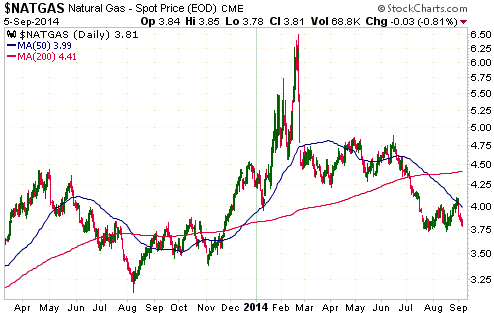
Natural Gas (NG) Update
From the 11th August 2014 Weekly Update:
"The US natural gas (NG) futures market has a seasonal low during
August-September. ...During those years when the NG market respects the seasonal
pattern and trends downward into August-September it sets up a good opportunity
to 'go long' for a 2-4 month trade. 2013 was one of those years (as pointed out
in TSI commentaries at the time), and ...so is 2014. The idea is to buy weakness
in NG or UNG (the US Natural Gas Fund) from late-July through to early-September
and to set an initial 'stop' just below whatever price low is put in place
during this period. Profits would then be taken during December."
If the NG market is going to continue following its seasonal pattern, then a
seasonal low should be in place by the end of this week. Therefore, anyone
interested in trading the seasonal pattern by averaging into a natgas position
during August-September weakness should place an initial sell stop just below
whatever low is in place at the end of this week.
 The Stock
Market
China
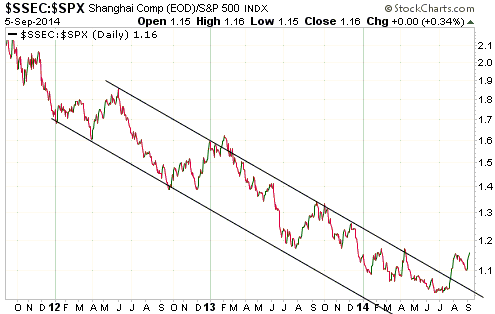
As mentioned in last week's Interim Update, with the recent upward reversal in
the EURO STOXX50 Index (a proxy for large-cap European stocks) relative to the
S&P500 Index there are signs that the US stock market is now underperforming on
a global basis. One example: Now trending higher relative to the US stock market
is China's stock market, as represented by the Shanghai Stock Exchange Composite
Index (SSEC).
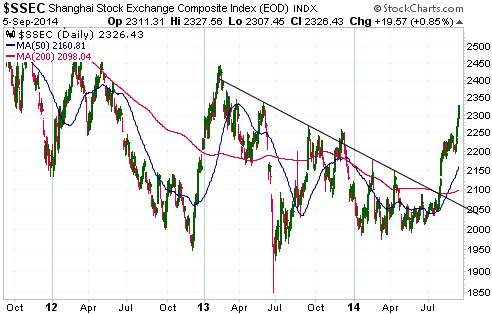
We noted in July that the SSEC was close to signaling the end of its cyclical
bear market and that despite the country's economic problems the SSEC's
intermediate-term risk/reward was skewed towards reward. Later the same month we
noted that the SSEC had broken out to the upside from an 18-month basing
pattern, a confirming signal that an intermediate-term upward trend had begun.
The first of the following daily charts shows that the SSEC has built on its
July-2014 upside breakout, while the second chart reveals evidence that the SSEC
has reversed course relative to the SPX.
Earlier in today's report we wrote that China's stock market could be
discounting the resumption of rapid credit expansion as China's leadership opts
for a more bullish short-term outcome at the cost of a far more bearish
long-term outcome. However, this is probably just part of the story. Another
likely part of the story was described as follows in a recent WSJ article:
"Starting in October, overseas money managers will be able to buy Chinese
companies listed in Shanghai via Hong Kong's stock exchange. Investors have
poured money into funds that track these so-called A-shares in anticipation of
the rule change, while some brokerage firms that operate in the region say they
are hiring new staff to handle added trading."
That is, Chinese stocks are probably being boosted by some investors buying in
anticipation of the buying that other investors will do after a rule change
comes into effect in October.
It's also possible that the domestic demand for Chinese stocks is getting a
boost from reduced demand for real estate investments. In other words, due to
recent poor returns in the property market, Chinese investment demand might be
shifting from the property to the stock market.
The US
The S&P500 Index made a marginal new closing high last Friday, but the downside
risk keeps growing. New index highs continue to be unconfirmed by the number of
individual stocks making new highs, and sentiment is as complacent as it ever
gets. We point out, in particular, that according to Investors Intelligence the
percentage of investment advisors who are bearish on the US stock market has
fallen to 13.3%. This is the lowest bearish percentage since August-1987.
A multi-week upside blow-off remains a realistic possibility, but the
risk/reward is skewed heavily towards risk over every timeframe.
Stock Market Manipulation
ZeroHedge.com is at it again -- taking a small piece of interesting information
and blowing it out of all proportion via one or two giant 'logical' leaps that
do not follow from the original information. Recent examples are "It's
Settled: Central Banks Trade S&P500 Futures" and "What's
The Point Of Hiding It Any Longer?".
The above-linked articles contain a giant leap from factual information that the
CME (one of the largest futures and options exchanges) offers discounts to
non-US central banks and, by extension, that the CME counts central banks among
its customers, to: central banks are rigging the US stock market on a daily
basis. We can't prove that the conclusion is wrong, but the information provided
to support the conclusion does not contain a single shred of evidence that
central banks trade S&P500 futures. Moreover, the first of the above-linked
articles does contain evidence that the US Fed is NOT involved in trading
futures.
Central banks are continually affecting all prices via their gross manipulations
of money and interest rates. Furthermore, bubbles in major financial markets can
only be caused by manipulating money and interest rates. They cannot be caused
or prolonged by the manipulative trading of futures. The amount of direct
manipulation carried out by the senior central banks (the ones that matter on a
global basis) is insignificant, which is why market prices often don't do what
the central banks want them to do and why central banks temporarily look
powerless whenever a major investment bubble bursts.
This week's
significant US economic events
(The most important events are shown
in bold)
| Date |
Description |
| Monday Sep 08 |
Consumer Credit | | Tuesday
Sep 09 |
No important events scheduled | | Wednesday
Sep 10 |
No important events scheduled | | Thursday
Sep 11 |
Treasury Budget
|
| Friday Sep 12 |
Retail Sales
Important and Export Prices
Consumer Sentiment
Business Inventories |
Gold and
the Dollar
Gold
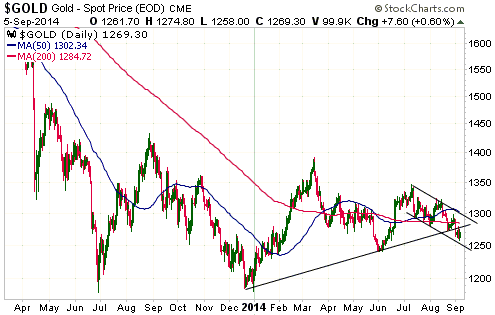
The gold price remains within the small downward-sloping channel that has
defined its progress over the past 2 months. In this respect, last week's price
action wasn't significant. However, gold's downward drift finally took a toll on
the gold-mining sector last Thursday, with the HUI and GDXJ breaking below the
bottoms of their 2-month ranges.
The TSI commentaries from late-June and early-July show that we were
anticipating some corrective activity. At that time, the gold market, the silver
market and the silver/gold ratio were clearly extended to the upside. That being
said, we obviously got more corrective activity than we were expecting in terms
of both price and time.
Prior to last week's price action we thought it was important to give the
'imminent rally' scenario the benefit of the doubt, mainly because the
gold-mining indices were strong relative to gold bullion and also because we
were entering a time of year when gold often rallies. But with Thursday's
downside breakouts in the gold-mining indices and Friday's failure to
immediately negate the breakouts, that's no longer the case. On a short-term
basis, uncertainty now reigns.
It's possible that our short-term outlook will get 'whipsawed' again within the
next few days, because some related markets appear to be near extremes and it
wouldn't take much strength from here to counteract last week's deterioration.
The key, we think, is the GDXJ/GDX ratio, as it proved to be the most reliable
short-term indicator by NOT generating any bullish signals over the past few
weeks.
Gold Stocks
Current Market Situation
The following chart shows the HUI's long-term basing pattern. On a couple of
occasions over the past month it looked like the HUI was about to complete the
basing process, but it wasn't to be. The basing process continues.
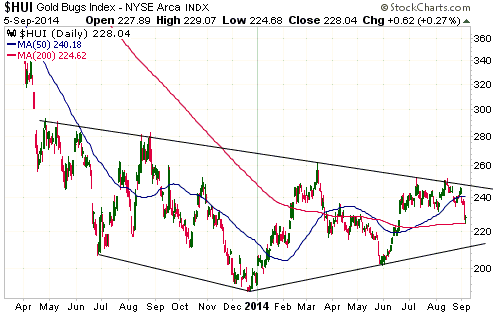
Last week's break below the bottom of the 233-250 trading range created a
chart-based downside target of 215-220. However, there is also some support
defined by the 200-day MA. The HUI began to rebound after coming within 0.06
points of this moving average last Friday.
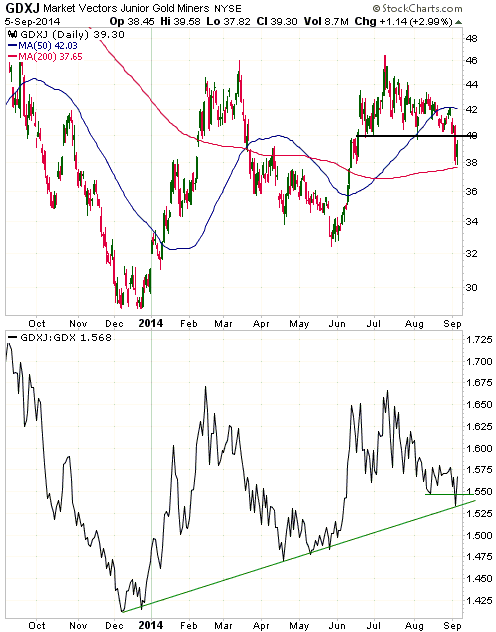
The next chart shows GDXJ and the GDXJ/GDX ratio. Like the HUI, GDXJ broke below
short-term support on Thursday and then began to rebound from close to its
200-day MA on Friday. $34 is the downside target created by Thursday's break
below support.
GDXJ was materially stronger than GDX on Friday, leading to the best single-day
bounce in the GDXJ/GDX ratio since July. However, the GDXJ/GDX ratio made a new
multi-month low on Thursday and Friday's bounce was not big enough to signal a
reversal.
Checking progress against the 1970s Model
The gold sector's price action of the past three years continues to have a lot
in common with its price action during the mid-1970s cyclical bear market and
the first part of the late-1970s cyclical bull market. The similarities are
evident on the following weekly chart, which shows the percentage change of the
Barrons Gold Mining Index (BGMI) from June-1974 in green and the HUI's
percentage change from September-2011 in blue. In direction terms the HUI has
tracked the late-1970s BGMI quite closely since its December-2013 bottom, but
its rallies have been weaker.
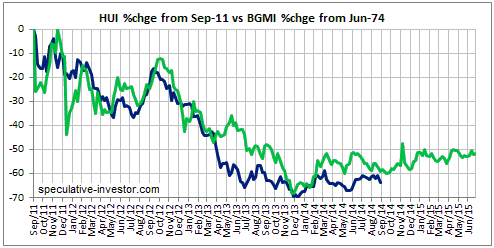
The BGMI's performance following both its 1970 bottom and its 1976 bottom
suggested an upside target of around 300 for the HUI this year. That's why 300
has been our upside target for 2014. We originally expected that this target
would be reached by mid-year and then by the end of September.
As a result of last week's price action there is no longer a realistic chance of
the HUI reaching our 2014 upside target by the end of September. That's the bad
news. The good news is that the overall pattern continues to match the early
part of the late-1970s bull market.
A literal interpretation of the HUI-BGMI comparison shown above is that the HUI
will decline into late-September and then rally into mid-November.
The Currency Market
The ECB's cunning new plan
Last Thursday (4th September) the ECB introduced a cunning new plan to spur
growth in the euro-zone, the first part of which involves cutting official
interest-rate targets by 0.1%. The benchmark refinancing rate has been reduced
to 0.05%, because 0.15% was obviously too high, and the deposit rate has gone
further into negative territory, because it obviously wasn't negative enough.
The actions have been taken due to "inflation" and inflation expectations being
too low.
Inflation of any kind is the last thing that Europe needs, but from the
Keynesian perspective, which is the perspective of all central bankers, it is
critical that both inflation and inflation expectations are well above zero. The
reason is that in the back-to-front world in which Keynesians are mired,
consumption spending comes first and is the driving force of the economy.
Furthermore, according to Keynesian logic if people believe that prices are
going to be lower in the future they will put off their spending, which will set
in motion a vicious deflationary spiral of price declines leading to reduced
spending, leading to additional price declines, and so on.
Keynesian logic explains why the computer and smartphone manufacturers never
sell anything. Everyone knows that if they wait a year they will be able to buy
a better smartphone and a better computer at a lower price, so nobody ever buys
these products. As a consequence, the entire computer and smartphone industries
have zero sales year after year.
Getting back to the ECB, a goal of reducing the cost of credit to zero is to
generate some "price inflation", which, according to the theories that inform
the decisions of central bankers, will boost immediate consumption and cause the
economy to grow faster. But if a faster rate of price inflation is what they
want, then what they will have to do is increase the rate of monetary inflation.
In this regard, taking an overnight interest rate down from 0.15% to 0.05% is
probably not going to do much. If the ECB is serious about generating
"inflation" then what it really needs to do is implement a Fed-style QE program.
Which brings us to the second part of the ECB's cunning new plan. The ECB
announced that it would begin monetising covered bonds and asset-backed
securities (ABS)*, including real-estate-backed securities, next month, with the
details to be announced at next month's ECB meeting. Depending on its size and
mechanics, this asset monetisation program could certainly cause prices to rise.
To the extent that it does cause prices to rise it will benefit banks and
speculators at the expense of savers, productive businesses and wage earners.
Fortunately or unfortunately, depending on your perspective, due to the limited
availability of eligible collateral the QE program announced by the ECB last
week might be restricted in size to about 200B euros. This means that it might
not be large enough to have much effect on the euro-zone money supply.
*Banks create asset-backed securities by pooling mortgages
and other loans. Covered bonds are similar, but the underlying assets are
'ring-fenced' on the bank's balance sheet, which means that the assets are still
there if the bank goes bust.
Current Market Situation
Despite the initial market reaction, to the extent that the ECB's new scheme
boosts asset prices it will be short-term and intermediate-term bullish for the
euro's exchange rate. This is because it will draw investment into the euro-zone
and temporarily reduce the risk of major economic weakness (while increasing
long-term risk). In particular, if the scheme leads to significant additional
strength in European bank stocks and European equities relative to US equities,
it should lead to strength in the euro relative to the US$.
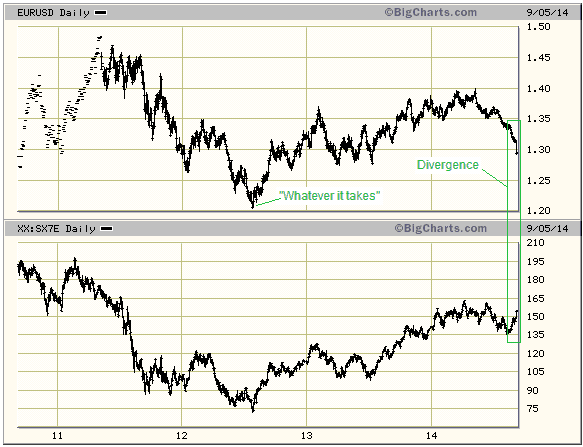
As things now stand, there is a sizeable divergence between the currency and
equity markets that points to future strength in the euro.
For the past four years, the euro and the EURO STOXX Banks Index (SX7E) have
been moving up and down together. However, over the past two weeks the SX7E has
reversed course and moved sharply higher while the euro has continued its
decline, resulting in the divergence indicated on the following chart.
By the way, the euro's upward reversal in July-August of 2012 coincided with
Mario Draghi's promise that the ECB would do whatever it takes to support
Europe's monetary union. Interestingly, the speculative net-short position in
euro futures is almost as big now as it was at the time of the 2012 reversal.
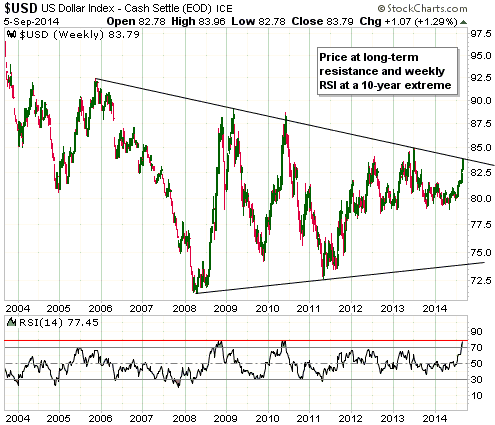
The following weekly chart shows the extent to which the Dollar Index is now
extended to the upside on both a short-term basis and an intermediate-term
basis. The price touched long-term resistance late last week and the weekly RSI
is now as high as it has been at any time over the past 10 years.
Updates
on Stock Selections
Notes: 1) To review the complete list of current TSI stock selections, logon at
http://www.speculative-investor.com/new/market_logon.asp
and then click on "Stock Selections" in the menu. When at the Stock
Selections page, click on a stock's symbol to bring-up an archive of
our comments on the stock in question. 2) The Small Stock Watch List is
located at http://www.speculative-investor.com/new/smallstockwatch.html
 Company
news/developments for the week ended Friday 5th September 2014: Company
news/developments for the week ended Friday 5th September 2014:
[Note: AISC = All-In Sustaining Cost, FS = Feasibility Study, IRR = Internal
Rate of Return, MD&A = Management Discussion and Analysis, M&I = Measured and
Indicated, NAV = Net Asset Value, NPV(X%) = Net Present Value using a discount
rate of X%, P&P = Proven and Probable, PEA = Preliminary Economic Assessment,
PFS = Pre-Feasibility Study]
*Almaden Minerals (AAU) released the results of an updated PEA for
its Tuligtic gold-silver project in Mexico. This is a very positive development
and is discussed later in today's report.
*Evolution Mining (EVN.AX) published its financial statements for
the Financial Year ending 30th June 2014.
The company achieved a bottom-line profit of A$50M, or A$0.07/share. Also, it
declared a 1c/share dividend, payable to shareholders of record at 9th
September.
The bulk of the important information in the annual financial report had been
provided in earlier press releases. From our perspective, the most interesting
new information was the change in the overall financial position as reflected in
the published balance sheet. Based on the reported production results we were
expecting to see a significant improvement in the financial position, but it
didn't happen. The company's net debt (long-term debt minus working capital) was
lower at 30th June 2014 than at 31st December 2013, but only by a relatively
small $7M (it was $123M at 31st December 2013 and $116M at 30th June 2014).
This is a disappointing performance. Despite the healthy profit margin suggested
by its reported per-ounce production costs, it is clear from the change in its
balance sheet that EVN is only marginally profitable at the current gold price
(the change in the balance sheet during a period is the best indicator of
performance, because it cuts through the accounting adjustments that affect the
reported net earnings). Being marginally profitable at the current gold price
puts EVN ahead of the average gold producer, but it will need a materially
higher gold price to have a good business in absolute terms.
Timmins Gold (TGD, TMM.TO) is one of a small number of gold producers that does
appear to have a decent business at the current gold price. This is one of the
reasons we recently added it to the TSI Stocks List and consider it to be a top
candidate for new buying. RIO Alto (RIOM), a former TSI stock, also has a decent
business at the current gold price, although it is now a very expensive stock
due to roughly doubling its share count in exchange for Sulliden Gold's
development-stage Shahuindo project.
*Pilot Gold (PLG.TO) released the results of recent step-out
drilling at the Valley porphyry discovery at the TV Tower project (Turkey). The
highlight was 0.63 g/t gold and 0.27% copper over 134.7 metres. Although these
results extend copper and gold mineralization at the Valley porphyry, this is
not the sort of news that will increase demand for the stock in the current
sombre market for gold-related investments.
*Ramelius Resources (RMS.AX) published its financial statements
for the Financial Year ending 30th June 2014.
The company's financial position can no longer be described as solid. Due to a
further consumption of cash over the latest half-year, its working capital fell
from $16M at 31st December to $8M at 30th June. This means that in the absence
of a quick and substantial rebound in the gold price, RMS probably only has
sufficient financial resources on hand to fund its business until December of
this year. It could obviously raise more money by issuing more shares, but a
large issue of new shares near the current market price would greatly reduce the
per-share value.
RMS also published updated resource and reserve estimates. Due primarily to a
lower gold price assumption, the total resource has fallen by 320K ounces over
the past 12 months to 2.3M ounces (1.3M in the M&I category plus 0.8M in the
Inferred category). P&P reserves fell by about 170K ounces to 427K ounces.
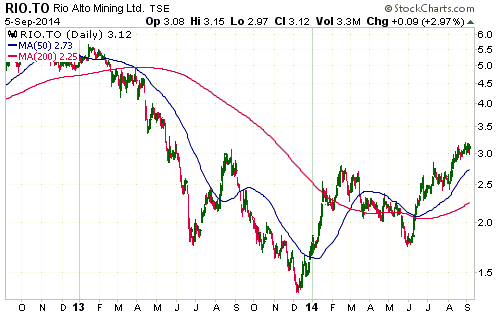
*Rio Alto Mining (RIOM, RIO.TO) was removed from the TSI Stocks
List in May in response to the company's agreement to pay a very high price for
Sulliden Gold (SUE.TO). This turned out to be a badly timed move on our part, as
RIO has since been one of the best-performing gold stocks.
Also, at the time of its removal from the TSI List and in subsequent notes in
TSI commentaries during May-July, we advised that we were retaining substantial
exposure to RIO in our own accounts with a plan to be out by the end of
September. This plan was based on a) our expectation that the gold-mining sector
would be strong during August-September, which is something that obviously
hasn't happened, and b) RIO likely getting a significantly higher weighting in
GDXJ due to the SUE takeover, leading to increased demand for RIO shares and a
good selling opportunity during the weeks following the August completion of the
merger.
The purpose of this note is to advise that our money-management plan is
unchanged. We've exited about half of our position and intend to exit the
balance by the end of this month.
RIO now has a market cap of around $1B, which constitutes a very high valuation
considering its assets and the valuations of many other gold miners.
List of candidates for new buying
After last week's price action many of the stocks we follow are both
under-valued and close to chart-based support levels. This means
that there are many good candidates for new buying. However, to make
this list more useful we limit it to 5 stocks.
From within the ranks of TSI stock selections, the best candidates
for new buying at this time are:
1) AAU in the US$1.40s (last Friday's closing price: US$1.51).
2) EDV.TO (last Friday's closing price: C$0.84).
3) EVN.AX (last Friday's closing price: A$0.68).
4) PVG (last Friday's closing price: US$6.66).
5) TGD (last Friday's closing price: US$1.54).
Almaden Minerals (AAU). Shares: 69M issued, 77M fully diluted.
Recent price: US$1.51
AAU published the results of a revised PEA for the Ixtaca Zone at
its Tuligtic project in Mexico. The Ixtaca Zone contains gold and
silver in roughly equal dollar amounts (using a gold/silver ratio of
60).
Here's what we wrote about the original PEA, which was issued in
April of this year:
"The PEA is based on an open-pit mine with average annual
production of 260K gold-equivalent ounces (130K ounces of gold plus
7.8M ounces of silver) and a mine life of 12.1 years. It is
estimated that the mine would cost about $500M to build and would
operate at a cash cost of around $600/oz.
At gold and silver prices of $1320/oz and $21/oz, resp., the
after-tax NPV(5%) is estimated to be $437M and the IRR is estimated
to be 22.2%. These figures suggest that the project would be
economically viable at these metal prices, but we doubt that anyone
would spend $500M building a gold mine with an NPV of $437M. At
metal prices of $1530 and $29 the after-tax NPV(5%) increases to
$875M and the IRR increases to 34.1%. These are robust economics."
And:
"...the cost to build a mine at the Tuligtic project is probably
high enough that a decision to build would not be made at the
current gold price [of around $1300/oz] even though it is estimated
that the mine would have a cash operating margin of almost $700/oz.
However, according to the PEA the project's economics are good
enough that it would only require a moderately higher gold price to
shift the balance in favour of mine development."
The revised PEA considers two cases: An updated base case and a
ramp-up case.
For the updated base case, almost everything is the same except for
the initial capex. By coming up with a more efficient way of doing
the pre-stripping, AAU has managed to reduce the initial capex by
about $100M. This makes a big difference to the economics and the
potential viability of the project. Specifically, at gold and silver
prices of $1320/oz and $21/oz, resp., the estimated after-tax
NPV(5%) rises from $437M to $515M and the estimated IRR rises from
22% to 28%. Most importantly, the bottom row of the following table
shows that the reduction in the initial capex causes the EVCC/NPV
ratio (the Enterprise Value of the company plus the initial Capital
Cost of the company's flagship exploration-stage project divided by
the project's NPV) to fall from 1.34 to 0.95 at the current stock
price and a gold price of $1320/oz. The updated base case therefore
suggests that the project would be economically viable and that AAU
would be a reasonable takeover target with gold in the low-$1300s,
whereas the original base case suggested that a gold price of around
$1450/oz would be needed.
The base case uses a 30,000-tonne/day mining operation from Year 1.
For the ramp-up case, the mining rate begins at 7,000-tonnes/day and
is increased to 30,000-tonnes/day in Year 6. This enables the
initial capex to be slashed to $244M.
At the same metal prices noted above, the ramp-up case has the
disadvantage of a lower NPV and IRR ($427M and 23% for the ramp-up
case versus $515M and 28% for the updated base case). However, the
bottom row of the following table's final column shows that the
large reduction in the initial capex enabled by the ramp-up plan
pushes the EVCC/NPV ratio down to only 0.78.
An EVCC/NPV ratio of 1.00 or lower is good (the lower the better).
An EVCC/NPV ratio of only 0.78 points to the Tuligtic project being
very under-valued at the current AAU stock price.
Both of the cases considered in AAU's revised PEA indicate that the
economics of the Tuligtic project are significantly better than
previously thought. This means that AAU offers even better value
than previously thought. We suspect that the ramp-up case would be
preferred in a difficult market for financing, but that the updated
base case would be preferred -- due to its higher NPV and IRR -- in
a market environment where reasonable-cost financing was readily
available.
Lastly, remember that PEA stands from PRELIMINARY Economic
Assessment. It's a first pass, with detailed engineering to follow
as part of the PFS and then the FS. AAU's PEA constitutes a good
start, but it's just a start.
|
Almaden Minerals (AAU) |
Original PEA |
Updated Base Case |
Ramp-Up Case |
|
Project Name |
Tuligtic |
Tuligtic |
Tuligtic |
|
Location |
Mexico |
Mexico |
Mexico |
|
Engineering Study / Date |
PEA / Apr-2014 |
PEA (updated base case) / Sep-2014 |
PEA (ramp-up case) / Sep-2014 |
|
Planned Mine Type |
Open Pit |
Open Pit |
Open Pit |
|
M&I Resource (oz) |
3.5M |
3.5M |
3.5M |
|
Avg Resource Grade |
1.2g/t Au-eq |
1.2g/t Au-eq |
1.2g/t Au-eq |
|
P&P Reserve (oz) |
|
|
|
|
Metallurgical Recovery |
90% |
90% |
90% |
|
Strip Ratio |
2:1 |
2:1 |
2:1 |
|
Avg Annual Production (oz) |
260K Au-eq |
260K Au-eq |
Not specified |
|
Cash Cost (per oz) |
$600 |
$600 |
Not specified |
|
All-In Cost (per oz) |
|
|
|
|
Mine Life |
12.1 years |
12.1 years |
Not specified |
|
Initial Capital Cost ($M) |
496 |
399 |
244 |
|
Assumed Gold Price (US$) |
1320 for gold, 21 for silver |
1320 for gold, 21 for silver |
1320 for gold, 21 for silver |
|
After-Tax NPV5% ($M) |
437 |
515 |
427 |
|
IRR |
22.2% |
28.0% |
23.0% |
|
Capital Payback Period |
4.0 years |
2.5 years |
4.9 years |
|
Project Ownership Percent |
100% |
100% |
100% |
|
NPV of Company Stake ($M) |
437 |
515 |
427 |
|
Current Stock Price (US$) |
1.51 |
1.51 |
1.51 |
|
Share Count (M) |
69 |
69 |
69 |
|
Current Market Cap ($M) |
104 |
104 |
104 |
|
Net Cash ($M) |
15 |
15 |
15 |
|
Current Enterprise Value ($M) |
89 |
89 |
89 |
|
EV/NPV |
20% |
17% |
21% |
|
Current Discount to NPV |
80% |
83% |
79% |
|
EV + Capital Cost (EVCC) |
585 |
488 |
333 |
|
EVCC/NPV |
1.34 |
0.95 |
0.78 |
The stock market's reaction to AAU's PEA news
was strange. There was no market reaction at all on the day of the press
release, but there was a high-volume appropriately-positive reaction the next
day. It seemed as if nobody got around to reading the press release until 24
hours after it was issued.
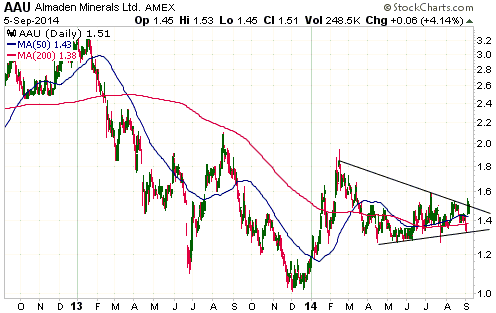
Chart Sources
Charts appearing in today's commentary
are courtesy of:
http://stockcharts.com/index.html
http://bigcharts.marketwatch.com/

|









