|
-- Weekly Market Update for the Week Commencing 8th October 2012
Big Picture
View
Here is a summary of our big picture
view of the markets. Note that our short-term views may differ from our
big picture view.
In nominal dollar terms, the BULL market in US Treasury Bonds
that began in the early 1980s will end by 2013. In real (gold)
terms, bonds commenced a secular BEAR market in 2001 that will continue
until 2014-2020. (Last
update: 23 January 2012)
The stock market, as represented by the S&P500 Index,
commenced
a secular BEAR market during the first quarter of 2000, where "secular
bear market" is defined as a long-term downward trend in valuations
(P/E ratios, etc.) and gold-denominated prices. This secular trend will bottom sometime between 2014 and 2020.
(Last update: 22 October 2007)
A secular BEAR market in the Dollar
began during the final quarter of 2000 and ended in July of 2008. This
secular bear market will be followed by a multi-year period of range
trading.
(Last
update: 09 February 2009)
Gold commenced a
secular bull market relative to all fiat currencies, the CRB Index,
bonds and most stock market indices during 1999-2001.
This secular trend will peak sometime between 2014 and 2020.
(Last update: 22 October 2007)
Commodities,
as represented by the Continuous Commodity Index (CCI), commenced a
secular BULL market in 2001 in nominal dollar terms. The first major
upward leg in this bull market ended during the first half of 2008, but
a long-term peak won't occur until 2014-2020. In real (gold) terms,
commodities commenced a secular BEAR market in 2001 that will continue
until 2014-2020.
(Last
update: 09 February 2009)
Copyright
Reminder
The commentaries that appear at TSI
may not be distributed, in full or in part, without our written permission.
In particular, please note that the posting of extracts from TSI commentaries
at other web sites or providing links to TSI commentaries at other web
sites (for example, at discussion boards) without our written permission
is prohibited.
We reserve the right to immediately
terminate the subscription of any TSI subscriber who distributes the TSI
commentaries without our written permission.
Outlook Summary
Market
|
Short-Term
(1-3 month)
|
Intermediate-Term
(6-12 month)
|
Long-Term
(2-5 Year)
|
|
Gold
|
Neutral
(10-Sep-12)
|
Bullish
(26-Mar-12)
|
Bullish
|
|
US$ (Dollar Index)
|
Neutral
(17-Sep-12)
|
Neutral
(09-Jan-12)
|
Neutral
(19-Sep-07)
|
|
Bonds (US T-Bond)
|
Bearish
(02-Jul-12)
|
Neutral
(18-Jan-12)
|
Bearish |
|
Stock Market
(DJW)
|
Bearish
(30-Jul-12)
|
Bearish
(28-Nov-11)
|
Bearish
|
|
Gold Stocks
(HUI)
|
Neutral
(17-Sep-12)
|
Bullish
(23-Jun-10)
|
Bullish
|
|
Oil |
Neutral
(30-Jul-12)
|
Neutral
(31-Jan-11)
|
Bullish
|
|
Industrial Metals
(GYX)
|
Neutral
(30-Jul-12)
|
Neutral
(29-Aug-11)
|
Neutral
(11-Jan-10)
|
Notes:
1. In those cases where we have been able to identify the commentary in
which the most recent outlook change occurred we've put the date of the
commentary below the current outlook.
2. "Neutral", in the above table, means that we either don't have a
firm opinion or that we think risk and reward are roughly in balance with respect to the timeframe in question.
3. Long-term views are determined almost completely by fundamentals,
intermediate-term views by
fundamentals, sentiment and technicals, and short-term views by sentiment and
technicals.
US Economic Numbers Update
The monthly numbers on US manufacturing
released last Monday and the monthly US employment numbers released last Friday
were slightly better than expected, but the overall picture hasn't changed.
There's a high probability that the current period will eventually be recognised
as being recessionary, but the recognition might not happen until the second
quarter of next year.
Due to words uttered by Ben Bernanke and other senior Fed officials over the
past two months, the financial markets now fixate more than ever on the monthly
employment numbers. If last Friday's serving of August employment data had shown
greater weakness than expected, there probably would have been another
price-surge in the assets that are considered to be the main beneficiaries of
QE. Alternatively, these assets would probably have sold off sharply if the data
had been strong enough to suggest a turnaround. The data turned out to be just a
little better than expected, so most markets consolidated. Consolidation has
actually been the name of the game in the financial world since the day after
the QE3 announcement.
Despite the Fed having promised a new QE program on 13th September and despite
the financial markets having reacted to the Fed's promise, a new QE program
hasn't yet begun. In fact, the very gradual contraction of the Fed's balance
sheet that began in July of 2011 continued over the past three weeks. Of
particular relevance, between 12th September and 3rd October (the date of the
latest data) the Fed's holdings of Mortgage-Backed Securities CONTRACTED by $9B,
the total amount of securities held outright by the Fed CONTRACTED by $16B, and
total reserve bank credit CONTRACTED by $21B. To put it bluntly, since
announcing a new inflation program the Fed has taken actions that are modestly
deflationary.
Natural Gas Update
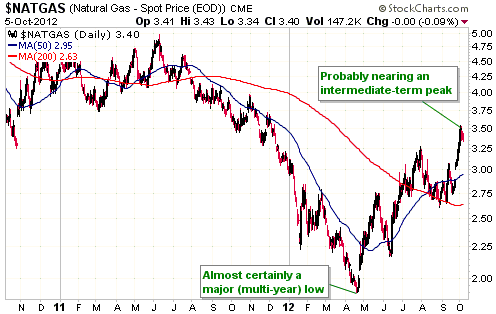
We speculated in the 14th May Weekly Update that
the natural gas price had just made a major (meaning multi-year) low. Subsequent
price action has removed most of the doubt that such a low is in place. The
question is: with the natgas price having rebounded from below $2.00 to around
$3.50, how much additional upside is it reasonable to expect over the coming
several months? The answer is: not a lot.
There is a supply-related and a demand-related reason to believe that a
sustained rise in the natgas price to above $4.00 is not going to happen anytime
soon. On the supply side, US natgas production was never significantly reduced
in response to this year's low prices, but it will probably be quickly increased
in response to higher prices. We suspect that producers will rush to take
advantage of a natgas price of $4 or more by ramping up current production and
hedging future production. On the demand side, it is now a lot cheaper in the US
to generate electricity using coal than to do so using natgas. Many power plants
can be easily switched between coal and natgas, so additional gains in the
natgas price should lead to a meaningful reduction in
electricity-generation-related natgas demand unless the price of thermal coal
moves sharply higher.
The Stock
Market
As is the case with most of the QE
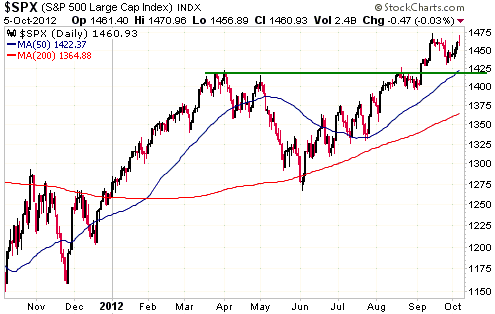
beneficiaries, the S&P500 Index (SPX) has essentially gone nowhere since its
immediate upward reaction to the Fed's new inflation program. We won't be
surprised if the SPX spikes above its September high to a new multi-year high
this week, but we will be surprised if there is a sustained upside breakout.
Important lateral support is in the 1420s. A routine short-term correction would
bottom near this support, which means that a decisive break below the 1420s
would be the first sign that something more serious than a routine short-term
correction had commenced.
This week's
important US economic events
| Date |
Description |
| Monday Oct 08 |
US Bond Market Closed
No important events scheduled
| | Tuesday Oct 09 |
No important events scheduled | | Wednesday
Oct 10 |
Fed's Beige Book
Treasury Budget | | Thursday
Oct 11 |
International Trade Balance
Import and Export Prices
|
| Friday Oct 12 |
PPI
Consumer Sentiment
|
Gold and
the Dollar
Gold and Silver
A weak US employment report on Friday could have temporarily broken gold above
resistance at $1800 by stirring up hopes/expectations of more Fed monetisation.
As it was, gold held up well in reaction to employment numbers that weren't as
weak as they could have been.
Gold remains below resistance at $1800 and has essentially moved sideways since
the immediate reaction to "QE3". A spike above $1800 wouldn't surprise us, but a
sustained move above $1800 is unlikely at this time. The gold market is now very
'overbought' on a short-term basis, as evidenced by the new 12-month high just
registered by the total speculative net-long position in COMEX gold futures and
the new all-time high just registered by the net-long position of small traders
in COMEX gold futures.
$1700 is a reasonable target for a pullback.
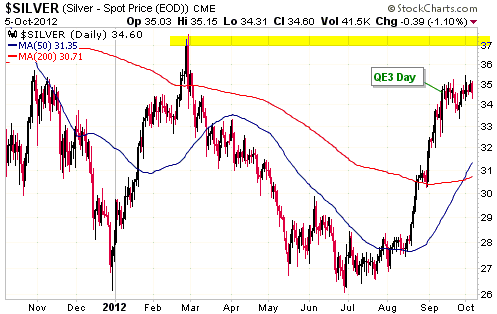
Silver is in a similar position, having traded sideways since "QE3" day and
being very 'overbought' on a short-term basis. The difference is that silver
never reached intermediate-term resistance ($37.00-$37.50 for silver is the
equivalent of $1800 for gold) and has greater short-term downside risk.
With or without a spike above the September high, silver's next correction will
probably take it back to $30-$32.
Gold Stocks
Current Market Situation
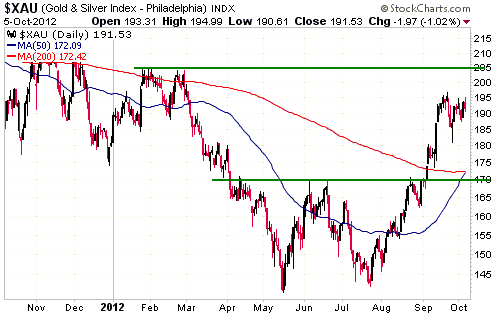
To make a change from the same old HUI chart, below is a daily chart of the XAU.
HUI resistance at 550 and HUI support at 460 are equivalent to XAU resistance at
205 and XAU support at 170. Our view is that support at 170 defines the
short-term downside risk and that a correction to just above this support
commenced in mid-September.
In the unlikely event that the XAU breaks above its September high within the
next few days, the upside will likely be limited by resistance at 205.
SA mining on strike
26th September was when we last wrote about the labour unrest disrupting South
Africa's mining industry. It was bad then, but it is worse now. According to the
latest report we've seen, 100,000 workers (about 20% of the country's total
mining workforce) are now on strike and the strikes are becoming increasingly
violent.
Major strike action (actual or threatened) is something the SA mining industry
has to deal with every two years at around the time that labour contracts are
renegotiated. It is par for the course, so to speak. However, the current round
of strikes is happening more than 6 months ahead of schedule, in that labour
contracts aren't due to be renegotiated en masse until mid-2013. SA was a
difficult place to operate a mining business when you had to deal with a
production-disrupting strike every two years. If the current unrest marks a
change such that from now on production-disrupting strikes will be more frequent
and less predictable, it will make no sense to own/operate a mining business in
SA.
We presently have no desire to own the shares of any mining company that does
most of its business in SA, but a potentially interesting trade is setting up in
the long-dated call options of Harmony Gold (HMY). HMY produces about 1.3M
ounces of gold per year, all of it from mines in SA. Thanks to the strikes that
have spread through SA's mining industry over the past several weeks, HMY's
stock price ended last week at a 3-year low. Furthermore, over the past 6 years
it only traded lower than it is today during the second half of 2008 -- around
the crescendo of the 2007-2009 global financial crisis.
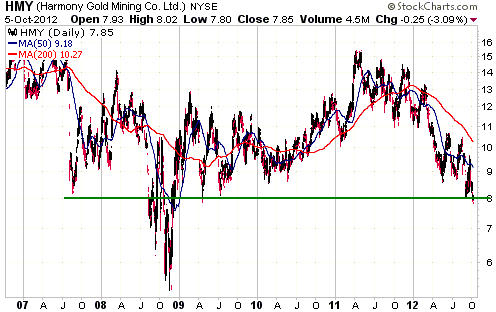
HMY earned US$0.71/share during the year ended June-2012, which means that it is
currently trading at around 11-times last year's earnings. Its earnings are
highly leveraged to the gold price, which means that it should earn a lot more
during the current financial year than it did during the preceding year provided
that a) the average gold price is significantly higher and b) its annual
production is not adversely affected in a big way by the strikes.
The risk that HMY's annual production will be affected in a big way by the
strikes is too great to justify buying the shares, but the risk/reward of the
January-2014 $10 call options looks attractive to us. The risk is 100%, but the
potential reward is a few hundred percent. It could be worth scaling into a
position in these options over the next couple of weeks, especially if the HMY
stock price falls further in reaction to the strikes and a sector-wide
correction.
Currency Market Update
Japan's Unintentional Strong Yen Policy
Over the years we have read many times that the Bank of Japan (BOJ) has rapidly
inflated the supply of Yen. The 'pundits' who made such statements were
obviously swayed by the numerous announcements of QE programs emanating from
Japanese officialdom, but they should have done a little research rather than
blindly assume that these QE programs led to large increases in the economy-wide
Yen supply. If they had done the appropriate research they would have discovered
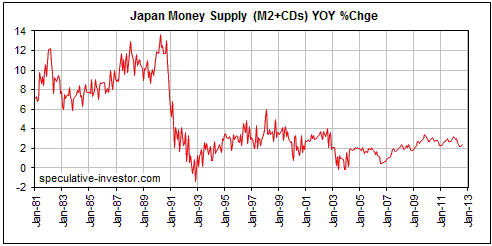
that over the past 20 years the annual rate of growth in the Yen supply (Japan's
monetary inflation rate) has oscillated in a narrow range around an average of
only 2%, and that it is presently near this long-term average. This is
illustrated by the following chart. The fact is that of the major currencies,
the Yen has had by far the slowest rate of supply growth over the past two
decades. That's why the Yen has maintained its purchasing power and why it has
been a relatively strong currency on a long-term basis despite the many blatant
short-term negatives.
On a side note, the following chart shows that Japan's money supply grew at an
average rate of around 10%/year during the boom years of the 1980s and that the
money-supply growth rate collapsed during 1990-1991. The monetary transition
from the bubble world to the post-bubble world is where comparisons between the
US and Japan break down. Whereas Japan's monetary inflation rate tanked after
its credit bubble burst, the US's monetary inflation rate moved sharply higher.
This is an important part of the explanation for why things never got that bad
in Japan and why the much-maligned Japanese economy had stronger real growth
over the past 10 years than the US economy. The reality is that monetary
inflation damages the economy. The more 'success' that the Fed enjoys in its
efforts to maintain a high rate of US$ inflation, the worse things will
inevitably get for the US economy.
On another side note, it's too bad that Japan's government went on one Keynesian
spending binge after another following the bursting of the credit bubble. If it
hadn't gone down this path, wasting resources on a grand scale and racking up an
enormous debt in the process, Japan's economy would probably now be in very good
shape.
As far as currency exchange rates are concerned, the relative monetary inflation
rate is the tide. Interest rate differentials, trade balances, equity and
commodity price trends, government debt/deficit levels and differences in
economic growth rates are waves. The waves can dominate for periods of up to a
few years, but the tide will eventually have its way.
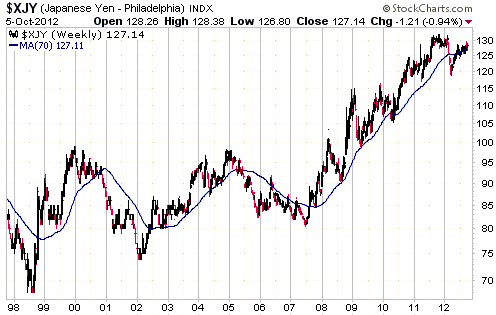
As mentioned in our opening paragraph, the tide has been in the Yen's favour for
a long time. One result is illustrated by the following weekly chart. Despite
the US dollar's interest rate advantage over the Yen during the entire 15-year
period covered by the chart, the Yen has been in a long-term bull market
relative to the US$.
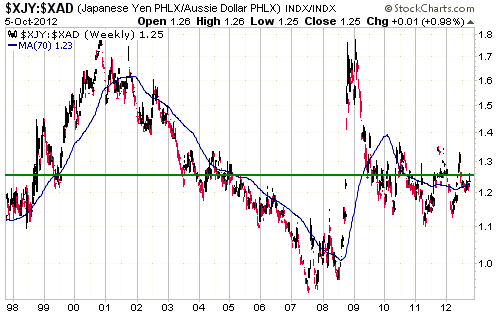
The US$ has done poorly relative to most major currencies over the past 10-15
years, so let's check the Yen's performance against a strong currency: the
Australian Dollar (A$). The following weekly chart shows that there have been
some big multi-year swings in the Yen/A$ exchange rate over the past 15 years,
but the current level of this rate is the same as it was in 2003 and the same as
it was in 1998. During the period covered by this chart the A$ apparently had
everything going for it. In particular, the A$ had a large interest rate
advantage throughout, the Australian economy was consistently stronger than the
Japanese economy, there was a secular bull market in commodities that attracted
considerable foreign investment into Australia, and the Australian government
ran budget surpluses or small deficits whereas the Japanese government
relentlessly ran huge deficits. All of these 'waves' added together constituted
a powerful force, but they were counteracted by the tide (Australia's average
money-supply growth rate was much higher than Japan's over the period in
question).
The past has been characterised by relatively slow growth in the Yen supply and
long-term strength in the Yen, but the future could look very different. Japan's
government has racked up so much debt that at some point within the next few
years it will have to either directly default on a substantial portion of its
debt or enlist the help of the central bank (the BOJ). Either way, savers will
be hurt. A lot of Japanese savers are invested in government bonds, so a direct
default would result in large nominal losses for many members of the voting
public. It would be blatantly obvious that the government was to blame for the
losses, so the government that took this action would effectively be committing
political hara-kiri. That's why it is more likely that the government will
enlist the help of the BOJ.
The BOJ could monetise a large slice of the debt. While this wouldn't reduce the
total size of the debt burden, it would effect a transfer from the balance
sheets of voting investors to the balance sheet of the central bank. The debt
could then be defaulted on, with the BOJ taking the loss. Due to the Yen's loss
of purchasing power, the cost to savers would be just as great as it would be in
the case of a direct default. Moreover, the cost to the overall economy would be
greater if the monetisation route were taken due to the distortion of price
signals and the mal-investment caused by creating a lot of money out of nothing.
However, it would have the political advantage of making it more difficult for
the average person to correctly assign blame.
Large-scale debt monetisation will very likely occur in Japan, leading to the
Yen becoming a relatively weak currency. The difficult question is: when will
the large-scale monetisation begin? We don't know the answer. A year ago we
thought it would have begun by now, but clearly it hasn't.
Current Market Situation
The Yen made an all-time high against the US$ at around this time last year. It
lost 10% over the ensuing 5 months and then recouped about two-thirds of its
losses. The 70-week moving average generally does a good job of defining the
Yen's intermediate-term trend. As illustrated by the following chart, this
moving average (the blue line on the chart) is flattening out and almost exactly
coincides with last Friday's closing price.
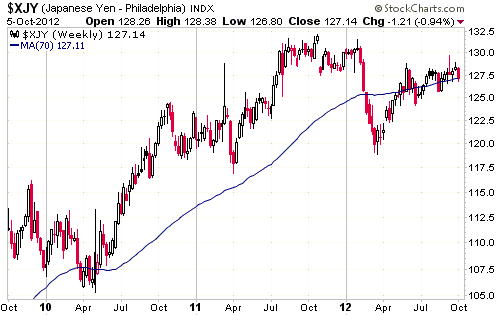
This year's performance by the Yen has been out of the ordinary. Based on what
had happened over the preceding 15 years, the rebound from the 'oversold'
extreme reached in March should have peaked at around the 70-week moving
average, with perhaps a 1-2 week overshoot. The rebound has therefore been
stronger than a typical countertrend rally. This means that the chart is even
less helpful than usual in our effort to guess the direction of the Yen's next
10% move.
The tide is still in the Yen's favour, but the direction of the next 10% move
will be determined to a greater extent by the waves than the tide. The most
important waves over the next few months are likely to be global stock market
performance and sentiment, with sentiment influenced to a substantial degree by
the words and actions of both the BOJ and the Fed. The Yen would be boosted by a
global stock market decline, whereas it would be pushed downward by a continuing
upward bias in equities and/or evidence that the BOJ was prepared to do a lot
more on the monetary inflation front.
Our guess is that the Yen's next 10% move will be to the downside. However, its
long-term bull market appears to be intact.
The plunge in the purchasing power and exchange rate of the Iranian rial
continues to be the biggest currency-related story of the day. From our
perspective, one of the strangest aspects of this currency crisis is that nobody
on the ground in Iran or commenting in the mainstream Western press appears to
have any clue as to the major role that must have been played by monetary
inflation. As evidenced by the New York Times article posted
HERE and several other articles and commentaries that we've read on the
topic, the finger of blame is either being pointed at economic sanctions
instigated by the US government or economic mismanagement by the Iranian
government. The sanctions are inexcusable (an absolute disgrace, actually) and
there is no doubt that the policies of Iran's own government have been harmful,
but neither of these factors could possibly be the primary cause of the currency
collapse and associated moon-shot in the general price level. The hyperinflation
that Iran is now experiencing would not be possible in the absence of a huge
increase in the country's money supply.
Update
on Stock Selections
Notes: 1) To review the complete list of current TSI stock selections, logon at
http://www.speculative-investor.com/new/market_logon.asp
and then click on "Stock Selections" in the menu. When at the Stock
Selections page, click on a stock's symbol to bring-up an archive of
our comments on the stock in question. 2) The Small Stock Watch List is
located at http://www.speculative-investor.com/new/smallstockwatch.html
 Company
news/developments for the week ended Friday 5th October 2012: Company
news/developments for the week ended Friday 5th October 2012:
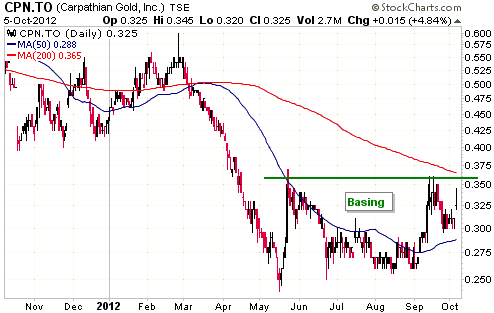
*Carpathian Gold (CPN.TO) announced that the construction of its
100K-oz/year RDM gold mine in Brazil was on track and on budget
($160M) for production commencement during the second half of next
year. Despite stating that the mine construction was on budget, the
company also implied that the budget would have to be increased due
to some scope changes to do with environmental requirements.
Assuming no major changes to the RDM construction budget, CPN says
that it will be fully funded through to production once it finalises
a $90M debt facility with Macquarie Bank. The debt facility is
expected to be finalised very soon.
CPN would not be near the top of our shopping list if we were
looking to add long-term exposure to the junior gold mining sector,
but at around C$0.30/share we like it as a 6-month trade. The stock
price appears to be basing, the valuation is low, and there will
probably be positive news flow from both of its gold projects (the
RDM project in Brazil and the Rovina Valley project in Romania) over
the next several months.
*Endeavour Mining (EDV.TO, EVR.AX) announced that two independent proxy
firms have recommended that Endeavour shareholders vote for the
resolution approving the issuance of Endeavour shares in connection
with the acquisition of Avion Gold (AVR.TO). A special meeting of
EDV shareholders to consider/approve the AVR takeover has been
scheduled for Friday October 12.
As previously explained, we don't view the AVR takeover as a bad
deal. We wouldn't vote against it, although we would prefer that it
hadn't happened. We think the deal increases the stock's risk by
more than it increases the potential upside.
At the current stock price EDV's risk/reward is attractive, although
its value isn't quite as good now as it was 5 weeks ago when it was
trading below $2 and was described in these pages as one of the best
buys in the gold sector.
*Energy Fuels (EFR.TO) announced in August that it had arranged to
buy-out its 50/50 joint venture partner in a small exploration-stage
uranium project in Utah (the Sage Plain properties), thus adding
about 1.4M pounds of uranium and 9M pounds of vanadium to its
in-ground resource at a total cost in cash plus shares of about $2M.
This deal has been completed. It is a plus, but not a significant
one.
*Fairborne Energy (FEL.TO) closed its previously-announced asset sale.
The $188M sale proceeds were used to eliminate all of FEL's bank
debt. As a result, the company is now debt free with an undrawn $80M
credit facility.
The asset sale has substantially reduced FEL's downside risk as well
as its upside potential. Our current intention is to exit the stock
if it rebounds to around C$2.
*Golden Predator (GPD.TO) reported drilling results from the Fosters Zone
at its Brewery Creek gold project in Canada's Yukon. None of the
reported intercepts were impressive, but they were all close to the
surface and when taken together they improve the odds that the
Fosters Zone will be developed into a profitable open-pit mine.
*Jaguar Mining (JAG) announced that it was once again in full compliance
with the NYSE's minimum price standard for continued listing (the
minimum price standard requires that a company's shares trade at an
average price of at least $1.00 over a 30 day period). That's nice,
but we are a lot more interested in how the company's cost reduction
program is going. With the cost reductions that have been
implemented to date and the recent rise in the gold price, JAG
should now be in a healthy cash-flow situation.
*Pretium Resources (PVG) reported another round of drilling results that
included another batch of ultra-high-grade gold intercepts. Of
particular note, Hole SU-542 had separate intersections of 2,258
grams per tonne over 2.30 meters, 8,912 grams per tonne over 0.50
meters, 1,780 grams per tonne over 0.5 meters and 2,420 grams per
tonne over 0.5 meters.
This year's exploration program is almost complete, with final
drilling results expected over the next few weeks and an updated
resource estimate scheduled for December-January. The updated
resource estimate is the next important milestone for PVG.
*Sabina Gold and Silver (SBB.TO) reported some excellent gold intercepts
within its latest bunch of drilling results, including 10.31 g/t Au
over 39.85m, 18.18 g/t Au over 25.7 m and 12.84 g/t over 23.00m.
These intercepts should help convert existing resources from the
Inferred to the Indicated categories, but they probably won't add to
the size of the overall resource.
SBB's 2012 drilling program is either complete or will be completed
within the next few days, but additional drilling results will be
reported over the coming month or so. After that, the next piece of
significant company-specific news is likely to be an updated
resource estimate that we expect to be published early next year.
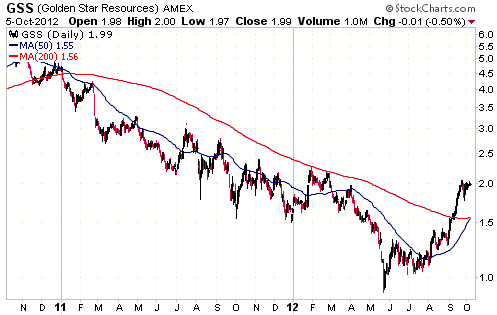
Golden
Star Resources (NYSE: GSS, TSX: GSC). Shares: 259M issued, 318M fully diluted as
at Sep 2012 (counting 47M $1.65 CNs as equity). Recent price: US$1.99
After the close of trading on Friday GSS announced its Q3 gold production and
updated 2012 guidance. As is almost always the case with this company, its
production over the latest quarter came in below its own forecast and guidance
for the full year was reduced. This could, but won't necessarily, cause the
stock to sell off this week. It won't necessarily cause a significant decline in
the stock price because a) the reduction in 2012 guidance was fairly small (338K
ounces down to 333K ounces), and b) if the company achieves its reduced Q4
guidance of 87K ounces it should generate a lot of cash due to the likelihood of
gold averaging a much higher price in Q4 than in the previous two quarters.
Here are some back-of-the-envelope specifics. An average gold price of $1750/oz
during Q4 should result in a gross margin of at least $700/oz for GSS, which
should, in turn, enable the company to generate at least $36M of cash assuming
production of 87K ounces. If we use a fully diluted share count of 312M and
apply an 8 multiple to the annualised quarterly cash flow, we find that a
quarterly cash flow rate of $36M justifies a GSS share price of about $3.70 (85%
above last Friday's closing price). Therefore, if the market focuses on the
underlying value and the potential cash flow generation rather than the reduced
guidance, the stock won't sell off. It could even rally.
In the 24th September Weekly Update, with the stock price at US$2.04, we noted
that GSS was 'overbought' and a potential candidate for partial selling. Note
that IF the reduced production guidance prompts a sell-off this week, a
short-term buying opportunity would be created by a decline to the US$1.60s.
Short-term
trading idea: Rye Patch Gold (TSXV: RPM). Shares: 146M issued, 155M fully
diluted. Recent price: C$0.56
RPM is a gold junior with three exploration-stage projects in Nevada (the Wilco,
Lincoln Hill and Jessup projects). All told, these projects currently have 1.9M
ounces of gold in the M&I category and 0.8M ounces of gold in the Inferred
category as laid out in the table posted at
http://www.ryepatchgold.com/i/pdf/Rye_Patch_Resource_Table_Sept_2012.pdf.
This in-ground resource gives the company some option value and underpins its
market capitalisation, but the very low average grade of the resource (around
0.36-g/t) suggests that it couldn't be economically mined. We therefore wouldn't
be interested in owning RPM shares if the aforementioned projects were all the
company had going for it.
RPM only interests us at this time as a play on the outcome of a legal case
scheduled to go to trial next month. To cut a long story short, Coeur d'Alene
Mines (CDE) failed to pay the maintenance fees on unpatented mineral claims
around its Rochester silver/gold mine in Nevada by the due date of 31st August
2011. By late October of 2011 CDE still hadn't made the required payments to the
BLM (Bureau of Land Management). The mining claims were therefore forfeited and
became open to the location of new mining claims by any third party. Rye Patch
identified the open ground and located unpatented mining claims during October
and November 2011. RPM completed the monumentation of its mining claims in
November 2011, informed the senior management of CDE of the location of the
mining claims on November 28, 2011, and issued a
press release on December 5, 2011, informing the world of the situation. The
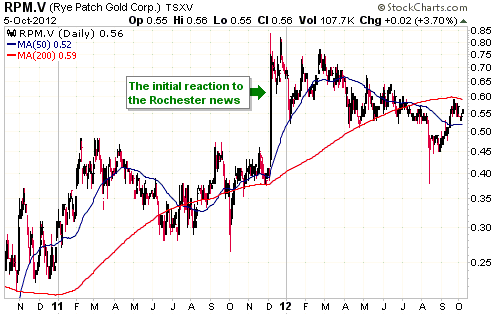
market's reaction was to immediately raise RPM's stock price from the
low-C$0.40s to the low-C$0.80s. CDE then initiated legal proceedings in an
effort to get their forfeited claims returned. As the months went by the market
gradually lost interest, causing RPM's stock price to drift downward to not far
above its level just prior to the Rochester news. However, interest should begin
to increase as the November court date approaches.
According to CDE, the disputed claims cover about 20% of the Rochester Mine's
reserves and a substantial portion of the Rochester Mine's resources. At this
time the mine is producing at the rate of about 4M Ag-eq (silver-equivalent)
ounces per year. Its reserves total 42M Ag-eq ounces and its resources total
185M Ag-eq ounces (155M M&I plus 30M Inferred). This makes it an important asset
for CDE.
We aren't knowledgeable about the legalities of unpatented US mineral claims,
but everyone we know who is knowledgeable believes that RPM will win the court
case. A legal victory would, in our opinion, push RPM's stock price up to at
least C$0.80 and probably as high as C$1.00. There's also a possibility that CDE
will try to resolve the issue by making a takeover bid for RPM prior to the
start of the trial. In the unlikely event that RPM loses in court, RPM's other
projects should prevent the stock from falling below the C$0.30s. This sets up
an attractive risk/reward for a short-term trade. The plan would be to take a
position in the low-to-mid-C$0.50s with the aim of either exiting at a profit of
60%-100% following a legal victory or takeover bid or exiting at a loss of up to
40% following a legal defeat.
We aren't adding RPM to the TSI Stocks List at this time, but will do so if it
becomes available at C$0.52 within the next two weeks.
Chart Sources
Charts appearing in today's commentary
are courtesy of:
http://stockcharts.com/index.html

|









