|
-- Weekly Market Update for the Week Commencing 9th March 2009
Big Picture
View
Here is a summary of our big picture
view of the markets. Note that our short-term views may differ from our
big picture view.
In nominal dollar terms, the BULL market in US Treasury Bonds
that began in the early 1980s will end by mid-2010. In real (gold)
terms, bonds commenced a secular BEAR market in 2001 that will continue
until 2014-2020. (Last
update: 09 February 2009)
The stock market, as represented by the S&P500 Index, commenced
a secular BEAR market during the first quarter of 2000, where "secular
bear market" is defined as a long-term downward trend in valuations
(P/E ratios, etc.) and gold-denominated prices. This secular trend will bottom sometime between 2014 and 2020. (Last update: 22 October 2007)
A secular BEAR market in the Dollar
began during the final quarter of 2000 and ended in July of 2008. This
secular bear market will be followed by a multi-year period of range
trading. (Last
update: 09 February 2009)
Gold commenced a
secular bull market relative to all fiat currencies, the CRB Index,
bonds and most stock market indices during 1999-2001. This secular trend will peak sometime between 2014 and 2020. (Last update: 22 October 2007)
Commodities,
as represented by the Continuous Commodity Index (CCI), commenced a
secular BULL market in 2001 in nominal dollar terms. The first major
upward leg in this bull market ended during the first half of 2008, but
a long-term peak won't occur until 2014-2020. In real (gold) terms,
commodities commenced a secular BEAR market in 2001 that will continue
until 2014-2020. (Last
update: 09 February 2009)
Copyright
Reminder
The commentaries that appear at TSI
may not be distributed, in full or in part, without our written permission.
In particular, please note that the posting of extracts from TSI commentaries
at other web sites or providing links to TSI commentaries at other web
sites (for example, at discussion boards) without our written permission
is prohibited.
We reserve the right to immediately
terminate the subscription of any TSI subscriber who distributes the TSI
commentaries without our written permission.
Outlook Summary
Market
|
Short-Term
(0-3 month)
|
Intermediate-Term
(3-12 month)
|
Long-Term
(1-5 Year)
|
Gold
|
Neutral
(17-Dec-08)
|
Bullish
(12-May-08)
|
Bullish
|
US$ (Dollar Index)
|
Bearish
(21-Jan-09)
| Neutral
(16-Feb-09)
|
Neutral
(19-Sep-07)
|
Bonds (US T-Bond)
|
Bearish
(21-Nov-08)
|
Bearish
(22-Sep-08)
|
Bearish
|
Stock Market (S&P500)
|
Neutral
(02-Mar-09)
|
Neutral
(02-Feb-09)
|
Bearish
|
Gold Stocks (HUI)
|
Bullish
(12-Jan-09)
|
Bullish
(12-May-08)
|
Bullish
|
| Oil | Bullish
(17-Nov-08)
| Neutral
(22-Sep-08)
| Bullish
|
Industrial Metals (GYX)
| Bullish
(26-Nov-08)
| Neutral
(22-Sep-08)
| Bullish
|
Notes:
1. In those cases where we have been able to identify the commentary in
which the most recent outlook change occurred we've put the date of the
commentary below the current outlook.
2. "Neutral", in the above table, means that we either don't have a
firm opinion or that we think risk and reward are roughly in balance with respect to the timeframe in question.
3. Long-term views are determined almost completely by fundamentals,
intermediate-term views by giving an approximately equal weighting to
fundmental and technical factors, and short-term views almost
completely by technicals.
Sentiment Overview
Gold Market Sentiment
When the gold price rose to $1000 in late February there was naturally
a lot of enthusiasm about this market's prospects, which, combined with
the almost uninterrupted $200 rise over the preceding five weeks, paved
the way for a downward correction. The gold price then fell for eight
trading days in a row, with the eighth down day being last Wednesday.
The stage was thus set for a rebound, but as noted in last week's
Interim Update the fact that the 8-day decline had barely put a dent in
bullish sentiment suggested that the overall correction from the
February high had not yet run its course.
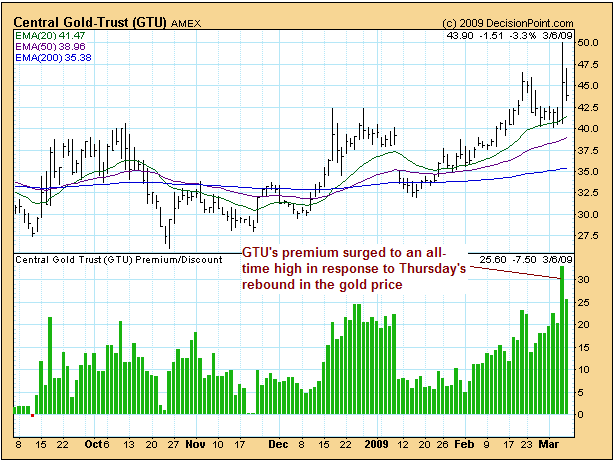
Interestingly, while the 8-day decline generated very little concern
amongst gold bulls, Thursday's rebound from support near $900 was
greeted with unrestrained exuberance. For example and as illustrated by
the following chart, the premium to net asset value of the Central Gold
Trust (GTU), a closed-end fund that invests in gold bullion, surged
from an already-high 20% on Wednesday to a new all-time high of 33% in
response to Thursday's technical rebound. Buyers of GTU near the close
of trading on Thursday were, in effect, paying about $1250/ounce for
gold while the spot gold price was in the $930s. No well-informed
investor would do this.
If the pullback that
culminated last Wednesday had been accompanied by significant concern
and the subsequent rebound had been accompanied by scepticism then the
gold market would be well positioned to resume its intermediate-term
upward trend. However, this is clearly not the situation.
Stock Market Sentiment
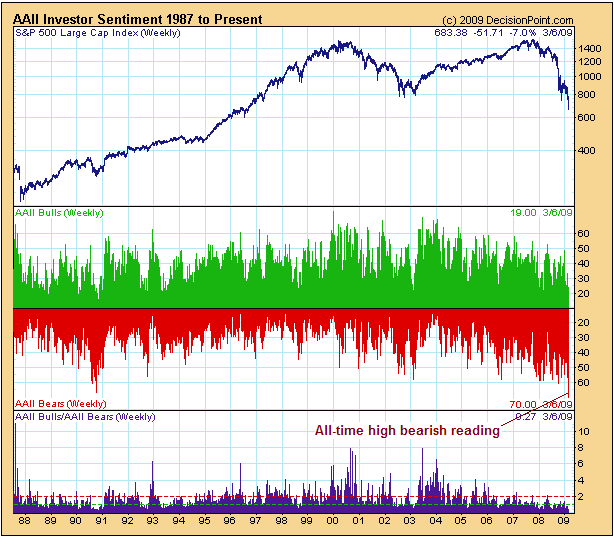
Extreme short-term optimism in the gold market is occurring alongside
extreme short-term pessimism in the stock market. For example, the
following chart of the weekly AAII Sentiment Survey indicates that 70%
of survey respondents were bearish as of last week, versus only 19%
that describe themselves as bullish. This happens to be the highest
bearish percentage in the survey's history.
We won't argue that the incredibly high bearish percentage isn't
justified by both the price action and the fundamentals. We also won't
claim that total capitulation has occurred. However, if the current
long-term equity bear evolves in similar fashion to previous examples
then total capitulation lies at least a year, and potentially as many
as 5 years, into the future. In the mean time there is a sentiment
platform in place capable of supporting a strong counter-trend rebound.
Industrial Commodities
With the exception of those who remain in a blissful state of denial,
observers of the economy and the financial markets realise that the
global boom has ended and that a new boom is not going to begin anytime
soon. Many people are therefore extrapolating today's bearish
industrial-commodity supply/demand trends (falling demand relative to
supply) well into the future. In other words, there is a great deal of
pessimism built into the current prices of most industrial commodities.
A good example of the current stark difference between gold sentiment
and industrial-commodity sentiment is the relative performances of the
Central Gold Trust (GTU) and the Uranium Participation Corp. (TSX: U).
GTU, as noted above, holds gold bullion and currently trades at a huge
premium to its net asset value (NAV). U, on the other hand, holds an
industrial commodity (uranium) and is currently priced at a substantial
DISCOUNT to its NAV (by our calculations, Friday's closing price of
C$5.95 for U represented a discount of about 16% to the market value of
its uranium).
Cramer
Jim Cramer, a very high-profile and outspoken commentator on the
financial markets, has recently had a lot to say about gold, almost all
of it positive. At the same time he has apparently been saying bearish
things about natural gas.
Cramer is a good indicator of public sentiment, meaning that when he is
very bullish it generally means that most people are bullish and when
he is very bearish it generally means that most people are bearish.
Cramer's current outlook therefore confirms that there is considerable
optimism built into gold's current price and considerable pessimism
built into the current prices of natural gas and other industrial
commodities.
By the way, we understand that Cramer has been advising people to scale
into gold on weakness, which is actually very good advice. Our point is
that his current strong focus on gold adds weight to the view that
sentiment represents a barrier to significant additional SHORT-TERM
gains in the gold price.
Conclusion
Sentiment suggests that there will soon be a temporary shift away from
the premier counter-cyclical investment (gold) to cyclical investments
such as general equities and industrial commodities. Silver is part
monetary (counter-cyclical) and part industrial (cyclical), so if/when
this shift takes place it will probably build on its recent strength
relative to gold.
Oil and Gas
Oil
Over the past few months there has been an unusually wide contango in
the oil market, meaning that the more distant futures contracts have
been trading at unusually large premiums to the cash market and to the
nearer contracts. This large contango arose due to an excess supply of
oil in the cash market. In effect, the price of oil was pushed downward
in the cash market relative to the futures market, and in the earlier
delivery months relative to the more distant delivery months, as an
increasing supply of physical oil bid for a limited amount of storage
space.
The contango eventually became large enough that it created the
incentive for oil companies and well-financed speculators to hire
tankers to store oil and to hedge these physical positions by selling
futures contracts. The idea was/is that the oil floats offshore in a
tanker for several months and is then delivered into the futures
contracts, generating a virtually risk-free profit equal to the
oil-market contango minus the cost of storage/transportation.
The above-described "contango trade" has been done on such a large
scale that tankers are now being used as temporary storage for more
than 80M barrels -- equivalent to about one day of worldwide oil
consumption -- of excess oil. At some point this oil will be delivered
into futures contracts and the buyers of these contracts will have to
figure out what to do with it.
The contango trade represents a huge overhang of physical oil supply
and there doesn't appear to be a realistic chance that global oil
demand will rise over the months ahead, so is there any reason to
believe that oil's downward trend has run its course?
The only reason we can think of is that all the important participants
in the oil market are fully aware of the supply overhang, meaning that
the futures market should have already done its best to factor-in the
effects of this excess supply. Furthermore, the oil price has recently
begun to strengthen despite this well-known negative.
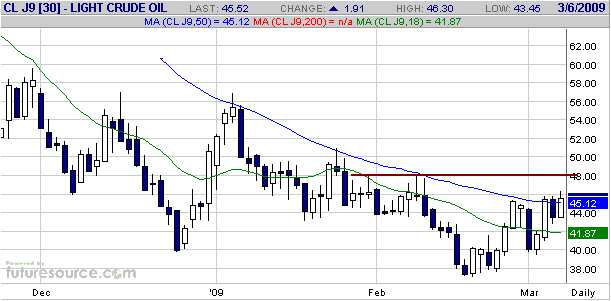
With reference to the following daily chart, the April crude futures
contract has nearby resistance at around $46 (last week's high) and
$48. A daily close above $48 would signal that a bottom of at least
short-term significance was put in place last month.
NG's supply/demand balance appears to be less bearish than that of oil.
The first reason is that local producers have more influence on the
market and have reacted both quickly and decisively to the price
decline, thus ensuring a substantial decline in production over the
coming 12 months. The second reason is that there has been no massive
build-up in NG supply anchored offshore. However, the price action has
recently been more bearish. In particular, the potentially bullish
outside reversal to the upside that occurred during the week before
last was completely negated by last week's action.
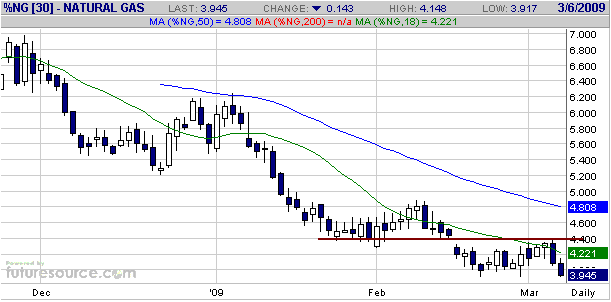
As illustrated by the following daily chart, the April NG futures
contract ended last week at a new closing low for the move and at its
27th February intra-day low. Preliminary evidence of an upward trend
reversal would be a daily close above resistance at $4.40, while a more
definitive reversal signal would be a daily close above resistance in
the $4.80s.
In our opinion, all of the stocks mentioned above are reasonable
candidates for new buying near their current prices. There is no
evidence yet that bottoms are in place, but investors can mitigate risk
by scaling into positions over time. This is what we are doing in our
own accounts. Gold will remain our largest position by a wide margin,
but we reduced our exposure to the gold sector in late February (as
noted at the time) and have begun to increase our exposure to natural
gas and other cyclical equities.
The Stock
Market
There is no question that the
US economy is in bad shape and is still deteriorating. For example, the
latest Purchasing Managers' Index (PMI) confirms the continuation of a
strong downward trend in manufacturing, the unemployment rate has risen
to around 15% (based on correct measurement, not the headline number),
and one in eight US homeowners are now delinquent on their mortgages.
This, however, is well known. It is a large part of the reason why the
stock market has been incredibly weak and why sentiment surveys reveal
extreme negativity.
Because it is well known, today's miserable economic backdrop won't
prevent the stock market from rebounding, or, for that matter, from
embarking on a new long-term upward trend. Note, though, that we don't
think there's a realistic chance of a new equity bull market starting
anytime soon. This is partly because valuations are still much higher
than they usually get near the ends of major bear markets and partly
because the actions being taken by policymakers to "stimulate" the
economy will prolong and deepen the downturn. Note, as well, that the
capitulation we expect to see towards the end of the equity bear will
probably encompass the gold price rising to some unbelievable price as
well as widespread acknowledgement that the interventionist economic
theories of Keynes et al are wrong. The current situation is that gold
is yet to exceed its March-2008 high, and most people still seem to
believe, or have not yet completely rejected, the idea that the
government can help by creating money out of nothing and by stealing
from Peter to pay Paul.
A new bull market appears to be out of the question, but we continue to
anticipate a tradable multi-month rebound. After a promising start the
anticipated rebound failed to materialise during the first quarter, but
we are now entering a 2-week time window when intermediate-term equity
market turning points have regularly occurred over the past 9 years.
Once a rebound begins it will probably NOT take the form of a
consistent upward trend, at least not initially. The most likely
pattern following a low will be a sharp 1-3 week bounce and then a
pullback to test the low prior to the start of a consistent upward
trend.
This week's
important US economic events
| Date |
Description |
Monday Mar 09
| No important events scheduled
| Tuesday Mar 10
| No important events scheduled
| | Wednesday Mar 11
| No important events scheduled
| | Thursday Mar 12
| Retail Sales
| | Friday Mar 13
| International Trade Balance
Import and Export Prices
Consumer Sentiment
|
Gold and
the Dollar
Gold
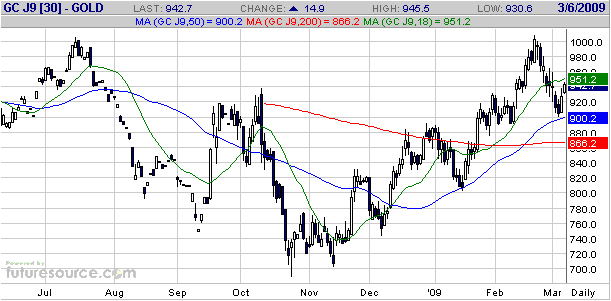
The following daily chart of April gold futures shows that the gold
price bottomed at its 50-day moving average last week. At this stage,
therefore, the current correction looks similar to the one that ended
during the first half of January. However, due primarily to the
sentiment situation discussed earlier in today's report we suspect that
the current correction is not complete.
With the economic and monetary backdrops the way they are there is a
significant risk that the gold price will soon blow through $1000/ounce
and begin heading rapidly to much higher levels. As a result, you would
have to be either crazy or oblivious to risk to be short gold right
now. However, a far more likely short-term outcome is that the rebound
from last week's low will end below the February high and be followed
by a decline to a new low for the move.
We have no particular target in mind for a correction low. All we can
say is that we would not be surprised if gold dropped to the mid-$800s
prior to the end of this correction, but would be surprised if it fell
below $800.
Rather than thinking in terms of a downside price target it makes more
sense to expect the correction to continue until the 'froth' has been
taken out of the market. Likely signs that the froth has been removed
include a peak-to-trough decline of more than 50K contracts in the
speculative net-long position in COMEX gold futures and substantially
reduced NAV premiums for CEF and GTU (premiums of 5% or lower would be
ideal).
Gold Stocks
The continuation of gold's correction would put downward pressure on
gold stocks. However, if a stock-market rally were to commence in the
near future then the downward pressure exerted by a consolidating gold
price would be at least partially offset by the upward pressure exerted
by a rising stock market. Furthermore, the average gold stock has not
yet come close to fully discounting the positive effects on the gold
mining business of the large rise in the real gold price that has
occurred over the past 6 months. As a result, the HUI has a much better
chance than gold of making a sustained move above its February high
within the next two months.
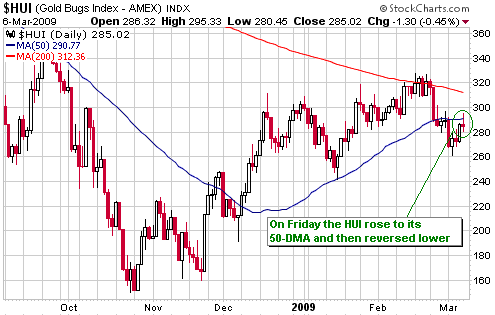
The following chart shows that the HUI plunged below its 50-day moving
average at the beginning of last week. It then rebounded to slightly
above this moving average on Friday before reversing lower and ending
the week below it.
We don't know if the HUI's correction is over. As noted in last week's
Interim Update, it is certainly possible that it ended when the HUI
dropped to 260 on Tuesday 3rd March. At the same time, it wouldn't
surprise us if there were some additional downside prior to a
sustainable low being reached. A daily close above last Friday's
intra-day high of 295 would be a clear indication that the correction
was over.
There is probably now
greater short-term upside potential in non-gold stocks than in gold
stocks, but there is also greater downside risk. Moreover, investors
should ensure that their primary focus remains on the gold sector
because in our opinion it is the only equity sector that happens to be
a long-term bull market.
Currency Market Update
A potentially significant divergence
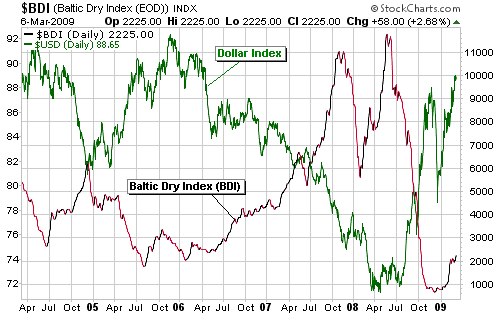
Important turning points in the Dollar Index tend to coincide with
important turning points in the Baltic Dry Index (BDI), with US$ highs
associated with BDI lows and US$ lows associated with BDI highs. For
example, the following chart shows a BDI low and a US$ high in Q2-2004,
a BDI high and a US$ low near the end of 2004, a BDI low and a US$ high
between July and November of 2005, and a BDI high combined with a US$
low in mid-2008.
A divergence between
the BDI and the Dollar Index has recently developed. Specifically, the
BDI bottomed in November of last year and has just made a new
multi-month high, but after declining sharply in the weeks following
its November high the Dollar Index resumed its advance and has also
just risen to a new multi-month high (actually, a multi-year high).
Based on the historical record we should expect that either the BDI
will soon begin heading back towards last year's low or the Dollar's
trend will reverse downward. If the stock market soon begins to rally
then it is likely that the BDI will maintain its upward bias and the
recent BDI-US$ divergence will be resolved via a downward reversal in
the US$.
Current Market Situation
Weakness in the Yen has created the impression that the US$ has
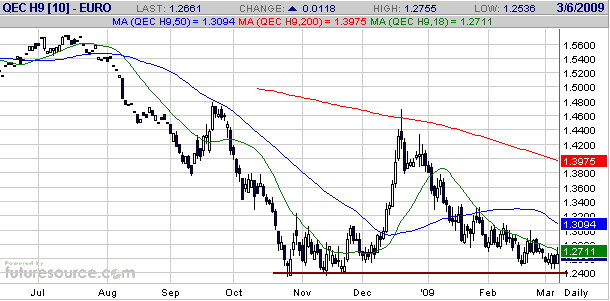
recently been very strong, but the following daily chart shows that the
March euro has spent the past month drifting between 1.25 and 1.30.
Apart from a quick 10% decline in the Yen, very little has happened in
the currency market over the past few weeks.
The euro has made numerous attempts to rally since the beginning of
this year, but each attempt has failed at, or below, the 18-day moving
average (the green line on the following chart). A decisive daily close
above this moving average should therefore be taken as an early warning
of a short-term trend change.
Update
on Stock Selections
(Note: To review the complete list of current TSI stock selections, logon at http://www.speculative-investor.com/new/market_logon.asp
and then click on "Stock Selections" in the menu. When at the Stock
Selections page, click on a stock's symbol to bring-up an archive of our comments on the stock in question)
 More comments on the NGD-WGW Merger More comments on the NGD-WGW Merger
The merged company is expected to have:
- 348M shares outstanding, 436M on a fully diluted basis
- 12.2M ounces of gold in the measured-and-indicated resource
category, including 7.6M ounces of reserves, all within politically
secure jurisdictions
- 340K ounces/year of current production rising to 420K
ounces/year in 2012 (assuming no contribution from Amapari and no
further acquisitions)
- Sufficient cash and cash flow to bring New Afton into
production in 2012 at the rate of 80K ounces/year of gold and 75M
pounds/year of copper without issuing more equity or debt
Go to http://www.bnn.ca/news/7668.html to view an interview with the CEOs of the two companies regarding the merger's rationale.
The more we think about this deal the more it seems like a good move
from NGD's perspective. In a nutshell, it answers the financing
question for the New Afton project in a cost-effective way, thus
eliminating one of the issues that had been weighing on NGD's stock
price. However, we still don't see that the deal makes a lot of sense
from WGW's perspective. It provides a growth path that didn't
previously exist, but with development-stage gold projects currently
having such low valuations there were, in our opinion, much better ways
in which WGW could have grown.
Here are some back-of-the-envelope calculations of the combined company's value:
340K ounces/year at US$2500 per ounce of production implies a valuation
of US$850M, or US$2.44/share assuming 348M shares (note that we are not
using the fully diluted share count because almost all the warrants are
a very long way out of the money). 420K ounces/year at US$3000/ounce (a
$3000/oz figure will be more appropriate once New Afton comes on line
and costs decline) implies a valuation of US$1260M, or US$3.62/share.
Adding US$150M for the company's 30% stake in the undeveloped El Morro
copper/gold project increases these valuations to US$2.87 and
US$4.05/share, respectively. These valuations assume that Amapari is
worthless, that the company's $170M of ABCP has no value, and that gold
and copper remain below US$1000 and US$2 respectively.
By the way, when we come up with a rough valuation by assuming that
production is worth $2500/ounce (or some other figure) we are not
saying that one ounce of gold is worth $2500; we are saying that an
ounce of gold per year for the next 10 (or so) years can be assumed to
have a present value of around $2500. Apart from the price of gold, the
value assigned to gold production will be determined by production cost
and risk. For example, production from higher-cost mines should be
assigned lower valuations, as should production from higher-risk
locations. Currently, the 37 gold producers followed by John Doody at
www.goldstockanalyst.com have a weighted average market-cap-per-ounce
of forecast 2009 production of around $4200. Furthermore, Gammon Gold,
which has about 15% lower gold production and higher risk than the
NGD-WGW combination, is presently being valued by the market at around
$3000 per ounce of forecast 2009 gold production. In other words, the
figures used in our NGD valuation are fairly conservative.
Finally, as happens from time to time on the AMEX stock exchange (now
called the NYSE Alternext), there was strange action at the end of
Friday's session in that WGW suddenly dropped from the mid-US$160s to
US$1.51 due to a single trade done just after the close. This sharp
drop was not reflected in WGW's Canadian-traded shares (TSX: WGI) or in
NGD shares and will probably be 'corrected' as soon as trading
commences on Monday. WGW should trade at a slight discount to NGD,
which closed at US$1.71 on Friday.
Great
Basin Gold (AMEX and TSX: GBG). Shares: 315M issued, 403M fully diluted
(including the latest financing). Recent price: US$0.99
After GBG announced an equity financing on 23rd February we said: "...this
financing has been poorly timed and is very much in the bad news
category. Furthermore, the company has proceeded with the equity
offering without first locking in a price for the new shares. This, in
our opinion, was a stupid thing to do. The financing news pushed GBG
down to support at US$1.40, which would ordinarily constitute an
opportunity for new buying. In this case, however, we would wait until
the financing price has been determined and the market has had time to
fully digest the effects of the share dilution before doing any new
buying."
The financing price was announced last Wednesday, and it was LOW:
C$1.30 (US$1.00) with a half warrant at C$1.60. GBG's management pretty
much guaranteed that the financing would be done at the lowest possible
price, thus wiping out the maximum possible amount of shareholder
value, by announcing the financing without first locking in a price.
GBG is developing two gold mines -- the Hollister mine in Nevada and
the Burnstone mine in South Africa. Hollister is expected to produce
138K ounces/year at a cash cost of US$384/ounce and is estimated to
have a net present value of US$100M using a discount rate of 10%.
Burnstone is expected to produce 275K ounces/year at a cash cost of
$303/ounce and is estimated to have a net present value of US$611M at a
discount rate of 5%. These figures are taken from GBG's web site. The
combined NPV of the two projects is therefore estimated to be US$711M.
Subtracting US$60M of debt yields an estimated market value for the
company of US$651M, or US$1.86/share assuming 350M shares. Taking a
different approach and valuing the 413K ounces of forecast annual
production at US$2500/ounce yields an estimated market value of
US$2.78/share.
The poorly handled financing has hurt our GBG stock position and has
all but guaranteed that our April-2009 GBG warrants will expire
worthless. However, the company should now be fully financed through to
production and at the current price or lower the stock offers
interesting upside potential, especially considering that we have not
allowed anything in the above valuations for Burnstone's excellent
expansion potential. The increase in supply will probably keep a lid on
the share price for a while, but we think the shares have a good
risk/reward at US$1.00 or lower.
Chart Sources
Charts appearing in today's commentary
are courtesy of:
http://stockcharts.com/index.html
http://www.futuresource.com/
http://www.decisionpoint.com/

|









