|
-- Weekly Market Update for the Week Commencing
9th June 2014
Big Picture
View
Here is a summary of our big picture
view of the markets. Note that our short-term views may differ from our
big picture view.
In nominal dollar terms, the BULL market in US Treasury Bonds
that began in the early 1980s ended in 2012. In real (gold)
terms, bonds commenced a secular BEAR market in 2001 that will continue
until 2018-2020. (Last
update: 20 January 2014)
The stock market, as represented by the S&P500 Index,
commenced
a secular BEAR market during the first quarter of 2000, where "secular
bear market" is defined as a long-term downward trend in valuations
(P/E ratios, etc.) and gold-denominated prices. This secular trend will bottom sometime between 2014 and 2020.
(Last update: 22 October 2007)
A secular BEAR market in the Dollar
began during the final quarter of 2000 and ended in July of 2008. This
secular bear market will be followed by a multi-year period of range
trading.
(Last
update: 09 February 2009)
Gold commenced a
secular bull market relative to all fiat currencies, the CRB Index,
bonds and most stock market indices during 1999-2001.
This secular trend will peak sometime between 2014 and 2020.
(Last update: 22 October 2007)
Commodities,
as represented by the Continuous Commodity Index (CCI), commenced a
secular BULL market in 2001 in nominal dollar terms. The first major
upward leg in this bull market ended during the first half of 2008, but
a long-term peak won't occur until 2014-2020. In real (gold) terms,
commodities commenced a secular BEAR market in 2001 that will continue
until 2014-2020.
(Last
update: 09 February 2009)
Copyright
Reminder
The commentaries that appear at TSI
may not be distributed, in full or in part, without our written permission.
In particular, please note that the posting of extracts from TSI commentaries
at other web sites or providing links to TSI commentaries at other web
sites (for example, at discussion boards) without our written permission
is prohibited.
We reserve the right to immediately
terminate the subscription of any TSI subscriber who distributes the TSI
commentaries without our written permission.
Outlook Summary
Market
|
Short-Term
(1-3 month)
|
Intermediate-Term
(6-12 month)
|
Long-Term
(2-5 Year)
|
|
Gold
|
Neutral
(02-Jun-14) |
Bullish
(26-Mar-12) |
Bullish
|
|
US$ (Dollar Index)
|
Bearish
(16-Apr-14) |
Bearish
(27-Jan-14) |
Neutral
(19-Sep-07) |
|
Bonds (US T-Bond)
|
Bullish
(11-Dec-13)
|
Neutral
(18-Jan-12)
|
Bearish |
|
Stock Market
(DJW)
|
Bearish
(07-Apr-14) |
Bearish
(28-Nov-11) |
Bearish
|
|
Gold Stocks
(HUI)
|
Neutral
(02-Jun-14) |
Bullish
(23-Jun-10) |
Bullish
|
|
Oil |
Neutral
(02-Jun-14) |
Neutral
(31-Jan-11) |
Bullish
|
|
Industrial Metals
(GYX)
|
Neutral
(17-Feb-14) |
Bullish
(28-Apr-14) |
Bullish
(28-Apr-14) |
Notes:
1. The date shown below the current outlook is when the most recent outlook change occurred.
2. "Neutral", in the above table, means that we either don't have a
firm opinion or that we think risk and reward are roughly in balance with respect to the timeframe in question.
3. Long-term views are determined almost completely by fundamentals,
intermediate-term views by
fundamentals, sentiment and technicals, and short-term views by sentiment and
technicals.
Fighting Deflation
The ECB is taking additional steps to fight
deflation. At least, that's how the outcome of last week's ECB meeting is being
portrayed by the mainstream media, most 'economists' (we use the term loosely)
and the ECB itself. However, this portrayal is wrong. The ECB is actually doing
nothing other than distorting prices.
The new measures to be taken by the ECB entail interest-rate reductions,
because, for example, the previous deposit rate of zero was obviously too high
and was therefore getting in the way of economic growth, as well as incentives
for banks to make more loans, because economies that are burdened by excessive
debt would obviously benefit from more debt.
These new measures leave no doubt that the ECB is every bit as misguided and
destructive as the US Fed. The ECB hasn't yet resorted to QE, but that's only
because of political obstacles (a.k.a. Germany). There's a high probability that
when the 'unconventional' measures introduced last week fail to have a sustained
positive effect, the political obstacles that have prevented euro-zone QE up
until now will be overcome and an asset monetisation program will be introduced.
We suspect that this will happen by the first quarter of next year.
Getting back to the "fighting deflation" propaganda, if, for the sake of
argument, we go with the flow and define deflation as a decline in the general
price level, then there are only two ways that deflation can occur. The first
way is via economic progress. Contrary to the popular view that economic growth
causes prices to rise and that rising prices are needed for economic growth,
per-capita economic growth is only possible via increased productivity.
Increased productivity will, all else remaining the same, lead to LOWER prices
(the same amount of money will be 'chasing' a larger quantity of goods and
services). Some analysts refer to this as "good deflation". The computer
industry is an excellent example. If the entire economy were able to achieve the
same productivity growth as the computer industry, then most prices would be in
steep downward trends and the average living standard would be in a steep upward
trend.
If the euro-zone is currently heading towards deflation it clearly isn't because
of real economic progress. However, the ECB's attempts to distort the price
signals upon which the productive sector relies will certainly get in the way of
economic progress (by curtailing production) and thus make falling prices ("good
deflation") less likely. In this respect the ECB is not really "fighting"
deflation, it is robbing the average euro-zone consumer of the deflation from
which he/she would otherwise benefit.
The other way that deflation can occur is via a contraction in the supply of
money and/or credit (a contraction in the supply of credit will typically
provoke an increase in the demand for money that has the knock-on effect of
lowering prices). This is sometimes called "bad deflation". In this case, the
deflationary force is caused by the prior inflations of money and credit
stemming from the artificially-low interest rates brought about by the central
bank.
See the problem? In its attempts to "fight deflation" the ECB is not only
reducing the chances of "good deflation", it is also doing more of what created
the potential for "bad deflation". Nobody wants "bad deflation", but after a
period of rapid money/credit inflation there is no rational way to avoid it. The
central bank can only postpone the inevitable by taking actions that will lead
to a more painful future denouement in the form of a deflationary great
depression (the best case) or a hyper-inflationary great depression (the worst
case).
Commodities
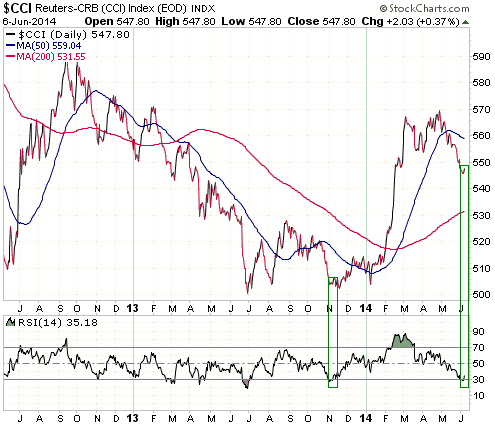
The Continuous Commodity Index (CCI) appears to
be close to completing a normal correction to the intermediate-term advance that
got underway late last year. In particular, after becoming very 'overbought' --
based on the daily RSI(14) shown at the bottom of the following chart -- in
early March, it recently became as 'oversold' as it was just prior to the start
of its upward trend last November.
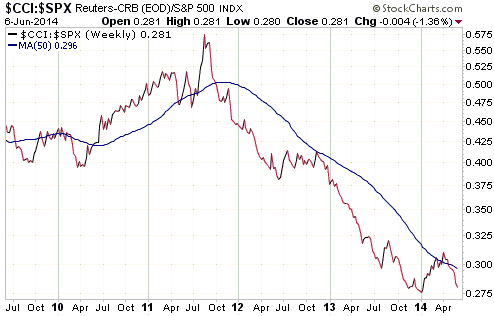
While the CCI's correction has been routine in nominal currency terms, it has
experienced a more serious decline relative to the US stock market. As
illustrated by the following weekly chart, the CCI/SPX ratio gained enough
ground during the first quarter of this year to trade above its 50-week moving
average for the first time since the third quarter of 2011, but almost all of
this ground has since been given back.
Our view is that the CCI/SPX ratio is in the process of successfully testing its
January-2014 bear-market low as part of a gradual transition from relative
strength in equities to relative strength in commodities. A gradual transition
from relative weakness to relative strength in emerging-market equities in
general and Russian equities in particular is part of the same theme.
 The Stock
Market
Periods like the last few weeks make us wish
we were believers in the idea that direct manipulation of prices by a cartel
comprising the government, the central banks and the largest commercial banks
was the primary driving force in the markets. Then when the markets moved
counter to our expectations we could say something along the lines of "our
analysis was spot on and would have been proven right if not for the
manipulators". Unfortunately, we could never make such a claim in good faith.
We are surprised that the stock market's upward trend has extended into June.
This opens up the possibility that the overall topping process could continue
into the final quarter of this year, with a significant decline during the next
couple of months followed by a rally to test the high later in the year.
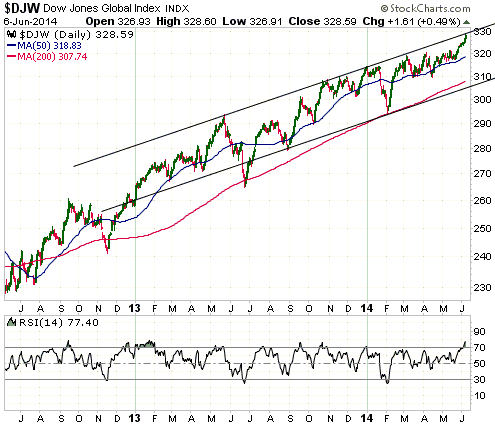
On a short-term basis, however, the recent price action has only increased the
downside risk, in that the strength that has enabled the NASDAQ100 Index (NDX)
to confirm the new highs in the S&P500 Index (SPX) has led to the senior stock
indices becoming very 'overbought'. As an example, the Dow Jones World Stock
Index (DJW) has risen on 10 of the past 12 trading days. The daily advances have
all been small, but, as illustrated by the following daily chart, the result is
that DJW is now at the top of its intermediate-term price channel and DJW's
daily RSI(14) is now at a 2-year high.
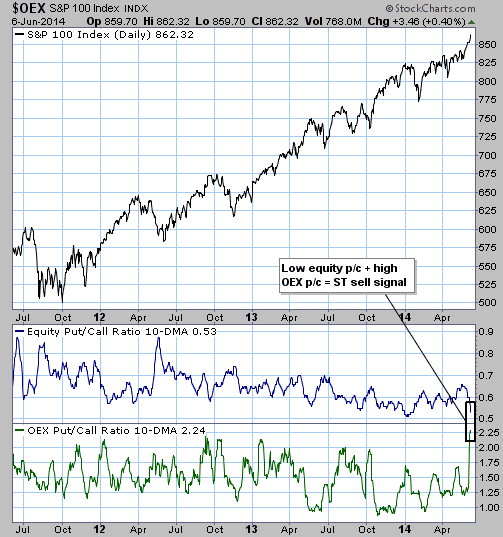
Also worth noting is that a put/call sell signal was generated at the end of
last week in the US stock market. We define a put/call sell signal as the 10-day
moving average of the equity put/call ratio moving to the vicinity of its 3-year
low concurrently with the 10-day MA of the OEX (S&P100 Index) put/call ratio
moving to the vicinity of its 3-year high. Such signals usually occur no more
than twice per year and are short-term bearish omens because they indicate a
lack of concern about downside risk on the part of the 'dumb money' (the
dominant influence on equity option volumes) combined with a heightened level of
concern about downside risk on the part of the 'smart money' (the dominant
influence on OEX option volumes).
Therefore, although the stock market has defied our expectations over the past
few weeks, this is not a good time to become more short-term bullish.
This week's
important US economic events
| Date |
Description |
| Monday Jun 09 |
No important events scheduled | | Tuesday
Jun 10 |
No important events scheduled | | Wednesday
Jun 11 |
Treasury Budget | | Thursday
Jun 12 |
Retail Sales
Import and Export Prices
Business Inventories
|
| Friday Jun 13 |
PPI
Consumer Sentiment |
Gold and
the Dollar
Gold
GLD's Gold Inventory
It has been several months since we last discussed the changes in the amount of
gold bullion held by the SPDR Gold Trust (GLD), the largest gold bullion ETF.
This is because there has been nothing to discuss, in that the changes to GLD's
gold inventory have been small and, given the price action, there has been no
reason to expect anything different. However, it's time for an update, if only
to counter the misinformation that regularly gets bandied about on this topic.
The concept that must always be kept in mind when analysing changes in GLD's
inventory is that these changes can only happen as a result of arbitrage. More
specifically, the Authorised Participants (APs) in the ETF will only add gold to
the inventory when the price of a GLD share moves above the net asset value (NAV)
of a GLD share. The addition of the gold involves multiple steps (the
short-selling of GLD shares, the purchase of gold bullion, the delivering of
gold bullion to the ETF and the creation of new GLD shares that are used to
cover the aforementioned short position) that occur almost simultaneously, but
the key is that it is a mechanistic process that a) gets initiated by GLD's
market price moving above its NAV and b) serves the purpose of closing the
price-NAV gap. Similarly, the APs will only ever remove gold from the GLD
inventory when the price of a GLD share moves below the NAV of a GLD share.
Again, there are multiple virtually-simultaneous steps involved (the buying of
GLD shares, the short-selling of gold bullion, the redeeming of GLD shares for
gold bullion from GLD's inventory, and the use of the bullion obtained from the
inventory to cover the aforementioned gold short position). And again, it is a
mechanistic process that a) gets initiated by GLD's market price moving below
its NAV and b) serves the purpose of closing the price-NAV gap.
In the hope of adding clarity we'll mention two related points. First, it is not
possible for GLD's gold inventory to be used to cover short positions elsewhere
in the gold market except as part of the arbitrage described above. Second,
because GLD holds gold bullion, a change in the price of gold will not
necessitate a change in GLD's inventory. GLD's shares will naturally track the
price of gold without the need to do anything, regardless of how far or how fast
the price of gold moves. However, there are times when the buyers of GLD shares
become over-eager, causing the market price of GLD to rise relative to the price
of gold, and there are times when the sellers of GLD shares become over-eager,
causing the market price of GLD to fall relative to the price of gold. This sets
in motion the arbitrage described above.
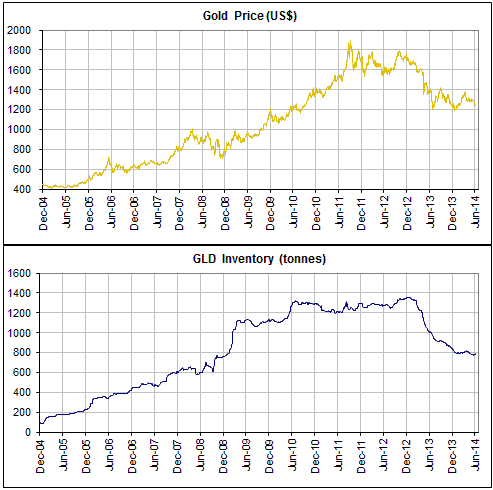
Now, buyers are most likely to become over-eager after the price has been
trending higher for a while and sellers are most likely to become over-eager
after the price has been trending lower for a while. That's why the chart
presented below shows that major trends in the GLD inventory FOLLOW major trends
in the gold price, and why it makes more sense to view last year's decline in
GLD's gold inventory as an effect, not a cause, of the decline in the gold
price.
With the gold price having stopped falling last December but not yet having done
enough to suggest to most people that there has been a sustained turn to the
upside, it is not surprising that the GLD inventory has essentially flat-lined
since the beginning of this year. After the gold price starts trending upward
with conviction we should start to see a steady build-up in the GLD inventory.
Current Market Situation
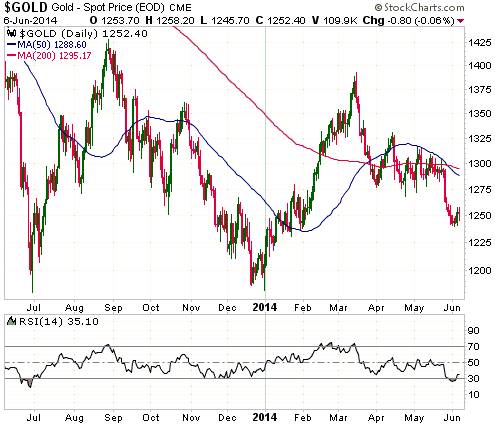
Despite some potentially market-moving news in the form of the ECB's new
counter-productive actions and the US monthly employment report, the financial
markets did very little last week. In this respect the gold market was no
exception. The "death cross" that occurred during the week before last appears
to have marked some sort of price bottom for gold, but gold hasn't done anywhere
near enough to confirm that the bottom will hold beyond the very short-term.
It seems that almost every 'technical analyst' on the planet is calling for gold
and the gold-mining indices to make new lows within the next few months. The
long-term bulls expect a final decline to marginal new lows prior to the start
of a multi-year upward trend, whereas the long-term bears expect a decline to
well below last year's lows as part of a continuing bear market. Enough strength
over the weeks ahead to confirm that the March-June decline was a correction to
a new upward trend rather than the continuation of the 2011-2013 downward trend
would therefore catch the maximum number of chart-huggers and price-followers
off guard. This doesn't mean that gold is about to reverse course and prove the
majority wrong, but it does mean that there is plenty of sentiment-related fuel
to propel the price upward. As discussed in previous commentaries, there is also
now plenty of fundamentals-related fuel for a gold rally, although we are
getting the impression that the inverse relationship between the gold and stock
markets is the only fundamental that matters at this moment.
Getting back above $1280 on a daily closing basis would be a clear sign that the
trend had reversed, while $1230 +/- a few dollars remains a realistic target for
a near-term downward spike.
Gold Stocks
The price action of the past three weeks has invalidated our 1970s model, at
least temporarily. It looks like the initial rebound from the 2013 bottom is
going to be more drawn-out than the initial rebounds from the 1970 and 1976
bottoms, undoubtedly as a result of the extension of the US stock market's
topping process.
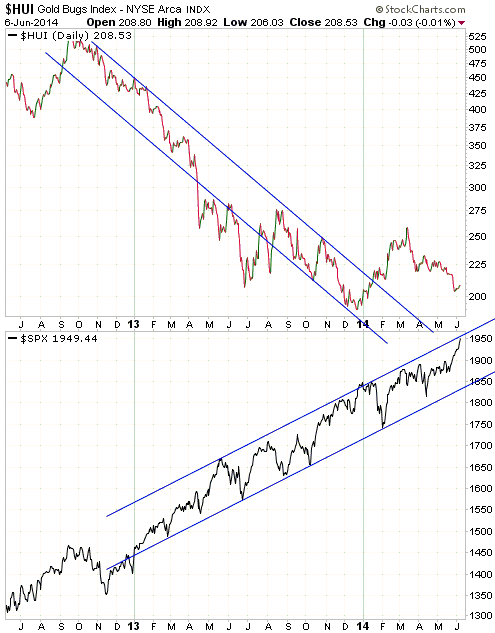
Below is another view of the loose inverse relationship between the HUI and the
SPX. Although the HUI made a new low in December-2013, it essentially stopped
trending downward in June of 2013. It broke out to the upside in January of this
year, but the SPX's continuing advance has restrained the enthusiasm for
gold-related investments.
The SPX is now as stretched to the upside as it was when the HUI reversed higher
in late-December.
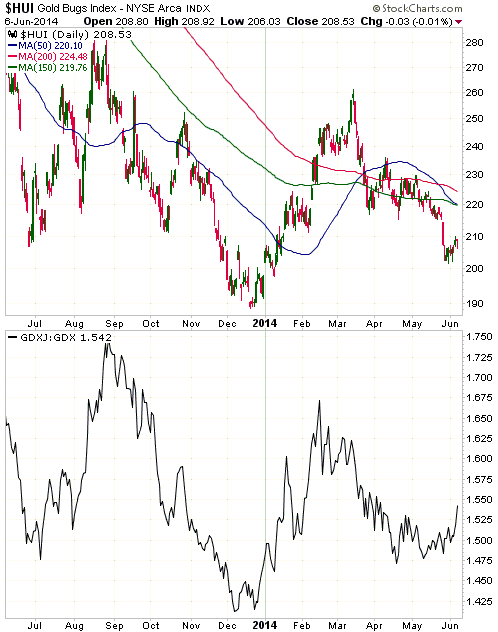
The following chart shows that while the HUI did very little last week, the GDXJ/GDX
ratio ended the week at a 2-month high. As a consequence, the current bullish
divergence between the HUI and the GDXJ/GDX ratio is far more pronounced than
the one that occurred last December. The stage therefore remains set for a new
short-term upward trend, but the HUI has not yet done anything to signal the
start of such a trend.
Critical short-term resistance lies at 220. A daily close above this resistance
would confirm a reversal.
The Currency Market
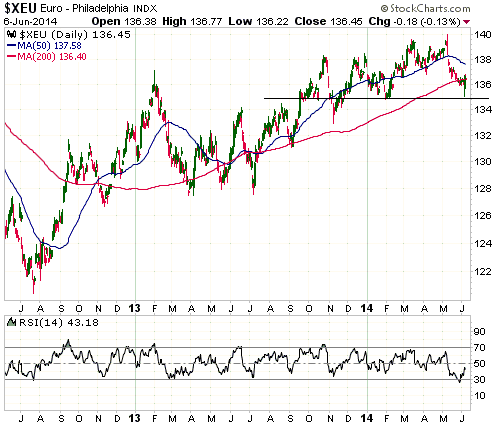
After all was said and the ECB had done its worst, the euro managed to end last
week at roughly where it began the week. In holding its ground it also managed
to hold its 200-day MA after spiking below it in the immediate aftermath of the
ECB's irresponsible promises to 'do more'.
The modest recovery following the ECB news was predictable given that the euro
had lost almost four points and become quite 'oversold' in anticipation of the
news.
With the euro still 'oversold' and with the speculative net-short position in
euro futures having just reached its highest level since last July, the euro is
poised to rally. A counter-trend rally within a downward trend would take it up
to around 138, but we are expecting more than a counter-trend rally. Unless the
market proves otherwise, we will work under the assumption that the euro's
intermediate-term trend is to the upside.
A daily close below 135 would prove otherwise.
Updates
on Stock Selections
Notes: 1) To review the complete list of current TSI stock selections, logon at
http://www.speculative-investor.com/new/market_logon.asp
and then click on "Stock Selections" in the menu. When at the Stock
Selections page, click on a stock's symbol to bring-up an archive of
our comments on the stock in question. 2) The Small Stock Watch List is
located at http://www.speculative-investor.com/new/smallstockwatch.html
 Company
news/developments for the week ended Friday 6th June 2014: Company
news/developments for the week ended Friday 6th June 2014:
[Note: AISC = All-In Sustaining Cost, FS = Feasibility Study, IRR =
Internal Rate of Return, MD&A = Management Discussion and Analysis,
M&I = Measured and Indicated, NAV = Net Asset Value, NPV(X%) = Net
Present Value using a discount rate of X%, P&P = Proven and
Probable, PEA = Preliminary Economic Assessment, PFS =
Pre-Feasibility Study]
*Batero Gold (BAT.V) confirmed that it is in cash-preservation
mode and will therefore be doing little to advance its
Batero-Quinchia gold project in Colombia over the months ahead. It
will, however, be on the lookout for acquisitions with near-term
production potential. The company has about $13M (C$0.15/share) of
cash.
*Clifton Star Resources (CFO.V) advised that it is suing Osisko
over the failure of that company to provide a $22.5M loan in
accordance with a joint-venture agreement. This is consistent with
the following excerpt from our 2nd June report:
"We expect that CFO will conserve its cash over the next couple
of quarters by doing very little to advance its gold project and
devoting the small financial resources at its disposal to the legal
pursuit of the $22.5M loan that -- according to CFO -- should have
been provided by Osisko 18 months ago. This loan will soon be the
obligation of the Agnico Eagle (AEM) -Yamana Gold (AUY) joint
venture, which is in the process of buying Osisko.
Taking legal action to obtain the above-mentioned $22.5M loan is
currently the best way for the company to use its limited resources,
because doing so could prompt the AEM-AUY joint venture to settle
the matter by purchasing CFO or doing some other deal that would
benefit CFO shareholders."
*Pilot Gold (PLG.TO) announced more drilling results from the
Kinsley Mountain gold project in Nevada. These latest results show
that about 1km from the deep, high-grade zone that delivered
spectacular gold intercepts over the past several months, there is a
potentially-economic deposit of shallow, oxidised gold. Kinsley
Mountain keeps getting better.
The Kinsley Mountain project is 79% owned by PLG and 21% owned by
Nevada Sunrise Gold (NEV.V). Up until now NEV shares have benefited
to a far greater extent than PLG shares from the Kinsley exploration
success, with NEV now up by 560% since we brought the stock to the
attention of our readers in early February and PLG 'only' up by
around 40% over the same period. This is due to the fact that NEV is
a tiny company that holds nothing of real value aside from its 21%
stake in Kinsley Mountain (NEV is nothing other than a leveraged
play on Kinsley), whereas PLG is a much larger company with a lot of
cash and two potentially-valuable projects in addition to Kinsley
Mountain.
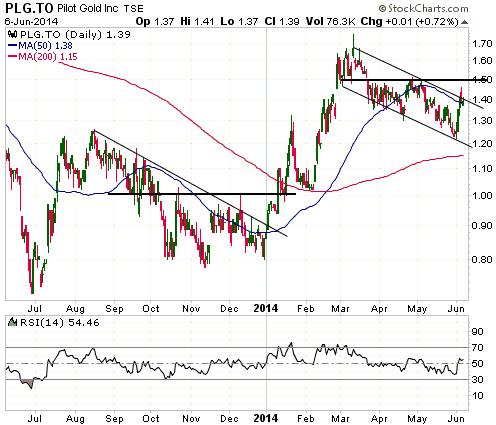
Although the depressed market for gold-mining stocks has thus far
prevented PLG's stock price from responding vigorously to the
Kinsley Mountain exploration success, the stock appears to be close
to ending a correction that looks similar to the multi-month
correction that occurred during the second half of last year.
*Pretium Resources (PVG) reported the results of the first hole
from a 3-hole surface drilling program in the Valley of the Kings
deposit at the Brucejack project. The main purpose of the drilling
is to test for gold mineralization at depth. To our non-geologist
eyes, the results of the first hole were not significant.
The next important market-moving event for PVG is expected to be the
publishing of the amended Brucejack FS, which is scheduled to happen
later this month.
List
of candidates for new buying
From within the ranks of TSI stock selections, the best candidates for new
buying at this time are:
1) EDV.TO (last Friday's closing price: C$0.75).
2) EVN.AX (last Friday's closing price: A$0.79).
3) PLG.TO (last Friday's closing price: C$1.39).
4) TGM.V (last Friday's closing price: C$0.38).
Chart Sources
Charts appearing in today's commentary
are courtesy of:
http://stockcharts.com/index.html

|









