|
-- Weekly Market Update for the Week Commencing 9th July 2012
Big Picture
View
Here is a summary of our big picture
view of the markets. Note that our short-term views may differ from our
big picture view.
In nominal dollar terms, the BULL market in US Treasury Bonds
that began in the early 1980s will end by 2013. In real (gold)
terms, bonds commenced a secular BEAR market in 2001 that will continue
until 2014-2020. (Last
update: 23 January 2012)
The stock market, as represented by the S&P500 Index, commenced
a secular BEAR market during the first quarter of 2000, where "secular
bear market" is defined as a long-term downward trend in valuations
(P/E ratios, etc.) and gold-denominated prices. This secular trend will bottom sometime between 2014 and 2020. (Last update: 22 October 2007)
A secular BEAR market in the Dollar
began during the final quarter of 2000 and ended in July of 2008. This
secular bear market will be followed by a multi-year period of range
trading. (Last
update: 09 February 2009)
Gold commenced a
secular bull market relative to all fiat currencies, the CRB Index,
bonds and most stock market indices during 1999-2001. This secular trend will peak sometime between 2014 and 2020. (Last update: 22 October 2007)
Commodities,
as represented by the Continuous Commodity Index (CCI), commenced a
secular BULL market in 2001 in nominal dollar terms. The first major
upward leg in this bull market ended during the first half of 2008, but
a long-term peak won't occur until 2014-2020. In real (gold) terms,
commodities commenced a secular BEAR market in 2001 that will continue
until 2014-2020. (Last
update: 09 February 2009)
Copyright
Reminder
The commentaries that appear at TSI
may not be distributed, in full or in part, without our written permission.
In particular, please note that the posting of extracts from TSI commentaries
at other web sites or providing links to TSI commentaries at other web
sites (for example, at discussion boards) without our written permission
is prohibited.
We reserve the right to immediately
terminate the subscription of any TSI subscriber who distributes the TSI
commentaries without our written permission.
Outlook Summary
Market
|
Short-Term
(1-3 month)
|
Intermediate-Term
(6-12 month)
|
Long-Term
(2-5 Year)
|
| Gold
|
Bullish
(26-Mar-12)
|
Bullish
(26-Mar-12)
|
Bullish
|
| US$ (Dollar Index)
|
Neutral
(28-May-12)
| Neutral
(09-Jan-12)
|
Neutral
(19-Sep-07)
|
| Bonds (US T-Bond)
|
Bearish
(02-Jul-12)
|
Neutral
(18-Jan-12)
|
Bearish
|
| Stock Market
(DJW)
|
Neutral
(25-Apr-12)
|
Bearish
(28-Nov-11)
|
Bearish
|
| Gold Stocks
(HUI)
|
Bullish
(26-Mar-12)
|
Bullish
(23-Jun-10)
|
Bullish
|
| Oil | Bullish
(02-Jul-12)
| Neutral
(31-Jan-11)
| Bullish
|
| Industrial Metals
(GYX)
| Bullish
(02-Jul-12)
| Neutral
(29-Aug-11)
| Neutral
(11-Jan-10)
|
Notes:
1. In those cases where we have been able to identify the commentary in
which the most recent outlook change occurred we've put the date of the
commentary below the current outlook.
2. "Neutral", in the above table, means that we either don't have a
firm opinion or that we think risk and reward are roughly in balance with respect to the timeframe in question.
3. Long-term views are determined almost completely by fundamentals,
intermediate-term views by giving an approximately equal weighting to
fundamental and technical factors, and short-term views almost
completely by technicals.
The cons and cons of debt
monetisation
Although it probably won't happen within the next couple of months, it's a good bet that the ECB will eventually be prodded into monetising a large amount of European government and commercial bank debt. It is therefore appropriate for us to discuss the pros and cons of such a development, but since we can't think of any pros* we'll have to focus on the cons.
A critical point to understand is that monetary inflation carried out by the central bank is a problem for the same reason that private counterfeiting is a problem. It results in an exchange of nothing for something and is therefore a form of theft. Nobody would argue that a private counterfeiter was providing a valuable service to the economy if he printed-up money to buy the bonds of financially-stressed governments, so why do many people believe that the central bank can do some good when it buys bonds with money conjured out of nothing?
Even believing that under certain conditions the central bank does no harm (rather than does some good) when it creates new money requires disabling the part of the brain devoted to logic and common sense. Of course it does harm! Adding to the supply of money cannot possibly add to the total wealth in the economy, and yet some people get richer as a result of the monetary injection. If some people get richer while the total wealth is not increased, then other people must be made poorer and what we are dealing with is a
forced transfer of wealth.
We now get to the essence of what central bank debt monetisation is: a means of transferring wealth from some people to other people. In the specific case of the ECB using new euros to buy-up the bonds of insolvent governments and banks, it would be a transfer of wealth to the investors in these bonds from everyone with euro-denominated savings. In effect, the costs of making a bad investment in bonds would be shifted from those who made the ill-conceived investment decision to those who had nothing to do with the decision. Furthermore, the shifting of costs would be done surreptitiously. If all euro savers were sent a bill for their share of the wealth transfer there would be an uprising, but when the transfer is done via monetary inflation not even one person in one hundred will be able to figure out why he/she has become poorer.
The costs to euro savers are hidden from view because rather than there being an immediate transfer of money there is a gradual transfer of purchasing power. Bondholders and banks
see an immediate boost in purchasing power because they are the first receivers of the new money, but savers see a gradual decrease in purchasing power as the new money works its way through the economy. It should also be understood that the price-related effects of the new money will be lumpy, in that some prices will be affected more than other prices. This leads to mal-investment and means that the debt monetisation not only brings about an unethical transfer of wealth, it also brings about a reduction in the overall pool of wealth.
All of which prompts the question: Why do it? Why would a central bank monetise debt when doing so helps a small number of speculators at the expense of a large number of savers and brings about a reduction in the total amount of wealth?
It clearly has nothing to do with protecting bank depositors, because the depositors at a bank don't lose anything when the bank's shareholders are wiped out and bondholders take large losses. It is done, we think, due to ignorance and a willingness to engage in unjust practices for political or financial gain.
Ignorance plays a part in the following ways:
1. Most people don't understand the link between monetary inflation and the eventual decline in their standard of living.
2. The top people at a central bank will necessarily be bad economists because a good economist would never want the job or would never be considered eligible for the job. For example, Ben Bernanke would not currently be the head of the Fed if not for his strong belief that creating money out of nothing can benefit the economy.
3. Almost all politicians are clueless about economics.
A willingness to do whatever it takes to achieve political or financial gain plays a part in the following ways:
1. The ability to create money out of nothing provides politicians with far greater scope to buy votes than would exist if their promises had to be funded by direct taxation.
2. Monetary inflation often creates the false impression of a more vibrant economy in the short-term, thus helping to boost the re-election chances of the incumbents.
3. The people who benefit the most from monetary inflation often exert a disproportionately large amount of influence over the central bank and the government.
4. Due to the promises made by politicians in the past, a lot of voters now have a vested interest in continuing the inflation because it is only via the wealth transfer brought about by monetary inflation that these people will ever receive their so-called entitlements.
Due to the combination of ignorance and vested interests outlined above, there will be a lot more monetary inflation in the future despite it being both unethical and economically debilitating. The question is when, not if.
Rocketing Grain Prices
An interesting article posted HERE
discusses the hot and dry conditions that have affected US crops and caused grain prices to rise steeply. As the article notes, the percentage of the corn crop rated "good to excellent" is now only 19% in Indiana and 26% in Illinois.
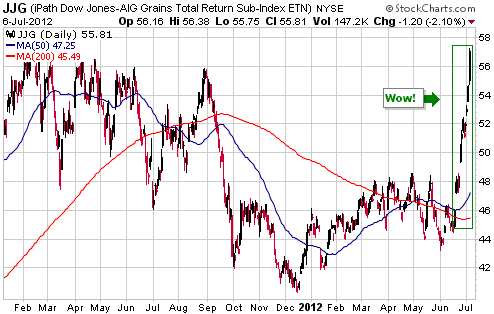
After an investment or commodity has experienced a large near-vertical price rise it is time to either sit tight or sell. It is not time to buy. We wish we had suggested buying grain futures or JJG shares 2-4 weeks ago, but we didn't. Our crystal ball didn't reveal the very unfavourable weather conditions (unfavourable for grain supply, favourable for grain prices) in timely fashion.
In addition to going into some detail about the weather patterns that are currently causing problems for US farmers, the article also makes the following "Austrian-like" observations about speculation in farmland:
"Farming has become more a function of investment types, who have driven up farmland prices as bond substitutes. According to Iowa State the mix of buyers in recent years has been 26% investors and funds, and 74% traditional farmers. The caveat is that "traditional" farmers have become large corporate types.
Clearly a farmer with a windfall crop profit might be inclined to buy farm land as opposed to parking in a sub-1% bank deposit. Accordingly, the traditional farmers have used the solid profits of the last few years to pay up for more land, as opposed to investing into farming operations and equipment. US farm capital expenditures have been modest, even as land speculation has not. This is just one more example of the effects of extreme low interest rate environments and bailout economics: encouraging participants to "put money to work" and ignore
risks...".
In other words, the increase in farmland speculation versus productive capital investment in farming is yet another example of the mal-investment wrought by the central bank's monetary inflation and manipulation of interest rates.
China's Empty Cities
Click HERE to see a slide show containing 28 pictures of China's empty (or near-empty) cities and housing developments:
The wastage of scarce resources in China is breathtaking.
The Stock
Market
Here's a daily chart of the Dow Jones World Index
(DJW):
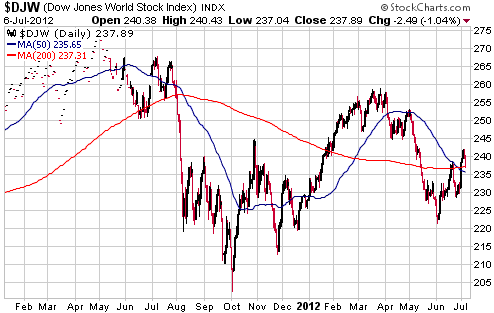
Here's our interpretation of the DJW chart:
First, while there are other plausible scenarios, the overarching view that makes the most sense to us is that a cyclical bear market commenced in May of last year. This view is consistent with the DJW's chart and is backed up by other evidence. Included in this other evidence are the downward reversals in manufacturing indices and industrial commodities during the first half of last year and the upward reversal in the Dollar Index at the same time.
Second, the initial downward leg in the equity bear market ended in October of last year, at which time an intermediate-term counter-trend rebound (a bear market rally) got underway.
Third, the rally ended and the bear market's second downward leg commenced in March.
Fourth, the first short-term decline of the second downward leg ended on 1st June, making way for a short-term counter-trend rebound. This rebound could end at any time and should end below the March high, after which a decline to new lows for the year will get underway.
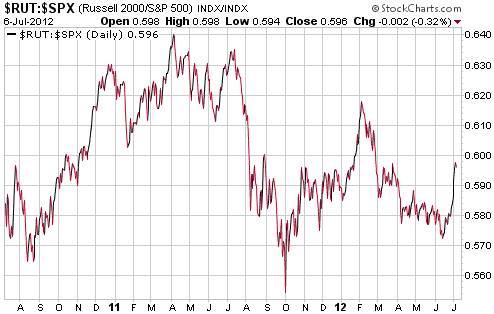
As noted above, the counter-trend rebound that began in early June could end at any time. However, there will hopefully be some bearish divergences to warn us of an upcoming reversal just prior to the rebound's end. A new multi-week high in the S&P500 Index (SPX) that isn't confirmed by a new multi-week high in the RUT/SPX ratio is the sort of divergence we are talking about.
As evidenced by the following chart, the RUT/SPX ratio has moved sharply higher over the past couple of weeks. This indicates strength in small-cap stocks relative to large-cap stocks and suggests that the recent short-term stock market rebound is intact. The chart also shows longer-term relative weakness in the small-cap stocks, which we consider to be another piece of evidence in support of the cyclical bear market hypothesis.
Just to be clear, a pullback in the S&P500 that was accompanied by a pullback in the RUT/SPX ratio wouldn't tell us anything. Given that both the SPX and the RUT/SPX ratio had become 'overbought' on a short-term basis by last Thursday it wouldn't be at all surprising if both weakened over the days ahead. What would tell us something is strength in the SPX accompanied by weakness in the RUT/SPX ratio.
The latest US monthly employment data were reported last Friday. The jobs-growth number was low and added another layer of support to the recession case, but the market's expectations were already depressed due to the weak jobs growth reported over the preceding two months and the mountain of other evidence pointing to a slowing or contracting economy. The latest employment report was therefore taken in stride. It was weak, but not shockingly so and did nothing to change the odds of more QE in the near future. The probability of more QE in the next two months remains miniscule, whereas the probability of more QE within the next 12 months remains high.
This week's
important US economic events
| Date |
Description |
| Monday Jul 09 | Consumer
Credit
| | Tuesday Jul 10 | No
important events scheduled
| | Wednesday Jul 11 | International
Trade Balance
FOMC Minutes | | Thursday
Jul 12 |
Import and Export Prices
Treasury Budget
|
| Friday Jul 13 | PPI
Consumer Sentiment
|
Gold and
the Dollar
Gold
Gold was down $32 over the final two days of last week. For those of us who've been closely monitoring the gold bull market from its inception, a $32 move can still feel significant even though it isn't. At the birth of the TSI web site about 12 years ago $32 was equivalent to 12%, but now it's equivalent to only 2%. A 2% move in a commodity is neither here nor there, especially in a case such as this when it occurs within the bounds of a short-term trading range.
As we noted in the latest Interim Update, fluctuations in the US$ gold price between the $1550s and the $1630s are just noise. However, the eventual breakout from this range will be interesting and potentially significant, regardless of whether it is to the upside or the downside. Based on the extent to which gold became 'oversold' during May, when a breakout occurs it will more likely be to the upside.
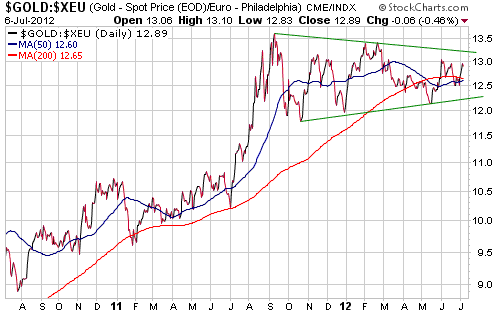
Considering that the euro's sharp decline was the talk of the financial world late last week, this is a good time to check on how gold is doing in euro terms. The following daily chart shows that not much has changed, in that gold/euro is still within the contracting range that began to develop last September.
Since the start of the current intermediate-term correction it has been likely that gold would break out to the upside and resume its long-term advance in euro terms before it did so in US$ terms. A breakout in euro terms could occur as soon as this month and in our opinion will almost certainly occur before the end of this year.
Gold Stocks
Current Market Situation
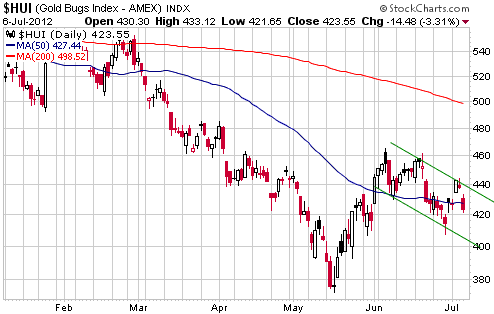
The HUI's price action since its early June high continues to have the hallmarks of a short-term consolidation within an upward trend. As a result of last week's price action, a daily close above 445 would signal that the consolidation had ended.
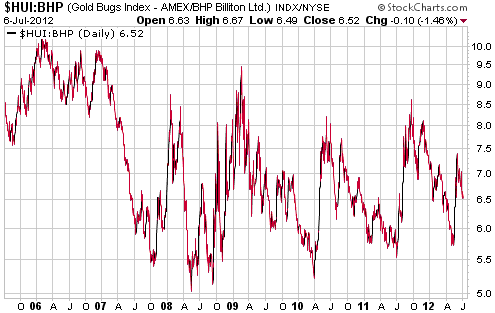
As the world's largest diversified mining company, BHP Billiton (BHP) can be used as a proxy for the mining sector of the stock market. The HUI/BHP ratio therefore reflects the performance of gold mining stocks relative to the performance of the overall mining sector. This ratio should rise during periods when the financial world is widely perceived to be getting riskier and fall during periods when most people are becoming less worried about risk, which is pretty much what it has done over the past several years.
The large swings on the following chart of the HUI/BHP ratio can be understood in terms of changes in the general perception of risk. In particular, there were surges in HUI/BHP due to increasing concern about risk during Oct2007-Jan2008 (the first phase of the global financial crisis), Sep2008-March2009 (the Lehman collapse and the crescendo of the global financial crisis), Apr-May of 2010 (the first phase of the EZ government debt crisis), and Jul-Sep of 2011 (the second phase of the EZ government debt crisis).
Up until now all the crises have been associated with debt default, deleveraging and fear of deflation, but future crises won't necessarily follow the same pattern. The next big financial crisis could, for example, be linked to rising fear of "inflation". An inflation-centred crisis would likely bring about a much greater upswing in the HUI/BHP ratio than we've seen to date.
The Barkerville question: Incredible resource, honest mistake, or fraud?
We have no financial interest in Barkerville Gold Mines (TSXV: BGM) and no intention of buying or shorting the stock. We had never even heard of it until early last week when a TSI subscriber drew our attention to the unbelievably good resource estimate
reported by the
company. Unbelievably good, in this instance, meaning: so good it's hard to believe it's true (the resource estimate went from about 500K ounces at an average grade of 2.2-g/t to 10.6M ounces at an average grade of 5.5-g/t).
Some smart geological types, including Brent Cook, have since expressed doubts about the accuracy of the resource estimate. According to Cook in an
interview with Northern Miner:
"It can't go from half a million oz. at half the grade to 10 million oz. at twice the grade, you can't do that, it doesn't happen in reality."
Although we don't have any direct financial stake in the outcome, we hope that the Barkerville resource estimate proves to be either correct or an honest mistake. For two reasons, we hope it is not a case of fraud. The first reason is that a fraud of this magnitude would further depress sentiment at the junior end of the mining sector. The second reason is that a high-profile fraud would prompt government regulators to become more active, which would be a longer-term problem because to make up for their inability to prevent actual wrongdoing the regulators would make life more difficult and costly for companies that are operating in good faith. We've already had one of our junior mining stocks (CFO.V) adversely affected by over-zealous regulators.
Currency Market Update
The ECB cut its targeted short-term interest rate last Thursday from 1.00% to 0.75%. This move was widely anticipated, so why did the euro tank on the same day? The answer, we think, is that the ECB didn't announce any other plans to promote inflation. In fact, the ECB has just tightened the monetary reins by capping at current levels the amount of government-guaranteed debt that banks can post as collateral in return for its loans.
As we've noted in earlier commentaries, in the current environment the currency market views a more inflationary stance by the ECB as a short-term plus for the euro. In other words, although policies that increase the supply of euros should, if anything, put downward pressure on the euro's exchange rate, under the current set of circumstances they temporarily do the opposite. This is probably because a higher euro inflation rate reduces the demand for safe havens and the perceived risk of euro-zone disintegration.
The euro ended last week at a new 12-month low, having plunged over the final two days of the week. We had guessed that the euro's recent rebound would extend to the high-120s, which means that the quick plunge to a new low took us by surprise.
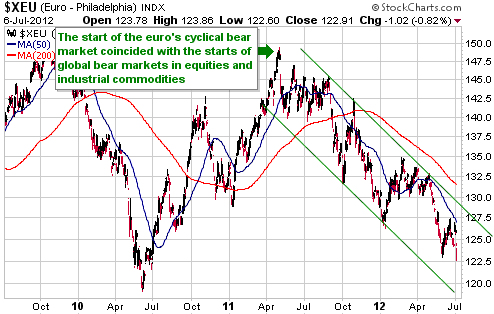
In last week's Interim Update we said that a drop by the euro to around 120 would likely create a good opportunity to take a speculative long position in either the euro or the Swiss Franc. At the time we were thinking that if a drop to 120 were going to happen then it would do so during August-November, but the market action last Thursday-Friday means that it could happen within the next few weeks.
Could happen, not will happen. There's no way of knowing, and as usual a lot of what happens in the currency market will depend on the performance of the stock market.
Our current plan is to do nothing until/unless the euro drops to 120, at which point we would start scaling into a long Swiss Franc position. This means that we will take no action if the euro reverses upward without making significant additional progress to the downside.
Update
on Stock Selections
Notes: 1) To review the complete list of current TSI stock selections, logon at
http://www.speculative-investor.com/new/market_logon.asp
and then click on "Stock Selections" in the menu. When at the Stock
Selections page, click on a stock's symbol to bring-up an archive of
our comments on the stock in question. 2) The Small Stock Watch List is
located at http://www.speculative-investor.com/new/smallstockwatch.html
 Things are definitely slow at the moment, at least as far as the TSI stock selections are concerned. There have recently been no price-related developments of significance and no news of significance, which leaves us with nothing new to say. There are a couple of potential additions to the List that we are watching closely for better entry points, but we would really like to remove some old stocks before adding new ones. This creates a challenge, because as we noted in a previous commentary in the current market environment there are a lot more buying opportunities than selling opportunities. Things are definitely slow at the moment, at least as far as the TSI stock selections are concerned. There have recently been no price-related developments of significance and no news of significance, which leaves us with nothing new to say. There are a couple of potential additions to the List that we are watching closely for better entry points, but we would really like to remove some old stocks before adding new ones. This creates a challenge, because as we noted in a previous commentary in the current market environment there are a lot more buying opportunities than selling opportunities.
As a group, the small-scale juniors aren't going to do much until the larger and more liquid stocks have established clear-cut upward trends. This means that positions in GDX and GDXJ are likely to out-perform our group of stocks over the next few months. However, a few small-scale juniors
will do very well due to company-specific developments. Unfortunately, nobody knows which ones.
For those who don't have much exposure to junior gold mining stocks, here is a shortlist (in alphabetical order) of the best buys at current prices:
Juniors with current gold (or silver) production: Dragon Mining (ASX: DRA), Elgin Mining (TSX: ELG), Endeavour Mining (TSX: EDV, ASX: EDR), Evolution Mining (ASX: EVN), Golden Star Resources (NYSE: GSS), and Ramelius Resources (ASX: RMS).
Exploration-stage juniors: Keegan Resources (NYSE: KGN), Prodigy Gold (TSX: PDG), Sabina Gold and Silver (TSX: SBB), and Volta Resources
(TSX: VTR).
Chart Sources
Charts appearing in today's commentary
are courtesy of:
http://stockcharts.com/index.html

|









