|
-- Weekly Market Update for the Week Commencing 9th November 2009
Big Picture
View
Here is a summary of our big picture
view of the markets. Note that our short-term views may differ from our
big picture view.
In nominal dollar terms, the BULL market in US Treasury Bonds
that began in the early 1980s will end by mid-2010. In real (gold)
terms, bonds commenced a secular BEAR market in 2001 that will continue
until 2014-2020. (Last
update: 09 February 2009)
The stock market, as represented by the S&P500 Index, commenced
a secular BEAR market during the first quarter of 2000, where "secular
bear market" is defined as a long-term downward trend in valuations
(P/E ratios, etc.) and gold-denominated prices. This secular trend will bottom sometime between 2014 and 2020. (Last update: 22 October 2007)
A secular BEAR market in the Dollar
began during the final quarter of 2000 and ended in July of 2008. This
secular bear market will be followed by a multi-year period of range
trading. (Last
update: 09 February 2009)
Gold commenced a
secular bull market relative to all fiat currencies, the CRB Index,
bonds and most stock market indices during 1999-2001. This secular trend will peak sometime between 2014 and 2020. (Last update: 22 October 2007)
Commodities,
as represented by the Continuous Commodity Index (CCI), commenced a
secular BULL market in 2001 in nominal dollar terms. The first major
upward leg in this bull market ended during the first half of 2008, but
a long-term peak won't occur until 2014-2020. In real (gold) terms,
commodities commenced a secular BEAR market in 2001 that will continue
until 2014-2020. (Last
update: 09 February 2009)
Copyright
Reminder
The commentaries that appear at TSI
may not be distributed, in full or in part, without our written permission.
In particular, please note that the posting of extracts from TSI commentaries
at other web sites or providing links to TSI commentaries at other web
sites (for example, at discussion boards) without our written permission
is prohibited.
We reserve the right to immediately
terminate the subscription of any TSI subscriber who distributes the TSI
commentaries without our written permission.
Outlook Summary
Market
|
Short-Term
(0-3 month)
|
Intermediate-Term
(3-12 month)
|
Long-Term
(1-5 Year)
|
Gold
|
Bullish
(02-Sep-09)
|
Bullish
(12-May-08)
|
Bullish
|
US$ (Dollar Index)
|
Neutral
(28-Sep-09)
| Bullish
(02-Nov-09)
|
Neutral
(19-Sep-07)
|
Bonds (US T-Bond)
|
Neutral
(28-Sep-09)
|
Neutral
(09-Sep-09)
|
Bearish
|
Stock Market (S&P500)
|
Bearish
(21-Sep-09)
|
Bearish
(11-May-09)
|
Bearish
|
Gold Stocks (HUI)
|
Neutral
(09-Nov-09)
|
Neutral
(16-Sep-09)
|
Bullish
|
| Oil | Neutral
(28-Oct-09)
| Neutral
(14-Oct-09)
| Bullish
|
Industrial Metals (GYX)
| Bearish
(21-Sep-09)
| Bearish
(25-May-09)
| Bullish
|
Notes:
1. In those cases where we have been able to identify the commentary in
which the most recent outlook change occurred we've put the date of the
commentary below the current outlook.
2. "Neutral", in the above table, means that we either don't have a
firm opinion or that we think risk and reward are roughly in balance with respect to the timeframe in question.
3. Long-term views are determined almost completely by fundamentals,
intermediate-term views by giving an approximately equal weighting to
fundmental and technical factors, and short-term views almost
completely by technicals.
Why changes in gold production don't matter
Introduction
Most analyses of the gold market consider the annual change in the
amount of gold produced by the mining industry to be an important
determinant of the gold price, with bulls regularly supporting their
case by citing the mining industry's inability to ramp up production
and bears sometimes claiming that increasing mine production will
eventually weigh the gold price down. Our contention, however, is that
the annual supply of newly-mined gold is so small relative to the
existing aboveground supply that changes in mine production should be
ignored when assessing gold's prospects.
We warn you that the following discussion is quite lengthy (by our
standards), but we wanted to cover most aspects of this important topic
-- important, that is, for anyone who genuinely wants to understand the
gold market -- in one hit. Also, please note that in an effort to
address the widespread misconceptions about what does and doesn't
contribute meaningfully to gold supply and demand, we are going to
publish this discussion as a standalone article at a number of web
sites later this week.
The aboveground gold supply (and why it makes sense to analyse gold as if it were a currency)
The gold that gets produced each year doesn't get consumed; rather, it
gets added to the existing aboveground stock. This means that the
entire aboveground stock represents potential gold supply. In this
respect, gold is more like a currency than a commodity.
Now, we realise that not all the gold that was ever mined is currently
in a readily saleable form, but a substantial chunk of it is. To be
more specific, it has been roughly estimated that around 150,000 tonnes
of gold have been mined throughout history, about two-thirds of which
has been mined since 1945. Of this 150,000 tonnes, we estimate that
around 108,000 tonnes* are held for monetary/investment purposes.
Monetary/investment (MI) gold includes official gold holdings (the gold
kept by central banks and the IMF), privately-held bars and coins, the
gold held by ETFs and closed-end funds, and monetary jewellery
(24-carat jewellery that is held solely as an investment or a store of
value). This 108,000-tonne figure is, in our opinion, a rough but
reasonable estimate of the MINIMUM amount of gold in readily saleable
form, and clearly dwarfs the 2,400 tonnes of gold produced by the
mining industry over the past year.
Analysing the gold market as if new mine supply dominated the supply
side of the equation would be like analysing the dollar market as if
the only dollars that really mattered were the new dollars that came
into existence over the past year. The fact is that a new dollar
created today will become an indistinguishable part of a total supply
that includes every dollar created, but not yet extinguished/destroyed,
up until today, and it is this total supply, combined with the
associated demand for this total supply, that determines the dollar's
price. Moreover, it could be argued that the gold mined each year is
less important to gold's supply-demand balance than are the dollars
created each year, because new dollar supply typically constitutes a
much greater percentage of the existing stock than does newly-mined
gold supply. Specifically, whereas the total aboveground supply of
saleable gold increases by about 2% every year, the total supply of
dollars sometimes increases at a double-digit rate and rarely increases
by less than 5%.
Putting things into perspective
As discussed above, the total supply of gold in readily saleable form
is probably at least 108,000 tonnes, which stands in stark contrast to
the current annual mine supply of around 2,400 tonnes. This suggests
that changes in investment demand (changes in the demand for the total
aboveground stock) are more than 40-times more important to gold's
price trend than changes in mine supply. To put it another way, a 0.25%
(one quarter of one percent) change in investment demand is more
important than a 10% change in mine supply.
Data provided by the London Bullion Market Association (LBMA) lend
additional support to the argument that changes in annual mine supply
are tiny in relation to the overall market. The LBMA reports that an
average of around 20M ounces (650 tonnes) of physical gold changes
hands on the London gold market every day. This means that the
equivalent of more than one year's mine supply changes hands in the
space of only four average trading days on the London market. And
London is not the world's only market for gold bullion.
If changes in mine supply are irrelevant, then what is relevant?
Over periods of 2 years or less, gold's price trend is usually
determined by the combination of the US dollar's exchange value, credit
spreads, nominal interest rates, inflation expectations, and the yield
curve. However, the long-term is the focal point as far as this
discussion is concerned.
Our view is that long-term trends in the gold price are driven by
changes in the overall level of confidence in the monetary system and
the economy, as best indicated by the long-term trend of the broad
stock market (note: there is no reason why the stock market should be
an indicator of monetary confidence, except that since the 1930s
governments have generally implemented policies that debase the
currency and create uncertainty whenever the economy weakens). We point
out, for example, that the equity bear market of 1966-1982 coincided
with a bull market in gold and gold-related investments (gold stocks);
that the equity bull market of 1982-2000 coincided with a bear market
in gold and gold-related investments; and that the equity bear market
that began in 2000 has, to date, coincided with a bull market in gold
and gold-related investments. Correlation doesn't imply causation, but
it makes sense that the world's favourite repository of savings over
the ultra-long-term would tend to trend inversely to the more
speculative investments.
An implication of the above is that almost regardless of anything else,
gold's current bull market will continue until the current equity bear
market reaches its conclusion, which, based on historical evidence,
won't happen until after the average P/E ratio has dropped to single
digits and the average dividend yield has moved above 5%.
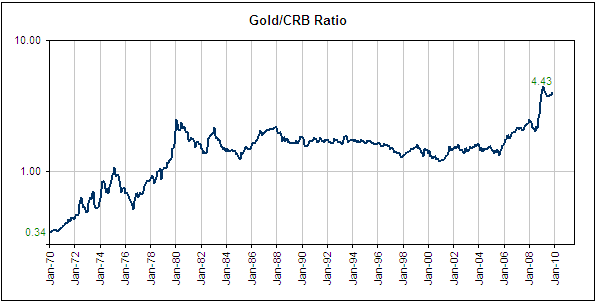
Wait a minute: most other commodities also rallied during the 1970s,
trended lower during 1980-2001, and trended upward during much of the
2000s. How, then, does gold's strong tendency to move counter to
long-term trends in the broad stock market differentiate it from any
other commodity? The answer is contained in the following monthly chart
of the gold/CRB ratio.
To see the true picture it is often helpful to remove the US$ (or any
other fiat currency) from the equation by monitoring the performance of
things in terms of gold (the Dow/gold ratio being a popular example) or
by monitoring gold's performance in terms of other things.
Specifically, to find out what gold REALLY did during any period we can
review how it performed in terms of commodities in general (as
represented by the CRB Index). The following chart makes the point that
the gold/CRB ratio has moved counter to long-term trends in the broad
stock market, meaning that gold has out-performed most other
commodities during long-term equity bear markets and under-performed
them during long-term equity bull markets.
Gold's performance
relative to other commodities during the 1930s is also worth
mentioning. Whereas most commodities and commodity-related equities did
poorly during the massive equity bear market of 1929-1938, gold and
gold stocks fared extremely well.
Other factors that affect, or are widely believed to affect, gold's price trend
Although our main purpose today is to deal with the ramifications (or
lack thereof) for the gold market of changes in gold production, we
will take this opportunity to also quickly deal with the effects of
central bank gold sales and changes in jewellery demand. In particular,
we want to quickly explain why the latter are irrelevant and why the
former have some significance, but nowhere near as much as commonly
believed.
The effects of central bank (CB) gold sales
In point form, here is a summary of the central-banking community's
influence on the gold market. Note that we place the gold held by the
IMF and the gold held by government treasury departments (in the US it
is the Treasury, not the Fed, that owns the gold reserve) under the
'central-banking umbrella'.
1. CBs hold about 30% of the MI gold stock, so they have the ability to
exert influence over gold's short- and intermediate-term price trends.
However, their actual sales over the past 20 years have been too small
to matter. Specifically, the World Gold Council (WGC) reports that CBs
reduced their collective gold reserve at the rate of around
250-tonnes/year during the 1990s and 400-tonnes/year during the first 8
years of the current decade. (By the way, this means that CBs reduced
their gold holdings at a faster rate during the current bull market
than during the final decade of the preceding bear market, which is
consistent with our view that their sales have not been a significant
influence on the price trend.)
2. News relating to CB gold sales often has a short-term effect, but
does not appear to have altered intermediate-term trends and cannot, in
our opinion, alter long-term trends.
3. CB gold sales represent reduced demand by some holders of the MI
stock, but these sales could actually cause an increase in overall MI
demand. This is because confidence in a fiat currency could fall if the
gold reserves 'backing' that currency were reduced, especially during a
period when confidence was already in a fragile state for other
reasons. Something along these lines occurred during the second half of
the 1970s, when gold sales by the Fed (on behalf of the US Treasury)
and the IMF were quickly followed by increases in the gold price.
4. CB monetary machinations (manipulations of interest rates, money
supply, and pretty much everything else to do with money and credit)
are probably of far greater importance to gold's long-term price trend
than the gold sales/purchases they happen to make from time to time.
The effects of changes in jewellery demand
Many gold market analysts attribute great importance to changes in
jewellery demand. For example, we occasionally read analyses where it
is stated that jewellery demand is something like 60% of total gold
demand, but what they really mean is that jewellery demand is 60% of
the flow of new gold (primarily mine supply, but also including scrap
supply). In other words, such analyses completely ignore the huge
aboveground supply of gold and the associated demand for the
aboveground supply.
The fact is that changes in annual jewellery demand are even less
significant than changes in mine supply, and should therefore be
ignored when assessing gold's prospects.
Anticipating some objections
1. An argument we've come across is that at any given time there may be
few, or perhaps even no, sellers of the existing aboveground gold
supply, resulting in the market being dominated by the regular selling
of gold miners (gold miners continually sell at whatever the market
price happens to be at the time the gold is removed from the ground).
Well, we know from the LBMA statistics that the selling of gold miners
is small compared to the amount of physical gold that routinely trades
via only the London market. However, even if all current owners of gold
decided to 'sit' on their investment in anticipation of higher prices
the selling by the gold mining industry wouldn't have an outsized, or
even a meaningful, effect on gold's price trend. The reason can best be
explained by considering the hypothetical example of Bill and Fred, two
shareholders of XYZ Corporation. Bill owns 70% of the outstanding XYZ
shares and Fred owns 1% of the outstanding shares. In our example, Fred
decides to sell his 1% stake immediately while Bill plans to wait for a
much higher price before parting with any of his shares. Even though
Fred is the one selling in the present, Bill's decision to hold his
shares off the market is vastly more important, as far as the market's
price discovery is concerned, than Fred's decision to immediately sell.
The reason, of course, is that Bill controls 70-times more shares than
Fred. Robert Blumen's article at http://mises.org/story/3593 goes more deeply into this concept.
2. It could be argued that industrial metals such as copper also have
huge aboveground supplies if we account for the metal 'stored' in
buildings and other structures. The difference is that this metal is
not in saleable form. For example, almost regardless of the copper
price it will never be economically feasible to tear down functional
office and apartment buildings for the sole purpose of extracting the
contained copper, meaning that the copper wiring and plumbing built
into these structures should not be counted as part of the aboveground
supply.
Gold is the only commodity where the "stocks-to-flow" or
"stocks-to-use" ratio is so large that the "flow" component can be
ignored. This point was touched on in an article posted by Steve
Matthews, a hedge fund commodity strategist, at http://www.lbma.org.uk/docs/alchemist/alch32_commodity.pdf. Mr. Matthews concludes: "It's
fair to say that nothing else even comes close to gold's 7,019 days [of
remaining supply]. This leads us to a proposition that I'm sure some of
you have thought about before: the right way to trade gold is as a
foreign currency, not as a commodity. You would need someone else to
give you a trading recommendation; I abdicate my duty to declare myself
bullish or bearish flat price in the face of what I consider
overwhelming evidence that gold resides outside my supply/demand
analytical framework."
By the way, we think the 7,019 days of remaining supply (the number of
days of supply in aboveground storage, assuming that there is no
further production and that non-investment demand proceeds at the
current rate) mentioned by Mr. Matthews greatly understates the true
situation. Our assessment is that the days of remaining supply in the
gold market is at least 13,000 (about 35 years). In comparison, the
days of remaining supply in the copper market is typically in the 30-90
range.
3. There has been a loose inverse relationship between gold production
and gold's price trend over the past 40 years. To be more specific, the
following chart of world annual gold production shows a downturn during
the first half of the 1970s (a bullish period for gold), a steady
upward trend from the early-1980s through to around 2000 (a generally
bearish period for gold), and then a tapering off during the current
bull market. This has been interpreted as evidence that changes in mine
supply do, contrary to our analysis, have a material effect on the gold
market. However, such interpretations reveal the danger of blindly
assuming that correlation implies causation.
Given the size of the overall gold market it is not reasonable to
conclude that the production trends illustrated by the following chart
were important influences on gold's price trend over the period in
question. So how, then, do we explain the apparent negative correlation
between price and production that has arisen over the past 4 decades?
The most logical explanation is that there is, in fact, a cause-effect
relationship between mine supply and price, but that price is the cause
and mine supply is the effect (a higher price leads to higher
production, etc.). Due to the extremely long delay between cause and
effect, what we get is the appearance that falling production pushes
the price up and that rising production pushes it down; but what is
actually happening is that today's production levels are a response to
price changes that occurred at least a decade earlier.
The time delay is so long because it will generally take at least a few
years of higher gold-mining profit margins to stimulate an increase in
exploration activity, that will, after several more years, lead to an
increase in production; and it will generally take many years of low
gold-mining profit margins to prompt the gold mining industry to reduce
its production and exploration activity.
With regard to the past few decades, our assessment is that rising
costs combined with a fixed gold price during the 1960s probably
brought about the decline in gold production during the first half of
the 1970s, while the large increase in gold-mining profit margins
during the 1970s prompted increased exploration activity that
eventually led to more mines being constructed and higher production
during the 1980s.
With gold-mining profit margins generally remaining robust and with
many people remaining convinced that gold's next bull market was just
around the corner, the industry continued its expansion throughout the
1980s. It wasn't until the second half of the 1990s that the downward
drift in gold-mining profitability really began to take its toll,
causing exploration activity to all but cease. The result has been an
essentially flat production profile from the late 1990s through to the
present day, but note that the past 15 months' surge in the gold/CRB
ratio (a proxy for gold-mining profit margins) should lead to more
aggressive exploration, and, eventually, to higher gold production.
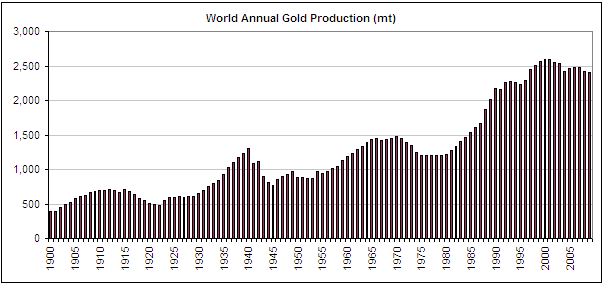
(Chart data from USGS for all years prior to 2006 and from the World Gold Council for 2006 onward)
Conclusion
Gold market analyses -- such as those put together by Gold Fields
Mineral Services (GFMS) -- that treat new mine production as if it
represented a substantial chunk of the total gold supply, and/or that
place great importance on factors such as jewellery demand and scrap
supply, are of no use to anyone whose goal is to understand what drives
the gold price. In fact, such analyses are worse than useless because
they create a false impression. The reality is that the contribution to
total gold supply made by newly-mined gold is so small that changes in
mine production should be considered irrelevant when assessing gold's
upside potential relative to its downside risk.
*The 108,000-tonne
figure is derived from the analysis presented by James Turk in his 1993
booklet "Do Central Banks Control the Gold Market". In this booklet Mr.
Turk estimated that the amount of monetary/investment (MI) gold was
72.7% of the total aboveground gold supply at the time (1993). To
arrive at the 108,000-tonne estimate for the current stock of MI gold,
we have assumed that the ratio of MI gold to total aboveground gold is
the same now as it was in 1993.
Oil Update
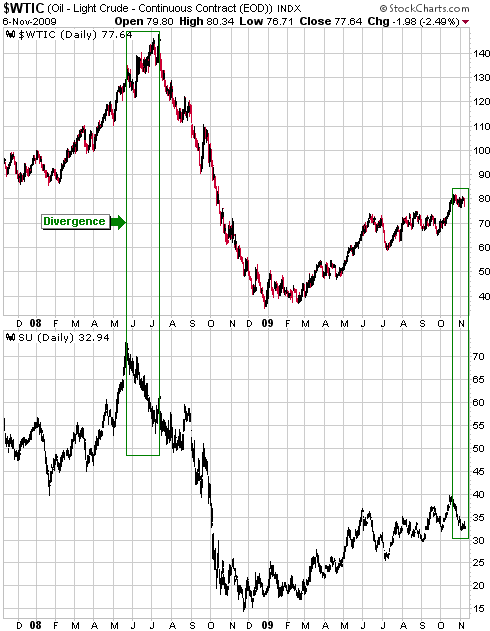
We
have been monitoring a chart that compares the oil price with the stock
price of Suncor Energy (SU). We do this because SU tends to reverse
higher or lower in advance of the oil market.
The following chart highlights the pronounced bearish divergence
between SU and oil that occurred during May-July of 2008 (oil continued
to trend upward while SU trended downward) and the minor divergence
that has occurred over the past few weeks (SU has been declining while
oil has been moving sideways).
If SU continues to trend downward, then even if the oil price rises to
a new high for the year it will be reasonable to assume that oil's
post-crash rebound is almost complete.
The Stock
Market
Our view is that the US stock
market has either reached an intermediate-term peak or is close to
doing so, but we doubt that a consistent downward trend will commence
in the near future. The main reason is the massive monetary support
that has been provided over the past 14 months. The pace of this
support is falling, but it will probably be sufficient to push the
start of a large price decline well into next year.
Due to the extreme difference in the monetary backdrop between now and
the early-1930s, we don't think it is reasonable to expect the stock
market to collapse the way it did in the aftermath of the 1929-1930
post-crash rebound.
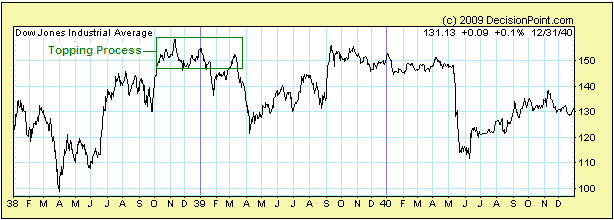
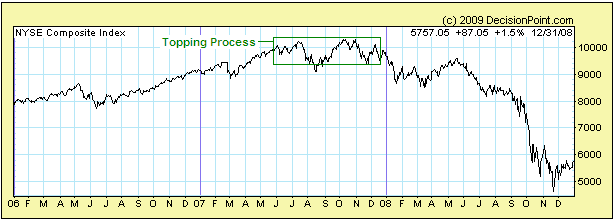
To give you an idea of what we expect over the next several months we
have included, below, a chart covering the performance of the Dow
Industrials Index during 1938-1940 and a chart covering the performance
of the NYSE Composite Index during 2006-2008. In both cases there was a
multi-month topping process involving multiple tests of the peak.
This week's
important US economic events
| Date |
Description |
Monday Nov 09
| No important events scheduled
| | Tuesday Nov 10 | No important events scheduled
| | Wednesday Nov 11
| No important events scheduled
| | Thursday Nov 12
| Treasury Budget
| | Friday Nov 13
| Trade Balance
Import and Export Prices
|
Gold and
the Dollar
Gold
Current Market Situation
The December gold futures contract ended last week at 'round number'
resistance ($1100) and at the top of its short-term price channel. As
such, there is a good chance that some sort of downward price
correction will soon commence. Our short-term outlook remains bullish,
however, due to the risk of an upside blow-off.
An upside blow-off is not the most likely short-term outcome, but it's
a possibility that should be taken seriously. It should be taken
seriously because we are into the final two months of the year and with
the exception of interest-bearing securities such as T-Bills, which
have almost no remaining upside potential, gold is the only
high-profile market that is at, or near, an all-time high. This puts
gold in the position where it could conceivably attract substantial
additional speculative demand between now and year-end as hedge funds
and other large speculators scramble to maximise their 2009 returns.
By way of further explanation, gold's current position could be likened
to the position of the NASDAQ100 Index (NDX) exactly 10 years ago. At
the end of the first week of November 1999, the NDX had just completed
a 3-week surge from 2300 to 2750. Based on most oscillators and other
momentum indicators it was very 'overbought' at the time and apparently
in need of a pullback; however, it continued to move upward with almost
no hesitation and ended the year at 3750. In other words, it ignored
most technical indicators and gained 40% over the final 7 weeks of the
year.
We are not forecasting something similar for the gold market, primarily
because we think gold's bull market has at least a few years to run
(upside blow-offs such as that experienced by the NDX during the final
quarter of 1999 and the first quarter of 2000 usually only occur at the
ENDS of long-term bull markets). What we are saying is that an upside
blow-off is a realistic possibility given the gold market's current
position.
With regard to downside risk, we suspect that $1000 has become the 'floor' under the gold market.
Gold relative to other currencies and other 'stuff'
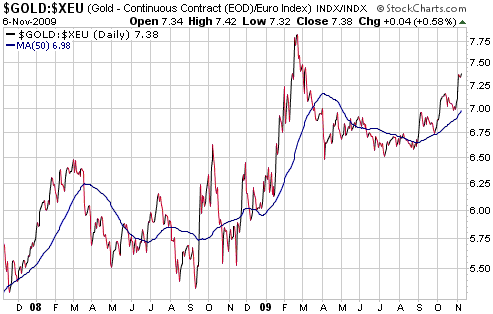
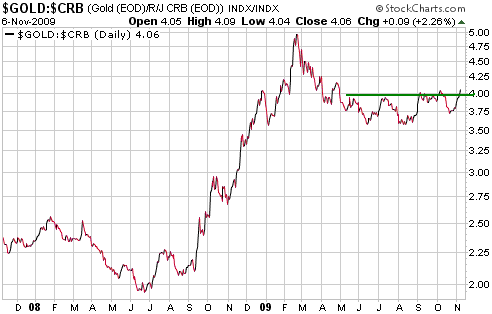
Up until about 6 weeks ago gold's short-term rally had a lot more to do
with US$ weakness than genuine gold strength, but gold has recently
begun to strengthen relative to almost everything. For example, the
first of the following charts shows that gold is now clearly in a
short-term upward trend in euro terms, while the second chart indicates
that gold is probably about to complete its consolidation -- and resume
its upward trend -- relative to the CRB Index.
By the way, if gold/CRB can build on its recent gains it will be a
bearish omen for the broad stock market as it will confirm that a shift
away from riskier investments has commenced.
Gold Stocks
We turned short-term bullish on the gold sector when the HUI dropped to
the low-380s during the week before last. We suspected that the HUI had
made an intermediate-term peak at 460 in mid October, but that even if
this were the case it would probably rebound to 'test' its peak before
resuming its decline. This meant that even under an intermediate-term
bearish scenario there was near-term upside potential of 15%-20%, and
probably not much downside risk.
The anticipated 15%-20% rebound has since occurred, but, unfortunately,
this doesn't make the next move easier to handicap. The reality is that
the short-term risk/reward is nowhere near as straightforward now as it
was 7 trading days ago. This is because we are now faced with three
plausible near-term scenarios, none of which stands out as being the
obvious choice.
The first scenario is that the HUI is now close to its rebound peak and
will soon begin the next phase of its intermediate-term correction. The
second is that the HUI will rise to a marginal new high for the year
within the coming three weeks and then embark on an intermediate-term
correction (which will, quite likely, involve an initial decline
followed by a rebound to test the peak). The recent bearish divergence
between gold stocks and gold bullion is consistent with either of these
scenarios. The third plausible scenario is that the HUI is about to be
pulled up to a much higher price level by an upside blow-off in the
bullion market.
Based on our belief that the third scenario has a lower probability
than either of the first two, we have downgraded our short-term HUI
outlook to "neutral". The reason we are downgrading our short-term HUI
outlook and not our short-term gold outlook is that we perceive more
downside risk in the major gold stocks than in the bullion.
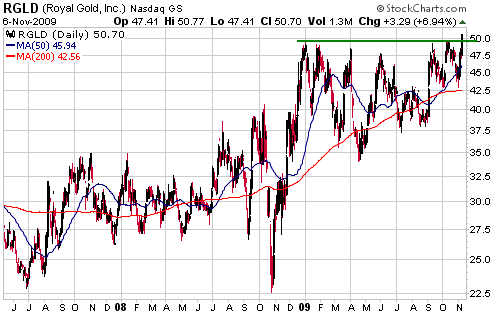
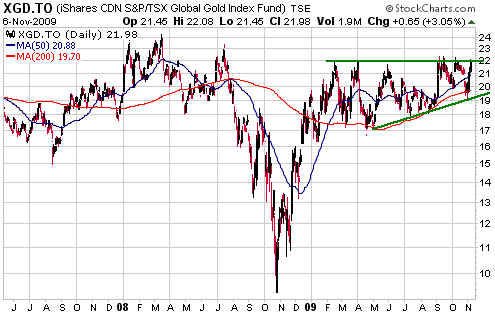
Below are charts of two items that we will be paying very close
attention to over the coming weeks. The first is Royal Gold (RGLD) and
the second is the iShares Global Gold Index Fund (XGD.TO). XGD is a
proxy for the performance of the gold sector in Canadian Dollar terms.
RGLD finally (!!!) broke above its January-2009 peak at the end of last
week. This is a bullish omen for the overall sector provided that the
breakout holds. From our perspective, the ideal would be for RGLD to
pull back to around $48 over the coming week or so and then move above
last Friday's high (or whatever new high is made early this week). This
would tell us that the breakout is sustainable.
XGD has been oscillating within a contracting range since February and
ended last week at the top of its range. A solid daily close above
C$22.00 would be an upside breakout and would create a measured
objective of C$27.
Currency Market Update
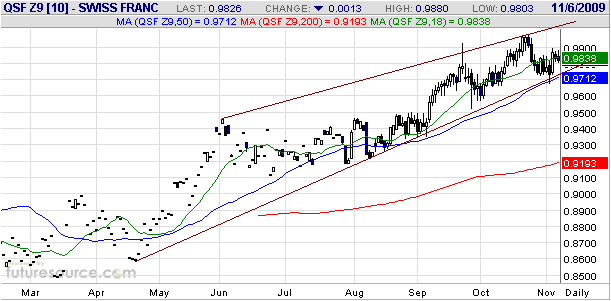
On the following daily chart of the December Swiss Franc futures we've
drawn an up-trend line dating back to April. This trend-line
constitutes psychological support (because a lot of traders draw
trend-lines on charts and react to tests/breaches of these lines) and
was successfully tested last week. A daily close below last week's low
would definitively break the psychological support line and signal that
a short-term, and quite likely an intermediate-term, top was in place.
The upside potential from here is probably limited to a test of the
October peak at around 1.00, although if things were to get a little
manic over the final weeks of the decade then the SF could possibly
rise as high as 1.10. We can't envisage it moving any higher than that,
because central banks generally don't want the currencies they 'manage'
to be inordinately strong and can therefore be relied upon to act
aggressively to curtail such strength should it materialise. In this
regard, the Swiss National Bank has made crystal-clear its intention to
intervene in the currency market -- by selling as many Francs as need
be -- should the Franc make significant additional headway.
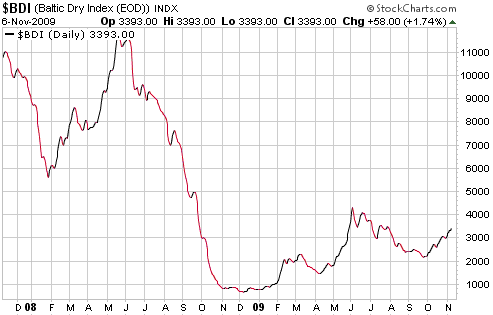
Over the years we've
used the Baltic Dry Index (BDI) as a currency market indicator on the
basis that its intermediate-term peaks and troughs tend to line up with
important turning points in the currency market. In particular, the BDI
tends to make an intermediate-term peak at around the same time as the
Dollar Index is making an intermediate-term bottom. We therefore
interpreted the BDI's June-September decline as evidence that the
Dollar Index was approaching a bottom.
The following chart shows that the BDI reversed course at the end of
September and has since been grinding upward. It is still comfortably
below its early-June peak, but its recent rebound has 'muddied the
waters'. If the Dollar Index really is bottoming then the BDI should
soon roll over into another decline.
Update
on Stock Selections
(Note: To review the complete list of current TSI stock selections, logon at http://www.speculative-investor.com/new/market_logon.asp
and then click on "Stock Selections" in the menu. When at the Stock
Selections page, click on a stock's symbol to bring-up an archive of our comments on the stock in question)
 Gryphon Gold (TSX: GGN). Shares: 62M issued, 76M fully diluted. Recent price: C$0.23 Gryphon Gold (TSX: GGN). Shares: 62M issued, 76M fully diluted. Recent price: C$0.23
In our 21st September update on GGN we wrote:
"The financing issue is,
we believe, about to be 'put to bed'. The company is in the process of
arranging a US$28M financing, which will probably be in the form of a
convertible note issue, and has scheduled a Special Meeting on 8th
October to enable shareholders to approve the resultant large increase
in the company's share count.
The financing will
probably result in GGN's fully-diluted share count rising to between
150M and 200M, so the stakes of current shareholders are going to be
substantially reduced. However, we think this is a positive
development."
And:
"There is still plenty of
risk, but if the financing issue can be resolved then the path to a
much higher GGN stock price will be clearer than it has been for a long
time, even after accounting for the dilution that the financing will
undoubtedly bring about."
As far as we know, there are no major problems and the financing
arrangements will be completed in the near future. However, we are a
little concerned that this issue has still not been 'put to bed' given
that the plan was to have the financing in place by the end of October.
We would hold off on any new buying of GGN until after the company
confirms that the financing is in place to construct its proposed new
gold mine.
Northgate Minerals (NXG) and New Gold (NGD)
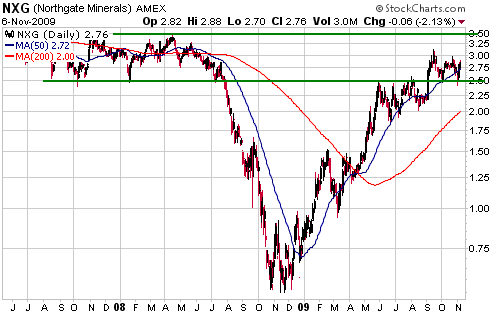
At its current price of US$2.76, Northgate Minerals (NXG) remains a
long way below our US$5.00/share valuation. Consequently, the stock
continues to offer substantial valuation-related upside potential.
Turning to NXG's chart (see below), there is strong support at around
US$2.50 and significant resistance at around US$3.50. We would
therefore look at a pullback to around $2.50 as a short-term buying
opportunity and would consider taking some money off the table as the
stock approached $3.50.
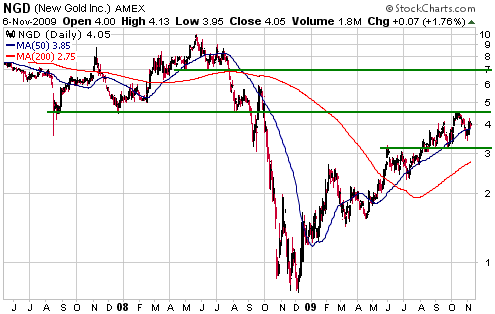
In our opinion, New
Gold (NGD) was close to being fully valued when it rose to around
US$4.50 last month. As evidenced by the following chart, US$4.50 also
coincides with an important resistance level.
The stock ended last week at $4.05, but this is not far enough below
full valuation to create a new buying opportunity for value-oriented
investors. A drop to the low-US$3 area would, we think, be required to
justify new/additional investment.
Due to their relative valuations we think it would make sense for
investors with large exposure to NGD and comparatively small exposure
to NXG to make a partial shift from NGD to NXG. We hasten to point out,
though, that NGD will probably have the more interesting short-term
news flow. In particular, we know of three market-moving NGD
developments that could occur over the next few months, chief among
them being a deal relating to NGD's 30% stake in the exploration-stage
El Morro copper/gold project (NGD is likely to sell this stake or swap
it for a gold-producing asset). The other potential developments are
deals to monetise the company's investments in Auction Rate Securities
(ARS) and the Amapari gold project. Our current valuation assumes that
the ARS and the Amapari project are worthless, so the successful sale
of either asset would be helpful.
For information
purposes we note that in our own accounts we recently sold half of our
NGD stake in the US$4.20-US$4.40 range. This brought our NGD exposure
down from 'large' to 'average'. At current stock prices, our exposure
to NXG is about 30% greater than our exposure to NGD.
Chart Sources
Charts appearing in today's commentary
are courtesy of:
http://stockcharts.com/index.html
http://www.futuresource.com/
http://www.decisionpoint.com/

|