|
-- Weekly Market Update for the Week Commencing 10th February 2014
Big Picture
View
Here is a summary of our big picture
view of the markets. Note that our short-term views may differ from our
big picture view.
In nominal dollar terms, the BULL market in US Treasury Bonds
that began in the early 1980s ended in 2012. In real (gold)
terms, bonds commenced a secular BEAR market in 2001 that will continue
until 2018-2020. (Last
update: 20 January 2014)
The stock market, as represented by the S&P500 Index,
commenced
a secular BEAR market during the first quarter of 2000, where "secular
bear market" is defined as a long-term downward trend in valuations
(P/E ratios, etc.) and gold-denominated prices. This secular trend will bottom sometime between 2014 and 2020.
(Last update: 22 October 2007)
A secular BEAR market in the Dollar
began during the final quarter of 2000 and ended in July of 2008. This
secular bear market will be followed by a multi-year period of range
trading.
(Last
update: 09 February 2009)
Gold commenced a
secular bull market relative to all fiat currencies, the CRB Index,
bonds and most stock market indices during 1999-2001.
This secular trend will peak sometime between 2014 and 2020.
(Last update: 22 October 2007)
Commodities,
as represented by the Continuous Commodity Index (CCI), commenced a
secular BULL market in 2001 in nominal dollar terms. The first major
upward leg in this bull market ended during the first half of 2008, but
a long-term peak won't occur until 2014-2020. In real (gold) terms,
commodities commenced a secular BEAR market in 2001 that will continue
until 2014-2020.
(Last
update: 09 February 2009)
Copyright
Reminder
The commentaries that appear at TSI
may not be distributed, in full or in part, without our written permission.
In particular, please note that the posting of extracts from TSI commentaries
at other web sites or providing links to TSI commentaries at other web
sites (for example, at discussion boards) without our written permission
is prohibited.
We reserve the right to immediately
terminate the subscription of any TSI subscriber who distributes the TSI
commentaries without our written permission.
Outlook Summary
Market
|
Short-Term
(1-3 month)
|
Intermediate-Term
(6-12 month)
|
Long-Term
(2-5 Year)
|
|
Gold
|
Bullish
(13-Jan-14) |
Bullish
(26-Mar-12) |
Bullish
|
|
US$ (Dollar Index)
|
Neutral
(13-Jan-14) |
Bearish
(27-Jan-14) |
Neutral
(19-Sep-07) |
|
Bonds (US T-Bond)
|
Bullish
(11-Dec-13)
|
Neutral
(18-Jan-12)
|
Bearish |
|
Stock Market
(DJW)
|
Bearish
(13-Jan-14)
|
Bearish
(28-Nov-11) |
Bearish
|
|
Gold Stocks
(HUI)
|
Bullish
(13-Jan-14) |
Bullish
(23-Jun-10) |
Bullish
|
|
Oil |
Neutral
(30-Jul-12) |
Neutral
(31-Jan-11) |
Bullish
|
|
Industrial Metals
(GYX)
|
Bullish
(15-Jan-14) |
Neutral
(06-Jan-14) |
Neutral
(11-Jan-10) |
Notes:
1. In those cases where we have been able to identify the commentary in
which the most recent outlook change occurred we've put the date of the
commentary below the current outlook.
2. "Neutral", in the above table, means that we either don't have a
firm opinion or that we think risk and reward are roughly in balance with respect to the timeframe in question.
3. Long-term views are determined almost completely by fundamentals,
intermediate-term views by
fundamentals, sentiment and technicals, and short-term views by sentiment and
technicals.
Commodities
General
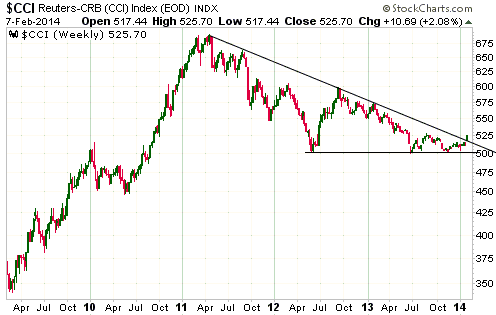
In the 27th January Weekly Update we wrote that while there wasn't yet any
price-related evidence that the commodity bear market had ended, all it would
take to establish the first piece of evidence of an important trend reversal is
a weekly close by the Continuous Commodity Index (CCI) above 520. As illustrated
by the following weekly CCI chart, we just got the first piece of evidence.
Uranium
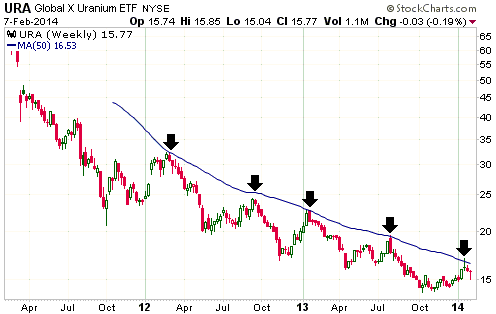
The uranium price is still chopping around within $2 of its multi-year low. Of
greater significance (since uranium-mining equities are likely to give an early
warning that uranium's cyclical bear market has ended), the Global X Uranium
Fund (URA) recently gained as much ground as it could WITHOUT signaling an
intermediate-term trend reversal.
As explained in the 15th January Interim Update, with every multi-month rebound
in URA over the past two years having ended at or just below the 50-week MA, a
weekly close above this moving average would constitute evidence that the
rebound of the past few months has longer-term significance. As illustrated
below, URA recently turned lower without achieving a weekly close above the
50-week moving average.
This doesn't mean that an intermediate-term or long-term rally has not begun. It
means that there is presently nothing in the price action to differentiate the
latest rally from the counter-trend moves of the past two years.
Grains
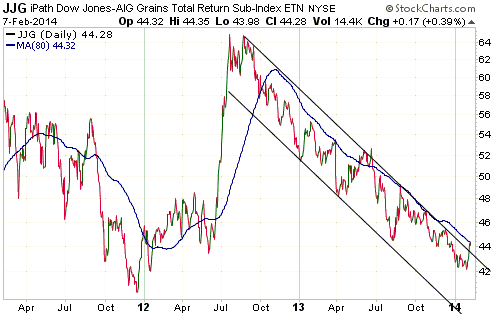
JJG, an ETN proxy for grain (corn, wheat and soybean) prices, has been in a
downward trend since the third quarter of 2012. A sign appeared last week that
this downward trend is either at an end or about to be interrupted by a tradable
rebound. We are referring to the channel breakout illustrated below.
It would be reasonable to take a trading position in JJG, ideally in the $43-$44
area with an initial sell stop placed just below the recent low. However, this
is not a trade that we will be tracking at TSI.
Oil
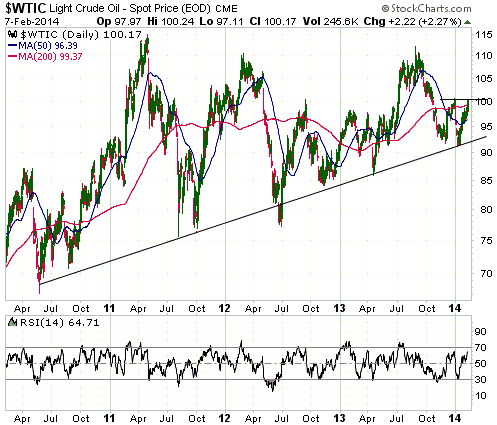
With regard to our current opinions about the major commodities, we are most
bullish on the precious metals (gold, silver, platinum) and least bullish on
oil. Oil is in a technically precarious position, with critical support in the
low-$90s, and is very expensive relative to most other commodities.
The Stock
Market
The US market
Anticipating a March low
Over the past 14 years the US stock market has often reversed upward or downward
on an intermediate-term basis during the month of March. As evidence, here is a
list of the important March turning points from 2000 onward for the S&P500 Index
(SPX):
March-2000: A major high
March-2001: A low that held until September of the same year
March-2002: The peak of the rebound from the September-2001 bottom
March-2003: A major low
March-2004: A high that held until November of the same year
March-2005: A high that held until July of the same year
March-2007: A low that held until January of the next year
March-2008: A low that held until July and wasn't breached on a monthly closing
basis until September of the same year
March-2009: A major low
March-2012: A high that held until September of the same year
The historical record therefore suggests that IF the downward trend that began
last month continues and makes a new low for the year in March, the March low
will hold until at least July. This is regardless of whether the short-term
downward trend is occurring within the context of an on-going bull market or a
new bear market. The historical record also suggests that the short-term
downward trend will extend into March.
With regard to downside potential, for the reasons outlined below we can make
the case for an SPX decline to as far as the 1570s.
First, there is long-term support in the 1570s defined by the 2007 peak. If the
SPX were to fall this far by March it would be testing this long-term support at
a time when it was extremely 'oversold' on a short-term basis, making it
unlikely that it would fall any further prior to experiencing a tradable
rebound.
Second, the following monthly SPX chart reveals a strong tendency for
multi-month declines to bottom near the 20-month moving average (the blue line
on the chart). Tests of this moving average are indicated by arrows on the
chart. Last year there was no test of the 20-month MA because there wasn't a
single multi-month decline, but if the SPX closes below 1783 this month then we
will be dealing with a multi-month decline and we will have a good reason to
expect a test of the 20-month MA prior to a short-term bottom. The 20-month MA
is presently at 1594.
That is, it's a reasonable bet that the decline will not go significantly
further than the 1570s but will go as far as the 20-month MA (near 1600).
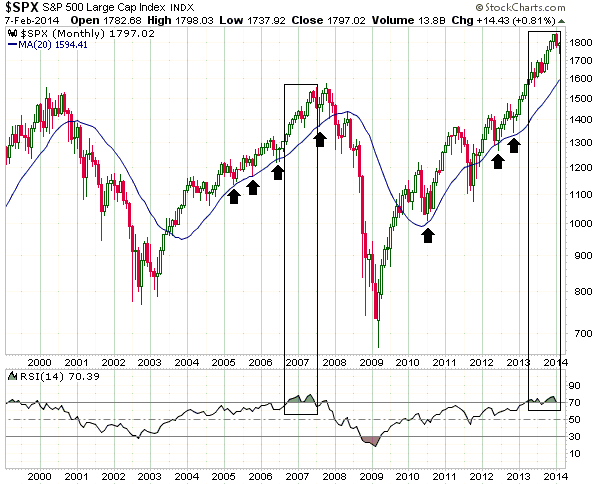
On a related matter, monthly price action and momentum (as indicated by the RSI
shown in the bottom section of the above chart) leading up to January-2014 look
similar to the monthly price action and momentum leading up to June-2007. The
relevant periods are shown in boxes on the above chart. We like the comparison.
The SPX's peak in June-July of 2007 was the penultimate peak of the 2003-2007
bull market and was followed by a quick decline to the 20-month MA. The ultimate
peak occurred in October of 2007, but notice that the October peak was only a
marginal new high and was not confirmed by momentum.
Current Market Situation
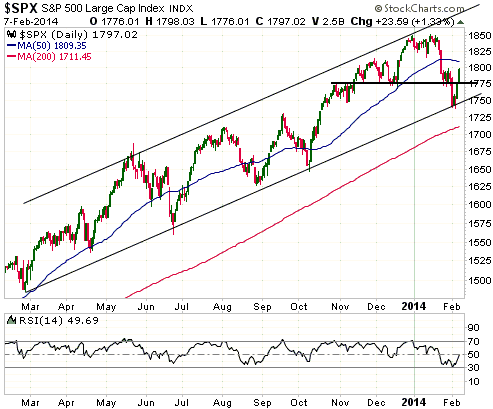
Last week's decline and rebound in the SPX further defined the price channel
drawn on the following daily chart. Consequently, taking out last week's low
will breach a very well defined channel and provide evidence that the downturn
will have intermediate-term implications and could have long-term implications.
The rebound from last week's low was strong and easily took-out resistance at
1775, but it hasn't invalidated the idea that the short-term decline is not
close to being complete. With resistance at 1775 having been overcome, the next
logical target for a rebound peak is the 50-day MA (currently at 1809).
It would be reasonable for short-term traders to take a bearish position, via
put options or a leveraged inverse fund or an actively managed bear fund such as
BEARX or HDGE, with the SPX trading at 1800-1810, using a tight stop.
This week's
important US economic events
| Date |
Description |
| Monday Feb 03 |
No important events scheduled | | Tuesday
Feb 04 |
No important events scheduled | | Wednesday
Feb 05 |
Treasury Budget | | Thursday
Feb 06 |
Retail Sales
Business Inventories
|
| Friday Feb 07 |
Consumer Sentiment
Industrial Production
Import and Export Prices |
Gold and
the Dollar
Gold and Silver
Ignore the scaremongers
It is certainly impressive that ZeroHedge.com is able to come up with a new
reason for imminent financial Armageddon every two weeks, but this is not a good
excuse to spend your time reading their 'analyses' unless you are looking for
interesting stories rather than facts and logic. Some of the best stories
involve the gold market.
An example is the 1st February article titled "Market
Cornered: JPMorgan Owns Over 60% Notional Of All Gold Derivatives". This
short article, the gist of which is clear from its title, shows how information
that is irrelevant can be used to create a false impression. We don't know that
the author is deliberately trying to create a false impression, as this could be
a case of ignorance rather than malice. Either way, the unwary reader will be
misled.
The article contains the following chart comparing the amount of gold in JP
Morgan's Comex vault with the notional value of gold derivatives owned by JPM.
The implication is that with the notional value of JPM's gold derivatives being
65-times greater than the amount of physical gold in JPM's vault, there are high
risks of a JPM default and a major dislocation in the gold market.
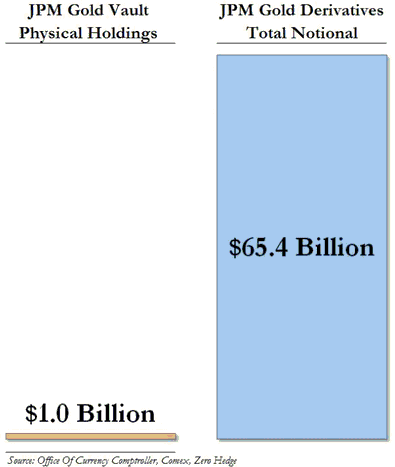
The problem with this implication is that the relative values of the gold in
JPM's Comex vault and JPM's gold derivatives are irrelevant. This is a
comparison between two completely unrelated quantities. A few years ago the
total notional value of JPM's gold derivatives was actually much greater than it
is today and JPM didn't even have a Comex gold vault.
Not satisfied with having falsely implied that the notional value of JPM's gold
derivatives book is dangerously high relative to the amount of gold in the
company's Comex gold vault, the ZeroHedge author goes on to state: "Finally, for
the purists out there, we realize that gross is not net... until there is a
breach in the derivative counterparty collateral chain, and gross becomes net."
No, 'gross' generally does not become 'net' when there's a breach. There are
only a few specific cases when it does. To understand why, consider this
hypothetical case: Fred, a speculator with a net worth of $500K, pays $2 per
option for call options covering 10,000 GLD shares. Fred's total outlay is
$20,000, but with GLD trading at $121/share the notional value of Fred's
derivative exposure is $1.21M. Comparing the notional value of Fred's derivative
position to his net worth would create the impression that Fred was risking his
entire financial future on this one trade, but the fact is that $20,000 is the
maximum amount that he could lose under any circumstances.
Even in cases where a breach or a catastrophic failure results in the "net", or
"value at risk", rising to meet the "notional value", the amount that changes
hands to settle all obligations will still likely be a small fraction of the
notional value. This is due to the netting-out of contracts. For example, when
US investment bank Lehman Brothers went bust in September of 2008 the
outstanding credit default swaps related to Lehman's debt amounted to around
$400B. Given that Lehman's bonds became almost worthless, this was the
worst-case scenario for the sellers of Lehman credit default swaps (someone who
sells a credit default swap is effectively insuring the underlying debt).
However, the amount that ended up changing hands -- between more than 300
counterparties -- to settle all outstanding obligations related to these swap
contracts was around $8B (about 2% of the total). The reason is that many
participants were involved on both sides of the market, resulting in the
majority of contracts canceling each other out.
So, steer clear of any analyst who quotes high notional values of derivatives as
if the high value was in and of itself indicative of a major systemic threat,
and who, when questioned about the relevance of notional value, glibly asserts
that gross becomes net in extreme situations.
Current Market Situation
Gold initially rallied last Friday in reaction to what was initially perceived
by traders and generally portrayed in the news media as a weak US employment
report. Gold's price gains were then given back when traders -- but not the news
media -- realised that the employment data were not actually weak. The headline
addition to non-farm payrolls was only 113K, versus a consensus expectation
prior to the report of 181K, but this 113K addition included a deletion of 29K
government jobs. Government jobs detract from the economy, so a monthly payrolls
increase of 113K that includes a 29K reduction in government jobs is better than
a monthly payrolls increase of 171K that includes a 29K addition to government
jobs. Furthermore, revisions to prior months added 34K jobs, average hourly
earnings were up, and there was an increase in the labour-force participation
rate. All things considered, the employment report should be viewed as a minor
economic plus and, therefore, not a reason to buy gold (gold actually did well
last Friday to hold its ground in the face of the economic data and a strong
stock market). It is also a backward-looking economic plus and subject to
substantial future revision.
With gold continuing to consolidate just below resistance in the $1270s, we'll
take a look at the situation in the silver market.
Silver has channel resistance at its current price of $20.00, but the more
importance resistance lies at $20.50. A daily close above $20.50 would eliminate
most remaining doubt that silver has reversed upward on an intermediate-term
basis.
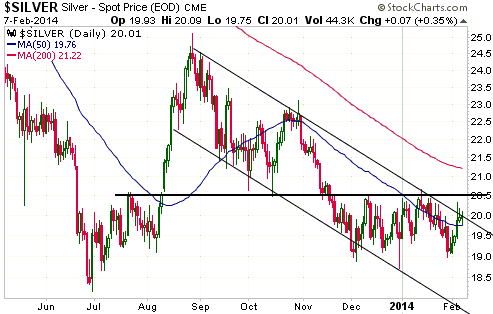
Silver is a long-term buy near its current price. It is also a short-term buy.
It would make sense for short-term traders who haven't already done so to buy
some silver with the aim of adding to the position following a break above
$20.50.
Short-term upside potential (from $20.00) is in the 10%-20% range.
Gold Stocks
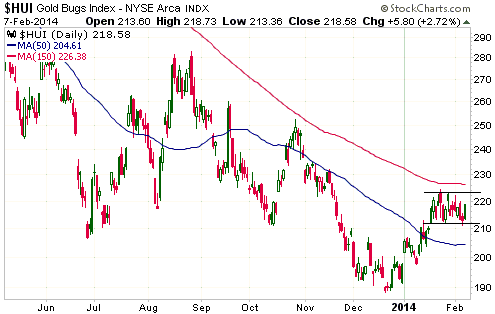
The HUI has now spent two weeks oscillating between 212 and 222. We interpret
this price action as a consolidation within a short-term upward trend, but we
won't know that this interpretation is correct until the HUI closes above the
top of its 2-week range. In the unlikely event that it closes below the bottom
of its 2-week range we'll know that the back-and-forth moves were part of a
reversal pattern rather than a consolidation.
While the HUI hasn't yet done anything to indicate that its consolidation is
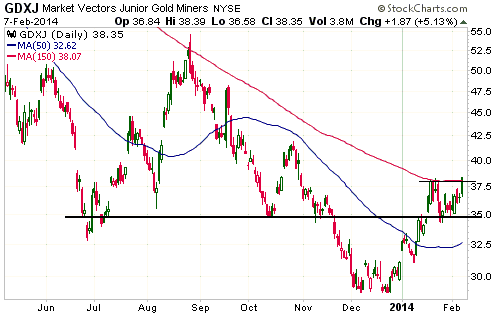
complete, there is preliminary evidence in the price action of GDXJ (the Junior
Gold Miners ETF) that the short-term upward trend has resumed. We are referring
to the fact that on Friday 7th February GDXJ closed slightly above the top of
its 2-week range and its 150-day MA.
As noted in a previous commentary, we currently think that early-March is a
likely time for a short-term peak in the gold sector. Unlike the short-term
peaks that occurred last year, the next one will probably be followed by a
multi-week correction that only partly retraces the preceding rally.
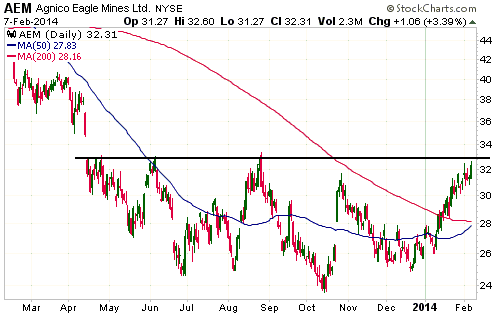
Agnico Eagle (AEM) continues to have one of the most bullish chart patterns in
the gold-mining sector. It is now testing the top of what appears to be a
10-month base.
A sustained break above resistance at $33.00 would suggest that the stock was on
its way to $40.
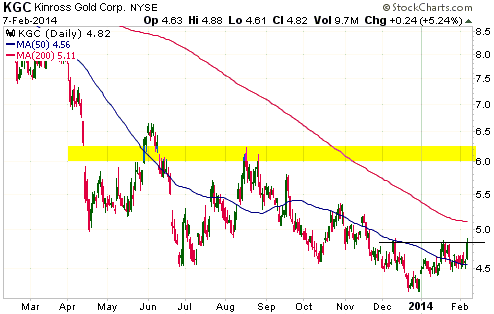
Kinross Gold (KGC) has a much weaker chart pattern than AEM, but it offers much
better value. KGC is now testing short-term resistance in the $4.80s.
A daily close above $5.00 would suggest that the stock was on its way to
$6.00-$6.50.
The Currency Market
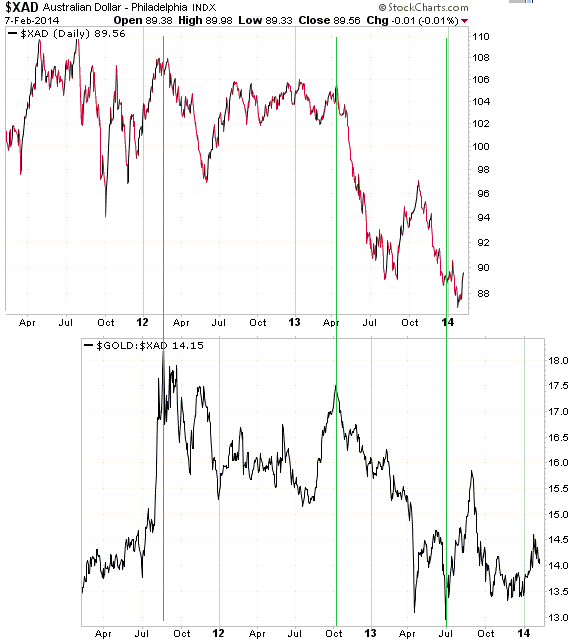
With the Dollar Index continuing to oscillate within a narrow multi-month range,
we'll take a look at the Australian Dollar (A$) from a different perspective.
The A$ and the C$ are generally considered to be the major commodity currencies,
but it can argued that the premier commodity currency is gold. Unlike the A$ and
the C$, which are periodically subject to double-digit inflation and which have
average long-term inflation rates of at least 8%, the supply of gold always
increases by 1.5%-2.0% per year. This inflation differential not only gives gold
a long-term upward bias relative to the other major commodity currencies, it
also makes gold the preferred commodity currency during the early stages of new
commodity bull markets. The fact is that gold usually begins to strengthen
relative to the A$ before the A$ begins to strengthen relative to the US$.
During 1999-2001, gold began a cyclical bull market relative to the A$ two years
before the A$ began a cyclical bull market relative to the US$. However, the
following chart comparison of the A$ and the A$-denominated gold price (gold/A$)
is based on the idea that the lead time is now about 6 months. This comparison
suggests that the A$'s recent low is equivalent to the low made by gold/A$ in
mid-2013.
We doubt that the A$'s bear market is over, but the chart displayed below meshes
with our view that there will be meaningful rallies in commodities and the
commodity currencies during the first half of this year. Note, though, that
these rallies probably won't begin in earnest until after the broad stock market
reaches a short-term bottom.
Updates
on Stock Selections
Notes: 1) To review the complete list of current TSI stock selections, logon at
http://www.speculative-investor.com/new/market_logon.asp
and then click on "Stock Selections" in the menu. When at the Stock
Selections page, click on a stock's symbol to bring-up an archive of
our comments on the stock in question. 2) The Small Stock Watch List is
located at http://www.speculative-investor.com/new/smallstockwatch.html
 Company
news/developments for the week ended Friday 7th February 2014: Company
news/developments for the week ended Friday 7th February 2014:
[Note: AISC = All-In Sustaining Cost, FS = Feasibility Study, IRR =
Internal Rate of Return, MD&A = Management Discussion and Analysis,
M&I = Measured and Indicated, NAV = Net Asset Value, NPV(X%) = Net
Present Value using a discount rate of X%, P&P = Proven and
Probable, PEA = Preliminary Economic Assessment, PFS =
Pre-Feasibility Study]
*Asanko Gold (AKG) completed its merger with PMI Gold. We estimate
that the company now has about 172M shares outstanding, $280M of
cash, $150M of unused credit, and 7.5M ounces of M&I gold resources
across two Ghana-based projects that are close to entering the
construction phase.
The next news of significance is expected to be the FS for the
Esaase project, which is due in the near future.
*Pretium Resources (PVG) issued its 43-101 Technical Report
covering the December-2013 resource estimate for the Brucejack
Project. The report was prepared by Snowden and included detailed
information about the results of the Bulk Sample Program (BSP).
The breakdown of the BSP results showing the quantity of gold
extracted from each of the five cross-cuts highlights the extremely
heterogeneous nature of the deposit. We note, in particular, that
while the average gold grade of the bulk sample was 17.9-g/t, none
of the individual cross-cuts had an average gold grade of anywhere
near the overall average. Specifically, three of the cross-cuts
averaged between 2.3 and 4.4 g/t, one (615L) averaged 25.5-g/t, and
one (426615E) averaged 39.4-g/t. Moreover, of the 5,923 ounces of
gold extracted from the bulk sample, about 62% came from a single
cross-cut (426615E).
Page 86 of the 194-page Technical Report contains the following:
"...the knowledge gained from mapping and sampling in the bulk
sample have shown that in some of the extreme grade drilling
intersections, the continuity of mineralization is far greater than
originally interpreted. Usually, an extreme grade would generally
have continuity of at best a metre or two, whereas extreme grades in
both the east-west (e.g., 615L and associated raises) and
north-south (e.g., 426615E crosscut and associated raises)
components of the stockwork system at Brucejack are continuous up to
the tens of metres scale. The outcome of this at Brucejack is that
whilst the November 2012 estimate honours the input data, the high
grade mineralization was under-estimated due to the lack of samples
in the high grade, and the low grade was over-estimated -- a
function of the interpretation as to how to deal with the extreme
grades."
It is a plus that there appears to be greater continuity of the
high-grade mineralisation than previously believed.
As far as we can tell, there was nothing in the Technical Report
that could be construed as surprising. The information in the report
is consistent with the assessment of PVG's management, but it
doesn't negate the assessment of Strathcona. There remains a
legitimate concern that due to the nature of the resource the BSP
didn't prove what it was intended to prove. The issue is that it is
probably not possible for any 10,000-tonne sample to be
representative of an entire large deposit when the deposit has huge
variations in grade.
With nothing of a geological nature being resolved, it makes sense
that PVG essentially traded with the overall gold sector over the
course of last week. The stock is almost certainly being held back
by anticipation of an equity financing, which opens up the
possibility of a rapid increase in the stock price if PVG's
management either raises additional money without issuing more
shares (there are multiple ways that this could be done, including
via the immediate mining of the ultra-rich Cleopatra Vein) or issues
new shares at well above the current market price.
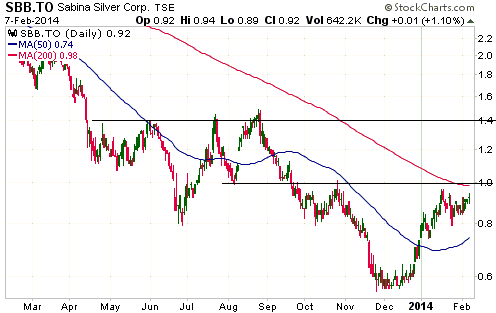
*Sabina Gold and Silver (SBB.TO) was hit harder than the average
junior gold-mining stock during the months leading up to the
December-2013 bottom. This was due to a disappointing PFS for its
Back River gold project and substantial selling of SBB shares by
Dundee Corp., the company's largest shareholder. It has since
rebounded strongly and appears to be forming a base with resistance
at C$1.00. Consecutive daily closes above C$1.00 would suggest a
short-term target of C$1.40.
SBB has the opportunity to improve the economics of Back River by
coming up with a mine plan that uses more of the project's resource.
It should also be remembered that SBB has exposure to silver and
base metals via a potentially valuable silver royalty on the Hackett
River project owned by Glencore.
More
evidence of upward reversals among TSI stock selections
Evidence continues to emerge that individual stocks have reversed upward on a
sustainable basis. For example:
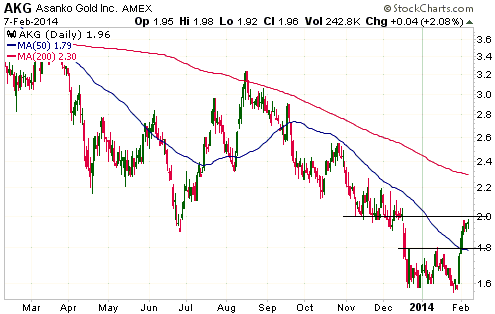
1) AKG finally began to rally. It has broken above short-term resistance at
US$1.80 and is now testing resistance at US$2.00. The next obstacle after $2.00
will be the 200-day MA, which is presently at $2.30.
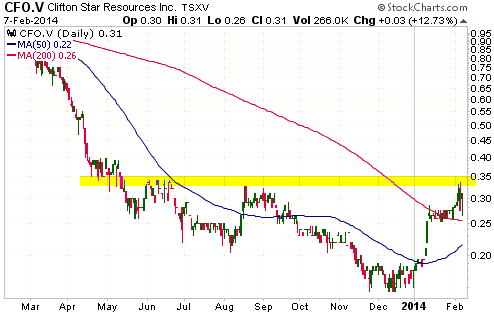
2) CFO.V has broken above its 200-day MA and is now challenging lateral
resistance at C$0.33-$0.35.
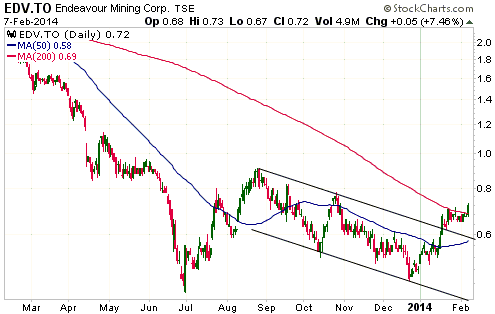
3) EDV.TO encountered resistance at its 200-day MA over the past two weeks. It
breached this resistance last Friday.
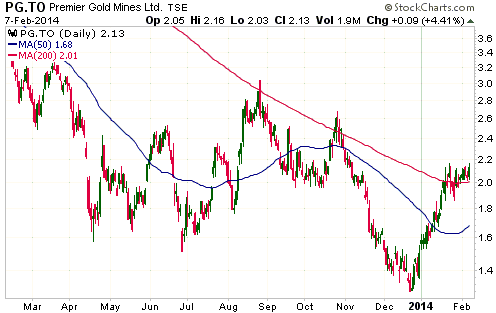
4) PG.TO reversed downward in August and October almost immediately after
reaching its 200-day MA. This time around, the stock traded sideways for a
couple of weeks after reaching its 200-day MA and now appears to be resuming its
advance.
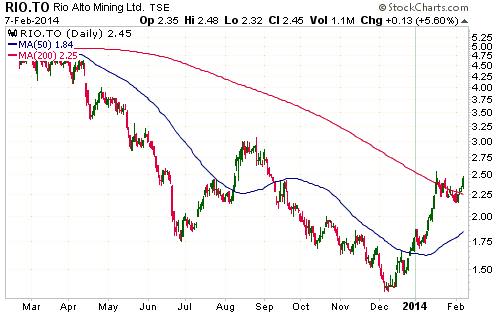
5) RIO.TO consolidated just below its 200-day MA over the past two weeks. Last
Friday's price action suggests that the consolidation has ended.
List
of candidates for new buying
From within the ranks of TSI stock selections, below is a list of the best
candidates for new buying at this time.
1) AKG (last Friday's closing price: US$1.96)
2) EDV.TO/EVR.AX (last Friday's closing price: C$0.72)
3) EVN.AX (last Friday's closing price: A$0.70)
4) PLG.TO (last Friday's closing price: C$1.02)
Chart Sources
Charts appearing in today's commentary
are courtesy of:
http://stockcharts.com/index.html

|









