|
-- Weekly Market Update for the Week Commencing 10th March 2014
Big Picture
View
Here is a summary of our big picture
view of the markets. Note that our short-term views may differ from our
big picture view.
In nominal dollar terms, the BULL market in US Treasury Bonds
that began in the early 1980s ended in 2012. In real (gold)
terms, bonds commenced a secular BEAR market in 2001 that will continue
until 2018-2020. (Last
update: 20 January 2014)
The stock market, as represented by the S&P500 Index,
commenced
a secular BEAR market during the first quarter of 2000, where "secular
bear market" is defined as a long-term downward trend in valuations
(P/E ratios, etc.) and gold-denominated prices. This secular trend will bottom sometime between 2014 and 2020.
(Last update: 22 October 2007)
A secular BEAR market in the Dollar
began during the final quarter of 2000 and ended in July of 2008. This
secular bear market will be followed by a multi-year period of range
trading.
(Last
update: 09 February 2009)
Gold commenced a
secular bull market relative to all fiat currencies, the CRB Index,
bonds and most stock market indices during 1999-2001.
This secular trend will peak sometime between 2014 and 2020.
(Last update: 22 October 2007)
Commodities,
as represented by the Continuous Commodity Index (CCI), commenced a
secular BULL market in 2001 in nominal dollar terms. The first major
upward leg in this bull market ended during the first half of 2008, but
a long-term peak won't occur until 2014-2020. In real (gold) terms,
commodities commenced a secular BEAR market in 2001 that will continue
until 2014-2020.
(Last
update: 09 February 2009)
Copyright
Reminder
The commentaries that appear at TSI
may not be distributed, in full or in part, without our written permission.
In particular, please note that the posting of extracts from TSI commentaries
at other web sites or providing links to TSI commentaries at other web
sites (for example, at discussion boards) without our written permission
is prohibited.
We reserve the right to immediately
terminate the subscription of any TSI subscriber who distributes the TSI
commentaries without our written permission.
Outlook Summary
Market
|
Short-Term
(1-3 month)
|
Intermediate-Term
(6-12 month)
|
Long-Term
(2-5 Year)
|
|
Gold
|
Neutral
(25-Feb-14) |
Bullish
(26-Mar-12) |
Bullish
|
|
US$ (Dollar Index)
|
Bearish
(05 Mar-14) |
Bearish
(27-Jan-14) |
Neutral
(19-Sep-07) |
|
Bonds (US T-Bond)
|
Bullish
(11-Dec-13)
|
Neutral
(18-Jan-12)
|
Bearish |
|
Stock Market
(DJW)
|
Neutral
(03-Mar-14)
|
Bearish
(28-Nov-11) |
Bearish
|
|
Gold Stocks
(HUI)
|
Bullish
(03-Mar-14) |
Bullish
(23-Jun-10) |
Bullish
|
|
Oil |
Neutral
(30-Jul-12) |
Neutral
(31-Jan-11) |
Bullish
|
|
Industrial Metals
(GYX)
|
Neutral
(17-Feb-14) |
Neutral
(06-Jan-14) |
Neutral
(11-Jan-10) |
Notes:
1. The date shown below the current outlook is when the most recent outlook change occurred.
2. "Neutral", in the above table, means that we either don't have a
firm opinion or that we think risk and reward are roughly in balance with respect to the timeframe in question.
3. Long-term views are determined almost completely by fundamentals,
intermediate-term views by
fundamentals, sentiment and technicals, and short-term views by sentiment and
technicals.
What should YOU do?
We never know the answer to the above
question. The best that we -- or any similar service -- can ever do is offer
well-thought-out investing/speculating ideas for our readers to consider. It
will be up to the readers to decide which, if any, of these ideas should be
acted upon given their own circumstances and risk tolerances.
It will never be possible for us to advise the best course of action for all of
our readers, because except in very general terms there is no such thing as 'one
size fits all' speculating/investing advice. That's why we don't provide a model
portfolio. The whole concept of a model portfolio is wrong because it is based
on the false premise that it would be appropriate for a wide range of people to
structure their investments in a similar way. As an example of why this premise
is false we point out that it will probably never make sense for retired folk on
fixed incomes with minimal excess savings to allocate significant money to
speculative stocks, but there are times when it could certainly make sense for
young or middle-aged folk with expanding cash flows and/or substantial savings
and/or plenty of time to recover from mistakes to have a sizeable amount of
money at risk in speculative stocks. What, then, should be the allocation to
speculative stocks in a newsletter's model portfolio?
We don't even provide a recommended stock portfolio. Instead, we provide a list
of stock selection ideas. For better or worse, this list will usually be
dominated by speculative stocks, because these are the stocks in which we are
most interested. Furthermore, over the past 13 years our greatest interest has
been in speculative gold-mining stocks, a situation that is unlikely to change
until we see evidence that gold's long-term bull market is coming to an end.
This means that our stock selection ideas will generally be unsuitable for
people who can't afford to take significant risk with part of their net worth.
These people could (we hope) still benefit from reading the TSI commentaries,
but should probably get the bulk of their precious metals exposure via the
purchase of physical bullion or bullion funds such as GLD.
When it comes to what YOU should do with your money, there is actually no
substitute for common sense. You know better than anyone, or at least you should
know better than anyone, your financial situation and the amount of risk that
you can afford to take. If you go to the trouble of becoming well informed by
reading/viewing/listening-to trustworthy sources and you exercise common sense,
you will have an advantage over most participants in the financial markets.
Commodities
Copper
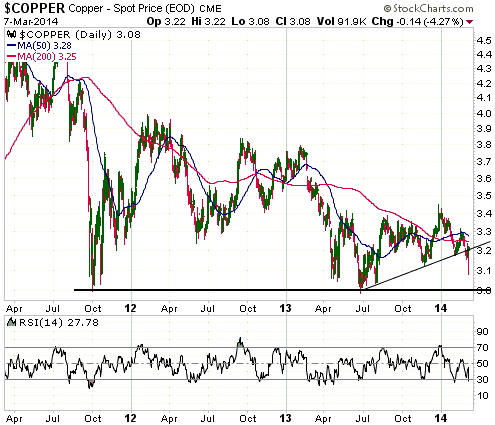
There were times over the past few months when the copper market threatened to
break out to the upside and other times when it threatened to break out to the
downside, but at no time did it follow through. Last Friday it finally 'made up
its mind' and clearly broke out to the downside. This should pave the way for a
test of major support at US$3.00 in the near future. The question is: will major
support hold if/when it is tested?
We don't know. For many months we've been concerned about the possibility that
the copper price would break below $3.00 and plunge to the mid-$2 area (or
perhaps even a little lower) before its cyclical bear market came to an end, but
being concerned about the risk of something happening is very different to
confidently predicting that it will happen. What we can say is:
a) If the copper price rebounds from near $3.00 it would create a triple bottom,
and triple bottoms usually end up being breached.
b) If the copper price breaks decisively below $3.00 and then quickly (within 2
weeks) moves back above $3.00, it would be a very bullish short and long term
price signal.
Grains
From the 10th February Weekly Update:
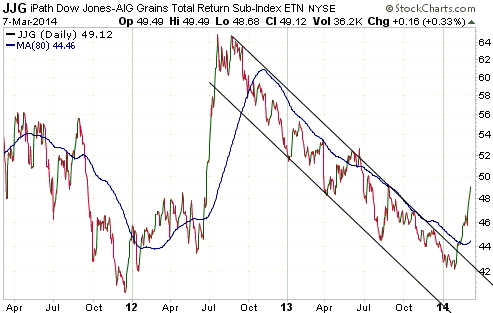
"JJG, an ETN proxy for grain (corn, wheat and soybean) prices, has been in a
downward trend since the third quarter of 2012. A sign appeared last week that
this downward trend is either at an end or about to be interrupted by a tradable
rebound. We are referring to the channel breakout illustrated below.
It would be reasonable to take a trading position in JJG, ideally in the $43-$44
area with an initial sell stop placed just below the recent low."
JJG has since risen from $44 to $49, or a bit over 10%. In doing so it has
indicated that an intermediate-term bottom was put in place early this year, but
it has also become stretched to the upside on a short-term basis. It would
therefore be appropriate for short-term traders to take profits or 'tighten
their stops'.
 The Stock
Market
Emerging Markets
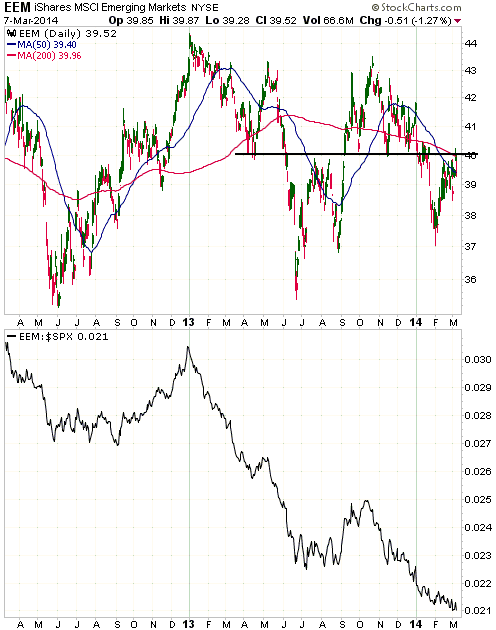
EEM, the Emerging Markets ETF, dropped sharply last Monday in reaction to the
risk that Russia was preparing to invade Ukraine, but then reversed upward in
impressive fashion the next day when the risk receded. By the end of the week
there had been no significant change, in that the upward reversal had failed to
push EEM above resistance at $40 on a daily closing basis.
The top section of the following daily chart shows EEM's choppy price action and
the bottom section of the following chart shows EEM's on-going decline relative
to the S&P500 Index (SPX). There is no evidence that the multi-year bear market
in the EEM/SPX ratio is over.
EEM's performance, especially its performance relative to the US stock market,
suggests that the emerging markets investment bubble popped a few years ago, but
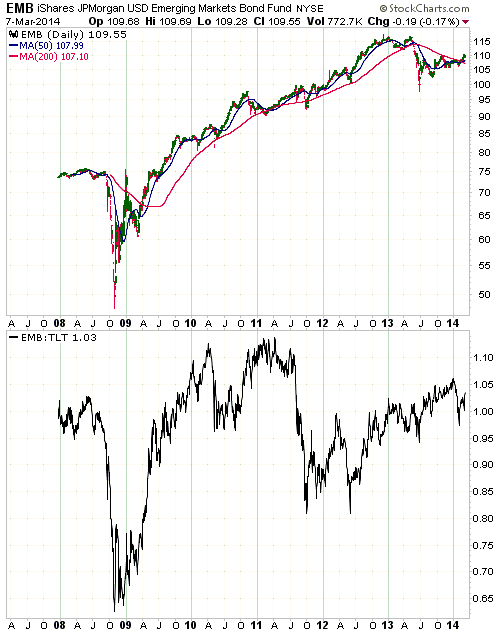
the performance of EMB, the Emerging Markets Bond Fund, tells a different story.
As illustrated by the following chart, EMB is only about 5% below its all-time
high in both nominal terms and relative to TLT (a fund that holds long-dated US
Treasury Bonds).
EMB's performance suggests that the bursting of the emerging markets investment
bubble lies in the future, not the past.
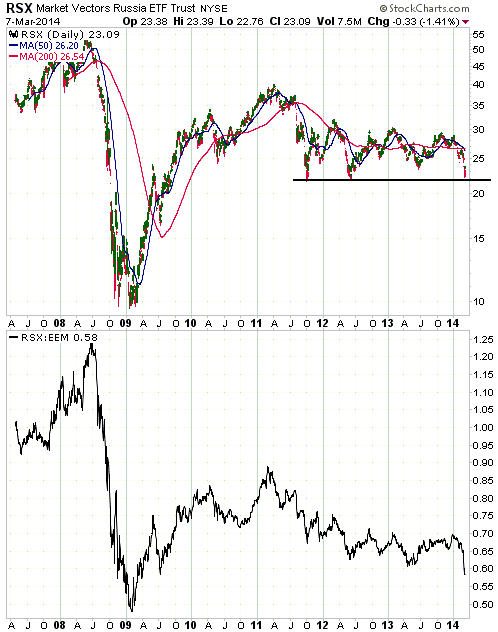
Recent news has brought a particular "emerging market" into sharp focus. We are
referring to Russia. The following chart shows the performance over the past 7
years of RSX, an ETF that holds Russian equities, and the RSX/EEM ratio. This
chart indicates that the Russian stock market has traded like a leveraged play
on emerging-market stocks in general.
RSX's past performance suggests that it will be a fund worth owning after EEM
bottoms out.
Small-Cap Canadian Resource Stocks
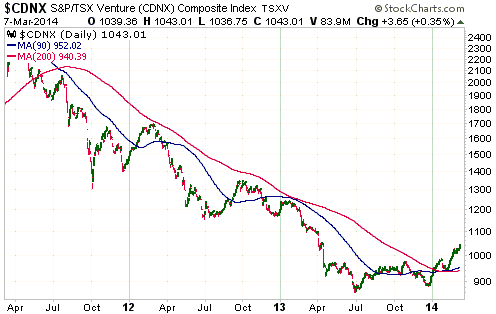
The CDNX, a proxy for the small-cap Canadian resource sector, continues to work
its way higher in the face of relentless scepticism from many people who know
this sector well. This sentiment is bullish. To paraphrase Don Coxe, in the
early stages of a bull market for an asset class the people who know the asset
the best will tend to love it the least because they have been disappointed the
most.
The price action is totally consistent with the idea that a new cyclical bull
market has begun.
This week's
important US economic events
| Date |
Description |
| Monday Mar 10 |
No important events scheduled | | Tuesday
Mar 11 |
No important events scheduled | | Wednesday
Mar 12 |
Treasury Budget | | Thursday
Mar 13 |
Retail Sales
Import and Export Prices
Business Inventories
|
| Friday Mar 14 |
PPI
Consumer Sentiment |
Gold and
the Dollar
Gold
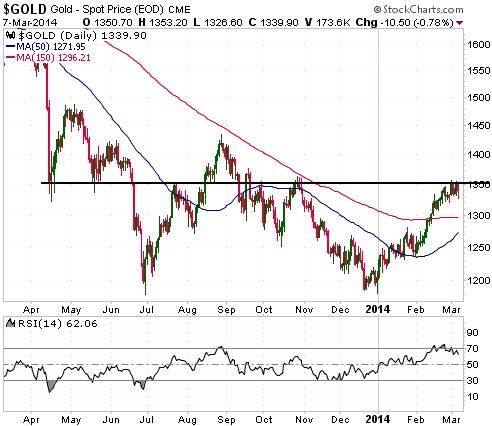
It isn't surprising that gold is having some difficulty getting through
resistance at $1350. Gold's true fundamentals are still mixed, the US stock
market is still strong, and the daily RSI shown at the bottom of the following
chart shows that gold is still slightly 'overbought' on a short-term basis. All
things considered, consolidating below this resistance is normal bull-market
price action.
It would also be normal if the gold price pulled back to around $1300 before
resuming its advance, given that the 150-day MA lies just below $1300 and that
at its present rate of ascent the 50-day MA will rise to around $1300 over the
coming two weeks. We aren't saying that the gold price will fall to $1300; we
are saying that it would be perfectly normal if it did.
Our expectation continues to be that gold will rise to the low-$1400s during the
first half of this year, with or without some additional corrective action over
the coming 1-2 weeks. Our short-term outlook will shift back to "bullish" if the
price drops to $1310 this week.
Gold Stocks
The HUI's price action continues to be consistent with a routine consolidation
within an upward trend. The consolidation will probably end within the coming
two weeks, but be aware that as part of this routine consolidation the HUI could
trade down to the mid-220s. One reason is that the 50-day, 150-day and 200-day
moving averages are likely to soon converge in the 225-230 range, causing this
range to be both strong support and a magnet.
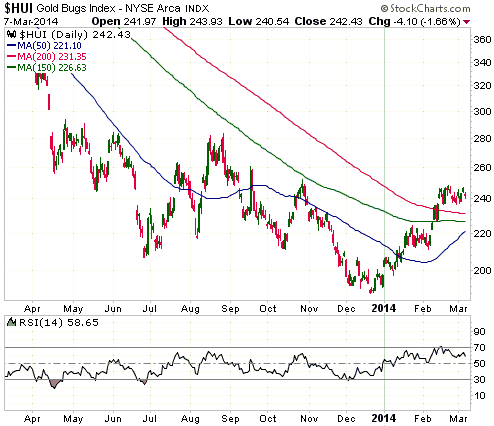
We continue to expect that the HUI will trade above 300 by the middle of this
year. This expectation is based on the historical record following cyclical bear
markets.
The Currency Market
The US dollar's "reserve" status
The US$ is not the most popular reserve currency because governments choose to
hold it in reserve. Governments around the world favour US dollars for their
currency reserves because the US$ is by far the most popular currency in the
global marketplace. The fact is that in terms of use in international financial
dealings, no other currency comes remotely close to the US$. That's not going to
change within the next several years, so political threats to abandon the dollar
can be ignored. These threats are just hot air.
Also, it's worth reiterating a point we've made in the past, which is that
foreign currency reserves aren't reserves in the true meaning of the word. A
nation's currency is not backed by the foreign currency reserves held by its
central bank. Instead, the volume of a nation's foreign currency reserves is
usually a reflection of the exchange-rate manipulation carried out by its
central bank. When a central bank other than the Fed wants to weaken its
currency it will sell newly created units of its own currency for the most
popular currency for international dealings, which, as noted above, is presently
the US$ by a wide margin. And when a central bank other than the Fed wants to
strengthen its currency it will do the opposite.
In other words, the accumulation of international currency reserves is usually
part of a process designed to devalue a currency. The efforts to devalue
generally run for several years, at which point it becomes obvious that the
manipulation has gone too far and caused an inflation problem. In desperation,
the opposite process is then initiated.
The Commodity Currencies
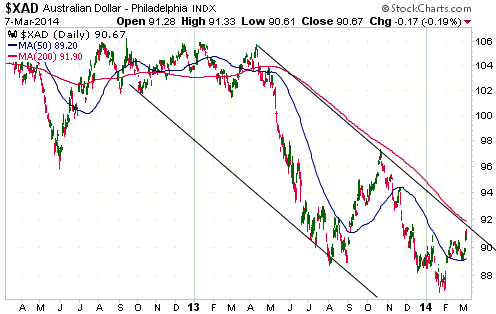
We think that the Australian Dollar (A$), one of the two most important
commodity currencies, is in the early phase of a multi-month, or possibly even a
multi-quarter, rally. Assuming it occurs, the rally will probably turn out to be
the bear-market variety, in that the A$ remains very over-valued on a
purchasing-power-parity basis, but an advance within the context of a long-term
bear market yields just as much profit as the same percentage increase within
the context of a long-term bull market.
The A$'s recent performance has generated some evidence to support the
aforementioned opinion of ours. We are referring to the fact that it broke above
its 50-day MA, pulled back to test its breakout and then made a new high for the
move.
There is substantial resistance at around 92 defined by the 200-day MA and the
top of a channel. This resistance could limit the upside over the next few
weeks.
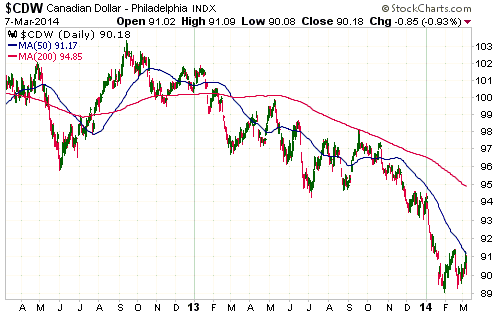
Our outlook for the Canadian Dollar (C$), the other major commodity currency, is
the same, but unlike the A$ the C$ hasn't yet generated any evidence that a
bottom is in place. At this time, all we have is a rebound to the 50-day MA.
Consequently, it is distinctly possible that the C$ will make a new multi-year
low before a meaningful rally gets underway.
A daily close above 91.5 would be initial price-related evidence that a
sustainable up-turn has occurred. In the meantime, we view the C$ as suitable
for accumulation below 90.
The Yen
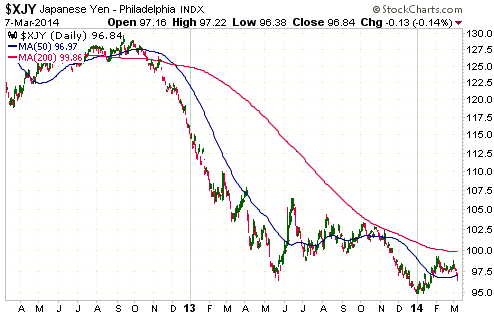
Despite everything, the Yen still trades like a safe-haven currency. In
particular, it tends to weaken in response to stock market strength and
strengthen in response to stock market weakness. This pattern should continue
over the next few quarters.
A 10%+ Yen rally will probably coincide with the next 10%+ stock market decline,
but if -- as now seems likely -- the stock market retains an upward bias until
at least late-April, it's possible that the Yen will test or even breach its
January-2014 bottom before a meaningful rally gets underway.
Updates
on Stock Selections
Notes: 1) To review the complete list of current TSI stock selections, logon at
http://www.speculative-investor.com/new/market_logon.asp
and then click on "Stock Selections" in the menu. When at the Stock
Selections page, click on a stock's symbol to bring-up an archive of
our comments on the stock in question. 2) The Small Stock Watch List is
located at http://www.speculative-investor.com/new/smallstockwatch.html
 Company
news/developments for the week ended Friday 7th March 2014: Company
news/developments for the week ended Friday 7th March 2014:
[Note: AISC = All-In Sustaining Cost, FS = Feasibility Study, IRR =
Internal Rate of Return, MD&A = Management Discussion and Analysis,
M&I = Measured and Indicated, NAV = Net Asset Value, NPV(X%) = Net
Present Value using a discount rate of X%, P&P = Proven and
Probable, PEA = Preliminary Economic Assessment, PFS =
Pre-Feasibility Study]
*Endeavour Mining (EDV.TO, EVR.AX) announced that its
newly-commissioned Agbaou gold mine in Cote d'Ivoire produced 33%
more gold than planned during its first two months of operation.
New gold mines usually experience 'teething problems' that cause
production to be lower than planned during the first few months of
operation, whereas the best mines begin producing on plan from the
'get go'. It is almost unprecedented in this industry for a new mine
to immediately begin producing gold at above its design capacity.
Obviously, this is very good news for EDV. The stock price reacted
well, but a lot intermediate-term upside potential remains.
*Energy Fuels (EFR.TO, UUUU) advised that it has restructured its
regulatory bonding, enabling $12M to be transferred from "restricted
cash" to cash that can be used as working capital. This is a small
plus, as it will reduce the need for EFR to obtain additional
financing.
*Pretium Resources (PVG) issued its MD&A and Financial Statements
for the December-2013 quarter and the 2013 year. It also provided an
update on its progress.
At 31st December the company had about $11M of working capital. It
subsequently raised about $25M via the equity financing that closed
last week, so allowing for expenditure since the beginning of this
year it should now have $30M-$34M of working capital. Along with the
cash that will be generated via mining (as discussed below), this
should be enough to fund the company for another 6-12 months.
The next big milestone for PVG will be the completion of an amended
FS during the second quarter of this year. The amended FS will
incorporate the resource re-estimate published in December.
According to the company's 5th March press release, it will also:
"...use lower metals prices ($1,100/oz gold and $17/oz silver)
and an exchange rate of $0.92 CAD:US. Based on the positive results
from the bulk sample, potential refinements are being evaluated in
the areas of mining, metallurgy and flow-sheet optimization in order
to reduce Project capital and operating expenditures. The Brucejack
Project is planned as a 2,700 tonnes per day underground mine using
the bulk mining method of longhole open stoping with a cemented
paste backfill."
The amended FS will probably be at least as positive as the FS
completed in mid-2013. The big unknown, and the basis of the
Strathcona controversy, is whether the Brucejack Project really
should be "planned as a 2,700 tonnes per day underground mine using
the bulk mining method." According to Strathcona, the project should
be planned as a smaller-scale operation using selective mining of
the high-grade areas.
It's important to understand that none of the information provided
by PVG to date invalidates the concerns expressed by Strathcona, and
that the upcoming amended FS will also not invalidate the concerns
expressed by Strathcona regardless of how positive it proves to be.
The critical question is whether or not it makes sense to base a
Feasibility analysis on a bulk-mining method. By assuming that it
does make sense, the FS will essentially beg the question.
It's also important to understand that the Brucejack project
contains a very lucrative gold deposit. This deposit WILL eventually
be a profitable gold mine, with the only question relating to the
type of mine.
The fact that Brucejack does contain a lucrative deposit will be
demonstrated this year by actual small-scale mining. As explained in
last week's press release, in addition to the 1,000-tonne bulk
sample extracted last year, PVG extracted 1,000 tonnes of high-grade
mineralisation for future processing. This processing was completed
last month and the results are pending. Also, 1,000 tonnes of
high-grade mineralisation will be extracted this year. As a
consequence, PVG could generate more than $20M in mining revenue
this year. Ironically, in generating this revenue PVG will be doing
what Strathcona claims it should be doing: selectively mining
high-grade parts of the deposit.
*Ramelius Resources (RMS.AX) advised that mining of the Coogee
open pit has ended as planned and that milling of the mined ore will
continue until August. Coogee is presently adding about 5K ounces of
gold per quarter to RMS's total production.
We don't know how, or if, the company will replace the 5K
ounces/quarter of production currently being provided by Coogee
after milling is completed in August.
*Sabina Gold and Silver (SBB.TO) reported an updated resource
estimate for its Back River project (Nunavut, northern Canada).
The M&I resource has increased from about 4.6M ounces to about 5.3M
ounces, with more than 100% of the increase occurring in the
higher-confidence 'M' (Measured) component due to the conversion of
some indicated resources to measured resources. The inferred
resource is roughly unchanged at around 1.9M ounces.
This is a satisfactory result.
For the Back River project to have the sort of economics that would
make it attractive to a large mining company, SBB and its
consultants will have to figure out a way to make use of a much
larger portion of the resource than was considered in the PFS
completed last October. Last year's PFS only made use of 2.7M out of
4.6M M&I ounces, which led to a relatively short mine life and
mediocre economics. The updated resource announced last week should
be helpful in this regard, as it reflects greater confidence in
resource continuity.
List
of candidates for new buying
From within the ranks of TSI stock selections, the best candidates for new
buying at this time are:
1) AAU in the US$1.40s (last Friday's closing price: US$1.56).
2) LYD.TO in the low-C$1 area (last Friday's closing price: C$1.15).
3) ORE.TO (last Friday's closing price: C$0.63). The price action over the final
two days of last week suggests that ORE has completed a routine pullback to
'test' its upside breakout.
Updates
on short-term TSI trading positions
1) We have exited the short-term trading position in EDV.TO at C$0.93. The
result was a profit of 69.1%.
2) We will exit (take a small loss on) the short-term trading position in EEV (UltraShort
Emerging Markets) if EEM (Emerging Market ETF) closes above US$40.20. Note that
the location of this 'stop' was validated by last week's price action in that
EEM traded as high as $40.22 last Thursday before reversing course.
3) We will exit (take profits on) the short-term trading position in GFI if the
stock trades at US$4.48 (a bit lower than the exit price previously mentioned).
The current price is US$3.77.
4) We will exit (take profits on) the short-term trading position in RIO.TO if
the stock trades at C$2.90. The current price is C$2.60.
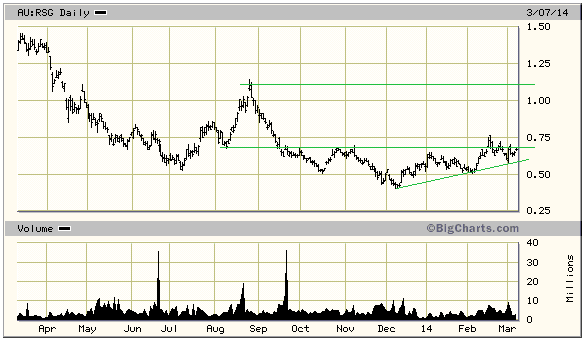
5) We have added a short-term trading position in Resolute Mining (RSG.AX) at
Friday's closing price of A$0.67. Here's a summary of our reasons for thinking
that RSG makes a good short-term speculation:
RSG is producing gold from mines in Mali (West Africa) and Australia. This
year's production is expected to be about 350K ounces at an AISC of around
US$1070/oz, which means that the production should be profitable if costs are as
planned and the gold price averages at least US$1300/oz. Furthermore, the
company's balance sheet is in reasonable shape. However, the market is valuing
RSG as if it were an unprofitable producer with a weak balance sheet. In fact,
we calculate that RSG's production is being valued at a 10% discount to the
production of Golden Star Resources (GSS), a similar-size gold producer with
similar country risk and a weaker balance sheet that will probably need a gold
price of around $1400/oz to turn a genuine profit.
RSG's under-valuation relative to other under-valued gold producers is one
reason for our interest in the stock. The other reason is the price chart (see
below). RSG appears to have built a strong base over the past 6 months and
stands a good chance of completing this base -- via a daily close above A$0.75
-- shortly after gold resumes its upward trend. An upside breakout from the
basing pattern would suggest a short-term target of around A$1.10.
The main company-specific risk is management. RSG is a former long-term member
of the TSI List, and even though it ended up performing satisfactorily we were
frustrated on multiple occasions by management's ill-timed or ill-conceived
attempts to finance the business. Management risk is why we would currently not
add RSG to the TSI List as a long-term position, but be aware that this risk
could also derail our short-term trading position. The reason is that the
company will have to raise at least $50M sometime this year to fund the
expansion of its Syama gold mine in Mali. It will be all well and good if the
money is raised via garden-variety debt, but we wouldn't put it past RSG's
management to raise the money by issuing new shares or convertible notes while
the stock price is depressed.
List
of candidates for profit-taking
In addition to the profit-taking suggestions outlined in the 17th February
Weekly Update, please note the following:
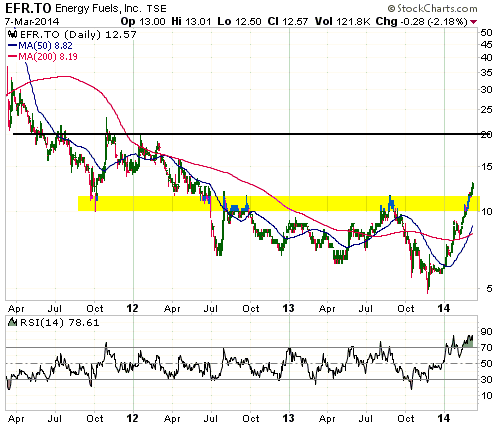
1) Junior uranium miner Energy Fuels (EFR.TO, UUUU) has gained more than 150%
since its Q4-2013 bottom and is now extremely 'overbought' on a short-term
basis. Anyone who bought EFR shares more than two years ago would still be
showing a loss (potentially a large loss), perhaps leading to the impression
that the current situation does not constitute a short-term selling opportunity.
However, the market never cares about your cost basis and you shouldn't defer to
your cost basis when determining what to do with a current holding. Regardless
of what was originally paid for the shares and depending on exposure to both EFR
and the uranium sector, it could make sense for EFR shareholders to take some
money off the table at this time.
For information purposes, we sold about 16% of our EFR shares in the C$12.90s
last Friday and will almost certainly do some additional selling if the price
rises to near major resistance at C$20 within the next three months.
2) We added Sprott Inc. (SII.TO) to the TSI List in mid-2013 when it was trading
in the C$2.30s. At that time it looked like a conservative (low-risk)
dividend-paying way to speculate on a turnaround in precious metals in
particular and commodities in general. It still looks the same and remains a
reasonable holding for conservative investors, but with plenty of evidence now
in place that a turnaround has occurred we prefer to concentrate on stocks with
higher risk and much higher potential reward. SII has therefore been removed
from the TSI List. Including dividends, the result was a profit of 51.5%.
Major resistance at C$4.00 remains a realistic 3-month target for SII.
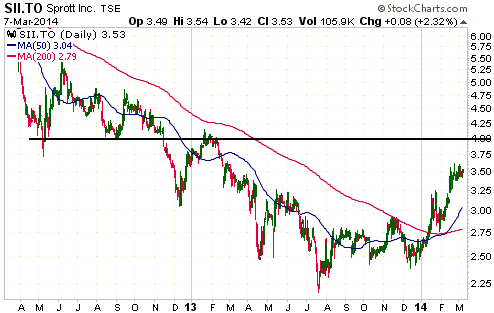
Chart Sources
Charts appearing in today's commentary
are courtesy of:
http://stockcharts.com/index.html
http://bigcharts.marketwatch.com/

|









