|
-- Weekly Market Update for the Week Commencing 10th July 2006
Big Picture
View
Here is a summary of our big picture
view of the markets. Note that our short-term views may differ from our
big picture view.
Bonds commenced a secular BEAR market in
June of 2003. (Last
update: 22 August 2005)
The stock market, as represented by the S&P500 Index, commenced a secular BEAR market during the first quarter of 2000. The rally
that
began in October of 2002 will end by the first quarter of 2006 and will
be followed by a substantial decline to a higher low (above the
Oct-2002 bottom) during the second half of 2006. The ultimate bottom of
the secular bear market won't occur until the next decade. (Last update: 12 December 2005)
The Dollar commenced a secular BEAR market during the final quarter of 2000. The
first major downward leg in this bear market ended during the first
quarter of 2005, but a long-term bottom won't occur until 2008-2010. (Last update: 28 March 2005)
Gold commenced a
secular bull market relative to all fiat currencies, the CRB Index,
bonds and most stock market indices during 1999-2001. The first major
upward leg in this secular bull market ended in December of 2003, but a
long-term peak won't occur until at least 2008-2010. (Last update: 13
February 2006)
Commodities, as
represented
by the CRB Index, commenced a secular BULL market in 2001. The first
major upward leg in this bull market will end during the first quarter of
2006, but a long-term
peak won't occur until at least 2008-2010. (Last update: 13 February 2006)
Copyright
Reminder
The commentaries that appear at TSI
may not be distributed, in full or in part, without our written permission.
In particular, please note that the posting of extracts from TSI commentaries
at other web sites or providing links to TSI commentaries at other web
sites (for example, at discussion boards) without our written permission
is prohibited.
We reserve the right to immediately
terminate the subscription of any TSI subscriber who distributes the TSI
commentaries without our written permission.
Outlook Summary
Market
|
Short-Term
(0-3 month)
|
Intermediate-Term
(3-12 month)
|
Long-Term
(1-5 Year)
|
Gold
|
Neutral
(10-Jul-06)
|
Neutral
(08-Mar-06)
|
Bullish
|
US$ (Dollar Index)
|
Bullish
(21-Apr-06)
| Bullish
(31-May-04)
|
Bearish
|
Bonds (US T-Bond)
|
Bearish
(19-Jun-06)
|
Bearish
(02-Jan-06)
|
Bearish
|
Stock Market (S&P500)
|
Neutral
(22-May-06)
|
Bearish
(05-Jan-05)
|
Bearish
|
Gold Stocks (HUI)
|
Neutral
(01-Jul-06)
|
Neutral
(08-Mar-06)
|
Bullish
|
General Commodities (CRB)
|
Bearish
(15-May-06)
|
Bearish
(23-Mar-05)
|
Bullish
|
Notes:
1. In those cases where we have been able to identify the commentary in
which the most recent outlook change occurred we've put the date of the
commentary below the current outlook.
2. "Neutral", in the above table, means that we either don't have a
firm opinion on which way the market will move or that we expect the
market to be trendless during the timeframe in question.
3. Long-term views are determined almost completely by fundamentals,
intermediate-term views by giving an approximately equal weighting to
fundmental and technical factors, and short-term views almost
completely by technicals.
Be prepared for boredom
We are entering a period of
the year when it tends to become more difficult to write twice-weekly
commentaries because the markets we follow have a tendency to be
trendless during July-August. It could be a different story this year
-- the major stock indices could plunge to well below their June lows
over the next several weeks while the gold price surges to $850 -- but
chances are it won't be. The most likely scenario is that the markets
spend the next two months chopping back and forth without making much
progress in any direction. So, get ready for an absence of excitement.
If we are entering a period of lethargy then opportunities to realise
profits are going to be few and far between. However, a general lack of
interest in the markets should create some opportunities to pick-up
junior resource stocks -- primarily gold stocks -- at attractive prices.
How much inflation is too much?
...the
US Dollar or any of its fiat currency counterparts wouldn't actually be
worth any less than they are today if their supply was suddenly doubled
because they are already essentially worthless...
When we talk about inflation we are talking about growth in the total
supply of money. If the supply of money grows at a fast enough pace an
inevitable effect will be a reduction in the purchasing power of the
money (prices will rise), so given that the purchasing power of today's
money -- whether the money be US dollars or Swiss Francs or Polish
zlotys -- falls year after year after year it is clear that there is an
irresistible inflationary bias built into the current monetary system.
By the way, it is important to understand that the ONLY way a general
increase in prices can occur is through a fall in the value of the
money in which the prices are denominated. For example, a rise in the
oil price can't cause inflation in the same way that a wet pavement
can't cause rain, but a rise in the oil price can be (usually is) an
EFFECT of inflation.
But how much inflation is too much? That is, by how much would the supply of money have to grow for a MAJOR problem to arise?
There's actually no way of quantifying the amount of inflation that
would be needed to cause a monetary crisis because today's fiat
currencies have no intrinsic value to begin with (they can be produced
in unlimited amounts at virtually no cost and have no use outside of
their role as mediums of exchange). In other words, the US Dollar or
any of its fiat currency counterparts wouldn't actually be worth any
less than they are today if their supply was suddenly doubled because
they are already essentially worthless (zero multiplied by any number
is zero). But what inflation does, when it is high enough and occurs
for long enough, is bring people around to the understanding that it's
in their best interest to exchange the money they hold for real wealth
as quickly as they can. And as the desire to hold money falls, the rate
of increase in prices accelerates causing the desire to hold money to
fall even further, and so on. Most people may never come to understand
the true nature of the money they use or why their money is buying less
and less, but they do recognise and understand how to react to the
price signals.
Too much inflation, at least from the viewpoint of the monetary
authorities, is therefore the amount that causes the public's desire to
hold money to fall below a psychological 'tipping point' -- the point
after which the rate of decrease in the currency's purchasing power
begins to accelerate. Unfortunately, there's no telling how much
inflation will be needed to reach this tipping point.
The role of the Fed and the other central banks is to inflate the money
supply whilst managing expectations to ensure that the desire to hold
money remains well above the aforementioned tipping point. We often
read that the Fed is afraid of deflation, but deflation is something
the Fed will always be able to avoid and is therefore not something the
Fed genuinely fears. What the Fed really fears is an out-of-control
rise in inflation expectations because with debt levels at astronomical
heights this is something the Fed would have no effective means of
combating.
The Stock
Market
Current Market Situation
...the best place to be right now is on the sidelines waiting for an opportunity to jump in.
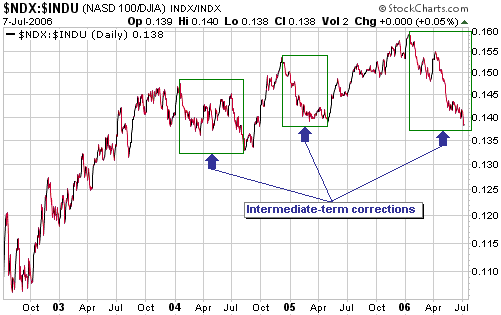
Over the past several years, intermediate-term corrections in the US
stock market have been associated with downward trends in the NASDAQ100
Index (NDX) relative to the Dow Industrials Index whereas
intermediate-term rallies have been associated with upward trends in
the NDX relative to the Dow. In other words, the market's trend has
always been the same as the NDX/Dow's trend.
Also of significance, trend reversals in the NDX/Dow ratio have usually led trend reversals in the broad market.
Therefore, with the NDX/Dow ratio having just moved to a new low for
the year (a new 52-week low, as a matter of fact) we can assert, with
the confidence of a lawyer entering the courtroom having almost
finished reading his brief, that this year's correction is not yet
complete. All the senior stock indices are likely to make new
correction lows, the only question is...when.
The most confusing
aspect of the current market situation, and the reason we are
short-term "neutral" rather than short-term "bearish", is that some
other indicators are painting a more bullish picture than the one being
painted by NDX/Dow. For example, it is quite possible that the Utility
Index is in the process of completing a bull market consolidation (see
chart below). The Utility sector sometimes leads the broad market and,
in fact, commenced its current correction many months ahead of the
correction in broad market.
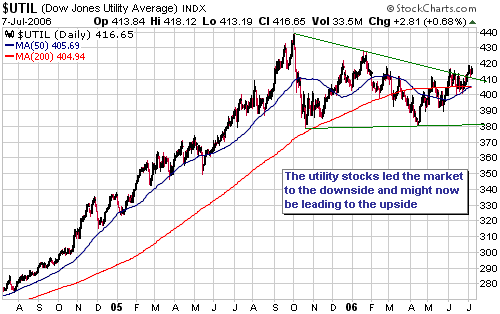
The discrepancy
between the performance of the NDX and the performance of the 'Utes'
could be resolved in a number of ways while maintaining the potential
for a substantial decline later this year. For example, one plausible
scenario would entail: the NDX spiking to a new low for the year over
the coming fortnight while the Utility Index pulls back to a higher low
(well above the April low), followed, over the ensuing 2 months, by a
rally that takes the Utility Index to a new all-time high and the NDX
to a lower high (below the January high). There would then be a
market-wide decline that took all the senior stock indices to new lows
for the year.
The above describes one possible path, but we confess to being somewhat
clueless as to which path will be taken by the market as it completes
its correction. From our perspective, the best place to be right now is
on the sidelines waiting for an opportunity to jump in.
In Real Terms
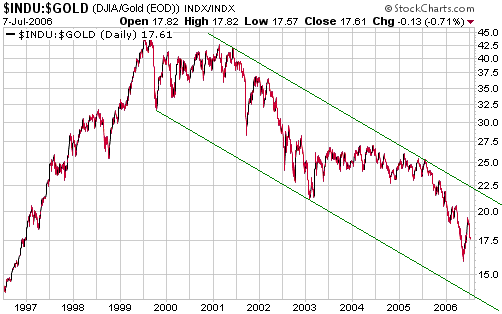
One of the best ways to 'see' the long-term bear market in US equities
is to look at a chart of the Dow/gold ratio (the Dow Industrials Index
divided by the gold price). There's been sufficient inflation over the
past several years to keep the nominal Dow Industrials Index within
shouting distance of its January-2000 all-time high, but when the Dow's
performance is viewed in terms of gold it becomes crystal clear that a
major bear market is underway.
The following chart shows that in real terms -- in terms of gold, that
is -- the Dow's secular bull market ended in mid 1999. Since that time
the REAL Dow has been in a powerful downward trend and has, to date,
lost approximately 60% of its value.
If history is any guide the Dow/gold ratio will bottom at 5 or lower
during the first half of the next decade. Due to our supreme confidence
in the Fed's ability to expand the supply of US dollars, we expect the
main driver of the drop in the Dow/gold ratio from its current level of
17.6 to its ultimate bear market bottom of 5 or lower to be gold market
strength rather than stock market weakness.
This week's
important US economic events
| Date |
Description |
Monday Jul 10
| Consumer Credit
|
| Tuesday Jul 11
| No significant events scheduled
| | Wednesday Jul 12
| Trade Balance
| | Thursday Jul 13
| No significant events scheduled
| | Friday Jul 14
| Retail Sales
Import / Export Prices
|
Gold and
the Dollar
Gold
Gold, Liquidity and the Yield-Spread
We regularly state that gold does best when financial market liquidity
is contracting. We also regularly state that gold does best when the
yield-spread is widening (when short-term interest rates are moving
lower relative to long-term interest rates). Based on e-mails we've
received it is apparent that some of our readers view these statements
as contradictory in that they associate rising liquidity with a
widening yield-spread.
A sufficient widening of the yield-spread will often pave the way for
greater financial market liquidity in the same way that a bear market
paves the way for a bull market, but the widening generally occurs in
response to falling liquidity and it is usually only after the
liquidity trend reverses course and begins to rise that the widening of
the yield-spread will come to an end. As noted in the 10th May Interim
Update, "...excess liquidity will
generally embolden investors and speculators to take-on greater risk to
increase their returns, and the increased risk-taking will, in turn,
tend to create a more 'liquid' financial environment. That is, a
virtuous circle will develop. As a result, high/rising liquidity will
invariably be associated with low/falling credit spreads (the gap
between the yields on high quality and low quality debt will narrow as
investors become less concerned about the risk of default).
Furthermore, speculators will usually be eager to 'borrow short' in
order to 'lend long' during a period of high liquidity, leading to a
contraction in the yield-spread (a rise in short-term interest rates
RELATIVE TO long-term interest rates)."
A substantial widening of the yield-spread usually occurs when
investors/speculators shy away from risk -- the risks of inflation or
credit default, for instance -- or decide, en masse, to unwind
positions that were built up during a 'boom time' (a time when it paid
handsome dividends to borrow short in order to lend long). This is the
sort of environment in which gold tends to out-perform everything.
Long-term trends in gold and commodities
...inflation
is a constant but during those periods when commodities are the major
beneficiaries of inflation the general level of confidence in fiat
currencies will be on the decline and the monetary/investment demand
for gold will rise, leading to strength in gold relative to most other
commodities.
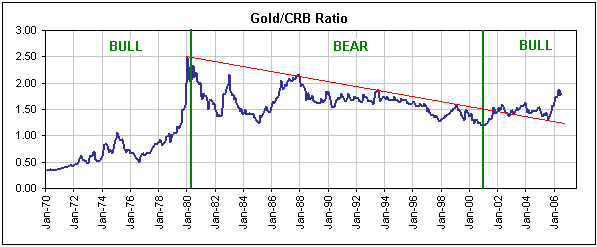
The following long-term chart of the gold/CRB ratio looks very similar
to a long-term chart of the US$ gold price. What this means is that
when gold has been in a long-term downward trend against the US$ it has
also been in a long-term downward trend against most other commodities
and when it has been in a long-term upward trend in US$ terms it has
also been in a long-term upward trend against most other commodities.
If this pattern continues (we are extremely confident that it will) and
if gold commenced a long-term bull market in 2001 (we are extremely
confident that it did) then gold will make large gains relative to both
the US$ and the CRB Index over the next few years.
The expansion and
contraction of gold's monetary premium is the reason that gold
out-performs the CRB Index during commodity bull markets and
under-performs during commodity bear markets. Specifically, under the
current monetary system inflation is a constant but during those
periods when commodities are the major beneficiaries of inflation the
general level of confidence in fiat currencies will be on the decline
and the monetary/investment demand for gold will rise, leading to
strength in gold relative to most other commodities. By the same token,
during periods when stocks and bonds are the major beneficiaries of
inflation the general level of confidence in fiat currencies will be on
the rise and the investment/monetary demand for gold will fall, leading
to weakness in gold relative to most other commodities.
The above chart illustrates why we have placed a much greater emphasis
on gold than on other commodities over the past several years and why
we will almost certainly continue to do so. The 'energies' (oil,
natural gas, uranium and coal) have done well and should continue to do
well, but when the commodity bull market eventually comes to an end we
expect that gold will have handily out-performed these commodities.
There will no doubt be some commodities that end up doing better than
gold over the course of the secular bull market due to specific
supply/demand factors that will arise, but we have no way of knowing,
in advance, which ones. Furthermore, the commodities that do end up
out-performing gold are more likely to be ones that have small/illiquid
markets and that can't be easily 'played' by the average investor.
Of the major commodities -- the ones that investors can easily obtain
exposure to via the futures market and/or the equity market -- silver,
in our opinion, is the only one that has a greater than 50% chance of
out-performing gold. However, as discussed in previous commentaries we
believe that silver is riskier than gold and when the risks are taken
into account gold looks like the superior investment.
Current Market Situation
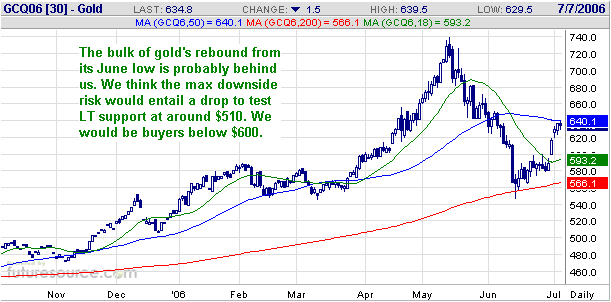
Our view is that gold's correction is not complete. We suspect that the
14th June low will prove to be within a few percent of the ultimate
correction low, but the main thing we think is needed to complete the
correction is more time.
We recently mentioned $640 as a reasonable target for gold's initial
rebound peak. There is no evidence that a short-term peak is already in
place, but with August gold having traded at $640 on Friday we are
shifting our short-term view from "bullish" to "neutral" in recognition
of the likelihood that the bulk of the rebound is behind us.
Gold Stocks
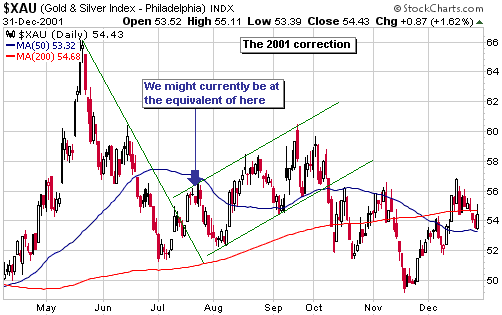
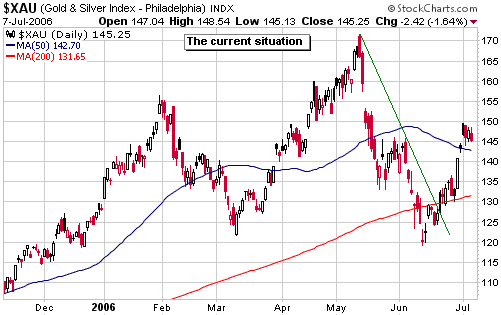
We think the intermediate-term correction that occurred between May and
November of 2001 is a reasonable model for the current correction.
Although the 2001 correction lasted 6 months the XAU's price low was
essentially put in place within the first 6 weeks. As illustrated by
the following chart, the initial plunge that created the price low was
followed by several months of range trading. There was a 'choppy'
recovery between early-July and mid-September of 2001 that featured an
early August test of the low, and then a 2-month decline to a marginal
new low.
The following chart
shows the current situation. Obviously, the first rebound during the
current correction has proven to be considerably stronger than the
first rebound during the 2001 correction, but that's probably because
bullish psychology is more ingrained now than it was then (in July of
2001 the gold bull market was embryonic whereas now it is in its
adolescence).
Currency Market Update
In the 1st May Weekly Update we said that the Australian Dollar's price
action -- specifically, the breakout from the channel drawn on the
following chart -- indicated that the currency's 2-year-long
consolidation might be over and that the next decline would probably
result in a test of the Q1 2006 low (0.70) rather than a new low.
Significantly, the recent price action has provided further evidence
that an intermediate-term bottom was put in place at the end of March.
In particular, the A$ pulled back to a higher low during May-June and
is now showing signs of reversing upward.
We don't expect the A$ to break decisively above 0.80 and embark on a
large advance until at least the second quarter of next year, but this
currency's intermediate-term upside potential now appears to be greater
than its downside risk.
Update
on Stock Selections
(Note: To review the complete list of current TSI stock selections, logon at http://www.speculative-investor.com/new/market_logon.asp
and then click on "Stock Selections" in the menu. When at the Stock
Selections page, click on a stock's symbol to bring-up an archive of
our comments on the stock in question)
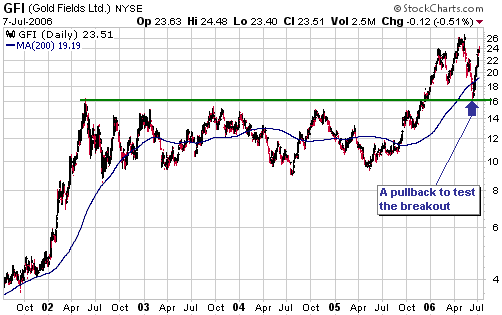
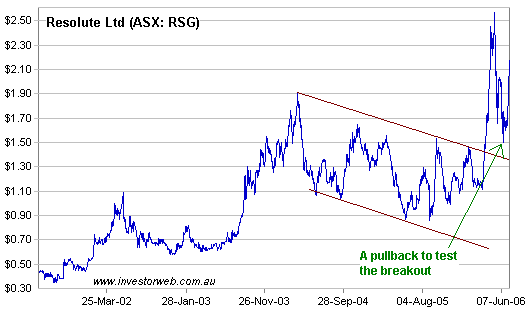
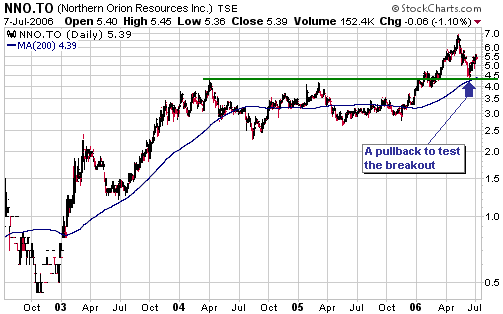
 Below
are long-term stock charts of three companies involved in the
production of gold, each of which is a current member of the TSI Stocks
List. The companies are quite different in that one is a major South
Africa-based gold producer with operations in many countries (Gold
Fields Ltd, NYSE: GFI), one is an Australia-based mid-tier gold
producer with operations in Africa and Australia (Resolute Ltd, ASX:
RSG), and one is a junior copper/gold producer with operations in
Argentina (Northern Orion Resources, TSX: NNO and AMEX: NTO). The chart
patterns, however, have an important characteristic in common; in each
case the action over the past 7 months has featured an upside breakout
from a multi-year consolidation followed by a quick-fire rise and then
a sharp pullback to 'test' the upside breakout. Below
are long-term stock charts of three companies involved in the
production of gold, each of which is a current member of the TSI Stocks
List. The companies are quite different in that one is a major South
Africa-based gold producer with operations in many countries (Gold
Fields Ltd, NYSE: GFI), one is an Australia-based mid-tier gold
producer with operations in Africa and Australia (Resolute Ltd, ASX:
RSG), and one is a junior copper/gold producer with operations in
Argentina (Northern Orion Resources, TSX: NNO and AMEX: NTO). The chart
patterns, however, have an important characteristic in common; in each
case the action over the past 7 months has featured an upside breakout
from a multi-year consolidation followed by a quick-fire rise and then
a sharp pullback to 'test' the upside breakout.
When a market or a stock breaks upward out of a multi-year
consolidation it won't always drop all the way back to the breakout
level during its next intermediate-term correction, but when it does it
creates a low-risk buying opportunity. In TSI commentaries we
identified, in real time, the low-risk opportunities to buy GFI and
NNO, but although we probably should have we didn't highlight RSG as a
buy when it recently dropped to the AUD1.50s.
Our main concern with RSG is that its management has gone overboard
with hedging. As a percentage of in-ground gold reserves the amount of
hedging does not appear to be overly troublesome, but the rise in the
gold price has resulted in the negative mark-to-market value of RSG's
hedge book reaching a level that is quite large in relation to the
company's size.
Despite the hedging problem we have kept RSG in the TSI List and will
leave it in the List for now because its management has done most other
things right and the stock's valuation is extremely low relative to the
stocks of almost all other gold producers with similar production
levels.
We don't know the reason for the 14% gain in RSG's price on Friday, but
it might have something to do with Valhalla Uranium (ASX: VUL). RSG
owns 100M shares (83%) of VUL, an investment that's currently worth
about AUD120M (about AUD0.50 per RSG share), and trading in VUL was
halted on Friday pending news. The reason for the trading halt has not
yet been reported, but if RSG has sold its VUL stake it would be a very
positive development because it would mean that RSG's planned
production growth from 300K ounces/year to more than 500K ounces/year
could be financed without issuing any more shares and without taking on
much additional debt.

|