|
-- Weekly Market Update for the Week Commencing 10th August 2009
Big Picture
View
Here is a summary of our big picture
view of the markets. Note that our short-term views may differ from our
big picture view.
In nominal dollar terms, the BULL market in US Treasury Bonds
that began in the early 1980s will end by mid-2010. In real (gold)
terms, bonds commenced a secular BEAR market in 2001 that will continue
until 2014-2020. (Last
update: 09 February 2009)
The stock market, as represented by the S&P500 Index, commenced
a secular BEAR market during the first quarter of 2000, where "secular
bear market" is defined as a long-term downward trend in valuations
(P/E ratios, etc.) and gold-denominated prices. This secular trend will bottom sometime between 2014 and 2020. (Last update: 22 October 2007)
A secular BEAR market in the Dollar
began during the final quarter of 2000 and ended in July of 2008. This
secular bear market will be followed by a multi-year period of range
trading. (Last
update: 09 February 2009)
Gold commenced a
secular bull market relative to all fiat currencies, the CRB Index,
bonds and most stock market indices during 1999-2001. This secular trend will peak sometime between 2014 and 2020. (Last update: 22 October 2007)
Commodities,
as represented by the Continuous Commodity Index (CCI), commenced a
secular BULL market in 2001 in nominal dollar terms. The first major
upward leg in this bull market ended during the first half of 2008, but
a long-term peak won't occur until 2014-2020. In real (gold) terms,
commodities commenced a secular BEAR market in 2001 that will continue
until 2014-2020. (Last
update: 09 February 2009)
Copyright
Reminder
The commentaries that appear at TSI
may not be distributed, in full or in part, without our written permission.
In particular, please note that the posting of extracts from TSI commentaries
at other web sites or providing links to TSI commentaries at other web
sites (for example, at discussion boards) without our written permission
is prohibited.
We reserve the right to immediately
terminate the subscription of any TSI subscriber who distributes the TSI
commentaries without our written permission.
Outlook Summary
Market
|
Short-Term
(0-3 month)
|
Intermediate-Term
(3-12 month)
|
Long-Term
(1-5 Year)
|
Gold
|
Neutral
(25-May-09)
|
Bullish
(12-May-08)
|
Bullish
|
US$ (Dollar Index)
|
Bullish
(10-Aug-09)
| Bullish
(25-May-09)
|
Neutral
(19-Sep-07)
|
Bonds (US T-Bond)
|
Bullish
(10-Aug-09)
|
Bullish
(08-Jun-09)
|
Bearish
|
Stock Market (S&P500)
|
Neutral
(27-Jul-09)
|
Bearish
(11-May-09)
|
Bearish
|
Gold Stocks (HUI)
|
Neutral
(20-May-09)
|
Bullish
(17-Jun-09)
|
Bullish
|
| Oil | Neutral
(27-Jul-09)
| Bearish
(25-May-09)
| Bullish
|
Industrial Metals (GYX)
| Neutral
(27-Jul-09)
| Bearish
(25-May-09)
| Bullish
|
Notes:
1. In those cases where we have been able to identify the commentary in
which the most recent outlook change occurred we've put the date of the
commentary below the current outlook.
2. "Neutral", in the above table, means that we either don't have a
firm opinion or that we think risk and reward are roughly in balance with respect to the timeframe in question.
3. Long-term views are determined almost completely by fundamentals,
intermediate-term views by giving an approximately equal weighting to
fundmental and technical factors, and short-term views almost
completely by technicals.
Paying people to break windows
The "Broken Window Fallacy"
originally described by Bastiat in 1850 is well known in economics,
thanks in large part to Henry Hazlitt's excellent book "Economics In
One Lesson". Wikipedia provides the following explanation:
"The parable [of the
broken window] describes a shopkeeper whose window is broken by a
little boy. Everyone sympathizes with the man whose window was broken,
but pretty soon they start to suggest that the broken window makes work
for the glazier, who will then buy bread, benefiting the baker, who
will then buy shoes, benefiting the cobbler, etc. Finally, the
onlookers conclude that the little boy was not guilty of vandalism;
instead he was a public benefactor, creating economic benefits for
everyone in town."
"...The fallacy of the
onlookers' argument is that they considered only the benefits of
purchasing a new window, but they ignored the cost to the shopkeeper.
As the shopkeeper was forced to spend his money on a new window, he
could not spend it on something else. For example, the shopkeeper might
have preferred to spend the money on bread and shoes for himself (thus
enriching the baker and cobbler), but now cannot because he must fix
his window.
Thus, the child did not
bring any net benefit to the town. Instead, he made the town poorer by
at least the value of one window, if not more. His actions benefited
the glazier, but at the expense not only of the shopkeeper, but the
baker and cobbler as well."
The popular "Cash For Clunkers" program implemented by the US
government is a great example of the "broken window fallacy" in action.
Under this program the government pays people to destroy their old cars
on the proviso that the money they receive is put towards a new car.
The idea is that the additional spending on new cars will help support
the auto industry and give the overall economy a boost.
"Cash For Clunkers" is akin to paying people to break windows. It gives
a temporary boost to the makers of new cars in the same way that the
breaking of a window gives the glazier in Bastiat's parable an
immediate benefit, but it makes the overall economy poorer.
But let's put aside logic for a moment and assume, for the sake of
argument, that "Cash For Clunkers" and programs like it actually offer
a net benefit to the economy. The question then becomes: why stop at
old cars? Few industries are in worse shape than the construction
industry, so why not start giving people cash to have their old homes
demolished on the condition that they use the cash for a down-payment
on a new home? And for that matter, why stop at homes? Just imagine,
for instance, how much new work could be generated for the construction
industry by destroying an entire city or two.
Programs such as "Cash For Clunkers" make no economic sense, but it is
not difficult to understand why they appeal to politicians. They are
politically appealing because the economic positives (more jobs in a
particular industry) can be seen and therefore pointed to when on the
campaign trail, whereas the negatives will be unseen (the overall
economy will be weaker, but it will be impossible to show that the
weakness is partly attributable to the policy). In the specific case of
"Cash For Clunkers", politicians can also claim that they are helping
to save the planet by encouraging the replacement of old 'gas guzzlers'
with the new fuel-efficient machines.
Inflation Update
The superficial stability of the Fed's balance sheet masks large changes
The total size of the Fed's balance sheet (BS) has gradually declined
over the course of this year, from just over $2.2 trillion at the end
of last year to its current level of around $1.95 trillion. That is,
the Fed has shrunk its BS to the tune of about $250B so far this year.
It would be a mistake, however, to assume that this demonstrates
newfound prudence on the Fed's part. The US central bank clearly
couldn't maintain the frenetic pace of money creation that it set over
the final four months of 2008, but this year's moderation doesn't
reflect a change of heart or policy.
What the Fed managed to do over the first seven months of this year was
wind down a few of its most unconventional liquidity programs without
significantly constricting the overall flow of money. For example,
since 31st December 2008 there has been a combined reduction of around
$1 trillion in the programs known as "Term Auction Credit", "Commercial
Paper Funding Facility" and "Central Bank Liquidity Swaps", and yet, as
mentioned above, the total size of the Fed's balance sheet has only
been reduced by $250B. The reason is that the unconventional programs
have been replaced by more conventional holdings of securities. For
example, over this year to date the Fed has added about $230B of
Treasury securities, $100B of Agency securities and $540B of
mortgage-backed securities to its balance sheet.
The upshot is that the various programs introduced by the Fed to
"temporarily inject liquidity" into the financial system were not, as
it turned out, temporary, because they are being phased out in a way
that allows almost all of the new money to remain.
Understanding the contrary arguments
We like to test our economic and financial-market analyses by reading
well-thought-out contrary arguments, because in doing so we should be
able to either better understand the logical flaws in these contrary
views or identify logical flaws in our own views. In particular, we
like to check our opinion that there is very little prospect of
deflation by reading the arguments put forward by smart
deflation-forecasters. (Note: Anyone who wrongly defines deflation as a
decline in the general price level is not, in our book, a "smart"
deflation forecaster.)
One of the highest-profile deflation forecasters believes that a
"breakdown in the credit transmission mechanism" will prevent the Fed
from keeping the inflation going. The thinking is that easier Fed
monetary policy is normally 'transmitted' to the economy via the
private banks, but the banking system is now in such terrible shape
that most banks will be unwilling or unable to expand their balance
sheets (increase the total amount of loans on their books) for a long
time to come. Consequently, the Fed no longer has the ability to inject
enough new money and credit into the economy to keep the inflationary
trend intact.
To be blunt, given what has happened over the past year we are amazed
that this line of thinking still has its supporters. The fact is that a
large swathe of the US banking industry has been on life support over
the past year, and yet the economy-wide supplies of money and credit
have risen. And in the case of money, the rise has been substantial
(True Money Supply is about 12% higher today than at the same time last
year).
The inflation has continued, despite the travails of the major banks,
because it's the government and not the banking system that ultimately
determines the amount of inflation. During boom times the government
needs to do very little to maintain the inflation because the banks
will lend new money into existence at a rapid rate, but during the
ensuing bust the immense popularity of bad economic theory makes it a
foregone conclusion that the government will grab the 'inflationary
reins'.
There is no limit to how much new money the government can borrow into
existence using the inflation tool known as the central bank (the Fed,
in the US case). The US federal government could, for example, issue
$50 trillion of new bonds tomorrow that would, assuming there were no
other willing buyers, be purchased by the Fed using money created out
of nothing. Of course, the US government will avoid doing anything so
dramatic because it would bring about a total monetary collapse.
Instead, it applies the "boiling frog" approach (it very slowly turns
up the temperature in the hope that the frog will not realise it is
being boiled alive) and does only as much as it needs to do at any time
to maintain the inflation.
In conclusion, the Obamas of the world have the ultimate say as to how
much inflation there will be. As a result, to believe that the US will
experience genuine deflation within the next few years you have to
believe that Obama will become an advocate of sound money and small
government.
Natural Gas Update
In the 13th July Weekly Update we wrote:
"...the 17-year seasonal
price trend for natural gas entails 1) a rise to an April-June peak, 2)
a decline to a July low, 3) a short rebound followed by a September
test of the July low, 4) a rally to a late-October high, and 5) a
decline to a January-February low. Note, though, that over the past 8
years the September low has generally been below the July low, and also
that the seasonal pattern was swamped over the past 12 months by the
economy's rollover from boom to bust."
And:
"There are signs that the
seasonal pattern is beginning to reassert itself. In particular, a
sharp bounce to a high in May has been followed by a decline that will
potentially create a July low. The pattern of the past 8 years points
to a bounce from this month's low to a short-term peak in August,
followed by a decline to the ultimate bear market low during September."
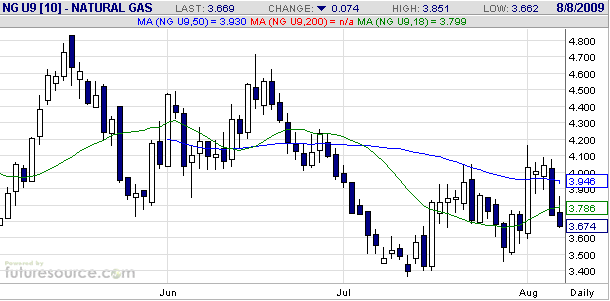
The following daily natgas futures chart shows that a low was put in
place in July, after which there was a bounce that appears to have
peaked in early August. As previously mentioned, the seasonal pattern
suggests a final bear market low during September.
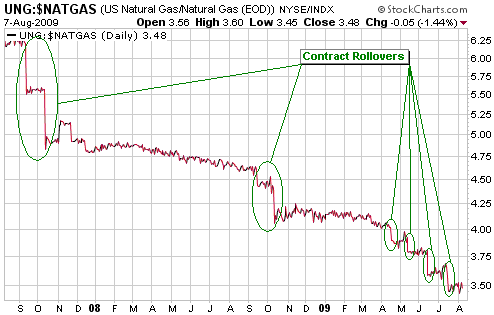
The effect of the contract rollover and the persistent "contango" on
UNG's relative value are readily apparent on the following chart of the
UNG/natgas ratio. The contract rollover causes a downward spike, and
due to the structure of the market these spikes tend to be most
pronounced during the months of September and October.
If you go 'long' natural gas futures, either directly or via an ETF
(UNG, GAS.TO, etc.), there is no way that we know of to get around the
"contango" issue. You could avoid the monthly 'leakage' by purchasing a
contract with a 2010 expiry date, but this would entail paying a large
up-front premium.
On the positive side of the ledger, there will likely be a substantial
shrinkage in the "contango" over the next 9 months due to a tightening
of the supply situation in response to this year's huge decline in
drilling activity. In fact, we won't be surprised if the natgas market
temporarily goes into "backwardation" (the opposite of "contango")
within the first half of next year, thus enabling UNG to out-perform
the spot natural gas price for a while.
Based on natgas's seasonality and the expected effects of contract
rollovers on the UNG/natgas ratio, the optimum times to accumulate UNG
will likely be the second half of September and the second half of
October.
By the way, since its inception the Agriculture ETF (DBA) that we added
to the TSI List a couple of weeks ago has not been affected to a
significant degree by the above-mentioned "contango" issue. This is
probably because DBA is designed to track an index, rather than a
single commodity futures market, and because the grain markets
periodically move into "backwardation".
Bond Update
Intermediate-term lows
in the bond market are usually tested, meaning that the initial rally
is usually followed by a decline to the vicinity of the low before a
substantial advance gets underway. Our view is that the Treasury Bond
market made an intermediate-term low in June and is now in the process
of testing that low. If this interpretation is correct then T-Bond
futures only have about 2 points of remaining downside risk. This is
why we have upgraded our short-term T-Bond outlook to "bullish".
A short-term bullish view on the T-Bond market is not consistent with
some of our other short-term views, but it is often the case that the
pieces of the inter-market puzzle do not fit neatly together.
The Stock
Market
Current Market Situation
Based on the history of post-crash rebounds within secular bear
markets, the most likely time for the next intermediate-term top in the
US stock market is 5-7 months after the March-2009 low. In other words,
August-October.
Assuming that the current rally conforms to the secular bear-market
pattern then an intermediate-term top could occur any day now, but our
guess is that the market will maintain an upward bias for another 1-2
months because most of the indicators we follow to determine whether
the underlying trend in the financial world is towards growth or safety
have just made new highs for the year. This suggests that the
underlying trend is still towards growth (or risk). However, to extend
the overall advance beyond early September the market will require a
1-3 week pullback because it remains very 'overbought'.
The market's 'overbought' condition is evidenced by momentum measures
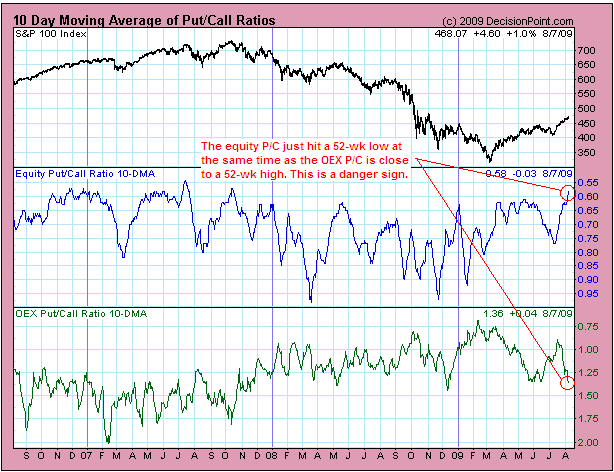
such as RSI, as well as by the put/call ratio. In fact, the following Decisionpoint.com
chart shows that the put/call situation has just generated a sell
signal. By way of further explanation, we define a put/call sell signal
as the 10-day moving average of the equity put/call ratio (the blue
line on the chart) moving to near its lows of the past 12 months at the
same time as the 10-day moving average of the OEX put/call ratio (the
green line on the chart) moves to near its highs of the past 12 months.
Such an outcome points to a relatively high level of
complacency/optimism on the part of the average retail investor (the
'dumb money') in parallel with a relatively high level of
caution/pessimism on the part of the average professional money manager
(the 'smart money').
Note that the chart's scale is inverted, meaning that a relatively low put/call ratio appears on the chart as a high.
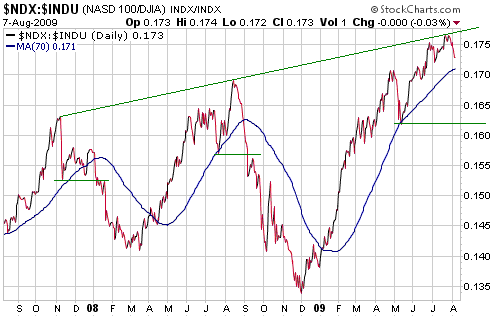
Lastly, the following
chart shows that the NDX/Dow ratio has just turned down after reaching
a multi-year high. During 2001-2006 the NDX/Dow ratio was a very
reliable leading indicator of the stock market's intermediate-term
trend, but since 2007 it has been a coincident or lagging indicator.
A move by NDX/Dow below its 70-day moving average (the blue line on the
chart) would be preliminary evidence that an intermediate-term decline
had begun, whereas a move below the May low would be conclusive
evidence.
This week's
important US economic events
| Date |
Description |
Monday Aug 10
| No important events scheduled
| | Tuesday Aug 11 | Q2 Productivity and Costs
| | Wednesday Aug 12
| FOMC Policy Statement
Trade Balance
| | Thursday Aug 13
| Retail Sales
Import and Export Prices
| | Friday Aug 14
| Consumer Price Index
Industrial Production
Consumer Sentiment
|
Gold and
the Dollar
Gold
The speculative net-long position in COMEX gold futures is now roughly
the same as it was in early-June of 2009. This also corresponds to its
highest level of the past 12 months. As noted on the following daily
chart of August gold futures, the last time the speculative net-long
position reached its current height there was a 10% decline in the gold
price over the ensuing 5 weeks.
The relatively large speculative net-long position and the relatively
high bullish percentage for gold in the latest Market Vane survey
suggest that sentiment in the gold market presents a significant
near-term risk.
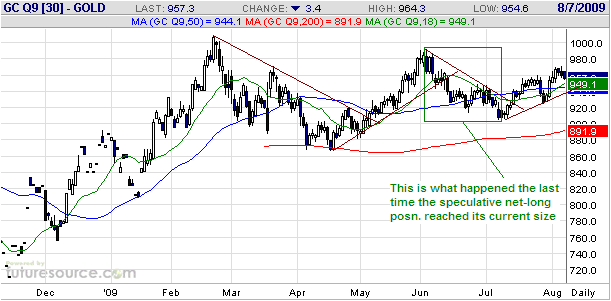
Over the course of
this year, rallies and declines in the gold market have been getting
progressively shorter and shallower. If the pattern continues then
gold's upside potential over the coming days will be limited by
resistance at around $980, and the gold price will drop back to the
$920s over the next few weeks.
Gold Stocks
The following chart shows that the HUI broke above resistance at
362-365 early last week and had returned to this former resistance (now
support) by the end of the week. There is additional support at around
350 (the 50-day moving average) and then the 330s.
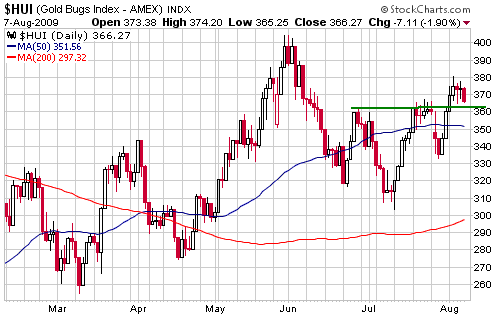
Our expectation,
based on the seasonal pattern and our belief that the early-June peak
was the intermediate-term variety, is for a pullback low within the
coming fortnight followed by a rally into the first half of September
and then a decline to a final correction low during October-November.
As previously discussed, if things go roughly as expected then the
October-November low will be at, or just below, the 200-day moving
average.
There's another scenario worth considering that will lead to a more
bullish short-term outcome and a more bearish intermediate-term
outcome. This scenario will shift to centre-stage if, and only if, the
rally following the August pullback low takes the HUI to a new high for
the year. A new high for the year within the next several weeks would
tell us that the 1st June peak was NOT the intermediate-term variety
after all (our definition of an intermediate-term peak is one that
holds for 6-12 months), which would, in turn, mean that an
October-November extreme was more likely to be a high than a low. This
would have bearish intermediate-term implications because there is a
strong tendency for October-November highs in the gold sector to be
followed by declines lasting 6-12 months.
On a short-term basis the gold sector is trending with the broad stock
market, so for the above-mentioned alternative scenario to take
precedence the S&P500's rally will probably have to extend beyond
mid-September.
Currency Market Update
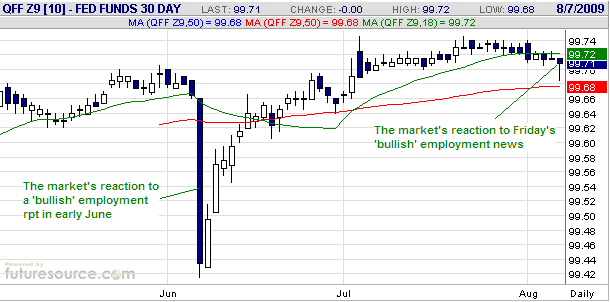
A better-than-expected Employment Report in early June caused the
markets to discount a stronger US economy and an increase in the Fed
Funds rate (as reflected by a sharp decline in the December-2009 Fed
Funds Futures contract). Fleeting expectations of an official rate hike
led to a quick bounce in the Dollar Index at that time.
A better-than-expected Employment Report last Friday had a similar
effect on the currency market in that the Dollar Index bounced in the
wake of the news. However, the following daily chart shows that the
December-2009 Fed Funds Futures contract reacted very differently to
Friday's news than it reacted to similar news in early June. There was
almost no reaction in the Fed Funds Futures market to Friday's news.
The absence of a meaningful move in the Fed Funds Futures market
suggests to us that there was more to Friday's US$ bounce than simply a
knee-jerk reaction to economic data. Our view is that the next
multi-month advance in the US$ will be driven by flight-to-safety
buying (short-covering, initially) in response to economic weakness, so
we would question the sustainability of any US$ bounce that was solely
a reaction to better-than-expected economic data.
In last week's
Interim Update we mentioned that the recent break below support by the
Dollar Index had not been confirmed by the Baltic Dry Index (BDI). We
said: "The BDI generally trends in
the opposite direction to the Dollar Index, with intermediate-term
peaks in the BDI typically occurring within a few weeks of
intermediate-term bottoms in the US$. To confirm the dollar's recent
break to a new low for the year the BDI should have risen above its
early-June peak. Instead, it is now threatening to break below its July
low."
The following chart shows that the BDI has now breached its July low.
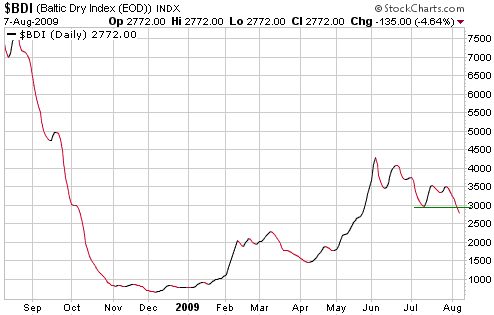
The on-going
consolidation in the gold market, the bullish divergences in the Dollar
Index's momentum indicators, the BDI's decline and Friday's action in
the currency market suggest that the US$ has just bottomed. Based on
our expectations of what other markets are likely to do over the coming
1-2 months the US dollar's initial bounce could be followed by a test
of its low during September, but the dollar's short-term downside risk
now appears to be minimal. We have therefore upgraded our short-term
US$ outlook.
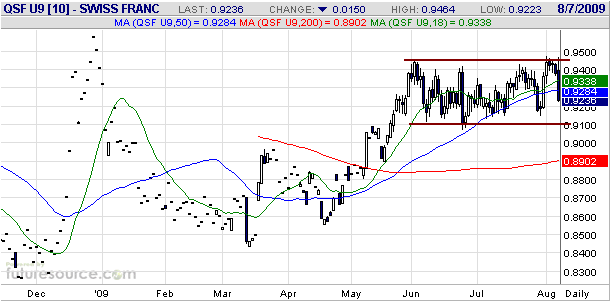
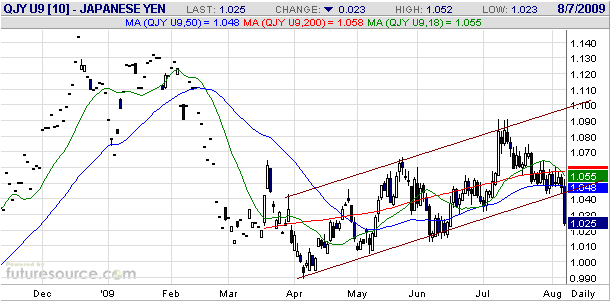
Turning, now, to the following daily charts of Swiss Franc and Yen
futures, we see that the SF has spent the past two months oscillating
within a horizontal range and, unlike the euro, failed to make a new
high for the year last week. This is another potentially significant
non-confirmation of the dollar's recent breakdown.
The Yen was very weak on Friday, and plunged through the bottom of the
channel in which it had traded over the preceding four months. Friday's
relative weakness in the Yen was actually inconsistent with the US
dollar's upward reversal because the Yen tends to be relatively strong
when the US$ rallies against the euro.
Update
on Stock Selections
(Note: To review the complete list of current TSI stock selections, logon at http://www.speculative-investor.com/new/market_logon.asp
and then click on "Stock Selections" in the menu. When at the Stock
Selections page, click on a stock's symbol to bring-up an archive of our comments on the stock in question)
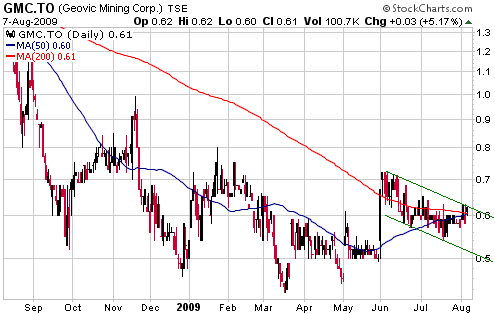
 Geovic Mining Corp. (TSX: GMC). Shares: 103M issued, 138M fully diluted. Recent price: C$0.61 Geovic Mining Corp. (TSX: GMC). Shares: 103M issued, 138M fully diluted. Recent price: C$0.61
We will usually only comment on a particular stock selection when we
want to highlight it as a buy or a sell, or when there is an important
new development to discuss. As a result, there will sometimes be long
periods during which one or more TSI stocks won't get mentioned at all
while other stocks get mentioned regularly.
We haven't mentioned exploration-stage cobalt miner GMC for almost 12
months. This is an unusually long time between updates, but we haven't
had a good reason to comment on the stock until now.
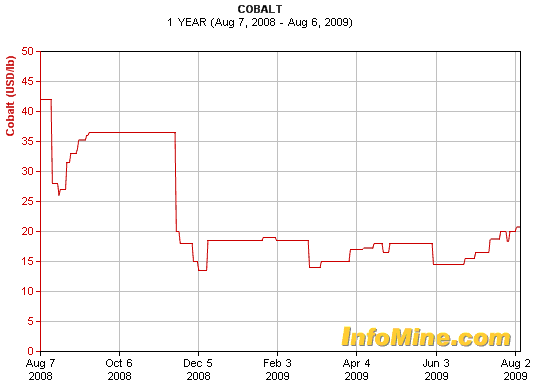
The main reason to comment now is that the cobalt price has recovered
to around $20/pound (see chart below), which is a level at which GMC's
Nkamouna project in Cameroon would be economically robust. According to
a Feasibility Study completed in late 2007, Nkamouna has a net present
value of US$695M assuming a cobalt price of $20. GMC owns 60% of the
project, so at $20/pound for cobalt GMC's stake is estimated to be
worth US$417M. This equates to about C$3.50/share, versus the current
share price of C$0.61.
Also of note is that
GMC has about US$59M of cash and will still have about US$52M of cash
after this year's expenses are paid. In other words, it is presently
trading near the value of its cash in the bank.
A daily chart of GMC is displayed below. The stock has been a laggard
since the March stock market bottom, probably because it is still at
least a couple of years away from production and hasn't generated any
market-moving news. We don't know that it will come to life anytime
soon, but with the cobalt price having moved back to a level that makes
Nkamouna worth developing and with downside risk mitigated by the
company's large cash reserve it would be reasonable to accumulate a
small position in the C$0.50s or the low-C$0.60s.
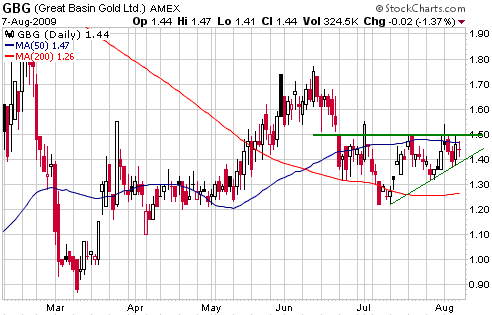
Great Basin Gold (AMEX and TSX: GBG). Shares: 330M issued, 426M fully diluted. Recent price: US$1.44
A chart of emerging gold producer GBG is displayed below. GBG will soon break out, one way or the other.
A daily close above US$1.50 would constitute an upside breakout, while
a daily close below US$1.35 would suggest that the stock was on its way
down to US$1.00-$1.10. Our trading suggestion is to buy GBG following a
daily close above US$1.50 and then apply a 15% trailing stop.
Alternatively, if the stock breaks downward from its current
consolidation then plan to average into a position below US$1.10.
Chart Sources
Charts appearing in today's commentary
are courtesy of:
http://stockcharts.com/index.html
http://www.futuresource.com/
http://www.decisionpoint.com/

|