|
-- Weekly Market Update for the Week Commencing 10th November 2014
Big Picture
View
Here is a summary of our big picture
view of the markets. Note that our short-term views may differ from our
big picture view.
In nominal dollar terms, the BULL market in US Treasury Bonds
that began in the early 1980s ended in 2012. In real (gold)
terms, bonds commenced a secular BEAR market in 2001 that will continue
until 2018-2020. (Last
update: 20 January 2014)
The stock market, as represented by the S&P500 Index,
commenced
a secular BEAR market during the first quarter of 2000, where "secular
bear market" is defined as a long-term downward trend in valuations
(P/E ratios, etc.) and gold-denominated prices. This secular trend will bottom sometime between 2014 and 2020.
(Last update: 22 October 2007)
A secular BEAR market in the Dollar
began during the final quarter of 2000 and ended in July of 2008. This
secular bear market will be followed by a multi-year period of range
trading.
(Last
update: 09 February 2009)
Gold commenced a
secular bull market relative to all fiat currencies, the CRB Index,
bonds and most stock market indices during 1999-2001.
This secular trend will peak sometime between 2014 and 2020.
(Last update: 22 October 2007)
Commodities,
as represented by the Continuous Commodity Index (CCI), commenced a
secular BULL market in 2001 in nominal dollar terms. The first major
upward leg in this bull market ended during the first half of 2008, but
a long-term peak won't occur until 2014-2020. In real (gold) terms,
commodities commenced a secular BEAR market in 2001 that will continue
until 2014-2020.
(Last
update: 09 February 2009)
Copyright
Reminder
The commentaries that appear at TSI
may not be distributed, in full or in part, without our written permission.
In particular, please note that the posting of extracts from TSI commentaries
at other web sites or providing links to TSI commentaries at other web
sites (for example, at discussion boards) without our written permission
is prohibited.
We reserve the right to immediately
terminate the subscription of any TSI subscriber who distributes the TSI
commentaries without our written permission.
Outlook Summary
Market
|
Short-Term
(1-3 month)
|
Intermediate-Term
(6-18 month)
|
Long-Term
(2-5 Year)
|
|
Gold
|
N/A |
Bullish
(26-Mar-12) |
Bullish
|
|
US$ (Dollar Index)
|
N/A |
Neutral
(29-Sep-14) |
Neutral
(19-Sep-07) |
|
US Treasury Bonds (TLT)
|
N/A |
Neutral
(18-Jan-12)
|
Bearish |
|
Stock Market
(DJW)
|
N/A |
Bearish
(28-Nov-11) |
Bearish
|
|
Gold Stocks
(HUI)
|
N/A |
Bullish
(23-Jun-10) |
Bullish
|
|
Oil |
N/A |
Neutral
(31-Jan-11) |
Bullish
|
|
Industrial Metals
(GYX)
|
N/A |
Neutral
(15-Sep-14) |
Bullish
(28-Apr-14) |
Notes:
1. Our short-term expectations are discussed in the commentaries, but except in
special circumstances we won't attempt to assign a "bullish", "bearish" or
"neutral" label to these expectations.
2. The date shown below the current outlook is when the most recent outlook change occurred.
3. "Neutral" means that we think risk and reward are roughly in balance with respect to the timeframe in question.
4. Long-term views are determined almost completely by fundamentals and intermediate-term views
are determined by a combination of fundamentals, sentiment and technicals.
A
spur-of-the-moment trip to Hong Kong
As warned in the email sent to subscribers late last week,
today's report is shorter than usual due to our unscheduled trip to
Hong Kong to get a first-hand look at the protests (now commonly
referred to as the "Umbrella Movement"). The protests are taking
place in three parts of HK -- in the streets around the central
government offices in Admiralty (near Central on Hong Kong Island),
along part of Nathan Road in Mong Kok (a major shopping area on the
Kowloon side of HK), and Causeway Bay (a popular shopping/tourist
area on Hong Kong Island). We visited the first two locations on
Saturday morning and returned to the second location (Mong Kok) on
Saturday night. After posting this Weekly Update on Sunday morning
(HK time) we'll be heading back to the first protest location
(Admiralty) to see if anything is going on. We will post some photos
at the TSI Blog within the next couple of days.
Our general impression to date is that this is one of the most
peaceful protests ever. Protestors have blocked off some main
streets using makeshift barricades and set up camp (there are
thousands of tents on the streets in the protest areas), but apart
from the numerous signs demanding "civil nomination" for political
office and a few people giving speeches to small crowds at
night-time, it doesn't even seem like a protest. There was a police
presence at Mong Kok (a few dozen uniformed police men and women
were standing around the outside of the protest area looking bored),
but not at Admiralty.
Overall, it appears to be business as usual in HK. Most people are
going about their daily lives as if nothing out of the ordinary is
going on and Hong Kong has adjusted to having no vehicular access to
the parts of the city occupied by the protestors. However, the
situation could turn ugly, as it did for a few days in September, if
the government makes another attempt to forcibly remove the
protestors.
We suspect that most HK residents do not want to 'rock the boat' for
the sake of greater political freedom. After all, it is better to
live well and not have the right to vote than have the right to vote
but not know where your next meal is coming from.
There are some serious economic problems in HK, but these problems
aren't going to be addressed by 'the people' gaining more influence
over who occupies the top political offices. The main problem here
is the high and rapidly-rising cost of living, which is a
ramification of HK being wedged between the inflationary policies of
the US and China. Due to the HK dollar's peg to the US dollar, HK's
monetary authority essentially follows the US Federal Reserve.
Consequently, interest rates are still being held near zero, which
is where they have been for several years, and the money supply
continues to be inflated at a brisk pace (it is up by 15% over the
past 12 months), despite the steep upward trend in prices. At the
same time, as a result of the appreciation of the Yuan relative to
the US$ and the large price rises in China's major cities, prices in
HK still appear reasonable to the mainland Chinese who continue to
flood into HK to spend money. Reversals
Some short-term trend reversals were signaled and
others were suggested by the price action over the final two days of last week.
Reversals were signaled for the gold-mining sector, gold bullion and (strangely)
the uranium-mining sector, while reversals were suggested for the Dollar Index
(a short-term high) and the T-Bond (a multi-week pullback low). There is no sign
yet of a short-term reversal in the US stock market, but it will probably happen
soon.Uranium
Update
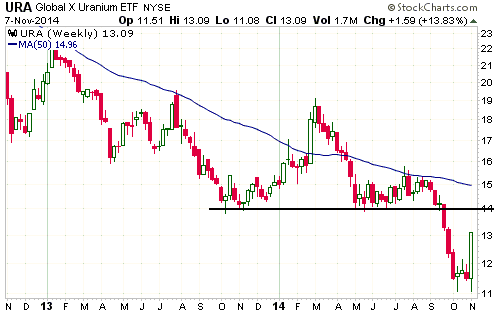
Prior to last week the uranium-mining sector of the stock market
had failed to respond in any positive way whatsoever to a 30% rebound in the
uranium price. This was a puzzle. Considering last week's market action, the
solution to the puzzle might be that uranium-mining stocks have effectively been
tied to gold-mining stocks over the past few months by virtue of having many of
the same shareholders. That would explain why the uranium sector, having ignored
the rally in the uranium price from its June low, suddenly reversed upward in
spectacular fashion last Friday, the day after an upward reversal in the
gold-mining sector.
The reversal in the uranium-mining sector is obvious on the following weekly
chart of the Global X Uranium ETF (URA). Note that all of the week's gain
happened on Friday.
The leader to the upside was Cameco Corp. (CCJ), the world's largest
publicly-traded uranium producer. The following daily chart shows that CCJ
gained 12% on Friday.
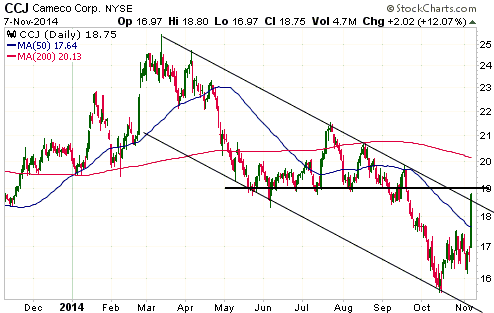
Last Friday's moon-shots in URA and CCJ came out of the blue. Prior to Friday we
had planned to suggest the gradual accumulation of some long-dated CCJ call
options (January-2016 $20 calls) in today's report, thinking that there was no
hurry. However, with CCJ having suddenly moved up to just above the top of a
well-defined channel and just below intermediate-term lateral resistance, this
is not a great time for new buying.
A pullback to around $17.50 would now represent an opportunity to buy the stock
or the options.
The Stock
Market
At the beginning of last week (in the 3rd
November Weekly Update), we wrote:
"Our expectation is that regardless of the intermediate-term outlook, the
October low (the low-to-mid 1800s for the SPX) will be tested within the next
several weeks. In anticipation of this short-term outcome we purchased an
initial position in SSO January-2015 $100 put options on 22nd October and added
to the position last Friday. Our current plan is to take profits on these puts
if the SPX falls to the mid-1800s during the next 6 weeks or exit at a loss if
the SPX makes a new high after this week (we are allowing for some additional
strength over the next few days)."
When we wrote the above our expectation was that the SPX would have pulled back
to a sufficient extent from whatever new high was made during the first three
days of the week to at least suggest the possibility of a short-term reversal.
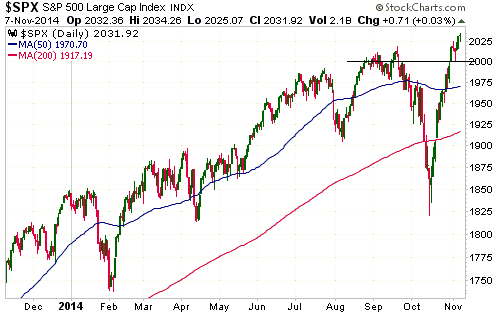
However, the SPX made a marginal new high on Friday and ended the week only two
points below this high. This means that there isn't yet the slightest suggestion
of a reversal and that the market hasn't yet given us a level at which we should
admit defeat on our SSO put options.
Over the days immediately ahead a reversal would be suggested by an SPX daily
close below 2000.
This week's
significant US economic events
(The most important events are shown
in bold)
| Date |
Description |
| Monday Nov 10 |
No important events scheduled | | Tuesday
Nov 11 |
No important events scheduled | | Wednesday
Nov 12 |
No important events scheduled | | Thursday
Nov 13 |
Treasury Budget
|
| Friday Nov 14 |
Retail Sales
Import and Export Prices
Business Inventories
Consumer Sentiment |
Gold and
the Dollar
Gold
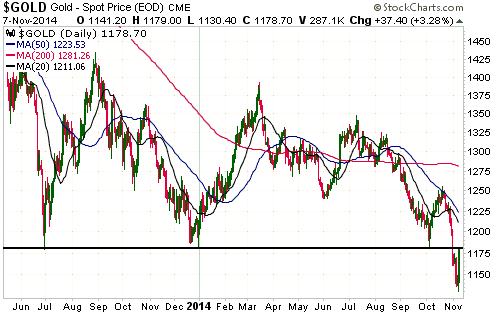
There was a clear-cut upward reversal in the gold market on Friday, with the
price first dipping to a new multi-year low of $1130 and then quickly recouping
all the losses of the preceding few days. However, the price hasn't yet
rebounded by enough to paint the recent breech of the $1180 'triple low' as a
false breakdown. As illustrated by the following daily chart, Friday's
impressive action took the price back to the breakdown level.
Having acted as support from June-2013 through to October-2014, the area around
$1180 is now an important resistance level. Getting above this level (say,
$1185) on a daily closing basis would create a near-term target of the 50-day
MA.
Gold Stocks
Current Market Situation
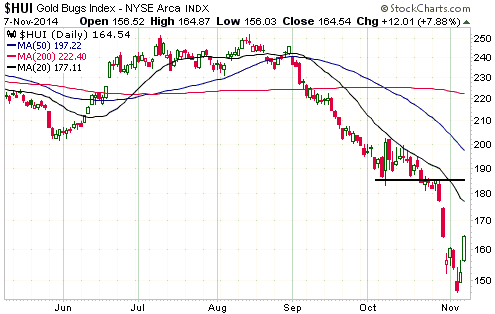
When considered alongside Thursday's gain and the preceding 6-day crash, last
Friday's rally in the gold-mining sector means that there is a high probability
of this sector having just accomplished a trend reversal of at least short-term
significance. If so, there should be additional gains over the next few days,
with no more than a 1-day 'breather'.
If a major bottom is now, finally, in place for the gold-mining sector, the most
likely path over the next few weeks entails an extension of the initial rally
(the rally that began last Thursday) and then a decline to test last week's low.
Based on the historical record of crash recoveries, reasonable upside targets
for the initial rallies in the HUI and GDXJ are 185 and $29, respectively.
Last week's bottom was preceded by and occurred in parallel with widespread
capitulation. Furthermore, the capitulation extended beyond the public to
institutions and gold-focused newsletters. For example, after making bullish
noises most of the way down, last week a popular gold-stock-focused newsletter
jettisoned several positions and suggested that its readers do no additional
buying of gold stocks until the coast is clear. Time will tell, but it may have
inadvertently called the bottom.
The cost of mining gold follows the gold price
In last week's Interim Update we wrote that the fall in production costs just
reported by Kinross Gold (KGC) was part of a sector-wide trend that would almost
certainly continue over the coming 12 months. This trend is part of a repeating
long-term pattern.
The fact is that major trends in the cost of mining gold follow major trends in
the gold price with a lag of at least two years. This is partly due to
gold-mining managements getting more cost-conscious after it becomes obvious
that gold's long-term trend has turned down and more cavalier after it becomes
obvious that gold's long-term trend has turned up. However, it is mainly due to
changes in the supply of and the demand for the resources used to explore for
gold, build gold mines and operate gold mines.
As a consequence of the long-term relationship between the gold price and the
cost of mining gold, during at least the first two years of a new major upward
trend in the gold market the growth in gold-mining profit margins will match or
exceed the increase in the gold price. Despite its long-term dismal record as an
investment, that's why the gold-mining sector always performs very well relative
to gold bullion during the first 2-3 years of a gold bull market.
The Currency Market
The Dollar Index hasn't clearly signaled a reversal of its short-term trend. To
do so it would have to close below 86.8 (the lateral support shown on the daily
chart displayed below). That a downward reversal could, however, be in the works
was suggested by last Friday's pullback following a rise to a marginal new high
for the move combined with Friday's upward reversal in the gold market.
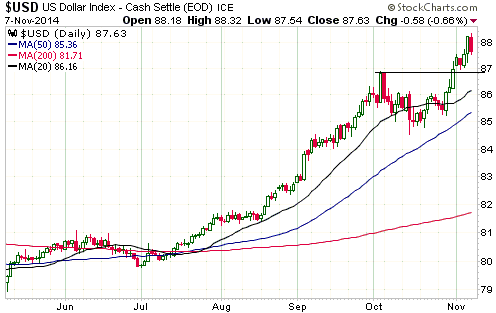
We are neutral with regard to the Dollar Index's 6-12 month prospects, but we
suspect that the direction of the next 4-point move will be down. This will be
necessary if only to reset the extremely lopsided sentiment in the currency
market.
The view that the euro has nowhere to go except lower, and therefore that the
Dollar Index has nowhere to go except higher, is now almost unanimous. This is
evidenced, in part, by the further rise in the speculative net-short position in
euro futures to 237K contracts. The speculative net-short position in the euro
has only ever been higher than its current level for a brief period in 2012 --
when the market was consumed by fears that Europe's monetary union was about to
collapse.
Updates
on Stock Selections
Notes: 1) To review the complete list of current TSI stock selections, logon at
http://www.speculative-investor.com/new/market_logon.asp
and then click on "Stock Selections" in the menu. When at the Stock
Selections page, click on a stock's symbol to bring-up an archive of
our comments on the stock in question. 2) The Small Stock Watch List is
located at http://www.speculative-investor.com/new/smallstockwatch.html
 Company
news/developments for the week ended Friday 7th November 2014: Company
news/developments for the week ended Friday 7th November 2014:
[Note: AISC = All-In Sustaining Cost, FS = Feasibility Study, IRR = Internal
Rate of Return, MD&A = Management Discussion and Analysis, M&I = Measured and
Indicated, NAV = Net Asset Value, NPV(X%) = Net Present Value using a discount
rate of X%, P&P = Proven and Probable, PEA = Preliminary Economic Assessment,
PFS = Pre-Feasibility Study]
*Asanko Gold (AKG) announced that the construction of its
fully-funded Asanko Gold Mine (Phase 1) is now 12% complete. The mine is
scheduled to commence production at the annual rate of 200K ounces/year during
the first quarter of 2016.
The next milestone for AKG will be the release of the Definitive Project Plan (DPP)
on 13th November. The DPP is expected to confirm that the main aspects of the
2012 FS for Phase 1, which was previously known as the Obotan project, remain
valid.
*Endeavour Mining (EDV.TO, EVR.AX) published its financial results
for the September quarter. The company had an AISC of $991/oz during the
quarter, which was about $30/oz better than expected. It managed a small
bottom-line profit and improved its balance sheet by about $11M.
Operationally, EDV continues to perform as well as could reasonably be expected.
However, with its current cost structure it will need a gold price of at least
$1300 to generate good returns for shareholders in terms of profits and free
cash-flow.
*Golden Star Resources (GSS) published its financial results for
the September quarter. The company announced a profit of $1M for the quarter,
but profit figures are sometimes deceptive because they can include accounting
adjustments to the valuations of assets and liabilities. We therefore check
reported profits/losses against changes in the balance sheet to make sure that
the reported profits/losses accurately reflect financial performance.
In the September quarter GSS's balance sheet deteriorated by $8M, so from a
practical perspective GSS lost $8M during the latest quarter. This is what would
be expected from the quarterly result of a relatively high-cost gold miner that
produced less gold than planned during the quarter.
GSS's costs are trending downward (costs were 12% lower in the latest quarter)
and should continue to do so. Also, the company has sufficient financial
resources to ensure that it is not in short-term danger of going broke. However,
its balance sheet will continue to bleed until the gold price moves back to at
least $1300/oz.
*Premier Gold (PG.TO) announced a small (3M-share) equity
financing to raise about C$7M. This is a surprising move considering the
depressed market and the fact that the company already has about $30M in the
bank.
*Pretium Resources (PVG) published its financial results for the
September quarter.
For an exploration/development-stage company such PVG that burns substantial
cash every quarter in its efforts to progress its project to the point where it
can be sold or put into production, the working capital is the most important
number in the quarterly report. The results published last week show that PVG
had C$65M of working capital at 30th September. This should be enough to fund
the company through to mid-2015 at its current rapid rate of progress.
PVG was hit as hard as the average junior gold-mining stock during the dramatic
sell-off that unfolded over the past few months. This shows the indiscriminate
nature of the sell-off, considering that PVG owns the best large (10M+ ounces)
undeveloped gold deposit in North America -- a deposit that would probably still
be economically robust at $1000/oz.
*UEX Corp. (UEX.TO) reported that it had about C$9M of working
capital at 30th September. This is enough to fund the company's uranium
exploration work over the coming 12 months.
List of candidates for new buying
From within the ranks of TSI stock selections
the best candidates for new buying at this time, listed in alphabetical order,
are:
1) AAU (last Friday's closing price: US$1.05).
2) DNA.TO (last Friday's closing price: C$0.55).
3) EGD.V (last Friday's closing price: C$1.03).
4) EVN.AX (last Friday's closing price: A$0.55).
5) TGD (last Friday's closing price: US$0.95).
Note that the above list is limited to five stocks. It will sometimes contain
less than five, but it will never contain more than five regardless of how many
stocks are attractively priced for new buying.
The Kinross Gold (KGC) trade
In last week's Interim Update we added a short-term KGC trading
position to the TSI List at Wednesday's closing price of US$2.00
(the market price at the time). The stock opened at US$2.08 on
Thursday and didn't trade lower than $2.07, so for record purposes
we'll move the starting price for this trade up to $2.08.
The plan was/is to exit following a rebound to around US$3.00. To be
more specific, this position will automatically be exited if KGC
trades at US$2.90.
Chart Sources
Charts appearing in today's commentary
are courtesy of:
http://stockcharts.com/index.html

|









