|
-- Weekly Market Update for the Week Commencing 11th January 2010
Big Picture
View
Here is a summary of our big picture
view of the markets. Note that our short-term views may differ from our
big picture view.
In nominal dollar terms, the BULL market in US Treasury Bonds
that began in the early 1980s will end by mid-2010. In real (gold)
terms, bonds commenced a secular BEAR market in 2001 that will continue
until 2014-2020. (Last
update: 09 February 2009)
The stock market, as represented by the S&P500 Index, commenced
a secular BEAR market during the first quarter of 2000, where "secular
bear market" is defined as a long-term downward trend in valuations
(P/E ratios, etc.) and gold-denominated prices. This secular trend will bottom sometime between 2014 and 2020. (Last update: 22 October 2007)
A secular BEAR market in the Dollar
began during the final quarter of 2000 and ended in July of 2008. This
secular bear market will be followed by a multi-year period of range
trading. (Last
update: 09 February 2009)
Gold commenced a
secular bull market relative to all fiat currencies, the CRB Index,
bonds and most stock market indices during 1999-2001. This secular trend will peak sometime between 2014 and 2020. (Last update: 22 October 2007)
Commodities,
as represented by the Continuous Commodity Index (CCI), commenced a
secular BULL market in 2001 in nominal dollar terms. The first major
upward leg in this bull market ended during the first half of 2008, but
a long-term peak won't occur until 2014-2020. In real (gold) terms,
commodities commenced a secular BEAR market in 2001 that will continue
until 2014-2020. (Last
update: 09 February 2009)
Copyright
Reminder
The commentaries that appear at TSI
may not be distributed, in full or in part, without our written permission.
In particular, please note that the posting of extracts from TSI commentaries
at other web sites or providing links to TSI commentaries at other web
sites (for example, at discussion boards) without our written permission
is prohibited.
We reserve the right to immediately
terminate the subscription of any TSI subscriber who distributes the TSI
commentaries without our written permission.
Outlook Summary
Market
|
Short-Term
(0-3 month)
|
Intermediate-Term
(3-12 month)
|
Long-Term
(1-5 Year)
|
Gold
|
Neutral
(07-Dec-09)
|
Bullish
(12-May-08)
|
Bullish
|
US$ (Dollar Index)
|
Bullish
(23-Nov-09)
| Bullish
(02-Nov-09)
|
Neutral
(19-Sep-07)
|
Bonds (US T-Bond)
|
Bearish
(28-Dec-09)
|
Bearish
(14-Dec-09)
|
Bearish
|
Stock Market (S&P500)
|
Neutral
(07-Dec-09)
|
Bearish
(11-May-09)
|
Bearish
|
Gold Stocks (HUI)
|
Neutral
(09-Nov-09)
|
Neutral
(16-Sep-09)
|
Bullish
|
| Oil | Neutral
(28-Oct-09)
| Neutral
(14-Oct-09)
| Bullish
|
Industrial Metals (GYX)
| Bearish
(21-Sep-09)
| Bearish
(25-May-09)
| Neutral
(11-Jan-10)
|
Notes:
1. In those cases where we have been able to identify the commentary in
which the most recent outlook change occurred we've put the date of the
commentary below the current outlook.
2. "Neutral", in the above table, means that we either don't have a
firm opinion or that we think risk and reward are roughly in balance with respect to the timeframe in question.
3. Long-term views are determined almost completely by fundamentals,
intermediate-term views by giving an approximately equal weighting to
fundmental and technical factors, and short-term views almost
completely by technicals.
Inflation: A deliberate policy, not the natural way
The US Federal Reserve ("the
Fed") was created in 1913. All the shares of the Fed are owned by
private banks (every bank operating within the Federal Reserve system
must have equity in the Fed), so it can be said that the Fed is
privately owned. However, the shares held by the private banks confer
almost none of the normal ownership privileges, and control of the Fed
is almost completely within the hands of the US Government. It is
therefore more accurate to consider the Fed a government agency -- an
agency that operates for the benefit of the government and the banks.
The Fed's main achievement during its existence has been massive
inflation of the US dollar supply, the bulk of which occurred after the
loosening of the 'gold shackles' in 1934. And one of the most obvious
effects of this monetary inflation has been a 95% decline in the
dollar's purchasing power (one dollar today buys roughly what 5c bought
in 1913). Furthermore, the loss of purchasing power has transpired in
such a relentless fashion that almost everyone now perceives rising
prices to be the natural way of things. Few people realise that during
the 100-year period prior to the Fed's creation -- a period during
which the US economy made exceptional progress -- the dollar lost none
of its purchasing power.
The reality is that a long-term DOWNWARD trend in prices is the natural
way of things in a FREE economy. In the absence of government
manipulation of the money supply, prices will naturally fall over the
long-term due to increasing productivity. This means that in the
absence of government manipulation of the money supply there would be
no need for a person to speculate in order to secure his/her financial
future. A person could simply save cash, safe in the knowledge that the
cash will buy at least as much in the future as it does in the present.
In other words, monetary inflation forces everyone to become a
speculator, an endeavour at which some will succeed and most will fail.
A few smart people are presently anticipating deflation. We certainly
see the appeal of the deflation view given the present economy-wide
debt burden, but, unfortunately, such a view flies in the face of both
logic and history (the history of the past 75 years and the history of
the past 15 months). We say "unfortunately" because a period of
deflation is needed to establish the foundation for a sustainable
economic expansion, whereas more inflation will only make a terrible
situation even worse.
Rather than deflation, chances are that the US government, via its tool
known as "the Fed", will continue to borrow and spend enough new money
into existence to more than offset the private sector's desperate
attempts to repair its collective balance sheet. In the process they
will probably end up eradicating much of the remaining 5% of the
dollar's purchasing power.
Money Supply Variations
Rarely in the past has the choice of monetary aggregate (TMS, M2, M3,
etc.) been so important, because rarely have there been such large
differences between the rates of change of the different money supply
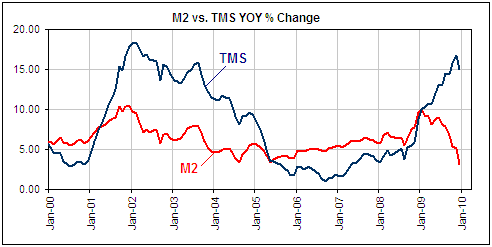
measures. For example, the following chart reveals a dramatic
divergence over the past 12 months between the year-over-year (YOY)
growth rates of M2 and TMS, such that we now have M2's YOY growth rate
at a 10-year low at the same time as TMS's YOY growth rate is near a
10-year high. Moreover, some measures of US money supply -- most
notably, the M3 calculation at http://www.nowandfutures.com/key_stats.html and Frank Shostak's AMS calculation -- currently show outright monetary deflation!
The reason we are harping on this subject is that over the next few
months you will very likely read articles in which money-supply charts
are used to 'prove' that DEFLATION is occurring and other articles in
which money-supply charts are used to highlight an INFLATION problem.
It is important to understand how such contradictory conclusions could
be drawn about something that should be straightforward.
Oil and Gas Updates
Oil
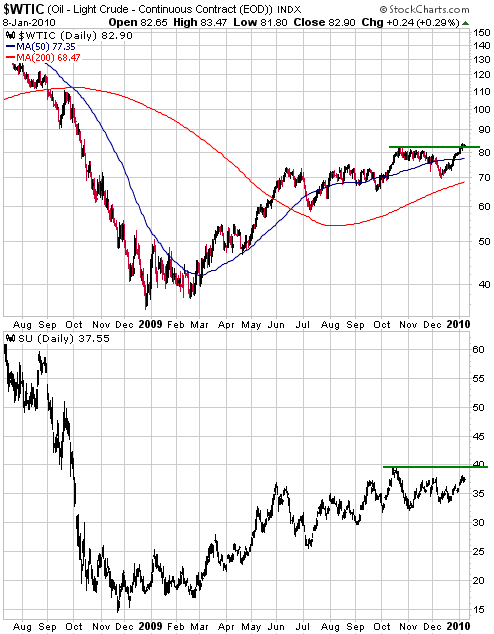
Below is a chart comparing oil and the share price of Suncor Energy
(SU). Unlike many large-cap oil producers, SU offers leverage to
changes in the oil price.
As explained in previous commentaries, intermediate-term turning points
in SU tend to occur ahead of intermediate-term turning points in the
oil market. That is, SU can be considered a leading indicator of oil's
price trend. This means that a break above US$40 by SU would point to a
further extension of oil's upward trend.
Natural Gas
In our 16th November commentary we wrote:
"As always, natgas's
performance over the months ahead will be influenced by the weather.
However, near the current price the potential reward looks attractive
relative to the remaining downside risk, given that a) the natgas/oil
ratio remains at an extremely low level, b) there should soon be a
decline in production resulting from the past year's reduction in
drilling activity, c) sentiment towards natgas is close to a
pessimistic extreme, d) there is a large speculative net-short position
in the natgas futures market that will have to be covered at some
point, and e) the next major downturn in the US economy probably won't
begin prior to the second quarter of next year."
The natgas price has gained about 30% since we wrote the above, but the
risk/reward still looks attractive on a 3-6 month basis. This is
because the bullish factors previously cited remain intact. For
example, the increase in price since mid November has not prompted much
speculative short covering, meaning that a large speculative net-short
position is still in place. This creates the potential for a positive
surprise -- such as a greater-than-expected drawdown in natgas storage
-- to cause an outsized price gain.
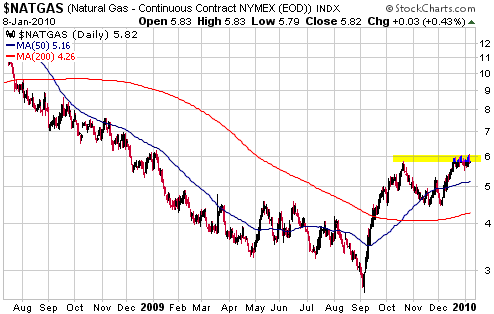
The following daily continuous-contract chart shows that natgas is currently testing resistance at US$5.80-$6.00.
"While we think natgas
has a very favourable risk/reward with regard to the next 6 months, we
are becoming less bullish on its long-term prospects. This is partly
due to the sharp increase in well productivity stemming from new
drilling technologies (multi-stage fracturing and horizontal drilling).
Throughout much of the past decade the North American natgas production
industry had to drill a larger number of wells every year just to
maintain the previous year's production level, meaning that it was, in
effect, having to run faster each year just to stand still. However,
there has been a dramatic change over the past 12-18 months. It seems
that production levels can now be maintained with a smaller number of
wells due to the increased efficiencies resulting from the new
technologies."
The combination of horizontal drilling and multi-stage fracturing makes
it economically viable, at relatively low prices, to extract gas
trapped in shale formations. There is a huge amount of gas in these
rock formations, so for all intents and purposes it appears that the
new drilling technologies have brought about a permanent change in the
natgas supply/demand equation -- a change that will result in the
average natgas price being significantly lower over the next 10 years
than it otherwise would have been.
This, by the way, is not an across-the-board bearish development for
the companies that produce natgas, because it means that some producers
will be able to generate greater profits at lower commodity prices. In
particular, well-financed producers that can employ the new technology
to good effect will potentially attain much higher valuations over the
years ahead, as will service companies that offer the latest in
drilling technology. Also, additional demand for natgas will be
promoted by the knowledge that there is a vast readily-accessible
natgas reserve to draw upon.
The Stock
Market
The US stock market is
'overbought' and could experience a sharp pullback at any time, but the
bearish divergences that were evident during September-November of last
year have mostly evaporated. In particular, we note that the
S&P500's recent move to a new 52-week high has been confirmed by
new 52-week highs in the Russell 2000 Small Cap Index, the NYSE
Advance-Decline Line and the NDX/Dow ratio, as well as by new lows in
credit spreads. The NASDAQ's Advance-Decline Line remains below its
September-2009 peak, but has been moving upward since mid December. All
of which suggests that the post-crash rebound has still not reached its
ultimate top.
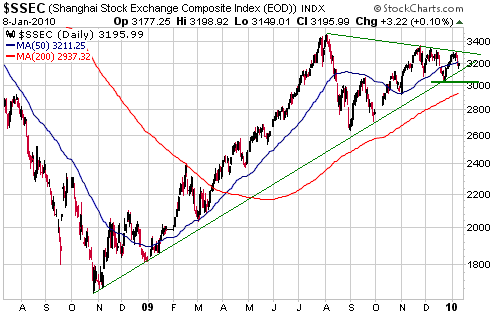
The Shanghai Stock Exchange Composite Index (SSEC) is presently in an
interesting position. As illustrated below, this index has worked
itself into a corner such that within the next couple of weeks it will
have to either break out to the upside or break out to the downside.
The direction of the breakout will likely have significance outside
China because the 'China growth story' has been an important part of
the worldwide rebound in economic confidence.
This week's
important US economic events
| Date |
Description |
Monday Jan 11
| No important events scheduled
| | Tuesday Jan 12 | Trade Balance
| | Wednesday Jan 13
| Fed's Beige Book
Treasury Budget
| | Thursday Jan 14
| Retail Sales
Import and Export Prices
| | Friday Jan 15
| CPI
Industrial Production
Consumer Sentiment
|
Gold and
the Dollar
Gold
Current Market Situation
In the 25th November 2009 Interim Update we wrote:
"Gold/euro [gold in euro
terms] is testing its February-2009 peak. It is 'overbought' on a
short-term basis -- as evidenced by the large gap between the current
level and the 50-day moving average -- but is not yet 'overbought' on
an intermediate-term basis. We doubt that gold/euro is close to an
intermediate-term peak, but the risk of a short-term correction is
high."
The euro-denominated gold price reached a short-term peak a few days
later and then dropped back to the vicinity of its 50-day moving
average, thus eliminating the 'overbought' condition. The current
situation is shown below.
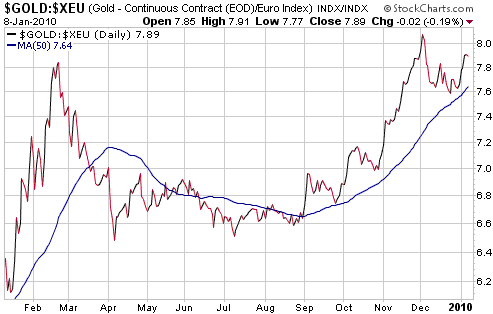
We suspect that
gold/euro's short-term correction bottomed at around 760 in late
December and that new highs will be seen during the first quarter of
this year.
If gold/euro invalidates our short-term outlook by breaking decisively
below its late-December low then it will mean that the early-December
peak was probably the intermediate-term, rather than just the
short-term, variety.
Gold versus the Industrial Metals
Gold tends to weaken relative to industrial metals when economic
confidence is on the rise and strengthen relative to industrial metals
during periods when confidence is falling.
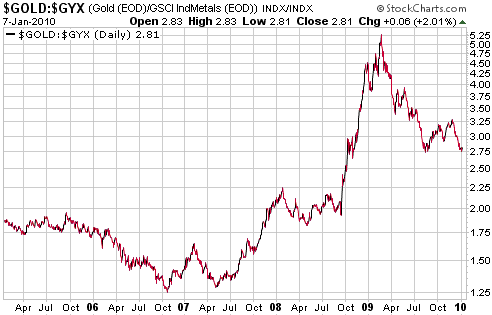
At the beginning of 2009 we thought that there would be rebounds in
economic confidence and the broad stock market during the first half of
the year, paving the way for gold to retrace some of the gains it had
made during 2007-2008 relative to the industrial metals. This, we
believed, would be followed by a second-half resumption of gold's
relative strength due to the emerging realisation that a sustainable
economic recovery would not begin anytime soon. We seemed to be 'on
track' when the gold/GYX ratio (gold relative to a basket of industrial
metals) reversed upward in August of 2009, but the following chart
shows that the August-November gains made by gold/GYX have since been
given back. This tells us that despite the absence of supporting
evidence, investors, as a group, still have moderately optimistic
expectations about economic growth.
We view the on-going
strength in the industrial metals in both dollar and gold terms as the
triumph of hope over logic. It is indicative of a general perception
that the world is entering a period characterised by robust growth and
minimal inflation risk. This, in our opinion, is not only unlikely, it
is one of the lowest-probability outcomes we can imagine.
As long as the broad stock market holds together there probably won't
be large price declines in most industrial metals, but at their current
prices the downside risk certainly appears to be high relative to the
upside potential. This is particularly the case for copper, a metal
that has now recouped the bulk of its 2008 losses despite burgeoning
inventory levels.
We were long-term bullish on the industrial metals complex throughout
the past decade, but even with the strong likelihood of a lot more
monetary inflation over the next several years the risk/reward no
longer justifies such a view.
Gold Stocks
We are operating under the assumptions that a) gold-stock indices such
as the HUI and the XAU made intermediate-term peaks on 2nd December of
last year, and b) many small-cap gold stocks will make new 52-week
highs during the first half of this year (note: six of our junior
gold/silver stocks have already made new 52-week highs in 2010).
We can't yet rule out the possibility that the gold-stock indices will
rise to new highs within the next few months, but what we can say is
that if 2nd December of 2009 did not yield the ultimate high for the
intermediate-term advance that began back in October of 2008 then it
almost certainly yielded the penultimate high (meaning that the next
surge to a new high would create THE top). Putting it another way, we
see little chance that a break above the 2nd December highs would
usher-in a major extension of the intermediate-term advance.
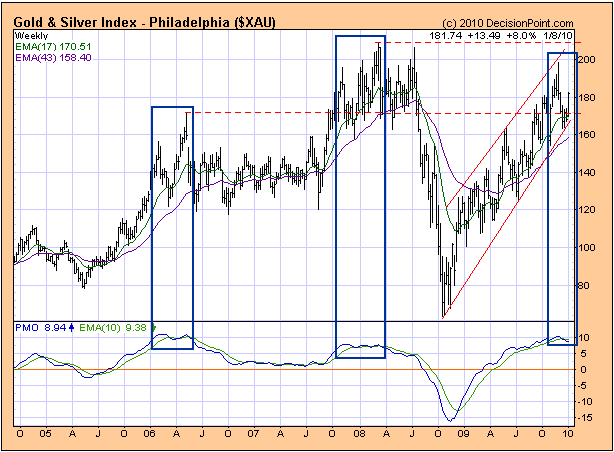
The following weekly DecisionPoint.com chart of the XAU supports our
view. The chart shows that the XAU's weekly Price Momentum Oscillator
(PMO) has turned down from a high level in the same way as it did in
early 2006 and late 2007. In each of these prior cases, a final 1-2
month surge to a new high followed the PMO's initial downward reversal
from its high.
A broad-based stock
market decline represents a significant threat to the gold sector,
particularly since the next meaningful decline in the overall stock
market will likely be accompanied by US$ strength. The stock market
PROBABLY won't experience anything more serious than a routine pullback
over the next three months, but, given that it is being held up by
something as insubstantial as misplaced optimism about the economy,
there is a risk that it will begin its next major downward leg earlier
than currently expected.
The best way to manage the risk of a market decline is to build up
cash, and the best way to build up cash is to take some money off the
table in response to price surges in your investments/speculations. For
example, we are maintaining plenty of exposure to the junior end of the
gold sector in our own accounts while methodically adding to our cash
reserve as short-term selling opportunities arise in individual stocks.
We are now 45% cash and will probably go to 50% cash if prices continue
to escalate over the next two weeks.
Currency Market Update
When we look at charts of the euro and the Swiss Franc we see evidence
that intermediate-term peaks were put in place in late-November of last
year. These currencies have rallied following their sharp December
declines, but the rallies look like counter-trend rebounds rather than
new upward trends.
Charts of the senior commodity currencies (the A$ and the C$) look
different in that there is no visible evidence, yet, that
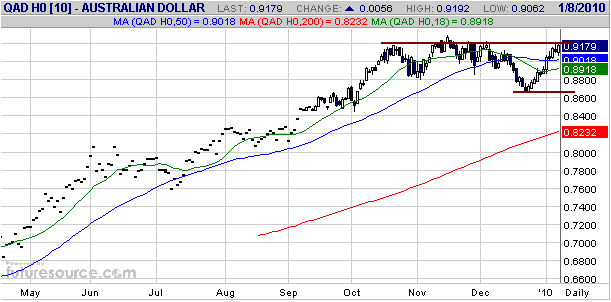
intermediate-term peaks are in place. The A$, for example, moved lower
from mid November through to late December, but has since recouped all
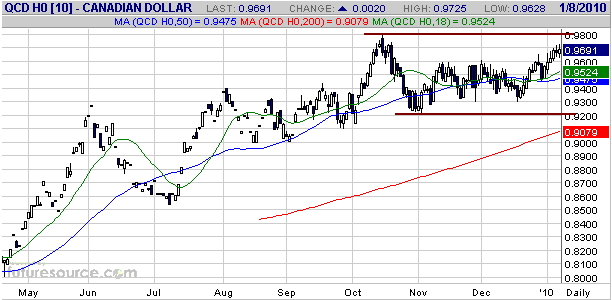
of its losses. For its part, the C$ has now recouped most of the losses
sustained during the pullback from its October peak. Daily charts of
the March A$ and the March C$ are displayed below.
The A$ and the C$ need to drop below 0.86 and 0.92, respectively, to signal intermediate-term peaks.
We suspect that the
commodity currencies will remain comparatively firm until after the
broad stock market peaks, at which point they will become good
short-sale or put-option candidates.
There is an unusually large "commercial" net-short position in the
Dollar Index futures market right now. Some analysts have cited this as
an important dollar-bearish factor, and, by extension, an important
gold-bullish factor, but the "commercials" also have an unusually large
net-short position in gold futures. Is it reasonable to argue that the
commercials are smart to be short the dollar and, at the same time,
dumb to be short gold? Or is it more reasonable to take the Commitments
of Traders (COT) data with the proverbial 'grain of salt'? We think the
latter. The COT report is just one small piece of a very large puzzle.
Update
on Stock Selections
(Note: To review the complete list of current TSI stock selections, logon at http://www.speculative-investor.com/new/market_logon.asp
and then click on "Stock Selections" in the menu. When at the Stock
Selections page, click on a stock's symbol to bring-up an archive of our comments on the stock in question)
 Clifton Star Resources (TSXV: CFO). Shares: 25M issued, 38M fully diluted. Recent price: C$4.82 Clifton Star Resources (TSXV: CFO). Shares: 25M issued, 38M fully diluted. Recent price: C$4.82
The interview with Paul Zweng at http://www.kereport.com/dailyshow/daily-jan0710-seg1.html
contains a good overview of the Clifton Star story. Mr. Zweng discusses
the potentially important similarities between CFO's gold deposit and
the nearby Malartic deposit owned by Osisko, and towards the end of the
interview explains why he has a 1-2 year price target of C$12-C$17 for
CFO.
New Gold (AMEX: NGD, TSX: NGD). Shares: 387M issued, 471M fully diluted. Recent price: US$4.72
We have previously noted the potential for positive market-moving NGD
news in the form of a deal relating to the company's 30% stake in the
exploration-stage El Morro copper/gold project. What we had in mind was
the sale of the El Morro stake or the swapping of it for a
gold-producing asset, but the deal that was announced prior to the
start of trading last Thursday involves NGD retaining its interest in
El Morro on more favourable terms. The more favourable terms include an
immediate payment of US$50M from the new owner of the remaining 70%
(Goldcorp) and a commitment by Goldcorp to arrange all
mine-construction financing at a relatively low cost to NGD.
The market liked this deal enough to propel NGD's stock price 21%
higher over the final two days of last week. Our view is that the deal
adds significant (at least US$0.30/share) value to NGD, although we
would have preferred that it had sold El Morro and used the proceeds to
purchase a gold or gold/silver asset (El Morro will be a copper mine
with a substantial gold byproduct). This is because we perceive a lot
of downside risk in the copper market, and NGD already has sizeable
exposure to copper via the New Afton and Peak projects.
The copper exposure probably won't hurt over the next few months, but it could become a problem further down the track.
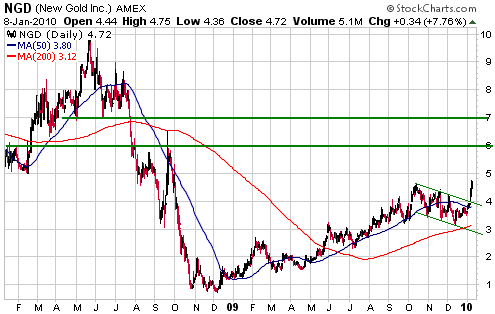
The following chart shows that last week's surge took NGD to a new
52-week high. This has, we think, created another short-term selling
opportunity. If you failed to make a PARTIAL exit when the stock rose
to the mid-US$4 area last October then you now have another chance to
do so.
There is some resistance at US$5.00, but more important resistance lies
at US$6-US$7. At this stage our plan is to make a complete exit from
NGD if it rises to around US$6.00 during the first half of this year.
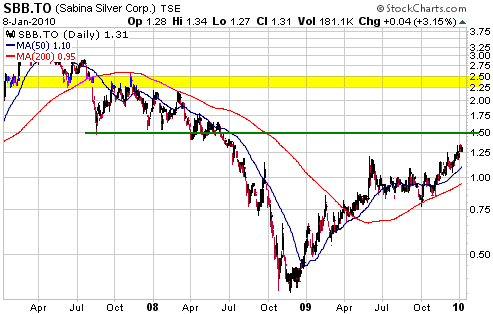
Sabina Gold and Silver (TSX: SBB). Shares: 108M issued, 124M fully diluted. Recent price: C$1.31
Based on conservative assumptions (relatively low metal prices and a
discount rate of 10%), SBB's Hackett River project in northern Canada
is estimated to have a net present value of C$523M. To this we will add
C$72M for the 2.4M-ounce gold resource at SBB's Back River project on
the basis that this resource is worth C$30/oz. This results in a very
rough and fairly conservative estimate of C$595M, or C$4.80 per
fully-diluted share, for SBB's total value. SBB therefore has a lot of
valuation-related upside potential.
The following chart shows that the stock has resistance at C$1.50 and
then at C$2.25-C$2.50. We view the $2.25-$2.50 range as a reasonable
intermediate-term target.
Chart Sources
Charts appearing in today's commentary
are courtesy of:
http://stockcharts.com/index.html
http://www.futuresource.com/
http://www.decisionpoint.com/

|