|
-- Weekly Market Update for the Week Commencing 12th March 2012
Big Picture
View
Here is a summary of our big picture
view of the markets. Note that our short-term views may differ from our
big picture view.
In nominal dollar terms, the BULL market in US Treasury Bonds
that began in the early 1980s will end by 2013. In real (gold)
terms, bonds commenced a secular BEAR market in 2001 that will continue
until 2014-2020. (Last
update: 23 January 2012)
The stock market, as represented by the S&P500 Index, commenced
a secular BEAR market during the first quarter of 2000, where "secular
bear market" is defined as a long-term downward trend in valuations
(P/E ratios, etc.) and gold-denominated prices. This secular trend will bottom sometime between 2014 and 2020. (Last update: 22 October 2007)
A secular BEAR market in the Dollar
began during the final quarter of 2000 and ended in July of 2008. This
secular bear market will be followed by a multi-year period of range
trading. (Last
update: 09 February 2009)
Gold commenced a
secular bull market relative to all fiat currencies, the CRB Index,
bonds and most stock market indices during 1999-2001. This secular trend will peak sometime between 2014 and 2020. (Last update: 22 October 2007)
Commodities,
as represented by the Continuous Commodity Index (CCI), commenced a
secular BULL market in 2001 in nominal dollar terms. The first major
upward leg in this bull market ended during the first half of 2008, but
a long-term peak won't occur until 2014-2020. In real (gold) terms,
commodities commenced a secular BEAR market in 2001 that will continue
until 2014-2020. (Last
update: 09 February 2009)
Copyright
Reminder
The commentaries that appear at TSI
may not be distributed, in full or in part, without our written permission.
In particular, please note that the posting of extracts from TSI commentaries
at other web sites or providing links to TSI commentaries at other web
sites (for example, at discussion boards) without our written permission
is prohibited.
We reserve the right to immediately
terminate the subscription of any TSI subscriber who distributes the TSI
commentaries without our written permission.
Outlook Summary
Market
|
Short-Term
(0-3 month)
|
Intermediate-Term
(3-12 month)
|
Long-Term
(1-5 Year)
|
| Gold
|
Neutral
(22-Feb-12)
|
Neutral
(24-Jan-11)
|
Bullish
|
| US$ (Dollar Index)
|
Neutral
(22-Nov-11)
| Neutral
(09-Jan-12)
|
Neutral
(19-Sep-07)
|
| Bonds (US T-Bond)
|
Bearish
(05-Mar-12)
|
Neutral
(18-Jan-12)
|
Bearish
|
| Stock Market (S&P500)
|
Bearish
(23-Jan-12)
|
Bearish
(28-Nov-11)
|
Bearish
|
| Gold Stocks
(HUI)
|
Neutral
(29-Feb-12)
|
Bullish
(23-Jun-10)
|
Bullish
|
| Oil | Neutral
(31-Jan-11) | Neutral
(31-Jan-11)
| Bullish
|
| Industrial Metals
(GYX)
| Neutral
(22-Nov-11)
| Neutral
(29-Aug-11)
| Neutral
(11-Jan-10)
|
Notes:
1. In those cases where we have been able to identify the commentary in
which the most recent outlook change occurred we've put the date of the
commentary below the current outlook.
2. "Neutral", in the above table, means that we either don't have a
firm opinion or that we think risk and reward are roughly in balance with respect to the timeframe in question.
3. Long-term views are determined almost completely by fundamentals,
intermediate-term views by giving an approximately equal weighting to
fundamental and technical factors, and short-term views almost
completely by technicals.
A new twist on
"Operation Twist"
Just when we think that Bernanke has exhausted his ability to come up with harebrained schemes to distort prices, he proves us wrong. Last week it was reported that the Fed was considering a new way of putting downward pressure on long-term interest rates. Why? Because as everyone knows, the US economy would be doing much better if interest rates weren't so darn high.
The new tactic would be a variation on the old tactic that goes by the name "operation twist". Under the old tactic, which the Fed began to implement during the second half of last year, the Fed sells short-dated debt securities from its stash and uses the proceeds to buy long-dated debt securities. This would tend to contract the yield-spread (flatten the yield curve) by pushing long-term interest rates downward and short-term interest rates upward, except that at the same time the Fed does whatever it needs to do to keep the official short-term interest rate near zero. The idea, then, is that the yield-spread contracts due to falling long-term interest rates.
The problem with the old tactic is that it is limited by the Fed's holdings of short-dated securities, which isn't good. After all, if the Fed and the government wanted limitations they would have stayed with the Gold Standard. One of the main purposes of the monetary system's current design is that there be no financial limitations on the extent to which intervention can occur. The new tactic under discussion would solve this problem.
Under the new tactic the Fed would have the ability to buy an UNLIMITED amount of long-dated debt securities using money created out of nothing. It would also have the ability -- so the story goes -- to eliminate the inflationary effects of this monetisation by issuing new short-dated debt securities. Putting it simply, the Fed would create new money to buy long-term bonds and then 'soak up' this new money by selling short-term bonds. The result is that long-term interest rates would be forced lower, provided that short-term rates continued to be pegged near zero. And the best part: there would be no inflationary effect! Or would there?
The reality is that there would be at least three inflationary effects.
One is due to money being injected into the economy at one point and withdrawn at a different point. This means that even if the Fed 'soaked up' the extra money as promised, the act of injecting and removing the money would distort relative prices.
A second inflationary effect stems from the fact that the money 'soaked up' by the Fed wouldn't disappear. It would, instead, be temporarily removed from the economy in exchange for short-term interest-bearing securities. In effect, the money would be parked in time deposits at the Fed. At some future time the owners of these time deposits would want their money, at which point the Fed's original purchase of the long-dated securities would effectively become an outright debt monetisation (QE).
A third effect that also comes under the "inflationary" umbrella is that the creation of these new short-term deposits at the Fed would alter the private banking system's deposit structure. This is similar to the first effect, in that it wouldn't bring about an economy-wide loss of money purchasing power but it would distort relative prices. By way of explanation consider the hypothetical situation of Bill, a wealthy investor who has $100M invested on a short-term basis with an investment bank. Bill decides that he'd rather invest his $100M in the new short-term securities issued by the Fed, so he sells his existing investment. In this hypothetical example the Fed's policy has resulted in money being transferred from the buyer of Bill's investment to the Fed, and the transfer of money from the Fed to the seller of the long-term bonds purchased by the Fed. Who knows what the seller of the long-term bonds will do with the cash received from the Fed? The answer is that nobody knows. Maybe he will buy oil futures, thus boosting the cost of energy.
There are undoubtedly other effects, but you get the picture. Like all attempts by the central bank to manipulate money and interest rates, this new twist on "operation twist" will cause problems in addition to the most basic problem. The most basic problem is that the central bank shouldn't be making any attempt to force interest rates below where they would otherwise be.
Bernanke is like a kid with a new chemistry set who is gleefully mixing chemicals together without the slightest clue as to what the reaction will be. The difference is that whereas the kid with the chemistry set is probably going to do no worse than burn a hole in his parents' carpet, Bernanke's monetary experiments are burning holes in the US economy.
The coming big move in the
T-Bond
Last week we wrote:
"Just as bull markets are followed by bear markets (and vice versa), periods of low volatility are followed by periods of high volatility. There's a good chance, then, that the T-Bond 'flat-line' of the past few months will give way to a period during which a big move occurs. Nothing in the sentiment indicators or the recent price action clearly points to the direction of the coming big move, but our guess is that it will be to the downside."
We went on to say that we planned to buy some TBT $20 call options for our own account over the ensuing two weeks. TBT is designed to move inversely to the T-Bond, so TBT call options would benefit from a T-Bond decline. However, because we are more confident in the magnitude than the direction of the coming T-Bond move, what we have actually done is buy out-of-the-money TBT call options AND put options ($20 calls and $18 puts). In effect, we have taken a long position in T-Bond volatility. The trade should be profitable if the T-Bond makes a sizeable move in either direction over the next couple of months and will lose money if the pattern of the past few months continues.
Here's the current situation in chart form:
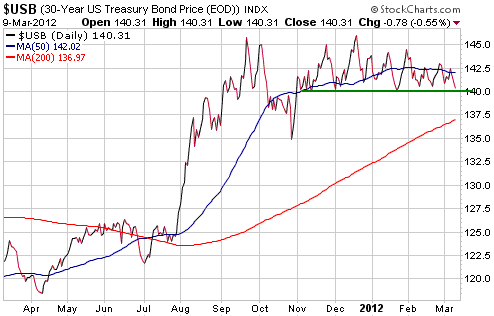
The first chart shows that the T-Bond has spent the past 4 months in a narrow horizontal range and has bounced off support at 140 numerous times. The 140 support level was tested again on Friday 9th March. It should be considered bullish that 140 managed to hold on Friday despite a stronger-than-expected US monthly employment report and a return by the S&P500 Index to its high for the year, but this resilience could be explained by a knee-jerk 'flight to safety' response to the official confirmation that the Greek government had defaulted.
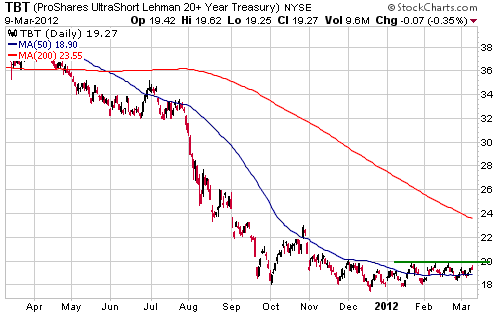
The next chart shows TBT. With the T-Bond having spent the past few months trading sideways near its high it is to be expected that TBT has spent the past few months trading sideways near its low.
The Stock
Market
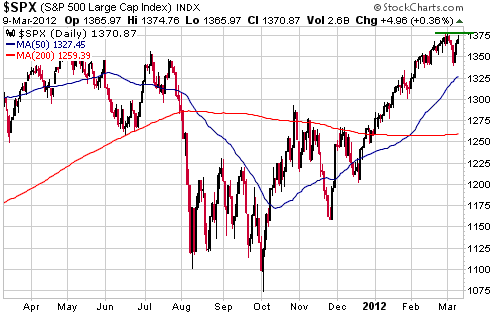
The S&P500 Index dropped during the first two days of last week and then rebounded. This rebound led to a test of the high on Friday.
The odds are in favour of the test being successful and being followed by a decline to a new multi-week low. Furthermore, an upside break to a new high at this time would not be a reliable bullish signal, the reason being that the market is 'overbought'.
This week's
important US economic events
| Date |
Description |
| Monday Mar 12 | Treasury
Budget
| | Tuesday Mar 13 | FOMC
Announcement
Retail Sales
Business Inventories
| | Wednesday Mar 14 | Import
and Export Prices
Q4-2011 Current Account Balance | | Thursday
Mar 15 |
PPI
TIC Report
Empire State Manufacturing Survey
Philadelphia Fed Survey
|
| Friday Mar 16 | CPI
Industrial Production
Consumer Sentiment
|
Gold and
the Dollar
Gold
For the past several months we have been comparing gold's price action following its August-2011 peak with gold's price action following its May-2006 peak. As illustrated below, the path being tracked by the current market is still remarkably similar to the path that was tracked by the market after of its May-2006 peak. It looks like we are now at the equivalent of late-December 2006.
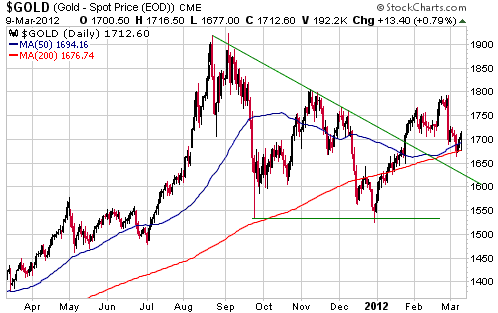
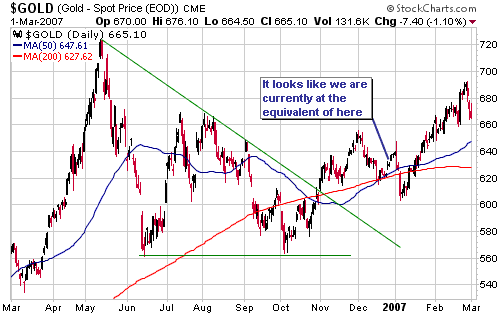
If the similarities persist then gold will bottom a few percent below last week's low during the second half of this month.
There is no guarantee that the similarities will persist, but the idea that gold was at or within a few percent of a pullback low when it dropped to the $1660s last Tuesday is reasonable. On this day the bullish percentage reported by Market Vane was at 61 (10 lower than one week earlier) and the total speculative net-long position was at 200K contracts (55K contracts lower than one week earlier), meaning that sentiment had tumbled in reaction to the price decline. There is scope in the sentiment indicators for some additional weakness, but not a lot of additional weakness.
Gold Stocks
The high-profile gold-stock indices did almost nothing during the second half of last week, leaving us with little to add to what we have already said. In summary, the odds favour a test of HUI support at 480 within the next couple of weeks. With the HUI so 'oversold' relative to the broad stock market, further weakness in the HUI will probably require weakness in the S&P500.
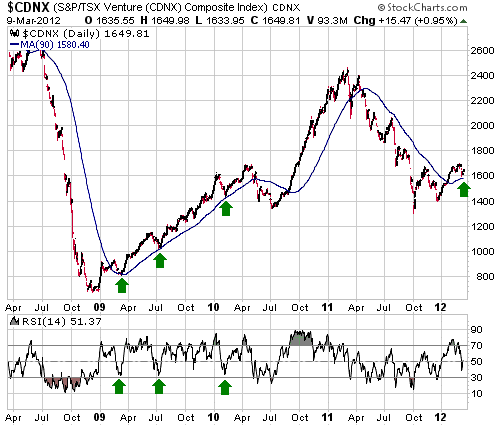
This is an appropriate time to update our analysis of the CDNX (the TSX Venture Exchange Composite Index).
As previously advised, the 90-day moving average (MA) usually does a good job of defining the CDNX's intermediate-term trend. We therefore took January's break above this MA as confirmation that the CDNX's intermediate-term trend had reversed from down to up.
Once an intermediate-term upward trend is established, corrections tend to be limited by the 90-day MA. For example, the following chart shows that there were three pullbacks to the 90-day MA during the 2009-2010 rally. Notice that each of these 2009-2010 corrections resulted in the RSI (shown at the bottom of the chart) dipping below 35.
The historical record suggests to us that the CDNX is not going to fall by more than 5% from its current level before resuming its upward trend.
Currency Market Update
On Friday we had the latest in a long -- and not yet anywhere near complete -- sequence of mini climaxes in the euro-zone's government debt disaster, when a chapter in the Greek government's drawn-out debt default came to an end.
It turned out that Greece's government had to invoke the Collective Action Clauses (CACs) linked to its bonds in order to get the required participation of private bondholders in a previously negotiated bond swap. This means that the bond swap can no longer be classified as voluntary and, therefore, that the sellers of CDSs (bond insurance) will have to make payment. The payment by the CDS sellers is expected to be about 80% of the par value of the original bonds, because the Greek government debt now held by private bondholders is estimated to be worth about 80% less than the par value of the original debt.
The total payment to be made by the CDS sellers is likely to be no more than $2.5B, which isn't a lot in the grand scheme of things. However, the Greek government's default was an important test of CDS viability. It is true that CDSs are contracts with clearly defined terms, and that the committee that decides whether or not a payment failure constitutes a default was within its rights to define the Greek government's failure as a non-default as long as the restructuring of the debt was deemed to be voluntary. But it is also true that the private bondholders' involvement in the debt swap was never really voluntary. And, most importantly, it is true that the debt restructuring was designed by euro-zone officialdom with the intent of avoiding payment on CDSs despite the fact that the restructuring would crystallise a decline in bond value of at least 75%. It turned out that the cunning plan to avoid CDS payouts didn't come to fruition, but aspersions have been cast on CDSs linked to government bonds nevertheless.
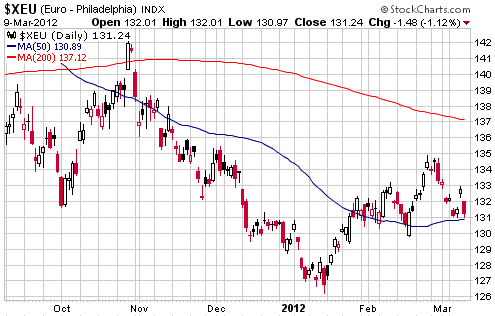
Moving along, there was a sizeable reaction in the currency market to Friday's news that the Greek government's default had become official. Naturally, the euro pulled back and the Dollar Index rallied. As evidenced by the following daily chart, though, Friday's action didn't even manage to push the euro below the low made earlier in the week.
Euro futures could pull back as far as the high-120s over the coming fortnight, especially if the stock market resumes its downward correction. However, the upward trend in the euro that began in the first half of January is probably not yet complete.
While the Greek news garnered almost all the attention in the mainstream financial press, a lower-profile development was just as significant. We are referring to the large reduction in "Central Bank Liquidity Swaps" reported by the Fed last Thursday. According to the latest release of the
Fed's balance sheet, CB Liquidity Swaps declined by $36B (from $107B to $71B) during the week ended 7th March. This suggests that the US$ shortage within Europe's banking system has begun to abate, which is short-term bearish for the US dollar's foreign exchange value.
Update
on Stock Selections
Notes: 1) To review the complete list of current TSI stock selections, logon at
http://www.speculative-investor.com/new/market_logon.asp
and then click on "Stock Selections" in the menu. When at the Stock
Selections page, click on a stock's symbol to bring-up an archive of
our comments on the stock in question. 2) The Small Stock Watch List is
located at http://www.speculative-investor.com/new/smallstockwatch.html
 Clifton Star Resources (TSXV: CFO). Shares: 36M issued, 40M fully diluted. Recent price: C$2.03 Clifton Star Resources (TSXV: CFO). Shares: 36M issued, 40M fully diluted. Recent price: C$2.03
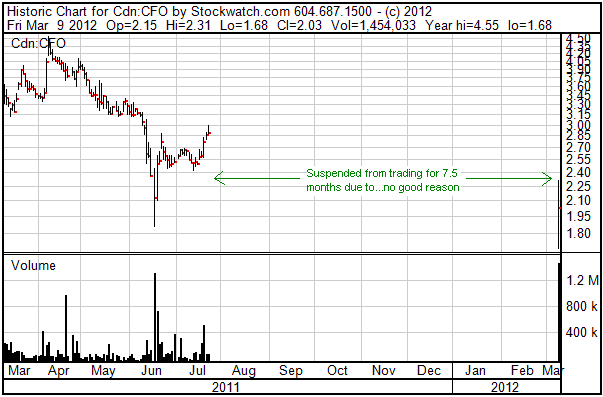
Publicly traded companies have engaged in a lot of fraudulent activity over the past two years. It seems that government regulators have decided to make up for their failure to pick up on any of these frauds in timely fashion by going after companies that have done nothing dishonest. CFO was a victim of the resultant regulatory zeal.
CFO finally resumed trading last Friday following a 7.5-month suspension. The press release on project metallurgy issued during the week before last suggests that CFO is more valuable now than it was when trading was halted in July of 2011, but the stock was hammered by a flurry of emotional selling as soon as trading resumed. Short-term price moves are usually driven more by sentiment than fundamentals.
Friday's price action was roughly as expected. The stock price first collapsed as value-oriented investors hung back and 'stale longs' tried to get out at any price. It dropped as low as C$1.68 before accumulation by value-oriented investors started to overwhelm the emotional "get me out at any price" liquidation. It then recovered to the C$2.30s before settling back to end the day at C$2.03.
Friday's intra-day low of C$1.68 will probably turn out to be THE low, but the stock could spend a bit more time below C$2 before commencing an upward trend. In our opinion, it is a strong buy below C$2.10.
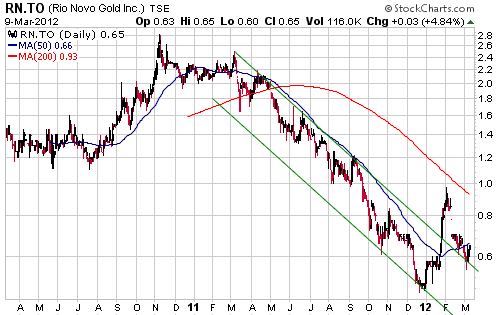
Rio Novo Gold (TSX: RN). Recent price: C$0.65
A few weeks ago RN announced a "bought deal" equity financing priced at C$0.75/share. The market's reaction to this financing drove the stock price down to the low-C$0.60s, at which time we added RN to the TSI Stocks List as a short-term trade.
When a company does a "bought deal" financing, the broker or bank that arranges the financing is supposed to take all the price risk. Apparently, however, that's not the way it works these days in Canada. These days, Canadian brokers/banks are happy to honour their commitments to buy shares at a certain price as long as the market price is the same or higher than the financing price, but these commitments cease to apply if the market price drops well below the financing price. It's a great business. You do a deal that you are only obligated to go through with if you are guaranteed of a profit.
With RN's stock trading well below the 'agreed' financing price, RN was forced to opt out of the deal. In a 7th March press release RN announced:
"Rio Novo Gold Inc. has agreed to terminate the underwriting agreement with a syndicate of underwriters...in respect of its previously announced $20,025,000 bought deal financing. The company will not be proceeding with the offering at the present time."
RN's press release went on to state:
"Rio Novo has a cash balance of over $28-million and will finance its exploration, engineering and operating expenses from its working capital."
Exactly, so why did you feel the need to do a large low-priced value-destroying equity financing in the first place?
RN continues to be a buy for a trade in the low-C$0.60s. Significant news (the preliminary economic assessment for the company's Brazil-based Almas gold project) is due this week.
Sandspring Resources (TSXV: SSP). Shares: 131M issued, 143M fully diluted (including the latest financing). Recent price: C$1.08
In our 1st February attempt to explain the recent weakness in SSP's stock price, we wrote:
"SSP will have to do a sizeable equity financing within the next 12 months, but the company presently has about $14M of working capital and therefore shouldn't be under pressure to do an immediate financing. That being said, the managers of many junior Canadian mining companies are seemingly incapable of saying no when offered the opportunity to raise money at value-destroying prices. We therefore can't rule out the possibility that the stock was sold down in anticipation of a financing."
It is now clear that the weakness in the stock price was, indeed, the result of a planned equity financing. Prior to last Friday SSP had not traded below C$1.09 in more than two years, but on Friday it was announced that the company's management had decided to issue about 23M new shares at C$1.08/share. Naturally, this caused the market price to immediately fall to a new 2-year low.
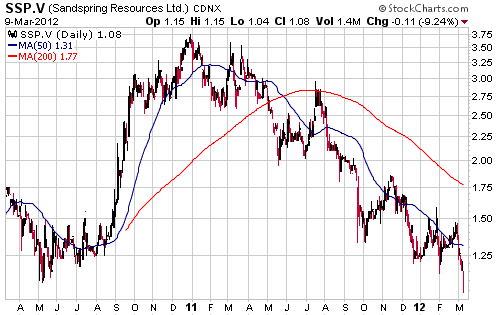
SSP is now being valued by the market at less than one-seventh of the estimated net present value of its Guyana-based gold project. It probably isn't going to get much cheaper, but a meaningful rebound is unlikely to begin until after the equity financing is 'put to bed'. Completion of the financing is scheduled for 30th March.
Potential future TSI stock selection: Sprott Resource Corp. (TSX: SCP). Recent price: C$3.98
SCP is a good and reasonably conservative vehicle for gaining exposure to energy, agriculture and gold. It is a former TSI stock selection and will make its way back into the TSI List if its valuation becomes low enough.
SCP holds large stakes in a number of private and public natural-resource-oriented companies. These investments include 81% of Waseca Energy (a private oil producer), 32% of Independence Contract Drilling (a newly-formed private company focused on unconventional drilling services), 18% of Guide Exploration (GO.TO), 20% of Westfire Energy (WFE.TO), 33% of Stonegate Agricom (ST.TO), and 80% of One Earth Farms (Canada's largest farming operation). It also holds 74,000 ounces of gold bullion.
The substantial investments in private companies make SCP's net asset value difficult to estimate, but we calculate that it is somewhere in the C$5-C$6 range. There is plenty of scope for the NAV to grow due to rises in commodity prices, growth in the businesses in which SCP has stakes, and the proven ability of SCP's management to increase shareholder value via astute investing and trading.
The chart suggests the potential for SCP to trade as low as C$3.00 over the months ahead, but major weakness in the broad stock market will probably be required for it to get that low. A more realistic downside target is C$3.50.
We will add SCP to the TSI List if it trades at C$3.53 within the next two months.
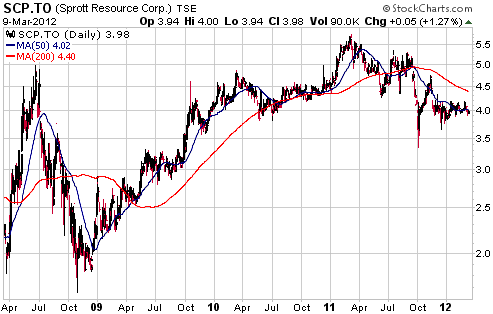
Chart Sources
Charts appearing in today's commentary
are courtesy of:
http://stockcharts.com/index.html
http://www.stockwatch.com/

|









