|
-- Weekly Market Update for the Week Commencing 12th April 2010
Big Picture
View
Here is a summary of our big picture
view of the markets. Note that our short-term views may differ from our
big picture view.
In nominal dollar terms, the BULL market in US Treasury Bonds
that began in the early 1980s will end by mid-2010. In real (gold)
terms, bonds commenced a secular BEAR market in 2001 that will continue
until 2014-2020. (Last
update: 09 February 2009)
The stock market, as represented by the S&P500 Index, commenced
a secular BEAR market during the first quarter of 2000, where "secular
bear market" is defined as a long-term downward trend in valuations
(P/E ratios, etc.) and gold-denominated prices. This secular trend will bottom sometime between 2014 and 2020. (Last update: 22 October 2007)
A secular BEAR market in the Dollar
began during the final quarter of 2000 and ended in July of 2008. This
secular bear market will be followed by a multi-year period of range
trading. (Last
update: 09 February 2009)
Gold commenced a
secular bull market relative to all fiat currencies, the CRB Index,
bonds and most stock market indices during 1999-2001. This secular trend will peak sometime between 2014 and 2020. (Last update: 22 October 2007)
Commodities,
as represented by the Continuous Commodity Index (CCI), commenced a
secular BULL market in 2001 in nominal dollar terms. The first major
upward leg in this bull market ended during the first half of 2008, but
a long-term peak won't occur until 2014-2020. In real (gold) terms,
commodities commenced a secular BEAR market in 2001 that will continue
until 2014-2020. (Last
update: 09 February 2009)
Copyright
Reminder
The commentaries that appear at TSI
may not be distributed, in full or in part, without our written permission.
In particular, please note that the posting of extracts from TSI commentaries
at other web sites or providing links to TSI commentaries at other web
sites (for example, at discussion boards) without our written permission
is prohibited.
We reserve the right to immediately
terminate the subscription of any TSI subscriber who distributes the TSI
commentaries without our written permission.
Outlook Summary
Market
|
Short-Term
(0-3 month)
|
Intermediate-Term
(3-12 month)
|
Long-Term
(1-5 Year)
|
Gold
|
Bullish
(12-Apr-10)
|
Bullish
(12-May-08)
|
Bullish
|
US$ (Dollar Index)
|
Neutral
(20-Jan-10)
| Bullish
(02-Nov-09)
|
Neutral
(19-Sep-07)
|
Bonds (US T-Bond)
|
Bearish
(05-Apr-10)
|
Bearish
(14-Dec-09)
|
Bearish
|
Stock Market (S&P500)
|
Bearish
(08-Mar-10)
|
Bearish
(11-May-09)
|
Bearish
|
Gold Stocks (HUI)
|
Neutral
(08-Mar-10)
|
Neutral
(16-Sep-09)
|
Bullish
|
| Oil | Neutral
(28-Oct-09)
| Bearish
(01-Mar-10)
| Bullish
|
Industrial Metals (GYX)
| Bearish
(21-Sep-09)
| Bearish
(25-May-09)
| Neutral
(11-Jan-10)
|
Notes:
1. In those cases where we have been able to identify the commentary in
which the most recent outlook change occurred we've put the date of the
commentary below the current outlook.
2. "Neutral", in the above table, means that we either don't have a
firm opinion or that we think risk and reward are roughly in balance with respect to the timeframe in question.
3. Long-term views are determined almost completely by fundamentals,
intermediate-term views by giving an approximately equal weighting to
fundmental and technical factors, and short-term views almost
completely by technicals.
Long-term bearish on China
Excluding the people who
labour under the delusion that the US is still the "land of the free"
and China is still a Soviet-style basket case, most people fall into
one of two groups when it comes to their views on China's economic
prospects. The first group is outright bullish on China's prospects
over all time periods, while the other is very optimistic on a
long-term basis but is concerned about the potential for a painful
'correction' within the next couple of years. In other words, most
people are long-term bullish. We, however, are not.
Our view is that China's economy looks strong right now only because
its credit bubble hasn't yet burst. In terms of the way it is widely
perceived, the current situation of China's economy can, we think, be
likened to the situation of the US economy in 1999-2000. Recall that
the US economy was thought by most pundits to be in wonderful shape at
the end of the last millennium, and that phrases such as
"productivity-driven growth miracle" and "King Dollar" were waved about
with abandon. Recall, as well, that intelligent observers argued in all
seriousness that 50-times earnings made sense for leading technology
stocks and that 36,000 was fair value for the Dow Industrials Index.
Interestingly, arguments of a similar flavour are being made today to
justify the absurd valuations in China's stock and property markets.
Even more interestingly, in some cases people who correctly diagnosed
the flaws and non-sustainability of the "US growth miracle" are now
failing to apply the same logic to China's "economic miracle".
There is no requirement for China's banks to mark their investments "to
market" or accurately report non-performing loans, so China's credit
bubble could go on longer and grow much bigger than its US counterpart.
For example, China's economy began to shrink during the second half of
2008 (not according to the official stats, but according to more
objective data such as power usage), which must have caused many bank
loans to become "non-performing" by Western standards, and yet China's
banking industry expanded its collective loan portfolio by 32% during
the course of 2009. Economy-wide loan growth of this rapidity is
unheard of in the US, and we reiterate that this spectacular surge in
new bank lending began when the economy was shrinking. How did it
happen? Simple: the government instructed the banks to make the
Yuan-equivalent of 1.5 trillion US dollars of new loans within the
space of 12 months, so that's what they did. Furthermore, most of these
new loans must have involved the creation of new money, because China's
M2 money supply and total deposits at Chinese financial institutions
were both up by around 28% in 2009.
With China's banking system being slightly less transparent than the
average house brick, there is no telling how big the bubble will get
before it bursts. As discussed in a previous commentary, if the
government doesn't deliberately deflate the bubble it could continue
until the effects of the massive monetary inflation become evident in
food prices. Once this happens, the political cost of not stopping the
inflation will, we think, be greater than the political cost of
continuing it.
It is not possible to know, in advance, when a great credit bubble will
burst. Also, it is dangerous to bet against a bubble because the nature
of these things is to go on for much longer than a rational observer
would expect. What we do know is that when they burst the result always
includes a severe economic downturn and the wiping out of much of the
'wealth' that was created during the bubble years.
But although the bursting of a credit bubble always leads to a severe
economic downturn, it doesn't have to cause long-term weakness. The key
to whether it does lead to long-term weakness is the government's
response to the initial downturn. History and logic tell us that if the
government gets out of the way and allows the economy to move back into
line with reality (as opposed to the distorted perception of reality
created by the preceding credit growth and inflation), the adjustment
will be painful but will likely be complete within 1-3 years; however,
if the government tries to soften the blow by, for example, propping up
prices and supporting failed enterprises, then the adjustment process
could take decades.
We think it's a good bet that China's government will make the same
mistakes that were made by the US government during the 1930s, Japan's
government post-1990 and the current US government, thus setting the
stage for a long-term decline once the bubble eventually bursts. This
is the main reason we are long-term bearish on China's economy.
As things now stand, we are inclined to give China's bubble the benefit
of the doubt; meaning that we are disinclined to bet on falling Chinese
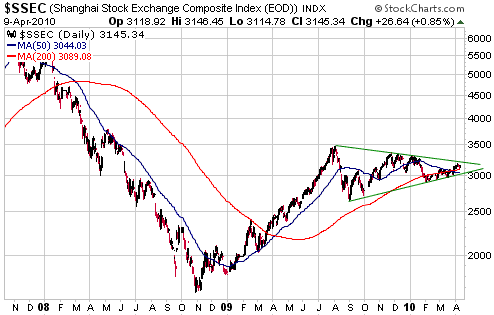
asset prices at this time. It looks like China's stock market, as
represented on the following chart by the Shanghai Stock Exchange
Composite Index (SSEC), made a major peak in 2007 and is in the midst
of a post-crash rebound, but the post-crash rebound may not be
complete. A signal as to whether or not it is complete will be the
direction of the breakout from the triangular pattern that the SSEC has
traced out since last August. A downside breakout from this pattern
could be interpreted as a warning that the credit bubble is in trouble,
although it should be noted that the epicentre of China's boom is the
property market, not the stock market.
The Stock
Market
Put/Calls and Probabilities
The 10-day moving average of the equity put/call ratio ended last week
at 0.50. The last time it was this low was July-2005, and the time
before that was January-2004. In other words, there were only two
previous occasions over the past 6 years when traders of equity options
were as optimistic as they are right now (a low put/call ratio suggests
optimism). Let's take a look at what happened on these two previous
occasions.
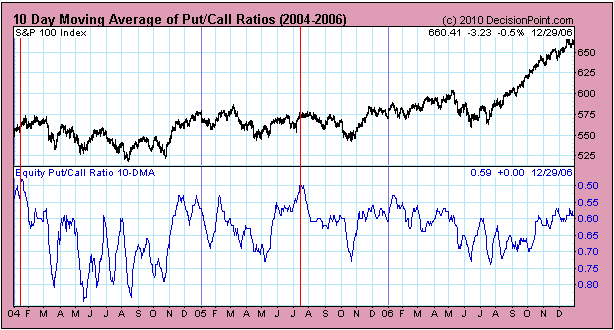
The following DecisionPoint.com
chart shows the S&P100 Index and the equity put/call's 10-day MA
during 2004-2006. Note that the scale on the put/call section of the
chart is inverted, meaning that a falling put/call ratio is represented
by a rising line on the chart. The vertical red lines mark the two
occasions when the 10-day MA of the equity put/call ratio (P/C) dropped
to 0.50.
After the P/C dropped to 0.50 in January of 2004, the market traded
sideways near its high for about six weeks and then embarked on an
intermediate-term correction. The peak-to-trough decline in the
S&P100 was about 10% over 5-6 months. Soon after the P/C dropped to
0.50 in July of 2005 the market commenced a short-term correction. In
this case the peak-to-trough decline in the S&P100 was about 5%
over 3 months.
What does the above
tell us about the future? Unfortunately, not a lot. We know that
important market tops almost always coincide with low put/call ratios,
but a low put/call ratio doesn't guarantee that an important market top
is at hand. Also, we don't know that the put/call ratio won't continue
to decline over the weeks ahead as market participants become even more
optimistic. Lastly, a multi-year low in the P/C doesn't tell us the
extent of the decline that will ensue over the coming months even if
the general level of optimism has just peaked. All we can say is that
when added to other information, today's unusually low P/C suggests
minimal additional upside potential over the next few months.
We'll now segue to a related point about probability, which is that in
the realms of financial markets and economics the historical data will
never enable you to quantify the probability of a future occurrence.
For example, if the P/C had just dropped to 0.50 and if the stock
market had fallen by 10% during the ensuing three months on eight of
the past ten occasions when the P/C had dropped to 0.50, this
information would not mean that there was an 80% probability of a 10%
decline within the next three months. One reason has to do with
insufficient data, which we will explain by considering the
hypothetical example of someone randomly tossing an unbiased coin. We
know that the probability of the coin coming up "heads" is 50%, but in
our example the coin is tossed 10 times and comes up "heads" 7 times.
Based on the historical data just gathered, our coin tosser arrives at
the false conclusion that the probability of the coin coming up "heads"
on the 11th toss is 70%.
Our hypothetical coin tosser drew an incorrect conclusion primarily
because his conclusion was based on insufficient data. Had he tossed
the coin a million times then he would almost certainly have arrived at
the correct probability.
In the financial markets and in economics, we are generally dealing
with a data set that is too small to accurately estimate probability.
These days, for example, we regularly see analysts drawing conclusions
about the future strength of the US economy based on what happened
during the years following previous recessions, but this means that
they are basing their conclusions on a very small sample size.
The other reason that the historical data relating to the financial
markets and the economy will never tell you the probability of a future
outcome is that the conditions are always different. To be more
specific, the current set of conditions will never be exactly the same
as any prior set of conditions. There will be important similarities
from time to time that can be QUALITATIVELY incorporated into our
analysis, but there will always be significant differences.
It is important to know what you don't know and can never know.
Otherwise you could end up deluding yourself and betting too
aggressively on a particular outcome.
Current Market Situation
The slow upward grind continues in the US stock market, with the
S&P500 Index having now risen for six weeks in succession and on
eight of the past nine weeks. The gains of the past several weeks will
probably be given back in quick time once a peak is in place, but with
the senior stock indices making new 52-week highs as recently as last
Friday there is no evidence, yet, that a peak is in place.
The chart pattern of the AMEX Oil Index (XOI) continues to evolve in a
way that points to additional gains over the coming 1-2 months. As
depicted below, the XOI has moved up to test the 'double top' of
October-2009 and January-2010. 'Triple tops' are rare, meaning that
they are typically followed by upside breakouts.
If the XOI were to break above its October and January highs then resistance at 1300 would become a logical short-term target.
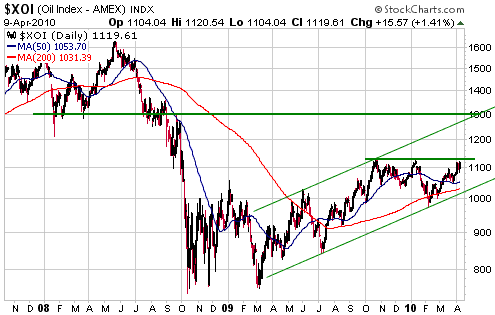
The XOI's chances of
making it to 1300 within the next couple of months would be enhanced if
it were to pull back to the mid-1000s before breaking above resistance
in the 1120s. Traders could therefore buy an oil-stock proxy such as
XLE following a near-term pullback to around 1050, employing a tight
trailing stop of, say, 5%.
Our plan is to use any strength in the oil sector over the coming month
or so to further reduce exposure to oil and gas stocks. As previously
noted, natural gas stocks have tended to trade with oil stocks over the
past year rather than with the price of natural gas.
This week's
important US economic events
| Date |
Description |
Monday Apr 12
| Treasury Budget
| | Tuesday Apr 13 | Trade Balance
Import and Export Prices
| | Wednesday Apr 14
| CPI
Retail Sales
| | Thursday Apr 15
| Treasury International Capital (TIC)
Industrial Production
Housing Market Index
| | Friday Apr 16
| Housing Starts
Consumer Sentiment
|
Gold and
the Dollar
Gold
Current Market Situation
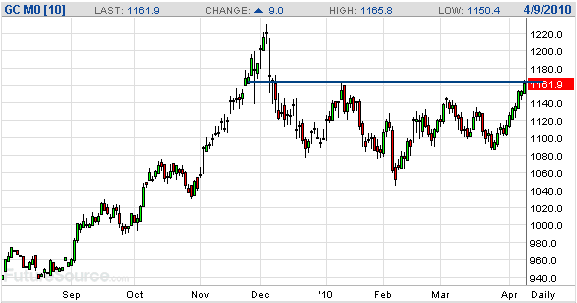
June gold futures ended last week at lateral resistance (see chart
below) after having risen on six of the past seven trading days. This
doesn't mean that a pullback is about to begin, but the gold price is
now at a level at which a pullback lasting at least a few days would be
a normal occurrence.
Although gold is now at a level where a $15-$30 pullback would be 'par
for the course', we are upgrading our short-term outlook from "neutral"
to "bullish". The reason is that it is looking increasingly likely that
the current rally will end up taking the US$ gold price into new-high
territory.
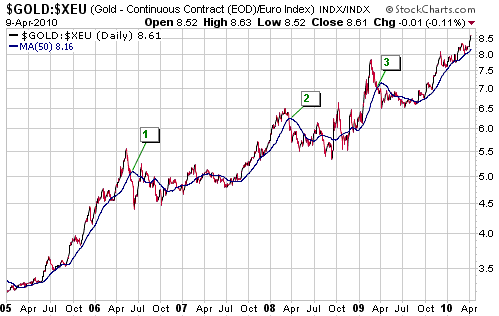
The euro gold price
(gold/euro) remains in a very consistent upward trend and at no stage
over the past six months has its short-term outlook been anything other
than "bullish". The consistency of this short-term upward trend is
useful because it means that gold/euro's first solid break below its
50-day moving average will probably be a timely signal of a trend
reversal.
To illustrate what we mean we have included, below, a chart of
gold/euro along with its 50-day moving average. Notice that since the
beginning of 2005, once gold/euro established a consistent upward trend
the first solid break below the 50-day moving average marked the start
of an intermediate-term consolidation. The sample size is only three,
but it does give us something to work with.
Gold versus other commodities
One thing we've learned to expect is for sentiment towards gold and
gold stocks to move with the nominal gold price rather than the real
gold price, even though it's the real performance of an investment that
determines its merit and the change in the real gold price that
determines whether gold mining profit margins rise or fall. The market
action of the past two years has been a wonderful example of the
aforementioned tendency, in that the share prices of gold-mining stocks
plummeted while the real gold price was rocketing upward during 2008
and then rallied strongly over the past 13 months while the real gold
price was in a downward trend.
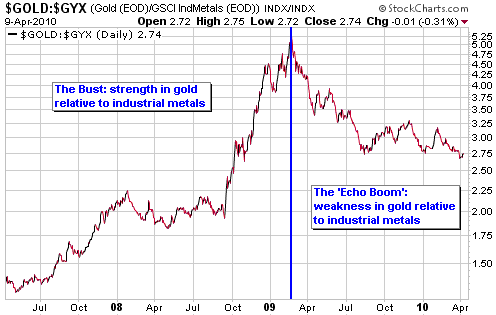
When we talk about the "real" gold price we mean the price of gold
relative to the prices of other commodities. The real gold price
generally does very well during major economic declines and quite
poorly during economic booms, as evidenced by the following chart of
the gold/GYX ratio (gold relative to a basket of industrial metals).
Relative to the industrial metals complex, gold hit a new 12-month LOW
last week.
Our view is that the downturn in gold/GYX that began in February-March
of 2009 will prove to be an intermediate-term correction within a
long-term bull market.
Gold Stocks
As mentioned in previous commentaries, a logical target for the HUI's
current rally is resistance at 470. This resistance is drawn on the
following daily chart. We have also mentioned that May is the most
likely time for the next short-term peak.
The HUI ended last week at 450. This means that it will have to pull
back or consolidate over the next week or so IF it is going to do no
better than reach 470 during May. Another possibility is that it will
continue to move upward over the next several days and reach 470 before
commencing a pullback/consolidation. If this were to happen then we
would begin to anticipate a test of the December-2009 high during May.
We are operating under the assumption that a rally into May would be
followed by a decline to an ultimate correction low during
October-November (most likely October). This scenario meshes with our
views on other markets (we expect the US$ to resume its advance
following several weeks of consolidation and we think the broad stock
market is close to an intermediate-term peak). It also meshes with the
gold sector's very strong tendency over the past decade to make
important turning points during October-November and the fact that
intermediate-term corrections in the gold sector generally last at
least 6 months (the current correction low was only two months after
the peak).
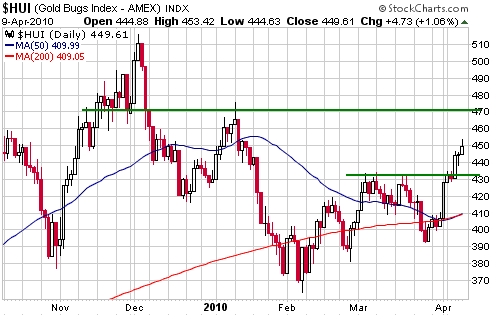
For traders, the risk
management parameters remain clear. Specifically, between now and when
a short-term peak is put in place the HUI should not close below 430,
so a daily close below 430 could be used as a stop for short-term
trading positions. Also, traders could reasonably buy a near-term
pullback to the mid-430s and then employ a very tight stop.
Currency Market Update
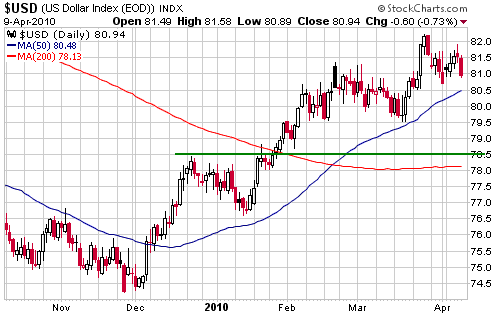
There is not yet much in the way of price-related evidence to confirm
this view, but we think the Dollar Index made a short-term peak in late
March and will consolidate/correct for several weeks before resuming
its intermediate-term advance. At the same time, we do not believe that
the dollar's downside risk from here is substantial. If a correction is
underway it will probably end up being of greater magnitude than the
previous two, but the downside is probably limited by lateral support
and the 200-day moving average at 78.0-78.5.
Update
on Stock Selections
(Notes: 1) To review the complete list of current TSI stock selections, logon at http://www.speculative-investor.com/new/market_logon.asp
and then click on "Stock Selections" in the menu. When at the Stock
Selections page, click on a stock's symbol to bring-up an archive of
our comments on the stock in question. 2) The Small Stock Watch List is
located at http://www.speculative-investor.com/new/smallstockwatch.html)
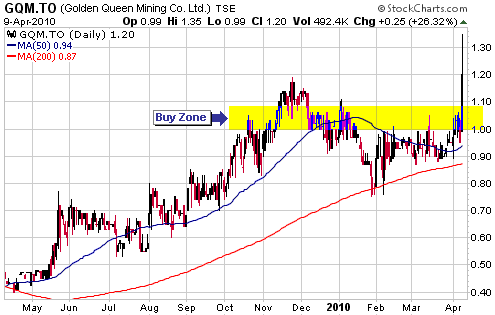
 Golden Queen Mining (TSX: GQM). Shares: 88M issued, 93M fully diluted. Recent price: C$1.20 Golden Queen Mining (TSX: GQM). Shares: 88M issued, 93M fully diluted. Recent price: C$1.20
GQM's Soledad Mountain project in California has a gold-equivalent
(gold + silver) M&I resource of 2.7M ounces. According to the
Feasibility Study (FS) completed in December of 2007, it could be
developed into a mine with annual gold-equivalent production of about
90K ounces and an initial capital cost of US$60M.
A press release put out by GQM on Friday morning stated:
"On April 8, 2010, the
Kern County Planning Commission formally considered Golden Queen Mining
Co. Ltd.'s Soledad Mountain project following a review and comment
period for the supplemental environmental impact report (SEIR). At the
meeting, the commission, consisting of a panel of three commissioners,
unanimously approved the project."
The long-awaited approval of the SEIR means that the project can now
proceed to the mine financing and construction phase, and that a
significant risk/uncertainty has been eliminated.
GQM gained 26% on Friday in response to the SEIR approval news, but at
the current price of $1.20 it still looks very under-valued.
Specifically, in the 17th December 2007 Weekly Update we outlined why
Soledad Mountain was probably worth more than $2 per GQM share at a
gold price of around $800/ounce (the gold price at the time). At the
current gold price the valuation would be significantly higher.
It is possible that the stock price will pull back to the low-C$1 area
to 'test' Friday's breakout. If it does, it will be a good opportunity
for new buying.
Copper Fox (TSXV: CUU). Shares: 257M issued, 375M fully diluted. Recent price: C$0.33
CUU was up another 26% on Friday and gained about 75% over the course
of last week. We don't know what caused the sudden surge in the demand
for CUU shares, but this sort of thing is not uncommon in the world of
junior resource stocks. Such stocks will sometimes lie dormant for an
agonisingly long period and then quickly double for no obvious reason.
At Friday's closing price of C$0.33 CUU remains under-valued.
Furthermore, it is a good candidate for a takeover, with Teck and
NovaGold being the most likely bidders. Having said that, it is
generally a good idea to take some money off the table after the price
of a stock has rocketed upward, especially if the large price rise
causes the stock in question to attain an excessive weighting within
one's portfolio.
Back in June of 2009 CUU issued a huge number of new shares at a very
low price in order to dig itself out of a financial hole. At the time
we suggested that existing CUU shareholders mitigate the extent to
which their stakes were being diluted by participating in the equity
financing. Shareholders who did participate now have a gain of more
than 900%, including the intrinsic value of the warrants received with
the new shares. It could make sense for these shareholders to sell the
shares they obtained via the financing and to maintain their position
in the stock by exercising the warrants. In any case, the warrants
should be exercised prior to their July-2010 expiry.
Red Hill Energy (TSXV: RH). Recent price: C$0.79
In the 22nd March Weekly Update we noted that since the announcement of
the merger between RH and Prophecy Resource (TSXV: PCY) in late
January, RH had traded at a substantial discount to the implied market
price of the post-merger shares. We said that we were less than
thrilled with the proposed merger, but that we would not consider
selling at a large discount to a legitimate offer currently 'on the
table'.
As at the close of trading on Friday the discount had narrowed to only
a few cents, so we are going to take the opportunity to exit RH. The
current price is about 2% below our November-2006 entry, but it is well
above the average price of the past 18 months.
We will continue to keep an eye on the progress of RH-PCY and may add it to the TSI Small Stocks Watch List in the future.
Chart Sources
Charts appearing in today's commentary
are courtesy of:
http://stockcharts.com/index.html
http://www.futuresource.com/
http://www.decisionpoint.com/

|