|
-- Weekly Market Update for the Week Commencing
12th May 2014
Big Picture
View
Here is a summary of our big picture
view of the markets. Note that our short-term views may differ from our
big picture view.
In nominal dollar terms, the BULL market in US Treasury Bonds
that began in the early 1980s ended in 2012. In real (gold)
terms, bonds commenced a secular BEAR market in 2001 that will continue
until 2018-2020. (Last
update: 20 January 2014)
The stock market, as represented by the S&P500 Index,
commenced
a secular BEAR market during the first quarter of 2000, where "secular
bear market" is defined as a long-term downward trend in valuations
(P/E ratios, etc.) and gold-denominated prices. This secular trend will bottom sometime between 2014 and 2020.
(Last update: 22 October 2007)
A secular BEAR market in the Dollar
began during the final quarter of 2000 and ended in July of 2008. This
secular bear market will be followed by a multi-year period of range
trading.
(Last
update: 09 February 2009)
Gold commenced a
secular bull market relative to all fiat currencies, the CRB Index,
bonds and most stock market indices during 1999-2001.
This secular trend will peak sometime between 2014 and 2020.
(Last update: 22 October 2007)
Commodities,
as represented by the Continuous Commodity Index (CCI), commenced a
secular BULL market in 2001 in nominal dollar terms. The first major
upward leg in this bull market ended during the first half of 2008, but
a long-term peak won't occur until 2014-2020. In real (gold) terms,
commodities commenced a secular BEAR market in 2001 that will continue
until 2014-2020.
(Last
update: 09 February 2009)
Copyright
Reminder
The commentaries that appear at TSI
may not be distributed, in full or in part, without our written permission.
In particular, please note that the posting of extracts from TSI commentaries
at other web sites or providing links to TSI commentaries at other web
sites (for example, at discussion boards) without our written permission
is prohibited.
We reserve the right to immediately
terminate the subscription of any TSI subscriber who distributes the TSI
commentaries without our written permission.
Outlook Summary
Market
|
Short-Term
(1-3 month)
|
Intermediate-Term
(6-12 month)
|
Long-Term
(2-5 Year)
|
|
Gold
|
Bullish
(26-Mar-14) |
Bullish
(26-Mar-12) |
Bullish
|
|
US$ (Dollar Index)
|
Bearish
(16-Apr-14) |
Bearish
(27-Jan-14) |
Neutral
(19-Sep-07) |
|
Bonds (US T-Bond)
|
Bullish
(11-Dec-13)
|
Neutral
(18-Jan-12)
|
Bearish |
|
Stock Market
(DJW)
|
Bearish
(07-Apr-14) |
Bearish
(28-Nov-11) |
Bearish
|
|
Gold Stocks
(HUI)
|
Bullish
(03-Mar-14) |
Bullish
(23-Jun-10) |
Bullish
|
|
Oil |
Bearish
(12-Mar-14) |
Neutral
(31-Jan-11) |
Bullish
|
|
Industrial Metals
(GYX)
|
Neutral
(17-Feb-14) |
Bullish
(28-Apr-14) |
Bullish
(28-Apr-14) |
Notes:
1. The date shown below the current outlook is when the most recent outlook change occurred.
2. "Neutral", in the above table, means that we either don't have a
firm opinion or that we think risk and reward are roughly in balance with respect to the timeframe in question.
3. Long-term views are determined almost completely by fundamentals,
intermediate-term views by
fundamentals, sentiment and technicals, and short-term views by sentiment and
technicals.
Oil
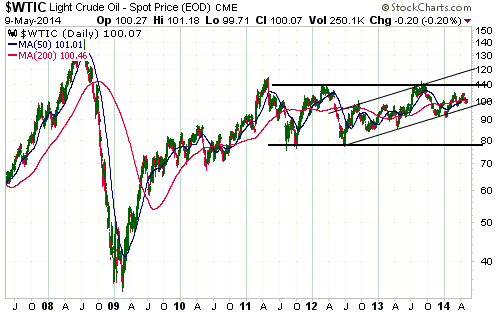
The oil market has now spent three years
trading sideways within a $30 range. There is major resistance at $110 and major
support in the high-$70s. Furthermore, within this broad horizontal range the
oil market has moved upward within a well-defined channel since mid-2012. A
daily close below the lower boundary of this channel, which is presently at
$97-$98, would suggest that the oil price was on its way back to the bottom of
its 3-year range.
Due to its high current valuation relative to most other commodities, we think
that a return by the oil price to near the bottom of its 3-year range has a
decent chance of happening within the coming 6 months.
The upper half of the next chart illustrates oil's high price relative to
copper. Notice that the oil/copper ratio has just turned downward after coming
within 10% of its 2008 major peak.
Also worth mentioning is that the last two multi-year trends in the oil/copper
ratio were in the opposite direction to the general commodity trend. This can be
seen by comparing the upper and lower halves of the following chart (the lower
half shows the Continuous Commodity Index - CCI). Specifically, notice that the
downward trend in the oil/copper ratio that extended from late-2008 through to
early-2011 occurred in parallel with a cyclical bull market in commodities and
that the upward trend in the oil/copper ratio that extended from early-2011
through to early-2014 occurred in parallel with a cyclical bear market in
commodities. The evidence that has emerged over the past three months that a new
cyclical bull market in commodities has begun is therefore another reason to
anticipate relative weakness in the oil price.

The Stock
Market
The US
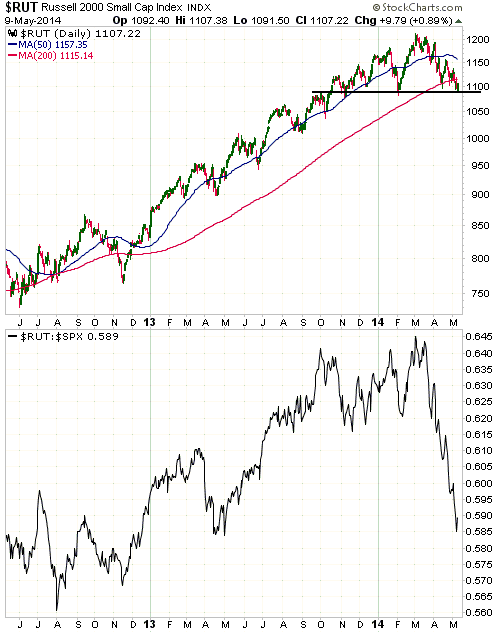
The top section of the following daily chart shows that the Russell2000
Small-Cap Index (RUT) ended last week slightly below its 200-day MA and slightly
above important lateral support at 1090. Although its technical situation looks
a little precarious, it doesn't look any worse than it did just prior to the
start of a huge rally in November of 2012. In other words, there is nothing in
the RUT's nominal price performance to indicate that the decline of the past two
months is anything more serious than a routine bull-market correction.
The evidence that the decline of the past two months is something more than a
routine correction is contained in the bottom section of the same chart. The
bottom section of the chart reveals that the RUT/SPX ratio has plunged to near
an 18-month low.
The RUT's recent relative weakness clearly differentiates the
March-2014-to-May-2014 decline from the normal corrections of the past two
years. It suggests to us that a top of at least intermediate-term significance
is being put in place.
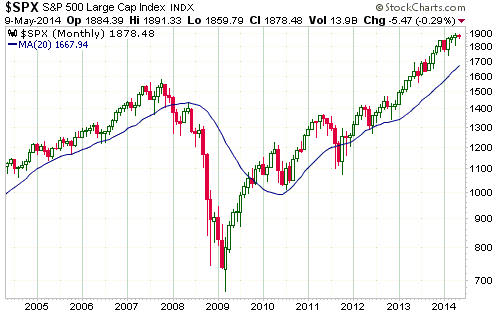
Next up is a monthly chart of the SPX. The blue line on the chart is the
20-month MA.
Previous bull-market corrections have taken the SPX down to its 20-month MA. The
absence of a decline to this moving average since 2012 therefore means that the
SPX has now gone more than 18 months without experiencing a proper correction.
This is unusual and suggests that even if the bull market were destined to
continue it would be reasonable to expect a decline to the 20-month MA within
the coming few months, especially considering the bearish divergences and
non-confirmations of the past two months and the bearish seasonality indicated
by the Presidential Cycle Model. In other words, an SPX decline to 1700 or lower
would be a likely prospect within the coming few months even if the cyclical
bull market were to remain intact.
In the 16th April Interim Update, we wrote: "...the next three weeks should
be a good time for speculators to average into bearish US equity positions. At
this stage we aren't going to make any formal recommendations, but for our own
account we will consider put options on QQQ (the NASDAQ100 ETF), IWM (the
Russell2000 ETF), and SSO (the ProShares UltraS&P500 ETF)."
We still don't plan on making any formal recommendations, but for information
purposes we advise that a small SSO put-option position was added to our account
late last week (we chose the January-2015 $100 puts). We might double our
exposure to these puts if there is some additional stock-market upside during
the first half of this week, but the overall position size will remain small.
Japan
Japan's Nikkei225 Index is hovering just above the 14,000 precipice. Breaking
below 14,000 would create a chart-based short-term target of 12,000-12,500.
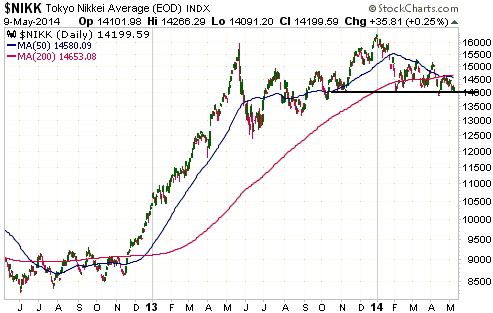
We expect that the Nikkei will be dragged downward over the next few months by
global stock-market weakness, the spreading realisation that "Abenomics" is
hurting, rather than helping, Japan's economy, and the continuing inability of
the Bank of Japan to boost the country's monetary inflation rate beyond the
3%-4% range. In our opinion the Nikkei will trade in the low-to-mid 12,000s
before October, at which point it could be appropriate to 'go long' the Japanese
stock market. Whether it is appropriate will largely depend on Japan's monetary
policy, the magnitude of the Yen's rebound on the foreign exchange market and
the extent to which other major stock markets have become 'oversold' in the
meantime.
This week's
important US economic events
| Date |
Description |
| Monday May 12 |
Treasury Budget | | Tuesday
May 13 |
Retail Sales
Import and Export Prices
Business Inventories | | Wednesday
May 14 |
PPI
Housing Market Index | | Thursday
May 15 |
CPI
Industrial Production
Empire State Mfg Survey
TIC Report
Philadelphia Fed Survey
|
| Friday May 16 |
Housing Starts
Consumer Sentiment |
Gold and
the Dollar
Gold and Silver
The Ratio
There are many gold and silver bulls who believe that direct downward
manipulation is a primary influence on gold's price trend. They are oblivious to
the fact that on an intermediate-term basis gold has done exactly what it should
have done -- considering the true fundamentals -- every step of the way over the
past 20 years, but that's a separate story that we've covered at length in the
past. A point that we now want to address is that many of the same gold and
silver bulls believe that silver should trade at more than one-twentieth of an
ounce of gold, that is, they believe that the gold/silver ratio should be less
than 20. If you have rigid beliefs that the gold price is being held down by
manipulators and that silver SHOULD be trading a lot higher relative to gold,
then you will necessarily conclude that silver must be manipulated downward to
an even greater extent than gold.
The belief that the gold/silver ratio should be less than 20 is usually based on
the claims that a) in nature, gold is only 8-times more rare than silver, and b)
there is a lot more aboveground gold in readily saleable form than aboveground
silver in readily saleable form. These claims are not necessarily wrong, but
they are irrelevant to the issue under discussion. For example, if the
comparative size of the aboveground inventory was a major determinant of gold's
relative market value, with a higher inventory resulting in a lower relative
value, then gold would only be about five times more valuable than copper
(versus the current six thousand times) and would trade at less than 1% of its
current price.
Moving a little off track, the aboveground gold inventory is so large that it is
almost constant over a normal investing timeframe (new mine supply results in
only a small annual increase), meaning that changes in the inventory can be
ignored when analysing past and expected-future price trends. Furthermore,
rather than being a strong bearish influence, the large aboveground gold
inventory should be viewed as a plus because a) it is due to gold's historical
uses as money and a store of value, and b) it makes gold the most suitable
commodity, by a very wide margin, for current use as a store of value and future
use as money. In fact, gold is now the only commodity that is sufficiently
liquid and fungible to be used effectively as a 'monetary' store of value by
wealthy investors and speculators.
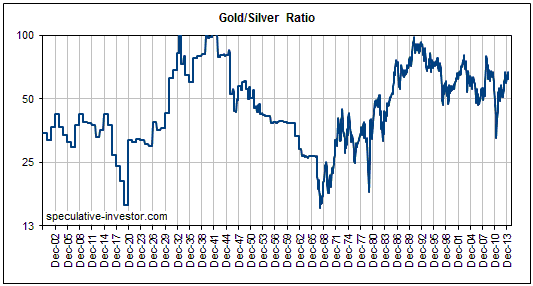
Getting back on track, the following chart shows that since 1900 the gold/silver
ratio has oscillated over a very wide range. It should come as no surprise to
anyone who understands how the gold price is formed that all the big swings in
this ratio had monetary roots. Of particular note: 1) There was a huge increase
in the ratio during the Great Depression due firstly to monetary deflation (the
official gold-dollar link resulted in gold holding its nominal value while
silver and all other commodities tanked in response to the deflation) and then
to the official devaluation of the dollar relative to gold); 2) there was a huge
decline in the ratio from the early-1940s through to the late-1960s due to
silver being boosted by monetary inflation while gold remained linked to the
dollar at a fixed rate; 3) there was initially a large increase in the ratio in
response to the severing of the official gold-dollar link during the
early-1970s, but later in the decade fear of inflation prompted a dramatic surge
in silver speculation that caused the ratio to spike down to near its 1960s
bottom; 4) currency, banking and savings-and-loan crises during the 1980s and
early-1990s pushed the ratio up to near its Great Depression high; and 5) from
the mid-1990s through to the present day the ratio has oscillated at a higher
frequency within a narrower range in response to periodic deflation scares, the
occasional currency crisis, bouts of inflation-fueled speculation and periods of
relative calm.
The chart also shows that the ratio has averaged 40-50 over the past 90 years
and 50-60 over the past 30 years. 55 now appears to be about right for the
ratio, with moves above 65 indicating that silver is significantly under-valued
relative to gold and moves below 45 indicating that silver is approaching a top
relative to gold.
The gold/silver ratio can be an economic confidence or market liquidity
indicator, with a rise in the ratio indicating a rising preference for
liquidity, safety and value stability (in reaction to declining economic
confidence) and a fall in the ratio indicating a rising preference for risk (in
reaction to increasing economic confidence). It often (but not always) works
this way because intermediate-term trends in the gold price are dominated by
investment- and store-of-value-related demand, whereas silver demand has a
sizeable industrial/commercial component. However, in this respect the
gold/silver ratio is not as reliable as the gold/CCI ratio (gold versus
commodities in general) or the gold/GYX ratio (gold versus industrial metals).
Finally, today's gold/silver ratio of 67 suggests that silver is now
significantly under-valued relative to gold and should be favoured by long-term
investors. Silver is also 'oversold' relative to gold on a short-term basis and
therefore stands a good chance of outperforming over the next three months.
Enthusiasm for silver relative to gold should be tempered, however, by silver's
historical tendency to have lacklustre performance relative to gold during the
first two years of a new cyclical precious-metals bull market. This historical
tendency tells us that, short-term fluctuations aside, the sort of relative
strength anticipated by the most ardent silver bulls is unlikely to materialise
prior to the second half of NEXT year.
Current Market Situation
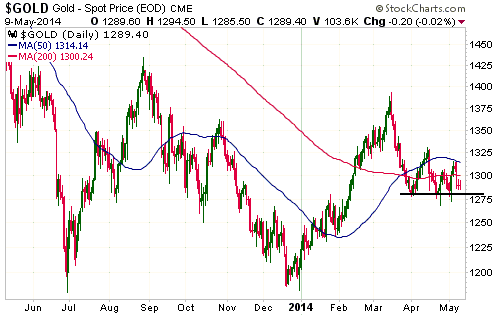
Gold's price action since its early-April bottom could be either a mid-trend
consolidation (a consolidation within a continuing short-term downward trend) or
a basing pattern. Prior to the past few days we thought that the latter
possibility was the more likely, but due to last week's downward reversal from
the 50-day MA there is no longer a clear favourite.
$1225-$1235 would be the chart-based objective following a daily close below
$1280, whereas intermediate-term resistance at $1400-$1425 would be the
short-term chart-based objective following a daily close above the 50-day MA. We
expect that the aforementioned intermediate-term resistance will be tested by
the end of June regardless of whether or not gold breaks below $1280 within the
coming week or so.
Gold Stocks
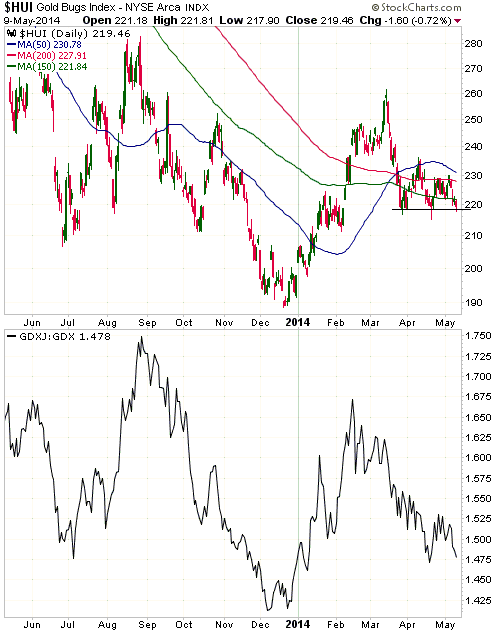
The HUI broke below the bottom of its 2-week range late last week. Short-term
support is now well defined at 219, with a break below 219 projecting a drop to
205-210.
The 219 level has now been tested enough times to suggest that it will soon give
way, which, in turn, suggests that a bullish short-term outlook is not
appropriate for the gold sector. However, our bullish/bearish/neutral views are
based on our assessment of risk versus reward, not on our best guess of price
direction. If the downside risk is limited to about 15 points then the
short-term risk/reward is still bullish.
As noted in last week's Interim Update, if the HUI spikes to a new multi-month
low in the near future we will be very interested to see whether this new
correction low is confirmed by the GDXJ/GDX ratio (shown in the lower half of
the following daily chart). A bullish divergence will be created if a spike to a
new multi-month low by the HUI is not confirmed by a new multi-month low in GDXJ/GDX.
We are keen to show updated charts comparing the gold sector's performance since
its December-2013 bottom with its performance following the cyclical bear-market
bottoms of 1970, 1976 and 2000, but before we do so we would like the HUI to
make a significant move in one direction or the other. At this time we will
simply note that a literal comparison with the post-1970 bottom points to an
upward reversal this week while a literal comparison with the post-1976 bottom
points to some additional downside this week followed by an upward reversal next
week.
The Currency Market
The euro and the Dollar Index
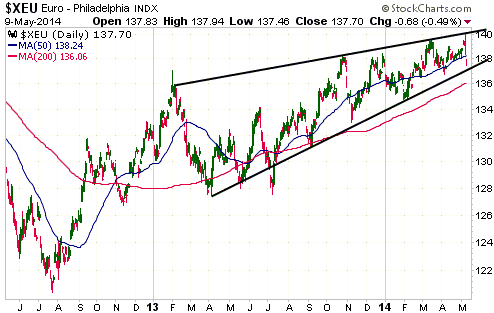
The euro reversed lower over the final two days of last week. The proximate
cause of the reversal was Mario Draghi's verbal diarrhea at a post-ECB-meeting
press conference last Thursday (Draghi said that the euro's strength was a
serious concern and implied that the ECB would introduce additional monetary
stimulus next month), but the following chart shows that the euro was at major
resistance and was therefore acutely vulnerable at the time that Draghi's words
were hitting the newswires. Also, there seems to be a general perception within
the currency-trading community that the ECB will stoutly defend the 140 level.
The euro's downward reversal from major resistance turned the Dollar Index
upward from major support. For the sixth time since September of 2012, the
Dollar Index has rebounded from at or just below 79.
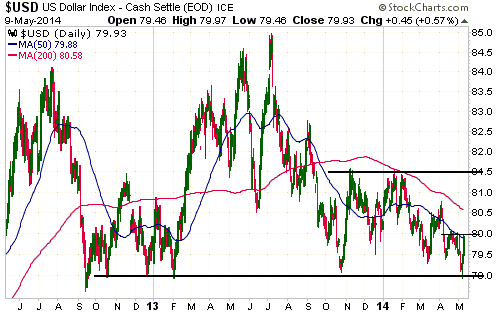
The more times a support or resistance level is successfully tested, the higher
the probability that a subsequent test will fail. Last week's rebound from
critical support at 79 therefore improves the chances that this support will
eventually give way, although it no longer appears that a downside breakout is
imminent. Instead, it looks like the Dollar Index is going to spend a few more
weeks in the 79-81 range.
The Yen
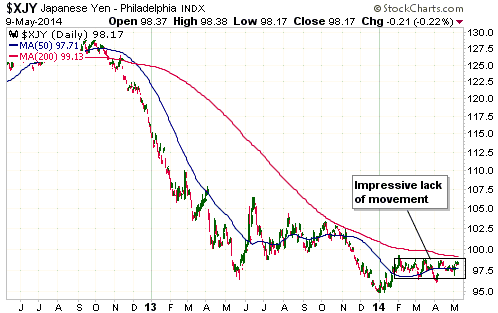
If gold traders are getting frustrated by gold's recent inability to sustain a
move in either direction, Yen traders must be pulling their hair out. Over the
past three months the Yen market has come as close as a major financial market
ever comes to trading in a horizontal line over a multi-month period. Compared
to the Yen's recent performance, gold's recent performance has been exciting.
We suspect that the Yen is coiling in preparation for a significant move to the
upside and that this move will unfold in parallel with stock market weakness.
However, most speculators remain convinced that the Yen is marking time prior to
resuming its bearish trend.
Updates
on Stock Selections
Notes: 1) To review the complete list of current TSI stock selections, logon at
http://www.speculative-investor.com/new/market_logon.asp
and then click on "Stock Selections" in the menu. When at the Stock
Selections page, click on a stock's symbol to bring-up an archive of
our comments on the stock in question. 2) The Small Stock Watch List is
located at http://www.speculative-investor.com/new/smallstockwatch.html
 Company
news/developments for the week ended Friday 9th May 2014: Company
news/developments for the week ended Friday 9th May 2014:
[Note: AISC = All-In Sustaining Cost, FS = Feasibility Study, IRR =
Internal Rate of Return, MD&A = Management Discussion and Analysis,
M&I = Measured and Indicated, NAV = Net Asset Value, NPV(X%) = Net
Present Value using a discount rate of X%, P&P = Proven and
Probable, PEA = Preliminary Economic Assessment, PFS =
Pre-Feasibility Study]
*Asanko Gold (AKG) published the results from the final 52 holes
of its 2013 drilling program at Dynamite Hill, a potentially
open-pit-able gold deposit located about 7km from the planned
processing facility for phase 1 of the Asanko gold mine (Ghana). In
addition, the company advised that it has begun an 11,000m infill
drilling program that should enable open-pit mine planning of oxide
mineralization at Dynamite Hill. AKG expects to report the results
of the current 11000m Dynamite Hill infill drilling program in
September and incorporate these results into an updated resource
estimate at year-end.
Although the mining of the Dynamite Hill deposit could enhance the
economics of the overall Asanko project by providing additional
mining flexibility for the early stages of the phase 1 operation
(initial gold production scheduled for Q1-2016), at this stage the
Dynamite Hill drilling results aren't important.
*Endeavour Mining (EDV.TO, EVR.AX) published its financial results
for the first quarter of this year. The financial statements
revealed that the company had net debt of around $200M at the end of
March. This constitutes a $9M improvement during the quarter.
Assuming that the gold price doesn't tank, the pace of balance-sheet
improvement should accelerate over the remainder of this year.
Gold production during the quarter was 105K ounces at an AISC of
$1059/oz. This was in accordance with the company's plan. Quarterly
production is expected to remain at around 105K ounces over the
course of this year, with costs trending downward due to the
increasing contribution of the low-cost Agbaou mine and the
conversion to owner-operated mining at the Tabakoto project.
EDV is marginally profitable at the current gold price and should
become very profitable after gold returns to $1400/oz. It is one of
the best candidates for new buying at this time.
*Golden Star Resources (GSS) published its financial results for
the first quarter of this year. As expected due to the
previously-reported low production during the quarter, the company
generated a large loss and suffered another significant
deterioration in its balance sheet. GSS's balance sheet worsened to
the tune of $19M during the latest quarter, which means that there
has been a $40M deterioration over the past 6 months.
Although the poor Q1 performance was in line with the company's plan
and although higher production and lower costs are expected over the
remainder of this year, GSS's financial situation is no longer
healthy. The company will probably be bailed out by a higher gold
price, but there is not much margin for error.
Due to the risk associated with its weakening balance sheet and
relatively high costs, GSS is not a good candidate for new buying at
this time.
*Pilot Gold (PLG.TO) advised that it has resumed its 25,600m 2014
drilling program at the Kinsley Mountain gold project in Nevada.
Results for the first 4,200m of drilling were reported earlier this
year and included some exceptional gold intercepts. The remaining
21,400m will be focused on step-out drilling around the high-grade
mineralization in the Western Flank target (the source of the
exceptional results achieved to date) as well as exploration
drilling at some other highly-prospective targets across the
property.
Also, PLG published its financial results for the first quarter of
this year. For a cash-flow-negative explorer such as PLG, the
salient number is working capital. Based on the balance sheet at the
end of March, we estimate that PLG currently has about $33M of
working capital. This should be enough to fully fund the company for
at least the next 18 months.
*Rio Alto (RIOM) published its financial results for the first
quarter of this year.
According to the company's plan, the first quarter should be the
worst quarter of the year. However, the worst quarter was still
good, in that a) the net profit was $11.9M (7c/share), b) the AISC
was low at only $773/oz, and c) RIOM's already-strong balance sheet
got a little stronger with a $7M increase in working capital.
Unlike GSS, which needs a significantly higher gold price to become
genuinely profitable and cash-flow positive, RIOM is likely to be
very profitable and add substantial cash to its balance sheet over
the remainder of this year unless the gold price moves much lower.
Its low costs and healthy balance sheet provide a margin of safety,
while its low valuation creates substantial upside potential.
GSS has more upside potential than RIOM, but the additional upside
potential comes with a lot more downside risk. On a
reward-versus-risk basis, RIOM is by far the better option at this
time.
List
of candidates for new buying
From within the ranks of TSI stock selections, the best candidates for new
buying at this time are:
1) EDV.TO (last Friday's closing price: C$0.79).
2) EVN.AX (last Friday's closing price: A$0.80).
3) PLG.TO (last Friday's closing price: C$1.35).
4) RIOM (last Friday's closing price: US$1.97).
5) RSG.AX (last Friday's closing price: A$0.58).
Chart Sources
Charts appearing in today's commentary
are courtesy of:
http://stockcharts.com/index.html

|









