|
-- Weekly Market Update for the Week Commencing
12th August 2013
Big Picture
View
Here is a summary of our big picture
view of the markets. Note that our short-term views may differ from our
big picture view.
In nominal dollar terms, the BULL market in US Treasury Bonds
that began in the early 1980s will end by 2013. In real (gold)
terms, bonds commenced a secular BEAR market in 2001 that will continue
until 2014-2020. (Last
update: 23 January 2012)
The stock market, as represented by the S&P500 Index,
commenced
a secular BEAR market during the first quarter of 2000, where "secular
bear market" is defined as a long-term downward trend in valuations
(P/E ratios, etc.) and gold-denominated prices. This secular trend will bottom sometime between 2014 and 2020.
(Last update: 22 October 2007)
A secular BEAR market in the Dollar
began during the final quarter of 2000 and ended in July of 2008. This
secular bear market will be followed by a multi-year period of range
trading.
(Last
update: 09 February 2009)
Gold commenced a
secular bull market relative to all fiat currencies, the CRB Index,
bonds and most stock market indices during 1999-2001.
This secular trend will peak sometime between 2014 and 2020.
(Last update: 22 October 2007)
Commodities,
as represented by the Continuous Commodity Index (CCI), commenced a
secular BULL market in 2001 in nominal dollar terms. The first major
upward leg in this bull market ended during the first half of 2008, but
a long-term peak won't occur until 2014-2020. In real (gold) terms,
commodities commenced a secular BEAR market in 2001 that will continue
until 2014-2020.
(Last
update: 09 February 2009)
Copyright
Reminder
The commentaries that appear at TSI
may not be distributed, in full or in part, without our written permission.
In particular, please note that the posting of extracts from TSI commentaries
at other web sites or providing links to TSI commentaries at other web
sites (for example, at discussion boards) without our written permission
is prohibited.
We reserve the right to immediately
terminate the subscription of any TSI subscriber who distributes the TSI
commentaries without our written permission.
Outlook Summary
Market
|
Short-Term
(1-3 month)
|
Intermediate-Term
(6-12 month)
|
Long-Term
(2-5 Year)
|
|
Gold
|
Bullish
(17-Oct-12)
|
Bullish
(26-Mar-12)
|
Bullish
|
|
US$ (Dollar Index)
|
Neutral
(24-Dec-12)
|
Bullish
(01-May-13)
|
Neutral
(19-Sep-07)
|
|
Bonds (US T-Bond)
|
Bullish
(24-Jun-13)
|
Neutral
(18-Jan-12)
|
Bearish |
|
Stock Market
(DJW)
|
Bearish
(15-Jul-13)
|
Bearish
(28-Nov-11)
|
Bearish
|
|
Gold Stocks
(HUI)
|
Bullish
(24-Dec-12)
|
Bullish
(23-Jun-10)
|
Bullish
|
|
Oil |
Neutral
(30-Jul-12)
|
Neutral
(31-Jan-11)
|
Bullish
|
|
Industrial Metals
(GYX)
|
Neutral
(30-Jul-12)
|
Neutral
(29-Aug-11)
|
Neutral
(11-Jan-10)
|
Notes:
1. In those cases where we have been able to identify the commentary in
which the most recent outlook change occurred we've put the date of the
commentary below the current outlook.
2. "Neutral", in the above table, means that we either don't have a
firm opinion or that we think risk and reward are roughly in balance with respect to the timeframe in question.
3. Long-term views are determined almost completely by fundamentals,
intermediate-term views by
fundamentals, sentiment and technicals, and short-term views by sentiment and
technicals.
Monetary Inflation Update
Regarding monetary inflation in Japan, in
the 15th July Weekly Update we wrote:
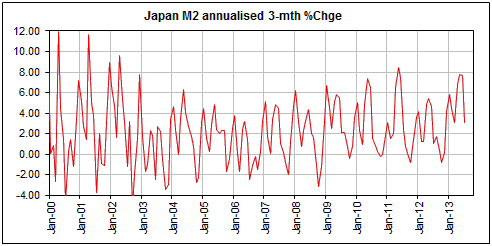
"...the annualised 3-month rate of change in Japan's M2 money supply does not
yet reveal a deviation from the pattern of the past 10 years. Specifically,
there has been a strong tendency for the 3-month rate-of-change in Japan's M2 to
peak in either April or May (usually May) and then plunge to a low during
September or October (usually October). We note that the 3-month rate of change
in Japan's M2 ticked downward in June in line with the seasonal pattern.
The next two months should be decisive. If the 3-month rate of change in Japan's
M2 moves to a new high for the year in July or August it will be a clear sign
that the Abe-BOJ inflation scheme is 'working', whereas more of the same would
be indicated by a sharp decline in the 3-month M2 growth rate."
The following chart shows that there was a sharp decline in Japan's 3-month M2
growth rate in July (the growth rate plunged from 7.69% to 3.11%). This means
that the rate of change in Japan's money supply is still tracking the seasonal
pattern established over the past 10 years. To put it another way, at this stage
there isn't any evidence that the aggressive new inflation policies introduced
at the behest of Japan's prime minister have had a meaningful effect on Japan's
money supply.
We don't know exactly how Japanese "QE" works, but it is crystal clear that the
BOJ's asset monetisation is a different process to the Fed's asset monetisation.
Contrary to popular belief, when the Fed monetises assets it simultaneously
boosts bank reserves and the economy-wide money supply (bank reserves are not
counted in the money supply). That's why the US money supply (TMS) has increased
by about $400B since the beginning of this year even though commercial bank
credit has only increased by around $70B over the same period, and why the US
money supply has increased at an annualised rate of around 10% over the past
three months even though there has been a small contraction in commercial bank
credit over the same period. In the US, the Fed is able to expand the money
supply by whatever amount it desires, regardless of what the commercial banks
are doing. On a side note, this is the main reason why the forecasters of US
deflation have been wrong since 1933 and will probably continue to be wrong for
years to come.
In Japan, though, it seems that central-bank "QE" does not involve the direct
injection of money into the economy. As far as we can tell, Japan-style QE
involves the BOJ adding reserves to the banking system and then relying on the
commercial banks to lend new money into the economy. Japan-style QE therefore
only boosts the economy-wide money supply to the extent that Japanese commercial
banks expand their loan books.
There are no hard-and-fast rules when it comes to government and central-bank
actions, so at some future point Japan's financial establishment could change
the rules to enable direct money-pumping by the BOJ. Up until now, however, it
is fair to say that the Nikkei rally and Yen decline have been 100%
sentiment-driven, given that the change in the monetary-inflation backdrop that
supposedly justifies these market moves has not materialised.
T-Bond Update
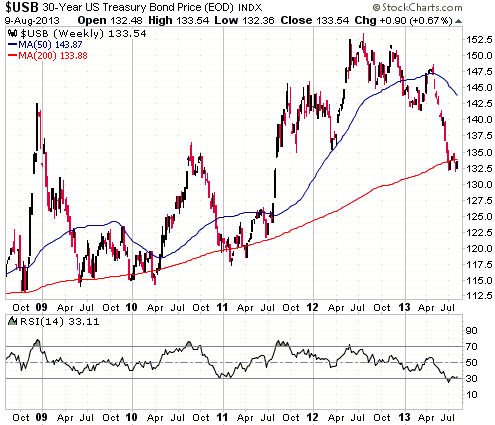
The Treasury Bond has essentially traded sideways
since making some sort of bottom about 6 weeks ago. It remains 'oversold' on an
intermediate-term basis and slightly below its 200-week moving average (the red
line on the following weekly chart). The other intermediate-term lows of the
past five years occurred at or slightly below the 200-week MA.
It's possible that the T-Bond has finally commenced a long-term bear market, but
regardless of whether it is in the early part of a new long-term bear market or
the late part of an old long-term bull market there's a good chance of a rebound
to the 50-week MA (the blue line on the following weekly chart). We are
short-term bullish in anticipation of such a rebound.
Copper Update
The copper market in particular and the
industrial metals markets in general were strong last week. Furthermore, the
strength in the commodities was confirmed by significant price gains for the
associated equities.
The recent rally in the copper price means that the late-June low was a
successful test of last year's low, but it doesn't mean that copper's cyclical
bear market has ended.
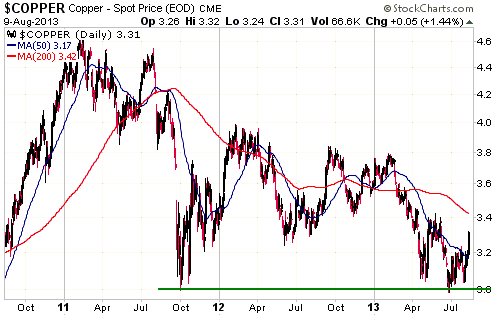
We doubt that the bear market is over. Unless there is much stronger nominal
economic growth and/or much more weakness in the US$ over the next 6-12 months
than we expect, the recent current rebound will probably be followed by a
decline to new multi-year price lows. However, additional short-term gains are
likely.
Short-term support for copper now lies at $3.20. Provided that this support
holds during any pullback over the coming 1-2 weeks, we guess that a subsequent
advance will make it to around $3.70.
The Stock
Market
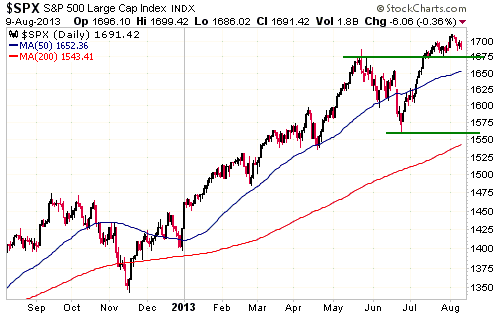
The S&P500 Index (SPX) could be rolling over
into either a short-term correction or a long-term decline. With reference to
the following chart, here are the parameters:
1) A daily close below 1675 will be a clear sign that a downward correction has
begun.
2) A steep correction over the coming 2-3 weeks that does not breech the June
low (around 1560) will leave the odds in favour of a rally to a marginal new
high during October-November.
3) Consecutive daily closes or a weekly close below the June low at some point
over the next few weeks will indicate that a multi-year top is in place.
4) If the SPX moves to a new high within the next two weeks (instead of
signaling the start of a correction by closing below 1675), it will create the
potential for a traditional October crash.
Interestingly, while the senior US stock indices appear to be rolling over to
the downside, some of the most beaten-down sectors of the market are showing
signs of upward trend reversals. As mentioned above in our "Copper" discussion,
one example is the industrial metals sector. The following daily chart shows
another example.
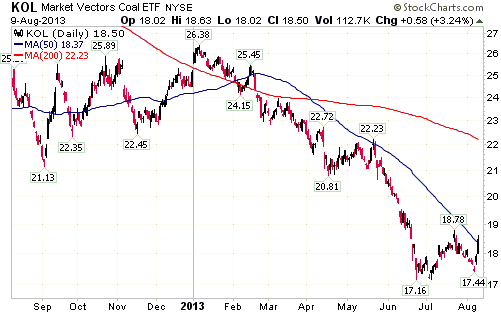
The chart indicates that KOL, an ETF proxy for the coal-mining sector of the
stock market, reversed upward over the past two trading days after testing its
June low. Even if this is nothing more than a bear-market rebound, KOL has
significant short-term upside potential.
Traders should consider buying a pullback in KOL to the low-$18 area and placing
an initial protective sell stop just below last week's low.
This week's
important US economic events
| Date |
Description |
| Monday Aug 12 |
Treasury Budget | | Tuesday
Aug 13 |
Retail Sales
Import and Export Prices
Business Inventories | | Wednesday
Aug 14 |
PPI | | Thursday
Aug 15 |
CPI
Empire State Mfg Survey
TIC Report
Industrial Production
Housing Market Index
Philadelphia Fed Survey
|
| Friday Aug 16 |
Housing Starts
Consumer Sentiment
Q2 Productivity and Costs |
Gold and
the Dollar
Gold
The Fed has a huge problem of its own making. Bernanke and his cohorts know that
they will soon have to begin reducing the 'monetary accommodation', but at the
same time they are not willing to allow the economy and the financial markets to
experience proper -- and necessarily painful -- adjustments. Consequently, a
normalisation of monetary policy will not happen in the foreseeable future.
Well before the level of 'monetary support' is reduced to zero, the stock market
and the economy will tank. The reason is that current high equity valuations and
a lot of today's economic activity result from the Fed's money pumping and will
not be sustainable in the absence of continued money pumping. And when the stock
market and the economy tank, the Fed will do what it always does in reaction to
such developments: it will ramp-up the rate of money pumping.
The upshot is that the probability of genuinely tight monetary policy within the
coming year is precisely zero. Tight monetary policy is absolutely not a threat
to gold's bull market, but significant short-term fluctuations will continue to
occur in reaction to the latest news or rumours about the Fed's intentions.
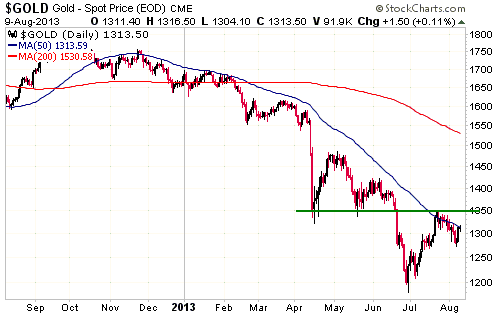
In last week's Interim Update we said that gold's decline from its July peak
looked like a run-of-the-mill pullback within a continuing short-term upward
trend. The price action over the final two days of the week was consistent with
this interpretation.
Important resistance lies at $1350. Taking out this resistance could prompt many
speculators to start thinking along the lines of "hey, maybe the gold bull
market has resumed", leading to significant upside follow-through.
A test of longer-term resistance at $1480-$1530 will be a realistic possibility
in September if $1350 is decisively breeched in August.
Gold Stocks
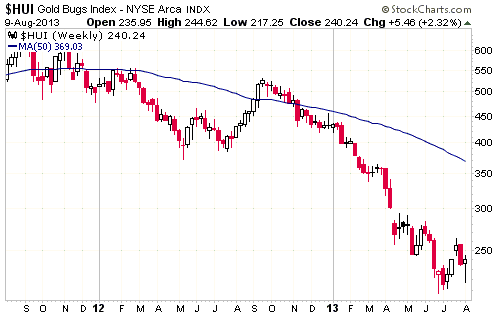
The following weekly chart shows that the HUI made a small gain last week. It
also shows that the small gain was achieved via a significant decline to a new
3-week low and then an upward reversal. This is bullish price action. This price
action is consistent with the idea that the gold sector's short-term upward
trend will continue into the first half of September, although it doesn't
suggest that there will be an immediate extension of the rally.
As illustrated by the chart displayed below, the HUI continues to track the
1968-1970 Model. This Model suggests the potential for a strong rally to begin
within the next two weeks.
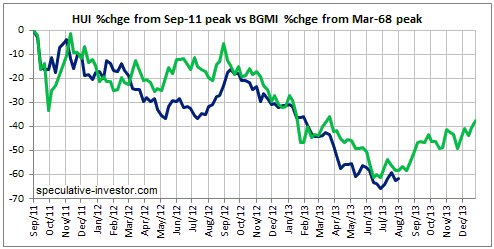
Last week's lows are now very important, because taking out these lows on even
an intra-day basis would change the pattern and suggest that a final multi-week
capitulation had begun. It would therefore make sense to place protective sell
stops on gold stock/ETF short-term trading positions just below last week's
lows.
Currency Market Update
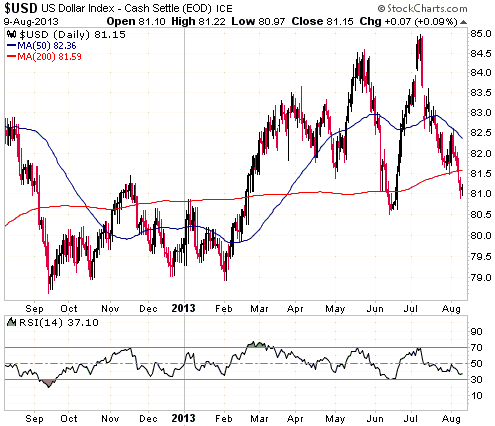
The Dollar Index, a daily chart of which is displayed below, could be close to
some sort of bottom. However, at this stage there is no evidence that a
meaningful/tradable rally is about to get underway. For one, US$ sentiment is
neutral, despite the sharp price decline of the past several weeks. For another,
the Dollar Index's daily RSI (refer to the bottom section of the following
chart) has not yet reached an 'oversold' extreme.
Also of significance, the European Bank Index (SX7E) broke out to a new 6-month
high last week. It's possible that the upside breakout won't be sustained, but
with the euro having traded in synch with the SX7E over the past couple of years
there is presently no good reason to expect anything more than a minor pullback
in the euro over the next few weeks.
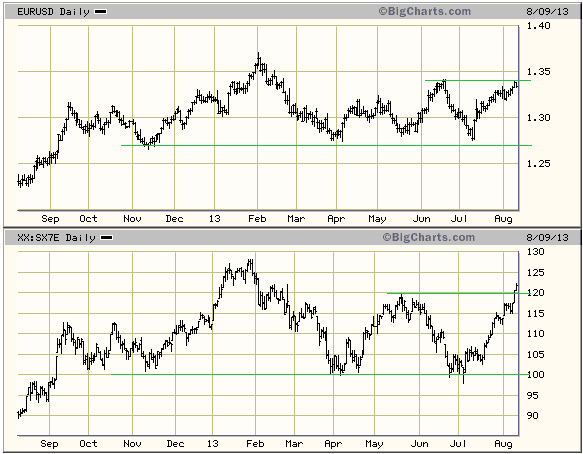
The upshot is that the Dollar Index could rebound over the next 1-2 weeks, but
there isn't any evidence that a short-term trend reversal is imminent.
Update
on Stock Selections
Notes: 1) To review the complete list of current TSI stock selections, logon at
http://www.speculative-investor.com/new/market_logon.asp
and then click on "Stock Selections" in the menu. When at the Stock
Selections page, click on a stock's symbol to bring-up an archive of
our comments on the stock in question. 2) The Small Stock Watch List is
located at http://www.speculative-investor.com/new/smallstockwatch.html
 Company
news/developments for the week ended Friday 9th August 2013: Company
news/developments for the week ended Friday 9th August 2013:
[Note: FS = Feasibility Study, IRR = Internal Rate of Return, MD&A =
Management Discussion and Analysis, M&I = Measured and Indicated,
NAV = Net Asset Value, NPV(X%) = Net Present Value using a discount
rate of X%, P&P = Proven and Probable, PEA = Preliminary Economic
Assessment, PFS = Pre-Feasibility Study]
*Almaden Minerals (AAU) issued its MD&A and Financial Statements
for the June quarter. Of primary interest, the reports confirm that
the company has no debt and about $23M of working capital (including
the $5M raised in last month's equity financing). This means that
AAU is in a strong financial position for a company of its type and
size.
*Endeavour Mining (EDV.TO) announced that its Agbaou gold mine in
Cote d'Ivoire remains on track for initial production in Q1-2014.
The mine construction is apparently now 81% complete.
*Jaguar Mining (JAG.TO) reported a large net loss of $64M for the
June-2013 quarter, but this was mostly due to non-cash accounting
adjustments. The key measures of JAG's performance are the changes
in its working capital and debt.
Unfortunately, after showing some improvement and making a small
addition to its net cash during the March-2013 quarter, JAG went
back to its cash-consumption ways during the latest quarter. Taking
into account the changes in working capital and total debt, we
estimate that JAG was cash-flow negative by about $15M during the
June quarter.
On a cash generation basis, the break-even gold price for JAG is
probably about $1450/oz. At a gold price of $1600/oz of higher it
should be profitable enough to justify a multiple of its current
stock price, but at a gold price of $1300/oz or lower it would
probably have trouble surviving beyond the end of this year.
Due to its precarious financial position, JAG remains a very
high-risk speculation.
*Sabina Gold and Silver (SBB.TO) issued its MD&A and Financial
Statements for the June quarter. Based on the information in the
Financial Statements, we estimate that SBB presently has working
capital of about $85M. This is enough to fully fund the company for
more than 12 months.
The next important milestone for SBB is completion of the Back River
PFS, which is now scheduled for October of this year (delayed by one
month). We expect that the PFS will indicate robust economics at a
gold price of $1300/oz.
*Sprott Inc. (SII.TO) reported its results for the June quarter.
EBITDA was $8M, but the bottom-line profit result was a loss of
$6.7M. Assets under management fell from $9.1B at the end of
March-2013 to $7.1B at the end of June-2013, mostly due to a decline
in the market value of the assets. Despite the bottom-line loss, the
company maintained its quarterly dividend at $0.03/share.
We expect that SII's profitability will hit its low for the cycle in
either the just-completed June quarter or the current quarter. It's
way too soon to be sure, but it's possible that the stock price made
its cyclical low last month.
*UEX Corp. (UEX.TO) announced some drilling results from its Shea
Creek uranium project (Shea Creek is a JV with Areva). One of the
drill holes appears to have extended the Kianna East deposit by
about 15m, but in general the results weren't significant.
Although UEX is an exploration-stage uranium miner, its potential is
not dependent upon generating new discoveries. This is because it
already has about 70M pounds of "Indicated" uranium resources and an
additional 16M pounds of "Inferred" uranium resources split roughly
50/50 across its Shea Creek and Hidden Bay projects in Athabasca.
Rather than being linked to future exploration success, UEX's upside
potential mostly stems from its leverage to the uranium price and
the likelihood that it will eventually be taken over by either Areva
or Cameco.
At the current low uranium price, almost all of UEX's value is
associated with Shea Creek. The reason is that Shea Creek has a
relatively high average grade of around 1.5% whereas Hidden Bay's
average grade is only 0.16%. Due to its low average grade, UEX has
decided to defer further evaluation of Hidden Bay until there is a
substantial and sustained recovery in the uranium price. This is
sensible.
UEX also issued its mandatory reports for the June quarter. These
reports indicate that the company has about $13M of working capital,
which should be enough to fund its overheads and exploration for the
next two years.
*Volta Resources (VTR.TO) issued its MD&A and Financial Statements
for the June quarter.
The reports confirm that the company has no debt and about $10M of
working capital. This is enough to fund VTR's operations for at
least the next 6 months and possibly for as long as 12 months.
VTR announced last month that it was changing its approach to the FS
for its flagship Kiaka Gold Project in Burkina Faso due to lower
gold prices, causing an undefined (at this time) delay to the
completion of the FS. The new focus is on the viability of
developing the project utilizing a smaller-scale mining plan
targeting the higher-grade portions of the overall deposit. We await
further details.
Candidates
for new buying
From within the ranks of TSI stock selections, the best candidates for new
buying at this time are:
- AKG in the US$2.50s (Friday's close: US$2.64)
- EDV.TO/EVR.AX
- GSS below US$0.50 and ideally at around US$0.45 (Note: This is one for
the risk-tolerant. By virtue of its high cost structure and low valuation, GSS
should rebound strongly IF gold breaks above $1350 in the near future.)
- PG.TO at C$2.05 or lower (Friday's close: C$2.10)
- PVG in the mid-US$7 area (Note: We mentioned last week that PVG would
be a buy following a decline to the mid-US$7 area. The stock pulled back sharply
and traded as low as US$7.14, creating a good short-term buying opportunity.
Short-term traders of this stock could manage risk by placing a sell stop just
below last week's low.)
- SBB.TO
New
TSI Stock Selection: Energold Drilling (TSXV: EGD). Shares: 48M issued, 51M
fully diluted. Recent price: C$1.70
EGD provides drilling services to the mining industry and the oil-and-gas
industry. It will probably generate about $150M of revenue this year and it
should make a profit.
EGD's latest quarterly financial results were for the March-2013 quarter (the
June-2013 quarterly results should be published within the next two weeks), for
which the company reported revenue of $54M and net earnings of $3.5M
($0.08/share). The revenue split was: $18M from the Mineral Division, $31.5M
from the Energy Division, and the balance from the Manufacturing Division. In
the same quarter during the previous year, the Mineral Division's revenue was
$8M higher, the Energy Division's revenue was $6M lower and the Manufacturing
Division's revenue was about $2M lower, leaving the total revenue roughly
unchanged. This performance highlights one of the reasons we like EGD as an
investment: it is capable of offsetting the effects of an industry-wide downturn
in one part of its business (in this case, mining exploration) by growing other
parts of its business.
Here is another reason we like EGD. Although it has enough exposure to the
junior end of the mining space to suffer a significant decline in its business
as a result of the difficult (to put it mildly) market environment of the past
12 months and enjoy a significant pick-up in its business after the market
improves, its success is not dependent upon a vibrant market for resource
juniors. This is because many of its customers are senior and mid-tier
companies.
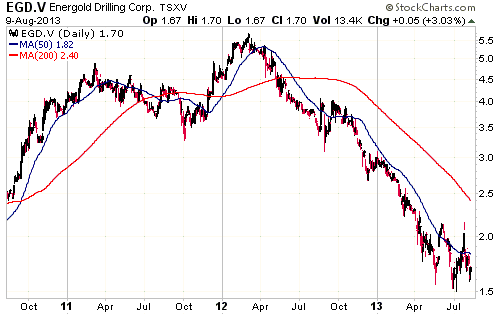
However, the main reason we like EGD as an investment at this time is its
valuation. As illustrated by the following daily chart, the company was being
valued by the market at $5.50/share early last year and is now being valued at
$1.70/share. By itself this doesn't mean much, but at $5.50/share the company
wasn't particularly expensive and in the interim there has been minimal share
issuance and no significant deterioration of the underlying business. At
$1.70/share, the $150M/year drilling business is being valued at only $82M. This
looks like a good deal, but it looks even better when we take into account that
EGD has $89M of working capital. In effect, the stock market is currently
valuing EGD's drilling business at approximately zero.
EGD's next two sets of quarterly results will likely be soft, but in our opinion
this 'softness' was already fully priced into the stock at a much higher level.
Even if the market remains difficult for mining-related enterprises, we see the
potential for EGD to rebound to at least C$3.00 within the next 12 months.
We have added EGD to the TSI List at Friday's closing price of C$1.70, but we do
not want to increase the number of long-term positions in the List. In fact, we
want to do the opposite. To make way for EGD we have therefore removed the Wind
Energy ETF (FAN), a position that a) has done very well over the past 12 months
(it is up 80% since its July-2012 bottom), b) has done very poorly since our
horribly-timed entry in 2008 (it is down 63% since the start of our coverage),
and c) we haven't followed closely.
Chart Sources
Charts appearing in today's commentary
are courtesy of:
http://stockcharts.com/index.html
http://bigcharts.marketwatch.com/

|









