|
-- Weekly Market Update for the Week Commencing 12th September 2011
Big Picture
View
Here is a summary of our big picture
view of the markets. Note that our short-term views may differ from our
big picture view.
In nominal dollar terms, the BULL market in US Treasury Bonds
that began in the early 1980s ended in December of 2008. In real (gold)
terms, bonds commenced a secular BEAR market in 2001 that will continue
until 2014-2020. (Last
update: 4 April 2011)
The stock market, as represented by the S&P500 Index, commenced
a secular BEAR market during the first quarter of 2000, where "secular
bear market" is defined as a long-term downward trend in valuations
(P/E ratios, etc.) and gold-denominated prices. This secular trend will bottom sometime between 2014 and 2020. (Last update: 22 October 2007)
A secular BEAR market in the Dollar
began during the final quarter of 2000 and ended in July of 2008. This
secular bear market will be followed by a multi-year period of range
trading. (Last
update: 09 February 2009)
Gold commenced a
secular bull market relative to all fiat currencies, the CRB Index,
bonds and most stock market indices during 1999-2001. This secular trend will peak sometime between 2014 and 2020. (Last update: 22 October 2007)
Commodities,
as represented by the Continuous Commodity Index (CCI), commenced a
secular BULL market in 2001 in nominal dollar terms. The first major
upward leg in this bull market ended during the first half of 2008, but
a long-term peak won't occur until 2014-2020. In real (gold) terms,
commodities commenced a secular BEAR market in 2001 that will continue
until 2014-2020. (Last
update: 09 February 2009)
Copyright
Reminder
The commentaries that appear at TSI
may not be distributed, in full or in part, without our written permission.
In particular, please note that the posting of extracts from TSI commentaries
at other web sites or providing links to TSI commentaries at other web
sites (for example, at discussion boards) without our written permission
is prohibited.
We reserve the right to immediately
terminate the subscription of any TSI subscriber who distributes the TSI
commentaries without our written permission.
Outlook Summary
Market
|
Short-Term
(0-3 month)
|
Intermediate-Term
(3-12 month)
|
Long-Term
(1-5 Year)
|
| Gold
|
Neutral
(19-Apr-11) |
Neutral
(24-Jan-11)
|
Bullish
|
| US$ (Dollar Index)
|
Bullish
(07-Sep-11)
| Neutral
(10-Aug-11)
|
Neutral
(19-Sep-07)
|
| Bonds (US T-Bond)
|
Bearish
(24-Aug-11)
|
Bearish
(24-Aug-11)
|
Bearish
|
| Stock Market (S&P500)
|
Neutral
(08-Aug-11)
|
Neutral
(24-Aug-11)
|
Bearish
|
| Gold Stocks
(HUI)
|
Neutral
(13-Jul-11) |
Bullish
(23-Jun-10)
|
Bullish
|
| Oil | Neutral
(31-Jan-11) | Neutral
(31-Jan-11)
| Bullish
|
| Industrial Metals
(GYX)
| Neutral
(29-Aug-11)
| Neutral
(29-Aug-11)
| Neutral
(11-Jan-10)
|
Notes:
1. In those cases where we have been able to identify the commentary in
which the most recent outlook change occurred we've put the date of the
commentary below the current outlook.
2. "Neutral", in the above table, means that we either don't have a
firm opinion or that we think risk and reward are roughly in balance with respect to the timeframe in question.
3. Long-term views are determined almost completely by fundamentals,
intermediate-term views by giving an approximately equal weighting to
fundamental and technical factors, and short-term views almost
completely by technicals.
The psychological enemy of
deflation
The desire to avoid short-term pain is a powerful motivator. Even in cases where it is known that the steps taken to avoid pain in the short-term will lead to greater pain in the distant future, people will often choose the path that entails lesser short-term pain. Also, there's often the hope that if pain is postponed for long enough then something will spring up to circumvent the need to experience the pain. The relevance to the inflation-deflation issue is that the long-term cure for an economy suffering from the bad effects of high monetary inflation involves stopping the inflation, but stopping the inflation always results in short-term pain.
Nowadays, people look back at the devastating inflation that occurred in Germany in the early 1920s and think: "How could the central bankers of that era have been so stupid? There's no way that the stewards of today's major currencies would make the same mistakes!" In real time, however, the gross stupidity of the German central bank's actions was only apparent to a small number of economists. At each step along the way to total monetary collapse, the pain involved in stopping the money-printing was weighed against the cost of continuing the inflation and it always appeared to make sense to continue the inflation for just a little longer.
It's very unlikely that a hyperinflationary collapse will happen in the US within the next two years, but having watched the Bernanke Fed in action it is not hard for us to imagine such a collapse eventually happening. We cite, for instance, the fact that some Fed governors are openly discussing the need for more monetary "stimulus" even though it should be clear to anyone with eyes and a modicum of economics knowledge that QE2 was an abject failure. We also cite the popular view that it is up to the Fed and the government to do something to get the economy moving forward again, despite the mountain of evidence that earlier attempts to "do something" resulted in bad unintended consequences. The sad truth is that the framers of monetary and fiscal policies are strongly influenced by faulty economic theory and short-term thinking.
The day might come when the costs of continuing the inflation are so widely understood that there exists the political will to bring the money-printing to an end, but don't hold your breath waiting for that day. If the day does come it will likely be years from now. In the mean time, the desire to avoid short-term pain will reign supreme.
Commodities Update
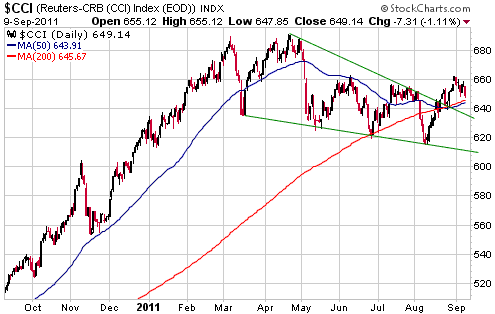
We have been surprised by the resilience of the Continuous Commodity Index (CCI) over the past few months. Given everything that has happened in the financial world, commodity prices should have suffered large declines. Some commodities did suffer large declines, but most held up rather well. The net effect is that the CCI's price action, as reflected by the following daily chart, does not yet indicate anything more serious than a routine multi-month consolidation.
The copper price has had more of a downward bias than the CCI (see chart below), but it has still held up better than we thought it would. This could be because the effects (or expected effects) on copper consumption of declining global economic growth have, to date, been partially offset by strike-related supply disruptions.
Aside from slowing global economic growth, the main risks facing the copper market are:
1) The high level of the real copper price (the inflation-adjusted copper price almost reached the top of its 50-year range early this year and is still in the top quartile of its long-term range).
2) The evidence that in addition to the 560 thousand tonnes of copper in exchange-approved warehouses, there are about 2.8 million tonnes outside the exchange warehousing system. Refer to the article posted
HERE.
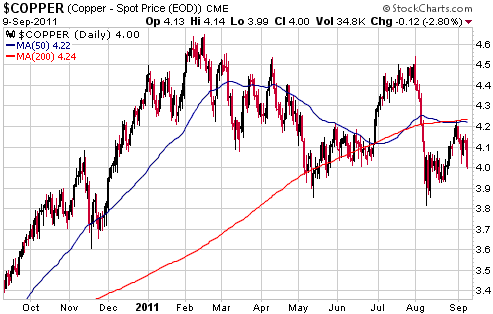
We became less bearish on copper and the other industrial metals in August, after evidence emerged that the stock market had reached a multi-month bottom. Our reasoning was that the stock market and the industrial metals complex generally trend together.
We are beginning to question this outlook change, but will remain on the sidelines ("neutral") for now.
The Stock
Market
The following daily chart shows that the S&P500 ended last week near the bottom of its short-term price channel. A break below the bottom of the channel would probably lead to a successful test of the August low (1100), but would possibly lead to a decline to well below the August low. The more bearish lower-probability outcome is a reason to remain cautious, but it isn't something we are interested in speculating on. To put it another way, we would not take a speculative bearish position in anticipation of, or in response to, a break below the channel bottom. The reason is that the trade wouldn't have a sufficiently attractive risk/reward.
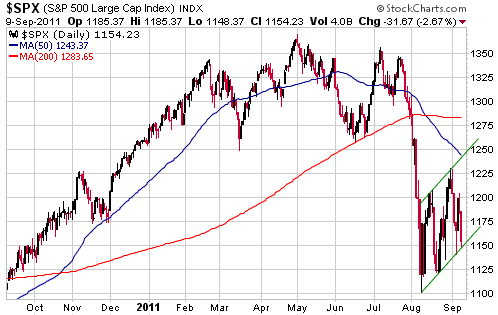
Due to the sentiment extreme reached in August, the S&P500's August price low will probably survive a near-term test. Furthermore, the recent relative strength of the NASDAQ100 Index (NDX) suggests that a break to a new low by the S&P500 in the near future wouldn't be confirmed by new lows in the NDX. Here is a daily NDX chart:
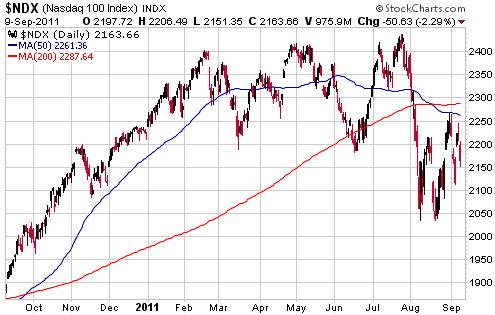
Rather than turning more bearish in response to a break below obvious support, we would be inclined to turn more bearish if the S&P500 were to hold its channel bottom for now and rebound to around 1250 (its channel top) over the days ahead.
The main reason for the most recent bout of weakness in stock markets around the world is the escalating debt crisis in Europe. However, while the sovereign debt issues are clearly bearish for bondholders and the sellers of bond insurance, beyond the very short-term they aren't necessarily bearish for most equities. This is because the debt crisis is likely to prompt an inflationary about-face by the
ECB.
This week's
important US economic events
| Date |
Description |
| Monday Sep 12 | No
important events scheduled
| | Tuesday Sep 13 | Import
and Export Prices
Treasury Budget | | Wednesday
Sep 14 | PPI
Retail Sales | | Thursday
Sep 15 | CPI
Empire State Manufacturing Survey
Philadelphia Fed Survey
Q2 Current Account Balance
Industrial Production
| | Friday Sep 16 | TIC
Report
Consumer Sentiment
|
Gold and
the Dollar
Gold
Real Gold
It isn't possible to measure the economy-wide change in a currency's purchasing power. In theory, however, the decline in purchasing power over the long term should be approximately equal to the increase in money supply, less an adjustment for population and productivity growth. The only significant assumption here is that aside from the changes in money demand that are directly related to increasing money supply and economic output, all changes in the demand for money will prove to be temporary. We can therefore calculate a theoretical loss of purchasing power that should, over periods of more than 5 years, approximate the actual loss. At least, such a calculation stands a much better chance than the price index method of arriving at a useful and realistic estimate of purchasing power change. That's why we use it when constructing long-term inflation-adjusted (IA) charts, such as the one presented below.
The following monthly chart shows the IA gold price, with historical prices converted to current (31st August 2011) dollars. The chart shows that the highest monthly closing price was around $2800/ounce in January of 1980 (the January-1980 closing price was $722, which is roughly equivalent to $2800 in today's money). Not shown on the chart is the highest intra-day price of around $3300/ounce that was hit at the top of the speculative blow-off in early January of 1980.
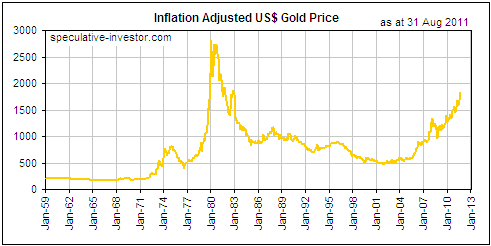
A point we want to make today is that the gold price is now quite high in real terms. We note, in particular, that gold didn't reach the inflation-adjusted equivalent of its current price until the final few weeks of the 1979-1980 blow-off (in today's money, gold was at $1690/oz at the end of November-1979 and $2186/oz at the end of December-1979). Due to the debilitating effects of monetary inflation on the economy's productivity over the intervening years, it's likely that gold will eventually exceed its Jan-1980 peak in real terms. It would be wrong, though, to think that gold is still a bargain. Many gold-mining equities could reasonably be described as bargains at their current prices, but gold bullion's bargain-basement days are behind it.
Current Market Situation
The US$ gold price traded in a range of more than $100 over each of the past 5 weeks. The high volatility indicates that gold is either topping (on a short- or intermediate-term basis, but not a long-term basis) or about to accelerate upward. We favour the former outcome, but we can't rule out the latter outcome.
In the less likely event that gold accelerates upward over the next couple of months, keep in mind the inflation-adjusted chart shown above. If gold were to rocket up to the mid-$2000s it would be over-valued by enough to create a long-lasting top.
Silver
The following chart compares the performance of the US$ silver price with the silver/gold ratio. Notice that the silver price has been trending upward within a channel over the past couple of months whereas the silver/gold ratio has maintained its downward bias.
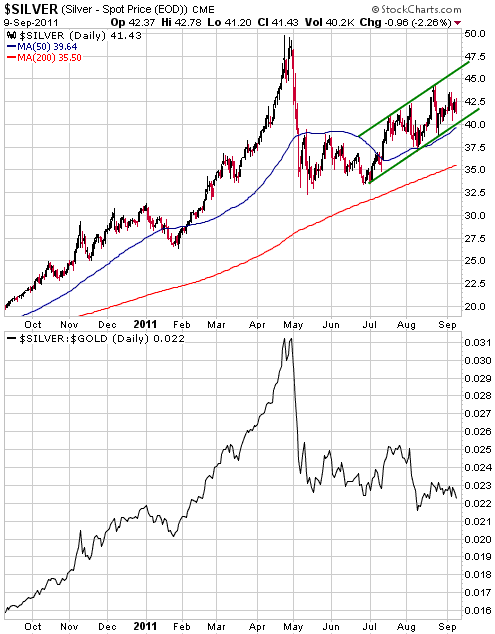
We said in early May that the late-April peak in the silver/gold ratio would probably hold for at least two years. There's no good reason to change this opinion. The questions we are wrestling with now are:
1. Will there be another large downward leg in the silver/gold ratio before silver makes a sustainable low relative to gold?
2. Will the next significant low in the silver market be above or below the May-2011 low?
We don't know the answers, but we expect that the answers will become known within the next two months. This is because the next two months have the potential to be negative for silver in nominal dollar terms and relative to gold. To be more specific, the period between now and late November will potentially be characterised by US$ strength, escalating fears of economic weakness and continued sloppiness in stock markets, which is a recipe for substantial weakness in silver relative to gold. Unless the gold price were to move much higher, substantial weakness in silver relative to gold would translate into a much lower US$-denominated silver price.
By the same token, if silver can get through the next two months without suffering a large decline in US$ terms or relative to gold, it may be safe to assume that it is out of the proverbial woods.
Gold Stocks
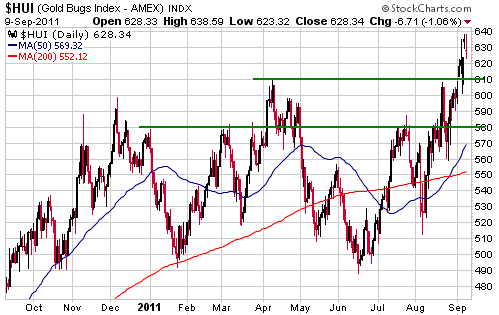
The XAU still hasn't confirmed the HUI's upside breakout, but with the HUI's breakout having been sustained for five trading days it is reasonable to assume that it is the genuine article. It is therefore reasonable to assume that the gold-stock indices and ETFs that haven't yet confirmed the HUI's breakout -- most notably, the XAU and GDXJ -- will do so over the weeks ahead.
Former resistance for the HUI should now act as support during a near-term correction. As illustrated below, the most important nearby support levels lie at 610 and 580. The HUI could drop as far as the low-580s without doing significant damage to the "technical" picture, but shouldn't close below 580 from here on.
Royal Gold (RGLD) and Franco Nevada (FNV), the senior gold royalty companies, are the gold mining stocks with the lowest risk. This is chiefly because their profits are not directly affected by increases in mine operating or construction costs. It is also because, as the owners of dozens of royalties spanning many jurisdictions, they are not subject to much political risk and are not reliant on the success of any single mining operation.
On the other side of the ledger is the fact that the royalty companies do not offer significant leverage to the gold price.
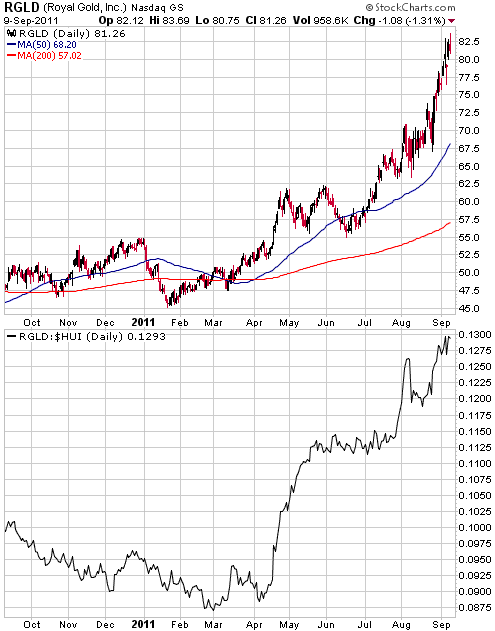
Due to their low risk and lack of leverage, the stocks of the senior gold royalty companies tend to perform relatively well during periods when risk aversion is increasing and relatively poorly during periods when market participants, as a group, are becoming more willing to take on risk. That explains the following chart. The chart shows that RGLD has not only performed very well over the past 6 months in absolute terms, but also performed very well relative to the HUI. This period was associated with a general shift away from risk.
The period of relative strength for the royalty stocks is probably almost over, because even an inherently low-risk stock can become risky if its valuation becomes sufficiently high. Also, if the HUI can build on its recent upside breakout it should lead to a sector-wide increase in speculation, which would tend to favour the stocks that offer the most leverage.
Currency Market Update
The Dollar Index broke above the top of its multi-month trading range on Friday. We originally expected the breakout to happen by mid August, so from our perspective the surprise is that it was so long in coming. In the end, it took the combination of a dramatic escalation of the PIIGS debt crisis and a dramatic inflationary policy shift by the Swiss National Bank to push the dollar out of the range in which it had calmly traded since May.
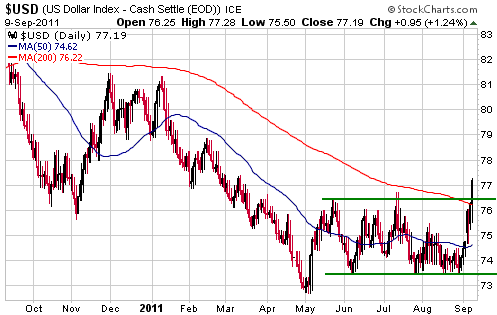
Part of the above-mentioned dramatic escalation of the PIIGS debt crisis was the increase in the yield on 1-year Greek government bonds to almost 100%. This means that the market is not only certain that the Greek government will default, it is convinced that the default will occur within the next few months and that the holders of short-term debt securities will recoup less than 10c on the dollar.
A Greek default creates a problem for the ECB, because the ECB holds a lot of Greek government debt on its balance sheet. The ECB is now technically insolvent, but like the Fed it could potentially print itself out of any financial hole. However, unlike the Fed it would have to get the approval of some inflation-wary governments before cranking up the money pumps.
Aside from the looming default of the Greek government, the euro-zone's bond market faces the issue that the Italian government will have to roll over about 170B euros of debt before year-end. Under normal circumstances this wouldn't be a big problem, but current circumstances are a long way from normal. Will the insolvent ECB, having been criticised by senior German politicians for its earlier buying of Italian and Spanish bonds, be able to wade into the bond market over the next three months to ensure that Italy's debt rollover happens smoothly? We look forward to finding out.
The USD/EUR exchange rate is about 58% of the Dollar Index, which means that a euro move in one direction will almost always be accompanied by a Dollar Index move in the opposite direction. It is therefore natural that last week's upside breakout in the Dollar Index coincided with a downside breakout in the euro.
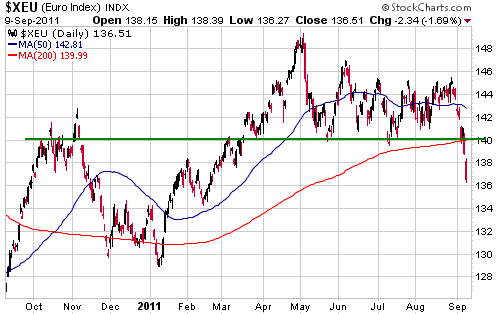
Having risen on 8 of the past 9 trading days, the Dollar Index is now 'overbought' on a short-term basis. If this leads to some consolidation over the days ahead then it could create an opportunity to place a speculative bet against the euro.
Update
on Stock Selections
Notes: 1) To review the complete list of current TSI stock selections, logon at
http://www.speculative-investor.com/new/market_logon.asp
and then click on "Stock Selections" in the menu. When at the Stock
Selections page, click on a stock's symbol to bring-up an archive of
our comments on the stock in question. 2) The Small Stock Watch List is
located at http://www.speculative-investor.com/new/smallstockwatch.html
 The dilemma posed by soaring capital costs The dilemma posed by soaring capital costs
NovaGold (NYSE and TSX: NG), a TSI favourite during 2002-2006, announced last week that the estimated cost to build a mine at its 50%-owned Donlin Creek project had risen from US$4.5B to $7.0B since 2009. $1B of the increase was due to the addition of a natural-gas-fueled power plant, while the remaining $1.5B increase was due to "inflation". In other words, the project's estimated capital cost has inflated by 33% in just two years. The Donlin Creek partners (NG and ABX) continue to talk-up the potential of this project, but even at the current gold price we suspect that it would be very difficult to finance such a large capex.
Donlin Creek's large and upward-trending capex is an industry-wide problem, especially when it comes to elephant-sized low-grade deposits. Three companies in the TSI Stocks List (International Tower Hill Mines, Pretium Resources and Carpathian Gold) are focused on deposits of this type, but in each case there are good reasons to believe that the cost to build a mine at the large low-grade project won't be a major stumbling block for the company.
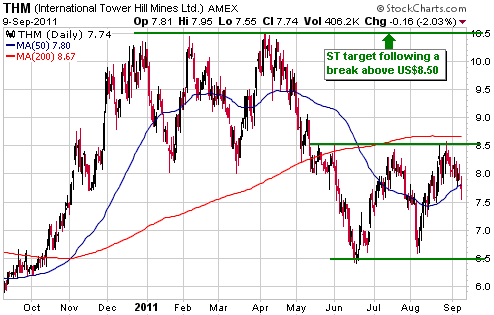
Like NG's Donlin Creek project, the Livengood project of International Tower Hill Mines (THM) is located in Alaska. But unlike NG's project, Livengood is close to power and transportation infrastructure. Also, at the recent estimate of $1.6B the cost to build a mine at Livengood does not appear to be prohibitive. Financing $1.6B of construction costs would definitely be a challenge for a company of THM's size, but it would be well within the financial resources of AngloGold (AU). This is important because AU is the most likely eventual purchaser of the Livengood project.
THM has just pulled back to its 50-day moving average and is a candidate for new buying.
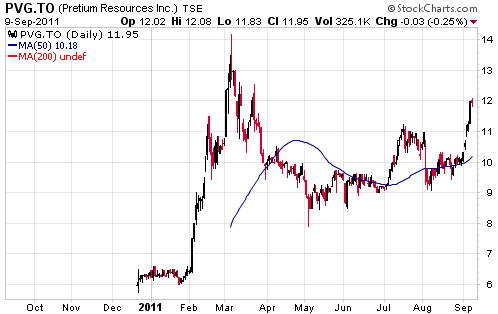
It will likely cost at least $4B to build a mine at the massive low-grade gold deposit owned by Pretium (TSX: PVG), which means that the initial capex is a big obstacle in the way of this project moving into the mine construction phase. Also, there is substantial permitting risk associated with this project. However, these risks are mitigated by the fact that PVG has two irons in the fire, one being the large low-grade resource with the potential to support an open-pit mine and the other being the smaller higher-grade portion of the resource. The smaller higher-grade portion of the resource could potentially support an underground mining operation that would be relatively quick/easy to permit and relatively cheap to build (initial capex currently estimated at $280M for a 200K-oz/year mining operation).
With PVG, the huge low-grade resource provides considerable option value while the high-grade portion of the resource could enable the company to be a producer within a couple of years.
PVG's price has risen sharply over the past two weeks. The stock is a 'hold' at this time.
Like PVG, Carpathian Gold (TSX: CPN) has two irons in the fire. In CPN's case, however, the "two irons" are different projects in different parts of the world. We are interested in the company primarily due to its large low-grade gold-copper project in Romania, but the risks associated with the development of this large project are mitigated by the fact that the company also owns a relatively small gold project in Brazil that is expected to be put into production within the next 18 months.
CPN ended last week at C$0.61 and would be a candidate for new buying in the mid-C$0.50s.
Chart Sources
Charts appearing in today's commentary
are courtesy of:
http://stockcharts.com/index.html

|









