|
-- Weekly Market Update for the Week Commencing 13th June 2011
Big Picture
View
Here is a summary of our big picture
view of the markets. Note that our short-term views may differ from our
big picture view.
In nominal dollar terms, the BULL market in US Treasury Bonds
that began in the early 1980s ended in December of 2008. In real (gold)
terms, bonds commenced a secular BEAR market in 2001 that will continue
until 2014-2020. (Last
update: 4 April 2011)
The stock market, as represented by the S&P500 Index, commenced
a secular BEAR market during the first quarter of 2000, where "secular
bear market" is defined as a long-term downward trend in valuations
(P/E ratios, etc.) and gold-denominated prices. This secular trend will bottom sometime between 2014 and 2020. (Last update: 22 October 2007)
A secular BEAR market in the Dollar
began during the final quarter of 2000 and ended in July of 2008. This
secular bear market will be followed by a multi-year period of range
trading. (Last
update: 09 February 2009)
Gold commenced a
secular bull market relative to all fiat currencies, the CRB Index,
bonds and most stock market indices during 1999-2001. This secular trend will peak sometime between 2014 and 2020. (Last update: 22 October 2007)
Commodities,
as represented by the Continuous Commodity Index (CCI), commenced a
secular BULL market in 2001 in nominal dollar terms. The first major
upward leg in this bull market ended during the first half of 2008, but
a long-term peak won't occur until 2014-2020. In real (gold) terms,
commodities commenced a secular BEAR market in 2001 that will continue
until 2014-2020. (Last
update: 09 February 2009)
Copyright
Reminder
The commentaries that appear at TSI
may not be distributed, in full or in part, without our written permission.
In particular, please note that the posting of extracts from TSI commentaries
at other web sites or providing links to TSI commentaries at other web
sites (for example, at discussion boards) without our written permission
is prohibited.
We reserve the right to immediately
terminate the subscription of any TSI subscriber who distributes the TSI
commentaries without our written permission.
Outlook Summary
Market
|
Short-Term
(0-3 month)
|
Intermediate-Term
(3-12 month)
|
Long-Term
(1-5 Year)
|
Gold
|
Neutral
(19-Apr-11)
|
Neutral
(24-Jan-11)
|
Bullish
|
US$ (Dollar Index)
|
Neutral
(07-Mar-11)
| Bullish
(02-May-11)
|
Neutral
(19-Sep-07)
|
Bonds (US T-Bond)
|
Neutral
(20-Sep-10)
|
Bearish
(21-Mar-11)
|
Bearish
|
Stock Market (S&P500)
|
Neutral
(13-Jun-11)
|
Bearish
(11-Oct-10)
|
Bearish
|
Gold Stocks (HUI)
|
Neutral
(24-Apr-11)
|
Bullish
(23-Jun-10)
|
Bullish
|
| Oil | Neutral
(31-Jan-11)
| Neutral
(31-Jan-11)
| Bullish
|
Industrial Metals (GYX)
| Bearish
(03-Jan-11)
| Bearish
(25-May-09)
| Neutral
(11-Jan-10)
|
Notes:
1. In those cases where we have been able to identify the commentary in
which the most recent outlook change occurred we've put the date of the
commentary below the current outlook.
2. "Neutral", in the above table, means that we either don't have a
firm opinion or that we think risk and reward are roughly in balance with respect to the timeframe in question.
3. Long-term views are determined almost completely by fundamentals,
intermediate-term views by giving an approximately equal weighting to
fundamental and technical factors, and short-term views almost
completely by technicals.
More thoughts on "Financial Repression"
In last week's Interim Update
we wrote about "financial repression", which is a term that has been
used to describe the strategy whereby the government attempts to reduce
its debt by holding interest rates at a low level (such that real
interest rates are negative) and simultaneously depreciating the
currency at the rate of about 4% per year. Based on responses received
from our readership, our comment that "financial repression" didn't
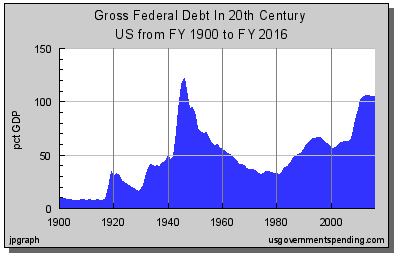
work in the past requires clarification. After all, the following chart
seems to indicate that it worked well between 1945 and the early-1970s.
This was a period during which the US government's debt fell from 120%
of GDP to 30% of GDP in parallel with slow, but steady, currency
depreciation.
Correlation doesn't
imply causation, so the fact that the government's debt relative to GDP
fell over a period of relentless moderate "price inflation" doesn't
necessarily mean that the "inflation" facilitated the debt reduction.
There is, indeed, a much better explanation for what happened.
The better explanation is that the large decline in the govt-debt/GDP ratio resulted from the combination of:
1) A huge decline in government spending during the years immediately
following the end of WWII. The collapse in spending is illustrated
below.
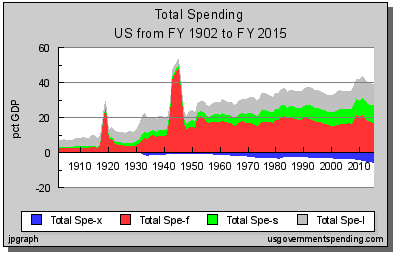
The point is that the
incredibly high debt/GDP ratio that existed in 1945 was an aberration
due to massive war-related spending, with the subsequent sharp decline
being the natural effect of a return to much lower peace-time spending
levels.
2) The freeing up of the economy due to the removal of war-time
controls and the abandoning of many "New Deal" programs/regulations.
The elimination of these encumbrances set the stage for many years of
rapid real growth.
3) Relative monetary stability from 1945 through to 1971 courtesy of the last remaining official link between the US$ and gold.
The situation today is that government spending is more likely to rise
than fall over the years ahead, the US government is heading in the
direction of greater intervention (less economic freedom), and there is
no official link to gold to create some semblance of monetary
stability. Consequently, if "financial repression" is now attempted,
which it most likely will be, it stands little chance of achieving its
intended purpose for even a short period.
The "backing" of today's money, part 2
Our
6th June commentary included a short piece titled "What backs today's
money?", in which we attempted to explain that money is not "backed" by
anything and nor does it need to be. Money is what it is -- the most
commonly used medium of exchange within an economy. This piece was
subsequently posted as a standalone article at a few web sites and
generated an unusually large amount of feedback (questions, comments
and objections). Today we'll address the three most common objections.
Based on the emails we received, the most controversial part of our
article related to "intrinsic value". Considering that some popular
gold market analysts and newsletter writers routinely assert that
"intrinsic value" is the most important difference between gold and the
dollar, we aren't surprised that many gold bulls reflexively rejected
our statement that gold, like the dollar, has no intrinsic value. Our
point was simply that all value is subjective. To explain what we meant
we said that gold would have no or very little value to someone
stranded alone on a desert island, but would likely have a lot of value
to someone living in a modern inflation-prone economy.
A common view is that gold has "intrinsic value" because it costs a
lot, in terms of materials and labour, to extract gold from the ground
and turn it into a readily tradable form, but it is important to
understand that something could be costly to produce and yet have
little or no value to most people. Again, value is subjective and will
often vary depending on personal circumstance.
That the production of gold requires the expenditure of a significant
amount of resources is very important, but not because it creates
"intrinsic value". It is important because it places a severe physical
restriction on the rate of increase in the total supply of gold. In
fact, in terms of suitability to perform the role of money, gold's
greatest advantage over the US dollar and all the other fiat currencies
of the world is the stability of its supply (the total aboveground
supply of gold increases at 1.5%-2.0% per year, every year). This
relates to the inability of anyone to create gold out of nothing.
Looking at it from a different angle, the main problem with today's
official money is that banks and governments have the power to create
it out of nothing. If you believe that these institutions have not
abused this power in the past then there is a large gap in your
knowledge of economics history, and if you believe that these
institutions will not abuse this power in the future then you are
extremely naive.
By the way, the critics of using gold as money often cite the
inflexibility of gold supply as a major negative. When they make such a
claim they are either being disingenuous or displaying ignorance of the
fact that flexibility of supply is most definitely NOT a desirable
characteristic of money. Flexibility of money supply benefits the
government and the banking industry, but because it distorts price
signals it hurts the generators of real wealth.
Moving along to the next objection, some readers argued that the US
dollar is backed by the US military. Our response is that if the US
military "backs" the US dollar, then what backs all the other fiat
currencies? Also, if the US dollar somehow garners support from the
US's global military advantage, then why has the Dollar Index lost
about 50% of its value over the past 26 years? After all, the US
military has never before been as dominant as it is today.
Rather than providing any backing for or adding any value to the
dollar, the US military is actually an important fundamental NEGATIVE
for the US$. The reason is that the expense of maintaining a massive
military leads to greater dollar supply and does nothing for dollar
demand (private demand for the dollar is primarily determined by
expected real return, and foreign-government demand for the dollar is
primarily determined by exchange-rate policy).
Lastly, our view that money is backed by nothing was countered by the
claim that a national currency is backed by the associated government's
ability to tax. The reality is that the ability to tax is what backs
government debt and why buying government debt is ethically unsound. As
succinctly put by Murray Rothbard, "the purchase of a government bond
is simply making an investment in the future loot from the robbery of
taxation." The ability to tax doesn't, however, "back" the money in
which a government's debt is denominated. Instead, taxation is part of
the demand side of the money supply-demand equation, which means that
although it doesn't "back" the money it does have some effect on the
purchasing power of the money.
Interesting quote of the week
In his latest weekly letter John Mauldin points out that US banks have
sold about $130B of credit insurance covering the government bonds of
Greece, Ireland and Portugal, meaning that US banks will be 'on the
hook' for up to $130B to the buyers of this insurance if the
governments of Greece, Ireland and Portugal default. He then exclaims:
"Why, oh why, are banks
putting American taxpayers at risk, as these too-big-to-fail banks
certainly are? And make no mistake, if several major banks were to
collapse, our government would need to step in. The largest banks are
too big for the FDIC to handle."
The truth of the matter, Mr. Mauldin, is that the banks are not putting
American taxpayers at risk; the government is. There is no obligation
or good economic reason for the government to prevent banks from
failing, regardless of how big the banks are.
Under the current monetary system a bank failure need never result in
depositors losing money, for three main reasons. First, the bonds
issued by the banks provide a huge buffer that would prevent deposits
from being put at risk in almost all cases. Second, valuable assets
never disappear as a result of a bankruptcy; they simply change
ownership. In the case of a bank going bust, the basic banking business
(taking deposits and making loans) could be sold to new owners/managers
without adversely affecting depositors. Third, in the very small number
of cases where the 'bond buffer' was insufficient and there were no
buyers for the basic banking business, the Fed could make the
depositors whole.
It is important to understand that bank bailouts are not about
protecting depositors or the overall economy, they are about protecting
bank bondholders and the current owners/managers of banks. Moreover,
not only does the government not need to step in when banks get into
financial trouble, the fact that the government routinely does step in
to protect the major banks at taxpayer expense is a CAUSE of the banks'
excessive risk-taking.
The Stock
Market
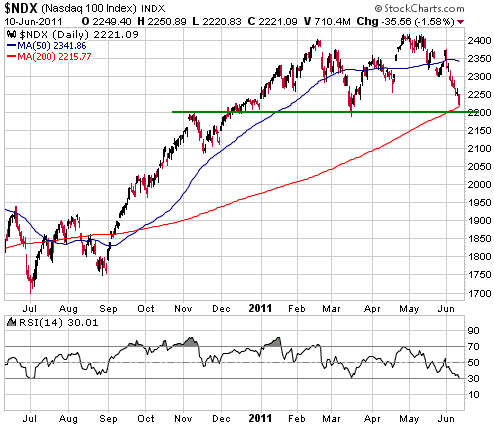
The NASDAQ100 Index (NDX) is
'oversold' and is now within 1% of support defined by its March low. It
has also pulled back far enough to touch its 200-day moving average.
The situation is illustrated below.
In addition,
sentiment indicators reveal that the public has recently become a lot
more bearish. As evidence we point to the following chart showing the
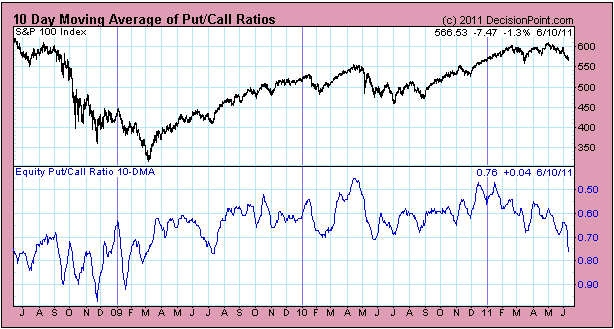
10-day moving average of the equity put/call ratio. This put/call
moving average has just moved to its highest level since July of 2009
(note that the chart's scale is inverted, meaning that the line on the
chart falls as the put/call increases), which suggests a marked shift
from complacency to nervousness on the part of the 'dumb money'.
With regard to the
shift in sentiment, we also point out that the percentages of bullish
respondents to the Investors Intelligence and AAII sentiment surveys
have just dropped to their lowest levels since August-September of last
year.
One measure of stock market sentiment that is yet to shift to a
significant degree is the Volatility Index (VIX), which remains at a
low level (meaning: not yet showing fear). The VIX's performance
indicates that while an interim low could be at hand, the overall
downward trend is just beginning.
The combination of the sentiment backdrop and the close proximity to
important support suggests to us that the US stock market is nearing a
temporary bottom. The ideal set-up for a multi-week rebound would be
created if the S&P500 Index dropped another 2% to around 1250 early
this week, but downside risk has now been reduced by enough to warrant
an upgrade to our short-term stock market outlook from "bearish" to
"neutral".
This week's
important US economic events
| Date |
Description |
Monday Jun 13
| No important events scheduled
| Tuesday Jun 14
| PPI
Retail Sales
| | Wednesday Jun 15
| CPI
Housing Market Index
Empire State Manufacturing Index
Industrial Production
TIC Report
| | Thursday Jun 16
| Housing Starts
Philadelphia Fed Survey
| | Friday Jun 17
| Consumer Sentiment
Leading Economic Indicators
|
Gold and
the Dollar
Gold and Silver
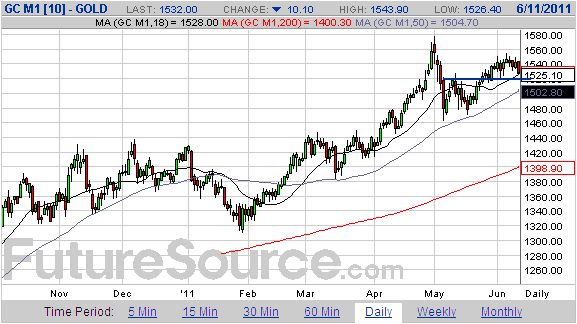
If the US$ gold price was going to make a new high prior to a
significant correction, last week was the most likely time for it do
so. Instead, the gold price had a slight downward bias over the course
of the past week.
A daily close below $1520 is still needed to confirm that a multi-month peak is in place.
There's the
possibility of a sharp decline in the prices of gold and silver
(especially silver) over the next two weeks. It could reasonably be
argued that such a possibility always exists, but at this time the
possibility has a higher probability than usual, because:
1. Gold appears to be rolling over after failing to make a new high
2. Silver appears to be rolling over after failing to exceed its May rebound peak
3. As discussed below, the gold sector of the stock market ended last
week precariously poised at, or just above, intermediate-term support.
Although we are very 'long' gold-related investments, we would welcome
a sharp 1-2 week decline at this time as it would clear the way for a
tradable upward trend and bring to an end the water-torture-style
declines in some of the junior mining stocks. The most likely near-term
alternative is more of the 'choppy' and essentially trendless trading
that we've had since the early-May plunge.
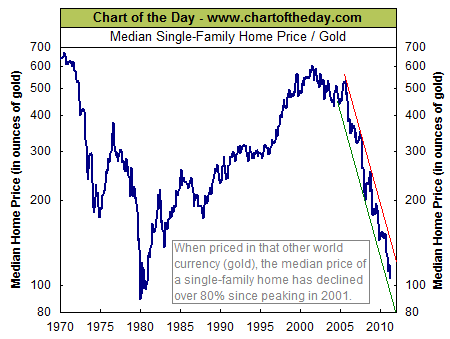
The following chart is courtesy of www.chartoftheday.com and is provided for information purposes. It shows that US residential real state is now cheap relative to gold.
Gold Stocks
Looking, again, at what happened during the 70s
The poor performance of the gold sector relative to gold bullion over
the past 6 months, and especially over the past 2 months, is
reminiscent of what happened during the final few years of the last
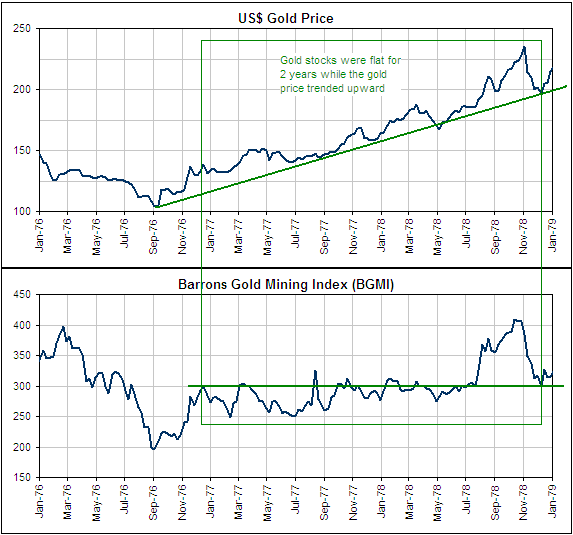
great gold bull market. As illustrated by the chart displayed below,
large declines in both the bullion and the mining shares (as
represented by the Barrons Gold Mining Index) ended in September of
1976. The bullion and the shares both rebounded strongly from their
correction lows into the end of 1976, but then there was a 2-year
period during which gold bullion trended upward while the shares moved
sideways.
The BGMI is a proxy
for large-cap gold mining shares. We don't know how the junior mining
shares fared during the second half of the 1970s, but there probably
would have been many big winners within this group if for no other
reason than the seniors would have been buying up the juniors to
counteract resource depletion (the seniors have to find or buy millions
of ounces of gold reserves every year just to stand still).
It's possible that the large-cap gold mining shares will do better
relative to gold bullion over the next few years than they did during
the late 1970s, but it should be kept in mind that mine depletion
generally constitutes a head-wind of sufficient strength to prevent
these shares from leveraging gains in the gold price over the long
term. From time to time the large-cap mining shares become 'oversold'
enough relative to the bullion to set the stage for a period lasting
many months, or perhaps even a couple of years, during which they
out-perform, but there is usually no good reason to expect long-term
out-performance by the shares.
Current Market Situation
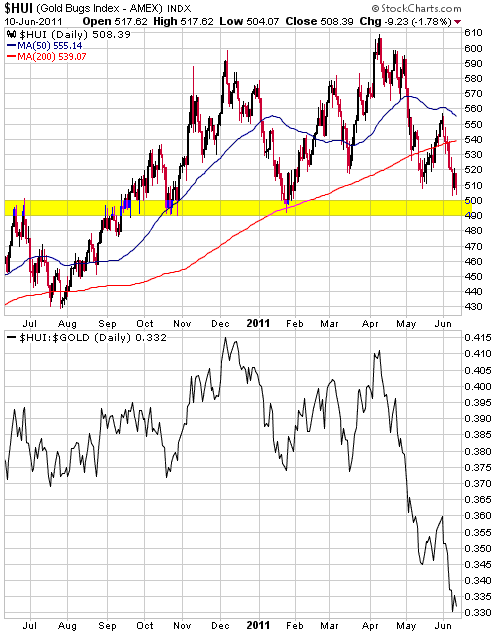
The following daily chart shows the HUI and the HUI/gold ratio.
The HUI has essentially moved sideways over the past 8 months and ended
last week just above the bottom of its 8-month range (support at
490-500 defines the bottom of the trading range). The HUI/gold ratio,
however, broke below the bottom of its own multi-month trading range in
early May and has since plunged. The HUI is now very 'oversold'
relative to gold bullion, but this doesn't mean that the HUI/gold ratio
has bottomed.
It wouldn't surprise us if support at 490-500 held for now and a
rebound soon began, but as mentioned above the close proximity of
important support combined with the price action in the bullion markets
opens up the potential for a sharp decline during the coming fortnight.
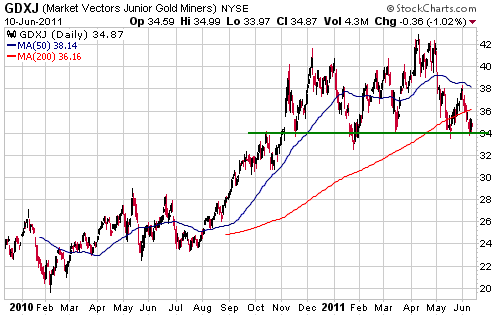
The following daily
chart of GDXJ, an ETF that holds the shares of junior and mid-tier gold
and silver miners, clearly shows the precarious position in which the
gold sector ended last week.
There is never any
appropriate 'one size fits all' advice, because the right thing to do
in any situation will depend on an individual's current circumstances,
expertise, risk tolerance and goals. For example, in the current
situation it could make sense for someone with almost no exposure to
junior gold stocks to immediately buy some GDXJ on the basis that a)
support at around $34 could hold and b) the GDXJ price will probably be
a lot higher in 12 months time, whereas someone with substantial
exposure to the junior gold mining sector should probably hold off on
any new buying.
The 470 short-term downside target we've previously suggested for the
HUI would equate to around $31 for GDXJ, but we think that support at
$26-$28 defines the maximum short-term downside risk for GDXJ.
Currency Market Update
Last week, ECB chief Trichet stated that higher commodity prices could
fuel an inflationary spiral if the central bank wasn't vigilant. He
also stated that a restructuring of Greek sovereign debt would not be
tolerated. Refer to the article posted HERE for details.
We get the impression that Trichet and Bernanke are in a contest, with
the winner being the one whose public utterances prove that he is the
most out of touch with reality. Recently we've had Bernanke claming
that rising commodity prices are unrelated to the Fed's monetary
machinations, which, of course, is ridiculous. Now we have Trichet
claiming that a Greek default won't happen, when such an outcome is
clearly inevitable and only the timing is unknown, and that an
"inflationary spiral" could be CAUSED by rising commodity prices, when
it should be obvious to anyone with at least a basic understanding of
economics that an upward spiral in the general price level could only
be caused by an upward spiral in money supply.
With people like this responsible for managing the monetary system, what could possibly go wrong?
Actually, that's not a fair question. It wouldn't matter how much
knowledge and integrity the monetary central planners had, they would
fail because they are trying to do the impossible.
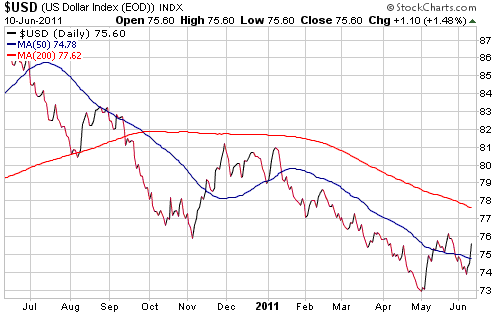
In the race to the bottom in which all the fiat currencies of the world
are engaged, the US$ is beginning to lose ground. In other words, the
US$ is beginning to strengthen. However, the Dollar Index would have to
break decisively above its 200-day moving average to confirm that it
had commenced a multi-month upward trend. As things currently stand, a
full test of the May low remains a likely outcome prior to the start of
a consistent upward trend.
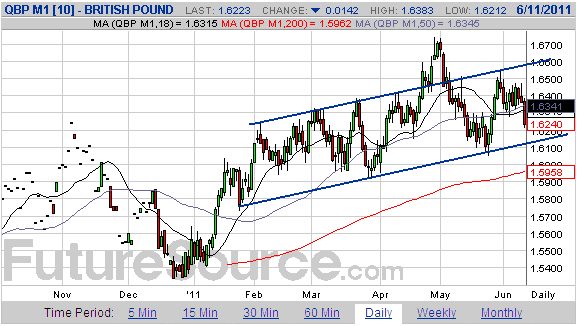
The British Pound has
a habit of setting intermediate-term tops ahead of intermediate-term
bottoms in the Dollar Index, but this time around a top for the Pound
might have coincided with a bottom for the Dollar Index. In the June
futures, a daily close below 1.61 would signal that the Pound had
peaked on an intermediate-term basis.
Update
on Stock Selections
(Notes: 1) To review the complete list of current TSI stock selections, logon at http://www.speculative-investor.com/new/market_logon.asp
and then click on "Stock Selections" in the menu. When at the Stock
Selections page, click on a stock's symbol to bring-up an archive of
our comments on the stock in question. 2) The Small Stock Watch List is
located at http://www.speculative-investor.com/new/smallstockwatch.html)
 Golden Star Resources (NYSE: GSS, TSX: GSC). Shares: 259M issued, 265M fully diluted. Recent price: US$2.44 Golden Star Resources (NYSE: GSS, TSX: GSC). Shares: 259M issued, 265M fully diluted. Recent price: US$2.44
GSS is expected to produce 340K ounces of gold this year from its
operations in Ghana at a high "cash cost" of $900/oz. Luckily for GSS,
the gold price is probably going to average at least $1450/oz this
year, so it should have a gross operating margin of around $550/oz
despite its high production cost.
Based on our experience, the cash flow that a gold producer generates
is typically only 50%-70% of the amount calculated by multiplying its
gross operating margin by its production. Being conservative and using
the bottom end of this percentage range, we estimate that GSS's 2011
cash flow will be around $94M (340K ounces * $550/oz * 50%). This means
that GSS is presently trading at around 6.8-times this year's expected
cash flow, which is cheap. It is not unreasonably cheap, though,
considering the operational problems the company has reported over the
past 6 months. To get a much higher valuation GSS's management will
have to prove to the market that an operational turnaround has
occurred. Our bet is that this will happen, but that it will probably
take two more quarters. In the mean time, GSS's downside risk is
mitigated by virtue of its current low valuation.
The following chart shows GSS in US$ terms and in gold terms. Notice
that in gold terms the stock has given back the bulk of its 2009-2010
gains. This is more evidence that the stock is cheap, but it doesn't
mean that a correction low is in place.
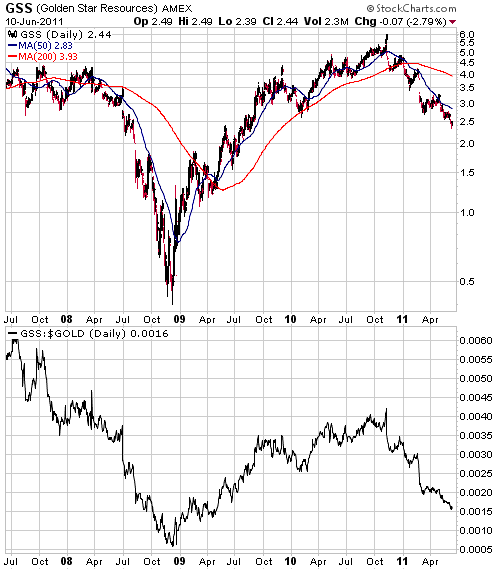
Chart Sources
Charts appearing in today's commentary
are courtesy of:
http://stockcharts.com/index.html
http://www.futuresource.com/
http://www.decisionpoint.com/

|